Japan EPDM Market Size & Growth Rate
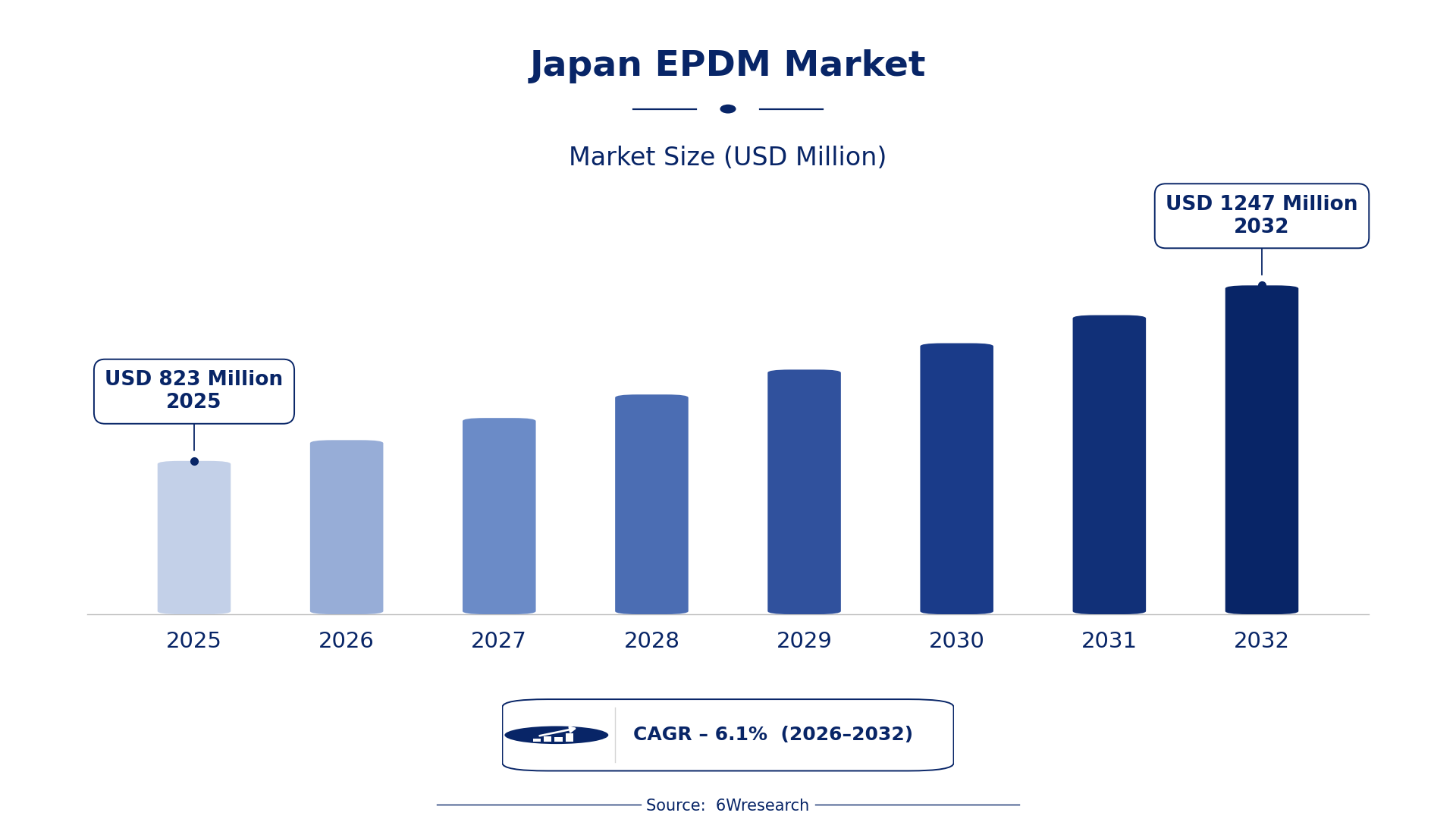
According to 6Wresearch internal database and industry insights, the Japan EPDM Market was valued at USD 823 Million in 2025 and is projected to reach USD 1,247 Million by 2032, growing at a CAGR of approximately 6.1% during 2026–2032.
Japan EPDM Market Highlights
| Report Metric | Details |
| Report Name | Japan EPDM Market (2026-2032) |
| Market Size 2025 | USD 823 Million |
| Market Size 2032 | USD 1,247 Million |
| Absolute Growth 2025–2032 | USD 424 Million |
| CAGR 2026–2032 | 6.1% |
| Peak Annual Growth | 7.0% in 2028 |
| Forecast Period | 2026–2032 |
| Historical Data | 2022–2025 |
| Base Year | 2025 |
| Leading Manufacturing Process, 2025 | Solution Polymerization Process (48% share) |
| Leading Application, 2025 | Automotive (35% share) |
| Fastest-Growing Manufacturing Process | Slurry/Suspension Process (8.4% CAGR) |
| Fastest-Growing Application | Building & Construction (8.5% CAGR) |
| Growing Sector | Automotive |
| Key End Users | Automotive manufacturers, construction firms, roofing contractors, electrical insulation producers |
Japan EPDM Market Year-wise Growth Rate and Key Drivers (2022–2032)
This graph illustrates the annual growth rates of the market from 2022 to 2032, highlighting a steady upward trajectory and projected market expansion over the forecast period.
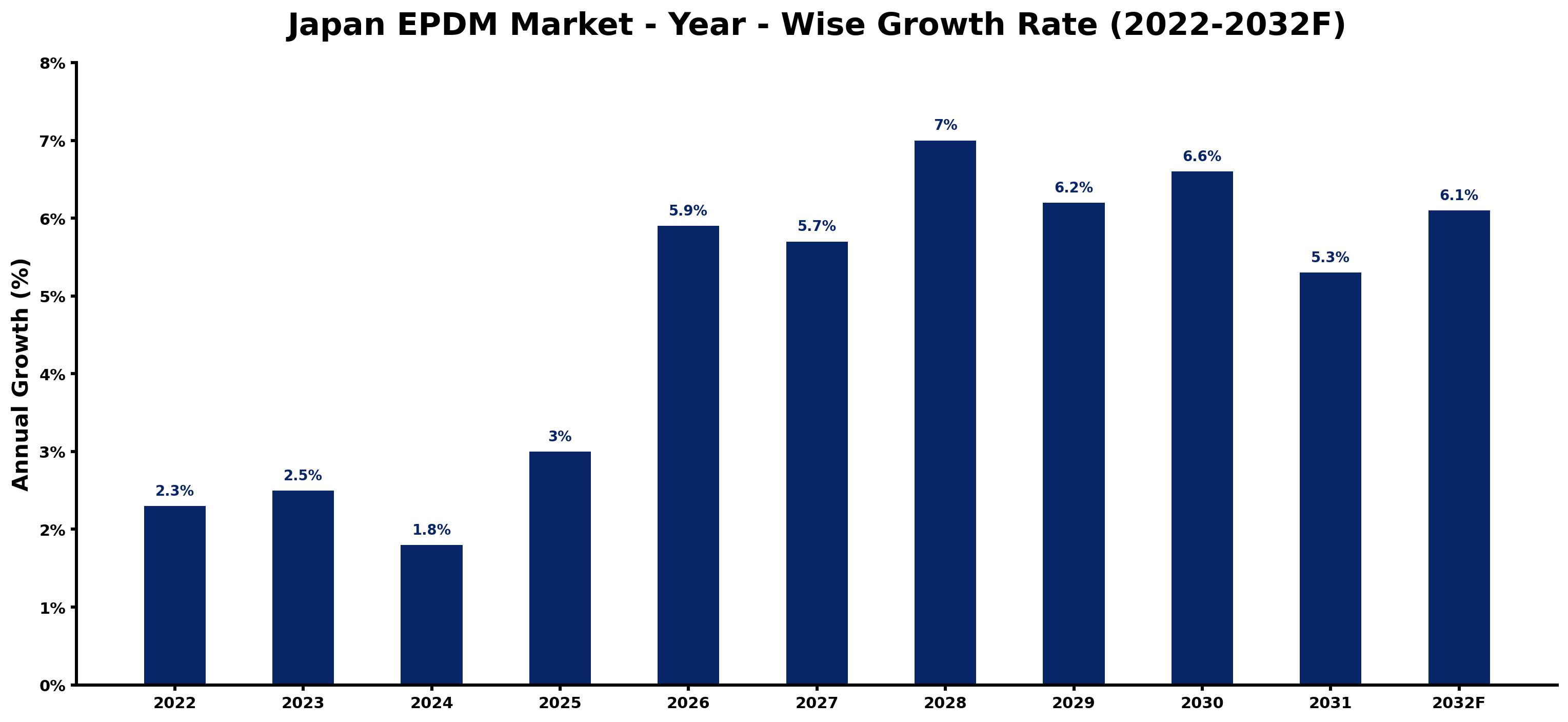
Each row of the following table gives one year's estimated growth and the event or demand shift that explains it.
| Year | Estimated Annual Growth (%) | Market Rationale |
| 2022 | 2.3 | The market showed steady growth due to ongoing demand from the automotive sector. |
| 2023 | 2.5 | Increased automotive production contributed to faster growth compared to the previous year. |
| 2024 | 1.8 | Growth slowed as the market adjusted to previous high demand levels. |
| 2025 | 3.0 | The automotive sector's expansion led to a return to faster growth rates. |
| 2026 | 5.9 | Rising construction activities are expected to boost demand for EPDM in roofing applications. |
| 2027 | 5.7 | Growth is projected to slow slightly as the market stabilises after rapid expansion. |
| 2028 | 7.0 | The peak growth rate will be driven by substantial investments in automotive applications. |
| 2029 | 6.2 | Demand growth is likely to slow as market dynamics begin to normalise after the peak. |
| 2030 | 6.6 | Continued investment in construction and automotive sectors will spur renewed growth. |
| 2031 | 5.3 | Growth is anticipated to moderate as the market adjusts to high consumption levels. |
| 2032 | 6.1 | Sustained demand from key sectors is expected to maintain positive growth. |
Note: Market size estimations and growth projections presented in this report are based on 6Wresearch's proprietary forecasting methodology, utilizing the latest available industry data, government publications, and primary research inputs.
Japan EPDM Market Synopsis
EPDM, or Ethylene Propylene Diene Monomer, is a type of synthetic rubber known for its excellent weather resistance and flexibility, produced mainly through solution polymerization. In Japan, the automotive sector is a primary consumer, accounting for around 40% of EPDM demand. Growth in the Japan EPDM Market stems from rising automotive production, ongoing construction projects, and a focus on energy-efficient building materials. Investment in EPDM production and applications is expected to increase as the market evolves.
Market Dynamics Impact Analysis (2026–2032)
| Factor | Type | Impact | Primary Segment Affected |
| Growing automotive production and demand for seals and gaskets. | Driver | High | Automotive |
| Expansion of construction projects requiring roofing and waterproofing materials. | Driver | High | Building & Construction |
| Increased demand for roofing systems in construction projects. | Opportunity | High | Building & Construction |
| Rising need for high-performance EPDM grades in automotive applications. | Opportunity | High | Automotive |
| Fluctuations in raw material prices affecting production costs. | Restraint | Medium | Solution Polymerization Process |
| Limited capacity in production facilities constraining supply. | Restraint | Medium | Solution Polymerization Process |
| Compliance with stringent quality standards increasing production costs. | Challenge | High | Solution Polymerization Process |
| Capacity constraints limiting the ability to meet rising demand. | Challenge | High | Solution Polymerization Process |
Evaluation of Drivers in Japan EPDM Market (2026–2032)
Key forces behind demand, with the segment each one moves most, are listed below.
| Drivers | Primary Segment Affected | Why It Matters (Evidence) |
| Increased automotive production. | Automotive | The automotive sector accounted for approximately 40% of EPDM demand in Japan in 2022. |
| Expansion of construction activities. | Building & Construction | The Building & Construction sector is projected to use 30% of EPDM in roofing by 2025. |
| Growing quality standards in manufacturing. | Solution Polymerization Process | Japan has implemented ISO 9001 standards for EPDM manufacturing quality assurance. |
| Rising exports to Asia. | Solution Polymerization Process | In 2023, Japan's EPDM exports reached 15,000 tons, primarily to Asia. |
| Investment in rubber industry innovation programs. | Solution Polymerization Process | The government allocated ¥1 billion for rubber industry innovation programs in 2023. |
A wider customer base explains much of the growth, as increased automotive production has driven EPDM demand. The automotive sector accounted for approximately 40% of EPDM demand in Japan in 2022, leading to higher purchases of seals and gaskets. Expansion in construction activities is also notable, with the Building & Construction sector projected to use 30% of EPDM in roofing by 2025. The implementation of ISO 9001 standards has improved manufacturing quality, encouraging more buyers to invest in high-performance EPDM grades. Japan's average annual consumption of EPDM is around 100,000 tons, indicating strong domestic demand.
Evaluation of Restraints in Japan EPDM Market
Several factors work against faster growth; the main ones are summarised below.
| Market Restraint | Primary Segment Affected | Why It Matters (Evidence) |
| Fluctuations in raw material prices. | Solution Polymerization Process | Volatile prices of raw materials can lead to unpredictable production costs, affecting profitability. |
| Limited production capacity. | Solution Polymerization Process | Production facilities in Aichi and Kanagawa prefectures face constraints that limit output. |
| Compliance costs with quality standards. | Solution Polymerization Process | Adhering to ISO 9001 standards increases operational costs for manufacturers. |
| Dependence on specific polymerization processes. | Solution Polymerization Process | Relying on solution polymerization limits flexibility in production methods. |
| Market saturation in automotive applications. | Automotive | High competition in the automotive sector may limit growth opportunities. |
Japan EPDM Market Challenges
Producers struggle with ISO 9001 standards for EPDM manufacturing, which necessitate extensive quality checks that can delay production schedules by up to three months. Buyers face intense competition from lower-cost synthetic rubber alternatives in Asia, forcing them to accept higher prices and reduced availability. Rising raw material costs have increased production expenses by approximately 15%, resulting in higher prices for buyers in the automotive and construction sectors. A shortage of skilled workers in advanced polymerisation techniques limits production capacity, potentially causing losses of around 20% for producers.
Trends in the Japan EPDM Market
Several trends are reshaping the Japan EPDM Market; the most important are set out below.
- Shift towards High-Performance EPDM Grades: The demand for high-performance EPDM grades is rising, particularly in automotive applications, as over 60% of new vehicle seals manufactured in Japan use EPDM. This shift reflects a growing focus on durability and weather resistance.
- Transition from Traditional to Energy-Efficient Roofing: The Building Energy Efficiency Act has prompted a transition to energy-efficient roofing materials, with EPDM being a key component. By 2025, 70% of roofing systems installed in Japan will incorporate EPDM, improving building sustainability.
- Emergence of Advanced Polymerization Techniques: New polymerization techniques are emerging, particularly in the production of EPDM. The adoption of these methods is anticipated to improve product quality and reduce costs, benefiting manufacturers and buyers alike.
- Growing Demand from Construction Sector: The construction sector is increasingly prioritising EPDM for roofing applications, driven by the need for waterproofing solutions. By 2025, the sector is projected to account for 30% of EPDM usage in Japan.
Investment Opportunities in the Japan EPDM Market
The opportunities below stand out in the Japan EPDM Market for new entrants and existing suppliers.
- Investment in Production Facilities: Aichi and Kanagawa prefectures are ideal for expanding EPDM production facilities, given their existing infrastructure. With the average annual consumption of EPDM around 100,000 tons, local manufacturers can meet rising demand.
- Focus on Automotive Seals and Gaskets: Japanese automotive manufacturers are seeking high-performance EPDM grades for seals and gaskets. With 40% of EPDM demand coming from this sector, suppliers can benefit from partnerships with local automotive producers.
- Expansion of Roofing Applications: Now is the time to invest in roofing applications, as the Building & Construction sector is projected to use 30% of EPDM by 2025. Collaborating with construction firms can facilitate market entry.
- Collaboration with Research Institutions: Engaging with research institutions can support the development of new EPDM grades. The government backs research initiatives, providing funding opportunities for collaborative projects.
Government Initiatives in the Japan EPDM Market
The Building Energy Efficiency Act, amended in 2022, mandates that all new buildings meet specific energy standards from April 2025. This regulation impacts EPDM producers, as they must ensure their products comply with these standards to remain competitive in the roofing market.
The Plastic Resource Circulation Act promotes the reduction, reuse, and recycling of plastics. This act encourages EPDM buyers in the construction sector to adopt sustainable practices, ensuring compliance with environmental regulations.
Future Insight of the Japan EPDM Market
Investment in rubber industry innovation programmes will drive advancements in EPDM production methods, creating more efficient processes. By 2032, the demand for EPDM in roofing will surge, with projections indicating that 70% of roofing systems will incorporate EPDM. Research initiatives supported by the Ministry of Economy, Trade and Industry will facilitate the development of higher-grade materials. The implementation of JIS K 6300 standards will further improve product quality, benefiting both buyers and suppliers.
Market Segmentation Analysis
Japan EPDM Market report covers a detailed analysis of the following market segments:
By Manufacturing Process – Solution Polymerization Process Leads, Slurry/Suspension Process Expected to Grow Fastest
According to Ravi Bhandari, Research Head at 6Wresearch, Solution Polymerization Process held 48% of the Japan EPDM Market by manufacturing process in 2025. The Solution Polymerization Process holds the largest share due to its capability to produce high-performance EPDM grades, which are crucial for demanding applications. This method is particularly prevalent in regions like Aichi and Kanagawa, where most of the production capacity is concentrated. Over 2026–2032, Slurry/Suspension Process is expected to post the fastest growth, at a CAGR of 8.4%. The Slurry/Suspension Process is experiencing rapid growth as it caters to the increasing demand for lower-performance EPDM grades, which are finding applications in various sectors. With government initiatives supporting rubber industry innovation, this method is likely to see further advancements. Suppliers must focus on enhancing their Slurry/Suspension Process capabilities to meet the growing market demand.
By Application – Automotive Leads, Building & Construction Expected to Grow Fastest
Automotive accounted for 35% of the market by application in 2025. The Automotive sector is the leading application for EPDM, accounting for approximately 40% of demand in 2022, primarily due to its extensive use in vehicle seals and gaskets. This sector's robust growth is supported by Japan's thriving automotive industry, which prioritises high-quality materials for production. Building & Construction is set to record the highest CAGR in this split, 8.5% over 2026–2032. The Building & Construction sector is projected to grow rapidly as it increasingly adopts EPDM for roofing and waterproofing applications, with expectations of 30% usage by 2025. This growth is spurred by a rise in construction projects and the need for durable roofing solutions. Buyers in the Building & Construction sector should consider securing long-term contracts to guarantee a consistent supply of EPDM.
Key Attractiveness of the Report
- 10 Years of Market Numbers
- Historical Data Starting from 2022 to 2025
- Base Year 2025
- Forecast Data until 2032
- Key Performance Indicators Impacting the Market
- Major Upcoming Developments and Projects
Key Highlights of the Report:
- Japan EPDM Market Outlook
- Market Size of Japan EPDM Market, 2025
- Forecast of Japan EPDM Market, 2032
- Historical Data and Forecast of Japan EPDM Revenues & Volume for the Period 2022-2032
- Japan EPDM Market Trend Evolution
- Japan EPDM Market Drivers and Challenges
- Japan EPDM Price Trends
- Japan EPDM Porter's Five Forces
- Japan EPDM Industry Life Cycle
- Historical Data and Forecast of Japan EPDM Market Revenues & Volume By Manufacturing Process for the Period 2022-2032
- Historical Data and Forecast of Japan EPDM Market Revenues & Volume By Solution Polymerization Process for the Period 2022-2032
- Historical Data and Forecast of Japan EPDM Market Revenues & Volume By Slurry/Suspension Process for the Period 2022-2032
- Historical Data and Forecast of Japan EPDM Market Revenues & Volume By Gas-phase Polymerization Process for the Period 2022-2032
- Historical Data and Forecast of Japan EPDM Market Revenues & Volume By Application for the Period 2022-2032
- Historical Data and Forecast of Japan EPDM Market Revenues & Volume By Automotive for the Period 2022-2032
- Historical Data and Forecast of Japan EPDM Market Revenues & Volume By Building & Construction for the Period 2022-2032
- Historical Data and Forecast of Japan EPDM Market Revenues & Volume By Plastic Modifications for the Period 2022-2032
- Historical Data and Forecast of Japan EPDM Market Revenues & Volume By Tires & Tubes for the Period 2022-2032
- Historical Data and Forecast of Japan EPDM Market Revenues & Volume By Wire & Cables for the Period 2022-2032
- Historical Data and Forecast of Japan EPDM Market Revenues & Volume By Lubricant Additives for the Period 2022-2032
- Historical Data and Forecast of Japan EPDM Market Revenues & Volume By Others for the Period 2022-2032
- Japan EPDM Import Export Trade Statistics
- Market Opportunity Assessment By Manufacturing Process
- Market Opportunity Assessment By Application
- Japan EPDM Top Companies Market Share
- Japan EPDM Competitive Benchmarking By Technical and Operational Parameters
- Japan EPDM Company Profiles
- Japan EPDM Key Strategic Recommendations
Market Covered
The study includes the following segmentation.
By Manufacturing Process
- Solution Polymerization Process
- Slurry/Suspension Process
- Gas-phase Polymerization Process
By Application
- Automotive
- Building & Construction
- Plastic Modifications
- Tires & Tubes
- Wire & Cables
- Lubricant Additives
- Others






































