Japan Erp Software Market Size & Growth Rate
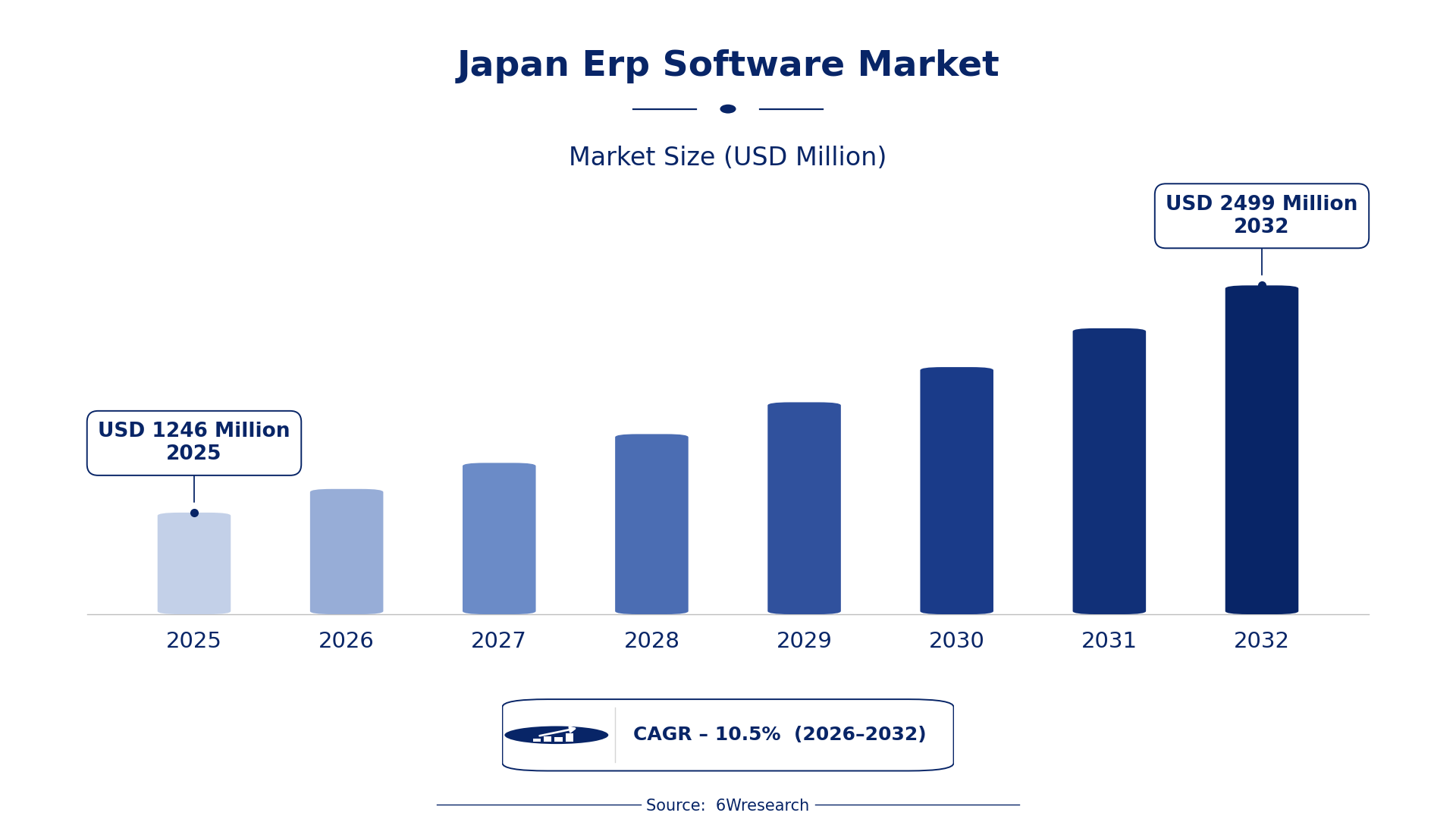
According to 6Wresearch internal database and industry insights, the Japan Erp Software Market was valued at USD 1,246 Million in 2025 and is projected to reach USD 2,499 Million by 2032, growing at a CAGR of approximately 10.5% during 2026–2032.
Japan Erp Software Market Highlights
| Report Metric | Details |
| Report Name | Japan Erp Software Market (2026-2032) |
| Market Size 2025 | USD 1,246 Million |
| Market Size 2032 | USD 2,499 Million |
| Absolute Growth 2025–2032 | USD 1,253 Million |
| CAGR 2026–2032 | 10.5% |
| Peak Annual Growth | 13.0% in 2026 |
| Forecast Period | 2026–2032 |
| Historical Data | 2022–2025 |
| Base Year | 2025 |
| Leading ERP software Function, 2025 | Finance (50% share) |
| Leading ERP software Deployment, 2025 | On-premises (39% share) |
| Leading ERP software Vertical, 2025 | Manufacturing (31% share) |
| Fastest-Growing ERP software Function | HR (12.8% CAGR) |
| Fastest-Growing ERP software Deployment | Cloud (14.8% CAGR) |
| Fastest-Growing ERP software Vertical | BFSI (13.7% CAGR) |
| Growing Sector | Manufacturing |
| Key End Users | Manufacturing, Healthcare, BFSI, SMEs |
Japan Erp Software Market Year-wise Growth Rate and Key Drivers (2022–2032)
This graph illustrates the annual growth rates of the market from 2022 to 2032, highlighting a steady upward trajectory and projected market expansion over the forecast period.
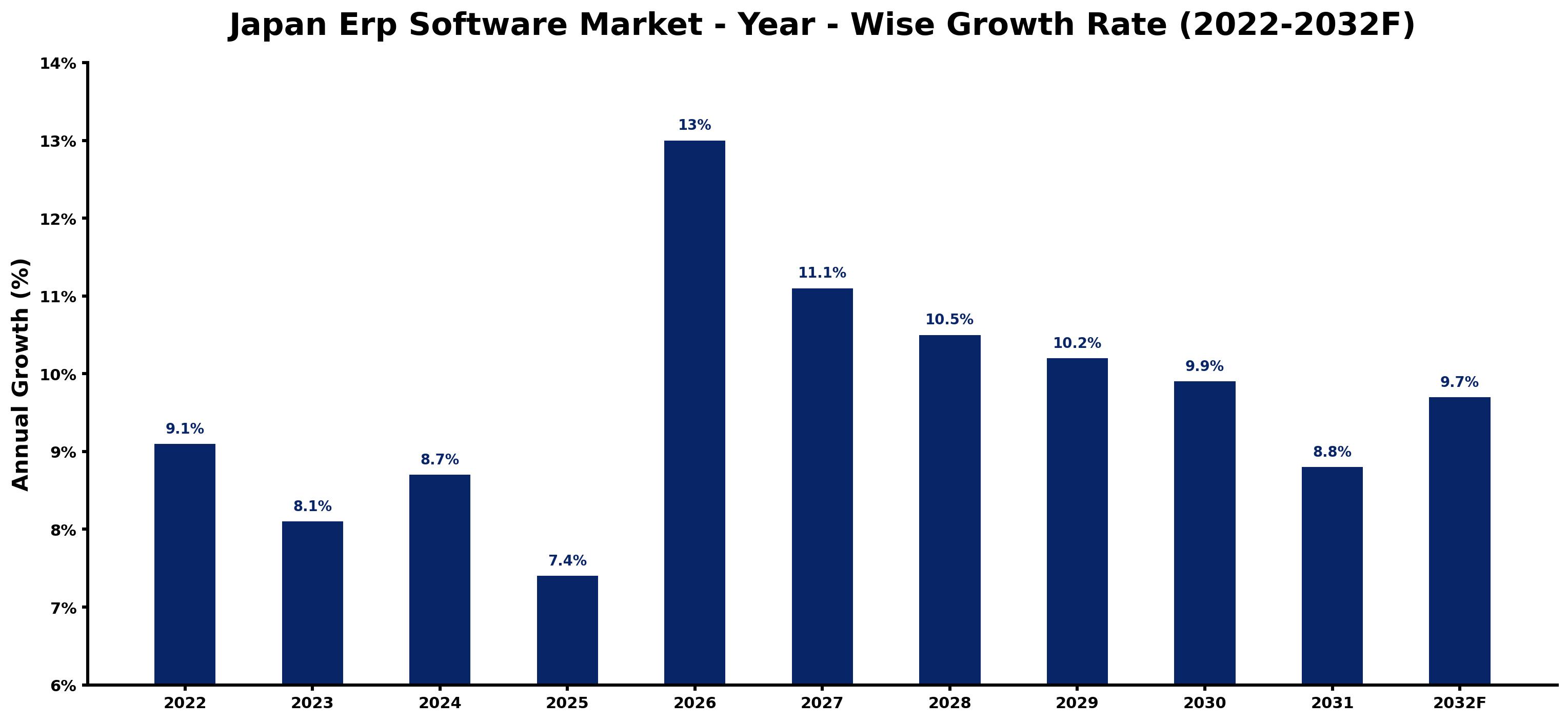
The yearly estimates that follow link every growth rate to its principal driver, so readers can see why the pace changed in each period.
| Year | Estimated Annual Growth (%) | Market Rationale |
| 2022 | 9.1 | The market experienced strong demand from various sectors, particularly manufacturing. |
| 2023 | 8.1 | ERP software adoption slowed slightly as companies adjusted to economic conditions. |
| 2024 | 8.7 | Increased investments in digital transformation spurred demand for ERP solutions. |
| 2025 | 7.4 | Market growth decelerated as businesses focused on optimizing existing systems. |
| 2026 | 13.0 | A surge in cloud ERP adoption is expected to drive growth in the market. |
| 2027 | 11.1 | Demand will remain strong, although growth rates are projected to moderate slightly. |
| 2028 | 10.5 | Continued interest in digital solutions will sustain the market's upward trend. |
| 2029 | 10.2 | Growth will slow as companies reassess their technology investments. |
| 2030 | 9.9 | The market will maintain steady growth with ongoing digital transformation efforts. |
| 2031 | 8.8 | Demand will continue to rise, supported by advancements in ERP technology. |
| 2032 | 9.7 | Increased focus on compliance and reporting will boost ERP software usage. |
Note: Market size estimations and growth projections presented in this report are based on 6Wresearch's proprietary forecasting methodology, utilizing the latest available industry data, government publications, and primary research inputs.
Japan Erp Software Market Synopsis
ERP software integrates core business processes in real-time, facilitating financial management, human resources, and supply chain operations. The Japan Erp Software Market was valued at approximately 500 billion JPY in 2022, with manufacturing accounting for 35% of ERP usage. The growing demand stems from investments in digital transformation initiatives, such as the government's 2023 programme targeting SMEs, promoting the adoption of cloud-based solutions and improving operational efficiency across various sectors.
Market Dynamics Impact Analysis (2026–2032)
| Factor | Type | Impact | Primary Segment Affected |
| Growing adoption of cloud-based solutions | Driver | High | Cloud |
| Increased focus on operational efficiency | Driver | High | Manufacturing |
| Expansion of digital transformation initiatives | Opportunity | High | Finance |
| Rising demand for compliance and reporting solutions | Opportunity | High | BFSI |
| High implementation costs for small enterprises | Restraint | Medium | Small Enterprises |
| Complexity of ERP systems may deter adoption | Restraint | Medium | Medium Enterprises |
| Limited talent pool for ERP implementation | Challenge | High | Finance |
| Competition from alternative software solutions | Challenge | Medium | Finance |
Evaluation of Drivers in Japan Erp Software Market (2026–2032)
Key forces behind demand, with the segment each one moves most, are listed below.
| Drivers | Primary Segment Affected | Why It Matters (Evidence) |
| Increased investments in digital transformation | Government | The government allocated 10 billion JPY for digital infrastructure development in 2024, supporting ERP adoption. |
| Growing demand for operational efficiency | Manufacturing | The manufacturing sector accounts for 35% of ERP software usage, driving demand for streamlined operations. |
| Surge in cloud adoption | Cloud | Cloud-based ERP solutions are projected to grow by 15% annually, attracting businesses seeking flexibility. |
| Need for compliance and reporting | BFSI | ERP solutions in the BFSI sector must comply with JIS standards, increasing demand for tailored solutions. |
| Expansion of healthcare ERP systems | Healthcare | The healthcare sector has seen a 20% increase in ERP adoption in 2023, driven by patient management needs. |
Behind the steady rise in orders is a shift towards cloud-based ERP solutions, projected to grow by 15% annually as businesses seek flexible options. The manufacturing sector, which accounts for 35% of ERP usage, drives demand for operational efficiency, while the healthcare sector has seen a 20% increase in ERP adoption in 2023 due to patient management needs. Compliance requirements in the BFSI sector further boost demand for tailored ERP solutions, ensuring that financial institutions meet JIS standards. Digital transformation investments are expected to accelerate technology adoption across industries, leading to increased ERP implementation.
Evaluation of Restraints in Japan Erp Software Market
Several factors work against faster growth; the main ones are summarised below.
| Market Restraint | Primary Segment Affected | Why It Matters (Evidence) |
| High implementation costs for small enterprises | Small Enterprises | The average cost of ERP software implementation in Japan is around 10 million JPY, limiting adoption. |
| Complexity of ERP systems may deter adoption | Medium Enterprises | Medium enterprises often face challenges in integrating complex ERP systems into their operations. |
| Limited availability of skilled professionals | Finance | The talent pool for ERP implementation is constrained, delaying project timelines for businesses. |
| Resistance to change among traditional businesses | Finance | Many traditional businesses are hesitant to adopt new ERP systems, impacting overall market growth. |
| Integration issues with existing systems | Large Enterprises | Large enterprises often encounter difficulties in integrating new ERP solutions with legacy systems. |
Japan Erp Software Market Challenges
Japan's ERP software market faces delays due to compliance with ISO 9001 standards, which can extend implementation timelines by up to six months for producers, hindering their operational efficiency. Distributors encounter skills shortages in ERP management, leading to increased training costs that may reach 2 million JPY per employee. Buyers experience disruptions during the average ERP implementation period of 6-12 months, potentially resulting in revenue losses estimated at 5% during the transition. Rising implementation costs, averaging 10 million JPY, strain budgets for many companies, particularly in the manufacturing sector, which accounts for 35% of ERP usage.
Trends in the Japan Erp Software Market
Several trends are reshaping the Japan Erp Software Market; the most important are set out below.
- Shift to Cloud-Based Solutions: The trend towards cloud-based ERP solutions has accelerated, particularly since the government's 2023 digital transformation initiative. This shift allows businesses to scale operations more efficiently, with cloud solutions projected to grow by 15% annually.
- Increased ERP Adoption in Healthcare: Since 2023, the healthcare sector has seen a 20% increase in ERP adoption, driven by the need for improved patient management and billing systems. This trend highlights the sector's focus on operational efficiency.
- Rising Compliance Demands in BFSI: With the BFSI sector's need for compliance with JIS standards, there has been a notable rise in demand for ERP solutions tailored to meet these regulations. This trend reflects the sector's commitment to risk management.
- Focus on Operational Efficiency in Manufacturing: Manufacturing has become a key sector for ERP software, accounting for 35% of usage. This emphasis on operational efficiency has driven investments in ERP solutions to streamline processes.
Investment Opportunities in the Japan Erp Software Market
The opportunities below stand out in the Japan Erp Software Market for new entrants and existing suppliers.
- Cloud-Based ERP Solutions: The growing preference for cloud-based ERP solutions presents an opportunity for suppliers to invest in scalable technologies. SMEs are particularly interested in these solutions, which offer flexibility and lower upfront costs.
- ERP Solutions for Compliance: With increasing regulatory requirements, there is a strong opportunity to supply ERP solutions that ensure compliance. The BFSI sector is a key buyer group, necessitating tailored solutions to meet JIS standards.
- Healthcare ERP Systems: The healthcare sector's 20% increase in ERP adoption creates an opportunity to supply specialized systems. Suppliers can enter this market by partnering with healthcare providers to develop tailored solutions.
- Digital Transformation Initiatives: The government's digital transformation initiatives create a timely opportunity for suppliers to provide ERP solutions. Collaborating with SMEs can facilitate entry into this growing market.
Government Initiatives in the Japan Erp Software Market
The AI Promotion Act, established in 2025, adds a national framework for AI research and development, supporting ERP software producers by encouraging the integration of AI technologies into their systems, which improves functionality and efficiency. This act complements existing regulations and aims to stimulate innovation in the ERP sector.
In 2024, the government allocated 10 billion JPY for digital infrastructure development, with the Digital Agency overseeing the initiative. This funding aims to support ERP software integration for SMEs, enhancing their operational capabilities.
Future Insight of the Japan Erp Software Market
The manufacturing sector will increasingly adopt ERP systems, with over 35% of firms expected to integrate advanced solutions by 2032, improving their operational efficiency. Digital transformation initiatives will provide small and medium enterprises with better access to ERP technologies, facilitating streamlined processes. The rise of cloud-based ERP solutions will allow for real-time data access, benefiting users across various sectors. Training programmes will adapt to ensure employees can fully utilise system capabilities, driving productivity and efficiency in operations.
Market Segmentation Analysis
Japan Erp Software Market report covers a detailed analysis of the following market segments:
By ERP software Function – Finance Leads, HR Expected to Grow Fastest
According to Sumit Sagar, AM at 6Wresearch, Finance accounted for 50% of the market by erp software function in 2025. The finance function holds the largest share as it is essential for managing financial data and reporting, which are critical for business operations. Many organisations implement ERP systems to ensure compliance with financial regulations, particularly in sectors like manufacturing where financial accuracy is paramount. Over 2026–2032, HR is expected to post the fastest growth, at a CAGR of 12.8%. The HR function is witnessing rapid growth as businesses increasingly recognise the importance of efficient employee management and payroll processing. This trend is underscored by the rising number of firms investing in ERP systems to streamline HR operations and improve workforce productivity. Suppliers should focus on enhancing finance and HR functionalities to meet the demands of businesses seeking efficiency.
By ERP software Deployment – On-premises Lead, Cloud Expected to Grow Fastest
The largest erp software deployment category in 2025 was On-premises, at 39% of revenue. On-premises deployment leads the market as it is preferred by enterprises that value in-house solutions for enhanced data security and control. This approach is particularly common in sectors where compliance and data integrity are crucial, ensuring that sensitive information remains protected. Cloud is projected to grow fastest, at a CAGR of 14.8% during 2026–2032. Cloud deployment is experiencing rapid growth due to its flexibility and scalability, making it an appealing choice for businesses looking for cost-effective solutions. As more organisations transition to digital infrastructures, this segment is poised for significant expansion. Buyers should evaluate cloud solutions for their adaptability and potential cost benefits.
By ERP software Vertical – Manufacturing Leads, BFSI Expected to Grow Fastest
Manufacturing took 31% of erp software vertical revenue in 2025, more than any other category. The manufacturing sector commands the largest share of ERP software usage, as it is vital for achieving operational efficiency and optimising processes. Its reliance on ERP systems is evident in the sector's substantial contribution to Japan's economic performance, highlighting the importance of these solutions. BFSI is set to record the highest CAGR in this split, 13.7% over 2026–2032. The BFSI sector is seeing the fastest growth, propelled by the increasing need for compliance and risk management solutions offered by ERP systems. As regulatory requirements become more stringent, investment in ERP solutions within the BFSI sector is expected to rise significantly. Suppliers should tailor their offerings to meet the specific compliance needs of the BFSI sector.
Key Attractiveness of the Report
- 10 Years of Market Numbers
- Historical Data Starting from 2022 to 2025
- Base Year 2025
- Forecast Data until 2032
- Key Performance Indicators Impacting the Market
- Major Upcoming Developments and Projects
Key Highlights of the Report:
- Japan Erp Software Market Outlook
- Market Size of Japan Erp Software Market, 2025
- Forecast of Japan Erp Software Market, 2032
- Historical Data and Forecast of Japan Erp Software Revenues & Volume for the Period 2022-2032
- Japan Erp Software Market Trend Evolution
- Japan Erp Software Market Drivers and Challenges
- Japan Erp Software Price Trends
- Japan Erp Software Porter's Five Forces
- Japan Erp Software Industry Life Cycle
- Historical Data and Forecast of Japan Erp Software Market Revenues & Volume By ERP software Function for the Period 2022-2032
- Historical Data and Forecast of Japan Erp Software Market Revenues & Volume By Finance for the Period 2022-2032
- Historical Data and Forecast of Japan Erp Software Market Revenues & Volume By HR for the Period 2022-2032
- Historical Data and Forecast of Japan Erp Software Market Revenues & Volume By Supply Chain for the Period 2022-2032
- Historical Data and Forecast of Japan Erp Software Market Revenues & Volume By ERP software Deployment for the Period 2022-2032
- Historical Data and Forecast of Japan Erp Software Market Revenues & Volume By On-premises for the Period 2022-2032
- Historical Data and Forecast of Japan Erp Software Market Revenues & Volume By Cloud for the Period 2022-2032
- Historical Data and Forecast of Japan Erp Software Market Revenues & Volume By ERP software Enterprise size for the Period 2022-2032
- Historical Data and Forecast of Japan Erp Software Market Revenues & Volume By Large Enterprises for the Period 2022-2032
- Historical Data and Forecast of Japan Erp Software Market Revenues & Volume By Medium Enterprises for the Period 2022-2032
- Historical Data and Forecast of Japan Erp Software Market Revenues & Volume By Small Enterprises for the Period 2022-2032
- Historical Data and Forecast of Japan Erp Software Market Revenues & Volume By ERP software Vertical for the Period 2022-2032
- Historical Data and Forecast of Japan Erp Software Market Revenues & Volume By Manufacturing for the Period 2022-2032
- Historical Data and Forecast of Japan Erp Software Market Revenues & Volume By BFSI for the Period 2022-2032
- Historical Data and Forecast of Japan Erp Software Market Revenues & Volume By Healthcare for the Period 2022-2032
- Historical Data and Forecast of Japan Erp Software Market Revenues & Volume By Retail for the Period 2022-2032
- Historical Data and Forecast of Japan Erp Software Market Revenues & Volume By Government for the Period 2022-2032
- Historical Data and Forecast of Japan Erp Software Market Revenues & Volume By Aerospace & Defense for the Period 2022-2032
- Historical Data and Forecast of Japan Erp Software Market Revenues & Volume By Telecom for the Period 2022-2032
- Historical Data and Forecast of Japan Erp Software Market Revenues & Volume By Others for the Period 2022-2032
- Japan Erp Software Import Export Trade Statistics
- Market Opportunity Assessment By ERP software Function
- Market Opportunity Assessment By ERP software Deployment
- Market Opportunity Assessment By ERP software Vertical
- Japan Erp Software Top Companies Market Share
- Japan Erp Software Competitive Benchmarking By Technical and Operational Parameters
- Japan Erp Software Company Profiles
- Japan Erp Software Key Strategic Recommendations
Market Covered
The following segment groups are covered in the report.
By ERP software Function
- Finance
- HR
- Supply Chain
By ERP software Deployment
- On-premises
- Cloud
- ERP software Enterprise size
- Large Enterprises
- Medium Enterprises
- Small Enterprises
By ERP software Vertical
- Manufacturing
- BFSI
- Healthcare
- Retail
- Government
- Aerospace & Defense
- Telecom
- Others






































