Japan Ethanol Market Size & Growth Rate
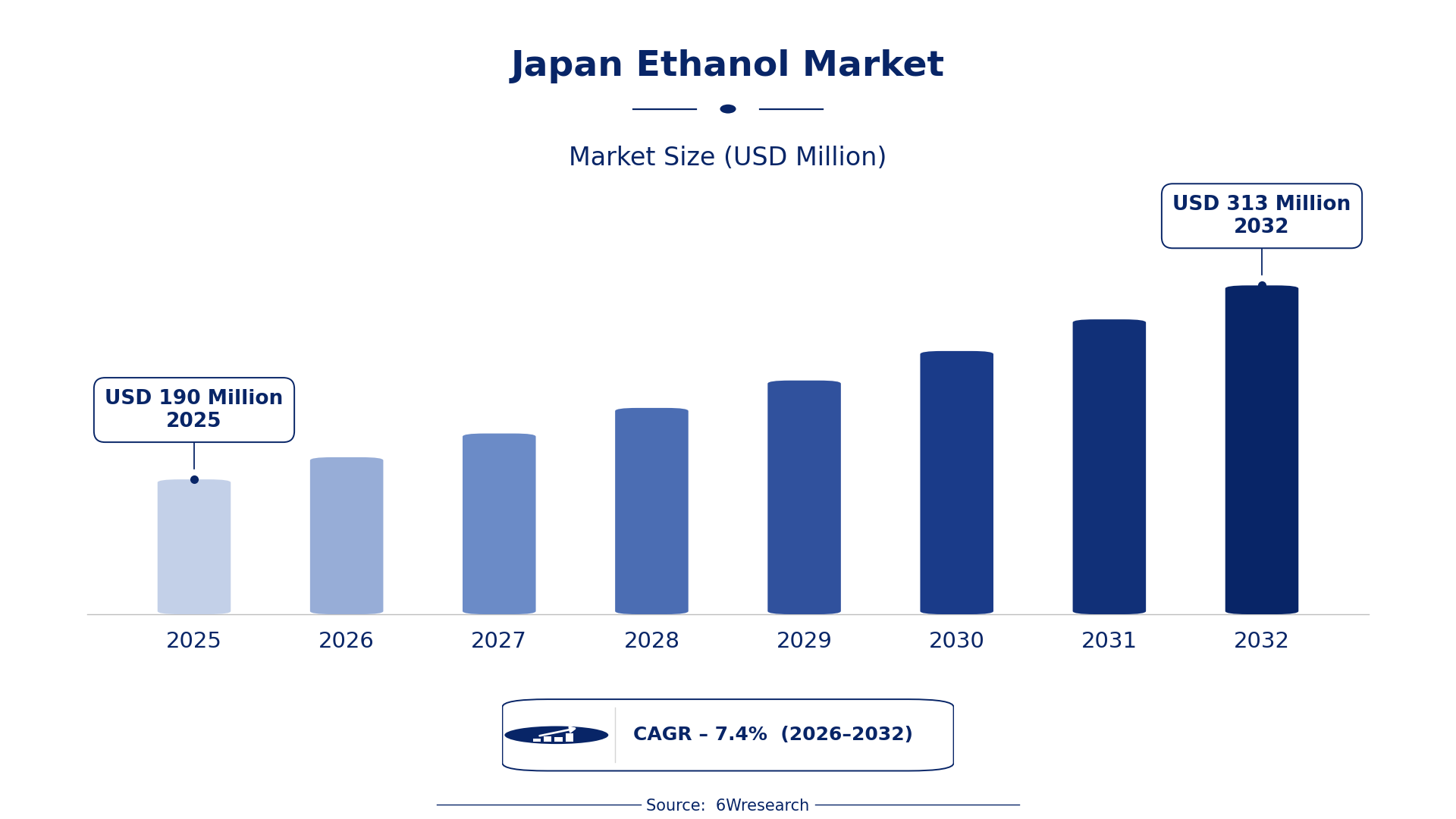
According to 6Wresearch internal database and industry insights, the Japan Ethanol Market was valued at USD 190 Million in 2025 and is projected to reach USD 313 Million by 2032, growing at a CAGR of approximately 7.4% during 2026–2032.
Japan Ethanol Market Highlights
| Report Metric | Details |
| Report Name | Japan Ethanol Market (2026-2032) |
| Market Size 2025 | USD 190 Million |
| Market Size 2032 | USD 313 Million |
| Absolute Growth 2025–2032 | USD 123 Million |
| CAGR 2026–2032 | 7.4% |
| Peak Annual Growth | 8.3% in 2030 |
| Forecast Period | 2026–2032 |
| Historical Data | 2022–2025 |
| Base Year | 2025 |
| Leading Type, 2025 | Bioethanol (38% share) |
| Leading Source, 2025 | Corn-Based (41% share) |
| Leading End-Use, 2025 | Automotive (45% share) |
| Leading Grade, 2025 | Industrial Grade (40% share) |
| Leading Application, 2025 | Fuel Additive (35% share) |
| Fastest-Growing Type | Synthetic Ethanol (10.3% CAGR) |
| Fastest-Growing Source | Sugarcane-Based (10.1% CAGR) |
| Fastest-Growing End-Use | Pharmaceuticals (9.2% CAGR) |
| Fastest-Growing Grade | Food Grade (10.4% CAGR) |
| Fastest-Growing Application | Alcoholic Beverages (9.6% CAGR) |
| Growing Sector | Automotive |
| Key End Users | Automotive manufacturers, pharmaceutical companies, cleaning product manufacturers, beverage producers |
Japan Ethanol Market Year-wise Growth Rate and Key Drivers (2022–2032)
This graph illustrates the annual growth rates of the market from 2022 to 2032, highlighting a steady upward trajectory and projected market expansion over the forecast period.
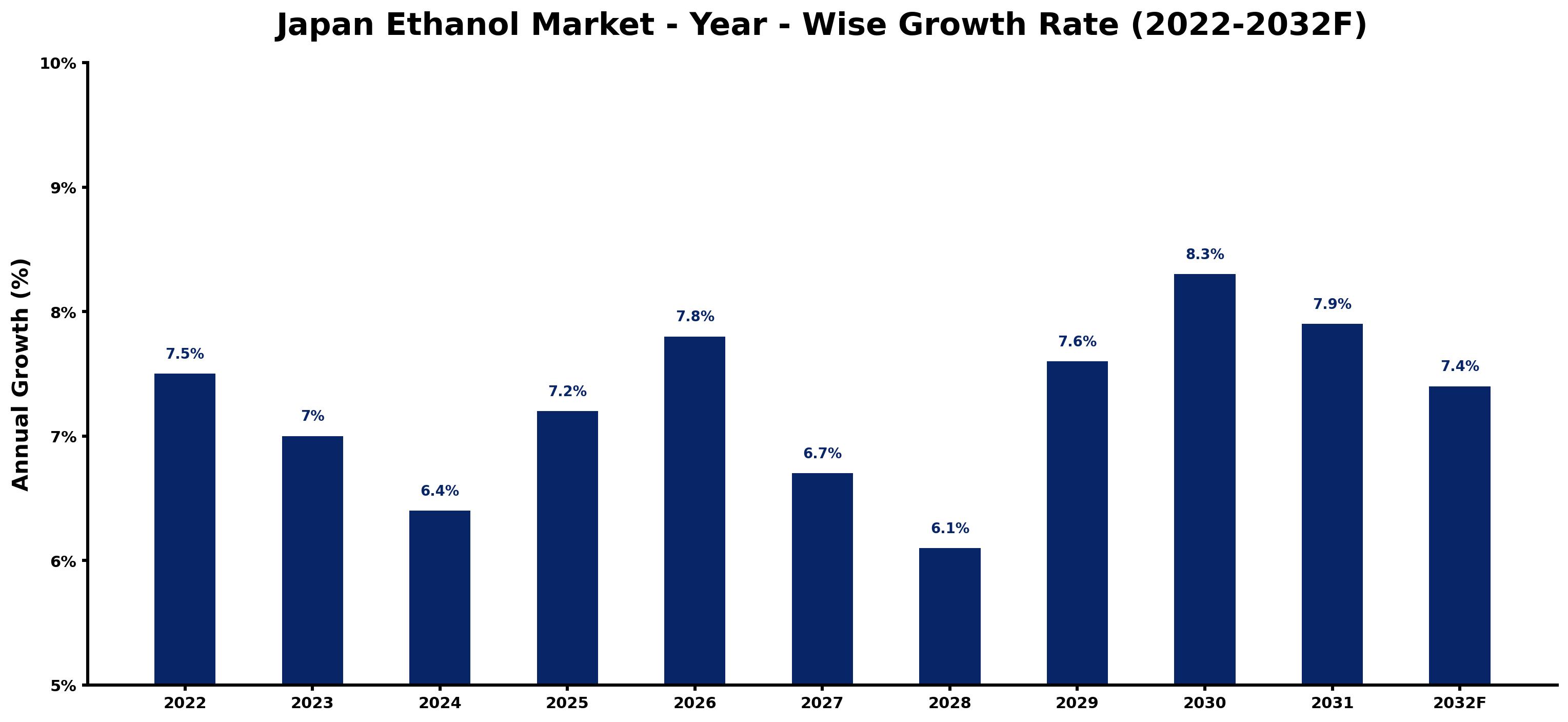
The table below sets out the estimated growth rate for each year and the main factor behind it.
| Year | Estimated Annual Growth (%) | Market Rationale |
| 2022 | 7.5 | The market exhibited strong activity with high bioethanol production levels. |
| 2023 | 7.0 | Growth slowed due to market saturation and stable production rates. |
| 2024 | 6.4 | Demand continued to slow as imports maintained steady levels. |
| 2025 | 7.2 | Growth accelerated as new bioethanol initiatives gained traction. |
| 2026 | 7.8 | The market is expected to grow as bioethanol use in transportation increases. |
| 2027 | 6.7 | Growth is projected to slow as competition from alternative fuels intensifies. |
| 2028 | 6.1 | Demand is expected to continue slowing as market conditions stabilise. |
| 2029 | 7.6 | Growth is anticipated to accelerate again due to rising interest in renewable fuels. |
| 2030 | 8.3 | The peak growth year will see substantial investments in bioethanol. |
| 2031 | 7.9 | Growth is projected to slow as the market adjusts to increased production capacity. |
| 2032 | 7.4 | The market continues to grow, driven by sustained bioethanol initiatives. |
Note: Market size estimations and growth projections presented in this report are based on 6Wresearch's proprietary forecasting methodology, utilizing the latest available industry data, government publications, and primary research inputs.
Japan Ethanol Market Synopsis
Ethanol, produced through fermentation or synthetic processes, is primarily derived from biomass like corn and sugarcane. Its main applications include fuel additives, solvents, and use in pharmaceuticals and food. The Japan Ethanol Market is growing due to rising consumption in the automotive sector and industrial applications, driven by government initiatives promoting bioethanol use in transportation and environmental management standards such as ISO 14001. With a population of approximately 126 million, Japan's ethanol consumption is supported by both substantial imports and domestic production.
Market Dynamics Impact Analysis (2026–2032)
| Factor | Type | Impact | Primary Segment Affected |
| Growing bioethanol production capacity | Driver | High | Bioethanol |
| Rising demand for renewable fuel sources | Driver | High | Automotive |
| Increasing investments in bioethanol technology | Opportunity | Medium | Corn-Based |
| Expansion of bioethanol usage in transportation | Opportunity | High | Fuel Additive |
| Regulatory challenges in chemical substance control | Restraint | High | Industrial Grade |
| Market competition from alternative fuels | Restraint | Medium | Synthetic Ethanol |
| High production costs affecting profitability | Challenge | High | Denatured Ethanol |
| Supply chain disruptions impacting availability | Challenge | Medium | Pharmaceuticals |
Evaluation of Drivers in Japan Ethanol Market (2026–2032)
These are the developments adding the most demand over the forecast period.
| Drivers | Primary Segment Affected | Why It Matters (Evidence) |
| Increased bioethanol production | Bioethanol | Japan produced approximately 1.2 million liters of bioethanol in 2022, driving demand for fuel additives. |
| Growing demand in the automotive sector | Automotive | Ethanol is a key ingredient in over 70% of alcoholic beverages, boosting overall consumption. |
| Government initiatives for bioethanol | Corn-Based | The government has set a target to increase bioethanol usage in fuel by 2025, encouraging production. |
| Technological advancements in ethanol production | Synthetic Ethanol | Research and development in ethanol technologies are enhancing production capabilities, leading to improved efficiency. |
| Environmental awareness among consumers | Industrial Grade | Adoption of environmental management standards is influencing production practices in the industry. |
What keeps demand rising is the increased production of bioethanol, with Japan producing approximately 1.2 million litres in 2022. This has led to a growing automotive sector, where ethanol is a key ingredient in over 70% of alcoholic beverages. Rising environmental awareness is pushing producers to adopt better management practices, while technological advancements are improving production efficiency, particularly in urban centres.
Evaluation of Restraints in Japan Ethanol Market
These restraints slow adoption and weigh on supplier margins.
| Market Restraint | Primary Segment Affected | Why It Matters (Evidence) |
| Regulatory compliance costs for chemical substances | Industrial Grade | The Chemical Substances Control Law requires evaluation and control, increasing operational costs for producers. |
| Competition from alternative fuels | Synthetic Ethanol | The rise of electric vehicles is diverting demand away from ethanol-based fuels, impacting market growth. |
| High production costs for bioethanol | Bioethanol | Production costs remain elevated due to raw material prices, impacting profitability for producers. |
| Supply chain disruptions affecting imports | Denatured Ethanol | Dependence on imports from Brazil and the US can lead to availability issues for producers. |
| Market saturation in certain applications | Fuel Additive | The market has reached a level where further growth is challenging without innovation in product offerings. |
Japan Ethanol Market Challenges
Producers face supply chain disruptions due to reliance on imported ethanol, primarily from Brazil and the United States, which can delay production schedules for local manufacturers. This dependency raises costs, as fluctuations in import availability can increase prices by up to 15% for buyers in the industrial sector. Buyers in the pharmaceutical and food industries experience delays in product availability, which can hinder their ability to meet market demand. A shortage of skilled workers in the ethanol sector reduces operational efficiency, potentially leading to losses of up to 10% in production capacity for local manufacturers.
Trends in the Japan Ethanol Market
The shifts below are changing how Japan Ethanol Market products are bought and supplied.
- Shift towards Sustainable Fuel Sources: Japan's ethanol market is increasingly focusing on sustainable fuel sources, with the government promoting bioethanol use in transportation. In 2023, a program was launched to increase bioethanol adoption, targeting a 25% rise by 2025.
- Increase in Bioethanol Research and Development: Since 2022, there has been a notable increase in research and development for bioethanol technologies. The Japan Bioethanol Association has allocated resources to innovation, improving production capabilities.
- Growing Demand for Industrial Applications: The demand for industrial-grade ethanol has surged, particularly in pharmaceuticals and cosmetics. Over 200 registered medical products in Japan rely on pharmaceutical-grade ethanol, highlighting its importance in the sector.
- Expansion of Cleaning Product Formulations: Ethanol is increasingly used in cleaning products, with over 50% of such products containing it. This trend reflects a growing consumer preference for effective and environmentally friendly cleaning solutions.
Investment Opportunities in the Japan Ethanol Market
Investors looking at the Japan Ethanol Market should consider the following areas.
- Current demand for bioethanol: With a target to increase bioethanol usage by 25% by 2025, now is the time to invest in bioethanol production facilities in Japan, particularly in regions like Tokyo.
- Supply of industrial-grade ethanol: The demand for industrial-grade ethanol is on the rise, particularly in pharmaceuticals. Investing in production capabilities can cater to this growing need, especially in urban centres.
- Investment in cleaning product formulations: The cleaning products sector is expanding, with over 50% of products containing ethanol. Suppliers can enter this market by partnering with local manufacturers to improve distribution.
- Focus on renewable energy initiatives: The government's push for renewable energy creates opportunities in the bioethanol sector. Collaborating with local agricultural hubs can strengthen supply chains and ensure sustainable sourcing.
Government Initiatives in the Japan Ethanol Market
The PRTR Law, enacted in 1999, mandates businesses to report chemical releases, impacting ethanol producers. The Chemical Substances Control Law, established in 1973, regulates the evaluation of chemical substances, ensuring safety in ethanol production. These laws create a framework that producers must navigate to operate effectively in the market, with compliance costs affecting profitability.
Buyers of ethanol benefit from the GX Promotion Act, which promotes the use of green technologies. The Ministry of Agriculture, Forestry and Fisheries oversees bioethanol production standards, ensuring compliance with safety regulations. This oversight helps buyers trust the quality and safety of the products they purchase, with over 200 registered medical products relying on pharmaceutical-grade ethanol.
Future Insight of the Japan Ethanol Market
Advancements in fermentation technology will transform demand patterns by 2032, as government initiatives promote its use in transportation. The implementation of stricter environmental management standards will improve production processes, benefiting suppliers. With a government target to increase bioethanol usage in fuel by 2025, collaboration with research institutions will drive innovation. New antimicrobial standards will elevate product quality, improving market competitiveness for buyers.
Market Segmentation Analysis
Japan Ethanol Market report covers a detailed analysis of the following market segments:
By Type – Bioethanol Leads, Synthetic Ethanol Expected to Grow Fastest
According to Sachin Kumar Rai, Senior Research Analyst at 6Wresearch, Bioethanol took 38% of type revenue in 2025, more than any other category. Bioethanol holds the largest share due to its extensive use as a renewable fuel additive, particularly in the transportation sector. The government's initiative to promote bioethanol usage further solidifies its appeal among key buyers in Japan. Synthetic Ethanol is projected to grow fastest, at a CAGR of 10.3% during 2026–2032. Synthetic Ethanol is witnessing rapid growth driven by its increasing utilisation in industrial applications, especially in pharmaceuticals. The rising demand for versatile solvents in these sectors is expected to accelerate this segment's expansion. Suppliers should focus on enhancing their synthetic ethanol products to meet the growing industrial demand.
By Source – Corn-Based Leads, Sugarcane-Based Expected to Grow Fastest
In 2025, Corn-Based led the source split with a 41% share. Corn-Based ethanol dominates the market as it serves as the primary feedstock for bioethanol production in Japan, supported by local agricultural practices. Its established supply chain and processing facilities contribute to its leading position. Sugarcane-Based is set to record the highest CAGR in this split, 10.1% over 2026–2032. Sugarcane-Based ethanol is growing quickly due to its potential as an alternative feedstock, particularly as Japan looks to diversify its sources. The increasing imports from Brazil are facilitating this segment's expansion. Buyers may benefit from exploring sugarcane-based options to ensure a more resilient supply chain.
By End-Use – Automotive Leads, Pharmaceuticals Expected to Grow Fastest
The largest end-use category in 2025 was Automotive, at 45% of revenue. The Automotive sector is the largest end-use market for ethanol, primarily due to its role as a fuel additive in vehicles. The high percentage of ethanol blended in fuels aligns with Japan's environmental goals. Over 2026–2032, Pharmaceuticals are expected to post the fastest growth, at a CAGR of 9.2%. Pharmaceuticals is the fastest-growing end-use segment, driven by the need for high-quality ethanol in drug formulations. The increasing number of registered medical products requiring pharmaceutical-grade ethanol is propelling this growth. Suppliers should ensure compliance with stringent quality standards to capture the growing pharmaceutical market.
By Grade – Industrial Grade Leads, Food Grade Expected to Grow Fastest
Industrial Grade accounted for 40% of the market by grade in 2025. Industrial Grade ethanol leads the market due to its widespread application across various sectors, including pharmaceuticals and cleaning products. The consistent demand from these industries reinforces its dominant position in the market. The quickest growth will come from Food Grade, forecast to expand at a CAGR of 10.4% between 2026 and 2032. Food Grade ethanol is experiencing significant growth owing to its essential role in food and beverage production. The heightened consumer focus on quality and safety in food products is propelling this segment's rapid expansion. Suppliers should prioritise food-grade ethanol to align with market trends that favour higher quality and safety standards.
By Application – Fuel Additive Leads, Alcoholic Beverages Expected to Grow Fastest
With 35% of application revenue in 2025, Fuel Additive was the largest category. Fuel Additive is the leading application for ethanol, primarily used to improve fuel performance in vehicles. This segment's growth is further supported by government policies that encourage the adoption of cleaner fuel alternatives. Alcoholic Beverages are projected to grow fastest, at a CAGR of 9.6% during 2026–2032. Alcoholic Beverages is the fastest-growing application, driven by high consumption levels of spirits in Japan. The rising trend towards premium alcoholic products is significantly contributing to this segment's rapid growth. Suppliers should target the alcoholic beverages sector to capitalise on the increasing consumer interest in premium offerings.
Key Attractiveness of the Report
- 10 Years of Market Numbers
- Historical Data Starting from 2022 to 2025
- Base Year 2025
- Forecast Data until 2032
- Key Performance Indicators Impacting the Market
- Major Upcoming Developments and Projects
Key Highlights of the Report:
- Japan Ethanol Market Outlook
- Market Size of Japan Ethanol Market,2025
- Forecast of Japan Ethanol Market, 2032
- Historical Data and Forecast of Japan Ethanol Revenues & Volume for the Period 2022-2032
- Japan Ethanol Market Trend Evolution
- Japan Ethanol Market Drivers and Challenges
- Japan Ethanol Price Trends
- Japan Ethanol Porter's Five Forces
- Japan Ethanol Industry Life Cycle
- Historical Data and Forecast of Japan Ethanol Market Revenues & Volume By Type for the Period 2022-2032
- Historical Data and Forecast of Japan Ethanol Market Revenues & Volume By Bioethanol for the Period 2022-2032
- Historical Data and Forecast of Japan Ethanol Market Revenues & Volume By Synthetic Ethanol for the Period 2022-2032
- Historical Data and Forecast of Japan Ethanol Market Revenues & Volume By Denatured Ethanol for the Period 2022-2032
- Historical Data and Forecast of Japan Ethanol Market Revenues & Volume By Undenatured Ethanol for the Period 2022-2032
- Historical Data and Forecast of Japan Ethanol Market Revenues & Volume By Source for the Period 2022-2032
- Historical Data and Forecast of Japan Ethanol Market Revenues & Volume By Corn-Based for the Period 2022-2032
- Historical Data and Forecast of Japan Ethanol Market Revenues & Volume By Sugarcane-Based for the Period 2022-2032
- Historical Data and Forecast of Japan Ethanol Market Revenues & Volume By Cellulose-Based for the Period 2022-2032
- Historical Data and Forecast of Japan Ethanol Market Revenues & Volume By Waste-Based for the Period 2022-2032
- Historical Data and Forecast of Japan Ethanol Market Revenues & Volume By End-Use for the Period 2022-2032
- Historical Data and Forecast of Japan Ethanol Market Revenues & Volume By Automotive for the Period 2022-2032
- Historical Data and Forecast of Japan Ethanol Market Revenues & Volume By Pharmaceuticals for the Period 2022-2032
- Historical Data and Forecast of Japan Ethanol Market Revenues & Volume By Personal Care for the Period 2022-2032
- Historical Data and Forecast of Japan Ethanol Market Revenues & Volume By Chemicals for the Period 2022-2032
- Historical Data and Forecast of Japan Ethanol Market Revenues & Volume By Grade for the Period 2022-2032
- Historical Data and Forecast of Japan Ethanol Market Revenues & Volume By Industrial Grade for the Period 2022-2032
- Historical Data and Forecast of Japan Ethanol Market Revenues & Volume By Food Grade for the Period 2022-2032
- Historical Data and Forecast of Japan Ethanol Market Revenues & Volume By Cosmetic Grade for the Period 2022-2032
- Historical Data and Forecast of Japan Ethanol Market Revenues & Volume By Pharmaceutical Grade for the Period 2022-2032
- Historical Data and Forecast of Japan Ethanol Market Revenues & Volume By Application for the Period 2022-2032
- Historical Data and Forecast of Japan Ethanol Market Revenues & Volume By Fuel Additive for the Period 2022-2032
- Historical Data and Forecast of Japan Ethanol Market Revenues & Volume By Alcoholic Beverages for the Period 2022-2032
- Historical Data and Forecast of Japan Ethanol Market Revenues & Volume By Cleaning Products for the Period 2022-2032
- Historical Data and Forecast of Japan Ethanol Market Revenues & Volume By Industrial Solvents for the Period 2022-2032
- Japan Ethanol Import Export Trade Statistics
- Market Opportunity Assessment By Type
- Market Opportunity Assessment By Source
- Market Opportunity Assessment By End-Use
- Market Opportunity Assessment By Grade
- Market Opportunity Assessment By Application
- Japan Ethanol Top Companies Market Share
- Japan Ethanol Competitive Benchmarking By Technical and Operational Parameters
- Japan Ethanol Company Profiles
- Japan Ethanol Key Strategic Recommendations
Market Covered
This report examines the market across the segments below.
By Type
- Bioethanol
- Synthetic Ethanol
- Denatured Ethanol
- Undenatured Ethanol
By Source
- Corn-Based
- Sugarcane-Based
- Cellulose-Based
- Waste-Based
By End-Use
- Automotive
- Pharmaceuticals
- Personal Care
- Chemicals
By Grade
- Industrial Grade
- Food Grade
- Cosmetic Grade
- Pharmaceutical Grade
By Application
- Fuel Additive
- Alcoholic Beverages
- Cleaning Products
- Industrial Solvents






































