Japan Export-Oriented Agri Products Market Size & Growth Rate
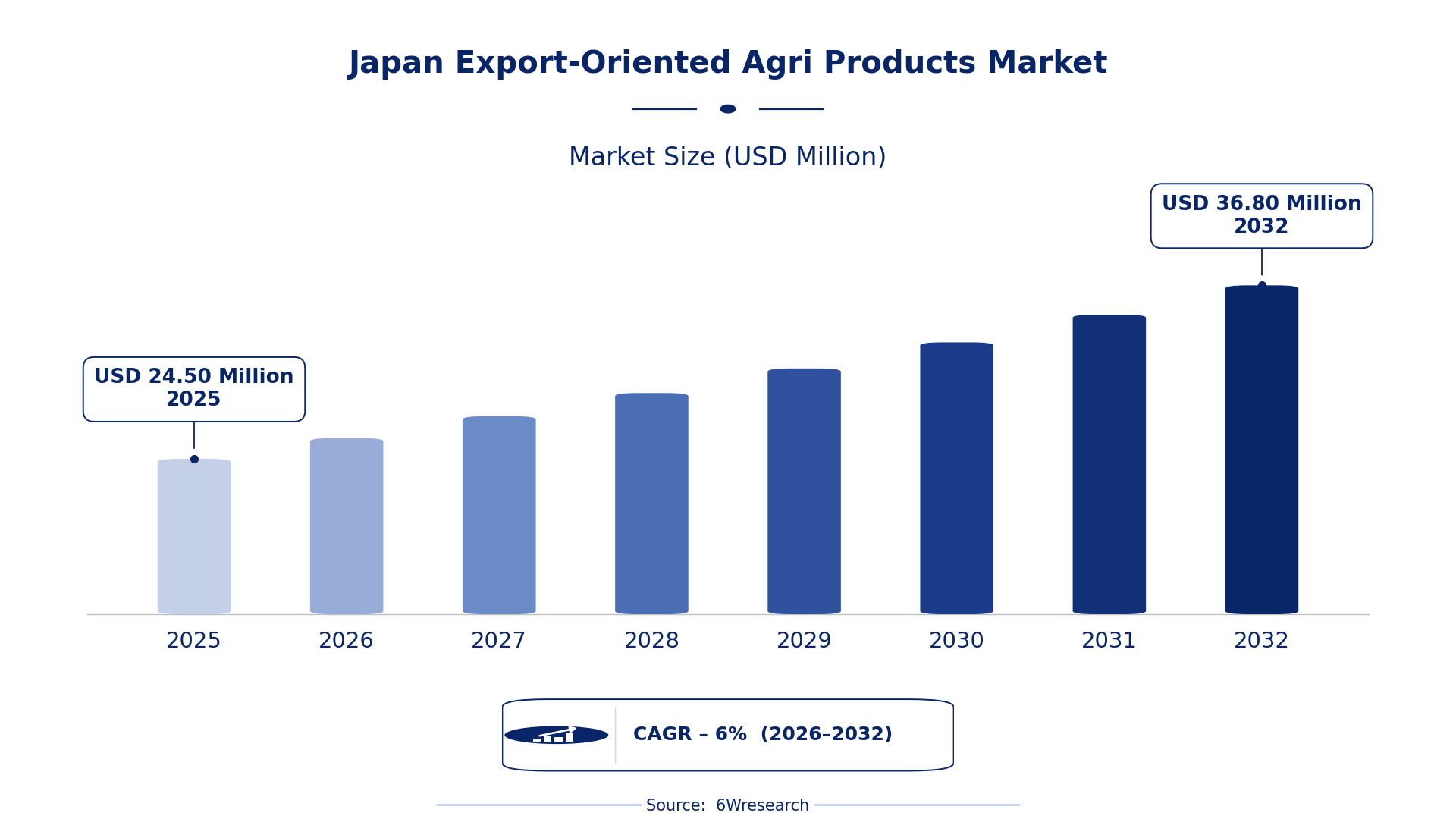
According to 6Wresearch internal database and industry insights, the Japan Export-Oriented Agri Products Market was valued at USD 24.50 Million in 2025 and is projected to reach USD 36.80 Million by 2032, growing at a CAGR of approximately 6% during 2026–2032.
Japan Export-Oriented Agri Products Market Highlights
| Report Metric | Details |
| Report Name | Japan Export-Oriented Agri Products Market (2026-2032) |
| Market Size 2025 | USD 24.50 Million |
| Market Size 2032 | USD 36.80 Million |
| Absolute Growth 2025–2032 | USD 12.30 Million |
| CAGR 2026–2032 | 6% |
| Peak Annual Growth | 7.0% in 2032 |
| Forecast Period | 2026–2032 |
| Historical Data | 2022–2025 |
| Base Year | 2025 |
| Leading Product Type, 2025 | Fresh Fruits (43% share) |
| Leading Export Region, 2025 | Middle East (42% share) |
| Leading Distribution Channel, 2025 | Export Agencies (50% share) |
| Leading End User, 2025 | Food Retailers (42% share) |
| Fastest-Growing Product Type | Spices (8.5% CAGR) |
| Fastest-Growing Export Region | Europe (7.2% CAGR) |
| Fastest-Growing Distribution Channel | Online Export Portals (7.8% CAGR) |
| Fastest-Growing End User | International Traders (7.9% CAGR) |
| Growing Sector | International Traders |
| Key End Users | Food Retailers, International Traders, Agro Importers, Restaurant Chains |
Japan Export-Oriented Agri Products Market Year-wise Growth Rate and Key Drivers (2022–2032)
This graph illustrates the annual growth rates of the market from 2022 to 2032, highlighting a steady upward trajectory and projected market expansion over the forecast period.
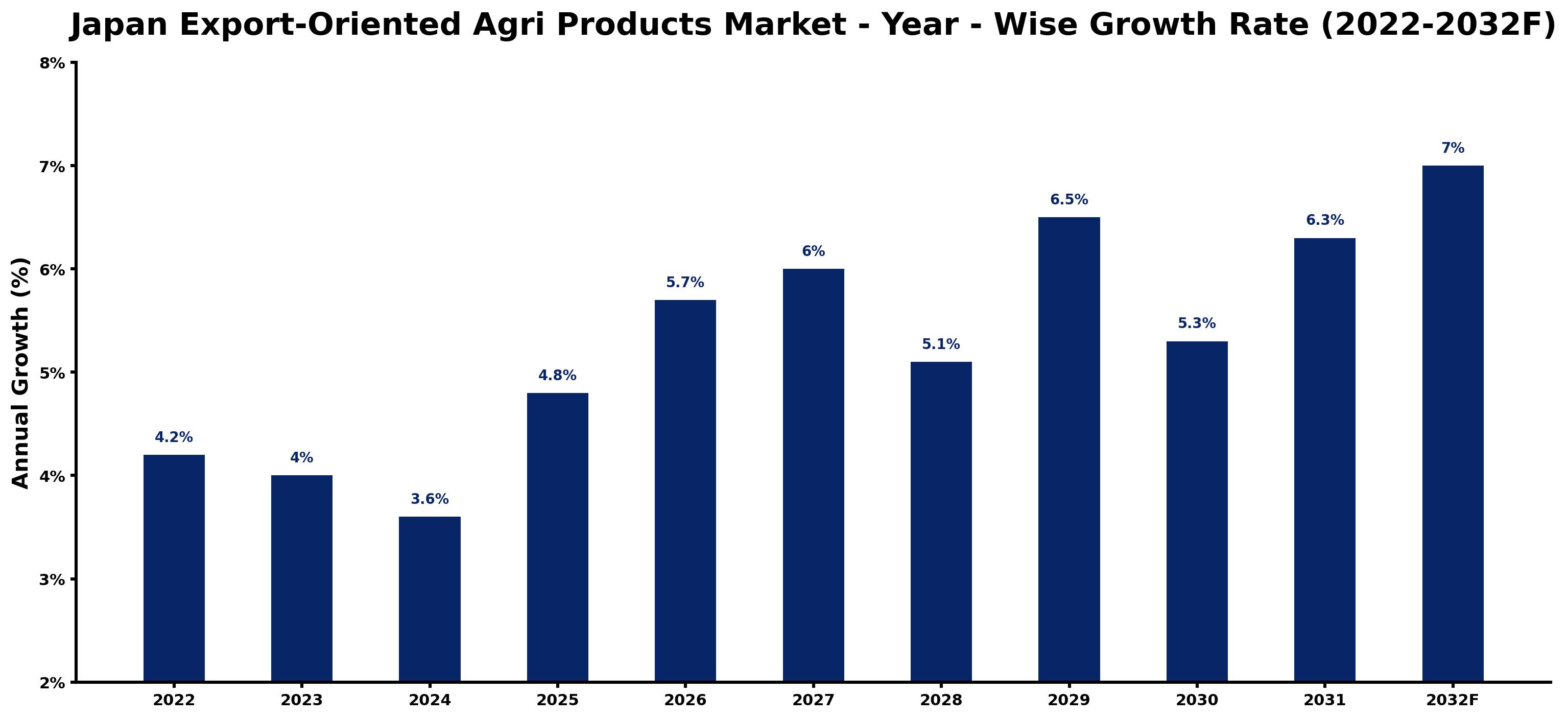
Year by year, the estimates below pair each growth rate with the development that shaped it.
| Year | Estimated Annual Growth (%) | Market Rationale |
| 2022 | 4.2 | The market experienced steady growth due to strong international demand for quality agri products. |
| 2023 | 4.0 | Growth slowed slightly as global supply chain challenges impacted export activities. |
| 2024 | 3.6 | Demand continued to rise, albeit at a slower pace, as producers adapted to market conditions. |
| 2025 | 4.8 | Growth accelerated as Japan's agricultural exports gained traction in key markets like Europe. |
| 2026 | 5.7 | Increased investments in quality assurance will drive demand, particularly for fresh fruits. |
| 2027 | 6.0 | The market will see further growth as dairy exports expand into new territories. |
| 2028 | 5.1 | Growth will slow again as competition intensifies in the global agri market. |
| 2029 | 6.5 | Demand will surge as Japan's rice and grains gain popularity in the Middle East. |
| 2030 | 5.3 | A slight slowdown will occur as market saturation begins to affect growth rates. |
| 2031 | 6.3 | Growth will pick up again due to renewed interest in Japanese dairy products. |
| 2032 | 7.0 | The market is expected to peak as investments in export quality reach fruition. |
Note: Market size estimations and growth projections presented in this report are based on 6Wresearch's proprietary forecasting methodology, utilizing the latest available industry data, government publications, and primary research inputs.
Japan Export-Oriented Agri Products Market Synopsis
Export-oriented agri products from Japan include fresh produce, grains, and dairy aimed at international markets. In 2022, Japan exported 1.5 million tons of fresh fruits, driven by high demand from regions like the Middle East and Europe. Advanced agricultural techniques, strict quality controls, and the support of export agencies contribute to the growth of the Japan Export-Oriented Agri Products Market, projected to reach USD 36.80 Million by 2032.
Market Dynamics Impact Analysis (2026–2032)
| Factor | Type | Impact | Primary Segment Affected |
| High demand for quality food products in the Middle East drives exports. | Driver | High | Fresh Fruits |
| Increasing global interest in Japanese dairy products creates new opportunities. | Driver | High | Dairy Products |
| The Middle East's demand for quality food products presents a significant opportunity. | Opportunity | High | Middle East |
| The rise of online export portals facilitates access to international markets. | Opportunity | Medium | Online Export Portals |
| Intense competition from other countries limits growth potential. | Restraint | High | Rice & Grains |
| Strict quality standards may hinder some producers from entering export markets. | Restraint | Medium | Dairy Products |
| Supply chain disruptions can delay shipments, affecting timely delivery. | Challenge | High | Fresh Fruits |
| Fluctuating global commodity prices impact profitability for exporters. | Challenge | Medium | Rice & Grains |
Evaluation of Drivers in Japan Export-Oriented Agri Products Market (2026–2032)
Demand rests on the following drivers, each shown with the segment it touches most.
| Drivers | Primary Segment Affected | Why It Matters (Evidence) |
| High demand for fresh fruits in the Middle East boosts exports. | Fresh Fruits | Japan exported 1.5 million tons of fresh fruits in 2022, meeting the region's quality expectations. |
| Growing interest in Japanese dairy products increases export opportunities. | Dairy Products | Exports reached 300,000 tons in 2021, driven by increasing demand from international markets. |
| Investment in quality assurance raises market competitiveness. | Rice & Grains | The Food Sanitation Act amendment made HACCP-based hygiene management mandatory for food businesses, attracting more buyers. |
| Online export portals streamline the export process for producers. | Online Export Portals | The online export portal usage increased by 30% in 2023, enabling easier access to international buyers. |
| Support from export agencies facilitates market entry for producers. | Export Agencies | Export Agencies accounted for 50% of distribution channels in 2025, enhancing market reach. |
Spending rises because demand for high-quality fresh fruits has surged, leading to increased exports. In 2022, Japan exported 1.5 million tons of fresh fruits, primarily to the Middle East, where quality expectations are high. The growing interest in Japanese dairy products reflects international markets' need for quality ingredients, with exports reaching 300,000 tons in 2021. Investments in quality assurance ensure that rice and grains meet international standards, attracting more buyers. The rise of online export portals simplifies access for producers, broadening their market capabilities.
Evaluation of Restraints in Japan Export-Oriented Agri Products Market
The main factors holding the market back are set out below.
| Market Restraint | Primary Segment Affected | Why It Matters (Evidence) |
| Rising supply chain costs impact profit margins for exporters. | Export Agencies | Transport expenses increased by 15% this year, affecting profitability for producers. |
| Slow technology adoption limits productivity improvements. | Fresh Fruits | Only 20% of farms utilise advanced agricultural technologies, delaying growth potential. |
| Skills shortages hinder output quality. | Dairy Products | 30% of agricultural workers lack necessary training, resulting in inefficiencies. |
| Fluctuating demand complicates pricing strategies. | Rice & Grains | Export volumes dropped by 10% in 2023, forcing sellers to manage excess inventory. |
| Intense competition reduces market share. | Export Agencies | Rival countries are increasing their agricultural exports, challenging Japan's position. |
Japan Export-Oriented Agri Products Market Challenges
Producers currently face increased transport costs, which have risen by 15% this year, squeezing profit margins for exporters. Limited technology adoption exists, as only 20% of farms employ advanced agricultural techniques, resulting in lower productivity and competitiveness for growers. A shortage of skilled workers is apparent, with 30% of agricultural employees lacking necessary training, causing inefficiencies that compromise output quality. Buyers are experiencing fluctuating demand from the Middle East, where export volumes fell by 10% in 2023, forcing sellers to adjust pricing strategies and manage excess inventory.
Trends in the Japan Export-Oriented Agri Products Market
Below are the shifts with the largest effect on the Japan Export-Oriented Agri Products Market.
- Increase in Online Export Portal Usage: The usage of online export portals surged by 30% in 2023, facilitating access for producers to international buyers. This trend allows for streamlined transactions and broader market reach.
- Focus on Quality Assurance: Japan's agricultural sector increasingly prioritises quality assurance, with the Food Sanitation Act mandating stricter hygiene management. This shift strengthens Japan's reputation in global markets.
- Growing Demand for Dairy Products: Dairy exports reached 300,000 tons in 2021, reflecting a growing demand for high-quality dairy in international markets. This trend indicates potential for further expansion in the sector.
- Rising Interest in Fresh Produce: The export of fresh fruits reached 1.5 million tons in 2022, driven by demand from regions like the Middle East. This growth highlights opportunities for producers to expand their offerings.
Investment Opportunities in the Japan Export-Oriented Agri Products Market
The following areas offer the clearest openings for investors and suppliers in the Japan Export-Oriented Agri Products Market.
- Expansion of Online Export Portals: The rise of online export portals presents an opportunity for producers to reach international buyers more effectively. With a 30% increase in usage in 2023, investing in these platforms can improve market access.
- Investment in Quality Assurance Initiatives: Now is the time to invest in quality assurance initiatives, as the Food Sanitation Act emphasises hygiene management. Producers can boost their competitiveness by aligning with these standards.
- Focus on Middle Eastern Markets: The Middle East remains a key market for Japanese agri products, accounting for 25% of exports in 2022. Targeting this region can yield substantial returns for exporters.
- Development of New Training Programs: With a skills gap in the agricultural workforce, developing training programs can improve productivity. Investing in workforce development will enhance the quality of agricultural output.
Government Initiatives in the Japan Export-Oriented Agri Products Market
Japan's recent Food Sanitation Act amendment (2018) mandates HACCP-based hygiene management for food businesses, improving safety and quality in exports. This law builds on the Food Recycling Law (2000), which promotes waste reduction and recycling in the agricultural sector.
In 2023, the Ministry of Agriculture, Forestry and Fisheries launched a program to improve agri product quality for export, supporting producers with funding and resources. The Japan External Trade Organization (JETRO) plays a crucial role in promoting these initiatives globally.
Future Insight of the Japan Export-Oriented Agri Products Market
The investment pipeline for agricultural technology will expand, creating demand for high-quality products that meet international standards. By 2032, the JAS will implement stricter quality controls, enhancing Japan's reputation in global markets. New training programmes will emerge, addressing skills gaps and improving workforce capabilities. The online export portal usage will continue to grow, streamlining transactions and broadening market access for suppliers.
Market Segmentation Analysis
Japan Export-Oriented Agri Products Market report covers a detailed analysis of the following market segments:
By Product Type – Fresh Fruits Lead, Spices Expected to Grow Fastest
According to Saurav Kr Singh, Senior Research Analyst at 6Wresearch, in 2025, Fresh Fruits led the product type split with a 43% share. Fresh fruits hold the largest share due to their high demand in international markets, especially in areas prioritising quality produce. In 2022, Japan exported 1.5 million tons of fresh fruits, highlighting their critical role in the export-oriented agri products sector. Spices are set to record the highest CAGR in this split, 8.5% over 2026–2032. Spices are experiencing rapid growth, fuelled by increasing global culinary trends that favour diverse flavours. Although production is limited compared to other countries, this niche market is becoming more recognised and sought after. Suppliers should enhance the quality and variety of spices to capitalise on this growing market.
By Export Region – Middle East Leads, Europe Expected to Grow Fastest
The largest export region category in 2025 was Middle East, at 42% of revenue. The Middle East holds the largest share of Japan's agri exports, largely due to a high demand for quality food products. This region accounted for 25% of Japan's agricultural exports in 2022, highlighting its critical role in the market. The quickest growth will come from Europe, forecast to expand at a CAGR of 7.2% between 2026 and 2032. Europe is experiencing the fastest growth in demand for Japanese agri products, with exports valued at $1.2 billion in 2022. This market's increasing appetite for high-quality agricultural goods underscores its significance. Suppliers may need to tailor their offerings to meet the specific preferences of European consumers.
By Distribution Channel – Export Agencies Lead, Online Export Portals Expected to Grow Fastest
With 50% of distribution channel revenue in 2025, Export Agencies was the largest category. Export agencies are pivotal in facilitating exports, ensuring products efficiently reach international markets. Their established networks and expertise are essential for the success of Japan's agri exports. Online Export Portals are projected to grow fastest, at a CAGR of 7.8% during 2026–2032. Online export portals are rapidly gaining traction, with a 30% increase in usage in 2023, indicating a shift towards digital solutions for connecting with international buyers. This trend shows a growing preference for convenience in the export process. Suppliers should consider investing in digital platforms to enhance their market reach.
By End User – Food Retailers Lead, International Traders Expected to Grow Fastest
Food Retailers took 42% of end user revenue in 2025, more than any other category. Food retailers serve as the primary end-users in export markets, directly supplying consumers with agricultural products. Their significant role in the supply chain guarantees that quality Japanese agri products are accessible to customers. Over 2026–2032, International Traders are expected to post the fastest growth, at a CAGR of 7.9%. International traders are witnessing the fastest growth, playing a crucial role in product distribution across borders. Their significance is highlighted by the increasing complexity of global supply chains and the demand for diverse offerings. Suppliers should strengthen relationships with international traders to optimise their distribution strategies.
Key Attractiveness of the Report
- 10 Years of Market Numbers
- Historical Data Starting from 2022 to 2025
- Base Year 2025
- Forecast Data until 2032
- Key Performance Indicators Impacting the Market
- Major Upcoming Developments and Projects
Key Highlights of the Report:
- Japan Export-Oriented Agri Products Market Outlook
- Market Size of Japan Export-Oriented Agri Products Market, 2025
- Forecast of Japan Export-Oriented Agri Products Market, 2032
- Historical Data and Forecast of Japan Export-Oriented Agri Products Revenues & Volume for the Period 2022-2032F
- Japan Export-Oriented Agri Products Market Trend Evolution
- Japan Export-Oriented Agri Products Market Drivers and Challenges
- Japan Export-Oriented Agri Products Price Trends
- Japan Export-Oriented Agri Products Porter's Five Forces
- Japan Export-Oriented Agri Products Industry Life Cycle
- Historical Data and Forecast of Japan Export-Oriented Agri Products Market Revenues & Volume By Product Type for the Period 2022-2032F
- Historical Data and Forecast of Japan Export-Oriented Agri Products Market Revenues & Volume By Fresh Fruits for the Period 2022-2032F
- Historical Data and Forecast of Japan Export-Oriented Agri Products Market Revenues & Volume By Spices for the Period 2022-2032F
- Historical Data and Forecast of Japan Export-Oriented Agri Products Market Revenues & Volume By Rice & Grains for the Period 2022-2032F
- Historical Data and Forecast of Japan Export-Oriented Agri Products Market Revenues & Volume By Dairy Products for the Period 2022-2032F
- Historical Data and Forecast of Japan Export-Oriented Agri Products Market Revenues & Volume By Export Region for the Period 2022-2032F
- Historical Data and Forecast of Japan Export-Oriented Agri Products Market Revenues & Volume By Middle East for the Period 2022-2032F
- Historical Data and Forecast of Japan Export-Oriented Agri Products Market Revenues & Volume By Europe for the Period 2022-2032F
- Historical Data and Forecast of Japan Export-Oriented Agri Products Market Revenues & Volume By Southeast Asia for the Period 2022-2032F
- Historical Data and Forecast of Japan Export-Oriented Agri Products Market Revenues & Volume By North America for the Period 2022-2032F
- Historical Data and Forecast of Japan Export-Oriented Agri Products Market Revenues & Volume By Distribution Channel for the Period 2022-2032F
- Historical Data and Forecast of Japan Export-Oriented Agri Products Market Revenues & Volume By Export Agencies for the Period 2022-2032F
- Historical Data and Forecast of Japan Export-Oriented Agri Products Market Revenues & Volume By Online Export Portals for the Period 2022-2032F
- Historical Data and Forecast of Japan Export-Oriented Agri Products Market Revenues & Volume By Government Boards for the Period 2022-2032F
- Historical Data and Forecast of Japan Export-Oriented Agri Products Market Revenues & Volume By Direct Exporters for the Period 2022-2032F
- Historical Data and Forecast of Japan Export-Oriented Agri Products Market Revenues & Volume By End User for the Period 2022-2032F
- Historical Data and Forecast of Japan Export-Oriented Agri Products Market Revenues & Volume By Food Retailers for the Period 2022-2032F
- Historical Data and Forecast of Japan Export-Oriented Agri Products Market Revenues & Volume By International Traders for the Period 2022-2032F
- Historical Data and Forecast of Japan Export-Oriented Agri Products Market Revenues & Volume By Agro Importers for the Period 2022-2032F
- Historical Data and Forecast of Japan Export-Oriented Agri Products Market Revenues & Volume By Restaurant Chains for the Period 2022-2032F
- Japan Export-Oriented Agri Products Import Export Trade Statistics
- Market Opportunity Assessment By Product Type
- Market Opportunity Assessment By Export Region
- Market Opportunity Assessment By Distribution Channel
- Market Opportunity Assessment By End User
- Japan Export-Oriented Agri Products Top Companies Market Share
- Japan Export-Oriented Agri Products Competitive Benchmarking By Technical and Operational Parameters
- Japan Export-Oriented Agri Products Company Profiles
- Japan Export-Oriented Agri Products Key Strategic Recommendations
Market Covered
The study includes the following segmentation.
By Product Type
- Fresh Fruits
- Spices
- Rice & Grains
- Dairy Products
By Export Region
- Middle East
- Europe
- Southeast Asia
- North America
By Distribution Channel
- Export Agencies
- Online Export Portals
- Government Boards
- Direct Exporters
By End User
- Food Retailers
- International Traders
- Agro Importers
- Restaurant Chains































