Japan Fabrics Market Size & Growth Rate
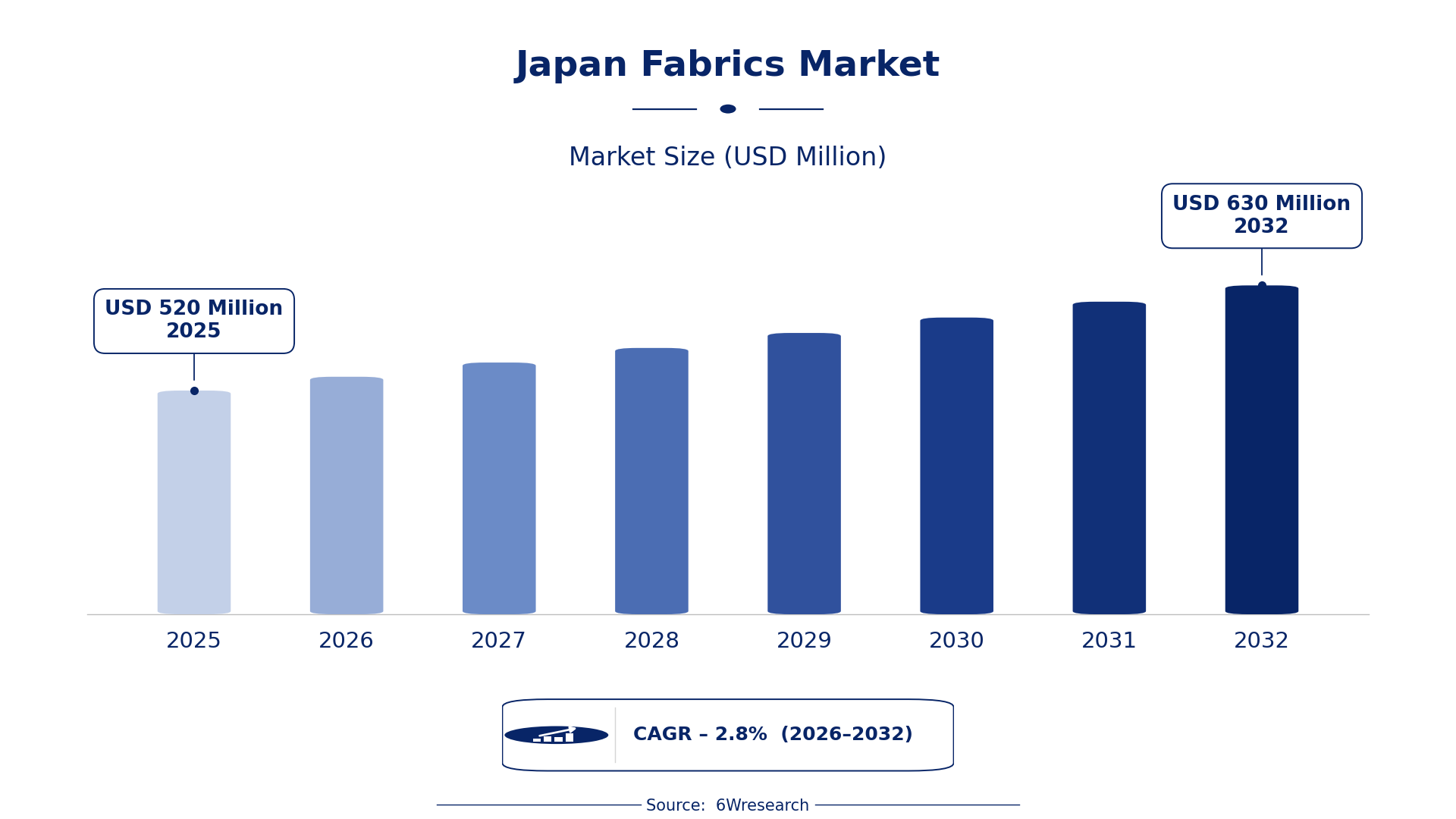
According to 6Wresearch internal database and industry insights, the Japan Fabrics Market was valued at USD 520 Million in 2025 and is projected to reach USD 630 Million by 2032, growing at a CAGR of approximately 2.8% during 2026–2032.
Japan Fabrics Market Highlights
| Report Metric | Details |
| Report Name | Japan Fabrics Market (2026-2032) |
| Market Size 2025 | USD 520 Million |
| Market Size 2032 | USD 630 Million |
| Absolute Growth 2025–2032 | USD 110 Million |
| CAGR 2026–2032 | 2.8% |
| Peak Annual Growth | 3.3% in 2028 |
| Forecast Period | 2026–2032 |
| Historical Data | 2022–2025 |
| Base Year | 2025 |
| Leading Types, 2025 | Cotton (50% share) |
| Leading Distribution Channel, 2025 | Direct (50% share) |
| Fastest-Growing Types | Manmade And Special Fiber Fabrics (4.0% CAGR) |
| Fastest-Growing Distribution Channel | Online Store (3.9% CAGR) |
| Growing Sector | Fashion and Apparel |
| Key End Users | Fashion designers, textile manufacturers, home textile producers, automotive interior suppliers |
Japan Fabrics Market Year-wise Growth Rate and Key Drivers (2022–2032)
This graph illustrates the annual growth rates of the market from 2022 to 2032, highlighting a steady upward trajectory and projected market expansion over the forecast period.
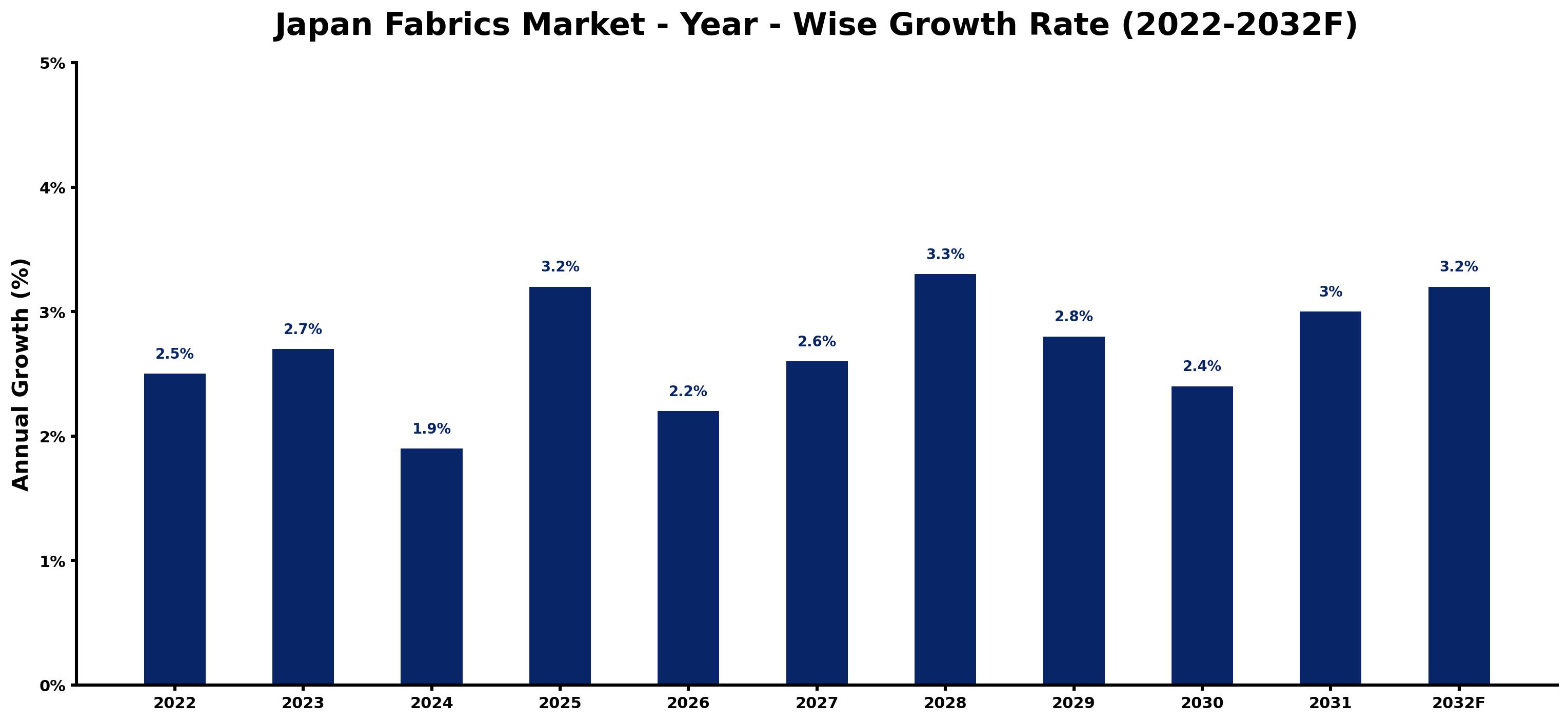
Annual growth estimates for each year appear below with the principal reason behind them, explaining the shifts that set the pace of the market.
| Year | Estimated Annual Growth (%) | Market Rationale |
| 2022 | 2.5 | Demand was steady, reflecting the established textile market in Japan. |
| 2023 | 2.7 | Growth accelerated due to increased consumer interest in fashion and textiles. |
| 2024 | 1.9 | Demand growth slowed as market conditions stabilised after a previous surge. |
| 2025 | 3.2 | A peak in growth occurred as fashion events boosted fabric visibility and sales. |
| 2026 | 2.2 | Growth is expected to slow again as the market adjusts to previous peaks in demand. |
| 2027 | 2.6 | Demand is projected to pick up with renewed interest in sustainable textiles and innovations. |
| 2028 | 3.3 | The market is expected to peak again, driven by a surge in manmade fiber applications. |
| 2029 | 2.8 | Growth will decelerate as supply chains face challenges in meeting demand. |
| 2030 | 2.4 | Demand is projected to continue slowing as market conditions stabilise post-peak. |
| 2031 | 3.0 | Growth is expected to resume with increasing investments in textile innovation and design. |
| 2032 | 3.2 | Demand will strengthen as sustainability trends influence purchasing decisions. |
Note: Market size estimations and growth projections presented in this report are based on 6Wresearch's proprietary forecasting methodology, utilizing the latest available industry data, government publications, and primary research inputs.
Japan Fabrics Market Synopsis
Fabrics in Japan encompass manmade, cotton, and knitted materials, primarily utilised in apparel, home textiles, and industrial applications. The Japan Fabrics Market is growing due to rising consumer interest in fashion, increased online sales, and government support for sustainable practices. With a textile production value of approximately 1.5 trillion yen in 2022, the market benefits from innovations showcased at events like Tokyo Fashion Week, which influence purchasing behaviour and trends.
Market Dynamics Impact Analysis (2026–2032)
| Factor | Type | Impact | Primary Segment Affected |
| Rising consumer interest in fashion and textiles | Driver | High | Cotton |
| Growth of online sales channels | Driver | High | Online Store |
| Increasing demand for sustainable textiles | Opportunity | High | Manmade And Special Fiber Fabrics |
| Expansion of textile recycling initiatives | Opportunity | Medium | Cotton |
| Challenges in supply chain logistics | Restraint | High | Knitted Fabrics |
| Competition from imported fabrics | Restraint | Medium | Non-Cotton |
| Limited production capacity for high-quality fabrics | Challenge | High | Manmade And Special Fiber Fabrics |
| Fluctuations in raw material prices | Challenge | Medium | Cotton |
Evaluation of Drivers in Japan Fabrics Market (2026–2032)
The table below links each growth driver to the segment it affects and the evidence for it.
| Drivers | Primary Segment Affected | Why It Matters (Evidence) |
| Increased consumer demand for fashionable textiles | Cotton | This demand drives manufacturers to produce more cotton fabrics, particularly in urban areas like Tokyo, where fashion trends influence purchases. |
| Growth of e-commerce platforms for fabric sales | Online Store | Online sales have surged by 15% annually since 2020, enabling consumers to access a wider variety of fabrics conveniently. |
| Rising interest in sustainable fabric production | Manmade And Special Fiber Fabrics | Sustainable practices are becoming essential, with the government launching a program in 2023 to support eco-friendly textile initiatives. |
| Technological advancements in fabric manufacturing | Knitted Fabrics | Innovations in knitting technology have improved production efficiency, leading to increased output and variety in knitted fabrics. |
| Growing emphasis on quality standards in textiles | Cotton | Adoption of ISO 9001 standards ensures high-quality production, appealing to both domestic and international buyers. |
Purchasing is picking up as consumer interest in fashion textiles grows, particularly in urban centres like Tokyo. The online fabric sales channel has expanded, with a 15% annual increase since 2020, allowing consumers easier access to diverse products. Technological advancements in manufacturing have improved production efficiency, leading to a broader range of offerings. Adherence to quality standards ensures high-quality output, attracting both domestic and international buyers.
Evaluation of Restraints in Japan Fabrics Market
The key brakes on demand, and where they bite hardest, are shown below.
| Market Restraint | Primary Segment Affected | Why It Matters (Evidence) |
| Supply chain disruptions affecting fabric availability | Knitted Fabrics | Logistical issues have delayed shipments, impacting the timely availability of knitted fabrics for manufacturers. |
| Increased competition from imported textiles | Non-Cotton | Imported fabrics often offer lower prices, making it challenging for domestic producers to compete effectively. |
| Limited capacity for high-quality fabric production | Manmade And Special Fiber Fabrics | Manufacturers face constraints in scaling production to meet rising demand for high-quality manmade fabrics. |
| Fluctuations in raw material costs impacting pricing | Cotton | Volatility in raw material prices affects the overall cost structure for cotton fabric producers. |
| Consumer preference shifting towards cheaper alternatives | Cotton | As consumers seek more affordable options, demand for premium cotton fabrics may decline. |
Japan Fabrics Market Challenges
A major producer in Japan's fabric market faces losses of up to 20% due to intense competition from low-cost manufacturers in neighbouring countries. Many suppliers experience delays of up to six months because of outdated technology, hindering their ability to launch new products. Compliance with ISO 9001 standards incurs additional costs of around 5% of production expenses for manufacturers, which pressures their profit margins. Buyers encounter unpredictable fabric prices that can disrupt budgeting, resulting in procurement delays of several weeks.
Trends in the Japan Fabrics Market
Four trends stand out in the Japan Fabrics Market.
- Shift towards Sustainable Fabric Production: The trend towards sustainable fabric production has gained momentum with the government's 2023 programme supporting eco-friendly practices. This initiative aims to increase the recycling rate, currently around 30%, influencing manufacturers to adopt greener methods.
- Growth of Online Fabric Sales: Since 2020, online fabric sales have risen by 15% annually, reflecting a shift in consumer purchasing behaviour. This trend allows buyers to conveniently access a wider range of products, reshaping retail dynamics.
- Rise of Technical Fabrics in Fashion: Tokyo Fashion Week showcases innovative designs, highlighting the growing demand for technical fabrics in fashion. This event influences trends, with a significant portion of the audience comprising fashion designers and manufacturers.
- Increased Focus on Quality Standards: The adoption of ISO 9001 standards in the textile sector has become more prevalent, ensuring quality assurance in fabric production. This shift is important for manufacturers aiming to compete in both domestic and international markets.
Investment Opportunities in the Japan Fabrics Market
The opportunities below stand out in the Japan Fabrics Market for new entrants and existing suppliers.
- Gap in Sustainable Fabric Supply: With a growing need for sustainable fabrics, there is a gap in supply. Manufacturers can invest in eco-friendly production methods, targeting fashion designers in urban areas who prioritise sustainability.
- Expansion of Online Retail Channels: The rise in online sales presents an opportunity to supply diverse fabric types. Collaborating with e-commerce platforms can help reach a broader customer base, especially among younger consumers.
- Investment in Advanced Fabric Technologies: Investing in advanced fabric technologies can meet the demand for unique textiles. Targeting fashion designers at events like Tokyo Fashion Week can facilitate market entry and brand visibility.
- Development of Niche Fabric Markets: With the textile recycling rate at 30%, there is potential for developing niche markets in recycled fabrics. Manufacturers can partner with local designers to create unique products that appeal to eco-conscious consumers.
Government Initiatives in the Japan Fabrics Market
The Act against Unjustifiable Premiums and Misleading Representations, established in 1962, prohibits misleading labelling and advertising of textiles. This law ensures that buyers receive accurate information about fabric quality and origin, fostering trust in the market. The Industrial Standardization Act, amended in 2019, governs product standards, ensuring that textiles meet quality benchmarks, which is essential for producers aiming to maintain competitiveness.
The Digital Agency, established in September 2021, oversees the implementation of digital transformation initiatives in the textile industry. This agency funds projects aimed at enhancing manufacturing processes and promoting innovation, supporting producers in adapting to new technologies and market demands.
Future Insight of the Japan Fabrics Market
Investment in sustainable textile practices will create substantial demand for innovative solutions. By 2032, the textile recycling rate is projected to rise to 50%, providing suppliers with new opportunities. Tokyo Fashion Week will continue to showcase unique fabric designs, influencing consumer preferences and driving demand. Online fabric sales are expected to grow, giving buyers better access to a wider range of products and improving sourcing efficiency.
Market Segmentation Analysis
Japan Fabrics Market report covers a detailed analysis of the following market segments:
By Types – Cotton Leads, Manmade And Special Fiber Fabrics Expected to Grow Fastest
According to Ravi Bhandari, Research Head at 6Wresearch, Cotton took 50% of types revenue in 2025, more than any other category. Cotton fabrics dominate the market as they are fundamental for traditional clothing and home textiles, appealing to a broad consumer base. The high-quality cotton produced in Okayama Prefecture significantly contributes to meeting both domestic and international needs. Over 2026–2032, Manmade And Special Fiber Fabrics are expected to post the fastest growth, at a CAGR of 4.0%. Manmade and special fiber fabrics are experiencing rapid growth due to their expanding use in fashion and technical applications, with production figures reaching 1.2 million tons in 2021. As fabric technology progresses, this segment is expected to see continued demand increases. This suggests that suppliers should focus on expanding their offerings in manmade fibers to align with the growing market trends.
By Distribution Channel – Direct Leads, Online Store Expected to Grow Fastest
Direct held 50% of the Japan Fabrics Market by distribution channel in 2025. Direct sales remain the leading distribution channel as they allow manufacturers to connect directly with consumers, ensuring better control over pricing and product quality. This method is particularly effective for brands showcasing unique fabric designs at events like Tokyo Fashion Week. Online Store is projected to grow fastest, at a CAGR of 3.9% during 2026–2032. Online stores are experiencing the fastest growth, with a 15% annual increase since 2020, as more consumers prefer the convenience of online shopping for fabrics. This trend indicates a shift in purchasing behaviour towards digital platforms. Suppliers must invest in online sales strategies to meet the rising consumer preference for digital purchasing.
Key Attractiveness of the Report
- 10 Years of Market Numbers
- Historical Data Starting from 2022 to 2025
- Base Year 2025
- Forecast Data until 2032
- Key Performance Indicators Impacting the Market
- Major Upcoming Developments and Projects
Key Highlights of the Report:
- Japan Fabrics Market Outlook
- Market Size of Japan Fabrics Market, 2025
- Forecast of Japan Fabrics Market, 2032
- Historical Data and Forecast of Japan Fabrics Revenues & Volume for the Period 2022-2032
- Japan Fabrics Market Trend Evolution
- Japan Fabrics Market Drivers and Challenges
- Japan Fabrics Price Trends
- Japan Fabrics Porter's Five Forces
- Japan Fabrics Industry Life Cycle
- Historical Data and Forecast of Japan Fabrics Market Revenues & Volume By Types for the Period 2022-2032
- Historical Data and Forecast of Japan Fabrics Market Revenues & Volume By Manmade And Special Fiber Fabrics for the Period 2022-2032
- Historical Data and Forecast of Japan Fabrics Market Revenues & Volume By Knitted Fabrics for the Period 2022-2032
- Historical Data and Forecast of Japan Fabrics Market Revenues & Volume By Cotton for the Period 2022-2032
- Historical Data and Forecast of Japan Fabrics Market Revenues & Volume By Non-Cotton for the Period 2022-2032
- Historical Data and Forecast of Japan Fabrics Market Revenues & Volume By Distribution Channel for the Period 2022-2032
- Historical Data and Forecast of Japan Fabrics Market Revenues & Volume By Direct for the Period 2022-2032
- Historical Data and Forecast of Japan Fabrics Market Revenues & Volume By Indirect for the Period 2022-2032
- Historical Data and Forecast of Japan Fabrics Market Revenues & Volume By Hypermarket/Supermarket for the Period 2022-2032
- Historical Data and Forecast of Japan Fabrics Market Revenues & Volume By Specialty Stores for the Period 2022-2032
- Historical Data and Forecast of Japan Fabrics Market Revenues & Volume By Online Store for the Period 2022-2032
- Japan Fabrics Import Export Trade Statistics
- Market Opportunity Assessment By Types
- Market Opportunity Assessment By Distribution Channel
- Japan Fabrics Top Companies Market Share
- Japan Fabrics Competitive Benchmarking By Technical and Operational Parameters
- Japan Fabrics Company Profiles
- Japan Fabrics Key Strategic Recommendations
Market Covered
The study includes the following segmentation.
By Types
- Manmade And Special Fiber Fabrics
- Knitted Fabrics
- Cotton
- Non-Cotton
By Distribution Channel
- Direct
- Indirect
- Hypermarket/Supermarket
- Specialty Stores
- Online Store































