Japan Face Filter Applications Market Size & Growth Rate
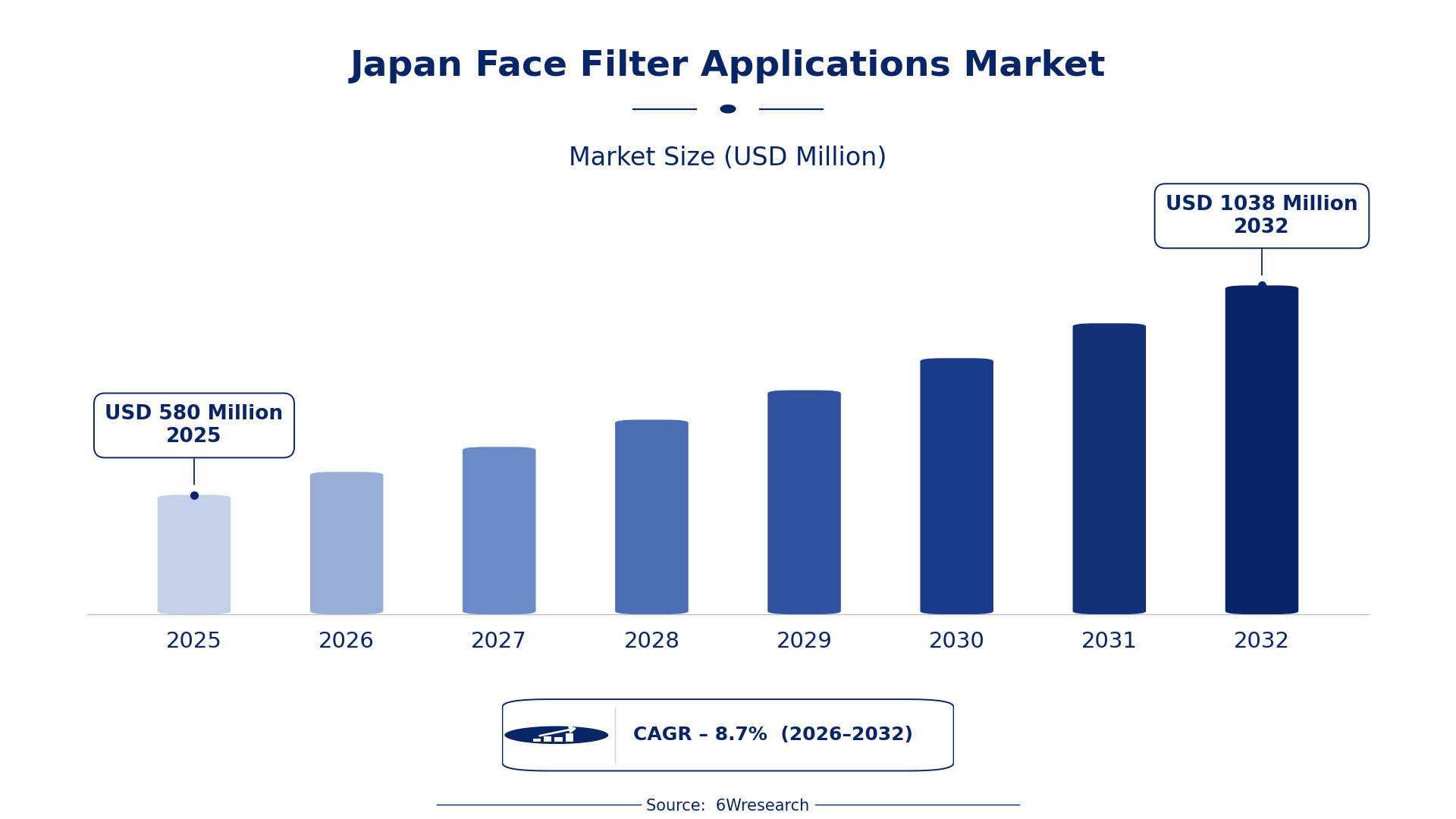
According to 6Wresearch internal database and industry insights, the Japan Face Filter Applications Market was valued at USD 580 Million in 2025 and is projected to reach USD 1,038 Million by 2032, growing at a CAGR of approximately 8.7% during 2026–2032.
Japan Face Filter Applications Market Highlights
| Report Metric | Details |
| Report Name | Japan Face Filter Applications Market (2026-2032) |
| Market Size 2025 | USD 580 Million |
| Market Size 2032 | USD 1,038 Million |
| Absolute Growth 2025–2032 | USD 458 Million |
| CAGR 2026–2032 | 8.7% |
| Peak Annual Growth | 9.6% in 2029 |
| Forecast Period | 2026–2032 |
| Historical Data | 2022–2025 |
| Base Year | 2025 |
| Leading Filter Type, 2025 | Beauty Filters (48% share) |
| Leading Platform Type, 2025 | Social Media (56% share) |
| Leading Distribution Channel, 2025 | App Stores (43% share) |
| Leading End User, 2025 | General Users (51% share) |
| Fastest-Growing Filter Type | AR Masks (11.9% CAGR) |
| Fastest-Growing Platform Type | Video Conferencing (11.7% CAGR) |
| Fastest-Growing Distribution Channel | Subscription Models (10.8% CAGR) |
| Fastest-Growing End User | Influencers (10.7% CAGR) |
| Growing Sector | Digital Content Creation |
| Key End Users | General Users, Influencers, Content Creators, Teenagers |
Japan Face Filter Applications Market Year-wise Growth Rate and Key Drivers (2022–2032)
This graph illustrates the annual growth rates of the market from 2022 to 2032, highlighting a steady upward trajectory and projected market expansion over the forecast period.
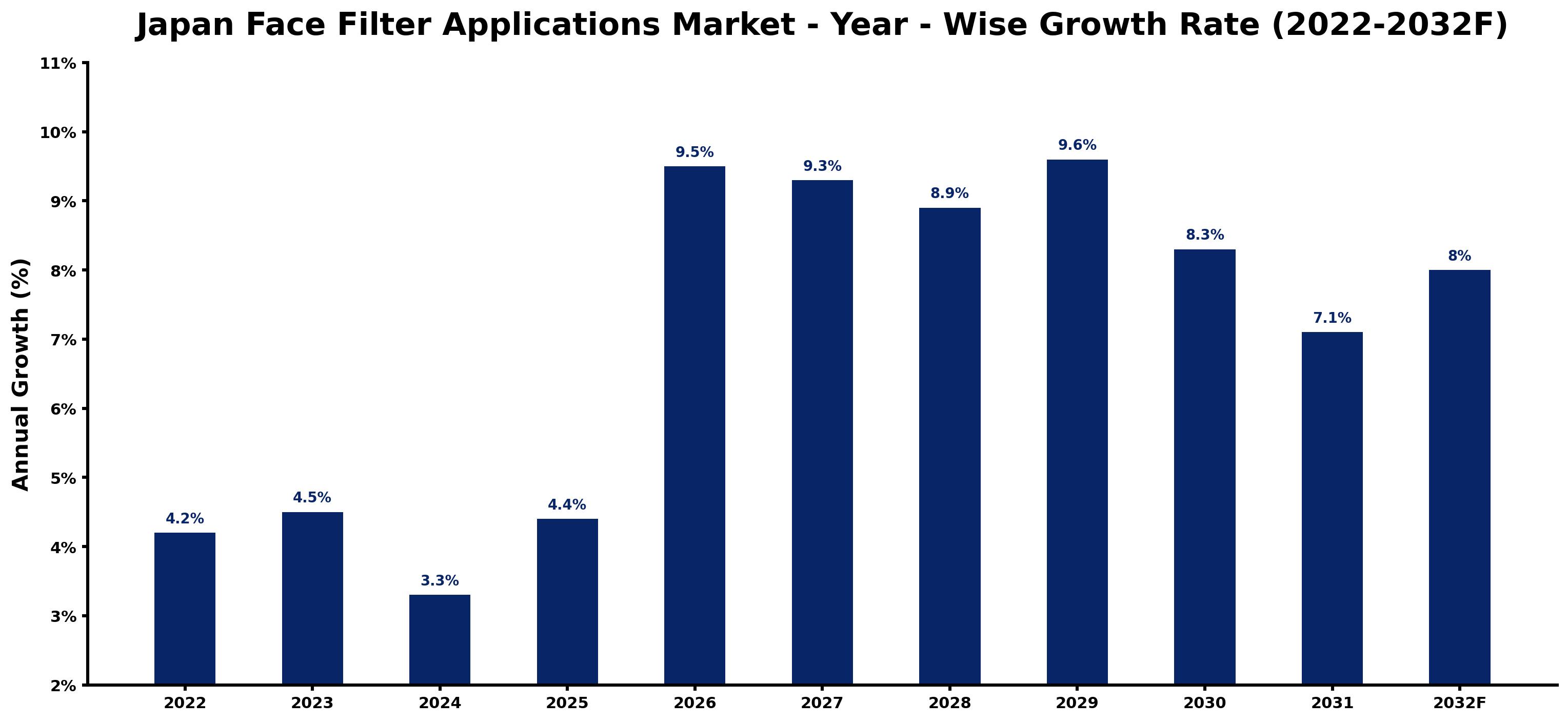
The following figures match every annual growth estimate with the main market development of that year, giving the reasoning behind each rise or slowdown.
| Year | Estimated Annual Growth (%) | Market Rationale |
| 2022 | 4.2 | The market showed solid activity with a growth rate reflecting strong user engagement. |
| 2023 | 4.5 | Demand increased as more users engaged with face filters on social media platforms. |
| 2024 | 3.3 | Growth slowed as market saturation began to affect new user acquisition. |
| 2025 | 4.4 | A resurgence in growth occurred due to increased content creation and user engagement. |
| 2026 | 9.5 | Rapid growth is anticipated due to advancements in AR technology and user adoption. |
| 2027 | 9.3 | Growth is expected to slow slightly as the market begins to mature and competition intensifies. |
| 2028 | 8.9 | Continued interest in AR applications is likely to keep demand strong, though at a slower pace. |
| 2029 | 9.6 | The market is projected to peak with heightened interest in immersive experiences and content creation. |
| 2030 | 8.3 | A slight slowdown is expected as user engagement stabilises and competition increases. |
| 2031 | 7.1 | Growth is anticipated to continue but at a reduced rate as the market reaches maturity. |
| 2032 | 8.0 | Demand is expected to rise again as new technologies and applications emerge, attracting users. |
Note: Market size estimations and growth projections presented in this report are based on 6Wresearch's proprietary forecasting methodology, utilizing the latest available industry data, government publications, and primary research inputs.
Japan Face Filter Applications Market Synopsis
Face filter applications utilise augmented reality technology to overlay digital effects on users' faces in real-time, providing engaging experiences for social media content and video calls. The Japan Face Filter Applications Market is expanding rapidly, driven by over 100 million active social media users and a youthful demographic of approximately 12 million aged 15-24. The AR technology market is projected to reach 1 trillion yen by 2025, stimulating demand for these applications, particularly among content creators and influencers in urban areas. This growth reflects a vibrant digital content environment that continues to evolve and engage users.
Market Dynamics Impact Analysis (2026–2032)
| Factor | Type | Impact | Primary Segment Affected |
| High engagement on social media platforms drives demand for face filters. | Driver | High | Social Media |
| The growing youth population actively uses face filters for content creation. | Driver | High | General Users |
| The AR technology market is projected to reach 1 trillion yen by 2025, creating opportunities for developers. | Opportunity | High | AR Masks |
| The increasing number of influencers creates demand for advanced face filter features. | Opportunity | High | Influencers |
| Market saturation may limit growth potential for new applications. | Restraint | Medium | Real-Time Editing |
| Competition among developers can lead to price wars, affecting profitability. | Restraint | Medium | Beauty Filters |
| High development costs can deter new entrants into the market. | Challenge | High | App Stores |
| Rapid technological changes require constant updates to stay competitive. | Challenge | High | Video Conferencing |
Evaluation of Drivers in Japan Face Filter Applications Market (2026–2032)
The factors lifting demand, and the evidence behind each, are summarised below.
| Drivers | Primary Segment Affected | Why It Matters (Evidence) |
| High social media usage among the youth drives demand for face filters. | Social Media | In 2022, over 100 million active social media users in Japan fuel demand for engaging content. |
| The popularity of live streaming increases the need for real-time editing features. | Real-Time Editing | The average time spent on social media is around 1 hour and 30 minutes daily, encouraging filter usage. |
| Influencers drive demand for advanced face filters to create engaging content. | Influencers | Many influencers in urban areas utilise face filters to engage their audiences effectively. |
| The growth of the AR technology market fosters new applications and features. | AR Masks | The AR market in Japan is expected to reach 1 trillion yen by 2025, boosting investment. |
| Teenagers' active social media engagement supports face filter usage. | Teenagers | Over 70% of teenagers in Japan use face filters, indicating strong demand. |
Much of the new demand traces back to the high engagement on social media among Japanese users, with over 100 million active accounts driving content creation. The youthful population, particularly those aged 15-24, actively utilises face filters, with approximately 12 million in this demographic. The AR technology market is expected to reach 1 trillion yen by 2025, encouraging developers to create new applications. In urban areas, content creators are increasingly adopting advanced face filters to improve their offerings, while the average social media usage time of 1 hour and 30 minutes daily fuels ongoing demand for engaging applications.
Evaluation of Restraints in Japan Face Filter Applications Market
These restraints slow adoption and weigh on supplier margins.
| Market Restraint | Primary Segment Affected | Why It Matters (Evidence) |
| Market saturation may limit the introduction of new face filter applications. | Real-Time Editing | As the market matures, new user acquisition becomes more challenging, affecting growth. |
| Intense competition can lead to price wars among developers. | Beauty Filters | Developers may lower prices to attract users, impacting profitability and innovation. |
| High development costs can deter new entrants in the face filter market. | App Stores | The financial burden of creating competitive applications may restrict market participation. |
| Rapid technological changes require constant updates to applications. | Video Conferencing | Keeping up with AR advancements necessitates ongoing investment, straining resources for developers. |
| Limited awareness of AR standards may hinder user trust in applications. | AR Masks | Without established guidelines, users may hesitate to adopt new technologies. |
Japan Face Filter Applications Market Challenges
Over 70% of teenagers in Japan use face filters on social media, yet unclear regulations can lead to inconsistent quality and safety standards for developers. This regulatory uncertainty increases compliance costs, delaying product launches for developers by up to six months. High operational costs in AR technology development strain producers' budgets, potentially reducing their profit margins by 15%. A lack of skilled AR programmers limits producers' ability to innovate, which may result in a 20% loss in market share to more skilled competitors.
Trends in the Japan Face Filter Applications Market
Buyers and suppliers in the Japan Face Filter Applications Market are adjusting to the following trends.
- Shift from Static Filters to Dynamic Effects: The trend is moving towards dynamic face filters that adapt in real-time to user movements. The Tokyo Game Show 2023 showcased several applications that improve user interaction, reflecting a growing demand for immersive experiences.
- Increased Integration of Face Filters in Video Conferencing: Video conferencing platforms are increasingly incorporating face filter technology to improve user engagement. For instance, over 50% of popular messaging apps in Japan now support face filters, catering to the rising demand for interactive communication.
- Rise of Influencer-Driven Content Creation: Influencers are increasingly utilising advanced face filters to create engaging content. In 2023, over 70% of teenagers reported using these filters, highlighting their impact on social media trends and user engagement.
- Expansion of AR Standards for Quality Assurance: The Japan Augmented Reality Association is promoting standards for AR applications, including face filters. The development of the JIS X 0120 standard aims to ensure quality and safety, which is important for user trust.
Investment Opportunities in the Japan Face Filter Applications Market
Investors looking at the Japan Face Filter Applications Market should consider the following areas.
- Investment Gap in Advanced AR Features: With the AR technology market projected to reach 1 trillion yen by 2025, there is a notable opportunity for developers to create advanced features. Content creators in urban areas are looking for new solutions to improve their offerings.
- Strategic Partnerships for Enhanced User Experience: Now is an ideal time for developers to form partnerships with social media platforms to improve user experience. Collaborating with influencers can help penetrate the market effectively, utilising their reach.
- Supply of Customised Face Filters for Events: There is a growing demand for customised face filters for events and promotions. Event organisers are increasingly seeking unique filters to improve audience engagement, presenting a lucrative opportunity for developers.
- Expansion of Free Download Models: The trend towards free downloads continues to gain traction, with many users preferring no-cost options. Developers should focus on creating engaging free applications to attract a larger user base.
Government Initiatives in the Japan Face Filter Applications Market
The 2023 digital content innovation program launched by the Ministry of Internal Affairs and Communications aims to support tech startups focusing on AR and VR technologies. This initiative complements existing laws like the Industrial Standardization Act, which governs product standards, ensuring quality in face filter applications. The program allocates significant funding to encourage innovation, benefiting numerous startups in the AR sector.
Buyers of face filter applications benefit from the subsidy program introduced in 2023, which supports AR and VR startups. This funding helps developers create applications, improving the offerings available to general users and content creators. The program aims to enhance the overall quality and accessibility of face filter applications in Japan.
Future Insight of the Japan Face Filter Applications Market
Investment in AR technology will surge due to new funding initiatives, creating a robust pipeline for innovative applications. The AR technology market in Japan is set to reach 1 trillion yen by 2025, significantly boosting demand for face filter applications. The introduction of the JIS X 0120 standard will enhance quality and safety, fostering greater user trust. As Tokyo continues to thrive as a digital content creation hub, an influx of new content creators will further drive the popularity of face filters.
Market Segmentation Analysis
Japan Face Filter Applications Market report covers a detailed analysis of the following market segments:
By Filter Type – Beauty Filters Lead, AR Masks Expected to Grow Fastest
According to Saurav Kr Singh, Senior Research Analyst at 6Wresearch, Beauty Filters held 48% of the Japan Face Filter Applications Market by filter type in 2025. Beauty filters dominate the market due to their widespread use for enhancing selfies and social media posts, appealing to a diverse demographic. This segment is particularly strong in urban areas like Tokyo, where influencers frequently utilise these filters to engage their audiences. Over 2026–2032, AR Masks are expected to post the fastest growth, at a CAGR of 11.9%. AR masks are experiencing rapid growth as they offer immersive experiences that attract users in social media and gaming contexts. The popularity of these masks is notably increasing among the youth demographic, which numbers around 12 million in Japan. Suppliers should focus on developing AR masks to meet the rising demand for engaging digital experiences.
By Platform Type – Social Media Leads, Video Conferencing Expected to Grow Fastest
Social Media took 56% of platform type revenue in 2025, more than any other category. Social media serves as the primary platform for face filter applications, with a large user base actively engaging with these tools. The average daily usage of 1 hour and 30 minutes on social media highlights its significance in the distribution of face filters. Video Conferencing is set to record the highest CAGR in this split, 11.7% over 2026–2032. Video conferencing is rapidly gaining traction as users adopt face filters for both professional and personal interactions. This trend is likely to accelerate, particularly with the government's recent digital content innovation programme. Buyers should explore integrating face filters into their video conferencing platforms to enhance user engagement.
By Distribution Channel – App Stores Lead, Subscription Models Expected to Grow Fastest
With 43% of distribution channel revenue in 2025, App Stores was the largest category. App stores are the main distribution channel for downloading face filter applications, providing users with easy access to a wide range of options. This channel is vital as it aligns with user preferences for convenient application acquisition. The quickest growth will come from Subscription Models, forecast to expand at a CAGR of 10.8% between 2026 and 2032. Subscription models are emerging as a growing revenue stream, appealing to users seeking premium features in specific applications. This trend suggests a shift towards more sustainable monetisation strategies within the market. Suppliers may need to consider incorporating subscription options into their distribution strategies to align with evolving user preferences.
By End User – General Users Lead, Influencers Expected to Grow Fastest
The largest end user category in 2025 was General Users, at 51% of revenue. General users represent the largest segment of face filter application users, leveraging these tools for personal expression on social media. Their extensive usage is supported by high engagement levels, particularly among the youth population. Influencers are projected to grow fastest, at a CAGR of 10.7% during 2026–2032. Influencers are significantly contributing to market growth as they utilise face filters for content creation, shaping trends and user interaction. Their impact is further amplified by the increasing number of digital content creators in urban centres. Suppliers should customise their offerings to cater to the specific needs of influencers to capitalise on their influence in the market.
Key Attractiveness of the Report
- 10 Years of Market Numbers
- Historical Data Starting from 2022 to 2025
- Base Year 2025
- Forecast Data until 2032
- Key Performance Indicators Impacting the Market
- Major Upcoming Developments and Projects
Key Highlights of the Report:
- Japan Face Filter Applications Market Outlook
- Market Size of Japan Face Filter Applications Market, 2025
- Forecast of Japan Face Filter Applications Market, 2032
- Historical Data and Forecast of Japan Face Filter Applications Revenues & Volume for the Period 2022-2032F
- Japan Face Filter Applications Market Trend Evolution
- Japan Face Filter Applications Market Drivers and Challenges
- Japan Face Filter Applications Price Trends
- Japan Face Filter Applications Porter's Five Forces
- Japan Face Filter Applications Industry Life Cycle
- Historical Data and Forecast of Japan Face Filter Applications Market Revenues & Volume By Filter Type for the Period 2022-2032F
- Historical Data and Forecast of Japan Face Filter Applications Market Revenues & Volume By Beauty Filters for the Period 2022-2032F
- Historical Data and Forecast of Japan Face Filter Applications Market Revenues & Volume By AR Masks for the Period 2022-2032F
- Historical Data and Forecast of Japan Face Filter Applications Market Revenues & Volume By Cartoon/Anime for the Period 2022-2032F
- Historical Data and Forecast of Japan Face Filter Applications Market Revenues & Volume By Real-Time Editing for the Period 2022-2032F
- Historical Data and Forecast of Japan Face Filter Applications Market Revenues & Volume By Platform Type for the Period 2022-2032F
- Historical Data and Forecast of Japan Face Filter Applications Market Revenues & Volume By Social Media for the Period 2022-2032F
- Historical Data and Forecast of Japan Face Filter Applications Market Revenues & Volume By Video Conferencing for the Period 2022-2032F
- Historical Data and Forecast of Japan Face Filter Applications Market Revenues & Volume By Messaging Apps for the Period 2022-2032F
- Historical Data and Forecast of Japan Face Filter Applications Market Revenues & Volume By Live Streaming for the Period 2022-2032F
- Historical Data and Forecast of Japan Face Filter Applications Market Revenues & Volume By Distribution Channel for the Period 2022-2032F
- Historical Data and Forecast of Japan Face Filter Applications Market Revenues & Volume By App Stores for the Period 2022-2032F
- Historical Data and Forecast of Japan Face Filter Applications Market Revenues & Volume By Subscription Models for the Period 2022-2032F
- Historical Data and Forecast of Japan Face Filter Applications Market Revenues & Volume By Free Downloads for the Period 2022-2032F
- Historical Data and Forecast of Japan Face Filter Applications Market Revenues & Volume By Integrated SDKs for the Period 2022-2032F
- Historical Data and Forecast of Japan Face Filter Applications Market Revenues & Volume By End User for the Period 2022-2032F
- Historical Data and Forecast of Japan Face Filter Applications Market Revenues & Volume By General Users for the Period 2022-2032F
- Historical Data and Forecast of Japan Face Filter Applications Market Revenues & Volume By Influencers for the Period 2022-2032F
- Historical Data and Forecast of Japan Face Filter Applications Market Revenues & Volume By Teenagers for the Period 2022-2032F
- Historical Data and Forecast of Japan Face Filter Applications Market Revenues & Volume By Content Creators for the Period 2022-2032F
- Japan Face Filter Applications Import Export Trade Statistics
- Market Opportunity Assessment By Filter Type
- Market Opportunity Assessment By Platform Type
- Market Opportunity Assessment By Distribution Channel
- Market Opportunity Assessment By End User
- Japan Face Filter Applications Top Companies Market Share
- Japan Face Filter Applications Competitive Benchmarking By Technical and Operational Parameters
- Japan Face Filter Applications Company Profiles
- Japan Face Filter Applications Key Strategic Recommendations
Market Covered
Coverage by segment is as follows.
By Filter Type
- Beauty Filters
- AR Masks
- Cartoon/Anime
- Real-Time Editing
By Platform Type
- Social Media
- Video Conferencing
- Messaging Apps
- Live Streaming
By Distribution Channel
- App Stores
- Subscription Models
- Free Downloads
- Integrated SDKs
By End User
- General Users
- Influencers
- Teenagers
- Content Creators































