Japan Factory Automation and Industrial Control Systems Market Size & Growth Rate
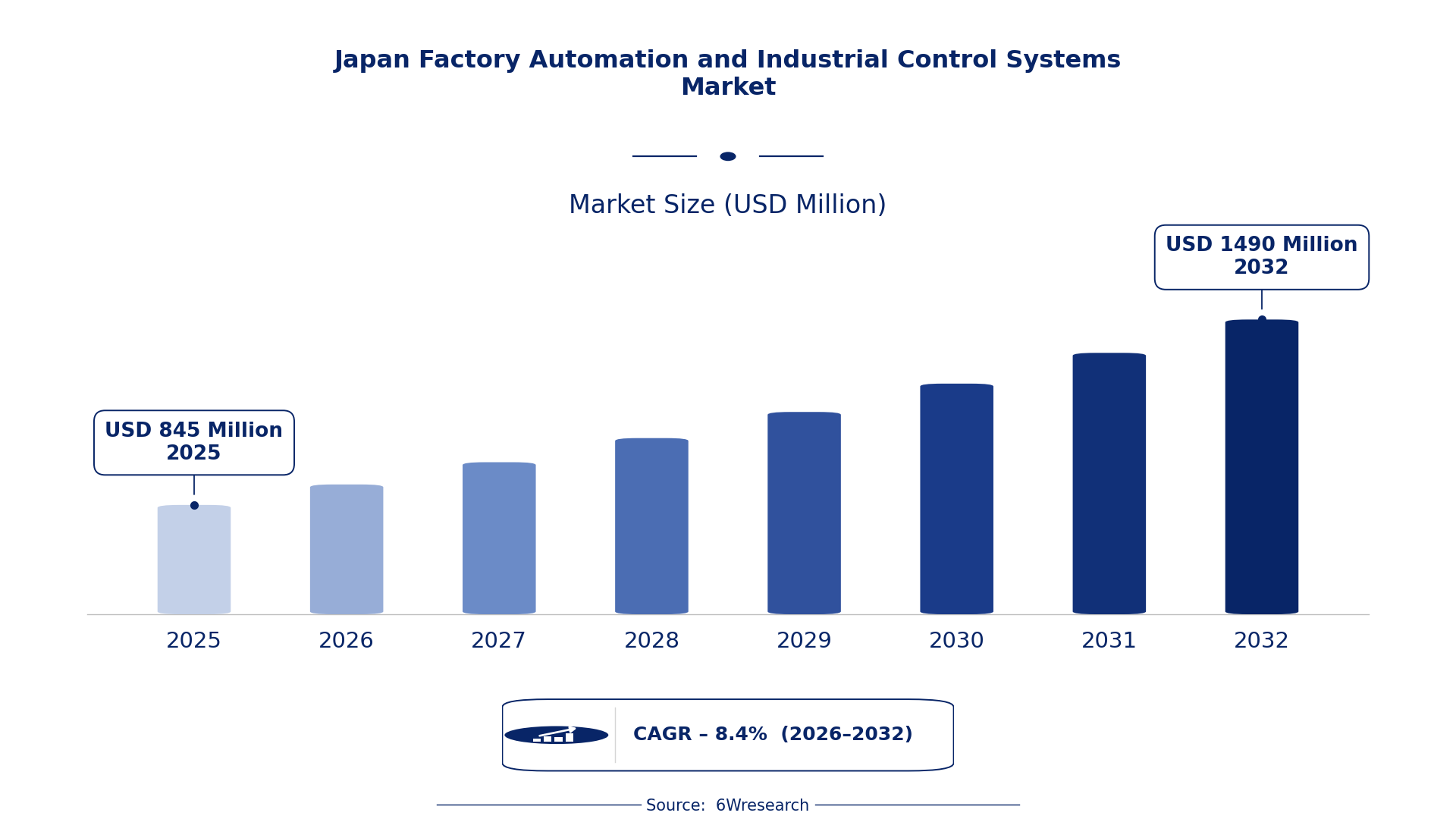
According to 6Wresearch internal database and industry insights, the Japan Factory Automation and Industrial Control Systems Market was valued at USD 845 Million in 2025 and is projected to reach USD 1,490 Million by 2032, growing at a CAGR of approximately 8.4% during 2026–2032.
Japan Factory Automation and Industrial Control Systems Market Highlights
| Report Metric | Details |
| Report Name | Japan Factory Automation and Industrial Control Systems Market (2026-2032) |
| Market Size 2025 | USD 845 Million |
| Market Size 2032 | USD 1,490 Million |
| Absolute Growth 2025–2032 | USD 645 Million |
| CAGR 2026–2032 | 8.4% |
| Peak Annual Growth | 9.4% in 2027 |
| Forecast Period | 2026–2032 |
| Historical Data | 2022–2025 |
| Base Year | 2025 |
| Leading Product Type, 2025 | Industrial Robots (41% share) |
| Leading Technology Type, 2025 | Artificial Intelligence (41% share) |
| Leading End User, 2025 | Automotive Manufacturers (36% share) |
| Leading Application, 2025 | Assembly Line Automation (43% share) |
| Fastest-Growing Product Type | Programmable Logic Controllers (PLC) (11.8% CAGR) |
| Fastest-Growing Technology Type | IoT-based Solutions (12.2% CAGR) |
| Fastest-Growing End User | Food & Beverage Industry (11.1% CAGR) |
| Fastest-Growing Application | Process Automation (11.6% CAGR) |
| Growing Sector | Automotive Manufacturing |
| Key End Users | Automotive Manufacturers, Food & Beverage Industry, Pharmaceutical Companies |
Japan Factory Automation and Industrial Control Systems Market Year-wise Growth Rate and Key Drivers (2022–2032)
This graph illustrates the annual growth rates of the market from 2022 to 2032, highlighting a steady upward trajectory and projected market expansion over the forecast period.
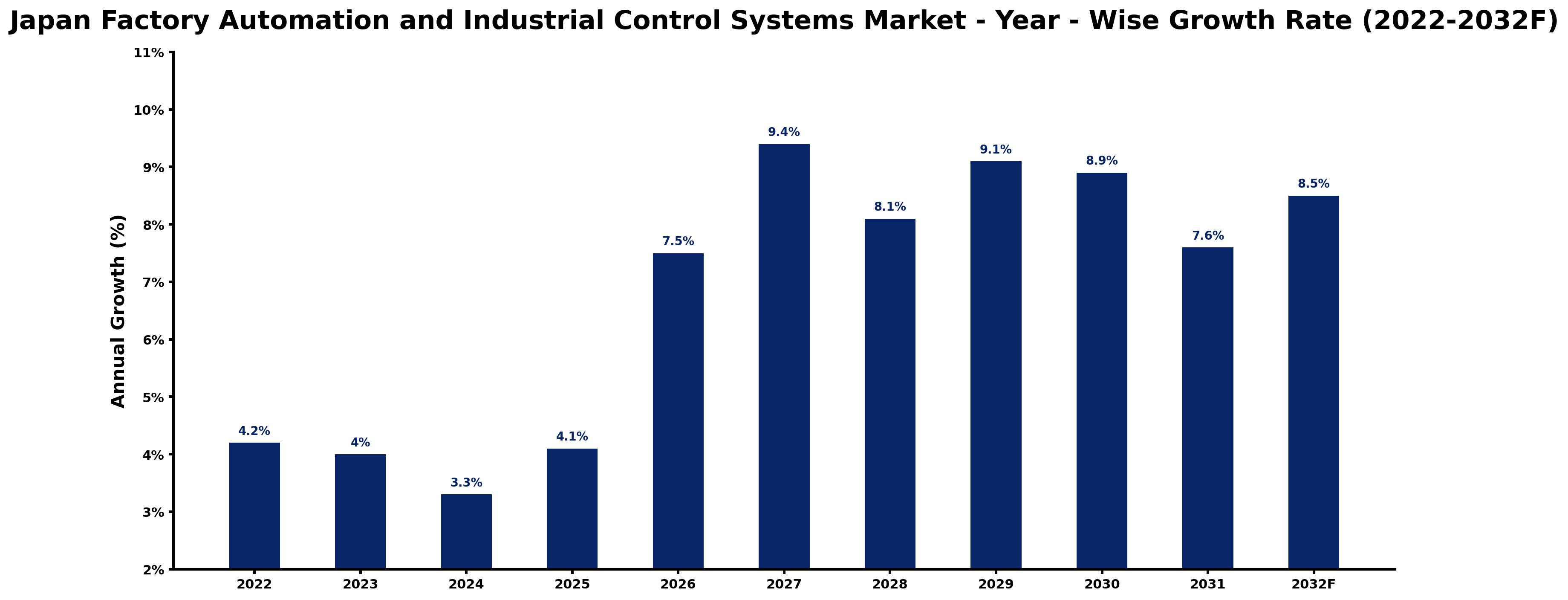
The yearly estimates that follow link every growth rate to its principal driver, so readers can see why the pace changed in each period.
| Year | Estimated Annual Growth (%) | Market Rationale |
| 2022 | 4.2 | The market experienced steady growth as manufacturers continued to invest in automation technologies. |
| 2023 | 4.0 | Growth slowed slightly due to a temporary dip in production across several sectors. |
| 2024 | 3.3 | The market saw further slowdown as companies adjusted to changing economic conditions. |
| 2025 | 4.1 | Growth picked up as demand for automation surged in the automotive sector. |
| 2026 | 7.5 | The market is expected to grow rapidly as new technologies gain traction in manufacturing. |
| 2027 | 9.4 | Peak growth is anticipated as companies fully embrace advanced automation solutions. |
| 2028 | 8.1 | Growth is projected to slow slightly as the market stabilises after peak demand. |
| 2029 | 9.1 | A resurgence in growth is expected as industries continue to modernise their operations. |
| 2030 | 8.9 | The market is likely to experience slower growth as saturation begins in key segments. |
| 2031 | 7.6 | Growth is projected to slow as the market matures and competition increases. |
| 2032 | 8.5 | A renewed focus on efficiency will drive growth as companies invest in innovative technologies. |
Note: Market size estimations and growth projections presented in this report are based on 6Wresearch's proprietary forecasting methodology, utilizing the latest available industry data, government publications, and primary research inputs.
Japan Factory Automation and Industrial Control Systems Market Synopsis
Factory Automation and Industrial Control Systems improve manufacturing efficiency through advanced electronics and software integration. These systems automate production lines, enhance quality control, and enable real-time data analysis. The Japan Factory Automation and Industrial Control Systems Market is expanding due to rising demand from sectors like automotive, which accounts for over 30% of demand, and the ongoing adoption of IoT technologies, supported by initiatives such as the 'Smart Factory' program.
Market Dynamics Impact Analysis (2026–2032)
| Factor | Type | Impact | Primary Segment Affected |
| Rising demand from the automotive sector | Driver | High | Industrial Robots |
| Increased investment in IoT technologies | Driver | High | Programmable Logic Controllers (PLC) |
| Growing need for automation in food production | Opportunity | High | Food & Beverage Industry |
| Expansion of automation in pharmaceuticals | Opportunity | High | Pharmaceutical Companies |
| High initial investment costs for automation systems | Restraint | High | Human-Machine Interface (HMI) |
| Shortage of skilled workforce for advanced technologies | Restraint | Medium | Distributed Control Systems (DCS) |
| Compliance with stringent safety regulations | Challenge | High | Industrial Robots |
| Pressure to modernise aging equipment | Challenge | Medium | Programmable Logic Controllers (PLC) |
Evaluation of Drivers in Japan Factory Automation and Industrial Control Systems Market (2026–2032)
The following drivers explain most of the expected growth.
| Drivers | Primary Segment Affected | Why It Matters (Evidence) |
| Increasing production efficiency through automation | Industrial Robots | The automotive sector accounts for over 30% of factory automation demand, driving purchases of industrial robots for production lines. |
| Growing adoption of IoT solutions | Programmable Logic Controllers (PLC) | The integration of IoT technologies supports real-time data analysis, leading to higher demand for PLCs in manufacturing. |
| Investment in advanced manufacturing technologies | Food & Beverage Industry | The food and beverage sector is projected to increase its automation adoption by 15% by 2025, boosting demand for automation solutions. |
| Focus on quality and compliance in pharmaceuticals | Pharmaceutical Companies | As the pharmaceutical industry adopts automation for precision, demand for systems that ensure compliance is rising. |
| Government initiatives promoting automation | Distributed Control Systems (DCS) | The 'Smart Factory' program launched in 2023 encourages the adoption of DCS for complex process automation. |
Purchasing is picking up as manufacturers increasingly recognise the need for automation to improve productivity. In 2023, Japan had over 2 million industrial robots installed, indicating strong demand for automation solutions. The automotive sector, accounting for over 30% of factory automation demand, drives purchases of industrial robots to enhance production efficiency. The food and beverage industry is projected to increase its automation adoption by 15% by 2025, reflecting a wider trend towards improved operational capabilities. The integration of IoT technologies into manufacturing processes is expected to boost demand for programmable logic controllers, facilitating real-time data analysis and decision-making.
Evaluation of Restraints in Japan Factory Automation and Industrial Control Systems Market
Below are the constraints most often cited by buyers and suppliers, with the segment each affects.
| Market Restraint | Primary Segment Affected | Why It Matters (Evidence) |
| High initial costs of automation systems | Human-Machine Interface (HMI) | The substantial investment required for advanced HMI systems can deter smaller manufacturers from adopting automation. |
| Shortage of skilled workforce for automation technologies | Distributed Control Systems (DCS) | A lack of trained personnel to operate and maintain advanced DCS systems limits their widespread implementation. |
| Compliance with safety regulations | Industrial Robots | Manufacturers must invest in safety measures to meet ISO 10218 standards, increasing operational costs. |
| Resistance to change among traditional manufacturers | Programmable Logic Controllers (PLC) | Some manufacturers are hesitant to modernise due to the perceived risks associated with new technologies. |
| Market saturation in certain segments | Food & Beverage Industry | As automation becomes commonplace, growth rates may slow due to increased competition and market maturity. |
Japan Factory Automation and Industrial Control Systems Market Challenges
Rising minimum wages in Japan, now at JPY 1,055 per hour, raise production costs for buyers, squeezing profit margins. Regulatory compliance with ISO 10218 standards delays project timelines for producers, limiting their capacity to respond to market demands. Importers face the financial burden of the GX Basic Policy's JPY 150 trillion decarbonisation investment target over ten years, complicating their budgeting for advanced technologies. Many producers operate outdated industrial robots, averaging five years old, which reduces their operational efficiency and competitiveness in the global market.
Trends in the Japan Factory Automation and Industrial Control Systems Market
These developments are changing demand patterns in the Japan Factory Automation and Industrial Control Systems Market.
- Shift from Traditional to Smart Manufacturing: Since 2023, manufacturers have been transitioning to smart factories, integrating IoT and AI technologies. This shift is illustrated by the 'Smart Factory' program, which aims to improve productivity through automation, with a projected investment of JPY 150 trillion over ten years.
- Emergence of AI in Automation: The integration of AI technologies in manufacturing processes has gained traction since 2025. The AI Promotion Act establishes a framework for research and development, facilitating the adoption of AI-driven solutions across various sectors, resulting in increased efficiency.
- Growth in Process Automation: By 2026, process automation is expected to experience substantial growth, driven by the need for efficiency in production workflows. The food and beverage industry is anticipated to adopt automation at a rate of 15% by 2025, reflecting this trend.
- Increased Focus on Compliance Automation: As of 2023, pharmaceutical companies are prioritising automation to meet stringent regulatory requirements. This emphasis on compliance is reshaping the market, with automation solutions becoming crucial for maintaining quality and safety.
Investment Opportunities in the Japan Factory Automation and Industrial Control Systems Market
Several openings in the Japan Factory Automation and Industrial Control Systems Market merit attention from investors.
- Timing for Investment in Automation: With Japan's factory automation market valued at approximately 1.5 trillion JPY in 2022, now is an ideal time to invest in automation technologies. The automotive sector, a major buyer, is increasingly seeking advanced solutions to improve production efficiency.
- Gap in Skilled Workforce: The shortage of skilled workers presents an opportunity for training programs and educational initiatives. By collaborating with educational institutions, companies can develop a workforce equipped to manage advanced automation technologies.
- Supply of IoT Solutions: As IoT-based solutions gain traction, there is a growing need for suppliers of these technologies. The 'Smart Factory' initiative encourages investment in IoT solutions, creating opportunities for companies to enter the market.
- Expansion in the Food & Beverage Sector: The food and beverage industry is projected to grow its automation adoption by 15% by 2025. Suppliers can capitalise on this trend by offering tailored automation solutions to meet industry-specific needs.
Government Initiatives in the Japan Factory Automation and Industrial Control Systems Market
The New Robot Strategy, established in 2015, aims to expand the use of robots across various sectors, including manufacturing and services. This policy framework has been instrumental in promoting automation and improving productivity in Japan. The AI Promotion Act, set for 2025, will further establish a national framework for AI research and development, supporting the integration of AI technologies in manufacturing processes.
The 'Smart Factory' initiative launched by the Ministry of Economy, Trade and Industry (METI) in 2023 aims to promote automation across industries. This initiative includes funding for research and development projects, with a target of JPY 150 trillion in public and private decarbonisation investment over ten years.
Future Insight of the Japan Factory Automation and Industrial Control Systems Market
The 'Smart Factory' program will introduce IoT technologies, transforming manufacturing processes and boosting productivity. The 'Society 5.0' initiative will drive technology adoption across sectors, particularly in pharmaceuticals and food and beverage, increasing automation levels. The DCS market will grow to 300 billion JPY by 2025, indicating a shift towards modernisation. As Japan targets net zero emissions by 2050, demand for sustainable automation solutions will rise, creating new opportunities for suppliers.
Market Segmentation Analysis
Japan Factory Automation and Industrial Control Systems Market report covers a detailed analysis of the following market segments:
By Product Type – Industrial Robots Lead, Programmable Logic Controllers (PLC) Expected to Grow Fastest
According to Sachin Kumar Rai, Senior Research Analyst at 6Wresearch, Industrial Robots took 41% of product type revenue in 2025, more than any other category. Industrial robots dominate the market as they are vital for automating repetitive tasks in manufacturing, particularly in the automotive sector. With over 2 million units installed, their widespread use exemplifies their importance in driving operational efficiency. Programmable Logic Controllers (PLC) is set to record the highest CAGR in this split, 11.8% over 2026–2032. Programmable logic controllers are experiencing rapid growth due to their essential function in controlling machinery and processes, especially in automotive production. As manufacturers seek to enhance efficiency, the demand for PLCs is set to increase significantly. Suppliers should focus on developing advanced PLC solutions to capitalise on the growing demand.
By Technology Type – Artificial Intelligence Leads, IoT-based Solutions Expected to Grow Fastest
In 2025, Artificial Intelligence led the technology type split with a 41% share. Artificial intelligence is the leading technology as it greatly enhances decision-making processes in automation systems. Its application across various sectors is crucial for improving productivity and operational efficiency. IoT-based Solutions are projected to grow fastest, at a CAGR of 12.2% during 2026–2032. IoT-based solutions are growing rapidly because they facilitate connectivity and data exchange, which are critical for modern manufacturing. The push towards smart factories is a key factor driving this segment's expansion. Buyers should invest in IoT technologies to remain competitive and improve manufacturing processes.
By End User – Automotive Manufacturers Lead, Food & Beverage Industry Expected to Grow Fastest
With 36% of end user revenue in 2025, Automotive Manufacturers was the largest category. Automotive manufacturers represent the largest segment due to their heavy reliance on automation for achieving production efficiency and maintaining high-quality standards. Their significant contribution to factory automation demand highlights their central role in the market. Over 2026–2032, Food & Beverage Industry is expected to post the fastest growth, at a CAGR of 11.1%. The food and beverage industry is rapidly adopting automation to enhance quality and safety in production, driven by increasing consumer expectations. This trend reflects a broader movement towards automation across manufacturing sectors. Suppliers must tailor solutions to meet the specific needs of the food and beverage sector to capture emerging opportunities.
By Application – Assembly Line Automation Leads, Process Automation Expected to Grow Fastest
Assembly Line Automation accounted for 43% of the market by application in 2025. Assembly line automation is the leading application because it plays a crucial role in modern manufacturing processes, particularly in automotive and electronics. This approach streamlines production and reduces operational costs, making it essential for manufacturers. The quickest growth will come from Process Automation, forecast to expand at a CAGR of 11.6% between 2026 and 2032. Process automation is witnessing the fastest growth as it optimises production workflows, especially in the food and beverage industry. The increasing emphasis on efficiency and quality control is driving this trend. Suppliers should prioritise solutions that enhance process automation capabilities to meet rising demand.
Key Attractiveness of the Report
- 10 Years of Market Numbers
- Historical Data Starting from 2022 to 2025
- Base Year 2025
- Forecast Data until 2032
- Key Performance Indicators Impacting the Market
- Major Upcoming Developments and Projects
Key Highlights of the Report:
- Japan Factory Automation and Industrial Control Systems Market Outlook
- Market Size of Japan Factory Automation and Industrial Control Systems Market,2025
- Forecast of Japan Factory Automation and Industrial Control Systems Market, 2032
- Historical Data and Forecast of Japan Factory Automation and Industrial Control Systems Revenues & Volume for the Period 2022-2032
- Japan Factory Automation and Industrial Control Systems Market Trend Evolution
- Japan Factory Automation and Industrial Control Systems Market Drivers and Challenges
- Japan Factory Automation and Industrial Control Systems Price Trends
- Japan Factory Automation and Industrial Control Systems Porter's Five Forces
- Japan Factory Automation and Industrial Control Systems Industry Life Cycle
- Historical Data and Forecast of Japan Factory Automation and Industrial Control Systems Market Revenues & Volume By Product Type for the Period 2022-2032
- Historical Data and Forecast of Japan Factory Automation and Industrial Control Systems Market Revenues & Volume By Industrial Robots for the Period 2022-2032
- Historical Data and Forecast of Japan Factory Automation and Industrial Control Systems Market Revenues & Volume By Programmable Logic Controllers (PLC) for the Period 2022-2032
- Historical Data and Forecast of Japan Factory Automation and Industrial Control Systems Market Revenues & Volume By Human-Machine Interface (HMI) for the Period 2022-2032
- Historical Data and Forecast of Japan Factory Automation and Industrial Control Systems Market Revenues & Volume By Distributed Control Systems (DCS) for the Period 2022-2032
- Historical Data and Forecast of Japan Factory Automation and Industrial Control Systems Market Revenues & Volume By Technology Type for the Period 2022-2032
- Historical Data and Forecast of Japan Factory Automation and Industrial Control Systems Market Revenues & Volume By Artificial Intelligence for the Period 2022-2032
- Historical Data and Forecast of Japan Factory Automation and Industrial Control Systems Market Revenues & Volume By IoT-based Solutions for the Period 2022-2032
- Historical Data and Forecast of Japan Factory Automation and Industrial Control Systems Market Revenues & Volume By Touchscreen Technology for the Period 2022-2032
- Historical Data and Forecast of Japan Factory Automation and Industrial Control Systems Market Revenues & Volume By Cloud Computing for the Period 2022-2032
- Historical Data and Forecast of Japan Factory Automation and Industrial Control Systems Market Revenues & Volume By End User for the Period 2022-2032
- Historical Data and Forecast of Japan Factory Automation and Industrial Control Systems Market Revenues & Volume By Automotive Manufacturers for the Period 2022-2032
- Historical Data and Forecast of Japan Factory Automation and Industrial Control Systems Market Revenues & Volume By Food & Beverage Industry for the Period 2022-2032
- Historical Data and Forecast of Japan Factory Automation and Industrial Control Systems Market Revenues & Volume By Pharmaceutical Companies for the Period 2022-2032
- Historical Data and Forecast of Japan Factory Automation and Industrial Control Systems Market Revenues & Volume By Oil and Gas Industry for the Period 2022-2032
- Historical Data and Forecast of Japan Factory Automation and Industrial Control Systems Market Revenues & Volume By Application for the Period 2022-2032
- Historical Data and Forecast of Japan Factory Automation and Industrial Control Systems Market Revenues & Volume By Assembly Line Automation for the Period 2022-2032
- Historical Data and Forecast of Japan Factory Automation and Industrial Control Systems Market Revenues & Volume By Process Automation for the Period 2022-2032
- Historical Data and Forecast of Japan Factory Automation and Industrial Control Systems Market Revenues & Volume By Real-time Monitoring and Control for the Period 2022-2032
- Historical Data and Forecast of Japan Factory Automation and Industrial Control Systems Market Revenues & Volume By Remote Operations for the Period 2022-2032
- Japan Factory Automation and Industrial Control Systems Import Export Trade Statistics
- Market Opportunity Assessment By Product Type
- Market Opportunity Assessment By Technology Type
- Market Opportunity Assessment By End User
- Market Opportunity Assessment By Application
- Japan Factory Automation and Industrial Control Systems Top Companies Market Share
- Japan Factory Automation and Industrial Control Systems Competitive Benchmarking By Technical and Operational Parameters
- Japan Factory Automation and Industrial Control Systems Company Profiles
- Japan Factory Automation and Industrial Control Systems Key Strategic Recommendations
Market Covered
The following segment groups are covered in the report.
By Product Type
- Industrial Robots
- Programmable Logic Controllers (PLC)
- Human-Machine Interface (HMI)
- Distributed Control Systems (DCS)
By Technology Type
- Artificial Intelligence
- IoT-based Solutions
- Touchscreen Technology
- Cloud Computing
By End User
- Automotive Manufacturers
- Food & Beverage Industry
- Pharmaceutical Companies
- Oil and Gas Industry
By Application
- Assembly Line Automation
- Process Automation
- Real-time Monitoring and Control
- Remote Operations































