Japan Farm Automation Market Size & Growth Rate
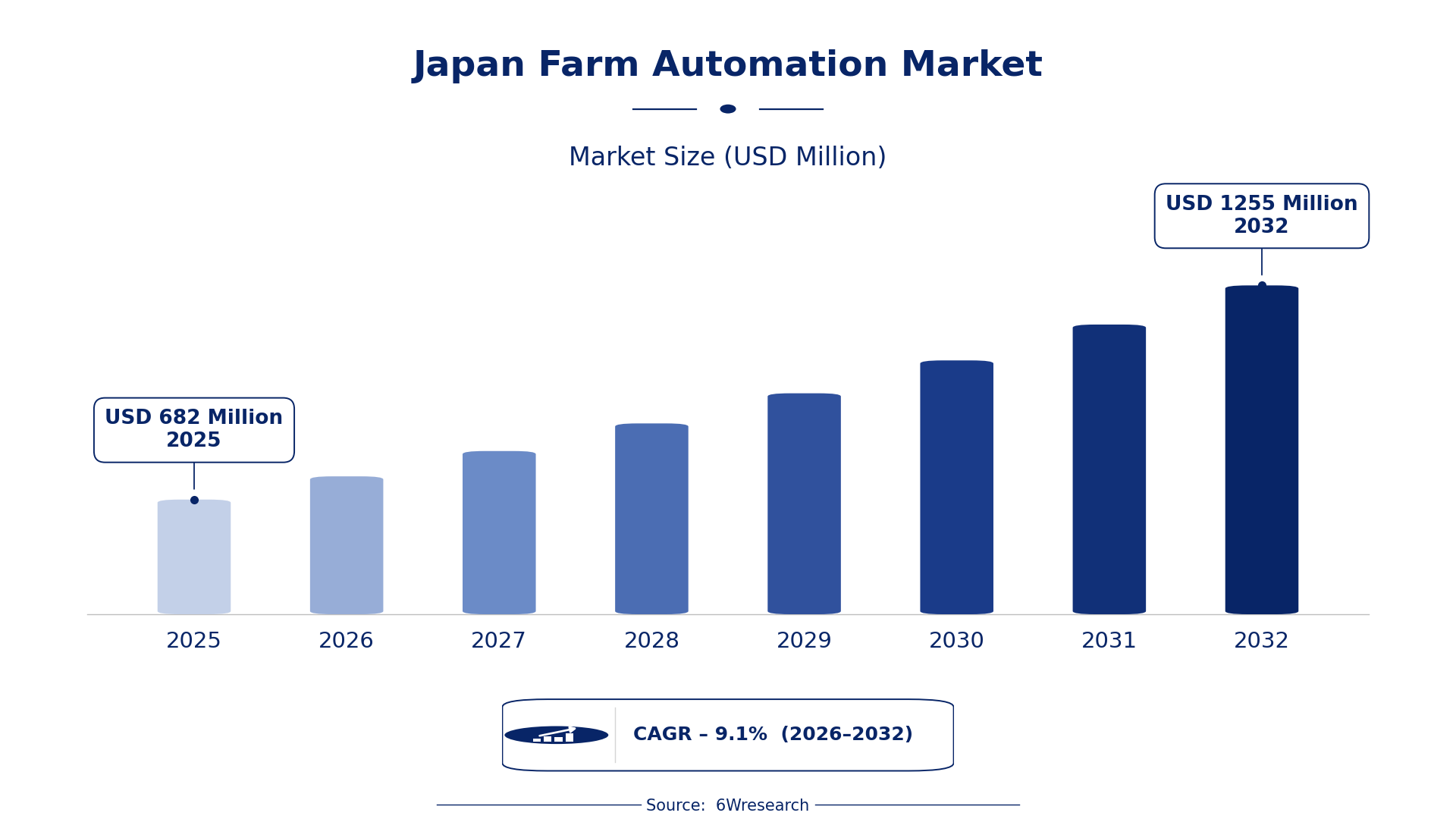
According to 6Wresearch internal database and industry insights, the Japan Farm Automation Market was valued at USD 682 Million in 2025 and is projected to reach USD 1,255 Million by 2032, growing at a CAGR of approximately 9.1% during 2026–2032.
Japan Farm Automation Market Highlights
| Report Metric | Details |
| Report Name | Japan Farm Automation Market (2026-2032) |
| Market Size 2025 | USD 682 Million |
| Market Size 2032 | USD 1,255 Million |
| Absolute Growth 2025–2032 | USD 573 Million |
| CAGR 2026–2032 | 9.1% |
| Peak Annual Growth | 9.7% in 2026 |
| Forecast Period | 2026–2032 |
| Historical Data | 2022–2025 |
| Base Year | 2025 |
| Leading Automation Type, 2025 | Robotic Harvesters (48% share) |
| Leading Application Area, 2025 | Water Management (52% share) |
| Leading Distribution Channel, 2025 | Agri Equipment Dealers (46% share) |
| Leading End User, 2025 | Large Farms (49% share) |
| Fastest-Growing Automation Type | Drone Monitoring (13.2% CAGR) |
| Fastest-Growing Application Area | Crop Health (10.8% CAGR) |
| Fastest-Growing Distribution Channel | Online Platforms (11.8% CAGR) |
| Fastest-Growing End User | Agri-Tech Firms (11.6% CAGR) |
| Growing Sector | Crop Health |
| Key End Users | Water Management, Crop Health, Fruit Picking, Tilling |
Japan Farm Automation Market Year-wise Growth Rate and Key Drivers (2022–2032)
This graph illustrates the annual growth rates of the market from 2022 to 2032, highlighting a steady upward trajectory and projected market expansion over the forecast period.
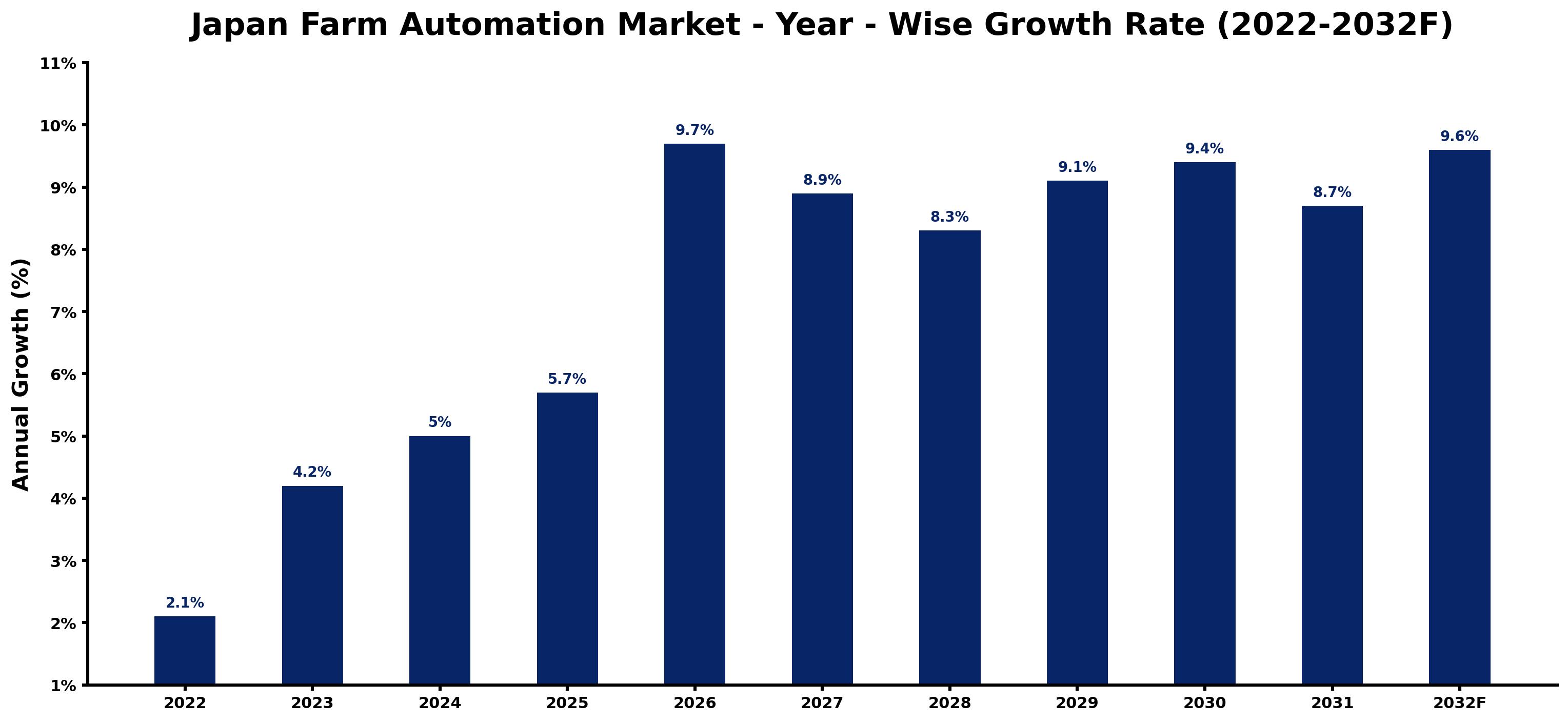
The table below sets out the estimated growth rate for each year and the main factor behind it.
| Year | Estimated Annual Growth (%) | Market Rationale |
| 2022 | 2.1 | The agricultural sector faced challenges in adapting to automation technologies. |
| 2023 | 4.2 | Increased awareness of efficiency benefits drove faster adoption of automation. |
| 2024 | 5.0 | Growing labour costs prompted a shift towards automated solutions in farming. |
| 2025 | 5.7 | The introduction of new smart farming subsidies spurred further investment in automation. |
| 2026 | 9.7 | Technological advancements in robotics and drones are expected to boost market growth. |
| 2027 | 8.9 | The market continues to expand, but at a slower pace due to saturation in some areas. |
| 2028 | 8.3 | Innovation in crop monitoring technologies will maintain steady growth in automation. |
| 2029 | 9.1 | Rising demand for precision agriculture tools will fuel a resurgence in market growth. |
| 2030 | 9.4 | The push for sustainability and efficiency will lead to increased automation adoption. |
| 2031 | 8.7 | Market growth slows as competition intensifies among automation providers. |
| 2032 | 9.6 | Demand for advanced automation technologies will rise as farms seek higher productivity. |
Note: Market size estimations and growth projections presented in this report are based on 6Wresearch's proprietary forecasting methodology, utilizing the latest available industry data, government publications, and primary research inputs.
Japan Farm Automation Market Synopsis
Farm automation involves using advanced technologies like robotics, drones, and smart systems to improve agricultural productivity. In 2022, the Japan Farm Automation Market was valued at approximately USD 682 million, driven by rising labour costs and government support for smart farming technologies. The Tohoku region is a notable area for automation adoption, while agri-tech firms are investing in solutions to meet sustainability goals.
Market Dynamics Impact Analysis (2026–2032)
| Factor | Type | Impact | Primary Segment Affected |
| Rising labour costs are pushing farmers to adopt automation technologies. | Driver | High | Robotic Harvesters |
| Increased investment in smart farming technologies is driving market expansion. | Driver | High | Drone Monitoring |
| The growing need for precision agriculture creates opportunities for automation. | Opportunity | High | Smart Irrigation |
| The push for sustainability in farming practices opens new avenues for investment. | Opportunity | High | Water Management |
| Limited access to advanced technologies restricts small farmers' growth potential. | Restraint | Medium | Small Farmers |
| High initial investment costs deter some farmers from automation adoption. | Restraint | Medium | Large Farms |
| Technological integration challenges can delay automation implementation. | Challenge | High | Agri-Tech Firms |
| Competition among providers may lead to price wars, affecting profitability. | Challenge | Medium | Commercial Growers |
Evaluation of Drivers in Japan Farm Automation Market (2026–2032)
The following drivers explain most of the expected growth.
| Drivers | Primary Segment Affected | Why It Matters (Evidence) |
| Increasing labour costs drive demand for automation solutions. | Robotic Harvesters | With Japan's national minimum wage rising to JPY 1,055 per hour, farmers seek cost-effective solutions. |
| Government subsidies for smart farming technologies encourage investment. | Drone Monitoring | The Ministry of Agriculture's subsidy program launched in 2023 promotes technology adoption. |
| Technological advancements improve the efficiency of agricultural processes. | Smart Irrigation | Innovations in irrigation systems lead to better water management and reduced waste. |
| Growing consumer demand for sustainable farming practices boosts automation adoption. | Water Management | Japan's target to reduce water usage in agriculture by 25% by 2030 drives investment. |
| Rising crop yields from automation attract larger investments in agriculture. | Autonomous Tractors | The Japanese government aims for a 30% increase in farm productivity by 2030. |
Much of the new demand traces back to rising labour costs, prompting farmers to seek automation solutions. The national minimum wage increase has pushed many towards robotic harvesters for cost efficiency. Innovations in smart irrigation technologies improve water management, aligning with Japan's goal to reduce agricultural water usage by 25% by 2030.
Evaluation of Restraints in Japan Farm Automation Market
Below are the constraints most often cited by buyers and suppliers, with the segment each affects.
| Market Restraint | Primary Segment Affected | Why It Matters (Evidence) |
| High input costs limit adoption of advanced technologies. | Robotic Harvesters | Rising minimum wages increase operational costs, affecting profitability for farmers. |
| Skills shortages hinder effective automation implementation. | Drone Monitoring | Many agricultural workers lack training in advanced technologies, delaying adoption. |
| Substantial costs for implementing smart farming technologies strain budgets. | Smart Irrigation | Agri-tech firms are expected to invest over 500 million yen in automation in 2024. |
| Supply chain disruptions create uneven access to technology. | Water Management | The Tohoku region leads in automation adoption, affecting other areas. |
| Limited awareness of automation benefits slows market growth. | Autonomous Tractors | Some farmers remain hesitant to invest in new technologies. |
Japan Farm Automation Market Challenges
In the Tohoku region, uneven access to automation technology raises operational costs for farmers, limiting their competitiveness in the market. Skills shortages in the agricultural workforce, which employs about 1.5 million people, hinder producers from effectively adopting advanced technologies, delaying productivity improvements. Implementing smart farming technologies incurs high expenses, with agri-tech firms expected to invest over 500 million yen in automation in 2024, straining financial resources for smaller growers. Supply chain disruptions also affect timely delivery of agricultural machinery, causing delays that impact harvest schedules for producers across Japan.
Trends in the Japan Farm Automation Market
The trends below show where the Japan Farm Automation Market is heading.
- Shift Towards Smart Irrigation Systems: In 2021, the Smart Agriculture Promotion Strategy encouraged the adoption of smart irrigation systems. Chiba Prefecture has become a leader in this area, with a target to reduce water usage by 25% by 2030.
- Rise of Drone Technology for Crop Monitoring: Since 2023, drone technology for crop monitoring has seen a surge, with over 10,000 units in use. This trend improves data collection and precision agriculture practices across Japan.
- Increasing Use of Robotic Harvesters: Robotic harvesters have gained traction in Yamagata Prefecture, where efficiency in fruit harvesting has improved. The adoption rate is expected to rise significantly by 2025.
- Expansion of Online Platforms for Agricultural Equipment: Online platforms for agricultural equipment sales have experienced a 20% increase in transactions in 2023. This shift reflects changing buying behaviours among farmers seeking convenience.
Investment Opportunities in the Japan Farm Automation Market
The following opportunities in the Japan Farm Automation Market pair current demand with a clear way in.
- Investment in Smart Farming Technologies: The Tohoku region presents opportunities for investment in smart farming technologies, with a growing need for automation solutions. Agri-tech firms can enter through local partnerships to address this need.
- Expansion of Drone Monitoring Services: The demand for precision agriculture tools creates opportunities for drone monitoring services. Agri-tech firms can establish joint ventures to supply these technologies effectively.
- Development of Robotic Harvesters: The increasing use of robotic harvesters in Yamagata Prefecture offers investment opportunities for manufacturers. Collaborating with local agricultural firms can facilitate market entry.
- Improvement of Water Management Solutions: With Japan's target to reduce agricultural water usage by 25% by 2030, there is a need for advanced water management solutions. Suppliers can engage with commercial growers to provide these technologies.
Government Initiatives in the Japan Farm Automation Market
The New Robot Strategy, introduced in 2015, aimed to expand robot use across various sectors, including agriculture. This initiative has led to increased funding for research and development in automation technologies, promoting innovation in the agricultural sector. The Green Growth Strategy, updated in 2021, identifies agriculture as a key sector for investment in sustainable practices, targeting substantial public and private funding.
Commercial growers benefit from the Ministry of Agriculture's subsidy program for smart farming technologies, launched in 2023. This program provides financial support for adopting advanced technologies, facilitating the transition to more efficient farming practices. The Agricultural and Food Research Organization also plays a role in funding automation research, supporting projects that improve productivity and sustainability in agriculture.
Future Insight of the Japan Farm Automation Market
Drone technology will revolutionise monitoring practices, with over 10,000 units in use in 2023, streamlining data collection for farmers. By 2032, increased investment in automation will lead to greater efficiency in agricultural operations, benefiting both buyers and suppliers. The government aims for a 30% increase in farm productivity by 2030 through automation initiatives, driving demand for advanced technologies. As smart irrigation systems gain traction in Chiba Prefecture, water conservation practices will improve, setting new standards for sustainable agriculture.
Market Segmentation Analysis
Japan Farm Automation Market report covers a detailed analysis of the following market segments:
By Automation Type – Robotic Harvesters Lead, Drone Monitoring Expected to Grow Fastest
According to Saurav Kr Singh, Senior Research Analyst at 6Wresearch, with 48% of automation type revenue in 2025, Robotic Harvesters was the largest category. Robotic harvesters lead this segment due to their effectiveness in automating labor-intensive harvesting tasks, which is vital for large-scale agricultural operations. Their prevalent use in regions such as Yamagata Prefecture underscores their critical role in boosting productivity. Drone Monitoring is set to record the highest CAGR in this split, 13.2% over 2026–2032. The rapid growth of drone monitoring is attributed to its increasing role in precision agriculture and crop health assessment, highlighted by a 15% rise in drone usage in 2023. This trend reflects a shift towards data-driven farming practices that can enhance crop yields. Suppliers should focus on developing advanced drone technologies to meet the rising demand for precision agriculture.
By Application Area – Water Management Leads, Crop Health Expected to Grow Fastest
Water Management accounted for 52% of the market by application area in 2025. Water management is the leading application area as smart systems are crucial for optimising water use in Japan's agriculture, particularly in light of the government's target for a 25% reduction in water usage by 2030. This focus on efficiency makes it a priority for farmers. Over 2026–2032, Crop Health is expected to post the fastest growth, at a CAGR of 10.8%. The crop health application is experiencing rapid growth, driven by the necessity of monitoring technologies for assessing crop conditions, which aligns with a greater emphasis on sustainability and productivity. Increased investments in smart farming technologies by agri-tech firms further highlight this trend. Buyers should invest in advanced crop health monitoring solutions to enhance agricultural productivity.
By Distribution Channel – Agri Equipment Dealers Lead, Online Platforms Expected to Grow Fastest
In 2025, Agri Equipment Dealers led the distribution channel split with a 46% share. Agri equipment dealers dominate the distribution channel as they provide essential equipment to farmers, ensuring access to the latest technologies. Their established relationships with farmers facilitate the adoption of advanced agricultural solutions. Online Platforms are projected to grow fastest, at a CAGR of 11.8% during 2026–2032. Online platforms are growing the fastest as they serve as a marketplace for agricultural products, evidenced by a 20% increase in transactions in 2023. This shift towards digital sales channels indicates evolving purchasing behaviours among farmers. Suppliers need to enhance their online presence to capture the growing market for digital agricultural equipment sales.
By End User – Large Farms Lead, Agri-Tech Firms Expected to Grow Fastest
Large Farms took 49% of end user revenue in 2025, more than any other category. Large farms represent the largest segment of end users, being the primary adopters of automation technologies that improve efficiency and output. Their scale allows for substantial investments in advanced agricultural solutions. The quickest growth will come from Agri-Tech Firms, forecast to expand at a CAGR of 11.6% between 2026 and 2032. Agri-tech firms are the fastest-growing end user group, driving innovation in farm automation with projected investments exceeding 500 million yen in 2024. Their focus on developing new technologies is reshaping the agricultural sector. Suppliers should align their products with the requirements of agri-tech firms to capitalise on emerging opportunities in farm automation.
Key Attractiveness of the Report
- 10 Years of Market Numbers
- Historical Data Starting from 2022 to 2025
- Base Year 2025
- Forecast Data until 2032
- Key Performance Indicators Impacting the Market
- Major Upcoming Developments and Projects
Key Highlights of the Report:
- Japan Farm Automation Market Outlook
- Market Size of Japan Farm Automation Market, 2025
- Forecast of Japan Farm Automation Market, 2032
- Historical Data and Forecast of Japan Farm Automation Revenues & Volume for the Period 2022-2032F
- Japan Farm Automation Market Trend Evolution
- Japan Farm Automation Market Drivers and Challenges
- Japan Farm Automation Price Trends
- Japan Farm Automation Porter's Five Forces
- Japan Farm Automation Industry Life Cycle
- Historical Data and Forecast of Japan Farm Automation Market Revenues & Volume By Automation Type for the Period 2022-2032F
- Historical Data and Forecast of Japan Farm Automation Market Revenues & Volume By Autonomous Tractors for the Period 2022-2032F
- Historical Data and Forecast of Japan Farm Automation Market Revenues & Volume By Robotic Harvesters for the Period 2022-2032F
- Historical Data and Forecast of Japan Farm Automation Market Revenues & Volume By Drone Monitoring for the Period 2022-2032F
- Historical Data and Forecast of Japan Farm Automation Market Revenues & Volume By Smart Irrigation for the Period 2022-2032F
- Historical Data and Forecast of Japan Farm Automation Market Revenues & Volume By Application Area for the Period 2022-2032F
- Historical Data and Forecast of Japan Farm Automation Market Revenues & Volume By Tilling for the Period 2022-2032F
- Historical Data and Forecast of Japan Farm Automation Market Revenues & Volume By Fruit Picking for the Period 2022-2032F
- Historical Data and Forecast of Japan Farm Automation Market Revenues & Volume By Crop Health for the Period 2022-2032F
- Historical Data and Forecast of Japan Farm Automation Market Revenues & Volume By Water Management for the Period 2022-2032F
- Historical Data and Forecast of Japan Farm Automation Market Revenues & Volume By Distribution Channel for the Period 2022-2032F
- Historical Data and Forecast of Japan Farm Automation Market Revenues & Volume By Agri Equipment Dealers for the Period 2022-2032F
- Historical Data and Forecast of Japan Farm Automation Market Revenues & Volume By OEMs for the Period 2022-2032F
- Historical Data and Forecast of Japan Farm Automation Market Revenues & Volume By Online Platforms for the Period 2022-2032F
- Historical Data and Forecast of Japan Farm Automation Market Revenues & Volume By Agri Consultants for the Period 2022-2032F
- Historical Data and Forecast of Japan Farm Automation Market Revenues & Volume By End User for the Period 2022-2032F
- Historical Data and Forecast of Japan Farm Automation Market Revenues & Volume By Large Farms for the Period 2022-2032F
- Historical Data and Forecast of Japan Farm Automation Market Revenues & Volume By Agri-Tech Firms for the Period 2022-2032F
- Historical Data and Forecast of Japan Farm Automation Market Revenues & Volume By Commercial Growers for the Period 2022-2032F
- Historical Data and Forecast of Japan Farm Automation Market Revenues & Volume By Small Farmers for the Period 2022-2032F
- Japan Farm Automation Import Export Trade Statistics
- Market Opportunity Assessment By Automation Type
- Market Opportunity Assessment By Application Area
- Market Opportunity Assessment By Distribution Channel
- Market Opportunity Assessment By End User
- Japan Farm Automation Top Companies Market Share
- Japan Farm Automation Competitive Benchmarking By Technical and Operational Parameters
- Japan Farm Automation Company Profiles
- Japan Farm Automation Key Strategic Recommendations
Market Covered
The report covers the following segments.
By Automation Type
- Autonomous Tractors
- Robotic Harvesters
- Drone Monitoring
- Smart Irrigation
By Application Area
- Tilling
- Fruit Picking
- Crop Health
- Water Management
By Distribution Channel
- Agri Equipment Dealers
- OEMs
- Online Platforms
- Agri Consultants
By End User
- Large Farms
- Agri-Tech Firms
- Commercial Growers
- Small Farmers































