Japan Farm Implements Market Size & Growth Rate
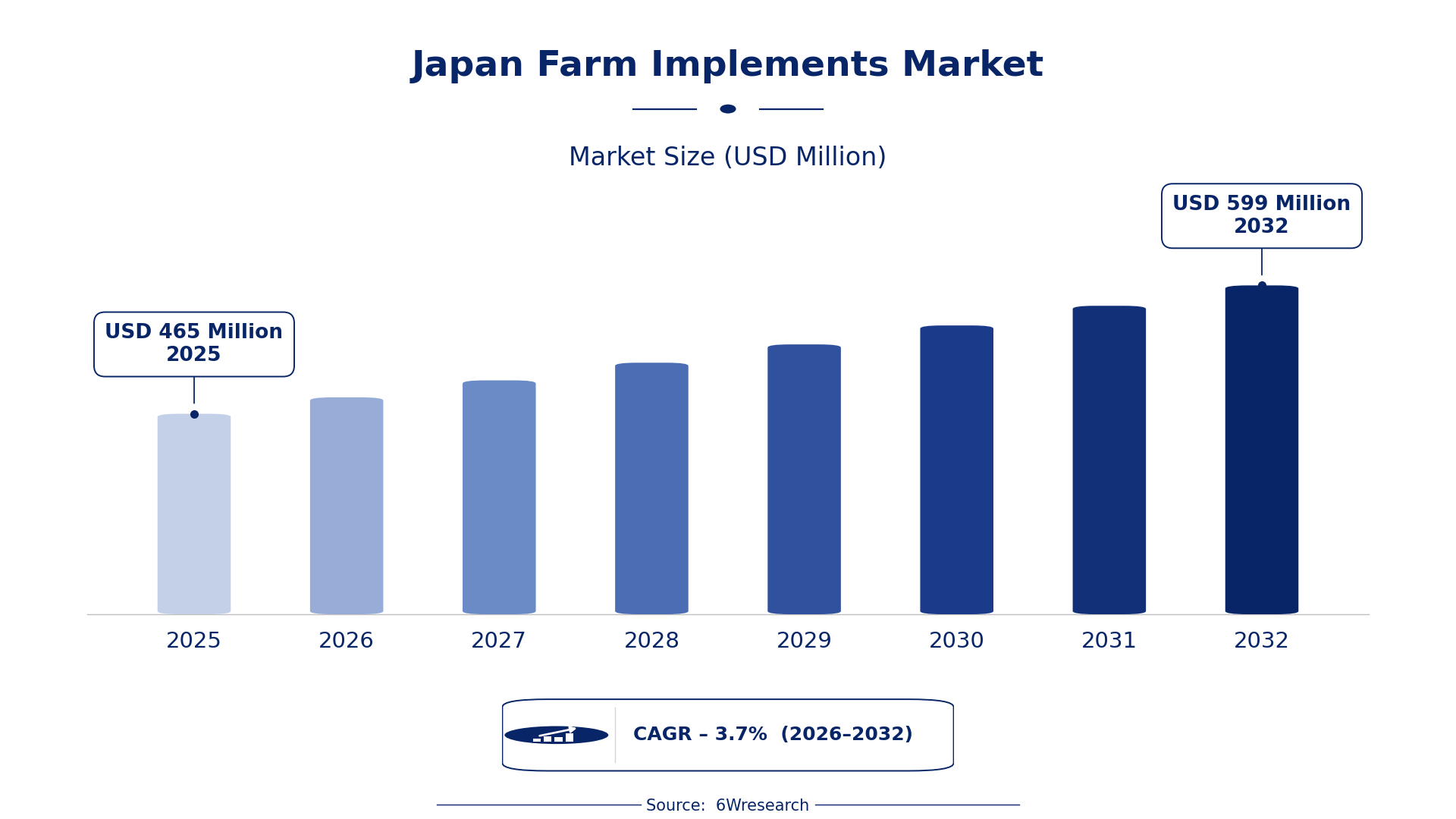
According to 6Wresearch internal database and industry insights, the Japan Farm Implements Market was valued at USD 465 Million in 2025 and is projected to reach USD 599 Million by 2032, growing at a CAGR of approximately 3.7% during 2026–2032.
Japan Farm Implements Market Highlights
| Report Metric | Details |
| Report Name | Japan Farm Implements Market (2026-2032) |
| Market Size 2025 | USD 465 Million |
| Market Size 2032 | USD 599 Million |
| Absolute Growth 2025–2032 | USD 134 Million |
| CAGR 2026–2032 | 3.7% |
| Peak Annual Growth | 4.3% in 2026 |
| Forecast Period | 2026–2032 |
| Historical Data | 2022–2025 |
| Base Year | 2025 |
| Leading Implement Type, 2025 | Plows (46% share) |
| Leading Operation Type, 2025 | Tillage (52% share) |
| Leading Distribution Channel, 2025 | Equipment Distributors (38% share) |
| Leading End User, 2025 | Crop Farmers (35% share) |
| Fastest-Growing Implement Type | Harrows (5.2% CAGR) |
| Fastest-Growing Operation Type | Soil Preparation (5.7% CAGR) |
| Fastest-Growing Distribution Channel | Rural Retailers (4.9% CAGR) |
| Fastest-Growing End User | Agri Firms (4.8% CAGR) |
| Growing Sector | Agriculture |
| Key End Users | Crop Farmers, Agricultural Firms, Contract Growers, Smallholders |
Japan Farm Implements Market Year-wise Growth Rate and Key Drivers (2022–2032)
This graph illustrates the annual growth rates of the market from 2022 to 2032, highlighting a steady upward trajectory and projected market expansion over the forecast period.
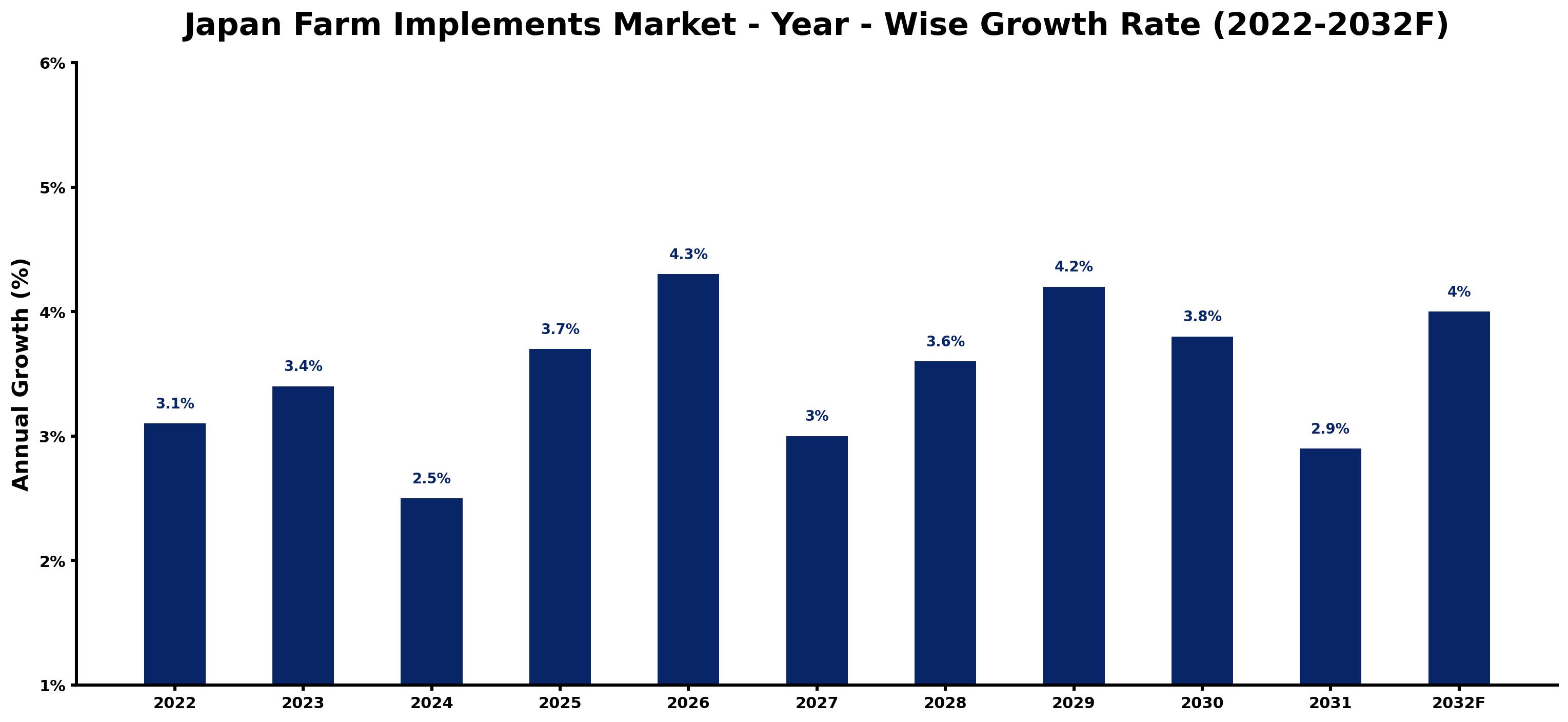
The yearly estimates that follow link every growth rate to its principal driver, so readers can see why the pace changed in each period.
| Year | Estimated Annual Growth (%) | Market Rationale |
| 2022 | 3.1 | The agricultural sector employed approximately 1.5 million people, driving demand for farm implements. |
| 2023 | 3.4 | Increased focus on sustainable farming practices boosted the need for modern agricultural tools. |
| 2024 | 2.5 | Growth slowed as market saturation began to affect new purchases of implements. |
| 2025 | 3.7 | The introduction of new farming technologies led to increased demand for advanced implements. |
| 2026 | 4.3 | A government programme supporting smallholder farmers is expected to spur investment in farm tools. |
| 2027 | 3.0 | Market growth is projected to slow as buyers become more selective in their purchases. |
| 2028 | 3.6 | Rising productivity goals will prompt farmers to invest in more efficient implements. |
| 2029 | 4.2 | Increased rice production in regions like Tohoku is expected to drive demand for tillage equipment. |
| 2030 | 3.8 | A focus on quality standards will lead to a slowdown in demand for lower-tier implements. |
| 2031 | 2.9 | The market is projected to continue growing slowly as buyers adjust to new regulations. |
| 2032 | 4.0 | Technological advancements in farming tools are expected to drive renewed interest in purchases. |
Note: Market size estimations and growth projections presented in this report are based on 6Wresearch's proprietary forecasting methodology, utilizing the latest available industry data, government publications, and primary research inputs.
Japan Farm Implements Market Synopsis
Farm implements are essential tools in agriculture, crafted from durable materials for efficiency in soil preparation, planting, and crop management. The Japan Farm Implements Market is expanding due to rising domestic crop production and government initiatives promoting sustainable practices. With over 4 million hectares of arable land and a workforce of approximately 1.5 million in agriculture, demand is driven by crop farmers and agricultural firms seeking modern solutions to improve productivity and efficiency. In 2023, a government programme was launched to support smallholder farmers with modern implements, further enhancing market growth.
Market Dynamics Impact Analysis (2026–2032)
| Factor | Type | Impact | Primary Segment Affected |
| Investment in modern farming technologies is increasing demand for efficient implements. | Driver | High | Tillage |
| Growing focus on sustainable farming practices creates opportunities for innovative implements. | Opportunity | High | Soil Preparation |
| Limited availability of skilled labour can hinder the adoption of advanced implements. | Restraint | Medium | Seed Drills |
| High initial costs of advanced farm implements may deter smallholder farmers from purchasing. | Restraint | High | Cultivators |
| Technological advancements in farm implements are creating new market opportunities. | Driver | High | Harrows |
| Increasing online sales channels are opening up new distribution opportunities for farm implements. | Opportunity | Medium | Equipment Distributors |
| Regulatory compliance costs can burden producers and affect pricing strategies. | Challenge | Medium | Weed Control |
| Competition from imported implements may pressure local manufacturers to innovate. | Challenge | High | Sowing |
Evaluation of Drivers in Japan Farm Implements Market (2026–2032)
The main growth drivers and the segments they affect most are set out below.
| Drivers | Primary Segment Affected | Why It Matters (Evidence) |
| Investment in advanced tillage equipment is rising as farmers seek efficiency. | Tillage | In 2023, the government launched a programme to support smallholder farmers with modern implements. |
| Growing demand for sustainable farming practices is increasing the need for efficient implements. | Soil Preparation | The Ministry of Agriculture, Forestry and Fisheries promotes sustainable farming practices. |
| Technological advancements in seed drills are improving planting efficiency. | Seed Drills | Seed drills used extensively in Hokkaido improve planting efficiency. |
| Increased rice production in regions like Tohoku drives demand for tillage equipment. | Cultivators | Japan produced over 7 million tons of rice in 2022, necessitating extensive tillage. |
| Rising online sales are expanding market access for farm implements. | Equipment Distributors | Online sales of farm implements increased by 15% in the last year. |
The promotion of sustainable practices leads to increased demand for efficient implements. Technological advancements in seed drills improve planting efficiency, particularly in regions like Hokkaido. In 2022, Japan produced over 7 million tons of rice, necessitating extensive tillage, which boosts demand for cultivators. The increase in online sales channels has expanded market access, with a 15% rise in online sales last year.
Evaluation of Restraints in Japan Farm Implements Market
Several factors work against faster growth; the main ones are summarised below.
| Market Restraint | Primary Segment Affected | Why It Matters (Evidence) |
| Limited availability of skilled labour can hinder the adoption of advanced implements. | Seed Drills | The average size of a farm in Japan is about 1.5 hectares, limiting labour availability. |
| High initial costs of advanced farm implements may deter smallholder farmers from purchasing. | Cultivators | Smallholders often struggle with financing the latest technologies due to budget constraints. |
| Regulatory compliance costs can burden producers and affect pricing strategies. | Weed Control | Compliance with JIS standards increases production costs for manufacturers. |
| Market saturation in certain regions may slow new purchases of implements. | Tillage | In some areas, farmers have already adopted modern implements, limiting further growth. |
| Competition from imported implements may pressure local manufacturers to innovate. | Sowing | Imported implements often offer lower prices, challenging local pricing strategies. |
Japan Farm Implements Market Challenges
Buyers encounter high costs due to limited access to modern farm implements, which can elevate operational expenses by 30% compared to traditional tools. Technology adoption is slow in rural areas, causing delays in planting and harvesting for farmers. Natural disasters in the Tohoku region disrupt supply chains, leading to delays in acquiring essential implements, which impacts timely crop management. The average farm size of 1.5 hectares limits economies of scale, compelling smallholders to incur higher input costs and diminishing their overall profitability.
Trends in the Japan Farm Implements Market
The following changes are redrawing the Japan Farm Implements Market.
- Shift Towards Online Sales Channels: Online sales of farm implements increased by 15% last year, reflecting a shift in purchasing behaviour. This trend allows buyers to access a wider range of products and compare prices more easily.
- Transition from Traditional to Modern Farming Techniques: In 2023, the government launched a programme to support smallholder farmers with modern implements. This shift is expected to improve productivity and efficiency across the agricultural sector.
- Emergence of Sustainable Farming Practices: Sustainable farming practices are becoming increasingly important, supported by government initiatives. The Ministry of Agriculture, Forestry and Fisheries promotes these practices to improve environmental outcomes in agriculture.
- Increase in Technological Integration: The integration of technology in farm implements is on the rise, with new innovations improving efficiency. For instance, advanced seed drills are being adopted to improve planting accuracy.
Investment Opportunities in the Japan Farm Implements Market
The openings below show where demand in the Japan Farm Implements Market is visible and how suppliers can enter.
- Investment in Rural Retailers: Rural retailers are expanding their offerings, with a focus on modern implements. The government aims to increase agricultural productivity by 20% by 2025, creating a gap for investment in these retailers.
- Support for Smallholder Farmers: In 2023, the government launched a programme to support smallholder farmers with modern implements. This initiative presents an opportunity for suppliers to partner with local agricultural firms.
- Expansion of Online Sales Platforms: Online sales channels are growing rapidly, presenting opportunities for suppliers to reach broader markets. The 15% increase in online sales last year indicates strong demand for digital purchasing options.
- Development of New Farming Technologies: Investment in new farming technologies is important for meeting rising productivity goals. Collaborating with agricultural firms can help suppliers tap into this growing demand.
Government Initiatives in the Japan Farm Implements Market
The 2023 programme supporting smallholder farmers builds on previous measures by providing access to modern farm implements, which are key for improving productivity. This initiative complements the Ministry of Agriculture, Forestry and Fisheries' efforts to promote sustainable farming practices and aligns with the Waste Management and Public Cleansing Act of 1970, which governs agricultural waste management. Together, these measures aim to modernise Japan's agricultural sector and enhance the efficiency of farm operations.
In 2022, the government allocated USD 50 million to promote agricultural innovation through the Agricultural Machinery Association of Japan, which oversees the implementation of new technologies. The Digital Agency, established in September 2021, plays a crucial role in ensuring that digital transformation standards are met, facilitating the integration of modern technology in farm implements, and improving the overall efficiency of agricultural practices.
Future Insight of the Japan Farm Implements Market
Advancements in precision agriculture technology will transform demand for farm implements by 2032, improving operational efficiency. Government support programmes for smallholder farmers will encourage the adoption of modern tools, particularly in rice farming, which produced over 7 million tons in 2022. JIS standards will evolve to include smart technology, ensuring enhanced quality in agricultural machinery. The goal to increase agricultural productivity by 20% by 2025 will drive further innovation and investment in advanced farming solutions.
Market Segmentation Analysis
Japan Farm Implements Market report covers a detailed analysis of the following market segments:
By Implement Type – Plows Lead, Harrows Expected to Grow Fastest
According to Saurav Kr Singh, Senior Research Analyst at 6Wresearch, the largest implement type category in 2025 was Plows, at 46% of revenue. Plows hold the largest share in the market because they are essential for soil preparation, which directly impacts crop yields. Their widespread use in the Tohoku region for rice farming illustrates their critical role in local agricultural practices. Harrows are projected to grow fastest, at a CAGR of 5.2% during 2026–2032. Harrows are experiencing rapid growth as they become increasingly popular for soil cultivation, reflecting a shift towards more efficient land management. The government's programme to support smallholder farmers has also contributed to the rising demand for harrows, ensuring their continued expansion. This means suppliers should focus on enhancing their offerings in harrows to meet the growing market demand.
By Operation Type – Tillage Leads, Soil Preparation Expected to Grow Fastest
Tillage accounted for 52% of the market by operation type in 2025. Tillage dominates the market as it is fundamental for effective soil management, ensuring optimal conditions for crop growth. The agricultural practices in Japan, especially in rice production, heavily rely on tillage techniques. The quickest growth will come from Soil Preparation, forecast to expand at a CAGR of 5.7% between 2026 and 2032. Soil Preparation is the fastest-growing segment, spurred by the increasing emphasis on improving crop growth conditions. The government's goal to boost agricultural productivity by 20% by 2025 is likely to further accelerate this trend. Suppliers must adapt to the rising importance of soil preparation techniques to align with market demands.
By Distribution Channel – Equipment Distributors Lead, Rural Retailers Expected to Grow Fastest
Equipment Distributors held 38% of the Japan Farm Implements Market by distribution channel in 2025. Equipment Distributors dominate the market as they are vital for providing access to a wide range of farm implements throughout Japan. Their established networks facilitate effective distribution, catering to the diverse needs of various farming operations. Over 2026–2032, Rural Retailers are expected to post the fastest growth, at a CAGR of 4.9%. Rural Retailers are witnessing the fastest growth due to their essential role in local sales and direct engagement with farmers. The 15% increase in online sales last year indicates a shift towards more accessible purchasing options for rural customers, further boosting their importance. This trend suggests that suppliers should strengthen collaborations with rural retailers to enhance their market presence.
By End User – Crop Farmers Lead, Agri Firms Expected to Grow Fastest
With 35% of end user revenue in 2025, Crop Farmers was the largest category. Crop Farmers represent the largest user group as they are the primary consumers of farm implements necessary for their agricultural practices. With around 1.5 million people working in Japan's agricultural sector, crop farmers form a substantial market segment. Agri Firms are set to record the highest CAGR in this split, 4.8% over 2026–2032. Agri Firms are the fastest-growing user segment, increasingly utilising advanced farm implements to improve production efficiency. This growth is bolstered by government initiatives aimed at modernising agricultural practices, which further drives demand for these implements. Suppliers should prioritise engagement with agri firms to capitalise on their rising need for modern agricultural solutions.
Key Attractiveness of the Report
- 10 Years of Market Numbers
- Historical Data Starting from 2022 to 2025
- Base Year 2025
- Forecast Data until 2032
- Key Performance Indicators Impacting the Market
- Major Upcoming Developments and Projects
Key Highlights of the Report:
- Japan Farm Implements Market Outlook
- Market Size of Japan Farm Implements Market, 2025
- Forecast of Japan Farm Implements Market, 2032
- Historical Data and Forecast of Japan Farm Implements Revenues & Volume for the Period 2022-2032F
- Japan Farm Implements Market Trend Evolution
- Japan Farm Implements Market Drivers and Challenges
- Japan Farm Implements Price Trends
- Japan Farm Implements Porter's Five Forces
- Japan Farm Implements Industry Life Cycle
- Historical Data and Forecast of Japan Farm Implements Market Revenues & Volume By Implement Type for the Period 2022-2032F
- Historical Data and Forecast of Japan Farm Implements Market Revenues & Volume By Plows for the Period 2022-2032F
- Historical Data and Forecast of Japan Farm Implements Market Revenues & Volume By Harrows for the Period 2022-2032F
- Historical Data and Forecast of Japan Farm Implements Market Revenues & Volume By Seed Drills for the Period 2022-2032F
- Historical Data and Forecast of Japan Farm Implements Market Revenues & Volume By Cultivators for the Period 2022-2032F
- Historical Data and Forecast of Japan Farm Implements Market Revenues & Volume By Operation Type for the Period 2022-2032F
- Historical Data and Forecast of Japan Farm Implements Market Revenues & Volume By Tillage for the Period 2022-2032F
- Historical Data and Forecast of Japan Farm Implements Market Revenues & Volume By Soil Preparation for the Period 2022-2032F
- Historical Data and Forecast of Japan Farm Implements Market Revenues & Volume By Sowing for the Period 2022-2032F
- Historical Data and Forecast of Japan Farm Implements Market Revenues & Volume By Weed Control for the Period 2022-2032F
- Historical Data and Forecast of Japan Farm Implements Market Revenues & Volume By Distribution Channel for the Period 2022-2032F
- Historical Data and Forecast of Japan Farm Implements Market Revenues & Volume By Equipment Distributors for the Period 2022-2032F
- Historical Data and Forecast of Japan Farm Implements Market Revenues & Volume By Rural Retailers for the Period 2022-2032F
- Historical Data and Forecast of Japan Farm Implements Market Revenues & Volume By Dealer Networks for the Period 2022-2032F
- Historical Data and Forecast of Japan Farm Implements Market Revenues & Volume By Online Vendors for the Period 2022-2032F
- Historical Data and Forecast of Japan Farm Implements Market Revenues & Volume By End User for the Period 2022-2032F
- Historical Data and Forecast of Japan Farm Implements Market Revenues & Volume By Crop Farmers for the Period 2022-2032F
- Historical Data and Forecast of Japan Farm Implements Market Revenues & Volume By Agri Firms for the Period 2022-2032F
- Historical Data and Forecast of Japan Farm Implements Market Revenues & Volume By Contract Growers for the Period 2022-2032F
- Historical Data and Forecast of Japan Farm Implements Market Revenues & Volume By Smallholders for the Period 2022-2032F
- Japan Farm Implements Import Export Trade Statistics
- Market Opportunity Assessment By Implement Type
- Market Opportunity Assessment By Operation Type
- Market Opportunity Assessment By Distribution Channel
- Market Opportunity Assessment By End User
- Japan Farm Implements Top Companies Market Share
- Japan Farm Implements Competitive Benchmarking By Technical and Operational Parameters
- Japan Farm Implements Company Profiles
- Japan Farm Implements Key Strategic Recommendations
Market Covered
The study includes the following segmentation.
By Implement Type
- Plows
- Harrows
- Seed Drills
- Cultivators
By Operation Type
- Tillage
- Soil Preparation
- Sowing
- Weed Control
By Distribution Channel
- Equipment Distributors
- Rural Retailers
- Dealer Networks
- Online Vendors
By End User
- Crop Farmers
- Agri Firms
- Contract Growers
- Smallholders






































