Japan Farm-to-Fork Supply Chain Market Size & Growth Rate
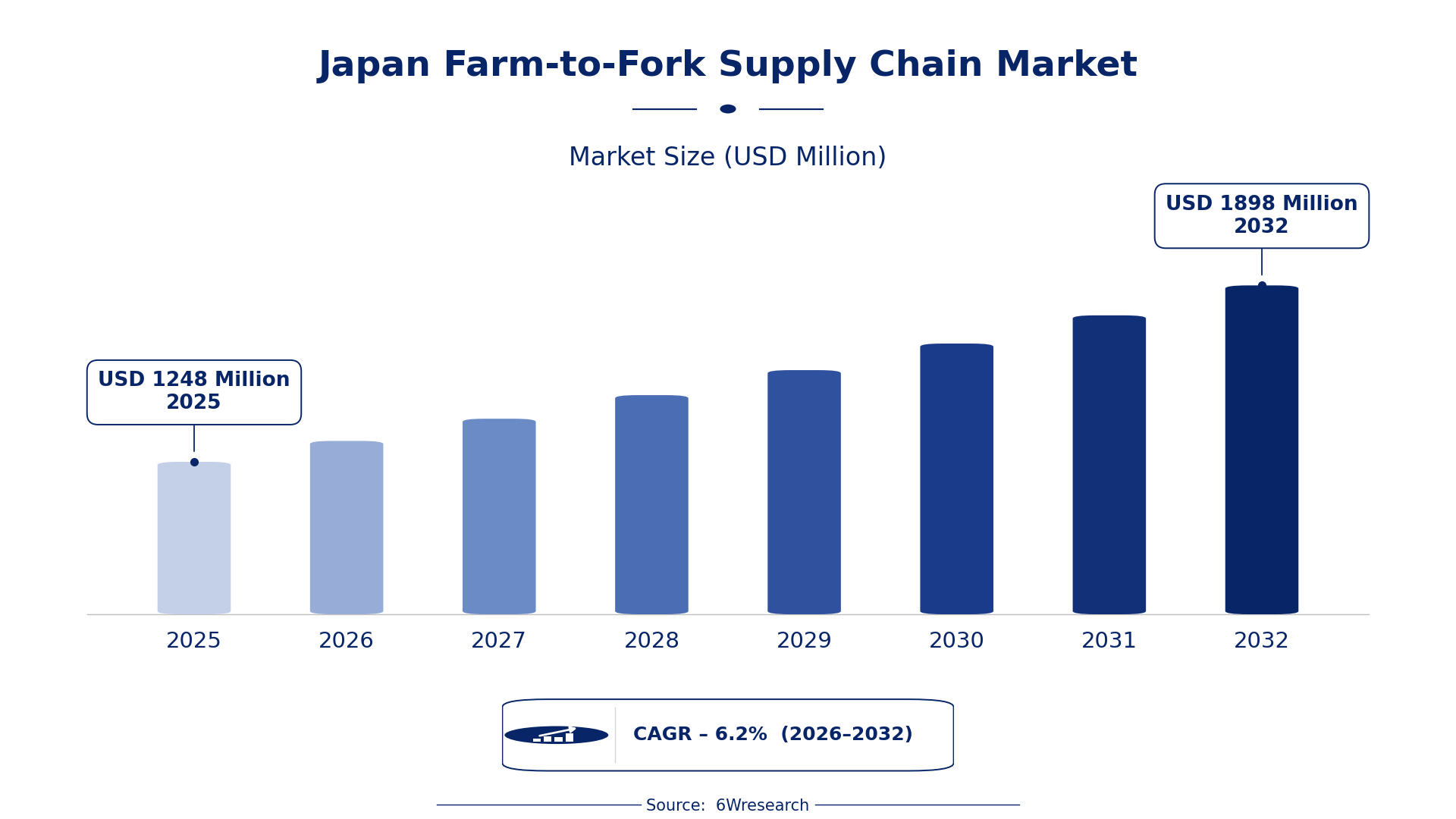
According to 6Wresearch internal database and industry insights, the Japan Farm-to-Fork Supply Chain Market was valued at USD 1,248 Million in 2025 and is projected to reach USD 1,898 Million by 2032, growing at a CAGR of approximately 6.2% during 2026–2032.
Japan Farm-to-Fork Supply Chain Market Highlights
| Report Metric | Details |
| Report Name | Japan Farm-to-Fork Supply Chain Market (2026-2032) |
| Market Size 2025 | USD 1,248 Million |
| Market Size 2032 | USD 1,898 Million |
| Absolute Growth 2025–2032 | USD 650 Million |
| CAGR 2026–2032 | 6.2% |
| Peak Annual Growth | 7.0% in 2028 |
| Forecast Period | 2026–2032 |
| Historical Data | 2022–2025 |
| Base Year | 2025 |
| Leading Chain Segment, 2025 | Processing (49% share) |
| Leading Technology Used, 2025 | Cold Chain Logistics (41% share) |
| Leading Distribution Channel, 2025 | Retail Chains (38% share) |
| Leading End User, 2025 | Supermarkets (41% share) |
| Fastest-Growing Technology Used | IoT Sensors (9.3% CAGR) |
| Fastest-Growing Distribution Channel | Online Grocery Apps (8.2% CAGR) |
| Fastest-Growing End User | Agro-Processors (7.9% CAGR) |
| Growing Sector | Agro-Processors |
| Key End Users | Supermarkets, Agro-Processors, Farmers, End Consumers |
Japan Farm-to-Fork Supply Chain Market Year-wise Growth Rate and Key Drivers (2022–2032)
This graph illustrates the annual growth rates of the market from 2022 to 2032, highlighting a steady upward trajectory and projected market expansion over the forecast period.
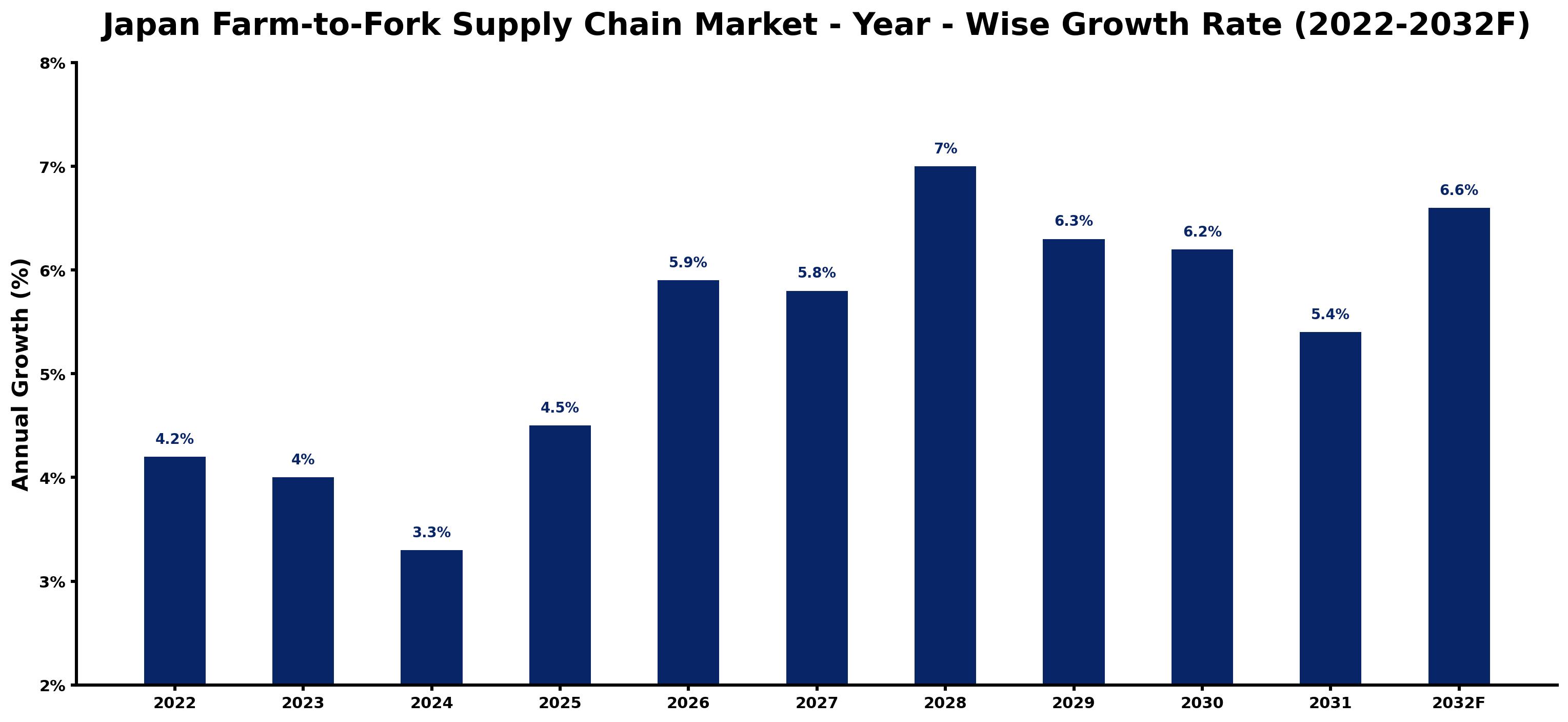
Each row of the following table gives one year's estimated growth and the event or demand shift that explains it.
| Year | Estimated Annual Growth (%) | Market Rationale |
| 2022 | 4.2 | The market experienced stable growth driven by strong domestic demand. |
| 2023 | 4.0 | Growth slowed due to market saturation and increased competition among suppliers. |
| 2024 | 3.3 | Demand continued to slow as consumers became more price-sensitive amid economic uncertainty. |
| 2025 | 4.5 | Growth accelerated as investments in technology and infrastructure improved supply chain efficiency. |
| 2026 | 5.9 | Demand will rise as IoT adoption in agriculture reaches 30%, improving operational capabilities. |
| 2027 | 5.8 | Growth will slow slightly as market adjustments to new technologies take place. |
| 2028 | 7.0 | The market will peak with increased orders for cold chain logistics and automation. |
| 2029 | 6.3 | Growth will slow as the market stabilises after the previous peak in demand. |
| 2030 | 6.2 | Demand will continue to slow as market maturity sets in, reflecting consumer habits. |
| 2031 | 5.4 | Growth will slow further as competition intensifies in the retail sector. |
| 2032 | 6.6 | Demand is expected to rise again as organic farming initiatives gain traction. |
Note: Market size estimations and growth projections presented in this report are based on 6Wresearch's proprietary forecasting methodology, utilizing the latest available industry data, government publications, and primary research inputs.
Japan Farm-to-Fork Supply Chain Market Synopsis
The Farm-to-Fork Supply Chain encompasses the entire food production process, integrating advanced technologies like IoT and automation for efficiency and traceability. The cold chain logistics market, valued at over $6 billion, supports strong domestic demand from supermarkets and agro-processors. The Smart Agriculture Promotion Project, launched in 2023, is expected to drive investments in technology, while the focus on food safety and quality continues to stimulate growth in this sector.
Market Dynamics Impact Analysis (2026–2032)
| Factor | Type | Impact | Primary Segment Affected |
| Strong domestic demand from consumers and agro-processors | Driver | High | Distribution |
| Investment in technology and infrastructure improvements | Driver | High | Processing |
| Growing demand for organic products and food safety compliance | Opportunity | High | Retail |
| Expansion of online grocery shopping channels | Opportunity | Medium | Distribution |
| Aging farmer population leading to reduced workforce | Restraint | High | Production |
| High operational costs impacting profit margins | Restraint | Medium | Processing |
| Technological adoption costs for farmers and producers | Challenge | High | Production |
| Intense competition among suppliers affecting pricing strategies | Challenge | Medium | Distribution |
Evaluation of Drivers in Japan Farm-to-Fork Supply Chain Market (2026–2032)
The following drivers explain most of the expected growth.
| Drivers | Primary Segment Affected | Why It Matters (Evidence) |
| Increased consumer demand for fresh, locally sourced food | Retail | This trend has led supermarkets to expand their offerings, with over 50,000 supermarkets across Japan. |
| Investments in cold chain logistics to maintain food quality | Distribution | The cold chain logistics market is valued at over $6 billion, driving demand for efficient transport solutions. |
| Rising adoption of IoT technologies in agriculture | Production | IoT adoption is projected to reach 30% by 2025, enabling better monitoring and traceability. |
| Growth of online grocery shopping among consumers | Distribution | An estimated 30 million online grocery shoppers in Japan are increasing demand for efficient delivery systems. |
| Focus on food safety and compliance with JIS standards | Processing | Adhering to JIS standards ensures quality, driving demand for processed food products. |
Behind the steady rise in orders sits a notable increase in consumer demand for fresh, locally sourced food, particularly in supermarkets, which number over 50,000 nationwide. The cold chain logistics market, valued at over $6 billion, ensures food quality during transport, driving retailer demand. The adoption of IoT technologies in agriculture is expected to reach 30% by 2025, enabling better monitoring and traceability. The growth of online grocery shopping, with around 30 million shoppers, pushes suppliers to improve delivery systems. Compliance with JIS standards for food safety further drives demand for processed food products, as consumers seek assurance of quality.
Evaluation of Restraints in Japan Farm-to-Fork Supply Chain Market
The table below lists the restraints and the evidence behind each.
| Market Restraint | Primary Segment Affected | Why It Matters (Evidence) |
| Aging farmer population leading to a skills gap | Production | The average age of farmers in Japan is around 67 years, which delays food production and increases reliance on older practices. |
| High costs of regulatory compliance | Processing | Regulatory compliance with food safety standards can consume up to 15% of producers' operating budgets. |
| Competition from imported food products | Retail | Japan's food self-sufficiency rate is only 37%, forcing local producers to lower prices and margins. |
| Limited investment in modern farming techniques | Production | Many farmers lack the resources to invest in new technologies, impacting productivity and efficiency. |
| Supply chain disruptions due to natural disasters | Distribution | Japan's geographical vulnerability to earthquakes and typhoons can disrupt food supply chains. |
Japan Farm-to-Fork Supply Chain Market Challenges
Japan's agricultural sector faces a skills gap, as the average age of farmers is around 67 years, leading to delayed food production and reliance on outdated methods, which reduces output for producers. High compliance costs with food safety regulations from the Food Safety Commission can consume up to 15% of operating budgets, straining financial resources for producers. Importers encounter fierce competition from foreign food products, as Japan's food self-sufficiency rate is only 37%, compelling them to lower prices and margins. Buyers face rising costs due to increased demand for quality assurance, which can inflate retail prices by approximately 10%.
Trends in the Japan Farm-to-Fork Supply Chain Market
The shifts below are changing how Japan Farm-to-Fork Supply Chain Market products are bought and supplied.
- Shift towards Smart Agriculture: The adoption of IoT technologies is transforming agriculture, with IoT usage projected to reach 30% by 2025. This shift improves monitoring and efficiency, benefiting farmers and suppliers.
- Growth of Online Grocery Shopping: The number of online grocery shoppers in Japan is estimated at 30 million, reflecting a significant shift in consumer behaviour. This trend drives demand for efficient delivery systems and logistics solutions.
- Increased Focus on Food Safety Standards: The implementation of JIS standards is becoming more prevalent, ensuring food safety and quality. This focus is vital for maintaining consumer trust and meeting regulatory requirements.
- Expansion of Cold Chain Logistics: Cold chain logistics are critical for maintaining the quality of seafood exports, valued at over $6 billion. This sector is evolving to meet the demands of both domestic and international markets.
Investment Opportunities in the Japan Farm-to-Fork Supply Chain Market
Investors looking at the Japan Farm-to-Fork Supply Chain Market should consider the following areas.
- Invest in Partnerships with Local Farmers: Now is an ideal time to invest in partnerships with local farmers to improve supply chain efficiency. The network of agricultural cooperatives in Japan supports collaboration and resource sharing.
- Invest in Cold Chain Infrastructure: With the cold chain logistics market valued at over $6 billion, investing in this infrastructure is timely. Distribution companies can enhance their offerings by improving transport solutions.
- Develop IoT Solutions for Agriculture: The projected rise in IoT adoption to 30% by 2025 presents an opportunity for technology firms. Collaborating with agricultural cooperatives can facilitate the introduction of innovative monitoring solutions.
- Expand Online Grocery Platforms: The growing number of online grocery shoppers, estimated at 30 million, indicates a need for improved delivery systems. Investing in technology for online grocery platforms can meet this rising demand.
Government Initiatives in the Japan Farm-to-Fork Supply Chain Market
The GX Promotion Act, introduced in 2023, builds on earlier regulations by establishing a legal framework for climate transition initiatives. This act encourages investments in sustainable practices within the farm-to-fork supply chain, improving resilience and efficiency. The act aims to support the agricultural sector in adapting to climate change while ensuring food security.
The Smart Agriculture Promotion Project, launched by the Ministry of Agriculture, Forestry and Fisheries (MAFF) in 2023, aims to increase organic farming to 3% of total farmland by 2030. This initiative supports farmers with funding and resources to adopt sustainable practices, directly impacting the farm-to-fork supply chain.
Future Insight of the Japan Farm-to-Fork Supply Chain Market
IoT adoption in agriculture will transform food production by 2025, allowing for real-time crop monitoring and improved quality control. By 2032, organic farming is projected to reach 3% of total farmland, responding to consumer demand for healthier food options. New traceability standards will simplify compliance for suppliers, enhancing consumer trust in food safety. Advances in logistics technology will ensure that seafood exports maintain high quality, opening new international market opportunities.
Market Segmentation Analysis
Japan Farm-to-Fork Supply Chain Market report covers a detailed analysis of the following market segments:
By Chain Segment – Processing Leads and Records the Fastest Growth
According to Saurav Kr Singh, Senior Research Analyst at 6Wresearch, Processing took 49% of chain segment revenue in 2025, more than any other category. Processing holds the largest share in Japan's farm-to-fork supply chain due to its essential role in converting raw materials into consumable products. The robust food processing industry, valued at approximately $200 billion, exemplifies the strong demand for processed food. The same category is also set to grow fastest, at a CAGR of 8.0% during 2026–2032. The processing segment is also the fastest growing, as the Smart Agriculture Promotion Project launched in 2023 is expected to drive further advancements in food transformation techniques. This initiative will likely enhance efficiency and quality in processing, solidifying its leading position. Suppliers should focus on innovations in processing technologies to meet the growing demand.
By Technology Used – Cold Chain Logistics Leads, IoT Sensors Expected to Grow Fastest
Cold Chain Logistics accounted for 41% of the market by technology used in 2025. Cold chain logistics leads this segment as it is vital for maintaining food quality during transport, especially for perishable goods. With a market valued at over $6 billion, it showcases the critical need for effective temperature-controlled supply chains. IoT Sensors are set to record the highest CAGR in this split, 9.3% over 2026–2032. IoT sensors are the fastest growing technology, projected to reach 30% adoption in agriculture by 2025, as they provide real-time monitoring of conditions throughout the supply chain. This capability is increasingly essential for ensuring food safety and traceability. Investing in IoT technology will be crucial for suppliers aiming to enhance operational efficiency.
By Distribution Channel – Retail Chains Lead, Online Grocery Apps Expected to Grow Fastest
In 2025, Retail Chains led the distribution channel split with a 38% share. Retail chains dominate the distribution channel as they serve as major outlets for consumer purchases of food, with over 50,000 supermarkets nationwide. Their extensive reach makes them a primary choice for consumers seeking convenience and variety. The quickest growth will come from Online Grocery Apps, forecast to expand at a CAGR of 8.2% between 2026 and 2032. Online grocery apps are the fastest growing channel, with an estimated 30 million online grocery shoppers in Japan, reflecting a shift towards digital purchasing. This trend is likely to reshape consumer access to food products significantly. Suppliers must adapt to the growing importance of online platforms to capture market share.
By End User – Supermarkets Lead, Agro-Processors Expected to Grow Fastest
Supermarkets held 41% of the Japan Farm-to-Fork Supply Chain Market by end user in 2025. Supermarkets are the leading end user, representing the main retail format for food products in Japan. Their widespread presence and consumer preference for shopping in-store contribute to their significant market share. Over 2026–2032, Agro-Processors are expected to post the fastest growth, at a CAGR of 7.9%. Agro-processors are the fastest growing end user, as they transform raw agricultural products into food items, driven by increasing demand for processed food. This growth indicates a shift towards value-added products in the food supply chain. Suppliers should explore collaborations with agro-processors to capitalise on this growth opportunity.
Key Attractiveness of the Report
- 10 Years of Market Numbers
- Historical Data Starting from 2022 to 2025
- Base Year 2025
- Forecast Data until 2032
- Key Performance Indicators Impacting the Market
- Major Upcoming Developments and Projects
Key Highlights of the Report:
- Japan Farm-to-Fork Supply Chain Market Outlook
- Market Size of Japan Farm-to-Fork Supply Chain Market, 2025
- Forecast of Japan Farm-to-Fork Supply Chain Market, 2032
- Historical Data and Forecast of Japan Farm-to-Fork Supply Chain Revenues & Volume for the Period 2022-2032F
- Japan Farm-to-Fork Supply Chain Market Trend Evolution
- Japan Farm-to-Fork Supply Chain Market Drivers and Challenges
- Japan Farm-to-Fork Supply Chain Price Trends
- Japan Farm-to-Fork Supply Chain Porter's Five Forces
- Japan Farm-to-Fork Supply Chain Industry Life Cycle
- Historical Data and Forecast of Japan Farm-to-Fork Supply Chain Market Revenues & Volume By Chain Segment for the Period 2022-2032F
- Historical Data and Forecast of Japan Farm-to-Fork Supply Chain Market Revenues & Volume By Production for the Period 2022-2032F
- Historical Data and Forecast of Japan Farm-to-Fork Supply Chain Market Revenues & Volume By Processing for the Period 2022-2032F
- Historical Data and Forecast of Japan Farm-to-Fork Supply Chain Market Revenues & Volume By Distribution for the Period 2022-2032F
- Historical Data and Forecast of Japan Farm-to-Fork Supply Chain Market Revenues & Volume By Retail for the Period 2022-2032F
- Historical Data and Forecast of Japan Farm-to-Fork Supply Chain Market Revenues & Volume By Technology Used for the Period 2022-2032F
- Historical Data and Forecast of Japan Farm-to-Fork Supply Chain Market Revenues & Volume By IoT Sensors for the Period 2022-2032F
- Historical Data and Forecast of Japan Farm-to-Fork Supply Chain Market Revenues & Volume By Automation & Robotics for the Period 2022-2032F
- Historical Data and Forecast of Japan Farm-to-Fork Supply Chain Market Revenues & Volume By Cold Chain Logistics for the Period 2022-2032F
- Historical Data and Forecast of Japan Farm-to-Fork Supply Chain Market Revenues & Volume By POS & Inventory Tools for the Period 2022-2032F
- Historical Data and Forecast of Japan Farm-to-Fork Supply Chain Market Revenues & Volume By Distribution Channel for the Period 2022-2032F
- Historical Data and Forecast of Japan Farm-to-Fork Supply Chain Market Revenues & Volume By Co-operative Networks for the Period 2022-2032F
- Historical Data and Forecast of Japan Farm-to-Fork Supply Chain Market Revenues & Volume By F&B Vendors for the Period 2022-2032F
- Historical Data and Forecast of Japan Farm-to-Fork Supply Chain Market Revenues & Volume By Retail Chains for the Period 2022-2032F
- Historical Data and Forecast of Japan Farm-to-Fork Supply Chain Market Revenues & Volume By Online Grocery Apps for the Period 2022-2032F
- Historical Data and Forecast of Japan Farm-to-Fork Supply Chain Market Revenues & Volume By End User for the Period 2022-2032F
- Historical Data and Forecast of Japan Farm-to-Fork Supply Chain Market Revenues & Volume By Farmers for the Period 2022-2032F
- Historical Data and Forecast of Japan Farm-to-Fork Supply Chain Market Revenues & Volume By Agro-Processors for the Period 2022-2032F
- Historical Data and Forecast of Japan Farm-to-Fork Supply Chain Market Revenues & Volume By Supermarkets for the Period 2022-2032F
- Historical Data and Forecast of Japan Farm-to-Fork Supply Chain Market Revenues & Volume By End Consumers for the Period 2022-2032F
- Japan Farm-to-Fork Supply Chain Import Export Trade Statistics
- Market Opportunity Assessment By Chain Segment
- Market Opportunity Assessment By Technology Used
- Market Opportunity Assessment By Distribution Channel
- Market Opportunity Assessment By End User
- Japan Farm-to-Fork Supply Chain Top Companies Market Share
- Japan Farm-to-Fork Supply Chain Competitive Benchmarking By Technical and Operational Parameters
- Japan Farm-to-Fork Supply Chain Company Profiles
- Japan Farm-to-Fork Supply Chain Key Strategic Recommendations
Market Covered
This report examines the market across the segments below.
By Chain Segment
- Production
- Processing
- Distribution
- Retail
By Technology Used
- IoT Sensors
- Automation & Robotics
- Cold Chain Logistics
- POS & Inventory Tools
By Distribution Channel
- Co-operative Networks
- F&B Vendors
- Retail Chains
- Online Grocery Apps
By End User
- Farmers
- Agro-Processors
- Supermarkets
- End Consumers































