Japan Farming Equipment Market Size & Growth Rate
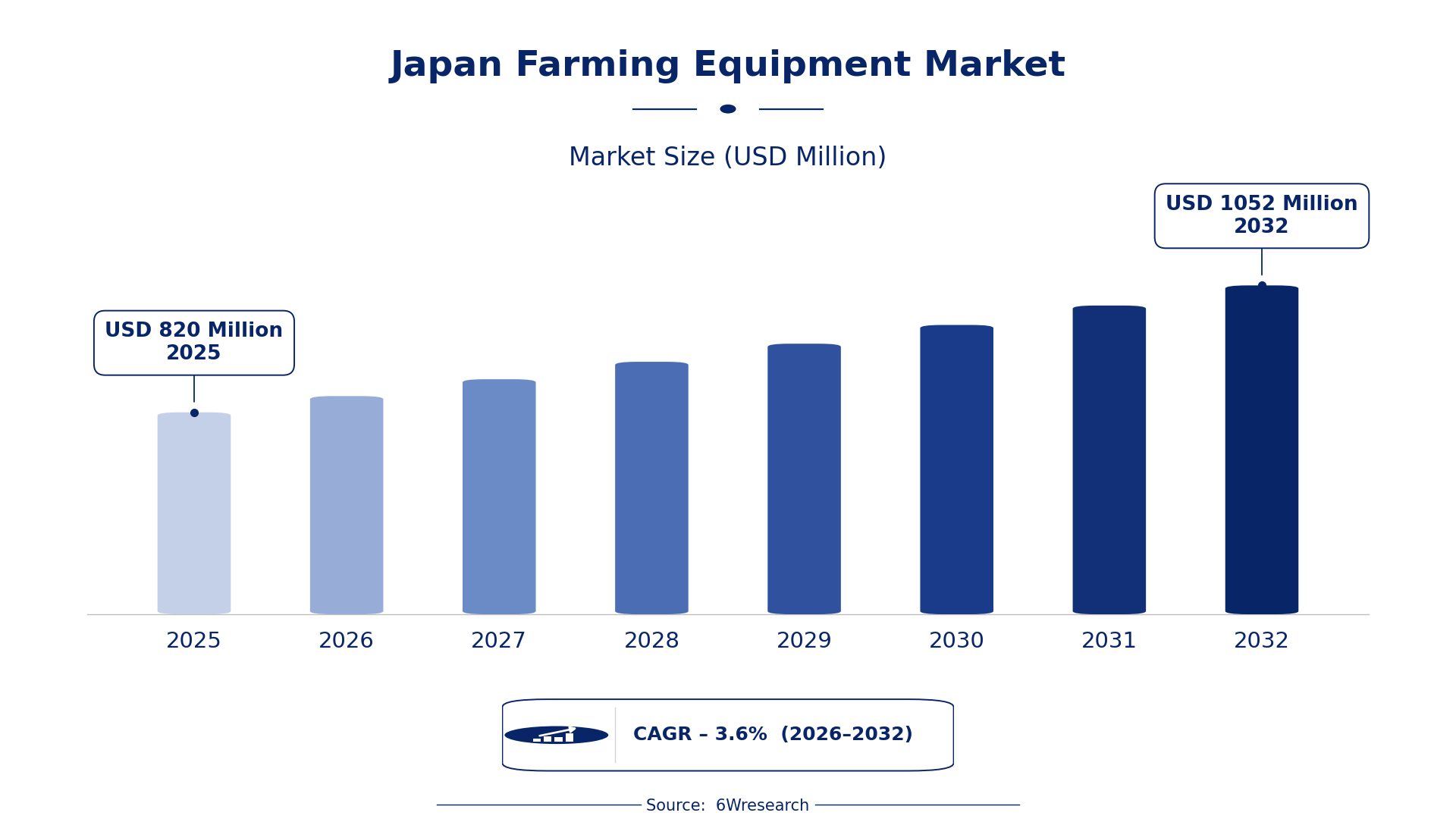
According to 6Wresearch internal database and industry insights, the Japan Farming Equipment Market was valued at USD 820 Million in 2025 and is projected to reach USD 1,052 Million by 2032, growing at a CAGR of approximately 3.6% during 2026–2032.
Japan Farming Equipment Market Highlights
| Report Metric | Details |
| Report Name | Japan Farming Equipment Market (2026-2032) |
| Market Size 2025 | USD 820 Million |
| Market Size 2032 | USD 1,052 Million |
| Absolute Growth 2025–2032 | USD 232 Million |
| CAGR 2026–2032 | 3.6% |
| Peak Annual Growth | 4.7% in 2028 |
| Forecast Period | 2026–2032 |
| Historical Data | 2022–2025 |
| Base Year | 2025 |
| Leading Equipment Type, 2025 | LED Grow Lights (35% share) |
| Leading Technology Type, 2025 | Hydroponics (44% share) |
| Leading Distribution Channel, 2025 | Online Retailers (34% share) |
| Leading End User, 2025 | Indoor Farms (41% share) |
| Fastest-Growing Equipment Type | HVAC Systems (5.3% CAGR) |
| Fastest-Growing Technology Type | Aeroponics (5.5% CAGR) |
| Fastest-Growing Distribution Channel | Direct Sales (4.8% CAGR) |
| Fastest-Growing End User | Greenhouses (4.7% CAGR) |
| Growing Sector | Urban Agriculture |
| Key End Users | Indoor Farms, Greenhouses, Research Institutions, Urban Agriculture |
Japan Farming Equipment Market Year-wise Growth Rate and Key Drivers (2022–2032)
This graph illustrates the annual growth rates of the market from 2022 to 2032, highlighting a steady upward trajectory and projected market expansion over the forecast period.
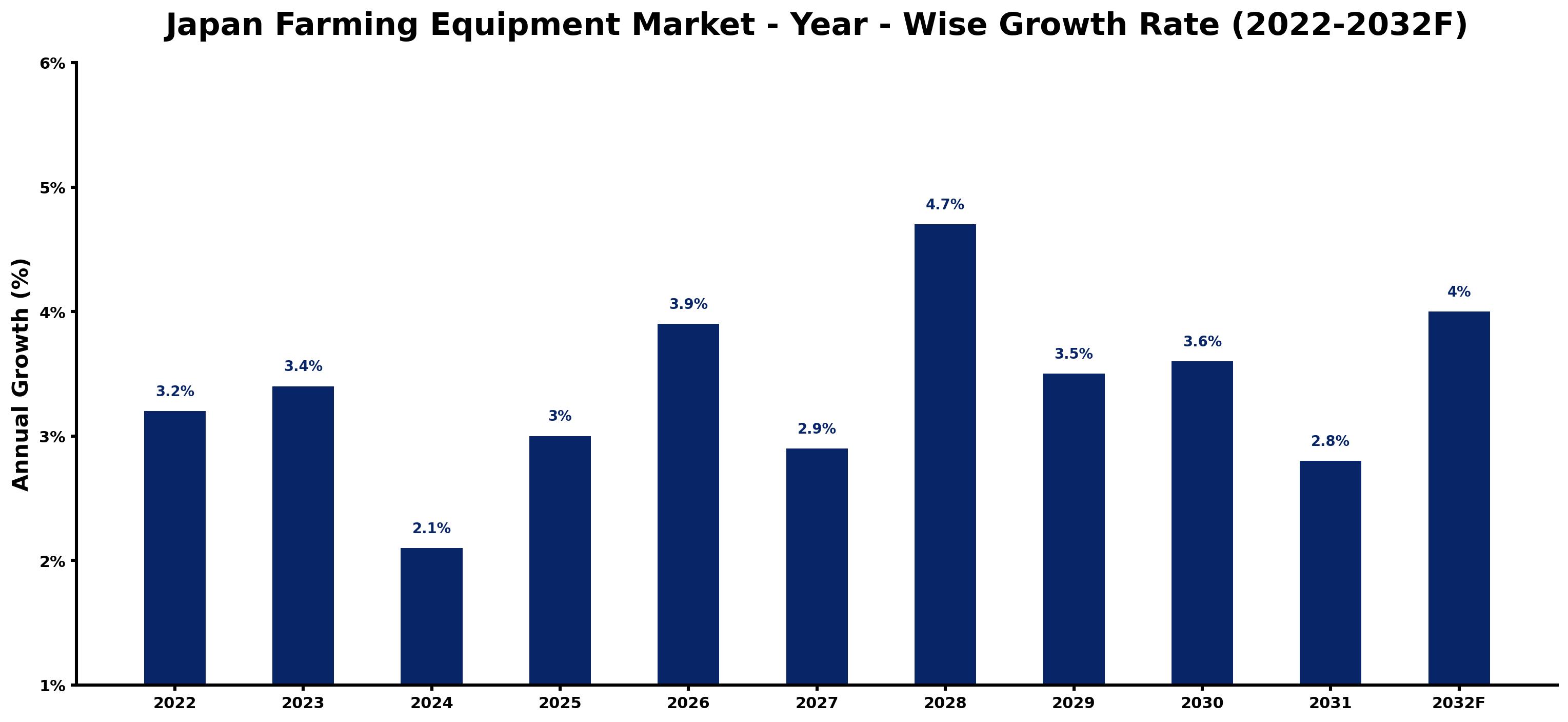
Year by year, the estimates below pair each growth rate with the development that shaped it.
| Year | Estimated Annual Growth (%) | Market Rationale |
| 2022 | 3.2 | The market exhibited steady growth due to increasing urban farming initiatives. |
| 2023 | 3.4 | Demand accelerated as urban agriculture projects gained traction in metropolitan areas. |
| 2024 | 2.1 | Growth slowed as market adjustments occurred amidst rising operational costs. |
| 2025 | 3.0 | A resurgence in demand was noted, driven by technological advancements in farming. |
| 2026 | 3.9 | Investment in smart farming technologies is expected to boost growth rates. |
| 2027 | 2.9 | The market will experience a slowdown as competition intensifies among suppliers. |
| 2028 | 4.7 | Growth is anticipated to accelerate due to the adoption of advanced farming technologies. |
| 2029 | 3.5 | Growth will slow as market saturation begins to affect new purchases. |
| 2030 | 3.6 | Demand is expected to increase with the expansion of urban agriculture initiatives. |
| 2031 | 2.8 | The market will slow due to rising costs impacting purchasing decisions. |
| 2032 | 4.0 | Growth is projected to accelerate as modern farming solutions gain wider acceptance. |
Note: Market size estimations and growth projections presented in this report are based on 6Wresearch's proprietary forecasting methodology, utilizing the latest available industry data, government publications, and primary research inputs.
Japan Farming Equipment Market Synopsis
Farming equipment in Japan includes various advanced tools designed to improve agricultural productivity, particularly in urban settings. The Japan Farming Equipment Market is expanding, driven by a growing urban population of approximately 126 million, which increases the need for efficient farming solutions. With over 1,000 registered indoor farms and government support allocating ¥5 billion for urban agriculture initiatives, the sector is set to thrive in the coming years.
Market Dynamics Impact Analysis (2026–2032)
| Factor | Type | Impact | Primary Segment Affected |
| Rising urban population drives demand for efficient farming solutions. | Driver | High | Indoor Farms |
| Technological advancements in farming equipment enhance productivity. | Driver | High | Smart Farming Tech |
| Urban agriculture initiatives create a need for modern farming tools. | Opportunity | High | Urban Agriculture |
| Increased adoption of hydroponics systems opens new market segments. | Opportunity | Medium | Hydroponics |
| High operational costs can limit purchasing power for farmers. | Restraint | High | Indoor Farms |
| Competition among suppliers may lead to price wars affecting margins. | Restraint | Medium | Smart Farming Tech |
| Compliance with JIS standards can increase operational complexity. | Challenge | High | LED Grow Lights |
| Limited access to financing affects investment in new technologies. | Challenge | Medium | LED Grow Lights |
Evaluation of Drivers in Japan Farming Equipment Market (2026–2032)
Demand rests on the following drivers, each shown with the segment it touches most.
| Drivers | Primary Segment Affected | Why It Matters (Evidence) |
| Increasing urban population necessitates efficient farming solutions. | Indoor Farms | Japan's urban population of approximately 126 million drives demand for efficient farming technologies. |
| Technological advancements improve agricultural productivity. | Smart Farming Tech | The adoption of smart farming technologies is rising, with a 25% increase in LED grow lights among indoor farms. |
| Government subsidies promote urban agriculture initiatives. | Urban Agriculture | In 2023, the government allocated ¥5 billion to support urban agriculture projects. |
| Growing interest in hydroponics systems boosts market demand. | Hydroponics | Hydroponics systems are currently utilized in over 300 greenhouses across Japan. |
| Research institutions are adopting aquaponics for sustainability. | Aquaponics | Research institutions are increasingly utilizing aquaponics systems for sustainable agricultural practices. |
A wider customer base explains much of the growth, as the urban population drives demand for efficient farming solutions. The adoption of smart farming technologies has risen, with a notable increase in LED grow light usage among indoor farms. In 2023, substantial funding was allocated to support urban agriculture projects, promoting the development of modern farming solutions. Interest in hydroponics systems reflects a shift towards soil-less agriculture, with many greenhouses implementing these technologies. Research institutions are increasingly incorporating aquaponics systems, indicating a move towards sustainable practices in agriculture.
Evaluation of Restraints in Japan Farming Equipment Market
The main factors holding the market back are set out below.
| Market Restraint | Primary Segment Affected | Why It Matters (Evidence) |
| High operational costs limit purchasing power for farmers. | Indoor Farms | Rising costs impact the ability of farmers to invest in new equipment, affecting overall market growth. |
| Intense competition may lead to price wars among suppliers. | Smart Farming Tech | Price wars can erode profit margins, making it difficult for suppliers to maintain financial stability. |
| Compliance with JIS standards increases operational complexity. | LED Grow Lights | Producers must invest in testing and certification processes, adding to their operational burdens. |
| Limited access to financing affects investment in new technologies. | Hydroponics | Farmers may struggle to secure funding for advanced equipment, hindering market expansion. |
| Market saturation may slow new equipment purchases. | Indoor Farms | As more farms adopt existing technologies, the demand for new purchases may decline. |
Japan Farming Equipment Market Challenges
High operational costs pressure urban farms, with Japan's minimum wage at JPY 1,055 per hour, limiting budgets for essential equipment. A scarcity of suppliers complicates access to tools, as only around 200 specialty stores exist, leading to delays in procurement for buyers. Rapid technological advancements challenge producers to adapt quickly, resulting in product launch delays that hinder competitiveness. Compliance with stringent JIS standards imposes additional costs on suppliers, which ultimately drives up prices for clinics and producers needing dependable farming equipment.
Trends in the Japan Farming Equipment Market
Four trends stand out in the Japan Farming Equipment Market.
- Urban Farmers Adopting Smart Farming Technologies: Urban farmers are increasingly adopting smart farming technologies, with a notable rise in LED grow light usage by 25%. This shift improves productivity in densely populated areas, particularly in the Tokyo metropolitan area, which accounts for 40% of urban agriculture initiatives.
- Hydroponics Systems Gaining Popularity in Greenhouses: Hydroponics systems are gaining traction, currently utilized in over 300 greenhouses across Japan. This trend reflects a growing preference for soil-less agriculture, driven by the need for efficient land use in urban settings.
- Government Investment in Urban Agriculture Initiatives: The Japanese government allocated ¥5 billion in 2023 to support urban agriculture initiatives. This funding encourages the development of modern farming solutions in cities, responding to the needs of a growing urban population.
- Aquaponics Systems Gaining Ground in Research Institutions: Research institutions are increasingly adopting aquaponics systems for sustainable agricultural practices. This trend indicates a shift towards integrated farming solutions, improving resource efficiency and productivity.
Investment Opportunities in the Japan Farming Equipment Market
The openings below show where demand in the Japan Farming Equipment Market is visible and how suppliers can enter.
- Urban Agriculture Initiatives Demand Modern Farming Tools: Urban agriculture initiatives are expanding, with the Tokyo metropolitan area leading urban farming projects. This creates a demand for modern farming tools, presenting opportunities for suppliers to meet this growing need.
- Supply Hydroponics Systems to Meet Market Demand: There is a gap in the market for hydroponics systems, with over 300 greenhouses currently using them. Suppliers can target urban farms and greenhouses to provide these efficient solutions.
- Invest in Smart Farming Technologies for Urban Farms: With the urban population driving demand for efficient farming, investing in smart farming technologies is essential. Urban farms in regions like Osaka are ideal targets for these innovations.
- Expand Online Retail Channels for Farming Equipment: The online retail channel is growing, with a 34% market share in 2025. Suppliers should enhance their online presence to reach a broader customer base effectively.
Government Initiatives in the Japan Farming Equipment Market
The Act on the Rational Use of Energy, established in 1979, requires large energy users to improve energy efficiency and report energy use. This law complements the Industrial Standardization Act, which governs JIS standards for farming equipment, ensuring quality and safety in production processes.
The Ministry of Agriculture, Forestry and Fisheries approves subsidies for urban agriculture initiatives, providing funding to support modern farming solutions. This agency plays an important role in promoting sustainable agricultural practices through various programs.
Future Insight of the Japan Farming Equipment Market
Emerging smart farming technologies will reshape urban agriculture by 2032, enhancing productivity for local farms. Government initiatives will boost funding for urban agriculture, facilitating the adoption of advanced equipment. The urban population's demand for efficient farming solutions will stimulate innovation in product design. Approximately 1,000 registered indoor farms will increasingly incorporate hydroponics systems, showcasing a shift towards sustainable agricultural practices.
Market Segmentation Analysis
Japan Farming Equipment Market report covers a detailed analysis of the following market segments:
By Equipment Type – LED Grow Lights Lead, HVAC Systems Expected to Grow Fastest
According to Saurav Kr Singh, Senior Research Analyst at 6Wresearch, the largest equipment type category in 2025 was LED Grow Lights, at 35% of revenue. LED grow lights are essential for efficient plant growth in controlled environments, making them a top choice among indoor farms. Their widespread adoption is particularly notable in urban areas where space constraints necessitate advanced solutions. Over 2026–2032, HVAC Systems are expected to post the fastest growth, at a CAGR of 5.3%. HVAC systems are experiencing rapid growth due to their critical role in maintaining optimal climate conditions for indoor farming, with installations significantly increasing. This trend is fuelled by the rise in the number of indoor farms, which surpassed 1,000 in 2023. Suppliers should focus on developing HVAC solutions to meet the increasing demand from indoor farms.
By Technology Type – Hydroponics Lead, Aeroponics Expected to Grow Fastest
With 44% of technology type revenue in 2025, Hydroponics was the largest category. Hydroponics is widely utilised for soil-less agriculture practices, establishing itself as the leading technology in Japan's farming equipment market. Its effectiveness in urban settings has resulted in a strong installed base across numerous facilities. Aeroponics are projected to grow fastest, at a CAGR of 5.5% during 2026–2032. Aeroponics is gaining momentum due to its efficiency, with more farmers exploring this technology as a viable alternative. The growing interest is underscored by an increase in research initiatives and practical trials. Buyers may benefit from considering aeroponics as a practical option to improve yield and resource efficiency.
By Distribution Channel – Online Retailers Lead, Direct Sales Expected to Grow Fastest
Online Retailers held 34% of the Japan Farming Equipment Market by distribution channel in 2025. Online retailers are becoming a significant channel for purchasing farming equipment, catering to the rising demand from tech-savvy farmers. This trend reflects the growing preference for the convenience of online shopping among agricultural buyers. The quickest growth will come from Direct Sales, forecast to expand at a CAGR of 4.8% between 2026 and 2032. Direct sales remain a traditional yet effective method for reaching farmers directly, and this channel is witnessing a resurgence as suppliers aim to strengthen customer relationships. The personal engagement offered by direct sales appeals to many farm operators. Suppliers should enhance their online presence while maintaining strong direct sales strategies to accommodate diverse buyer preferences.
By End User – Indoor Farms Lead, Greenhouses Expected to Grow Fastest
Indoor Farms accounted for 41% of the market by end user in 2025. Indoor farms are the primary end-users of farming equipment, employing various technologies to optimise productivity within confined spaces. Their significant presence in urban areas drives the demand for advanced farming solutions. Greenhouses are set to record the highest CAGR in this split, 4.7% over 2026–2032. Greenhouses are increasingly being adopted for various farming technologies, indicating a shift towards more controlled agricultural environments. This trend is further supported by government initiatives aimed at promoting urban agriculture. Suppliers should tailor their offerings to meet the specific needs of greenhouse operators as this segment continues to expand.
Key Attractiveness of the Report
- 10 Years of Market Numbers
- Historical Data Starting from 2022 to 2025
- Base Year 2025
- Forecast Data until 2032
- Key Performance Indicators Impacting the Market
- Major Upcoming Developments and Projects
Key Highlights of the Report:
- Japan Farming Equipment Market Outlook
- Market Size of Japan Farming Equipment Market, 2025
- Forecast of Japan Farming Equipment Market, 2032
- Historical Data and Forecast of Japan Farming Equipment Revenues & Volume for the Period 2022-2032F
- Japan Farming Equipment Market Trend Evolution
- Japan Farming Equipment Market Drivers and Challenges
- Japan Farming Equipment Price Trends
- Japan Farming Equipment Porter's Five Forces
- Japan Farming Equipment Industry Life Cycle
- Historical Data and Forecast of Japan Farming Equipment Market Revenues & Volume By Equipment Type for the Period 2022-2032F
- Historical Data and Forecast of Japan Farming Equipment Market Revenues & Volume By LED Grow Lights for the Period 2022-2032F
- Historical Data and Forecast of Japan Farming Equipment Market Revenues & Volume By HVAC Systems for the Period 2022-2032F
- Historical Data and Forecast of Japan Farming Equipment Market Revenues & Volume By Drip Irrigation Kits for the Period 2022-2032F
- Historical Data and Forecast of Japan Farming Equipment Market Revenues & Volume By Shelving Systems for the Period 2022-2032F
- Historical Data and Forecast of Japan Farming Equipment Market Revenues & Volume By Sensors & Controllers for the Period 2022-2032F
- Historical Data and Forecast of Japan Farming Equipment Market Revenues & Volume By Technology Type for the Period 2022-2032F
- Historical Data and Forecast of Japan Farming Equipment Market Revenues & Volume By Hydroponics for the Period 2022-2032F
- Historical Data and Forecast of Japan Farming Equipment Market Revenues & Volume By Aeroponics for the Period 2022-2032F
- Historical Data and Forecast of Japan Farming Equipment Market Revenues & Volume By Aquaponics for the Period 2022-2032F
- Historical Data and Forecast of Japan Farming Equipment Market Revenues & Volume By Fogponics for the Period 2022-2032F
- Historical Data and Forecast of Japan Farming Equipment Market Revenues & Volume By Smart Farming Tech for the Period 2022-2032F
- Historical Data and Forecast of Japan Farming Equipment Market Revenues & Volume By Distribution Channel for the Period 2022-2032F
- Historical Data and Forecast of Japan Farming Equipment Market Revenues & Volume By Online Retailers for the Period 2022-2032F
- Historical Data and Forecast of Japan Farming Equipment Market Revenues & Volume By Direct Sales for the Period 2022-2032F
- Historical Data and Forecast of Japan Farming Equipment Market Revenues & Volume By Wholesale Suppliers for the Period 2022-2032F
- Historical Data and Forecast of Japan Farming Equipment Market Revenues & Volume By Equipment Distributors for the Period 2022-2032F
- Historical Data and Forecast of Japan Farming Equipment Market Revenues & Volume By Specialty Stores for the Period 2022-2032F
- Historical Data and Forecast of Japan Farming Equipment Market Revenues & Volume By End User for the Period 2022-2032F
- Historical Data and Forecast of Japan Farming Equipment Market Revenues & Volume By Indoor Farms for the Period 2022-2032F
- Historical Data and Forecast of Japan Farming Equipment Market Revenues & Volume By Greenhouses for the Period 2022-2032F
- Historical Data and Forecast of Japan Farming Equipment Market Revenues & Volume By Research Institutions for the Period 2022-2032F
- Historical Data and Forecast of Japan Farming Equipment Market Revenues & Volume By Urban Agriculture for the Period 2022-2032F
- Historical Data and Forecast of Japan Farming Equipment Market Revenues & Volume By Vertical Farms for the Period 2022-2032F
- Japan Farming Equipment Import Export Trade Statistics
- Market Opportunity Assessment By Equipment Type
- Market Opportunity Assessment By Technology Type
- Market Opportunity Assessment By Distribution Channel
- Market Opportunity Assessment By End User
- Japan Farming Equipment Top Companies Market Share
- Japan Farming Equipment Competitive Benchmarking By Technical and Operational Parameters
- Japan Farming Equipment Company Profiles
- Japan Farming Equipment Key Strategic Recommendations
Market Covered
Segments analysed in this report are listed below.
By Equipment Type
- LED Grow Lights
- HVAC Systems
- Drip Irrigation Kits
- Shelving Systems
- Sensors & Controllers
By Technology Type
- Hydroponics
- Aeroponics
- Aquaponics
- Fogponics
- Smart Farming Tech
By Distribution Channel
- Online Retailers
- Direct Sales
- Wholesale Suppliers
- Equipment Distributors
- Specialty Stores
By End User
- Indoor Farms
- Greenhouses
- Research Institutions
- Urban Agriculture
- Vertical Farms































