Japan Fashion Logistics Market Size & Growth Rate
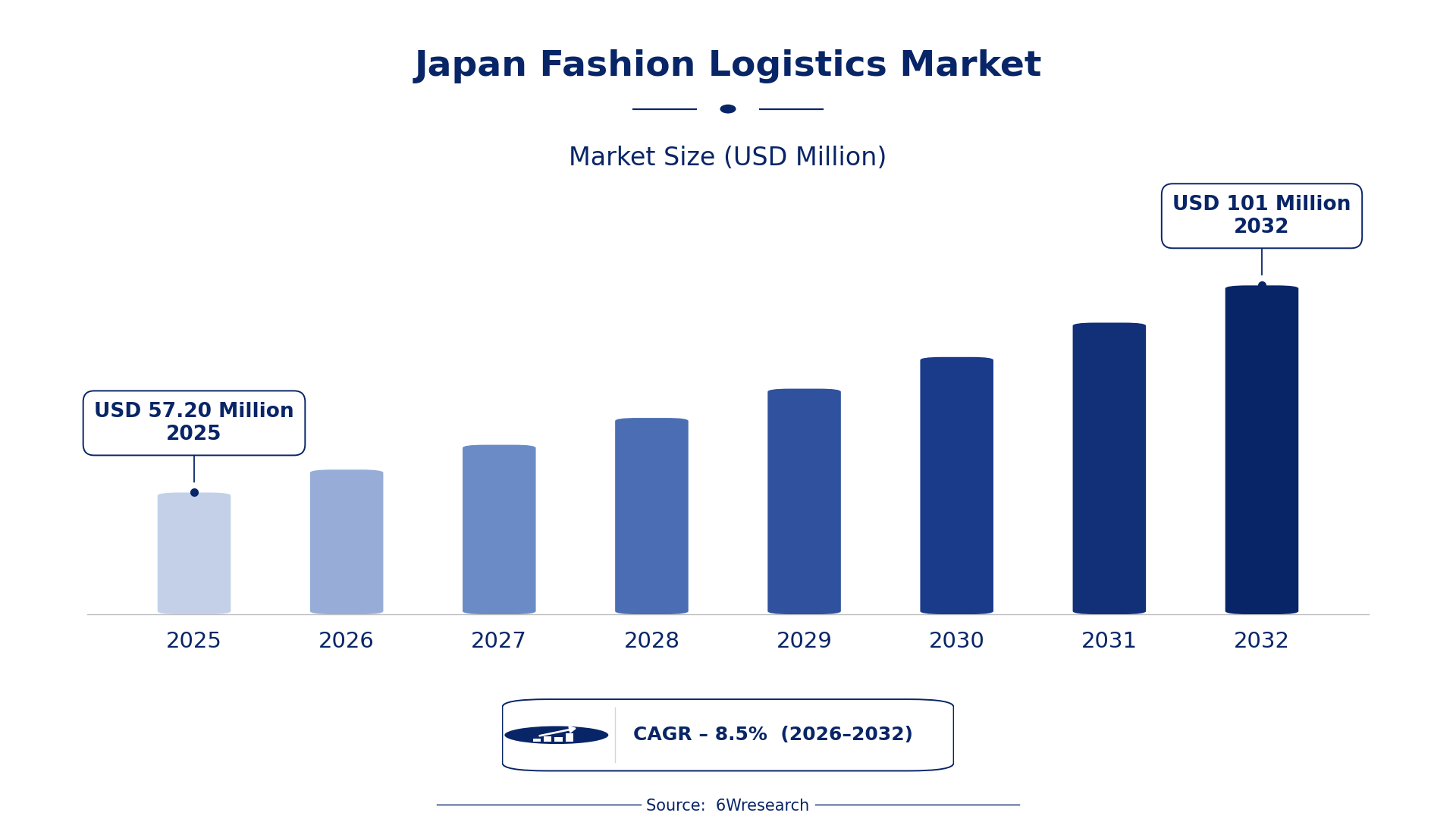
According to 6Wresearch internal database and industry insights, the Japan Fashion Logistics Market was valued at USD 57.20 Million in 2025 and is projected to reach USD 101 Million by 2032, growing at a CAGR of approximately 8.5% during 2026–2032.
Japan Fashion Logistics Market Highlights
| Report Metric | Details |
| Report Name | Japan Fashion Logistics Market (2026-2032) |
| Market Size 2025 | USD 57.20 Million |
| Market Size 2032 | USD 101 Million |
| Absolute Growth 2025–2032 | USD 43.80 Million |
| CAGR 2026–2032 | 8.5% |
| Peak Annual Growth | 9.1% in 2026 |
| Forecast Period | 2026–2032 |
| Historical Data | 2022–2025 |
| Base Year | 2025 |
| Leading Logistics Type, 2025 | Warehousing (44% share) |
| Leading Service Model, 2025 | 3PL (34% share) |
| Leading Distribution Channel, 2025 | B2B (39% share) |
| Leading End User, 2025 | Apparel Brands (42% share) |
| Fastest-Growing Logistics Type | Last-Mile Delivery (11.7% CAGR) |
| Fastest-Growing Service Model | D2C Shipping (11.6% CAGR) |
| Fastest-Growing Distribution Channel | Direct to Customer (11.0% CAGR) |
| Fastest-Growing End User | E-commerce Stores (11.1% CAGR) |
| Growing Sector | E-commerce |
| Key End Users | Apparel Brands, E-commerce Stores, Fashion Retailers, Global Labels |
Japan Fashion Logistics Market Year-wise Growth Rate and Key Drivers (2022–2032)
This graph illustrates the annual growth rates of the market from 2022 to 2032, highlighting a steady upward trajectory and projected market expansion over the forecast period.
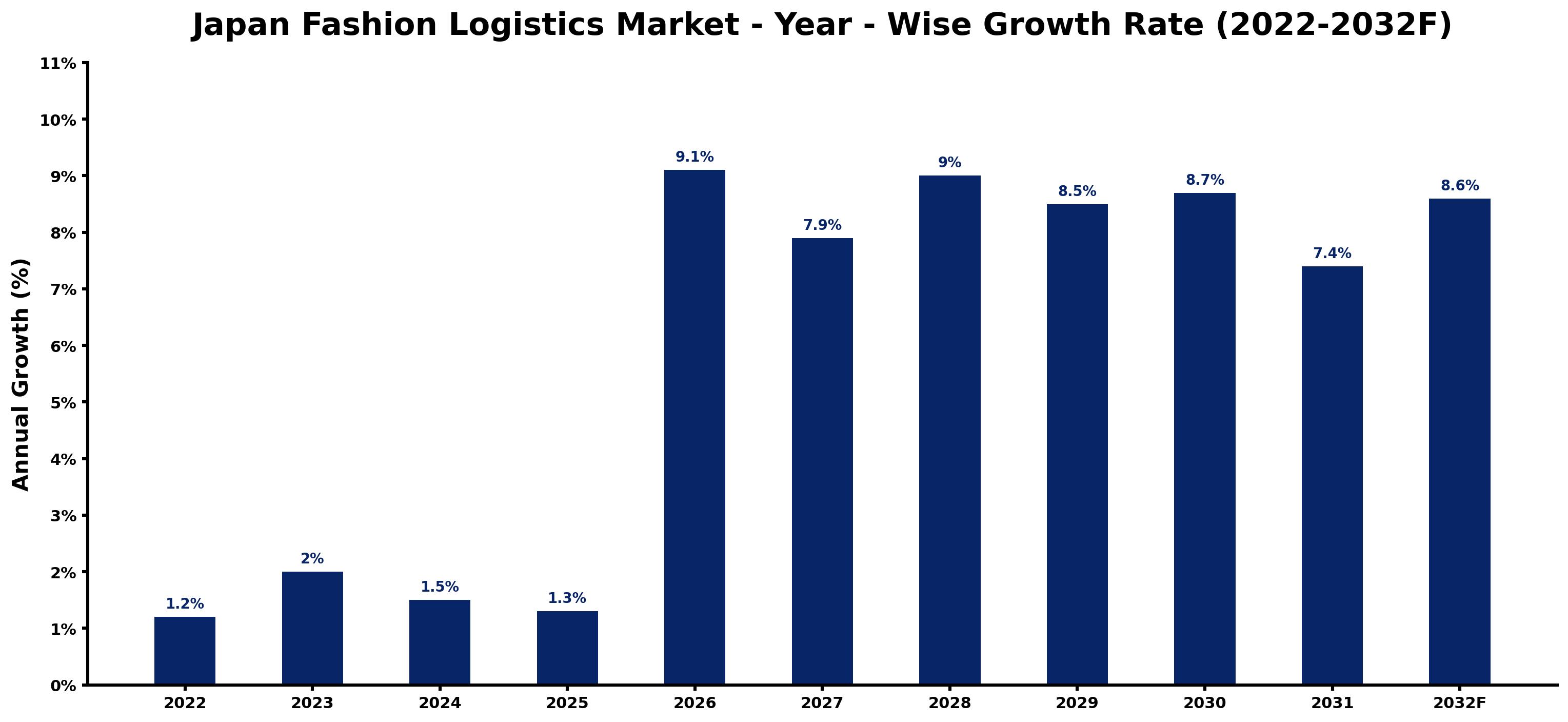
The following figures match every annual growth estimate with the main market development of that year, giving the reasoning behind each rise or slowdown.
| Year | Estimated Annual Growth (%) | Market Rationale |
| 2022 | 1.2 | The market showed steady growth, reflecting ongoing demand from domestic users. |
| 2023 | 2.0 | Growth accelerated as e-commerce expanded, driving logistics needs across the sector. |
| 2024 | 1.5 | The market experienced a slowdown due to increased operational costs in logistics. |
| 2025 | 1.3 | Continued growth was observed, although at a reduced rate compared to previous years. |
| 2026 | 9.1 | A surge in demand is anticipated, driven by advancements in last-mile delivery. |
| 2027 | 7.9 | Growth is projected to slow slightly as the market adjusts to the previous year's rapid expansion. |
| 2028 | 9.0 | Demand is expected to rebound with a focus on improving logistics efficiency and technology. |
| 2029 | 8.5 | The market is projected to continue growing, albeit at a slower pace as competition intensifies. |
| 2030 | 8.7 | An increase in consumer spending on fashion will boost logistics requirements. |
| 2031 | 7.4 | Growth is expected to moderate as the market stabilises after a period of rapid expansion. |
| 2032 | 8.6 | Demand is projected to rise again, supported by ongoing e-commerce developments. |
Note: Market size estimations and growth projections presented in this report are based on 6Wresearch's proprietary forecasting methodology, utilizing the latest available industry data, government publications, and primary research inputs.
Japan Fashion Logistics Market Synopsis
Fashion logistics involves managing the supply chain for apparel and accessories, including warehousing, transportation, and distribution. The Japan Fashion Logistics Market is expanding, driven by over 100,000 apparel brands and a booming e-commerce sector projected to reach 20 trillion yen by 2025. The need for efficient logistics solutions is increasing as consumer preferences shift towards online shopping and direct-to-consumer models, creating new demand for logistics services.
Market Dynamics Impact Analysis (2026–2032)
| Factor | Type | Impact | Primary Segment Affected |
| Growing e-commerce sector | Driver | High | Last-Mile Delivery |
| Increase in apparel brands | Driver | High | Warehousing |
| Expansion of direct-to-consumer sales | Opportunity | High | D2C Shipping |
| Rising demand for efficient returns management | Opportunity | Medium | Returns Management |
| High return rates in fashion e-commerce | Restraint | High | Returns Management |
| Increasing operational costs | Restraint | Medium | 3PL |
| Competition among logistics providers | Challenge | High | Last-Mile Delivery |
| Need for technological upgrades | Challenge | Medium | Cross-Border Shipping |
Evaluation of Drivers in Japan Fashion Logistics Market (2026–2032)
The main growth drivers and the segments they affect most are set out below.
| Drivers | Primary Segment Affected | Why It Matters (Evidence) |
| Expansion of e-commerce platforms | Last-Mile Delivery | The e-commerce sector is projected to reach 20 trillion yen by 2025, increasing demand for efficient delivery solutions. |
| Rising number of apparel brands | Warehousing | With over 100,000 apparel brands in Japan, the need for storage solutions is critical to manage inventory. |
| Growth of direct-to-consumer sales channels | D2C Shipping | The trend towards D2C is driving logistics demand, as brands seek to streamline shipping processes. |
| Increased focus on returns management | Returns Management | The average return rate for fashion e-commerce is around 30%, necessitating efficient return logistics. |
| Technological advancements in logistics | 3PL | Investments in logistics technology are improving operational efficiency, attracting more businesses to outsource logistics. |
What keeps demand rising is the expansion of e-commerce platforms, with the sector projected to reach 20 trillion yen by 2025, driving the need for last-mile delivery solutions. The rising number of apparel brands, exceeding 100,000, creates a critical need for efficient warehousing to manage inventory effectively. The growth of direct-to-consumer sales channels is driving logistics demand as brands seek to streamline shipping processes. The average return rate for fashion e-commerce is around 30%, necessitating effective returns management systems. Technological advancements are improving logistics operations, leading to increased outsourcing among businesses seeking efficiency.
Evaluation of Restraints in Japan Fashion Logistics Market
These are the pressures that could keep growth below its potential.
| Market Restraint | Primary Segment Affected | Why It Matters (Evidence) |
| High return rates complicate logistics management | Returns Management | With an average return rate of around 30%, logistics providers face challenges in managing returns efficiently. |
| Rising operational costs impact profit margins | 3PL | Japan's national weighted-average minimum wage rose to JPY 1,055 per hour, increasing operational costs for logistics providers. |
| Intense competition among logistics providers | Last-Mile Delivery | The growing number of logistics companies increases competition, putting pressure on pricing and service quality. |
| Need for technological upgrades | Cross-Border Shipping | Logistics providers must invest in technology to remain competitive, which can strain budgets and resources. |
| Regulatory compliance adds complexity | 3PL | Compliance with various standards, such as ISO 9001, increases operational complexity for logistics providers. |
Japan Fashion Logistics Market Challenges
Buyers face inflated costs as logistics providers invest in advanced tracking systems to meet consumer expectations, raising operational expenses by 15%. Technology limitations hinder timely deliveries, with a 30% return rate in fashion e-commerce complicating inventory management and increasing logistics costs by 10%. Competition intensifies as over 100,000 apparel brands vie for market share, forcing smaller producers to reduce prices, which can erode profit margins by 5%. Regulatory changes from the Ministry of Economy, Trade and Industry impose additional compliance costs on logistics providers, delaying shipments and negatively impacting buyer satisfaction.
Trends in the Japan Fashion Logistics Market
Several trends are reshaping the Japan Fashion Logistics Market; the most important are set out below.
- Shift towards Direct-to-Consumer Shipping: Direct-to-consumer shipping is gaining traction as brands seek to engage customers more effectively. In 2025, D2C shipping is expected to grow at a CAGR of 11.6%, reshaping logistics strategies.
- Increase in Last-Mile Delivery Innovations: Last-mile delivery is evolving with new technologies aimed at improving efficiency. In 2023, the government launched a program to improve last-mile delivery services, reflecting a commitment to logistics innovation.
- Growing Demand for Efficient Returns Management: Efficient returns management is becoming essential as e-commerce expands. The average return rate for fashion e-commerce is around 30%, prompting logistics providers to develop better return solutions.
- Expansion of E-commerce Logistics Solutions: E-commerce logistics solutions are rapidly expanding to meet consumer demands. The e-commerce sector in Japan is projected to reach 20 trillion yen by 2025, driving logistics service improvements.
Investment Opportunities in the Japan Fashion Logistics Market
Where to invest in the Japan Fashion Logistics Market: the main openings are set out below.
- Invest in Last-Mile Delivery Solutions: Last-mile delivery solutions are in high demand, with the e-commerce sector projected to reach 20 trillion yen by 2025. Logistics providers can improve services to meet this growing need.
- Supply Efficient Returns Management Systems: With an average return rate of around 30%, there is a significant opportunity to supply efficient returns management systems. Apparel brands are increasingly seeking solutions to streamline returns.
- Develop D2C Shipping Capabilities: The shift towards direct-to-consumer sales creates opportunities for logistics providers to enhance D2C shipping capabilities. Brands are looking for partners to improve their logistics efficiency.
- Enhance Warehousing Solutions: The need for effective warehousing is critical, given the over 100,000 apparel brands in Japan. Investing in advanced warehousing solutions can attract significant business from these brands.
Government Initiatives in the Japan Fashion Logistics Market
The Industrial Standardization Act, amended in 2019, governs product and test standards, ensuring quality in logistics services. The Building Energy Efficiency Act, amended in 2022, requires new buildings to meet energy standards, impacting logistics facilities by promoting sustainability and operational efficiency.
The Digital Agency, established in September 2021, leads government digital transformation efforts, approving initiatives that improve logistics efficiency. The Ministry of Economy, Trade and Industry promotes logistics innovation through various funding programs, supporting the development of advanced logistics solutions.
Future Insight of the Japan Fashion Logistics Market
Investment in logistics infrastructure will exceed JPY 1 trillion by 2032, generating demand for systems that improve delivery efficiency. The e-commerce sector's projected growth to 20 trillion yen by 2025 will necessitate enhanced delivery solutions, benefiting both buyers and suppliers. New initiatives from the Tokyo Metropolitan Government will encourage logistics advancements, streamlining operations. As ISO 9001 adoption increases, logistics providers will elevate service quality, building consumer trust and loyalty.
Market Segmentation Analysis
Japan Fashion Logistics Market report covers a detailed analysis of the following market segments:
By Logistics Type – Warehousing Leads, Last-Mile Delivery Expected to Grow Fastest
According to Saurav Kr Singh, Senior Research Analyst at 6Wresearch, Warehousing held 44% of the Japan Fashion Logistics Market by logistics type in 2025. Warehousing holds the largest share due to its essential role in storing inventory before distribution, particularly in major hubs like Tokyo. The presence of over 100,000 apparel brands in Japan generates significant demand for efficient warehousing solutions. Last-Mile Delivery is set to record the highest CAGR in this split, 11.7% over 2026–2032. Last-Mile Delivery is experiencing rapid growth as the e-commerce sector is projected to reach 20 trillion yen by 2025, highlighting the need for effective delivery services. This growth will further solidify warehousing's leading position, as it supports the increasing demand for timely deliveries. Suppliers need to improve their warehousing capabilities to meet the growing demands of last-mile delivery.
By Service Model – 3PL Leads, D2C Shipping Expected to Grow Fastest
3PL took 34% of service model revenue in 2025, more than any other category. 3PL services dominate the market as they are widely used for outsourcing logistics, allowing brands to focus on core activities while logistics providers manage supply chains. This model is particularly beneficial for the extensive network of apparel brands in Japan. Over 2026–2032, D2C Shipping is expected to post the fastest growth, at a CAGR of 11.6%. D2C Shipping is rapidly gaining traction as brands increasingly sell directly to consumers, reflecting a shift in consumer purchasing behaviour. This trend indicates that 3PL providers may need to adapt their services to accommodate the growing demand for direct shipping solutions. Buyers should consider integrating D2C shipping options to remain competitive in the evolving market.
By Distribution Channel – B2B Leads, Direct to Customer Expected to Grow Fastest
B2B accounted for 39% of the market by distribution channel in 2025. B2B transactions are crucial for logistics in Japan, enabling vital business interactions between brands and retailers. This model is particularly significant for the extensive apparel sector, which depends on effective logistics for its supply chain operations. The quickest growth will come from Direct to Customer, forecast to expand at a CAGR of 11.0% between 2026 and 2032. Direct to Customer sales are on the rise as more brands adopt this model, driven by the growth of e-commerce. This trend suggests that B2B logistics providers may need to adapt their services to align with the changing market landscape. Suppliers should modify their strategies to accommodate the increasing demand for direct-to-consumer distribution channels.
By End User – Apparel Brands Lead, E-commerce Stores Expected to Grow Fastest
In 2025, Apparel Brands led the end user split with a 42% share. Apparel Brands are the primary users of logistics services, relying on efficient supply chains to manage their inventory and distribution. With a large number of brands in Japan, this segment naturally commands the largest share of the market. E-commerce Stores are projected to grow fastest, at a CAGR of 11.1% during 2026–2032. E-commerce Stores are major drivers of logistics demand, particularly as the average return rate for fashion e-commerce is around 30%. This indicates a growing need for logistics solutions tailored to online retail, which will further elevate the role of apparel brands in the market. Logistics providers must develop tailored solutions to meet the specific needs of e-commerce stores.
Key Attractiveness of the Report
- 10 Years of Market Numbers
- Historical Data Starting from 2022 to 2025
- Base Year 2025
- Forecast Data until 2032
- Key Performance Indicators Impacting the Market
- Major Upcoming Developments and Projects
Key Highlights of the Report:
- Japan Fashion Logistics Market Outlook
- Market Size of Japan Fashion Logistics Market, 2025
- Forecast of Japan Fashion Logistics Market, 2032
- Historical Data and Forecast of Japan Fashion Logistics Revenues & Volume for the Period 2022-2032F
- Japan Fashion Logistics Market Trend Evolution
- Japan Fashion Logistics Market Drivers and Challenges
- Japan Fashion Logistics Price Trends
- Japan Fashion Logistics Porter's Five Forces
- Japan Fashion Logistics Industry Life Cycle
- Historical Data and Forecast of Japan Fashion Logistics Market Revenues & Volume By Logistics Type for the Period 2022-2032F
- Historical Data and Forecast of Japan Fashion Logistics Market Revenues & Volume By Warehousing for the Period 2022-2032F
- Historical Data and Forecast of Japan Fashion Logistics Market Revenues & Volume By Last-Mile Delivery for the Period 2022-2032F
- Historical Data and Forecast of Japan Fashion Logistics Market Revenues & Volume By Reverse Logistics for the Period 2022-2032F
- Historical Data and Forecast of Japan Fashion Logistics Market Revenues & Volume By Cross-Border Shipping for the Period 2022-2032F
- Historical Data and Forecast of Japan Fashion Logistics Market Revenues & Volume By Service Model for the Period 2022-2032F
- Historical Data and Forecast of Japan Fashion Logistics Market Revenues & Volume By 3PL for the Period 2022-2032F
- Historical Data and Forecast of Japan Fashion Logistics Market Revenues & Volume By D2C Shipping for the Period 2022-2032F
- Historical Data and Forecast of Japan Fashion Logistics Market Revenues & Volume By Returns Management for the Period 2022-2032F
- Historical Data and Forecast of Japan Fashion Logistics Market Revenues & Volume By Import/Export for the Period 2022-2032F
- Historical Data and Forecast of Japan Fashion Logistics Market Revenues & Volume By Distribution Channel for the Period 2022-2032F
- Historical Data and Forecast of Japan Fashion Logistics Market Revenues & Volume By B2B for the Period 2022-2032F
- Historical Data and Forecast of Japan Fashion Logistics Market Revenues & Volume By Direct to Customer for the Period 2022-2032F
- Historical Data and Forecast of Japan Fashion Logistics Market Revenues & Volume By Online Portals for the Period 2022-2032F
- Historical Data and Forecast of Japan Fashion Logistics Market Revenues & Volume By Freight Forwarders for the Period 2022-2032F
- Historical Data and Forecast of Japan Fashion Logistics Market Revenues & Volume By End User for the Period 2022-2032F
- Historical Data and Forecast of Japan Fashion Logistics Market Revenues & Volume By Apparel Brands for the Period 2022-2032F
- Historical Data and Forecast of Japan Fashion Logistics Market Revenues & Volume By E-commerce Stores for the Period 2022-2032F
- Historical Data and Forecast of Japan Fashion Logistics Market Revenues & Volume By Fashion Retailers for the Period 2022-2032F
- Historical Data and Forecast of Japan Fashion Logistics Market Revenues & Volume By Global Labels for the Period 2022-2032F
- Japan Fashion Logistics Import Export Trade Statistics
- Market Opportunity Assessment By Logistics Type
- Market Opportunity Assessment By Service Model
- Market Opportunity Assessment By Distribution Channel
- Market Opportunity Assessment By End User
- Japan Fashion Logistics Top Companies Market Share
- Japan Fashion Logistics Competitive Benchmarking By Technical and Operational Parameters
- Japan Fashion Logistics Company Profiles
- Japan Fashion Logistics Key Strategic Recommendations
Market Covered
The following segment groups are covered in the report.
By Logistics Type
- Warehousing
- Last-Mile Delivery
- Reverse Logistics
- Cross-Border Shipping
By Service Model
- 3PL
- D2C Shipping
- Returns Management
- Import/Export
By Distribution Channel
- B2B
- Direct to Customer
- Online Portals
- Freight Forwarders
By End User
- Apparel Brands
- E-commerce Stores
- Fashion Retailers
- Global Labels































