Japan Feed Hormones Market Size & Growth Rate
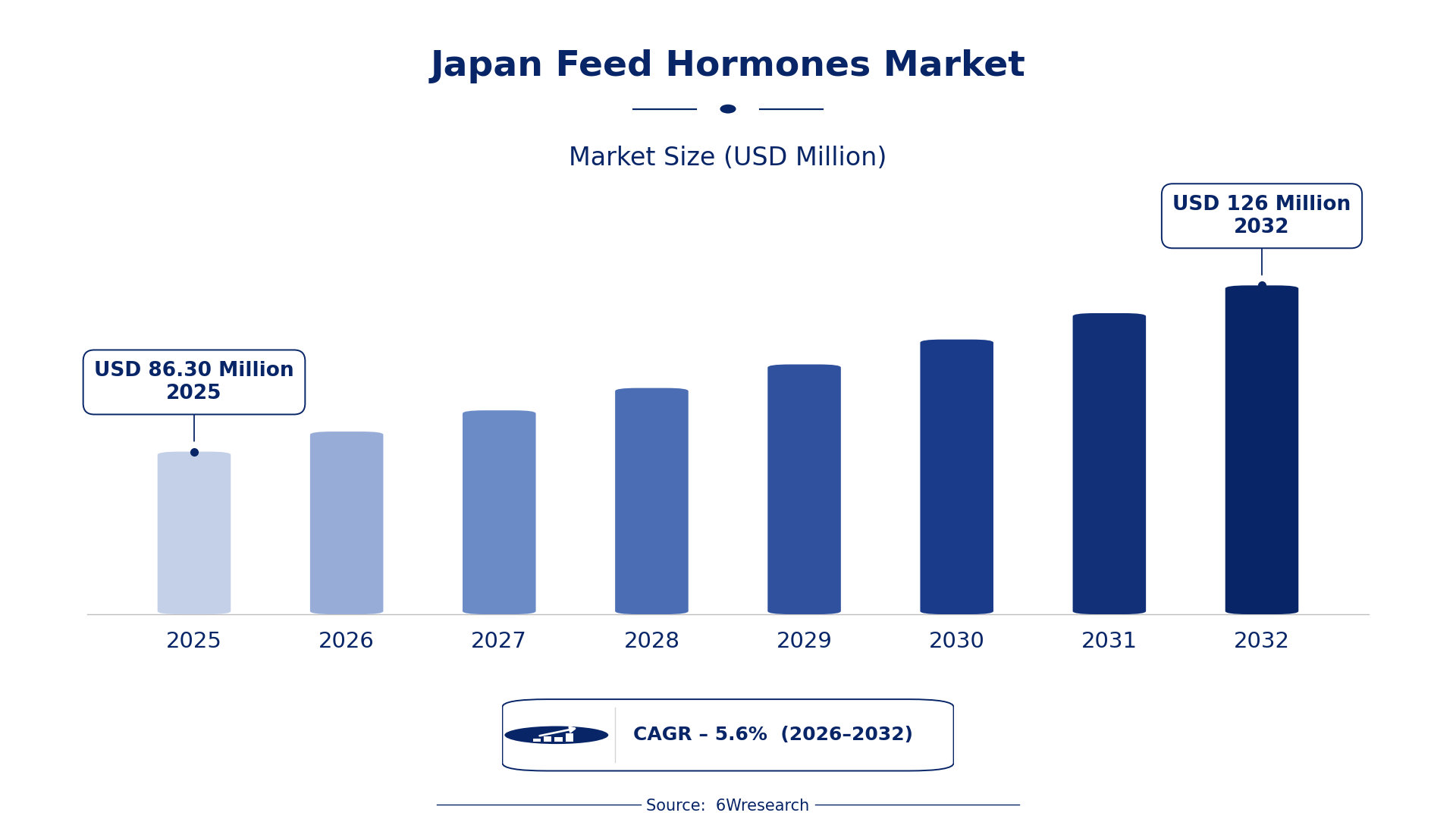
According to 6Wresearch internal database and industry insights, the Japan Feed Hormones Market was valued at USD 86.30 Million in 2025 and is projected to reach USD 126 Million by 2032, growing at a CAGR of approximately 5.6% during 2026–2032.
Japan Feed Hormones Market Highlights
| Report Metric | Details |
| Report Name | Japan Feed Hormones Market (2026-2032) |
| Market Size 2025 | USD 86.30 Million |
| Market Size 2032 | USD 126 Million |
| Absolute Growth 2025–2032 | USD 39.70 Million |
| CAGR 2026–2032 | 5.6% |
| Peak Annual Growth | 6.3% in 2026 |
| Forecast Period | 2026–2032 |
| Historical Data | 2022–2025 |
| Base Year | 2025 |
| Leading Hormone Type, 2025 | Growth Hormones (45% share) |
| Leading Function, 2025 | Weight Gain (43% share) |
| Leading Distribution Channel, 2025 | Veterinary Pharmacies (46% share) |
| Leading End User, 2025 | Dairy Farms (47% share) |
| Fastest-Growing Hormone Type | Metabolic Modifiers (7.8% CAGR) |
| Fastest-Growing Function | Feed Efficiency (7.2% CAGR) |
| Fastest-Growing Distribution Channel | Online Retailers (7.3% CAGR) |
| Fastest-Growing End User | Livestock Breeders (7.4% CAGR) |
| Growing Sector | Dairy Farming |
| Key End Users | Livestock Breeders, Dairy Farms, Meat Producers |
Japan Feed Hormones Market Year-wise Growth Rate and Key Drivers (2022–2032)
This graph illustrates the annual growth rates of the market from 2022 to 2032, highlighting a steady upward trajectory and projected market expansion over the forecast period.
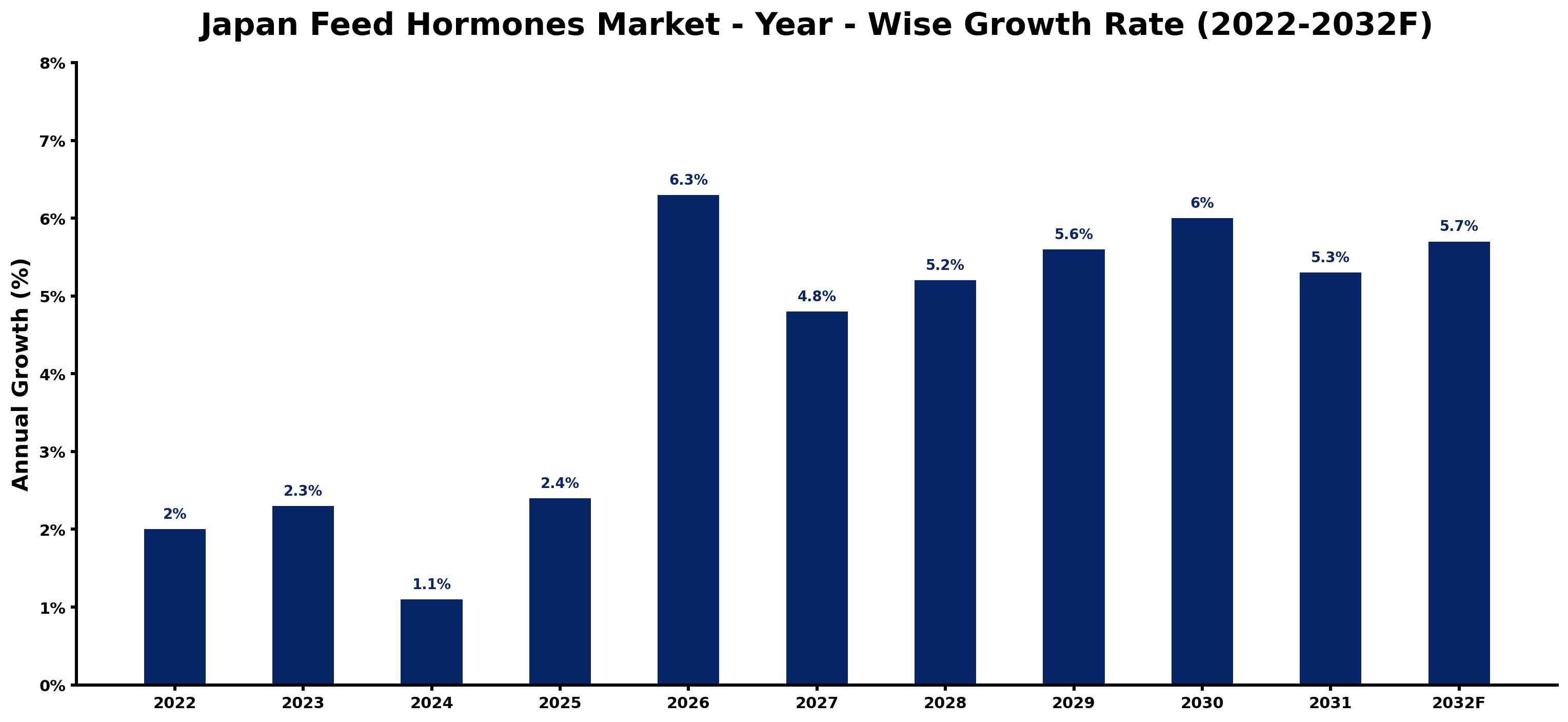
The yearly estimates that follow link every growth rate to its principal driver, so readers can see why the pace changed in each period.
| Year | Estimated Annual Growth (%) | Market Rationale |
| 2022 | 2.0 | The market showed steady growth, reflecting ongoing demand from livestock breeders. |
| 2023 | 2.3 | Growth accelerated due to increased dairy production and livestock management practices. |
| 2024 | 1.1 | A slowdown occurred as market adjustments took place amidst changing consumer preferences. |
| 2025 | 2.4 | Demand surged as livestock breeders adopted more efficient feeding strategies. |
| 2026 | 6.3 | The market is expected to peak with investments in advanced feed hormone technologies. |
| 2027 | 4.8 | Growth will slow slightly as the market stabilises after the peak. |
| 2028 | 5.2 | Demand is projected to increase again as feed efficiency becomes a priority for farmers. |
| 2029 | 5.6 | The market will continue to grow, supported by rising livestock numbers and production. |
| 2030 | 6.0 | Growth is expected to remain strong with advancements in hormone formulations and applications. |
| 2031 | 5.3 | A slight slowdown is anticipated as the market adjusts to new standards. |
| 2032 | 5.7 | Growth will resume as innovations in feed hormones improve livestock productivity. |
Note: Market size estimations and growth projections presented in this report are based on 6Wresearch's proprietary forecasting methodology, utilizing the latest available industry data, government publications, and primary research inputs.
Japan Feed Hormones Market Synopsis
Feed hormones are substances used in livestock feed to promote growth, reproduction, and milk production. These hormones are synthesized or derived from natural sources and play a crucial role in weight gain, breeding efficiency, and milk yield in dairy cows. The Japan Feed Hormones Market is growing due to rising domestic livestock production, with demand driven by dairy farms and livestock breeders. In 2022, Japan's dairy production reached approximately 8 million tons, underscoring the need for effective lactation solutions and other feed additives to support this growth.
Market Dynamics Impact Analysis (2026–2032)
| Factor | Type | Impact | Primary Segment Affected |
| Increasing livestock numbers drive demand for feed hormones. | Driver | High | Growth Hormones |
| Rising dairy production necessitates effective feed solutions. | Driver | High | Lactation Enhancers |
| Emerging online retail channels present new market opportunities. | Opportunity | Medium | Online Retailers |
| Investment in sustainable farming practices is increasing. | Opportunity | Medium | Dairy Farms |
| Regulatory constraints limit the use of certain hormones. | Restraint | High | Reproductive Hormones |
| Consumer preferences are shifting towards hormone-free products. | Restraint | High | Metabolic Modifiers |
| Aging farmer population may lead to labour shortages. | Challenge | Medium | Livestock Breeders |
| Technological advancements require continuous investment. | Challenge | Medium | Feed Efficiency |
Evaluation of Drivers in Japan Feed Hormones Market (2026–2032)
The factors lifting demand, and the evidence behind each, are summarised below.
| Drivers | Primary Segment Affected | Why It Matters (Evidence) |
| Growing livestock population increases demand for growth hormones. | Growth Hormones | Japan's livestock sector includes over 10 million cattle, necessitating effective growth solutions. |
| Higher dairy production drives the need for lactation solutions. | Lactation Enhancers | In 2022, Japan produced about 8 million tons of dairy, boosting demand for effective feed additives. |
| Rising interest in feed efficiency boosts the market for metabolic modifiers. | Metabolic Modifiers | Government programs aim to improve feed efficiency, reducing costs for livestock producers. |
| Veterinary pharmacies play a key role in distributing feed hormones. | Veterinary Pharmacies | They provide essential access to feed hormones for livestock health management across Japan. |
| Online retail channels are expanding access to feed hormones. | Online Retailers | Sales of agricultural products online have increased by 15% recently, enhancing purchasing options. |
A wider customer base explains much of the growth, as the livestock sector in Japan includes over 10 million cattle, driving demand for growth hormones. In 2022, dairy production reached about 8 million tons, necessitating effective lactation solutions. Interest in improving feed efficiency has led to increased demand for metabolic modifiers, reducing costs for farmers. Veterinary pharmacies are essential in providing access to these hormones, ensuring livestock health management. Recent data shows a 15% increase in online sales of agricultural products, expanding purchasing options for farmers.
Evaluation of Restraints in Japan Feed Hormones Market
The key brakes on demand, and where they bite hardest, are shown below.
| Market Restraint | Primary Segment Affected | Why It Matters (Evidence) |
| Regulatory constraints limit the use of certain hormones in livestock feed. | Reproductive Hormones | The Feed Safety Law restricts hormone usage, impacting availability for livestock breeders. |
| Consumer preferences are shifting towards hormone-free products. | Metabolic Modifiers | Growing health awareness among consumers leads to reduced demand for hormone-based products. |
| Aging farmer population may lead to labour shortages. | Livestock Breeders | The average age of farmers in Japan is rising, creating potential workforce issues. |
| Technological advancements require continuous investment. | Feed Efficiency | Producers must invest in new technologies to stay competitive, which can be financially burdensome. |
| Market competition may pressure pricing strategies. | Growth Hormones | Increasing competition among suppliers can lead to price reductions, affecting profitability. |
Japan Feed Hormones Market Challenges
Livestock breeders in Japan face rising costs due to strict regulations on hormone use, which can increase production expenses by up to 20%. Agricultural suppliers encounter sourcing challenges as compliance with local regulations leads to delivery delays, often extending to several weeks. Domestic producers struggle with competition from international markets, where lower-priced alternatives threaten profit margins and market share. Buyers, particularly dairy farms, experience inconsistent availability of effective additives, which can disrupt operational efficiency and reduce overall productivity by as much as 15%.
Trends in the Japan Feed Hormones Market
These developments are changing demand patterns in the Japan Feed Hormones Market.
- Shift from Traditional to Sustainable Farming Practices: Hokkaido is leading a shift towards sustainable livestock farming, with the government promoting eco-friendly practices. In 2023, a new initiative was launched to support this transition, encouraging farmers to adopt sustainable methods.
- Emergence of Online Retail Channels for Feed Hormones: The rise of online retailers is changing how farmers purchase feed hormones in Japan. Recent data shows a 15% increase in online sales of agricultural products, making it easier for farmers to access necessary supplies.
- Increased Focus on Feed Efficiency: Dairy farms are prioritising feed efficiency to reduce costs and improve productivity. Government programs targeting feed efficiency improvements are gaining traction, reflecting a growing trend among livestock producers.
- Adoption of Advanced Hormone Formulations: The livestock breeding sector is increasingly adopting advanced hormone formulations to improve productivity. By 2026, the market is expected to see a surge in demand for new solutions that boost growth rates.
Investment Opportunities in the Japan Feed Hormones Market
Investors looking at the Japan Feed Hormones Market should consider the following areas.
- Investment in Sustainable Livestock Facilities: Hokkaido is a key region for sustainable livestock farming, with investment opportunities in facilities. The government has allocated funds to support eco-friendly practices, creating a pathway for new entrants.
- Supply of Advanced Feed Hormones: Dairy farms are seeking new feed hormone solutions to boost milk production. Suppliers can enter this market by partnering with local agricultural associations for better access.
- Expansion of Online Sales Channels: Online retailers are increasingly important for distributing feed hormones. With a 15% rise in online agricultural sales, suppliers should consider establishing partnerships with e-commerce platforms.
- Development of Hormone-Free Alternatives: The shift towards hormone-free products presents opportunities for suppliers to develop alternatives. Engaging with livestock breeders who prefer natural solutions can facilitate market entry.
Government Initiatives in the Japan Feed Hormones Market
The 2018 amendment to the Food Sanitation Act mandates HACCP-based hygiene management for food businesses, establishing higher food safety standards for feed hormones. This law builds on previous regulations, ensuring that producers adhere to strict hygiene practices, which is vital for consumer trust. The amendment aims to enhance the safety and quality of feed additives, benefiting both producers and consumers.
The Ministry of Agriculture, Forestry and Fisheries (MAFF) oversees the approval of feed additives and funds research into alternative solutions. In 2023, the government allocated funds for research on reducing hormone usage, supporting the livestock industry's transition to sustainable practices. These measures are designed to improve the overall efficiency and safety of feed hormones, ensuring better outcomes for livestock health.
Future Insight of the Japan Feed Hormones Market
Emerging technologies will introduce alternative additives that support livestock growth without traditional hormones, reshaping demand by 2032. Government initiatives will promote sustainable farming practices, aligning with global environmental standards. The enforcement of the JIS Z 2801 standard will improve the efficacy and safety of additives, benefiting suppliers and buyers alike. With Japan's dairy production projected to reach 9 million tons, the emphasis on innovative solutions will drive substantial changes in the market.
Market Segmentation Analysis
Japan Feed Hormones Market report covers a detailed analysis of the following market segments:
By Hormone Type – Growth Hormones Lead, Metabolic Modifiers Expected to Grow Fastest
According to Saurav Kr Singh, Senior Research Analyst at 6Wresearch, in 2025, Growth Hormones led the hormone type split with a 45% share. Growth hormones dominate the market as they are essential for promoting weight gain in livestock, particularly in regions like Hokkaido where cattle farming is prevalent. The reliance on these hormones is underscored by the substantial cattle population in Japan, which exceeds 10 million. The quickest growth will come from Metabolic Modifiers, forecast to expand at a CAGR of 7.8% between 2026 and 2032. Metabolic modifiers are experiencing rapid growth due to their ability to enhance feed efficiency, a critical factor for livestock breeders aiming to reduce costs. Recent government initiatives focused on improving feed efficiency further highlight the increasing relevance of metabolic modifiers in the industry. Suppliers should focus on developing metabolic modifiers to meet the rising demand for more efficient livestock production.
By Function – Weight Gain Leads, Feed Efficiency Expected to Grow Fastest
Weight Gain held 43% of the Japan Feed Hormones Market by function in 2025. Weight gain serves as the primary function of growth hormones, making them vital for livestock producers who aim to maximise meat yield. This is particularly important in Japan, where the livestock sector's expansion is closely linked to the increasing demand for meat products. Over 2026–2032, Feed Efficiency is expected to post the fastest growth, at a CAGR of 7.2%. Feed efficiency is becoming a key growth driver as livestock operations seek to optimise feed resource utilisation. This trend is supported by government programs aimed at reducing feed costs, making feed efficiency a priority for producers. Buyers will benefit from solutions that improve feed efficiency, leading to lower operational costs and enhanced profitability.
By Distribution Channel – Veterinary Pharmacies Lead, Online Retailers Expected to Grow Fastest
Veterinary Pharmacies accounted for 46% of the market by distribution channel in 2025. Veterinary pharmacies are the leading distribution channel for feed hormones, providing essential access to livestock producers. Their role is critical in ensuring that farmers obtain the necessary hormones for livestock health management effectively. Online Retailers are set to record the highest CAGR in this split, 7.3% over 2026–2032. Online retailers are rapidly emerging as the fastest-growing distribution channel, driven by a 15% increase in online agricultural product sales. This trend indicates a shift towards more convenient purchasing options for farmers seeking feed hormones. Suppliers should consider expanding their online presence to capture the growing market of digital consumers in the agricultural sector.
By End User – Dairy Farms Lead, Livestock Breeders Expected to Grow Fastest
The largest end user category in 2025 was Dairy Farms, at 47% of revenue. Dairy farms represent the largest end user segment for feed hormones, primarily utilising them to enhance milk production, which is vital given the approximately 10,000 dairy farms in Japan. The ongoing need for effective feed solutions in this sector reinforces its dominant market position. Livestock Breeders are projected to grow fastest, at a CAGR of 7.4% during 2026–2032. Livestock breeders are the fastest-growing end user group, increasingly looking for solutions to improve breeding efficiency. This trend is bolstered by government initiatives aimed at enhancing overall livestock productivity, positioning breeders as a crucial focus area. Suppliers should tailor their products to address the specific needs of livestock breeders, who are becoming an increasingly important segment of the market.
Key Attractiveness of the Report
- 10 Years of Market Numbers
- Historical Data Starting from 2022 to 2025
- Base Year 2025
- Forecast Data until 2032
- Key Performance Indicators Impacting the Market
- Major Upcoming Developments and Projects
Key Highlights of the Report:
- Japan Feed Hormones Market Outlook
- Market Size of Japan Feed Hormones Market, 2025
- Forecast of Japan Feed Hormones Market, 2032
- Historical Data and Forecast of Japan Feed Hormones Revenues & Volume for the Period 2022-2032F
- Japan Feed Hormones Market Trend Evolution
- Japan Feed Hormones Market Drivers and Challenges
- Japan Feed Hormones Price Trends
- Japan Feed Hormones Porter's Five Forces
- Japan Feed Hormones Industry Life Cycle
- Historical Data and Forecast of Japan Feed Hormones Market Revenues & Volume By Hormone Type for the Period 2022-2032F
- Historical Data and Forecast of Japan Feed Hormones Market Revenues & Volume By Growth Hormones for the Period 2022-2032F
- Historical Data and Forecast of Japan Feed Hormones Market Revenues & Volume By Reproductive Hormones for the Period 2022-2032F
- Historical Data and Forecast of Japan Feed Hormones Market Revenues & Volume By Lactation Enhancers for the Period 2022-2032F
- Historical Data and Forecast of Japan Feed Hormones Market Revenues & Volume By Metabolic Modifiers for the Period 2022-2032F
- Historical Data and Forecast of Japan Feed Hormones Market Revenues & Volume By Function for the Period 2022-2032F
- Historical Data and Forecast of Japan Feed Hormones Market Revenues & Volume By Weight Gain for the Period 2022-2032F
- Historical Data and Forecast of Japan Feed Hormones Market Revenues & Volume By Breeding for the Period 2022-2032F
- Historical Data and Forecast of Japan Feed Hormones Market Revenues & Volume By Milk Production for the Period 2022-2032F
- Historical Data and Forecast of Japan Feed Hormones Market Revenues & Volume By Feed Efficiency for the Period 2022-2032F
- Historical Data and Forecast of Japan Feed Hormones Market Revenues & Volume By Distribution Channel for the Period 2022-2032F
- Historical Data and Forecast of Japan Feed Hormones Market Revenues & Volume By Veterinary Pharmacies for the Period 2022-2032F
- Historical Data and Forecast of Japan Feed Hormones Market Revenues & Volume By Agricultural Suppliers for the Period 2022-2032F
- Historical Data and Forecast of Japan Feed Hormones Market Revenues & Volume By Online Retailers for the Period 2022-2032F
- Historical Data and Forecast of Japan Feed Hormones Market Revenues & Volume By Direct Sales for the Period 2022-2032F
- Historical Data and Forecast of Japan Feed Hormones Market Revenues & Volume By End User for the Period 2022-2032F
- Historical Data and Forecast of Japan Feed Hormones Market Revenues & Volume By Feedlots for the Period 2022-2032F
- Historical Data and Forecast of Japan Feed Hormones Market Revenues & Volume By Livestock Breeders for the Period 2022-2032F
- Historical Data and Forecast of Japan Feed Hormones Market Revenues & Volume By Dairy Farms for the Period 2022-2032F
- Historical Data and Forecast of Japan Feed Hormones Market Revenues & Volume By Meat Producers for the Period 2022-2032F
- Japan Feed Hormones Import Export Trade Statistics
- Market Opportunity Assessment By Hormone Type
- Market Opportunity Assessment By Function
- Market Opportunity Assessment By Distribution Channel
- Market Opportunity Assessment By End User
- Japan Feed Hormones Top Companies Market Share
- Japan Feed Hormones Competitive Benchmarking By Technical and Operational Parameters
- Japan Feed Hormones Company Profiles
- Japan Feed Hormones Key Strategic Recommendations
Market Covered
The report covers the following segments.
By Hormone Type
- Growth Hormones
- Reproductive Hormones
- Lactation Enhancers
- Metabolic Modifiers
By Function
- Weight Gain
- Breeding
- Milk Production
- Feed Efficiency
By Distribution Channel
- Veterinary Pharmacies
- Agricultural Suppliers
- Online Retailers
- Direct Sales
By End User
- Feedlots
- Livestock Breeders
- Dairy Farms
- Meat Producers































