Japan Feed Methionine Additive Market Size & Growth Rate
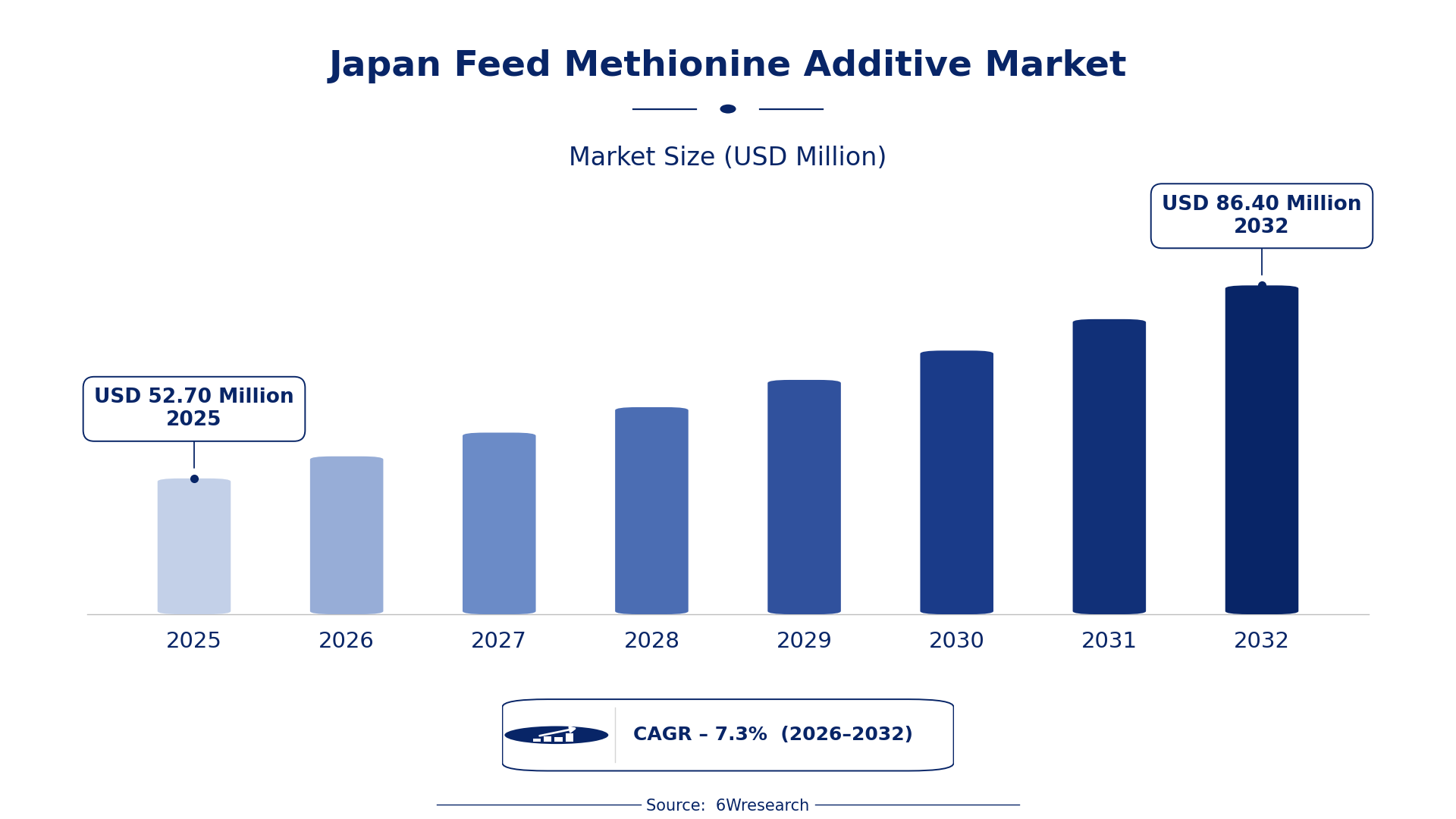
According to 6Wresearch internal database and industry insights, the Japan Feed Methionine Additive Market was valued at USD 52.70 Million in 2025 and is projected to reach USD 86.40 Million by 2032, growing at a CAGR of approximately 7.3% during 2026–2032.
Japan Feed Methionine Additive Market Highlights
| Report Metric | Details |
| Report Name | Japan Feed Methionine Additive Market (2026-2032) |
| Market Size 2025 | USD 52.70 Million |
| Market Size 2032 | USD 86.40 Million |
| Absolute Growth 2025–2032 | USD 33.70 Million |
| CAGR 2026–2032 | 7.3% |
| Peak Annual Growth | 8.2% in 2032 |
| Forecast Period | 2026–2032 |
| Historical Data | 2022–2025 |
| Base Year | 2025 |
| Leading Product Type, 2025 | Synthetic Methionine (51% share) |
| Leading Additive Type, 2025 | Amino Acid Additive (42% share) |
| Leading Application Area, 2025 | Poultry Feed (47% share) |
| Leading Distribution Channel, 2025 | Feed Distributors (47% share) |
| Leading End User, 2025 | Feed Manufacturers (40% share) |
| Fastest-Growing Product Type | Liquid Methionine (10.3% CAGR) |
| Fastest-Growing Additive Type | Nutritional Supplement (10.1% CAGR) |
| Fastest-Growing Application Area | Livestock Nutrition (8.6% CAGR) |
| Fastest-Growing Distribution Channel | Direct Sales (9.0% CAGR) |
| Fastest-Growing End User | Farms (9.2% CAGR) |
| Growing Sector | Livestock Nutrition |
| Key End Users | Poultry Feed, Livestock Nutrition, Ruminant Feed |
Japan Feed Methionine Additive Market Year-wise Growth Rate and Key Drivers (2022–2032)
This graph illustrates the annual growth rates of the market from 2022 to 2032, highlighting a steady upward trajectory and projected market expansion over the forecast period.
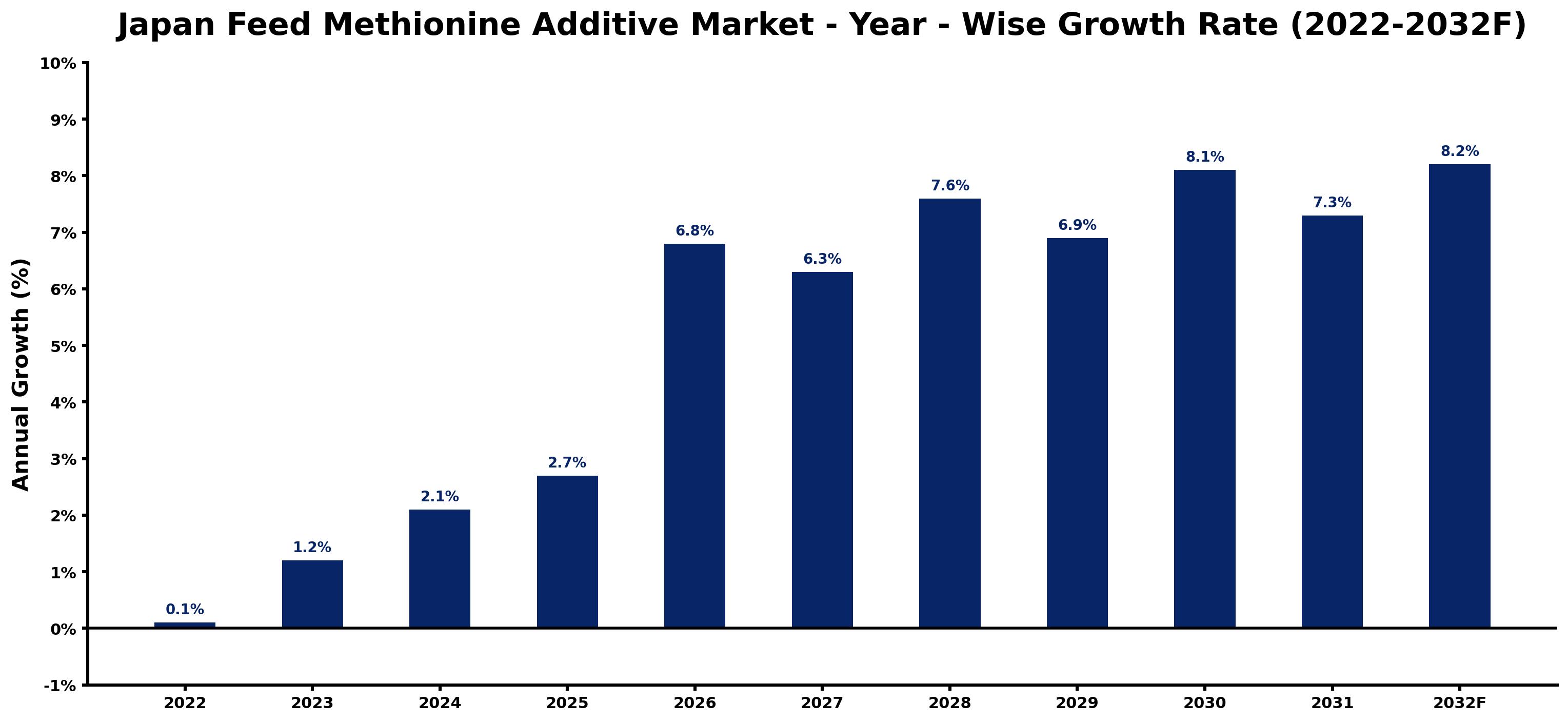
The yearly estimates that follow link every growth rate to its principal driver, so readers can see why the pace changed in each period.
| Year | Estimated Annual Growth (%) | Market Rationale |
| 2022 | 0.1 | The market showed minimal growth due to stable feed prices and steady demand. |
| 2023 | 1.2 | Growth accelerated as poultry production increased, driving higher feed additive requirements. |
| 2024 | 2.1 | Continued growth was supported by rising livestock health awareness among farmers. |
| 2025 | 2.7 | Demand surged as feed conversion ratios improved, increasing profitability for producers. |
| 2026 | 6.8 | Growth is expected to accelerate further as investments in feed efficiency technologies rise. |
| 2027 | 6.3 | Growth is projected to slow slightly due to market saturation in certain feed types. |
| 2028 | 7.6 | Demand is expected to rebound with increased poultry production and health-focused feed formulations. |
| 2029 | 6.9 | A slight slowdown is projected as competition intensifies among feed manufacturers. |
| 2030 | 8.1 | Growth is expected to pick up again as new nutritional standards are adopted in the industry. |
| 2031 | 7.3 | The market is projected to experience a slowdown as producers adjust to changing regulations. |
| 2032 | 8.2 | Demand is expected to peak due to heightened focus on sustainable livestock practices and efficiency. |
Note: Market size estimations and growth projections presented in this report are based on 6Wresearch's proprietary forecasting methodology, utilizing the latest available industry data, government publications, and primary research inputs.
Japan Feed Methionine Additive Market Synopsis
Feed Methionine Additive is a synthetic amino acid used in animal nutrition to improve growth and feed efficiency. The Japan Feed Methionine Additive Market is expanding due to rising poultry production, increased health awareness among farmers, and government initiatives promoting sustainable livestock practices. With the livestock sector contributing 5% to agricultural output, demand from feed manufacturers and farms is driving this growth, particularly in regions like Hokkaido and Kyushu.
Market Dynamics Impact Analysis (2026–2032)
| Factor | Type | Impact | Primary Segment Affected |
| Rising poultry production in regions like Hokkaido | Driver | High | Poultry Feed |
| Increased focus on animal health and nutrition | Driver | High | Amino Acid Additive |
| Growth in specialized feed formulations for young animals | Opportunity | Medium | Encapsulated Methionine |
| Expansion of feed distributors in rural areas | Opportunity | Medium | Feed Distributors |
| Regulatory compliance costs for feed manufacturers | Restraint | High | Feed Manufacturers |
| Market saturation in some feed types | Restraint | Medium | Liquid Methionine |
| High production costs affecting profitability | Challenge | High | Feed Manufacturers |
| Competition from alternative feed additives | Challenge | Medium | Nutritional Supplement |
Evaluation of Drivers in Japan Feed Methionine Additive Market (2026–2032)
The following drivers explain most of the expected growth.
| Drivers | Primary Segment Affected | Why It Matters (Evidence) |
| Increased poultry population | Poultry Feed | Japan's poultry population of approximately 150 million birds leads to higher demand for feed additives. |
| Focus on improving feed conversion ratios | Amino Acid Additive | The average feed conversion ratio for poultry is around 1.7 kg feed per kg meat, driving demand for additives. |
| Support for sustainable livestock practices | Nutritional Supplement | The Ministry of Agriculture, Forestry and Fisheries promotes sustainable practices, increasing the need for nutritional supplements. |
| Growth in the livestock sector | Livestock Nutrition | Japan's livestock sector represented 5% of the total agricultural output in 2023, boosting feed additive demand. |
| Rising consumer awareness of animal health | Encapsulated Methionine | Encapsulated Methionine is gaining traction for its controlled release benefits in specialized feeds for young animals. |
Behind the steady rise in orders sits Japan's poultry population, which is approximately 150 million birds, boosting demand for feed additives. The average feed conversion ratio for poultry is around 1.7 kg feed per kg meat, creating a need for amino acid additives. In 2023, the livestock sector represented 5% of total agricultural output, indicating strong growth potential. Growing consumer awareness of animal health is making encapsulated methionine increasingly popular in specialised feeds for young animals.
Evaluation of Restraints in Japan Feed Methionine Additive Market
These are the pressures that could keep growth below its potential.
| Market Restraint | Primary Segment Affected | Why It Matters (Evidence) |
| High compliance costs for JIS standards | Feed Manufacturers | Regulatory compliance under JIS standards increases operational costs, impacting profitability for feed manufacturers. |
| Market saturation in certain feed types | Liquid Methionine | Market saturation in liquid methionine limits growth opportunities for producers, affecting overall sales. |
| Limited adoption of new feed technologies | Nutritional Supplement | Slow adoption of new feed technologies restricts growth in the nutritional supplement segment. |
| High competition among feed manufacturers | Amino Acid Additive | Intense competition among manufacturers leads to price wars, reducing profit margins for amino acid additives. |
| Dependence on raw material prices | Poultry Feed | Fluctuating raw material prices impact production costs, affecting pricing strategies for poultry feed. |
Japan Feed Methionine Additive Market Challenges
Buyers in Japan's feed industry face difficulties with outdated technology in feed production, which can raise costs by 10% for livestock farmers. Suppliers encounter fierce competition from alternative feed additives, pressuring profit margins and potentially reducing their market share by 15%. Buyers also struggle with fluctuating prices for raw materials, causing unpredictability in feed costs that can delay procurement decisions for feed manufacturers. Regulatory compliance with JIS standards complicates operations, increasing costs for suppliers by 5%, ultimately impacting pricing for feed manufacturers.
Trends in the Japan Feed Methionine Additive Market
Several trends are reshaping the Japan Feed Methionine Additive Market; the most important are set out below.
- Shift from Traditional to Specialized Feed: Since 2022, the feed industry in Japan has been moving towards specialised formulations, particularly for young animals. This shift is evidenced by the increasing adoption of encapsulated methionine, which is gaining traction in specialised feed formulations.
- Transition from Liquid to Solid Methionine: In recent years, there has been a noticeable transition from liquid methionine to solid forms in the feed market. This change is driven by the preference of feed manufacturers for solid additives, which accounted for over 70% of the market in 2023.
- Poultry Feed Prioritised over Livestock Nutrition: As of 2023, poultry feed has been prioritised in the feed additive market, capturing 47% of the total market share. This focus is due to the increasing poultry population and demand for efficient growth solutions.
- Emerging Demand for Nutritional Supplements: The demand for nutritional supplements has been on the rise since 2022, with these products accounting for approximately 30% of the total feed additive market. This trend reflects farmers' growing awareness of animal health and productivity.
Investment Opportunities in the Japan Feed Methionine Additive Market
The openings below show where demand in the Japan Feed Methionine Additive Market is visible and how suppliers can enter.
- Hokkaido Feed Manufacturing Facilities: In Hokkaido, there is a growing opportunity to supply specialised feed formulations, with the local market showing a demand increase of 8% in the past year. Collaborating with regional feed manufacturers can facilitate market entry.
- Current Market Timing: With the livestock sector representing 5% of agricultural output, now is an ideal time to invest in feed efficiency technologies. This investment aligns with the government's target to reduce feed costs by 10% by 2025.
- Nutritional Supplement Demand: The nutritional supplement segment, accounting for 30% of the total feed additive market, presents a significant opportunity. Focusing on this area can attract feed manufacturers looking to improve animal health.
- Specialised Feed Formulations: The rising interest in encapsulated methionine creates a chance to supply this product type. Engaging with nutrition companies can help tap into this niche market.
Government Initiatives in the Japan Feed Methionine Additive Market
The Electrical Appliance and Material Safety Act, established in 1961, mandates safety standards for animal feed additives, including Feed Methionine. The Chemical Substances Control Law of 1973 requires thorough evaluation and control of chemical substances used in production. More recently, the Economic Security Promotion Act of 2022 aims to enhance supply-chain resilience for critical materials, ensuring that producers adhere to safety and quality standards while promoting sustainable practices within the feed industry.
In 2023, the Ministry of Agriculture, Forestry and Fisheries allocated funding to support research on feed efficiency, benefiting livestock farmers and feed manufacturers. The Japan Feed Association plays a crucial role in developing industry standards and practices, ensuring compliance with regulations. These measures collectively improve the quality and safety of Feed Methionine Additive, ultimately benefiting end users by promoting better animal health and productivity.
Future Insight of the Japan Feed Methionine Additive Market
Investment in advanced processing technology will streamline production and create demand for improved formulations. The Japanese government's support for research on feed efficiency will drive innovation, benefiting both suppliers and livestock farmers. Encapsulated Methionine is anticipated to represent 30% of the total feed additive market, catering to specific nutritional needs. New sustainability standards will encourage suppliers to align with environmental goals, ensuring they meet buyer demands for cost-effective and nutritious feed.
Market Segmentation Analysis
Japan Feed Methionine Additive Market report covers a detailed analysis of the following market segments:
By Product Type – Synthetic Methionine Leads, Liquid Methionine Expected to Grow Fastest
According to Vasu Joshi, Associate Consultant at 6Wresearch, in 2025, Synthetic Methionine led the product type split with a 51% share. Synthetic Methionine holds the largest share because it is essential for animal nutrition and growth, particularly in poultry. The substantial poultry population in Japan, approximately 150 million birds as of 2022, drives demand for this product. The quickest growth will come from Liquid Methionine, forecast to expand at a CAGR of 10.3% between 2026 and 2032. Liquid Methionine is experiencing rapid growth due to its increasing use in specific nutritional formulations for young animals. This trend aligns with government initiatives to improve feed efficiency and reduce costs by 10% by 2025. Suppliers should focus on enhancing the availability of Liquid Methionine to meet the growing demand in specialized feed formulations.
By Additive Type – Amino Acid Additive Leads, Nutritional Supplement Expected to Grow Fastest
With 42% of additive type revenue in 2025, Amino Acid Additive was the largest category. Amino Acid Additive dominates the market as it is crucial for maintaining balanced diets in livestock, ensuring optimal health and productivity. The importance of this segment is underscored by nutritional supplements accounting for about 30% of the total feed additive market in Japan. Over 2026–2032, Nutritional Supplement is expected to post the fastest growth, at a CAGR of 10.1%. Nutritional Supplement is the fastest-growing segment, as awareness of animal health and productivity increases among farmers. The promotion of sustainable livestock practices by the government further boosts the demand for these supplements. Buyers should consider investing in nutritional supplements to enhance the overall health and productivity of their livestock.
By Application Area – Poultry Feed Leads, Livestock Nutrition Expected to Grow Fastest
Poultry Feed accounted for 47% of the market by application area in 2025. Poultry Feed is the leading application area for Feed Methionine due to its direct impact on the growth and health of poultry, a major part of the livestock sector. The average feed conversion ratio for poultry in Japan, around 1.7 kg feed per kg meat, highlights the importance of nutritional additives. Livestock Nutrition is set to record the highest CAGR in this split, 8.6% over 2026–2032. Livestock Nutrition is growing rapidly as it encompasses a wider range of livestock, reflecting the increasing demand for balanced nutrition across various animal species. The livestock sector in Japan employs over 200,000 people directly, indicating a robust market for nutritional enhancements. Suppliers should expand their offerings to cater to the diverse nutritional needs of livestock beyond poultry.
By Distribution Channel – Feed Distributors Lead, Direct Sales Expected to Grow Fastest
Feed Distributors took 47% of distribution channel revenue in 2025, more than any other category. Feed Distributors are the primary channel for reaching end users, ensuring that feed manufacturers and farms have access to essential additives. With over 300 active companies in this sector, distributors play a crucial role in the supply chain. Direct Sales is projected to grow fastest, at a CAGR of 9.0% during 2026–2032. Direct Sales is gaining traction as a distribution method, particularly for specialised products that require tailored solutions. This shift may reflect the increasing demand for direct engagement between suppliers and end users. Suppliers may need to develop direct sales strategies to effectively reach and serve their customers.
By End User – Feed Manufacturers Lead, Farms Expected to Grow Fastest
The largest end user category in 2025 was Feed Manufacturers, at 40% of revenue. Feed Manufacturers are the largest consumers of Feed Methionine additives, as they formulate feeds that meet the nutritional needs of various livestock. Their pivotal role in the feed industry is evident in the substantial total feed production of approximately 18 million tons in Japan in 2022. The quickest growth will come from Farms, forecast to expand at a CAGR of 9.2% between 2026 and 2032. Farms are rapidly becoming the fastest-growing end user segment, as they seek to optimise the nutritional value of the feed they purchase. This trend is driven by the need for improved animal health and productivity in a competitive market. Suppliers should strengthen relationships with farms to ensure their products meet the evolving nutritional requirements.
Key Attractiveness of the Report
- 10 Years of Market Numbers
- Historical Data Starting from 2022 to 2025
- Base Year 2025
- Forecast Data until 2032
- Key Performance Indicators Impacting the Market
- Major Upcoming Developments and Projects
Key Highlights of the Report:
- Japan Feed Methionine Additive Market Outlook
- Market Size of Japan Feed Methionine Additive Market, 2025
- Forecast of Japan Feed Methionine Additive Market, 2032
- Historical Data and Forecast of Japan Feed Methionine Additive Market Revenues & Volume for the Period 2022-2032F
- Japan Feed Methionine Additive Market Trend Evolution
- Japan Feed Methionine Additive Market Drivers and Challenges
- Japan Feed Methionine Additive Market Price Trends
- Japan Feed Methionine Additive Market Porter's Five Forces
- Japan Feed Methionine Additive Market Industry Life Cycle
- Historical Data and Forecast of Japan Feed Methionine Additive Market Revenues & Volume By Product Type for the Period 2022-2032F
- Historical Data and Forecast of Japan Feed Methionine Additive Market Revenues & Volume By Synthetic Methionine for the Period 2022-2032F
- Historical Data and Forecast of Japan Feed Methionine Additive Market Revenues & Volume By Liquid Methionine for the Period 2022-2032F
- Historical Data and Forecast of Japan Feed Methionine Additive Market Revenues & Volume By Encapsulated Methionine for the Period 2022-2032F
- Historical Data and Forecast of Japan Feed Methionine Additive Market Revenues & Volume By Additive Type for the Period 2022-2032F
- Historical Data and Forecast of Japan Feed Methionine Additive Market Revenues & Volume By Amino Acid Additive for the Period 2022-2032F
- Historical Data and Forecast of Japan Feed Methionine Additive Market Revenues & Volume By Nutritional Supplement for the Period 2022-2032F
- Historical Data and Forecast of Japan Feed Methionine Additive Market Revenues & Volume By Controlled Release for the Period 2022-2032F
- Historical Data and Forecast of Japan Feed Methionine Additive Market Revenues & Volume By Application Area for the Period 2022-2032F
- Historical Data and Forecast of Japan Feed Methionine Additive Market Revenues & Volume By Poultry Feed for the Period 2022-2032F
- Historical Data and Forecast of Japan Feed Methionine Additive Market Revenues & Volume By Livestock Nutrition for the Period 2022-2032F
- Historical Data and Forecast of Japan Feed Methionine Additive Market Revenues & Volume By Ruminant Feed for the Period 2022-2032F
- Historical Data and Forecast of Japan Feed Methionine Additive Market Revenues & Volume By Distribution Channel for the Period 2022-2032F
- Historical Data and Forecast of Japan Feed Methionine Additive Market Revenues & Volume By Feed Distributors for the Period 2022-2032F
- Historical Data and Forecast of Japan Feed Methionine Additive Market Revenues & Volume By Direct Sales for the Period 2022-2032F
- Historical Data and Forecast of Japan Feed Methionine Additive Market Revenues & Volume By OEM Supply for the Period 2022-2032F
- Historical Data and Forecast of Japan Feed Methionine Additive Market Revenues & Volume By End User for the Period 2022-2032F
- Historical Data and Forecast of Japan Feed Methionine Additive Market Revenues & Volume By Feed Manufacturers for the Period 2022-2032F
- Historical Data and Forecast of Japan Feed Methionine Additive Market Revenues & Volume By Farms for the Period 2022-2032F
- Historical Data and Forecast of Japan Feed Methionine Additive Market Revenues & Volume By Nutrition Companies for the Period 2022-2032F
- Japan Feed Methionine Additive Market Import Export Trade Statistics
- Market Opportunity Assessment By Product Type
- Market Opportunity Assessment By Additive Type
- Market Opportunity Assessment By Application Area
- Market Opportunity Assessment By Distribution Channel
- Market Opportunity Assessment By End User
- Japan Feed Methionine Additive Market Top Companies Market Share
- Japan Feed Methionine Additive Market Competitive Benchmarking By Technical and Operational Parameters
- Japan Feed Methionine Additive Market Company Profiles
- Japan Feed Methionine Additive Market Key Strategic Recommendations
Market Covered
The report covers the following segments.
By Product Type
- Synthetic Methionine
- Liquid Methionine
- Encapsulated Methionine
By Additive Type
- Amino Acid Additive
- Nutritional Supplement
- Controlled Release
By Application Area
- Poultry Feed
- Livestock Nutrition
- Ruminant Feed
By Distribution Channel
- Feed Distributors
- Direct Sales
- OEM Supply
By End User
- Feed Manufacturers
- Farms
- Nutrition Companies






































