Japan Fermented Foods Beverages Market Size & Growth Rate
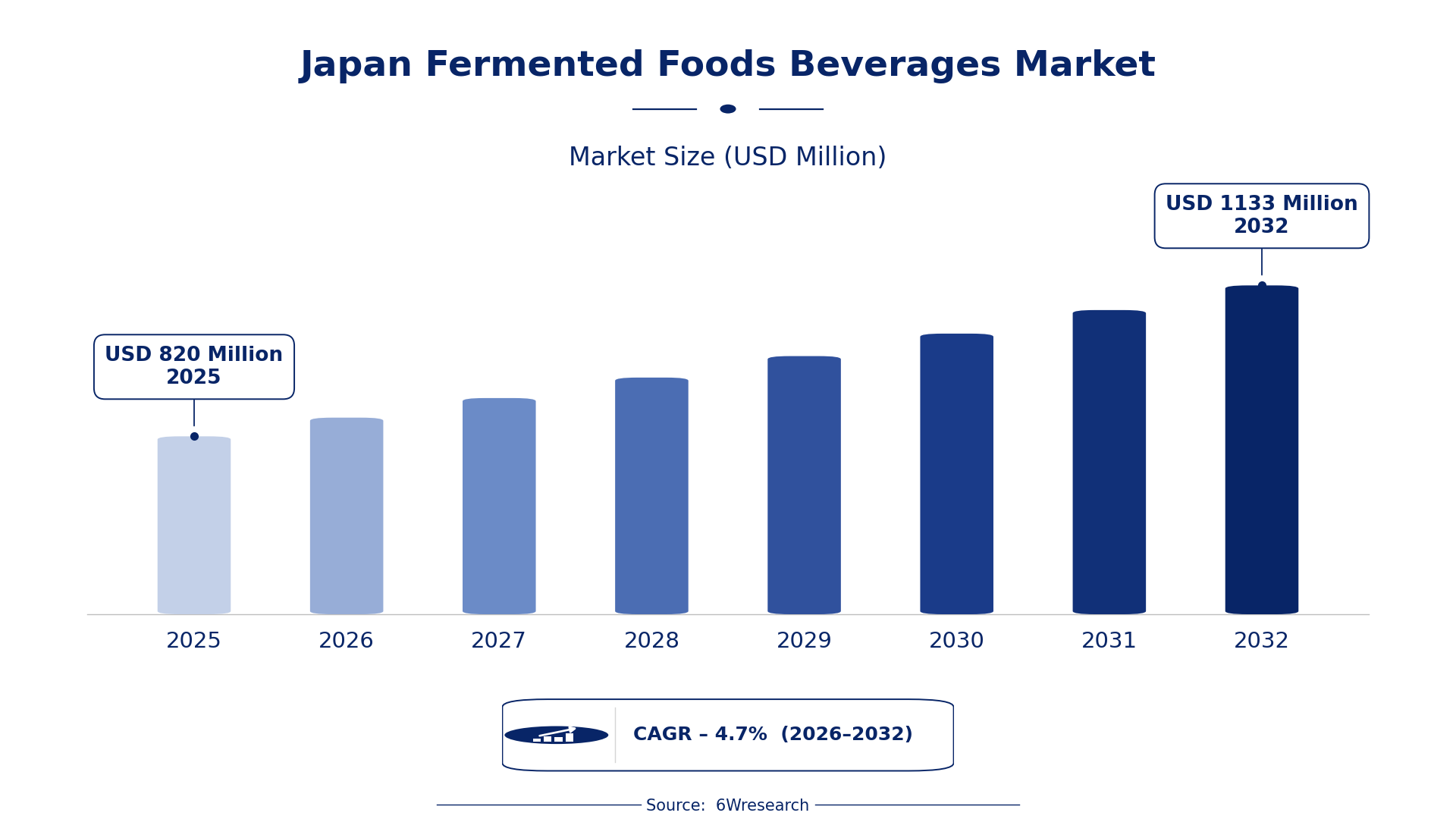
According to 6Wresearch internal database and industry insights, the Japan Fermented Foods Beverages Market was valued at USD 820 Million in 2025 and is projected to reach USD 1,133 Million by 2032, growing at a CAGR of approximately 4.7% during 2026–2032.
Japan Fermented Foods Beverages Market Highlights
| Report Metric | Details |
| Report Name | Japan Fermented Foods Beverages Market (2026-2032) |
| Market Size 2025 | USD 820 Million |
| Market Size 2032 | USD 1,133 Million |
| Absolute Growth 2025–2032 | USD 313 Million |
| CAGR 2026–2032 | 4.7% |
| Peak Annual Growth | 5.6% in 2032 |
| Forecast Period | 2026–2032 |
| Historical Data | 2022–2025 |
| Base Year | 2025 |
| Leading Type, 2025 | Dairy-based (42% share) |
| Leading Application, 2025 | Dairy Products (44% share) |
| Leading Distribution Channel, 2025 | Supermarkets & Hypermarkets (43% share) |
| Fastest-Growing Type | Non-alcoholic (6.6% CAGR) |
| Fastest-Growing Application | Functional Beverages (7.1% CAGR) |
| Fastest-Growing Distribution Channel | Online Retail (6.3% CAGR) |
| Growing Sector | Functional Beverages |
| Key End Users | Consumers, health-conscious buyers, food service providers, retailers |
Japan Fermented Foods Beverages Market Year-wise Growth Rate and Key Drivers (2022–2032)
This graph illustrates the annual growth rates of the market from 2022 to 2032, highlighting a steady upward trajectory and projected market expansion over the forecast period.
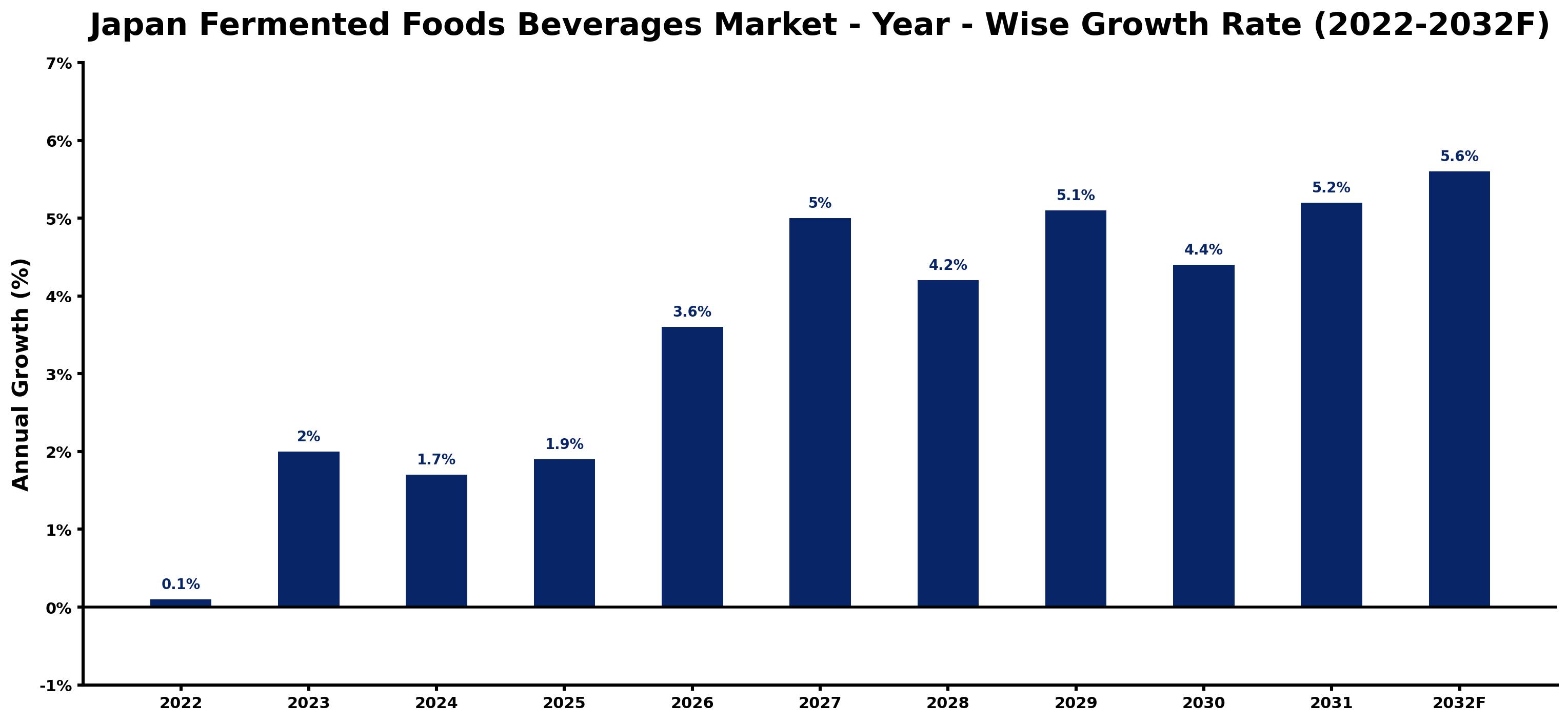
Each row of the following table gives one year's estimated growth and the event or demand shift that explains it.
| Year | Estimated Annual Growth (%) | Market Rationale |
| 2022 | 0.1 | The market experienced minimal growth due to ongoing economic adjustments. |
| 2023 | 2.0 | Growth accelerated as consumer interest in health-focused products increased. |
| 2024 | 1.7 | A slowdown occurred as market saturation in certain segments began to take effect. |
| 2025 | 1.9 | Demand rose again as traditional products gained renewed consumer interest. |
| 2026 | 3.6 | Growth is expected to pick up as health awareness drives purchases of functional beverages. |
| 2027 | 5.0 | The market is projected to expand further with increasing popularity of non-alcoholic options. |
| 2028 | 4.2 | Growth is anticipated to slow slightly as competition intensifies among established brands. |
| 2029 | 5.1 | Demand is expected to surge as new fermented products attract diverse consumer segments. |
| 2030 | 4.4 | A slight slowdown is projected as market dynamics stabilise after rapid growth. |
| 2031 | 5.2 | Growth is anticipated to accelerate again as exports of traditional products increase. |
| 2032 | 5.6 | The market is expected to peak with strong demand for both alcoholic and non-alcoholic beverages. |
Note: Market size estimations and growth projections presented in this report are based on 6Wresearch's proprietary forecasting methodology, utilizing the latest available industry data, government publications, and primary research inputs.
Japan Fermented Foods Beverages Market Synopsis
Fermented foods and beverages in Japan are produced through fermentation processes that enhance flavour, preservation, and nutritional value. The Japan Fermented Foods Beverages Market is projected to grow from USD 820 million in 2025 to USD 1,133 million by 2032, driven by rising health consciousness and demand for probiotics. The increasing popularity of functional beverages and traditional products like miso, which are integral to Japanese cuisine, will fuel this growth.
Market Dynamics Impact Analysis (2026–2032)
| Factor | Type | Impact | Primary Segment Affected |
| Rising health consciousness among consumers | Driver | High | Functional Beverages |
| Growing demand for traditional products like miso and sake | Driver | High | Alcoholic |
| Expansion of online retail channels | Opportunity | High | Online Retail |
| Increased interest in probiotic-rich foods | Opportunity | Medium | Dairy Products |
| Regulatory compliance costs for producers | Restraint | High | Dairy Products |
| Market saturation in certain segments | Restraint | Medium | Functional Beverages |
| High production costs due to labour expenses | Challenge | High | Non-alcoholic |
| Limited capacity for new entrants in traditional markets | Challenge | Medium | Alcoholic |
Evaluation of Drivers in Japan Fermented Foods Beverages Market (2026–2032)
The main growth drivers and the segments they affect most are set out below.
| Drivers | Primary Segment Affected | Why It Matters (Evidence) |
| Health awareness driving demand for probiotics | Functional Beverages | The average Japanese consumes about 10 kg of fermented foods annually, boosting interest in health-focused products. |
| Cultural significance of traditional fermented products | Alcoholic | With over 1,000 sake breweries, the cultural heritage drives consistent demand for sake and other beverages. |
| Increased accessibility through online platforms | Online Retail | The rise of e-commerce has led to a notable increase in online retail for fermented foods. |
| Growing interest in gut health | Dairy Products | The annual consumption of yogurt in Japan is around 1.5 million tons, indicating strong demand for dairy-based products. |
| Product development in non-alcoholic beverages | Non-alcoholic | The market for non-alcoholic beverages is expanding rapidly, appealing to health-conscious consumers. |
Purchasing is picking up as the average Japanese consumes about 10 kg of fermented foods annually, reflecting a growing interest in gut health. The annual consumption of yogurt in Japan is around 1.5 million tons, driving demand for dairy-based products. Cultural significance fuels consistent demand for traditional beverages, with over 1,000 sake breweries contributing to market stability. The rise of e-commerce has made fermented foods more accessible, attracting a wider consumer base. Product development in non-alcoholic beverages is drawing health-conscious consumers, further boosting market growth.
Evaluation of Restraints in Japan Fermented Foods Beverages Market
The main factors holding the market back are set out below.
| Market Restraint | Primary Segment Affected | Why It Matters (Evidence) |
| High production costs due to labour expenses | Non-alcoholic | Japan's national weighted-average minimum wage rose to JPY 1,055 per hour, impacting production costs. |
| Regulatory compliance costs for producers | Dairy Products | The Food Sanitation Act amendment requires stringent hygiene management, increasing operational costs. |
| Market saturation in certain segments | Functional Beverages | The proliferation of similar products has led to intensified competition and limited growth opportunities. |
| Limited capacity for new entrants in traditional markets | Alcoholic | Established brands dominate the market, making it difficult for newcomers to gain a foothold. |
| Consumer preference for established brands | Dairy Products | Brand loyalty in dairy products limits the market share for new entrants. |
Japan Fermented Foods Beverages Market Challenges
Intense competition from global markets drives local producers to reduce prices, which can diminish profit margins for suppliers. A shortage of skilled workers in fermentation techniques hampers innovation, leading to stagnation for producers unable to meet evolving consumer preferences. Disruptions in the supply chain, especially in sourcing high-quality ingredients, extend production timelines for manufacturers, affecting their capacity to satisfy market demand. Stringent regulations imposed by the Japanese Food Safety Agency increase compliance costs, compelling buyers to pay higher prices for safe products, which ultimately limits their purchasing power.
Trends in the Japan Fermented Foods Beverages Market
Buyers and suppliers in the Japan Fermented Foods Beverages Market are adjusting to the following trends.
- Health-Conscious Consumers Preferring Functional Beverages: Consumers are increasingly opting for functional beverages, such as kombucha, which has seen a rise in popularity. The annual consumption of yogurt in Japan stands at approximately 1.5 million tons, indicating a shift towards health-focused products.
- E-commerce Growth in Fermented Foods: The online retail channel for fermented foods is expanding rapidly, with a growth rate of 6.3%. This shift is noticeable in urban areas like Tokyo, where consumers are increasingly purchasing fermented products online.
- Resurgence of Traditional Fermented Products: Traditional products like miso are experiencing a resurgence, with over 200 varieties available in Japan. This trend reflects a growing appreciation for heritage foods among younger consumers.
- Rise of Non-alcoholic Beverages: The non-alcoholic segment is emerging strongly, with a projected growth rate of 6.6%. This trend is particularly noticeable in urban centres, where health-conscious consumers seek alternatives to alcoholic beverages.
Investment Opportunities in the Japan Fermented Foods Beverages Market
Where to invest in the Japan Fermented Foods Beverages Market: the main openings are set out below.
- Potential in Functional Beverage Market: The market for functional beverages is expanding, with rising consumer interest in health-focused products. Producers should focus on probiotic drinks to meet this demand, particularly among health-conscious buyers.
- Ideal Timing for Traditional Fermented Products: With a growing interest in traditional foods, now is the ideal time to invest in artisanal miso production. This opportunity is particularly relevant for local producers in regions known for their culinary heritage.
- Growth of Online Retail for Fermented Products: The online retail channel is expanding rapidly, with a growth rate of 6.3%. Companies should consider partnerships with e-commerce platforms to reach a broader audience.
- Increasing Demand for Non-alcoholic Beverages: The non-alcoholic beverage segment is experiencing rapid growth, driven by health-conscious consumers. Suppliers should focus on developing products that cater to this growing market.
Government Initiatives in the Japan Fermented Foods Beverages Market
The Food Sanitation Act amendment, fully applied in June 2021, mandates HACCP-based hygiene management for food businesses, ensuring safety in fermented food production. This regulation impacts producers, requiring them to implement stringent hygiene protocols, thereby building consumer trust in their products. The Japanese government allocated JPY 1 billion for 2023 to support local fermentation businesses. The Ministry of Agriculture, Forestry and Fisheries oversees this initiative, helping producers improve their processes and maintain high standards.
The Japanese government allocated JPY 1 billion for 2023 to support local fermentation businesses. The Ministry of Agriculture, Forestry and Fisheries oversees this initiative, helping producers improve their processes and maintain high standards.
Future Insight of the Japan Fermented Foods Beverages Market
Consumers will demand fermented foods that enhance gut health, leading suppliers to diversify their product lines. Innovations in fermentation methods will optimise production efficiency, allowing producers to respond to growing demand. By 2032, the annual consumption of fermented beverages is expected to rise by 5%, reflecting a broader trend towards healthier eating habits. Government support for local fermentation initiatives will attract new market entrants, expanding choices for consumers and revitalising the industry.
Market Segmentation Analysis
Japan Fermented Foods Beverages Market report covers a detailed analysis of the following market segments:
By Type – Dairy-based Leads, Non-alcoholic Expected to Grow Fastest
According to Sachin Kumar Rai, Senior Research Analyst at 6Wresearch, with 42% of type revenue in 2025, Dairy-based was the largest category. Dairy-based products dominate the market as they are essential staples in Japanese diets, particularly in forms like yogurt and cheese. The substantial consumption of fermented foods, with the average Japanese consuming about 10 kg annually, highlights the importance of dairy in this segment. Non-alcoholic is projected to grow fastest, at a CAGR of 6.6% during 2026–2032. The Non-alcoholic segment is experiencing rapid growth due to increasing consumer interest in health-oriented beverages, including options like kombucha. This trend is supported by government initiatives that promote local fermentation techniques, fostering innovation in this area. Suppliers should focus on enhancing their dairy-based offerings while also tapping into the growing non-alcoholic beverage market.
By Application – Dairy Products Lead, Functional Beverages Expected to Grow Fastest
In 2025, Dairy Products led the application split with a 44% share. Dairy Products lead the market as they include popular staples like yogurt and fermented milk, which are integral to Japanese dietary habits. The annual consumption of yogurt in Japan, estimated at around 1.5 million tons, underscores the significance of dairy in the fermented foods sector. The quickest growth will come from Functional Beverages, forecast to expand at a CAGR of 7.1% between 2026 and 2032. Functional Beverages are gaining traction as consumers increasingly seek products that offer health benefits, particularly those that support gut health. This segment's growth is propelled by rising awareness of probiotics and their positive effects on digestion. Buyers are likely to demand more functional options, prompting suppliers to expand their product lines to include health-focused beverages.
By Distribution Channel – Supermarkets & Hypermarkets Lead, Online Retail Expected to Grow Fastest
Supermarkets & Hypermarkets held 43% of the Japan Fermented Foods Beverages Market by distribution channel in 2025. Supermarkets & Hypermarkets are the primary distribution channels for fermented foods, providing mass accessibility to a wide range of products. This extensive reach enables consumers to easily find popular items like miso and yogurt in their local stores. Online Retail is set to record the highest CAGR in this split, 6.3% over 2026–2032. Online Retail is rapidly becoming a preferred shopping option, particularly for health-conscious consumers seeking niche fermented products. The shift towards e-commerce is reshaping consumer access to these offerings, necessitating adaptation from suppliers. Suppliers should enhance their online presence to cater to the increasing demand for convenient purchasing options.
Key Attractiveness of the Report
- 10 Years of Market Numbers
- Historical Data Starting from 2022 to 2025
- Base Year 2025
- Forecast Data until 2032
- Key Performance Indicators Impacting the Market
- Major Upcoming Developments and Projects
Key Highlights of the Report:
- Japan Fermented Foods Beverages Market Outlook
- Market Size of Japan Fermented Foods Beverages Market,2025
- Forecast of Japan Fermented Foods Beverages Market, 2032
- Historical Data and Forecast of Japan Fermented Foods Beverages Revenues & Volume for the Period 2022-2032
- Japan Fermented Foods Beverages Market Trend Evolution
- Japan Fermented Foods Beverages Market Drivers and Challenges
- Japan Fermented Foods Beverages Price Trends
- Japan Fermented Foods Beverages Porter's Five Forces
- Japan Fermented Foods Beverages Industry Life Cycle
- Historical Data and Forecast of Japan Fermented Foods Beverages Market Revenues & Volume By Type for the Period 2022-2032
- Historical Data and Forecast of Japan Fermented Foods Beverages Market Revenues & Volume By Dairy-based for the Period 2022-2032
- Historical Data and Forecast of Japan Fermented Foods Beverages Market Revenues & Volume By Non-dairy-based for the Period 2022-2032
- Historical Data and Forecast of Japan Fermented Foods Beverages Market Revenues & Volume By Alcoholic for the Period 2022-2032
- Historical Data and Forecast of Japan Fermented Foods Beverages Market Revenues & Volume By Non-alcoholic for the Period 2022-2032
- Historical Data and Forecast of Japan Fermented Foods Beverages Market Revenues & Volume By Application for the Period 2022-2032
- Historical Data and Forecast of Japan Fermented Foods Beverages Market Revenues & Volume By Functional Beverages for the Period 2022-2032
- Historical Data and Forecast of Japan Fermented Foods Beverages Market Revenues & Volume By Bakery & Confectionery for the Period 2022-2032
- Historical Data and Forecast of Japan Fermented Foods Beverages Market Revenues & Volume By Dairy Products for the Period 2022-2032
- Historical Data and Forecast of Japan Fermented Foods Beverages Market Revenues & Volume By Meat & Seafood for the Period 2022-2032
- Historical Data and Forecast of Japan Fermented Foods Beverages Market Revenues & Volume By Distribution Channel for the Period 2022-2032
- Historical Data and Forecast of Japan Fermented Foods Beverages Market Revenues & Volume By Online Retail for the Period 2022-2032
- Historical Data and Forecast of Japan Fermented Foods Beverages Market Revenues & Volume By Supermarkets & Hypermarkets for the Period 2022-2032
- Historical Data and Forecast of Japan Fermented Foods Beverages Market Revenues & Volume By Specialty Stores for the Period 2022-2032
- Historical Data and Forecast of Japan Fermented Foods Beverages Market Revenues & Volume By Convenience Stores for the Period 2022-2032
- Japan Fermented Foods Beverages Import Export Trade Statistics
- Market Opportunity Assessment By Type
- Market Opportunity Assessment By Application
- Market Opportunity Assessment By Distribution Channel
- Japan Fermented Foods Beverages Top Companies Market Share
- Japan Fermented Foods Beverages Competitive Benchmarking By Technical and Operational Parameters
- Japan Fermented Foods Beverages Company Profiles
- Japan Fermented Foods Beverages Key Strategic Recommendations
Market Covered
The study includes the following segmentation.
By Type
- Dairy-based
- Non-dairy-based
- Alcoholic
- Non-alcoholic
By Application
- Functional Beverages
- Bakery & Confectionery
- Dairy Products
- Meat & Seafood
By Distribution Channel
- Online Retail
- Supermarkets & Hypermarkets
- Specialty Stores
- Convenience Stores































