Japan Fertilizer Chemicals Market Size & Growth Rate
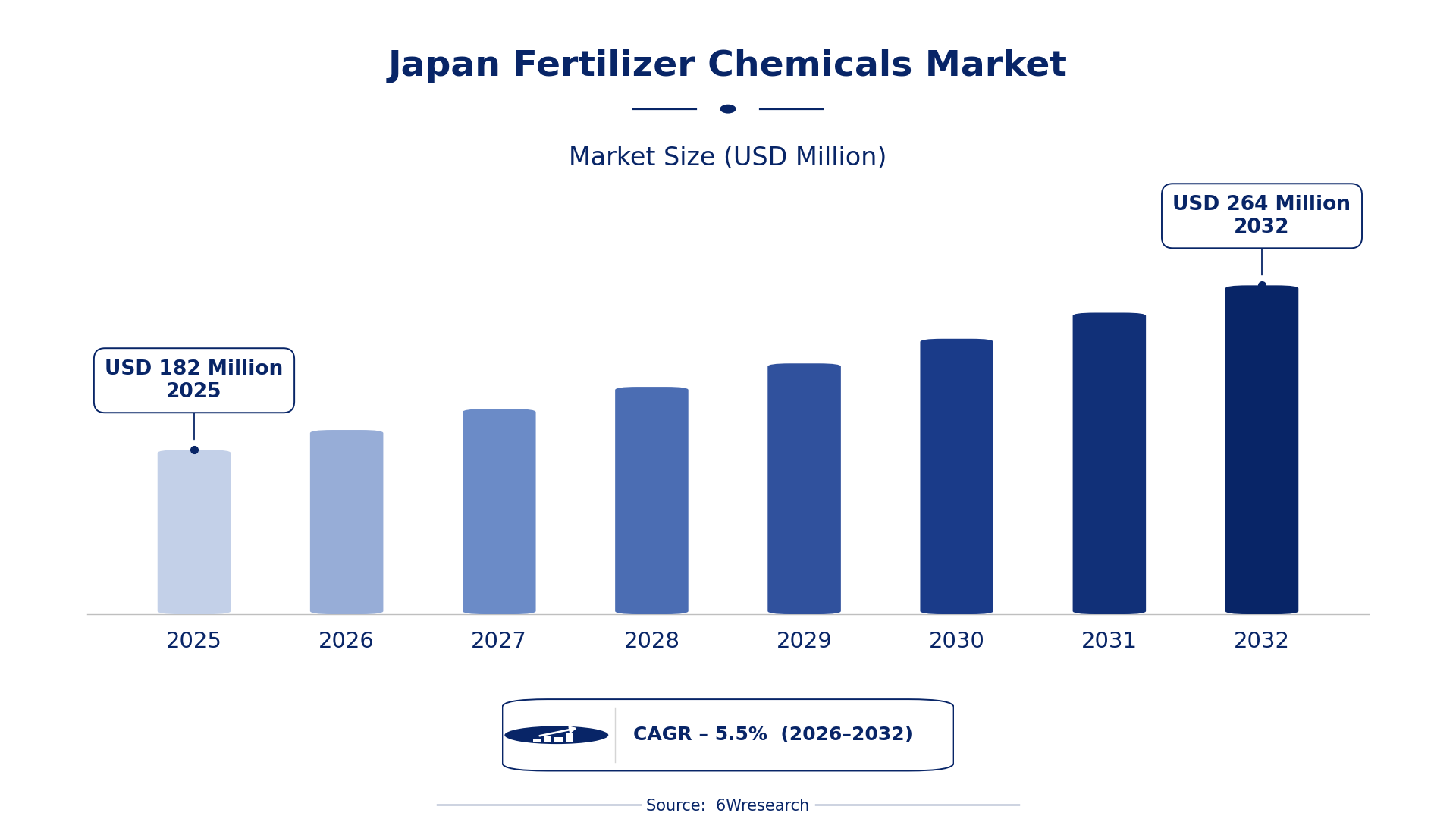
According to 6Wresearch internal database and industry insights, the Japan Fertilizer Chemicals Market was valued at USD 182 Million in 2025 and is projected to reach USD 264 Million by 2032, growing at a CAGR of approximately 5.5% during 2026–2032.
Japan Fertilizer Chemicals Market Highlights
| Report Metric | Details |
| Report Name | Japan Fertilizer Chemicals Market (2026-2032) |
| Market Size 2025 | USD 182 Million |
| Market Size 2032 | USD 264 Million |
| Absolute Growth 2025–2032 | USD 82 Million |
| CAGR 2026–2032 | 5.5% |
| Peak Annual Growth | 6.4% in 2029 |
| Forecast Period | 2026–2032 |
| Historical Data | 2022–2025 |
| Base Year | 2025 |
| Leading Chemical Type, 2025 | Nitrogen Fertilizers (45% share) |
| Leading Nutrient Composition, 2025 | Urea (45% share) |
| Leading Distribution Channel, 2025 | Agrochemical Suppliers (45% share) |
| Leading End User, 2025 | Crop Farmers (47% share) |
| Fastest-Growing Chemical Type | Micronutrients (7.8% CAGR) |
| Fastest-Growing Nutrient Composition | Zn (7.5% CAGR) |
| Fastest-Growing Distribution Channel | Online Platforms (7.3% CAGR) |
| Fastest-Growing End User | Horticulture Farms (7.2% CAGR) |
| Growing Sector | Agricultural Production |
| Key End Users | Crop Farmers, Horticulture Farms, Agri Distributors, Commercial Growers |
Japan Fertilizer Chemicals Market Year-wise Growth Rate and Key Drivers (2022–2032)
This graph illustrates the annual growth rates of the market from 2022 to 2032, highlighting a steady upward trajectory and projected market expansion over the forecast period.
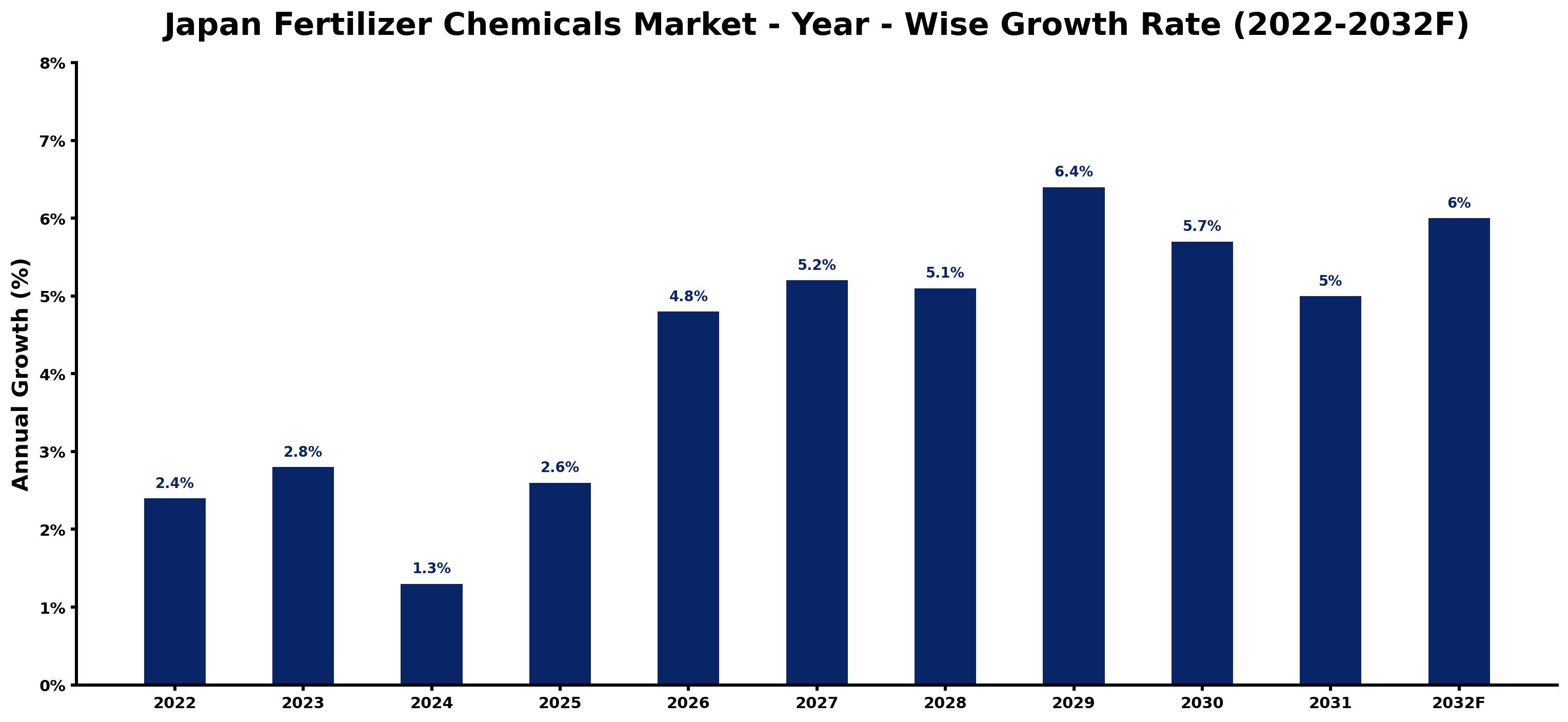
Annual growth estimates for each year appear below with the principal reason behind them, explaining the shifts that set the pace of the market.
| Year | Estimated Annual Growth (%) | Market Rationale |
| 2022 | 2.4 | The market experienced steady growth with established agricultural practices driving demand. |
| 2023 | 2.8 | Demand increased as farmers sought to improve crop yields through better fertilization. |
| 2024 | 1.3 | Growth slowed due to market saturation and a focus on sustainable practices. |
| 2025 | 2.6 | Demand rose as farmers adapted to changing agricultural policies and practices. |
| 2026 | 4.8 | The market is expected to accelerate as investments in sustainable agriculture gain traction. |
| 2027 | 5.2 | Growth will continue with rising interest in eco-friendly fertilizer solutions. |
| 2028 | 5.1 | Demand is projected to moderate as farmers adjust to market conditions and environmental regulations. |
| 2029 | 6.4 | The market is expected to peak as advanced fertilizer technologies are widely adopted. |
| 2030 | 5.7 | Growth will decelerate as the market stabilises after peak adoption rates. |
| 2031 | 5.0 | Demand will continue to slow as the market reaches maturity and competition intensifies. |
| 2032 | 6.0 | Growth is expected to resume as new agricultural initiatives and technologies emerge. |
Note: Market size estimations and growth projections presented in this report are based on 6Wresearch's proprietary forecasting methodology, utilizing the latest available industry data, government publications, and primary research inputs.
Japan Fertilizer Chemicals Market Synopsis
Fertilizer chemicals are substances used to improve soil fertility and support plant growth, derived from natural and synthetic materials. The Japan Fertilizer Chemicals Market is expanding due to increased investments in sustainable agriculture, with Japan targeting JPY 150 trillion for decarbonisation over the next decade. The agricultural sector contributes 1.1% to GDP, underscoring the importance of fertilizer chemicals in supporting food production and environmental goals. Demand is driven by agricultural production, horticulture, and landscaping, which are critical for Japan's food security and economic stability.
Market Dynamics Impact Analysis (2026–2032)
| Factor | Type | Impact | Primary Segment Affected |
| Increased focus on sustainable agriculture practices | Driver | High | Nitrogen Fertilizers |
| Growing demand for organic fertilizers | Driver | High | Micronutrients |
| Rising exports of agricultural products | Opportunity | Medium | Phosphate Fertilizers |
| Expansion of online purchasing channels | Opportunity | Medium | Potash Fertilizers |
| Regulatory restrictions on nitrogen fertilizer use | Restraint | High | Nitrogen Fertilizers |
| Aging farmer population affecting productivity | Restraint | High | Phosphate Fertilizers |
| High production costs for sustainable fertilizers | Challenge | Medium | Micronutrients |
| Competition from imported fertilizers | Challenge | Medium | Potash Fertilizers |
Evaluation of Drivers in Japan Fertilizer Chemicals Market (2026–2032)
The factors lifting demand, and the evidence behind each, are summarised below.
| Drivers | Primary Segment Affected | Why It Matters (Evidence) |
| Rising agricultural productivity demands | Nitrogen Fertilizers | Japan's agricultural sector, contributing 1.1% to GDP, requires effective fertilizers to support crop yields. |
| Increased interest in organic farming | Micronutrients | Sustainable practices are driving demand for micronutrients, as more farmers seek eco-friendly options to improve soil health. |
| Growing horticulture sector | Phosphate Fertilizers | Horticulture farms producing over 1 million tons of vegetables annually increase the need for phosphorus-rich fertilizers. |
| Investment in agricultural technology | Potash Fertilizers | Technological advancements in farming techniques lead to higher usage of fertilizers for optimal plant health and productivity. |
| Expansion of agrochemical distribution networks | Nitrogen Fertilizers | With over 1,000 agrochemical suppliers nationwide, accessibility to fertilizers is improving for farmers. |
Most of the extra volume comes from rising agricultural productivity demands as Japan's agricultural sector, contributing 1.1% to GDP, requires effective fertilizers to support crop yields. The growing horticulture sector, producing over 1 million tons of vegetables annually, increases the need for phosphorus-rich fertilizers. Investment in agricultural technology is driving higher usage of fertilizers, as farmers adopt advanced techniques to boost crop health. The expansion of agrochemical distribution networks is improving accessibility for farmers, allowing them to procure necessary fertilizers more easily.
Evaluation of Restraints in Japan Fertilizer Chemicals Market
These restraints slow adoption and weigh on supplier margins.
| Market Restraint | Primary Segment Affected | Why It Matters (Evidence) |
| Regulatory restrictions on nitrogen fertilizer use | Nitrogen Fertilizers | The use of nitrogen fertilizers is regulated to minimise environmental impact, limiting supply options for farmers. |
| Aging farmer population affecting productivity | Phosphate Fertilizers | With the average age of farmers around 67 years, productivity challenges arise, impacting fertilizer demand. |
| High production costs for sustainable fertilizers | Micronutrients | Sustainable fertilizers often come at a premium, with costs rising due to the need for eco-friendly materials. |
| Competition from imported fertilizers | Potash Fertilizers | Imported fertilizers can offer lower prices, challenging local producers in the market. |
| Limited awareness of fertilizer benefits among new farmers | Nitrogen Fertilizers | New entrants to farming may lack knowledge about the advantages of nitrogen fertilizers for crop yields. |
Japan Fertilizer Chemicals Market Challenges
High production costs for fertilizer chemicals create a significant barrier. Stringent regulations on nitrogen fertilizers increase compliance expenses for producers, leading to higher prices that burden buyers in the agricultural sector. The average age of farmers, around 67 years, results in a skilled labour shortage, which delays agricultural productivity and disrupts supply chains for producers. Intense competition from imported organic fertilizers pressures local suppliers to reduce prices, potentially squeezing profit margins and restricting investment in new technologies.
Trends in the Japan Fertilizer Chemicals Market
Several trends are reshaping the Japan Fertilizer Chemicals Market; the most important are set out below.
- Launch of Sustainable Agriculture Initiative: In 2023, Japan initiated a programme to promote sustainable agricultural practices, aiming to increase the use of organic fertilizers by 20%. This initiative is expected to influence fertilizer choices among farmers, improving soil health.
- Shift towards Organic Fertilizers: Farmers are increasingly adopting organic fertilizers to meet consumer demand for sustainably produced food. This trend is supported by government initiatives, with a projected 15% increase in organic fertilizer use by 2025.
- Growth in Online Fertilizer Sales: The rise of online platforms for purchasing fertilizers has transformed distribution channels. In 2023, online sales accounted for 10% of total fertilizer sales, reflecting changing buyer preferences and convenience.
- Increased Adoption of ISO 14001 Standards: Japan's agricultural sector is prioritising environmental management by adopting ISO 14001 standards. This shift began in 2022, with over 30% of farms expected to comply by 2025, improving sustainability in fertilizer use.
Investment Opportunities in the Japan Fertilizer Chemicals Market
Where to invest in the Japan Fertilizer Chemicals Market: the main openings are set out below.
- Crop Farmers seeking sustainable solutions: Crop farmers are increasingly looking for sustainable fertilizer options, with Japan's agricultural exports reaching approximately 1 trillion yen in 2023. Suppliers can enter this market by partnering with local distributors to provide organic fertilizers.
- Horticulture Farms requiring specialised fertilizers: With horticulture farms producing over 1 million tons of vegetables annually, there's a growing demand for specialised fertilizers. Suppliers can target this segment by offering tailored nutrient solutions and collaborating with local agricultural cooperatives.
- Agrochemical Suppliers expanding product lines: Agrochemical suppliers are looking to expand their product lines to include organic fertilizers, as consumer demand for sustainable options rises. This presents an opportunity for manufacturers to introduce new products in the market.
- Investment in digital sales channels: As online platforms for purchasing fertilizers grow, there is a strong opportunity to invest in digital sales channels. Suppliers can take advantage of this trend by developing user-friendly e-commerce platforms to reach a broader audience.
Government Initiatives in the Japan Fertilizer Chemicals Market
The Fertilizer Control Law regulates the production and distribution of fertilizers, ensuring safety and quality standards. Established in 1951, this law has shaped Japan's fertilizer market by requiring producers to adhere to strict guidelines and testing protocols. The Chemical Substances Control Law mandates the evaluation of chemical substances, impacting fertilizer formulations and their environmental compliance.
In 2023, Japan enacted the GX Promotion Act, which supports sustainable agricultural practices and encourages investments in eco-friendly fertilizers. The Ministry of Agriculture, Forestry and Fisheries oversees this initiative, aiming to promote environmentally responsible farming methods and improve soil health through organic fertilizers.
Future Insight of the Japan Fertilizer Chemicals Market
Buyers in the agricultural sector will increasingly favour organic fertilizers as the 2023 programme for improving soil health gains traction. Decarbonisation investments will rise, with JPY 150 trillion allocated over the next decade, creating opportunities for sustainable practices. Compliance with ISO 14001 standards will become crucial, aligning environmental management with buyer expectations. As agricultural exports reach approximately 1 trillion yen, a focus on quality will strengthen the competitiveness of domestic products.
Market Segmentation Analysis
Japan Fertilizer Chemicals Market report covers a detailed analysis of the following market segments:
By Chemical Type – Nitrogen Fertilizers Lead, Micronutrients Expected to Grow Fastest
According to Saurav Kr Singh, Senior Research Analyst at 6Wresearch, in 2025, Nitrogen Fertilizers led the chemical type split with a 45% share. Nitrogen fertilizers hold a dominant position in Japan due to their critical role in enhancing crop yields across various agricultural practices. Their extensive use among farmers, particularly in rice and vegetable production, reinforces their leading market share. The quickest growth will come from Micronutrients, forecast to expand at a CAGR of 7.8% between 2026 and 2032. The growth of micronutrients is propelled by the increasing focus on addressing specific nutrient deficiencies in high-value crops. This trend is evident as farmers aim to improve yield quality and overall crop health, ensuring sustained demand. Suppliers should expand their micronutrient offerings to cater to the rising demand from farmers seeking to optimise crop performance.
By Nutrient Composition – Urea Leads, Zn Expected to Grow Fastest
Urea took 45% of nutrient composition revenue in 2025, more than any other category. Urea is the most widely used nitrogen source in Japan, recognised for its effectiveness in promoting crop growth. Its established presence in the market ensures consistent demand from farmers across various agricultural sectors. Zn is set to record the highest CAGR in this split, 7.5% over 2026–2032. Zinc is gaining traction as a vital nutrient for specific crops, reflecting a growing awareness of the importance of micronutrients in agriculture. This trend is expected to accelerate as farmers increasingly prioritise crop quality and health. Buyers may need to integrate micronutrients like zinc into their fertilisation practices to enhance overall crop health and productivity.
By Distribution Channel – Agrochemical Suppliers Lead, Online Platforms Expected to Grow Fastest
Agrochemical Suppliers held 45% of the Japan Fertilizer Chemicals Market by distribution channel in 2025. Agrochemical suppliers serve as the primary distribution channel, providing essential fertilizers directly to farmers throughout Japan. Their extensive networks and established relationships ensure reliable access to necessary products in the agricultural sector. Over 2026–2032, Online Platforms are expected to post the fastest growth, at a CAGR of 7.3%. Online platforms are rapidly emerging as a preferred purchasing channel, driven by the convenience they offer to farmers. This shift in buying behaviour is particularly pronounced among younger farmers who favour digital solutions. Suppliers should enhance their online capabilities to attract the growing segment of farmers who prefer purchasing fertilizers through digital channels.
By End User – Crop Farmers Lead, Horticulture Farms Expected to Grow Fastest
With 47% of end user revenue in 2025, Crop Farmers was the largest category. Crop farmers represent the largest end user group for fertilizers, relying heavily on these products to maximise their agricultural output. Their significant contribution to Japan's agricultural sector underscores their importance in the market. Horticulture Farms are projected to grow fastest, at a CAGR of 7.2% during 2026–2032. Horticulture farms are witnessing rapid growth, primarily due to the increasing demand for ornamental plants and vegetables. This sector's unique fertilisation requirements are driving its swift expansion in the market. Suppliers should tailor their product offerings to address the specific needs of horticulture farms to capitalise on this growth opportunity.
Key Attractiveness of the Report
- 10 Years of Market Numbers
- Historical Data Starting from 2022 to 2025
- Base Year 2025
- Forecast Data until 2032
- Key Performance Indicators Impacting the Market
- Major Upcoming Developments and Projects
Key Highlights of the Report:
- Japan Fertilizer Chemicals Market Outlook
- Market Size of Japan Fertilizer Chemicals Market, 2025
- Forecast of Japan Fertilizer Chemicals Market, 2032
- Historical Data and Forecast of Japan Fertilizer Chemicals Revenues & Volume for the Period 2022-2032F
- Japan Fertilizer Chemicals Market Trend Evolution
- Japan Fertilizer Chemicals Market Drivers and Challenges
- Japan Fertilizer Chemicals Price Trends
- Japan Fertilizer Chemicals Porter's Five Forces
- Japan Fertilizer Chemicals Industry Life Cycle
- Historical Data and Forecast of Japan Fertilizer Chemicals Market Revenues & Volume By Chemical Type for the Period 2022-2032F
- Historical Data and Forecast of Japan Fertilizer Chemicals Market Revenues & Volume By Nitrogen Fertilizers for the Period 2022-2032F
- Historical Data and Forecast of Japan Fertilizer Chemicals Market Revenues & Volume By Phosphate Fertilizers for the Period 2022-2032F
- Historical Data and Forecast of Japan Fertilizer Chemicals Market Revenues & Volume By Potash Fertilizers for the Period 2022-2032F
- Historical Data and Forecast of Japan Fertilizer Chemicals Market Revenues & Volume By Micronutrients for the Period 2022-2032F
- Historical Data and Forecast of Japan Fertilizer Chemicals Market Revenues & Volume By Nutrient Composition for the Period 2022-2032F
- Historical Data and Forecast of Japan Fertilizer Chemicals Market Revenues & Volume By Urea for the Period 2022-2032F
- Historical Data and Forecast of Japan Fertilizer Chemicals Market Revenues & Volume By DAP for the Period 2022-2032F
- Historical Data and Forecast of Japan Fertilizer Chemicals Market Revenues & Volume By MOP for the Period 2022-2032F
- Historical Data and Forecast of Japan Fertilizer Chemicals Market Revenues & Volume By Zn, Fe, Cu for the Period 2022-2032F
- Historical Data and Forecast of Japan Fertilizer Chemicals Market Revenues & Volume By Distribution Channel for the Period 2022-2032F
- Historical Data and Forecast of Japan Fertilizer Chemicals Market Revenues & Volume By Agrochemical Suppliers for the Period 2022-2032F
- Historical Data and Forecast of Japan Fertilizer Chemicals Market Revenues & Volume By Retail Cooperatives for the Period 2022-2032F
- Historical Data and Forecast of Japan Fertilizer Chemicals Market Revenues & Volume By Online Platforms for the Period 2022-2032F
- Historical Data and Forecast of Japan Fertilizer Chemicals Market Revenues & Volume By Direct Sales for the Period 2022-2032F
- Historical Data and Forecast of Japan Fertilizer Chemicals Market Revenues & Volume By End User for the Period 2022-2032F
- Historical Data and Forecast of Japan Fertilizer Chemicals Market Revenues & Volume By Crop Farmers for the Period 2022-2032F
- Historical Data and Forecast of Japan Fertilizer Chemicals Market Revenues & Volume By Agri Distributors for the Period 2022-2032F
- Historical Data and Forecast of Japan Fertilizer Chemicals Market Revenues & Volume By Horticulture Farms for the Period 2022-2032F
- Historical Data and Forecast of Japan Fertilizer Chemicals Market Revenues & Volume By Commercial Growers for the Period 2022-2032F
- Japan Fertilizer Chemicals Import Export Trade Statistics
- Market Opportunity Assessment By Chemical Type
- Market Opportunity Assessment By Nutrient Composition
- Market Opportunity Assessment By Distribution Channel
- Market Opportunity Assessment By End User
- Japan Fertilizer Chemicals Top Companies Market Share
- Japan Fertilizer Chemicals Competitive Benchmarking By Technical and Operational Parameters
- Japan Fertilizer Chemicals Company Profiles
- Japan Fertilizer Chemicals Key Strategic Recommendations
Market Covered
The following segment groups are covered in the report.
By Chemical Type
- Nitrogen Fertilizers
- Phosphate Fertilizers
- Potash Fertilizers
- Micronutrients
By Nutrient Composition
- Urea
- DAP
- MOP
- Zn
- Fe
- Cu
By Distribution Channel
- Agrochemical Suppliers
- Retail Cooperatives
- Online Platforms
- Direct Sales
By End User
- Crop Farmers
- Agri Distributors
- Horticulture Farms
- Commercial Growers































