Japan Fertilizer Industry Market Size & Growth Rate
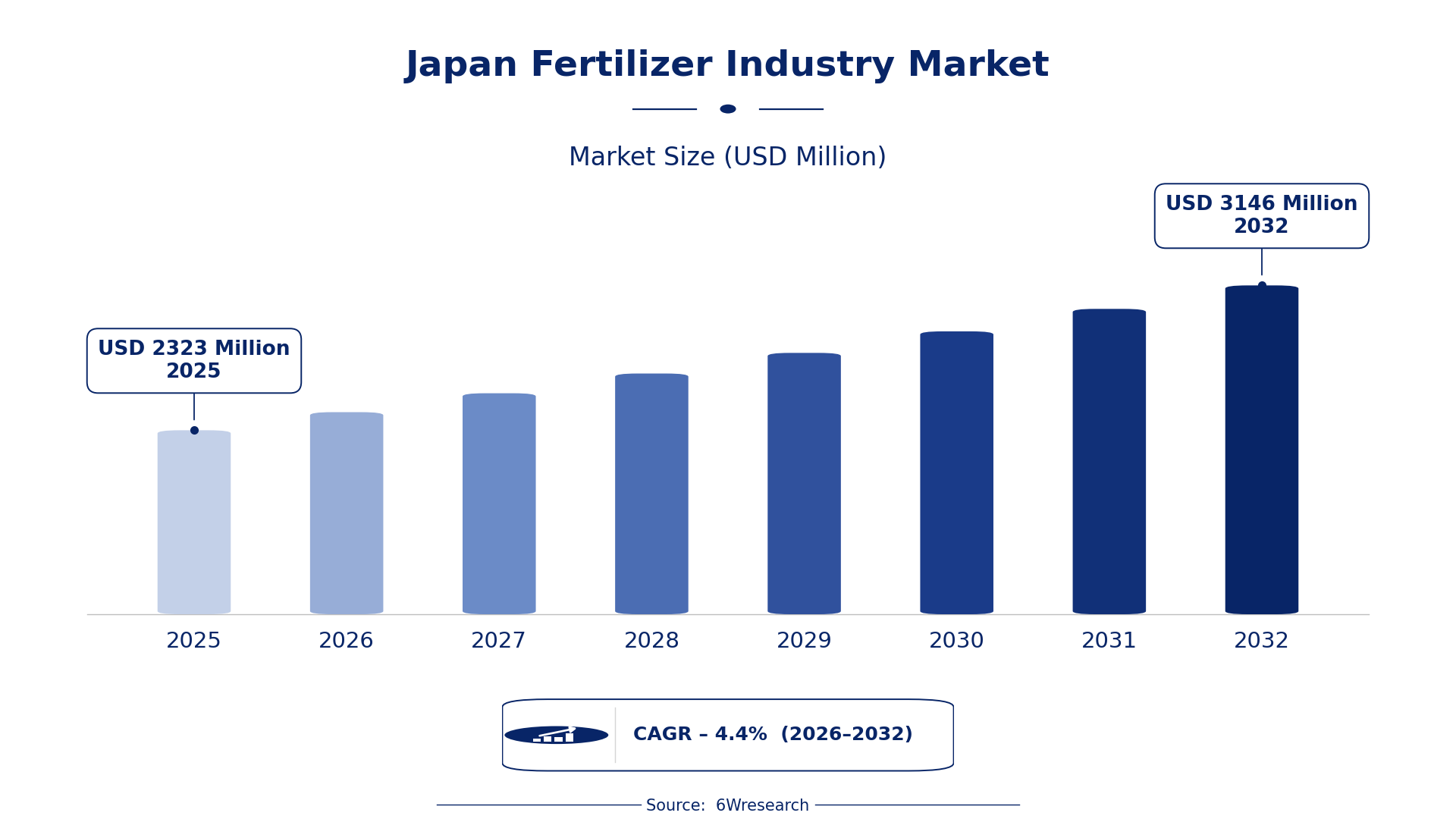
According to 6Wresearch internal database and industry insights, the Japan Fertilizer Industry Market was valued at USD 2,323 Million in 2025 and is projected to reach USD 3,146 Million by 2032, growing at a CAGR of approximately 4.4% during 2026–2032.
Japan Fertilizer Industry Market Highlights
| Report Metric | Details |
| Report Name | Japan Fertilizer Industry Market (2026-2032) |
| Market Size 2025 | USD 2,323 Million |
| Market Size 2032 | USD 3,146 Million |
| Absolute Growth 2025–2032 | USD 823 Million |
| CAGR 2026–2032 | 4.4% |
| Peak Annual Growth | 5.3% in 2028 |
| Forecast Period | 2026–2032 |
| Historical Data | 2022–2025 |
| Base Year | 2025 |
| Leading Product Segment, 2025 | Chemical Fertilizers (32% share) |
| Leading End Use Crop Type, 2025 | Cereals & Grains (43% share) |
| Leading Distribution Channel, 2025 | Agri Cooperatives (41% share) |
| Leading End User, 2025 | Farmers (55% share) |
| Fastest-Growing Product Segment | Organic Fertilizers (6.4% CAGR) |
| Fastest-Growing End Use Crop Type | Fruits & Vegetables (5.9% CAGR) |
| Fastest-Growing Distribution Channel | Online Retailers (5.8% CAGR) |
| Fastest-Growing End User | Organic Farms (6.0% CAGR) |
| Growing Sector | Organic Farming |
| Key End Users | Farmers, Agrochemical Companies, Agri Cooperatives |
Japan Fertilizer Industry Market Year-wise Growth Rate and Key Drivers (2022–2032)
This graph illustrates the annual growth rates of the market from 2022 to 2032, highlighting a steady upward trajectory and projected market expansion over the forecast period.
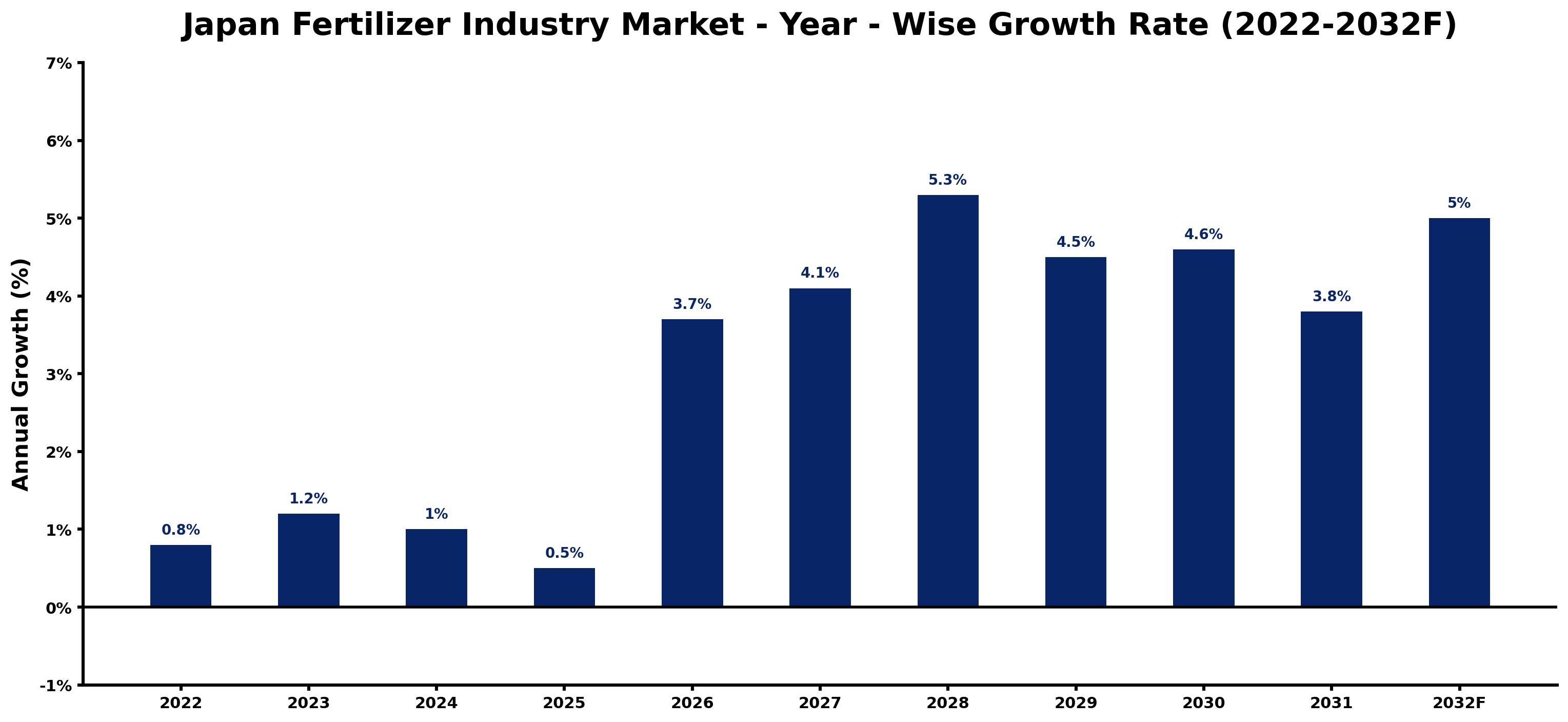
The following figures match every annual growth estimate with the main market development of that year, giving the reasoning behind each rise or slowdown.
| Year | Estimated Annual Growth (%) | Market Rationale |
| 2022 | 0.8 | The market showed steady growth with consistent demand from farmers and agrochemical companies. |
| 2023 | 1.2 | Growth accelerated as farmers increased fertilizer use to improve crop yields amid rising agricultural exports. |
| 2024 | 1.0 | Growth slowed as market adjustments occurred following the previous year's peak in demand. |
| 2025 | 0.5 | A further slowdown was observed as the market stabilised after prior growth phases. |
| 2026 | 3.7 | Growth is expected to resume as investments in sustainable farming practices begin to take effect. |
| 2027 | 4.1 | Demand is projected to increase as precision agriculture techniques gain traction among farmers. |
| 2028 | 5.3 | The market is expected to peak due to heightened investments in organic fertilizers and sustainable practices. |
| 2029 | 4.5 | Growth is projected to slow as the market adjusts to the peak demand levels of the previous year. |
| 2030 | 4.6 | Demand will pick up again as new agricultural technologies are adopted widely across the sector. |
| 2031 | 3.8 | Growth is expected to moderate as market conditions stabilise following the rapid expansion of organic fertilizers. |
| 2032 | 5.0 | The market is projected to grow as investments in eco-friendly fertilizers continue to rise. |
Note: Market size estimations and growth projections presented in this report are based on 6Wresearch's proprietary forecasting methodology, utilizing the latest available industry data, government publications, and primary research inputs.
Japan Fertilizer Industry Market Synopsis
Fertilizers in Japan include chemical, organic, liquid, and controlled-release types, primarily used to improve crop yields and soil fertility. The Japan Fertilizer Industry Market is growing, driven by rising agricultural exports, which reached 1 trillion yen in 2023, alongside a focus on sustainable farming practices. Government support for organic farming and the increasing adoption of precision agriculture techniques are key contributors to this growth.
Market Dynamics Impact Analysis (2026–2032)
| Factor | Type | Impact | Primary Segment Affected |
| Increasing demand for organic fertilizers due to sustainable farming practices | Driver | High | Organic Fertilizers |
| Rising agricultural exports driving higher fertilizer consumption | Driver | High | Chemical Fertilizers |
| Growing interest in organic farming leading to increased investment | Opportunity | High | Organic Fertilizers |
| Expansion of precision agriculture techniques enhancing fertilizer efficiency | Opportunity | Medium | Liquid Fertilizers |
| Regulatory compliance costs impacting production processes | Restraint | High | Chemical Fertilizers |
| Limited availability of certain raw materials affecting supply chains | Restraint | Medium | Organic Fertilizers |
| Competition from imported fertilizers affecting local producers | Challenge | High | Chemical Fertilizers |
| Technological advancements requiring constant investment | Challenge | Medium | Liquid Fertilizers |
Evaluation of Drivers in Japan Fertilizer Industry Market (2026–2032)
These are the developments adding the most demand over the forecast period.
| Drivers | Primary Segment Affected | Why It Matters (Evidence) |
| Increased agricultural exports leading to higher fertilizer usage | Chemical Fertilizers | Japan's agricultural export value reached 1 trillion yen in 2023, prompting farmers to improve yields. |
| Growing consumer demand for organic produce | Organic Fertilizers | Organic fertilizers accounted for 15% of total fertilizer consumption in 2023, as farmers shift to sustainable practices. |
| Adoption of precision agriculture techniques | Liquid Fertilizers | Liquid fertilizers are increasingly used in precision agriculture, improving application efficiency and crop yields. |
| Government support for sustainable farming initiatives | Organic Fertilizers | The government launched a program targeting 50,000 organic farms by 2025, boosting organic fertilizer demand. |
| Rising awareness of soil health and fertility | Controlled-Release | Controlled-release fertilizers are gaining traction as farmers seek to improve soil quality and crop productivity. |
Spending rises because Japan's agricultural export value reached 1 trillion yen in 2023, driving farmers to improve yields with chemical fertilizers. The adoption of precision agriculture techniques is increasing, with liquid fertilizers becoming essential for efficient application. The growing awareness of soil health is prompting farmers to invest in controlled-release fertilizers to improve productivity. In major agricultural regions like Hokkaido, the shift towards sustainable practices is visible, driving a rise in organic fertilizer consumption, which accounted for 15% of total usage in 2023.
Evaluation of Restraints in Japan Fertilizer Industry Market
Several factors work against faster growth; the main ones are summarised below.
| Market Restraint | Primary Segment Affected | Why It Matters (Evidence) |
| Regulatory compliance costs impacting production | Chemical Fertilizers | Compliance with the PRTR Law increases operational costs for manufacturers, affecting pricing. |
| Limited availability of raw materials for organic fertilizers | Organic Fertilizers | Supply chain disruptions have led to shortages of key ingredients, impacting production capacity. |
| Competition from imported fertilizers affecting market share | Chemical Fertilizers | Imported fertilizers often offer lower prices, challenging local producers' competitiveness. |
| Technological advancements requiring continuous investment | Liquid Fertilizers | Keeping up with new technologies demands substantial investment, straining smaller producers. |
| Market fluctuations affecting demand stability | Controlled-Release | Variable agricultural output can lead to unpredictable fertilizer demand, impacting production planning. |
Japan Fertilizer Industry Market Challenges
Buyers encounter regulatory hurdles due to the Fertilizer Control Law, complicating the approval process for new products and potentially delaying market entry by up to six months. Competition from imported organic fertilizers, which make up 15% of total consumption, pressures local producers to reduce prices, impacting profit margins. Supply chain disruptions stem from reliance on specific raw materials, resulting in increased costs for producers and potential shortages for buyers. Buyers face fluctuations in agricultural export values, which reached 1 trillion yen in 2023, affecting their purchasing power and investment choices.
Trends in the Japan Fertilizer Industry Market
Below are the shifts with the largest effect on the Japan Fertilizer Industry Market.
- Farmers Embracing Organic Practices: An increasing number of farmers in Japan are transitioning to organic farming methods, supported by government initiatives. In 2023, organic fertilizers accounted for 15% of total consumption, reflecting this trend.
- Shift Towards Precision Agriculture: The adoption of precision agriculture is reshaping fertilizer application in Japan. Liquid fertilizers are now essential for targeted nutrient delivery, improving crop yields through enhanced efficiency.
- Growing Demand for Sustainable Practices: The government launched a programme in 2023 to support organic farming, targeting 50,000 farms by 2025. This initiative is driving demand for organic fertilizers and sustainable practices across the sector.
- Increased Use of Controlled-Release Fertilizers: Controlled-release fertilizers are gaining traction among farmers aiming to improve soil fertility. This segment is expected to expand as awareness of soil health increases, supporting better crop yields.
Investment Opportunities in the Japan Fertilizer Industry Market
The following opportunities in the Japan Fertilizer Industry Market pair current demand with a clear way in.
- Rising Demand for Organic Fertilizers: With a growing focus on sustainability, the demand for organic fertilizers is rising. The government program targeting 50,000 organic farms by 2025 creates an opportunity for suppliers to meet this need.
- Investment in Precision Agriculture: The increasing adoption of precision agriculture creates opportunities for liquid fertilizers. Farmers in major agricultural regions like Tokyo are seeking efficient solutions to improve yields.
- Expansion of Distribution Channels: The rise of online retailers as a distribution channel is a key opportunity. Suppliers can partner with these platforms to reach a broader customer base, especially among tech-savvy farmers.
- Development of Controlled-Release Fertilizers: The growing awareness of soil health presents an opportunity to develop controlled-release fertilizers. Suppliers can enter the market by collaborating with agricultural research institutions.
Government Initiatives in the Japan Fertilizer Industry Market
The GX Promotion Act of 2023 strengthens the legal framework for sustainable farming, building on the PRTR Law. This act mandates stricter regulations on fertilizer use, encouraging producers to adopt eco-friendly practices and improve product safety. The act aims to increase the adoption of sustainable practices across 50,000 farms by 2025, significantly impacting the fertilizer industry.
Digital initiatives from the Digital Agency streamline access to information on sustainable farming practices for farmers. This agency promotes digital tools that assist farmers in complying with regulations and improving operational efficiency, thereby boosting their productivity and market competitiveness.
Future Insight of the Japan Fertilizer Industry Market
Investment in sustainable farming practices will surge by 2032, driven by government programmes targeting 50,000 farms by 2025. This shift will create demand for organic fertilizers, benefiting suppliers who align with evolving standards. The adoption of ISO 14001 will become more widespread among manufacturers, enhancing product credibility and consumer trust. Advances in precision agriculture will lead to increased use of liquid fertilizers, enabling producers to optimise crop yields and better meet buyer expectations.
Market Segmentation Analysis
Japan Fertilizer Industry Market report covers a detailed analysis of the following market segments:
By Product Segment – Chemical Fertilizers Lead, Organic Fertilizers Expected to Grow Fastest
According to Saurav Kr Singh, Senior Research Analyst at 6Wresearch, Chemical Fertilizers held 32% of the Japan Fertilizer Industry Market by product segment in 2025. Chemical fertilizers dominate the market as they are widely used by farmers to enhance crop yields across Japan. Their production of 2.5 million tons in 2022 underscores their critical role in agricultural productivity. Over 2026–2032, Organic Fertilizers are expected to post the fastest growth, at a CAGR of 6.4%. The growth of organic fertilizers is spurred by a government initiative promoting organic farming, which aims to support 50,000 farms by 2025. This aligns with the increasing consumer demand for sustainable agricultural practices. Suppliers should focus on developing organic fertilizer products to meet the rising demand for sustainable farming solutions.
By End Use Crop Type – Cereals & Grains Lead, Fruits & Vegetables Expected to Grow Fastest
With 43% of end use crop type revenue in 2025, Cereals & Grains was the largest category. Cereals and grains lead the market as they are the primary crops benefiting from fertilizer application, particularly in rice cultivation. The extensive farmland dedicated to these crops highlights their importance in Japan's agricultural sector. Fruits & Vegetables are projected to grow fastest, at a CAGR of 5.9% during 2026–2032. Fruits and vegetables are witnessing the fastest growth due to rising consumer demand for high-quality produce. This trend is influenced by changing dietary preferences that favour healthier food options, necessitating effective fertilisation. Suppliers must adjust their product offerings to cater to the increasing demand for high-quality fruits and vegetables, ensuring compliance with quality standards.
By Distribution Channel – Agri Cooperatives Lead, Online Retailers Expected to Grow Fastest
The largest distribution channel category in 2025 was Agri Cooperatives, at 41% of revenue. Agri cooperatives serve as the primary distribution channel, effectively linking farmers with essential fertilizers in rural areas. Their established networks ensure reliable access to agricultural inputs, making them crucial for farmers. The quickest growth will come from Online Retailers, forecast to expand at a CAGR of 5.8% between 2026 and 2032. Online retailers are rapidly becoming a significant distribution channel, offering convenient access to fertilizers for both farmers and consumers. This shift towards digital purchasing reflects changing consumer behaviours and preferences in the market. Suppliers should strengthen their online presence to capitalise on the growing trend of digital retail in the fertilizer industry.
By End User – Farmers Lead, Organic Farms Expected to Grow Fastest
Farmers accounted for 55% of the market by end user in 2025. Farmers are the main users of fertilizers, directly applying these products to enhance crop yields and soil fertility. With approximately 1.5 million farmers in Japan, their consistent demand plays a vital role in driving the market. Organic Farms are set to record the highest CAGR in this split, 6.0% over 2026–2032. Organic farms are experiencing the fastest growth due to their specific need for organic inputs that support sustainable agricultural practices. This trend reflects a broader movement towards environmentally friendly farming methods. Suppliers should concentrate on developing organic fertilizer solutions to meet the distinct requirements of organic farms.
Key Attractiveness of the Report
- 10 Years of Market Numbers
- Historical Data Starting from 2022 to 2025
- Base Year 2025
- Forecast Data until 2032
- Key Performance Indicators Impacting the Market
- Major Upcoming Developments and Projects
Key Highlights of the Report:
- Japan Fertilizer Industry Market Outlook
- Market Size of Japan Fertilizer Industry Market, 2025
- Forecast of Japan Fertilizer Industry Market, 2032
- Historical Data and Forecast of Japan Fertilizer Industry Revenues & Volume for the Period 2022-2032F
- Japan Fertilizer Industry Market Trend Evolution
- Japan Fertilizer Industry Market Drivers and Challenges
- Japan Fertilizer Industry Price Trends
- Japan Fertilizer Industry Porter's Five Forces
- Japan Fertilizer Industry Industry Life Cycle
- Historical Data and Forecast of Japan Fertilizer Industry Market Revenues & Volume By Product Segment for the Period 2022-2032F
- Historical Data and Forecast of Japan Fertilizer Industry Market Revenues & Volume By Chemical Fertilizers for the Period 2022-2032F
- Historical Data and Forecast of Japan Fertilizer Industry Market Revenues & Volume By Organic Fertilizers for the Period 2022-2032F
- Historical Data and Forecast of Japan Fertilizer Industry Market Revenues & Volume By Liquid Fertilizers for the Period 2022-2032F
- Historical Data and Forecast of Japan Fertilizer Industry Market Revenues & Volume By Controlled-Release for the Period 2022-2032F
- Historical Data and Forecast of Japan Fertilizer Industry Market Revenues & Volume By End Use Crop Type for the Period 2022-2032F
- Historical Data and Forecast of Japan Fertilizer Industry Market Revenues & Volume By Cereals & Grains for the Period 2022-2032F
- Historical Data and Forecast of Japan Fertilizer Industry Market Revenues & Volume By Fruits & Vegetables for the Period 2022-2032F
- Historical Data and Forecast of Japan Fertilizer Industry Market Revenues & Volume By Cash Crops for the Period 2022-2032F
- Historical Data and Forecast of Japan Fertilizer Industry Market Revenues & Volume By Plantation Crops for the Period 2022-2032F
- Historical Data and Forecast of Japan Fertilizer Industry Market Revenues & Volume By Distribution Channel for the Period 2022-2032F
- Historical Data and Forecast of Japan Fertilizer Industry Market Revenues & Volume By Agri Cooperatives for the Period 2022-2032F
- Historical Data and Forecast of Japan Fertilizer Industry Market Revenues & Volume By Online Retailers for the Period 2022-2032F
- Historical Data and Forecast of Japan Fertilizer Industry Market Revenues & Volume By Distributors for the Period 2022-2032F
- Historical Data and Forecast of Japan Fertilizer Industry Market Revenues & Volume By OEMs for the Period 2022-2032F
- Historical Data and Forecast of Japan Fertilizer Industry Market Revenues & Volume By End User for the Period 2022-2032F
- Historical Data and Forecast of Japan Fertilizer Industry Market Revenues & Volume By Farmers for the Period 2022-2032F
- Historical Data and Forecast of Japan Fertilizer Industry Market Revenues & Volume By Organic Farms for the Period 2022-2032F
- Historical Data and Forecast of Japan Fertilizer Industry Market Revenues & Volume By Agrochemical Companies for the Period 2022-2032F
- Historical Data and Forecast of Japan Fertilizer Industry Market Revenues & Volume By Agri Exporters for the Period 2022-2032F
- Japan Fertilizer Industry Import Export Trade Statistics
- Market Opportunity Assessment By Product Segment
- Market Opportunity Assessment By End Use Crop Type
- Market Opportunity Assessment By Distribution Channel
- Market Opportunity Assessment By End User
- Japan Fertilizer Industry Top Companies Market Share
- Japan Fertilizer Industry Competitive Benchmarking By Technical and Operational Parameters
- Japan Fertilizer Industry Company Profiles
- Japan Fertilizer Industry Key Strategic Recommendations
Market Covered
The following segment groups are covered in the report.
By Product Segment
- Chemical Fertilizers
- Organic Fertilizers
- Liquid Fertilizers
- Controlled-Release
By End Use Crop Type
- Cereals & Grains
- Fruits & Vegetables
- Cash Crops
- Plantation Crops
By Distribution Channel
- Agri Cooperatives
- Online Retailers
- Distributors
- OEMs
By End User
- Farmers
- Organic Farms
- Agrochemical Companies
- Agri Exporters































