Japan Fire-Resistant Insulation Market Size & Growth Rate
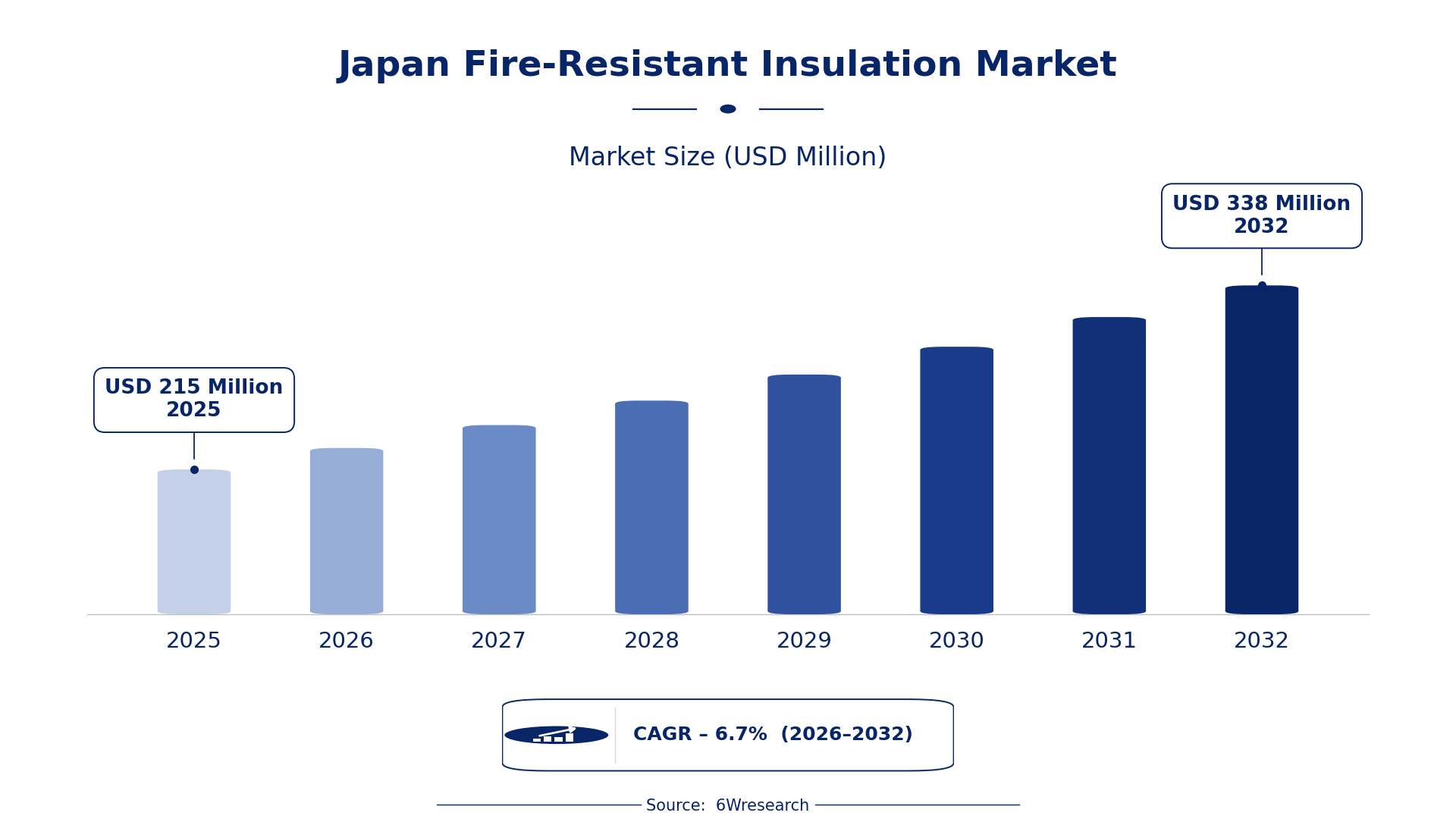
According to 6Wresearch internal database and industry insights, the Japan Fire-Resistant Insulation Market was valued at USD 215 Million in 2025 and is projected to reach USD 338 Million by 2032, growing at a CAGR of approximately 6.7% during 2026–2032.
Japan Fire-Resistant Insulation Market Highlights
| Report Metric | Details |
| Report Name | Japan Fire-Resistant Insulation Market (2026-2032) |
| Market Size 2025 | USD 215 Million |
| Market Size 2032 | USD 338 Million |
| Absolute Growth 2025–2032 | USD 123 Million |
| CAGR 2026–2032 | 6.7% |
| Peak Annual Growth | 8.4% in 2027 |
| Forecast Period | 2026–2032 |
| Historical Data | 2022–2025 |
| Base Year | 2025 |
| Leading Material Type, 2025 | Mineral Wool (40% share) |
| Leading Application Area, 2025 | Wall Insulation (52% share) |
| Leading Distribution Channel, 2025 | Construction Wholesalers (48% share) |
| Leading End User, 2025 | Building Contractors (36% share) |
| Fastest-Growing Material Type | Fiberglass (9.7% CAGR) |
| Fastest-Growing Application Area | HVAC Systems (8.1% CAGR) |
| Fastest-Growing Distribution Channel | OEMs (8.9% CAGR) |
| Fastest-Growing End User | Real Estate Developers (9.1% CAGR) |
| Growing Sector | Construction |
| Key End Users | Building Contractors, Real Estate Developers, Commercial Projects, Green Builders |
Japan Fire-Resistant Insulation Market Year-wise Growth Rate and Key Drivers (2022–2032)
This graph illustrates the annual growth rates of the market from 2022 to 2032, highlighting a steady upward trajectory and projected market expansion over the forecast period.
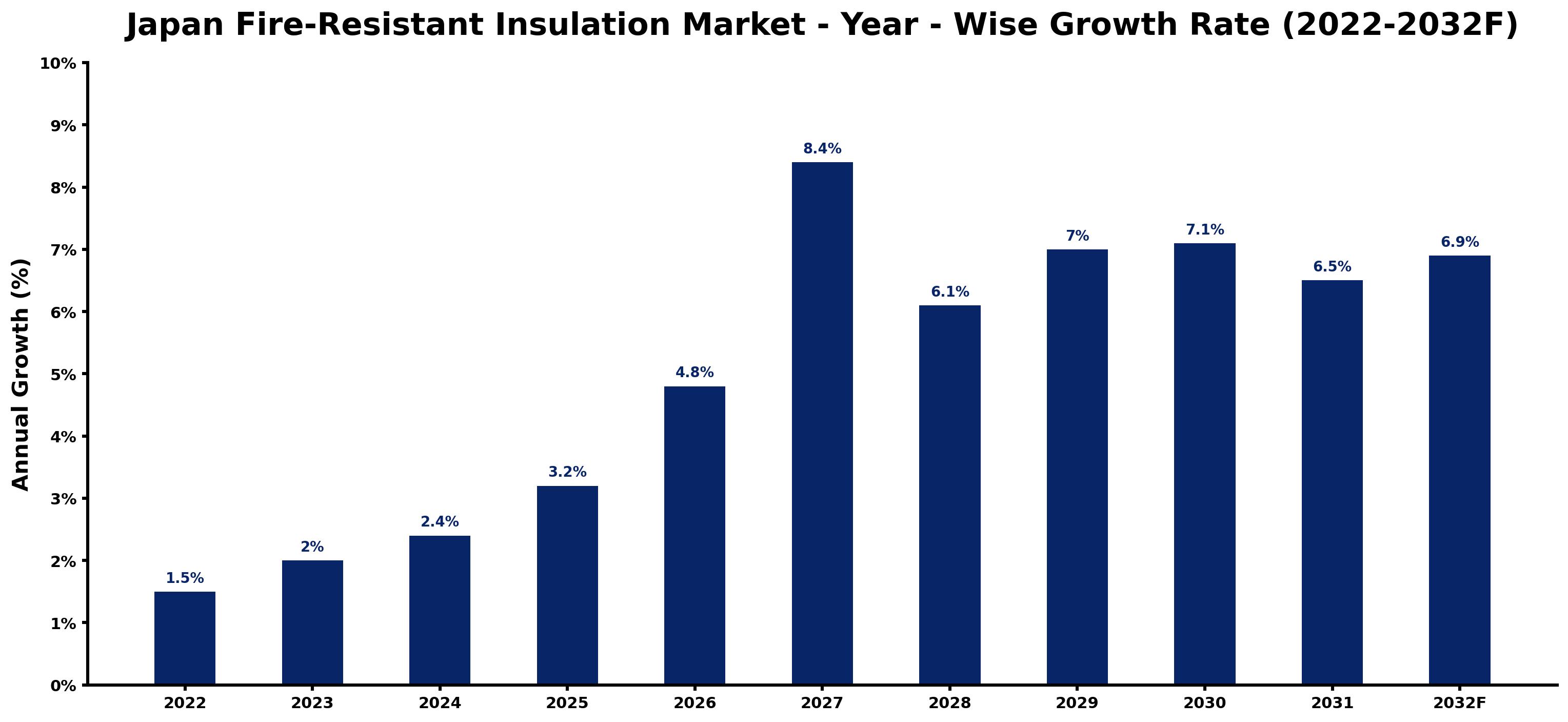
Below, each year's estimated growth is shown next to the factor that most influenced it.
| Year | Estimated Annual Growth (%) | Market Rationale |
| 2022 | 1.5 | The market experienced stable demand from the construction sector. |
| 2023 | 2.0 | Growth accelerated due to increased investments in fire safety standards. |
| 2024 | 2.4 | Demand continued to rise as construction projects expanded across regions. |
| 2025 | 3.2 | The market reached a peak growth rate as regulations tightened further. |
| 2026 | 4.8 | Growth is expected to continue as new building standards are implemented. |
| 2027 | 8.4 | The market will peak due to heightened awareness of fire safety. |
| 2028 | 6.1 | Growth will slow as the market begins to stabilise after rapid expansion. |
| 2029 | 7.0 | Demand will increase again as new commercial projects are initiated. |
| 2030 | 7.1 | The market is projected to maintain growth driven by ongoing construction. |
| 2031 | 6.5 | Growth will slow slightly as the market matures and stabilises. |
| 2032 | 6.9 | Demand is expected to rise as fire safety regulations become stricter. |
Note: Market size estimations and growth projections presented in this report are based on 6Wresearch's proprietary forecasting methodology, utilizing the latest available industry data, government publications, and primary research inputs.
Japan Fire-Resistant Insulation Market Synopsis
Fire-resistant insulation is a critical material used to prevent the spread of flames in buildings, made from mineral wool, fiberglass, cellulose, or foam board. The Japan Fire-Resistant Insulation Market is driven by the construction industry, valued at approximately ¥60 trillion, which demands these materials for compliance with safety regulations. Growth is propelled by increased investments in fire safety standards, particularly in urban areas like Tokyo, and government initiatives promoting fire safety in new buildings, with an estimated annual demand of 1 million cubic meters.
Market Dynamics Impact Analysis (2026–2032)
| Factor | Type | Impact | Primary Segment Affected |
| Increased construction activity in urban areas | Driver | High | Wall Insulation |
| Growing awareness of fire safety regulations | Driver | High | HVAC Systems |
| Rising demand for eco-friendly insulation materials | Opportunity | Medium | Cellulose |
| Expansion of commercial projects in the Kansai region | Opportunity | High | Commercial Projects |
| High initial costs of fire-resistant materials | Restraint | High | Fiberglass |
| Limited awareness among some builders about fire safety standards | Restraint | Medium | Mineral Wool |
| Supply chain disruptions affecting material availability | Challenge | High | Foam Board |
| Competition from alternative insulation materials | Challenge | Medium | Cellulose |
Evaluation of Drivers in Japan Fire-Resistant Insulation Market (2026–2032)
Demand rests on the following drivers, each shown with the segment it touches most.
| Drivers | Primary Segment Affected | Why It Matters (Evidence) |
| Increased urban construction projects drive demand for fire-resistant insulation materials. | Wall Insulation | The Tokyo metropolitan area has the highest demand, contributing to a portion of the annual 1 million cubic meters needed. |
| Tighter fire safety regulations increase the need for compliance in new buildings. | HVAC Systems | The Tokyo Fire Department mandates fire-resistant insulation in high-rise buildings, pushing contractors to purchase compliant materials. |
| The expansion of commercial projects increases overall insulation demand. | Commercial Projects | The Kansai region is experiencing a surge in commercial construction, necessitating fire-resistant solutions. |
| Investment in fire safety improvements by the government encourages material adoption. | Fiberglass | In 2023, the government allocated ¥10 billion for fire safety enhancements in public buildings. |
| The shift towards sustainable building practices boosts cellulose insulation usage. | Cellulose | With over 1,000 certified green builders in Japan, demand for eco-friendly options is rising. |
Spending rises because the construction sector is expanding rapidly, particularly in urban areas, with the Tokyo metropolitan area leading demand for fire-resistant insulation. The allocation of ¥10 billion for fire safety improvements in 2023 further stimulates purchases. Increased commercial construction in regions such as Kansai is also contributing to demand for insulation materials, especially fiberglass, as contractors seek to meet stringent fire safety standards.
Evaluation of Restraints in Japan Fire-Resistant Insulation Market
The table below lists the restraints and the evidence behind each.
| Market Restraint | Primary Segment Affected | Why It Matters (Evidence) |
| High initial costs deter some builders from using fire-resistant materials. | Fiberglass | The average cost of fire-resistant insulation can be higher than standard options, limiting adoption. |
| Limited awareness of fire safety regulations among smaller contractors affects compliance. | Mineral Wool | Many small building contractors may not fully understand the regulations, leading to inadequate material use. |
| Supply chain disruptions can lead to shortages of fire-resistant insulation materials. | Foam Board | Recent global supply chain issues have made it difficult for suppliers to maintain consistent inventory levels. |
| Competition from cheaper alternative insulation materials impacts market share. | Cellulose | Some builders opt for less expensive options, reducing demand for higher-cost fire-resistant materials. |
| Fluctuating raw material prices affect production costs for insulation manufacturers. | Fiberglass | Volatility in raw material prices can lead to increased costs, impacting pricing strategies. |
Japan Fire-Resistant Insulation Market Challenges
Annual demand for fire-resistant insulation in Japan reaches 1 million cubic meters, yet a skills shortage in the construction sector delays project timelines for builders, causing potential project overruns. Intense competition in the Tokyo metropolitan area forces suppliers to engage in price wars, which can erode profit margins by up to 20%. Compliance with fire safety regulations from the Ministry of Land, Infrastructure, Transport and Tourism adds costs for suppliers, estimated at ¥5 billion annually. Buyers struggle to source materials that meet the ISO 1182 standard, resulting in increased lead times and potential project delays of up to three months.
Trends in the Japan Fire-Resistant Insulation Market
The trends below show where the Japan Fire-Resistant Insulation Market is heading.
- Increase in Eco-Friendly Insulation Adoption: In 2023, cellulose insulation gained popularity due to its eco-friendly properties, with over 1,000 certified green builders in Japan promoting its use. This shift reflects a growing market segment, indicating a demand for sustainable construction.
- Shift Towards Fire Safety Regulations: The Tokyo Fire Department's mandate for fire-resistant insulation in high-rise buildings is reshaping the market. This requirement drives substantial purchases of insulation materials, particularly in urban construction projects.
- Growing Demand for Safety in Commercial Projects: The Kansai region is experiencing increased adoption of fire-resistant insulation in commercial projects, reflecting a broader trend towards prioritising safety in building designs. This change is leading to a surge in material demand.
- Expansion of Construction Wholesalers in the Market: Construction wholesalers are expanding their offerings of fire-resistant insulation products, capturing a larger market share. With a projected share of 48% in 2025, they are becoming key distributors for these materials.
Investment Opportunities in the Japan Fire-Resistant Insulation Market
Several openings in the Japan Fire-Resistant Insulation Market merit attention from investors.
- Kansai Region's Commercial Construction Boom: The Kansai region is experiencing a surge in commercial projects, creating a demand gap for fire-resistant insulation. With an estimated annual demand of 1 million cubic meters, suppliers can enter through local partnerships.
- Growing Market for Eco-Friendly Insulation: With cellulose insulation gaining traction, there is a strong opportunity to invest in its production. The rise of green builders indicates a demand for sustainable materials, allowing for joint ventures with local manufacturers.
- Government Funding for Fire Safety Improvements: The government allocated ¥10 billion for fire safety enhancements in public buildings, creating an opportunity for suppliers to provide fire-resistant materials. Engaging with public sector projects can yield substantial contracts.
- Rising Demand from Real Estate Developers: Real estate developers are increasingly requiring fire-resistant materials for compliance with safety regulations. This segment offers opportunities for targeted marketing and partnerships.
Government Initiatives in the Japan Fire-Resistant Insulation Market
The GX Promotion Act initiated in 2023 establishes a legal framework for fire safety in buildings. This act builds on the Building Energy Efficiency Act, which mandates energy standards for new constructions, ensuring that fire-resistant insulation is integrated into energy-efficient designs.
In 2023, the government allocated ¥10 billion for fire safety improvements in public buildings, overseen by the Ministry of Land, Infrastructure, Transport and Tourism. This funding supports the adoption of fire-resistant materials, ensuring compliance with updated safety regulations.
Future Insight of the Japan Fire-Resistant Insulation Market
A policy-driven shift towards enhanced fire safety will prompt suppliers to create compliant materials. By 2032, the rise in eco-friendly insulation will be influenced by the Japan Green Building Council's emphasis on sustainable architecture. Stricter fire safety regulations will necessitate advanced materials in high-rise buildings, especially in urban areas. The growth of certified builders will further encourage the use of fire-resistant insulation in construction, improving safety standards across the industry.
Market Segmentation Analysis
Japan Fire-Resistant Insulation Market report covers a detailed analysis of the following market segments:
By Material Type – Mineral Wool Leads, Fiberglass Expected to Grow Fastest
According to Saurav Kr Singh, Senior Research Analyst at 6Wresearch, in 2025, Mineral Wool led the material type split with a 40% share. Mineral wool commands the largest share due to its extensive use in thermal and fire insulation across diverse building types. Its prominent application in the Tokyo metropolitan area highlights its importance in maintaining fire safety standards. Fiberglass is set to record the highest CAGR in this split, 9.7% over 2026–2032. Fiberglass is rapidly gaining traction as it becomes more prevalent in both residential and commercial insulation projects, largely due to its affordability and effectiveness. The increasing push for energy-efficient building practices is further accelerating this segment's growth. Suppliers must prioritise the development of fiberglass products to cater to the rising demand in the insulation sector.
By Application Area – Wall Insulation Leads, HVAC Systems Expected to Grow Fastest
Wall Insulation accounted for 52% of the market by application area in 2025. Wall insulation leads the application area as it is vital for fire safety in building construction, especially in densely populated regions. The regulations set by the Tokyo Fire Department reinforce its critical role in ensuring compliance with fire safety standards. Over 2026–2032, HVAC Systems are expected to post the fastest growth, at a CAGR of 8.1%. HVAC systems are experiencing the fastest growth as there is a heightened focus on fire safety within ventilation systems, spurred by recent government initiatives. The urgency to adhere to fire safety regulations is driving increased demand in this segment. Buyers should focus on acquiring fire-resistant solutions for HVAC systems to meet regulatory standards and improve safety.
By Distribution Channel – Construction Wholesalers Lead, OEMs Expected to Grow Fastest
Construction Wholesalers held 48% of the Japan Fire-Resistant Insulation Market by distribution channel in 2025. Construction wholesalers dominate the distribution channel as they serve as key distributors for fire-resistant materials, ensuring availability across various construction projects. Their established networks facilitate the timely supply of materials to contractors. OEMs are projected to grow fastest, at a CAGR of 8.9% during 2026–2032. OEMs are rapidly expanding their use of fire-resistant insulation in their products, driven by the need for compliance with fire safety regulations. This trend indicates a shift towards integrating fire safety features in manufactured goods. Suppliers must strengthen relationships with OEMs to tap into this growing market segment.
By End User – Building Contractors Lead, Real Estate Developers Expected to Grow Fastest
The largest end user category in 2025 was Building Contractors, at 36% of revenue. Building contractors are the primary users of fire-resistant materials in construction projects, making them the largest end user group. Their direct involvement in the construction process ensures a consistent demand for these materials. The quickest growth will come from Real Estate Developers, forecast to expand at a CAGR of 9.1% between 2026 and 2032. Real estate developers are experiencing the fastest growth as they increasingly require fire-resistant materials to comply with stringent building regulations. This trend reflects the industry's shift towards prioritising safety in new developments. Suppliers should tailor their offerings to meet the specific needs of real estate developers to capture this emerging market.
Key Attractiveness of the Report
- 10 Years of Market Numbers
- Historical Data Starting from 2022 to 2025
- Base Year 2025
- Forecast Data until 2032
- Key Performance Indicators Impacting the Market
- Major Upcoming Developments and Projects
Key Highlights of the Report:
- Japan Fire-Resistant Insulation Market Outlook
- Market Size of Japan Fire-Resistant Insulation Market, 2025
- Forecast of Japan Fire-Resistant Insulation Market, 2032
- Historical Data and Forecast of Japan Fire-Resistant Insulation Revenues & Volume for the Period 2022-2032F
- Japan Fire-Resistant Insulation Market Trend Evolution
- Japan Fire-Resistant Insulation Market Drivers and Challenges
- Japan Fire-Resistant Insulation Price Trends
- Japan Fire-Resistant Insulation Porter's Five Forces
- Japan Fire-Resistant Insulation Industry Life Cycle
- Historical Data and Forecast of Japan Fire-Resistant Insulation Market Revenues & Volume By Material Type for the Period 2022-2032F
- Historical Data and Forecast of Japan Fire-Resistant Insulation Market Revenues & Volume By Mineral Wool for the Period 2022-2032F
- Historical Data and Forecast of Japan Fire-Resistant Insulation Market Revenues & Volume By Fiberglass for the Period 2022-2032F
- Historical Data and Forecast of Japan Fire-Resistant Insulation Market Revenues & Volume By Cellulose for the Period 2022-2032F
- Historical Data and Forecast of Japan Fire-Resistant Insulation Market Revenues & Volume By Foam Board for the Period 2022-2032F
- Historical Data and Forecast of Japan Fire-Resistant Insulation Market Revenues & Volume By Application Area for the Period 2022-2032F
- Historical Data and Forecast of Japan Fire-Resistant Insulation Market Revenues & Volume By Wall Insulation for the Period 2022-2032F
- Historical Data and Forecast of Japan Fire-Resistant Insulation Market Revenues & Volume By HVAC Systems for the Period 2022-2032F
- Historical Data and Forecast of Japan Fire-Resistant Insulation Market Revenues & Volume By Roofing Systems for the Period 2022-2032F
- Historical Data and Forecast of Japan Fire-Resistant Insulation Market Revenues & Volume By Industrial Facilities for the Period 2022-2032F
- Historical Data and Forecast of Japan Fire-Resistant Insulation Market Revenues & Volume By Distribution Channel for the Period 2022-2032F
- Historical Data and Forecast of Japan Fire-Resistant Insulation Market Revenues & Volume By Construction Wholesalers for the Period 2022-2032F
- Historical Data and Forecast of Japan Fire-Resistant Insulation Market Revenues & Volume By OEMs for the Period 2022-2032F
- Historical Data and Forecast of Japan Fire-Resistant Insulation Market Revenues & Volume By Online Suppliers for the Period 2022-2032F
- Historical Data and Forecast of Japan Fire-Resistant Insulation Market Revenues & Volume By B2B Retailers for the Period 2022-2032F
- Historical Data and Forecast of Japan Fire-Resistant Insulation Market Revenues & Volume By End User for the Period 2022-2032F
- Historical Data and Forecast of Japan Fire-Resistant Insulation Market Revenues & Volume By Building Contractors for the Period 2022-2032F
- Historical Data and Forecast of Japan Fire-Resistant Insulation Market Revenues & Volume By Real Estate Developers for the Period 2022-2032F
- Historical Data and Forecast of Japan Fire-Resistant Insulation Market Revenues & Volume By Green Builders for the Period 2022-2032F
- Historical Data and Forecast of Japan Fire-Resistant Insulation Market Revenues & Volume By Commercial Projects for the Period 2022-2032F
- Japan Fire-Resistant Insulation Import Export Trade Statistics
- Market Opportunity Assessment By Material Type
- Market Opportunity Assessment By Application Area
- Market Opportunity Assessment By Distribution Channel
- Market Opportunity Assessment By End User
- Japan Fire-Resistant Insulation Top Companies Market Share
- Japan Fire-Resistant Insulation Competitive Benchmarking By Technical and Operational Parameters
- Japan Fire-Resistant Insulation Company Profiles
- Japan Fire-Resistant Insulation Key Strategic Recommendations
Market Covered
Coverage by segment is as follows.
By Material Type
- Mineral Wool
- Fiberglass
- Cellulose
- Foam Board
By Application Area
- Wall Insulation
- HVAC Systems
- Roofing Systems
- Industrial Facilities
By Distribution Channel
- Construction Wholesalers
- OEMs
- Online Suppliers
- B2B Retailers
By End User
- Building Contractors
- Real Estate Developers
- Green Builders
- Commercial Projects































