Japan Fish Farming Equipment Market Size & Growth Rate
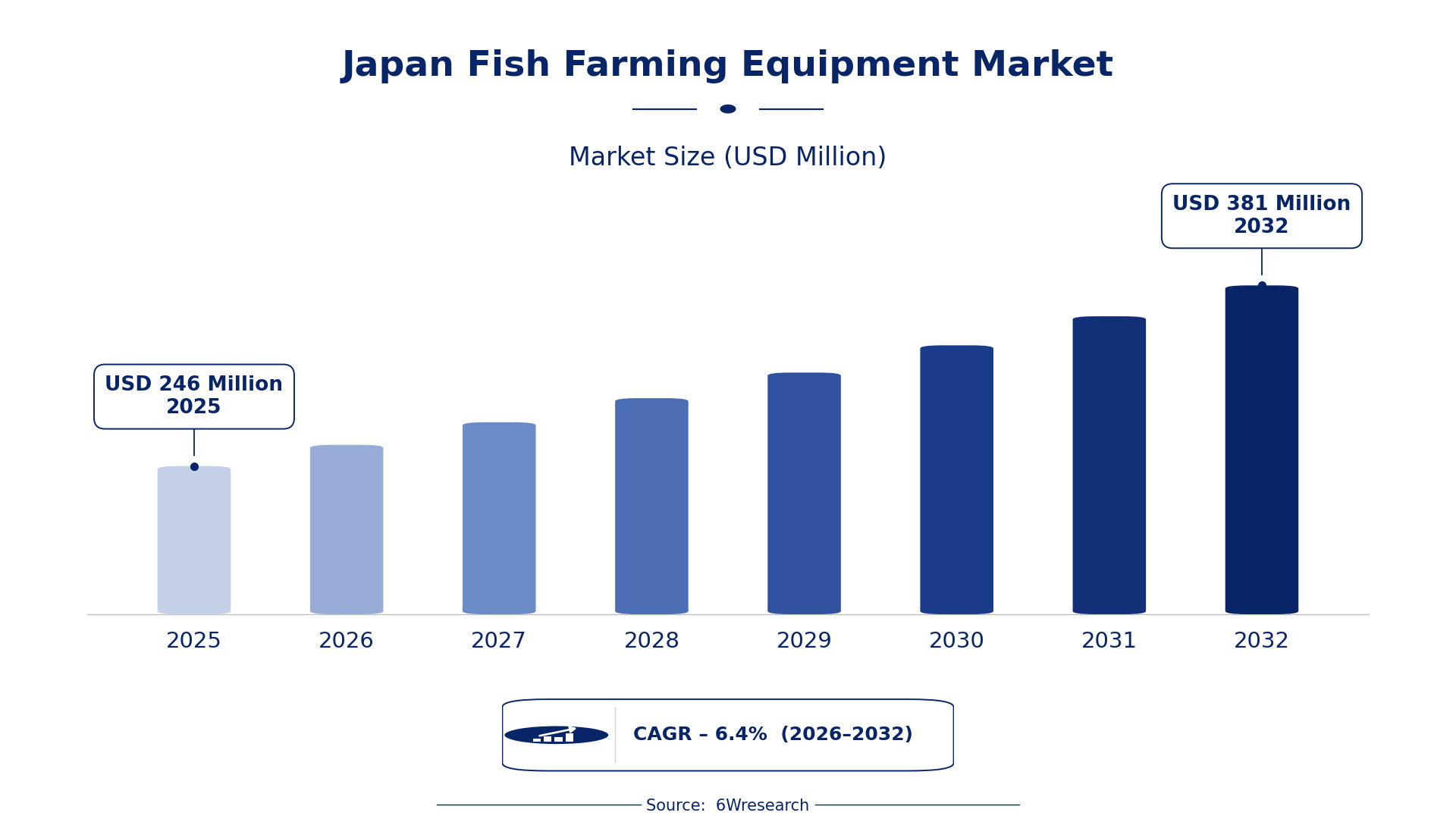
According to 6Wresearch internal database and industry insights, the Japan Fish Farming Equipment Market was valued at USD 246 Million in 2025 and is projected to reach USD 381 Million by 2032, growing at a CAGR of approximately 6.4% during 2026–2032.
Japan Fish Farming Equipment Market Highlights
| Report Metric | Details |
| Report Name | Japan Fish Farming Equipment Market (2026-2032) |
| Market Size 2025 | USD 246 Million |
| Market Size 2032 | USD 381 Million |
| Absolute Growth 2025–2032 | USD 135 Million |
| CAGR 2026–2032 | 6.4% |
| Peak Annual Growth | 8.6% in 2030 |
| Forecast Period | 2026–2032 |
| Historical Data | 2022–2025 |
| Base Year | 2025 |
| Leading Equipment Type, 2025 | Aerators (49% share) |
| Leading Farming Type, 2025 | Pond Farming (38% share) |
| Leading Distribution Channel, 2025 | Equipment Dealers (44% share) |
| Leading End User, 2025 | Fish Farms (47% share) |
| Fastest-Growing Equipment Type | Feeding Systems (9.2% CAGR) |
| Fastest-Growing Farming Type | Recirculation Systems (9.4% CAGR) |
| Fastest-Growing Distribution Channel | Online B2B (8.4% CAGR) |
| Fastest-Growing End User | Aquaculture Operators (8.3% CAGR) |
| Growing Sector | Aquaculture |
| Key End Users | Fish Farms, Aquaculture Operators, Hatchery Units |
Japan Fish Farming Equipment Market Year-wise Growth Rate and Key Drivers (2022–2032)
This graph illustrates the annual growth rates of the market from 2022 to 2032, highlighting a steady upward trajectory and projected market expansion over the forecast period.
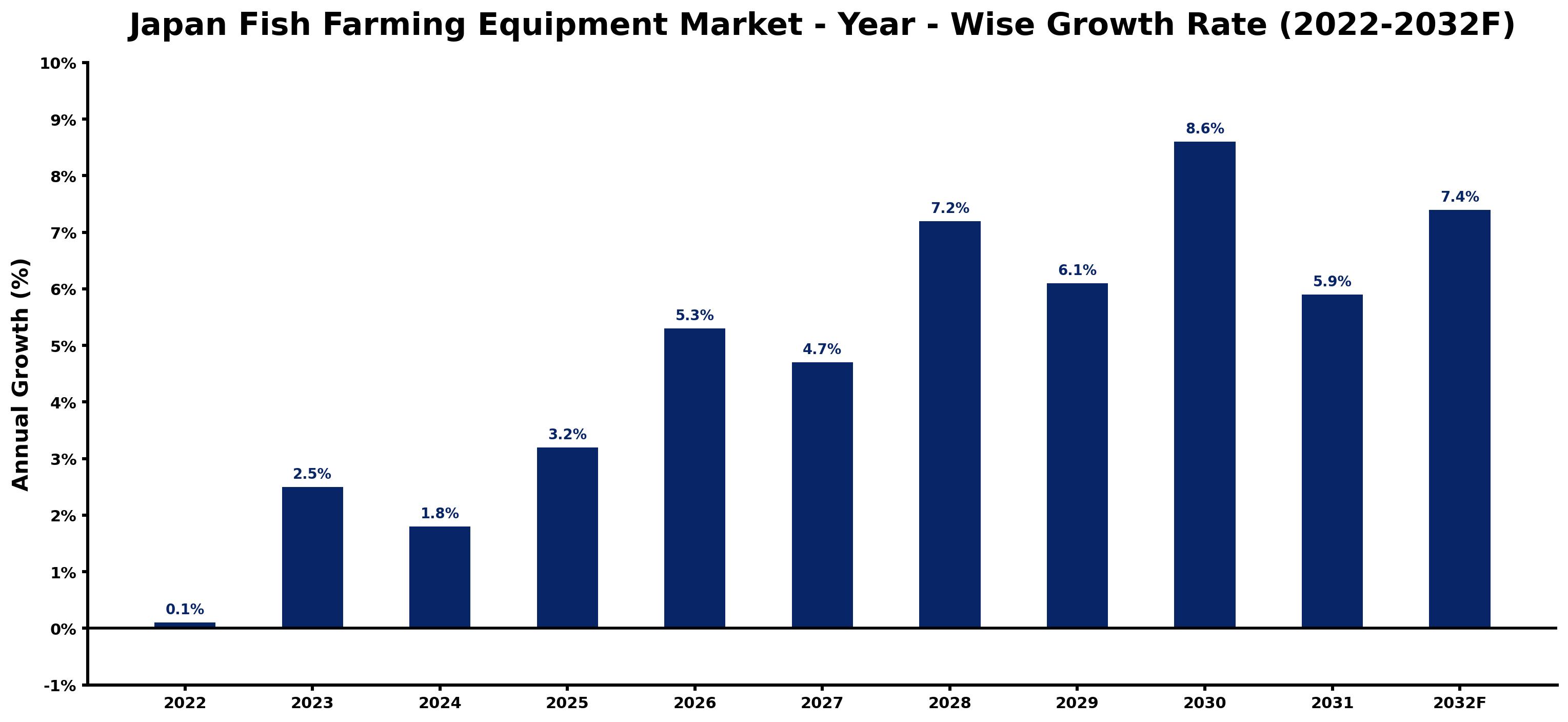
The table below sets out the estimated growth rate for each year and the main factor behind it.
| Year | Estimated Annual Growth (%) | Market Rationale |
| 2022 | 0.1 | The market experienced minimal growth due to limited investment in aquaculture technologies. |
| 2023 | 2.5 | Increased interest in sustainable practices led to faster growth compared to the previous year. |
| 2024 | 1.8 | Growth slowed as operators focused on cost management amid rising operational expenses. |
| 2025 | 3.2 | Demand surged as aquaculture production reached high levels, prompting investments in equipment. |
| 2026 | 5.3 | Growing awareness of efficient farming methods is expected to accelerate demand for advanced fish farming equipment. |
| 2027 | 4.7 | The market will see a slowdown as operators adjust to new regulations and standards. |
| 2028 | 7.2 | Investment in innovative technologies is projected to drive faster growth as producers seek efficiency. |
| 2029 | 6.1 | Growth will slow as market saturation begins to affect new equipment purchases. |
| 2030 | 8.6 | The peak growth is expected as demand for sustainable aquaculture practices intensifies. |
| 2031 | 5.9 | A slowdown in growth will be noted as the market stabilises after peak demand. |
| 2032 | 7.4 | Continued investment in aquaculture technologies is projected to drive renewed growth. |
Note: Market size estimations and growth projections presented in this report are based on 6Wresearch's proprietary forecasting methodology, utilizing the latest available industry data, government publications, and primary research inputs.
Japan Fish Farming Equipment Market Synopsis
Fish farming equipment includes tools and systems designed to improve aquaculture production, including aerators, feeding systems, and water treatment units. The Japan Fish Farming Equipment Market is expanding due to rising domestic aquaculture production, which reached 500,000 tons in 2022, and increased investments in sustainable practices. The Kanto region serves as a key hub for fish farming activities, while government initiatives aim to boost production by 20% by 2025, stimulating demand for advanced solutions in the sector.
Market Dynamics Impact Analysis (2026–2032)
| Factor | Type | Impact | Primary Segment Affected |
| Rising domestic aquaculture production | Driver | High | Aquaculture Operators |
| Increased focus on sustainable practices | Driver | High | Fish Farms |
| Growing demand for efficient farming technologies | Opportunity | Medium | Feeding Systems |
| Expansion of online sales channels | Opportunity | Medium | Equipment Dealers |
| High operational costs for fish farms | Restraint | High | Fish Farms |
| Limited adoption of automation technologies | Restraint | Medium | Automated |
| Regulatory compliance costs for producers | Challenge | High | Aquaculture Operators |
| Competition from imported equipment | Challenge | Medium | Direct Distributors |
Evaluation of Drivers in Japan Fish Farming Equipment Market (2026–2032)
The main growth drivers and the segments they affect most are set out below.
| Drivers | Primary Segment Affected | Why It Matters (Evidence) |
| Increased aquaculture production | Fish Farms | Japan's aquaculture production reached 500,000 tons in 2022, driving demand for various equipment. |
| Focus on sustainable practices | Aquaculture Operators | Government initiatives promote sustainable practices, resulting in increased demand for advanced technologies. |
| Growing demand for efficient feeding systems | Feeding Systems | Feeding systems are essential for maintaining optimal growth rates, leading to higher purchases among fish farms. |
| Expansion of the Kanto region as a hub | Equipment Dealers | The Kanto region is a major hub for fish farming, increasing demand for local equipment dealers. |
| Growing adoption of ISO 14001 standards | Water Treatment Units | Widespread adoption of ISO 14001 standards encourages investments in water treatment technologies. |
A wider customer base explains much of the growth, as Japan's aquaculture production reached 500,000 tons in 2022, prompting fish farms to invest in necessary equipment. Sustainable practices are increasingly important, leading operators to seek advanced technologies to improve efficiency. Equipment dealers are experiencing rising orders as demand increases. The need for efficient feeding systems is prompting aquaculture operators to invest in their production capabilities, while the focus on water quality drives investments in treatment units.
Evaluation of Restraints in Japan Fish Farming Equipment Market
These restraints slow adoption and weigh on supplier margins.
| Market Restraint | Primary Segment Affected | Why It Matters (Evidence) |
| High operational costs for fish farming equipment | Fish Farms | Japan's national minimum wage rose to JPY 1,055 per hour in October 2024, increasing operational costs for producers. |
| Limited automation adoption in aquaculture | Automated | The development of automation technologies is ongoing, causing delays in equipment purchases. |
| Regulatory compliance costs for producers | Aquaculture Operators | Producers incur high expenses to meet regulations set by the Fisheries Agency, impacting profitability. |
| Competition from cheaper imported equipment | Direct Distributors | Imported equipment often undercuts local prices, affecting sales for domestic distributors. |
| Market saturation affecting new purchases | Fish Farms | As the market matures, many farms are postponing investments in new equipment. |
Japan Fish Farming Equipment Market Challenges
Japan's aquaculture production reached 500,000 tons in 2022, but rising input costs pose challenges for producers. Increased wages, now at JPY 1,055 per hour, strain budgets and reduce profit margins for fish farms. Limited availability of water treatment units delays operations for buyers, affecting their ability to maintain optimal water quality. Skills shortages in aquaculture hinder the industry's capacity to adopt new technologies, resulting in slower growth for farms. Competition from imported fish farming equipment pressures local suppliers to reduce prices, further squeezing their profit margins.
Trends in the Japan Fish Farming Equipment Market
Below are the shifts with the largest effect on the Japan Fish Farming Equipment Market.
- Shift towards Sustainable Aquaculture: Fish farms in Japan are increasingly embracing sustainable practices, driven by government initiatives. A target of approximately 20% growth in aquaculture production by 2025 is prompting investments in eco-friendly equipment.
- Growth in Online Sales Channels: Equipment dealers are broadening their online presence, with online B2B sales of fish farming equipment increasing by 15% in recent years. This shift enables greater market reach and convenience for buyers.
- Increased Focus on Water Treatment Technologies: The focus on maintaining water quality in fish farms has led to a surge in demand for water treatment units. The adoption of new standards is propelling this trend, promoting efficient practices.
- Expansion of Recirculation Systems: Recirculation systems are gaining traction for their efficiency in water use, with a projected CAGR of 9.4% from 2026 to 2032. This trend is supported by aquaculture operators seeking sustainable solutions.
Investment Opportunities in the Japan Fish Farming Equipment Market
Investors looking at the Japan Fish Farming Equipment Market should consider the following areas.
- Investment in Feeding Systems: Aquaculture operators are seeking advanced feeding systems to improve growth rates. The segment presents a strong opportunity for suppliers, with a growing market for efficient solutions.
- Supply of Water Treatment Units: The demand for water treatment units is rising as farms focus on sustainability. Support for best practices creates a need for efficient solutions in the aquaculture sector.
- Expansion of Online B2B Platforms: With online B2B sales increasing by 15%, there is a gap for suppliers to improve their digital presence. Equipment dealers can capitalise on this trend to reach more customers.
- Growth in Recirculation Systems: As recirculation systems gain popularity, suppliers can invest in this technology. The focus on efficient water use aligns with the needs of aquaculture operators.
Government Initiatives in the Japan Fish Farming Equipment Market
The Industrial Safety and Health Act (1972) mandates that fish farming producers ensure safe working conditions, including proper handling of machinery and hazardous substances. This law strengthens existing regulations, reinforcing the need for compliance in the aquaculture sector, which is essential for maintaining operational safety and efficiency. The Act also requires regular inspections to ensure adherence to safety standards, benefiting both producers and workers in the industry.
The Fisheries Agency oversees compliance with aquaculture regulations and funds initiatives aimed at improving production standards. This includes approving projects that promote sustainability practices, ensuring that fish farms meet industry standards and improving overall production quality. The agency also provides guidance and support for producers seeking to enhance their operations.
Future Insight of the Japan Fish Farming Equipment Market
By 2032, government programs will drive a 20% increase in aquaculture production, prompting suppliers to innovate in response. Advances in technology will improve operational efficiency, benefiting buyers seeking cost-effective solutions. The annual aquaculture expo in Tokyo will showcase new practices, enabling buyers to access the latest equipment. Increased emphasis on sustainable practices will align with the Ministry of Agriculture, Forestry and Fisheries' support, ensuring compliance with evolving standards.
Market Segmentation Analysis
Japan Fish Farming Equipment Market report covers a detailed analysis of the following market segments:
By Equipment Type – Aerators Lead, Feeding Systems Expected to Grow Fastest
According to Saurav Kr Singh, Senior Research Analyst at 6Wresearch, in 2025, Aerators led the equipment type split with a 49% share. Aerators hold the largest share due to their essential function in oxygenating water, crucial for maintaining fish health. For instance, over 70% of fish farms in Japan rely on aerators to create optimal conditions for fish growth. The quickest growth will come from Feeding Systems, forecast to expand at a CAGR of 9.2% between 2026 and 2032. Feeding systems are witnessing accelerated growth as they automate food distribution, significantly improving fish growth rates. The increasing awareness of their efficiency is driving adoption among fish farms, ensuring better production outcomes. Suppliers should prioritise the development of advanced feeding systems to meet the rising demand for efficient aquaculture solutions.
By Farming Type – Pond Farming Leads, Recirculation Systems Expected to Grow Fastest
Pond Farming held 38% of the Japan Fish Farming Equipment Market by farming type in 2025. Pond farming dominates with approximately 60% of aquaculture production in Japan, reflecting its long-standing tradition and suitability for local conditions. This method is extensively practised across various regions, particularly in rural areas. Recirculation Systems are set to record the highest CAGR in this split, 9.4% over 2026–2032. Recirculation systems are gaining traction as they offer efficient water use, aligning with government initiatives to boost aquaculture production by 20% by 2025. Their adoption is expected to grow as sustainability becomes a priority. Buyers may need to consider integrating recirculation systems to align with future regulatory trends.
By Distribution Channel – Equipment Dealers Lead, Online B2B Expected to Grow Fastest
With 44% of distribution channel revenue in 2025, Equipment Dealers was the largest category. Equipment dealers lead the distribution channel as they provide vital tools and machinery directly to fish farms, ensuring accessibility and support. Their established networks facilitate the distribution of diverse fish farming equipment throughout Japan. Online B2B is projected to grow fastest, at a CAGR of 8.4% during 2026–2032. Online B2B sales are rapidly gaining popularity due to the convenience they offer, appealing to a new generation of aquaculture operators. The 15% growth in this channel indicates a shift towards digital purchasing methods in the market. Suppliers must enhance their online presence to capitalise on the increasing trend of digital sales in the aquaculture sector.
By End User – Fish Farms Lead, Aquaculture Operators Expected to Grow Fastest
Fish Farms accounted for 47% of the market by end user in 2025. Fish farms are the primary end users of fish farming equipment, directly involved in the cultivation and production of fish. Their large operational scale requires a comprehensive range of equipment to maintain efficiency and productivity. Over 2026–2032, Aquaculture Operators are expected to post the fastest growth, at a CAGR of 8.3%. Aquaculture operators are increasingly embracing new technologies to boost their production capabilities, reflecting a transition towards modern practices in the industry. This trend is bolstered by government initiatives that promote sustainable aquaculture practices. Suppliers should customise their offerings to align with the changing requirements of aquaculture operators for enhanced production efficiency.
Key Attractiveness of the Report
- 10 Years of Market Numbers
- Historical Data Starting from 2022 to 2025
- Base Year 2025
- Forecast Data until 2032
- Key Performance Indicators Impacting the Market
- Major Upcoming Developments and Projects
Key Highlights of the Report:
- Japan Fish Farming Equipment Market Outlook
- Market Size of Japan Fish Farming Equipment Market, 2025
- Forecast of Japan Fish Farming Equipment Market, 2032
- Historical Data and Forecast of Japan Fish Farming Equipment Revenues & Volume for the Period 2022-2032F
- Japan Fish Farming Equipment Market Trend Evolution
- Japan Fish Farming Equipment Market Drivers and Challenges
- Japan Fish Farming Equipment Price Trends
- Japan Fish Farming Equipment Porter's Five Forces
- Japan Fish Farming Equipment Industry Life Cycle
- Historical Data and Forecast of Japan Fish Farming Equipment Market Revenues & Volume By Equipment Type for the Period 2022-2032F
- Historical Data and Forecast of Japan Fish Farming Equipment Market Revenues & Volume By Aerators for the Period 2022-2032F
- Historical Data and Forecast of Japan Fish Farming Equipment Market Revenues & Volume By Cages & Nets for the Period 2022-2032F
- Historical Data and Forecast of Japan Fish Farming Equipment Market Revenues & Volume By Feeding Systems for the Period 2022-2032F
- Historical Data and Forecast of Japan Fish Farming Equipment Market Revenues & Volume By Water Treatment Units for the Period 2022-2032F
- Historical Data and Forecast of Japan Fish Farming Equipment Market Revenues & Volume By Farming Type for the Period 2022-2032F
- Historical Data and Forecast of Japan Fish Farming Equipment Market Revenues & Volume By Pond Farming for the Period 2022-2032F
- Historical Data and Forecast of Japan Fish Farming Equipment Market Revenues & Volume By Offshore Farming for the Period 2022-2032F
- Historical Data and Forecast of Japan Fish Farming Equipment Market Revenues & Volume By Automated for the Period 2022-2032F
- Historical Data and Forecast of Japan Fish Farming Equipment Market Revenues & Volume By Recirculation Systems for the Period 2022-2032F
- Historical Data and Forecast of Japan Fish Farming Equipment Market Revenues & Volume By Distribution Channel for the Period 2022-2032F
- Historical Data and Forecast of Japan Fish Farming Equipment Market Revenues & Volume By Equipment Dealers for the Period 2022-2032F
- Historical Data and Forecast of Japan Fish Farming Equipment Market Revenues & Volume By Online B2B for the Period 2022-2032F
- Historical Data and Forecast of Japan Fish Farming Equipment Market Revenues & Volume By OEMs for the Period 2022-2032F
- Historical Data and Forecast of Japan Fish Farming Equipment Market Revenues & Volume By Direct Distributors for the Period 2022-2032F
- Historical Data and Forecast of Japan Fish Farming Equipment Market Revenues & Volume By End User for the Period 2022-2032F
- Historical Data and Forecast of Japan Fish Farming Equipment Market Revenues & Volume By Fish Farms for the Period 2022-2032F
- Historical Data and Forecast of Japan Fish Farming Equipment Market Revenues & Volume By Aquaculture Operators for the Period 2022-2032F
- Historical Data and Forecast of Japan Fish Farming Equipment Market Revenues & Volume By Hatchery Units for the Period 2022-2032F
- Historical Data and Forecast of Japan Fish Farming Equipment Market Revenues & Volume By Fisheries for the Period 2022-2032F
- Japan Fish Farming Equipment Import Export Trade Statistics
- Market Opportunity Assessment By Equipment Type
- Market Opportunity Assessment By Farming Type
- Market Opportunity Assessment By Distribution Channel
- Market Opportunity Assessment By End User
- Japan Fish Farming Equipment Top Companies Market Share
- Japan Fish Farming Equipment Competitive Benchmarking By Technical and Operational Parameters
- Japan Fish Farming Equipment Company Profiles
- Japan Fish Farming Equipment Key Strategic Recommendations
Market Covered
Coverage by segment is as follows.
By Equipment Type
- Aerators
- Cages & Nets
- Feeding Systems
- Water Treatment Units
By Farming Type
- Pond Farming
- Offshore Farming
- Automated
- Recirculation Systems
By Distribution Channel
- Equipment Dealers
- Online B2B
- OEMs
- Direct Distributors
By End User
- Fish Farms
- Aquaculture Operators
- Hatchery Units
- Fisheries































