Japan Fish Feed Additives Market Size & Growth Rate
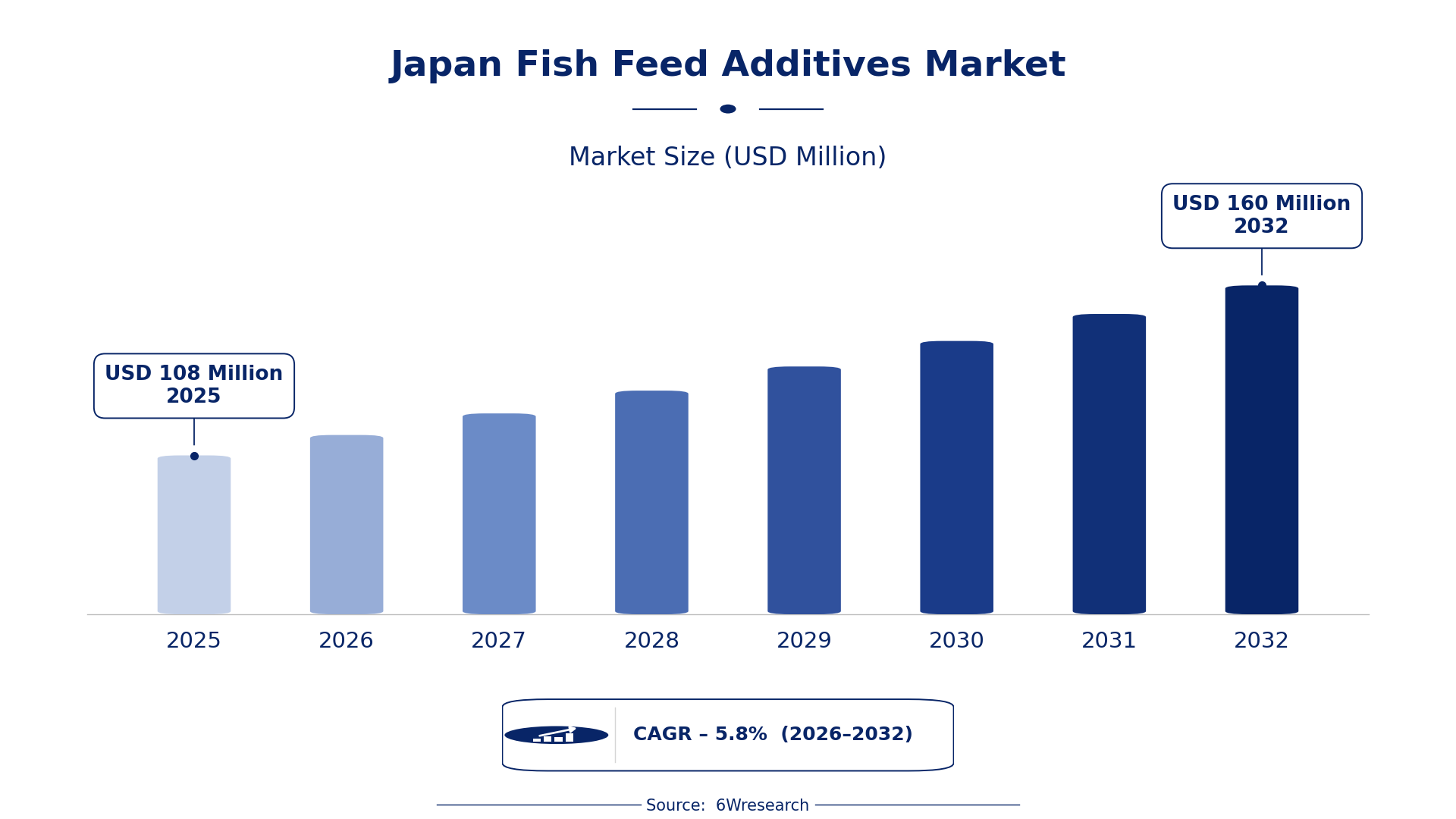
According to 6Wresearch internal database and industry insights, the Japan Fish Feed Additives Market was valued at USD 108 Million in 2025 and is projected to reach USD 160 Million by 2032, growing at a CAGR of approximately 5.8% during 2026–2032.
Japan Fish Feed Additives Market Highlights
| Report Metric | Details |
| Report Name | Japan Fish Feed Additives Market (2026-2032) |
| Market Size 2025 | USD 108 Million |
| Market Size 2032 | USD 160 Million |
| Absolute Growth 2025–2032 | USD 52 Million |
| CAGR 2026–2032 | 5.8% |
| Peak Annual Growth | 6.8% in 2026 |
| Forecast Period | 2026–2032 |
| Historical Data | 2022–2025 |
| Base Year | 2025 |
| Leading Additive Type, 2025 | Amino Acids (52% share) |
| Leading Function, 2025 | Growth & Protein Synthesis (47% share) |
| Leading Distribution Channel, 2025 | Animal Feed Companies (37% share) |
| Leading End User, 2025 | Fish Feed Manufacturers (43% share) |
| Fastest-Growing Additive Type | Enzymes (8.0% CAGR) |
| Fastest-Growing Function | Nutrient Absorption (7.5% CAGR) |
| Fastest-Growing Distribution Channel | Chemical Distributors (7.9% CAGR) |
| Fastest-Growing End User | Aquaculture Industries (7.3% CAGR) |
| Growing Sector | Aquaculture Industries |
| Key End Users | Fish Feed Manufacturers, Aquaculture Industries, Hatcheries, Ornamental Fish Farms |
Japan Fish Feed Additives Market Year-wise Growth Rate and Key Drivers (2022–2032)
This graph illustrates the annual growth rates of the market from 2022 to 2032, highlighting a steady upward trajectory and projected market expansion over the forecast period.
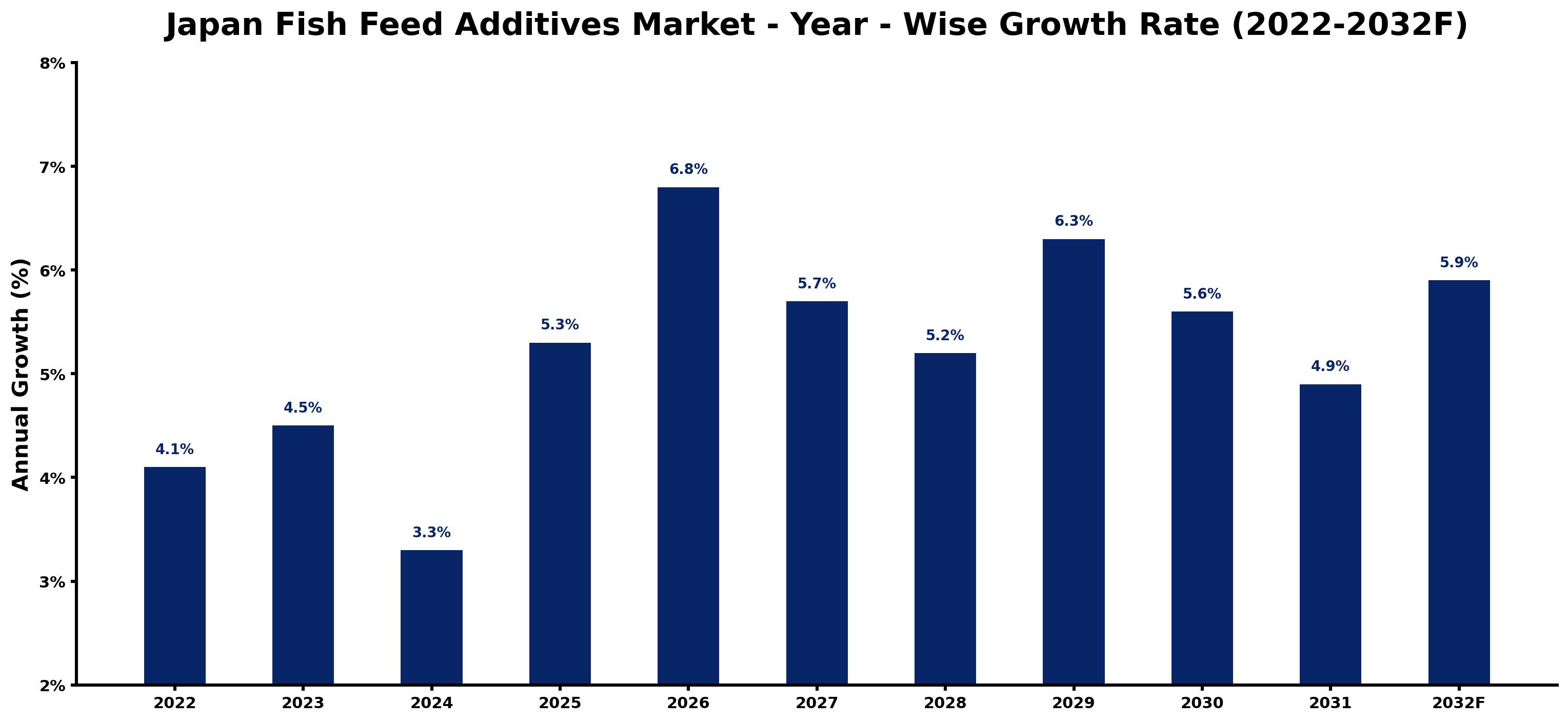
Annual growth estimates for each year appear below with the principal reason behind them, explaining the shifts that set the pace of the market.
| Year | Estimated Annual Growth (%) | Market Rationale |
| 2022 | 4.1 | The market showed steady growth due to increasing aquaculture production. |
| 2023 | 4.5 | Demand rose as fish feed manufacturers adopted more advanced formulations. |
| 2024 | 3.3 | Growth slowed as some manufacturers faced supply chain disruptions. |
| 2025 | 5.3 | The market accelerated with rising fish consumption and aquaculture expansion. |
| 2026 | 6.8 | A peak in growth occurred as new technologies improved feed efficiency. |
| 2027 | 5.7 | Growth slowed due to market saturation in certain feed types. |
| 2028 | 5.2 | The market continued to grow as environmental regulations encouraged innovation. |
| 2029 | 6.3 | Demand increased as aquaculture industries sought higher quality additives. |
| 2030 | 5.6 | Growth is projected to slow as competition intensifies among feed manufacturers. |
| 2031 | 4.9 | The market is expected to experience slower growth as consumer preferences shift. |
| 2032 | 5.9 | Demand is expected to rise again as hatcheries expand production capabilities. |
Note: Market size estimations and growth projections presented in this report are based on 6Wresearch's proprietary forecasting methodology, utilizing the latest available industry data, government publications, and primary research inputs.
Japan Fish Feed Additives Market Synopsis
Fish feed additives improve the nutritional quality of fish feed, promoting fish health and growth. These additives are produced through fermentation and chemical synthesis, with applications in aquaculture. The Japan Fish Feed Additives Market is growing due to increasing aquaculture production, supported by over 1,000 registered fish feed manufacturers. The average annual fish consumption in Japan is about 25 kg, driving demand for high-quality feed. The rising use of amino acids in formulations and a commitment to sustainable practices further contribute to market expansion.
Market Dynamics Impact Analysis (2026–2032)
| Factor | Type | Impact | Primary Segment Affected |
| Rising aquaculture production increases demand for fish feed additives. | Driver | High | Growth & Protein Synthesis |
| The adoption of advanced formulations enhances nutrient absorption. | Driver | High | Nutrient Absorption |
| The ornamental fish market is expanding, creating new opportunities. | Opportunity | Medium | Coloring Agents |
| Increased focus on sustainability drives demand for eco-friendly additives. | Opportunity | High | Enzymes |
| Stringent regulations on chemical substances may restrict additive usage. | Restraint | High | Amino Acids |
| Market saturation in certain segments can limit growth potential. | Restraint | Medium | Preservatives |
| Supply chain disruptions affect the availability of raw materials. | Challenge | High | Enzymes |
| Intense competition among manufacturers pressures pricing strategies. | Challenge | Medium | Fish Feed Manufacturers |
Evaluation of Drivers in Japan Fish Feed Additives Market (2026–2032)
Demand rests on the following drivers, each shown with the segment it touches most.
| Drivers | Primary Segment Affected | Why It Matters (Evidence) |
| Increased aquaculture production drives higher demand for fish feed. | Growth & Protein Synthesis | Japan's aquaculture production reached approximately 1.2 million tons in 2022, leading to greater feed consumption. |
| The use of amino acids in formulations boosts growth rates. | Amino Acids | Amino acids are key components in over 70% of fish feeds, improving their nutritional value. |
| Technological advancements improve feed efficiency and nutrient absorption. | Nutrient Absorption | Enzymes are included in 40% of fish feed formulations, aiding digestion and nutrient uptake. |
| Rising fish consumption supports the need for high-quality feed additives. | Fish Feed Manufacturers | The average annual fish consumption in Japan is about 25 kg per person, driving feed demand. |
| Sustainable practices in aquaculture encourage the use of eco-friendly additives. | Enzymes | The Fisheries Agency promotes sustainable aquaculture, increasing the demand for environmentally friendly additives. |
Most of the extra volume comes from the increasing aquaculture production, which reached approximately 1.2 million tons in 2022. Fish feed manufacturers are responding to the average annual fish consumption of about 25 kg per person by improving their formulations. The use of amino acids, a key component in over 70% of fish feeds, boosts growth rates. Technological advancements have led to enzymes being included in 40% of formulations, improving nutrient absorption. The focus on sustainable practices in aquaculture is driving the demand for eco-friendly additives in the market.
Evaluation of Restraints in Japan Fish Feed Additives Market
Several factors work against faster growth; the main ones are summarised below.
| Market Restraint | Primary Segment Affected | Why It Matters (Evidence) |
| Stringent regulations on chemical substances may limit additive usage. | Amino Acids | The Chemical Substances Control Law requires evaluation of new substances, impacting formulation options. |
| Market saturation in certain segments can restrict growth potential. | Preservatives | With many manufacturers offering similar products, differentiation becomes challenging. |
| Supply chain disruptions can affect the availability of raw materials. | Enzymes | Global supply chain issues have led to delays in sourcing essential ingredients. |
| Intense competition among manufacturers pressures pricing strategies. | Fish Feed Manufacturers | High competition can lead to price wars, affecting profit margins. |
| Consumer preferences shifting towards organic products may limit traditional additives. | Coloring Agents | The ornamental fish market's valuation is increasingly influenced by organic trends. |
Japan Fish Feed Additives Market Challenges
Producers face high input costs with fish feed averaging around $1,200 per ton, which squeezes profit margins and limits investment in product quality. Competition intensifies as over 1,000 registered fish feed manufacturers compete for market share, leading to price wars that can compromise the quality of the feed for buyers. The aquaculture industry suffers from skills shortages, making it challenging to recruit qualified personnel, which delays production timelines and affects the overall quality of fish feed. Technology adoption is sluggish, with only 40% of formulations incorporating enzymes, restricting efficiency and nutritional value for producers.
Trends in the Japan Fish Feed Additives Market
These developments are changing demand patterns in the Japan Fish Feed Additives Market.
- Shift from Traditional to Sustainable Feed Additives: A growing trend towards sustainable feed additives in aquaculture is emerging, driven by regulations and consumer demand. The Fisheries Agency promotes sustainable practices, resulting in a 20% increase in eco-friendly formulations in the last two years.
- Emergence of Enzymes as Key Ingredients: Enzymes are becoming increasingly popular in fish feed formulations, with their use rising to 40% among manufacturers. This trend reflects a shift towards improving nutrient absorption and feed efficiency in aquaculture.
- Expansion of the Ornamental Fish Market: The ornamental fish market in Japan is valued at approximately $100 million, indicating a shift in consumer preferences. This growth is prompting fish feed manufacturers to develop specialized additives for ornamental species.
- Increase in Aquaculture Research Funding: Government programs supporting research in aquaculture innovation are gaining momentum, with funding increasing by 15% in the last year. This investment aims to improve feed formulations and sustainability practices.
Investment Opportunities in the Japan Fish Feed Additives Market
The opportunities below stand out in the Japan Fish Feed Additives Market for new entrants and existing suppliers.
- Growing Demand for Eco-Friendly Additives: With a 20% increase in eco-friendly formulations, suppliers should focus on sustainable fish feed additives. Aquaculture industries are seeking these products to comply with regulations, creating a market gap for new solutions.
- Investment in Nutrient-Rich Formulations: The average fish consumption of 25 kg per person presents an opportunity to supply nutrient-rich additives. Fish feed manufacturers are looking for partners to develop high-quality formulations that meet consumer demands.
- Expansion of Hatchery Operations: As hatcheries expand production capabilities, there is a need for specialized additives. Suppliers can enter this market by collaborating with hatcheries to provide tailored solutions that enhance fish growth.
- Focus on Ornamental Fish Nutrition: The ornamental fish market's valuation indicates a need for specialized additives. Suppliers can invest in developing products that cater to the unique nutritional requirements of ornamental species.
Government Initiatives in the Japan Fish Feed Additives Market
The Chemical Substances Control Law requires businesses to evaluate new chemical substances, impacting the formulation of fish feed additives. Compliance with these regulations ensures that producers maintain safety and quality standards, which benefits buyers by providing reliable products.
The Ministry of Agriculture, Forestry and Fisheries oversees aquaculture regulations and funds research initiatives to support innovation in the sector. By approving projects that promote sustainable practices, the agency helps improve the overall quality of fish feed.
Future Insight of the Japan Fish Feed Additives Market
Hatcheries will transform by 2032 as government programs drive research in aquaculture innovation, enhancing production methods. The adoption of ISO 9001 standards will ensure higher quality and safety in fish feed, providing buyers with more reliable products. Advances in technology will boost the use of enzymes in formulations, improving nutrient absorption and growth rates. Japan's ornamental fish market is expected to expand as consumer preferences shift towards sustainable and premium aquatic products.
Market Segmentation Analysis
Japan Fish Feed Additives Market report covers a detailed analysis of the following market segments:
By Additive Type – Amino Acids Lead, Enzymes Expected to Grow Fastest
According to Saurav Kr Singh, Senior Research Analyst at 6Wresearch, Amino Acids held 52% of the Japan Fish Feed Additives Market by additive type in 2025. Amino acids are vital for fish growth and development, constituting a major part of over 70% of fish feeds produced in Japan. Their extensive use across various fish farms demonstrates their dominant position in the market. The quickest growth will come from Enzymes, forecast to expand at a CAGR of 8.0% between 2026 and 2032. The rising use of enzymes in 40% of fish feed formulations is primarily due to their role in improving digestion and nutrient absorption. This trend is expected to continue as manufacturers strive for enhanced feed efficiency. Suppliers should focus on developing enzyme products to cater to the increasing demand in the fish feed sector.
By Function – Growth & Protein Synthesis Leads, Nutrient Absorption Expected to Grow Fastest
The largest function category in 2025 was Growth & Protein Synthesis, at 47% of revenue. The growth and protein synthesis function leads the market as it is essential for fish growth, directly impacting aquaculture productivity. This function is crucial for fish feed manufacturers aiming to optimise growth rates in their formulations. Over 2026–2032, Nutrient Absorption is expected to post the fastest growth, at a CAGR of 7.5%. Nutrient absorption is rapidly gaining traction as it directly boosts feed efficiency, which is critical for aquaculture industries looking to maximise production. This focus on efficiency is likely to drive further advancements in nutrient absorption technologies. Buyers should prioritise additives that enhance nutrient absorption to improve overall feed performance.
By Distribution Channel – Animal Feed Companies Lead, Chemical Distributors Expected to Grow Fastest
Animal Feed Companies accounted for 37% of the market by distribution channel in 2025. Animal feed companies lead the market as they are the primary manufacturers of fish feed, ensuring a steady supply of essential additives. Their established distribution networks facilitate the delivery of fish feed across Japan's aquaculture sector. Chemical Distributors are set to record the highest CAGR in this split, 7.9% over 2026–2032. Chemical distributors are rapidly expanding as they supply essential additives to feed manufacturers, reflecting a shift towards more specialised supply chains. This growth is expected to continue as the demand for tailored solutions increases. Suppliers should explore partnerships with chemical distributors to broaden their market reach and improve product availability.
By End User – Fish Feed Manufacturers Lead, Aquaculture Industries Expected to Grow Fastest
In 2025, Fish Feed Manufacturers led the end user split with a 43% share. Fish feed manufacturers hold the largest market share as they are the primary users of additives, integrating them into their production processes. Their significant role in the aquaculture supply chain underscores their importance in driving demand for various additives. Aquaculture Industries are projected to grow fastest, at a CAGR of 7.3% during 2026–2032. Aquaculture industries are experiencing the fastest growth due to their high demand for fish farming, which is essential for meeting Japan's fish consumption. This trend indicates an increasing reliance on effective feed solutions. Suppliers must align their products with the specific requirements of aquaculture industries to take advantage of this growing market.
Key Attractiveness of the Report
- 10 Years of Market Numbers
- Historical Data Starting from 2022 to 2025
- Base Year 2025
- Forecast Data until 2032
- Key Performance Indicators Impacting the Market
- Major Upcoming Developments and Projects
Key Highlights of the Report:
- Japan Fish Feed Additives Market Outlook
- Market Size of Japan Fish Feed Additives Market, 2025
- Forecast of Japan Fish Feed Additives Market, 2032
- Historical Data and Forecast of Japan Fish Feed Additives Revenues & Volume for the Period 2022-2032F
- Japan Fish Feed Additives Market Trend Evolution
- Japan Fish Feed Additives Market Drivers and Challenges
- Japan Fish Feed Additives Price Trends
- Japan Fish Feed Additives Porter's Five Forces
- Japan Fish Feed Additives Industry Life Cycle
- Historical Data and Forecast of Japan Fish Feed Additives Market Revenues & Volume By Additive Type for the Period 2022-2032F
- Historical Data and Forecast of Japan Fish Feed Additives Market Revenues & Volume By Amino Acids for the Period 2022-2032F
- Historical Data and Forecast of Japan Fish Feed Additives Market Revenues & Volume By Enzymes for the Period 2022-2032F
- Historical Data and Forecast of Japan Fish Feed Additives Market Revenues & Volume By Preservatives for the Period 2022-2032F
- Historical Data and Forecast of Japan Fish Feed Additives Market Revenues & Volume By Coloring Agents for the Period 2022-2032F
- Historical Data and Forecast of Japan Fish Feed Additives Market Revenues & Volume By Function for the Period 2022-2032F
- Historical Data and Forecast of Japan Fish Feed Additives Market Revenues & Volume By Growth & Protein Synthesis for the Period 2022-2032F
- Historical Data and Forecast of Japan Fish Feed Additives Market Revenues & Volume By Nutrient Absorption for the Period 2022-2032F
- Historical Data and Forecast of Japan Fish Feed Additives Market Revenues & Volume By Shelf-life Extension for the Period 2022-2032F
- Historical Data and Forecast of Japan Fish Feed Additives Market Revenues & Volume By Pigmentation for the Period 2022-2032F
- Historical Data and Forecast of Japan Fish Feed Additives Market Revenues & Volume By Distribution Channel for the Period 2022-2032F
- Historical Data and Forecast of Japan Fish Feed Additives Market Revenues & Volume By Animal Feed Companies for the Period 2022-2032F
- Historical Data and Forecast of Japan Fish Feed Additives Market Revenues & Volume By Chemical Distributors for the Period 2022-2032F
- Historical Data and Forecast of Japan Fish Feed Additives Market Revenues & Volume By Online Feed Suppliers for the Period 2022-2032F
- Historical Data and Forecast of Japan Fish Feed Additives Market Revenues & Volume By Bulk Traders for the Period 2022-2032F
- Historical Data and Forecast of Japan Fish Feed Additives Market Revenues & Volume By End User for the Period 2022-2032F
- Historical Data and Forecast of Japan Fish Feed Additives Market Revenues & Volume By Fish Feed Manufacturers for the Period 2022-2032F
- Historical Data and Forecast of Japan Fish Feed Additives Market Revenues & Volume By Aquaculture Industries for the Period 2022-2032F
- Historical Data and Forecast of Japan Fish Feed Additives Market Revenues & Volume By Hatcheries for the Period 2022-2032F
- Historical Data and Forecast of Japan Fish Feed Additives Market Revenues & Volume By Ornamental Fish Farms for the Period 2022-2032F
- Japan Fish Feed Additives Import Export Trade Statistics
- Market Opportunity Assessment By Additive Type
- Market Opportunity Assessment By Function
- Market Opportunity Assessment By Distribution Channel
- Market Opportunity Assessment By End User
- Japan Fish Feed Additives Top Companies Market Share
- Japan Fish Feed Additives Competitive Benchmarking By Technical and Operational Parameters
- Japan Fish Feed Additives Company Profiles
- Japan Fish Feed Additives Key Strategic Recommendations
Market Covered
The following segment groups are covered in the report.
By Additive Type
- Amino Acids
- Enzymes
- Preservatives
- Coloring Agents
By Function
- Growth & Protein Synthesis
- Nutrient Absorption
- Shelf-life Extension
- Pigmentation
By Distribution Channel
- Animal Feed Companies
- Chemical Distributors
- Online Feed Suppliers
- Bulk Traders
By End User
- Fish Feed Manufacturers
- Aquaculture Industries
- Hatcheries
- Ornamental Fish Farms































