Japan Fitness and Recreational Sports Center Market Size & Growth Rate
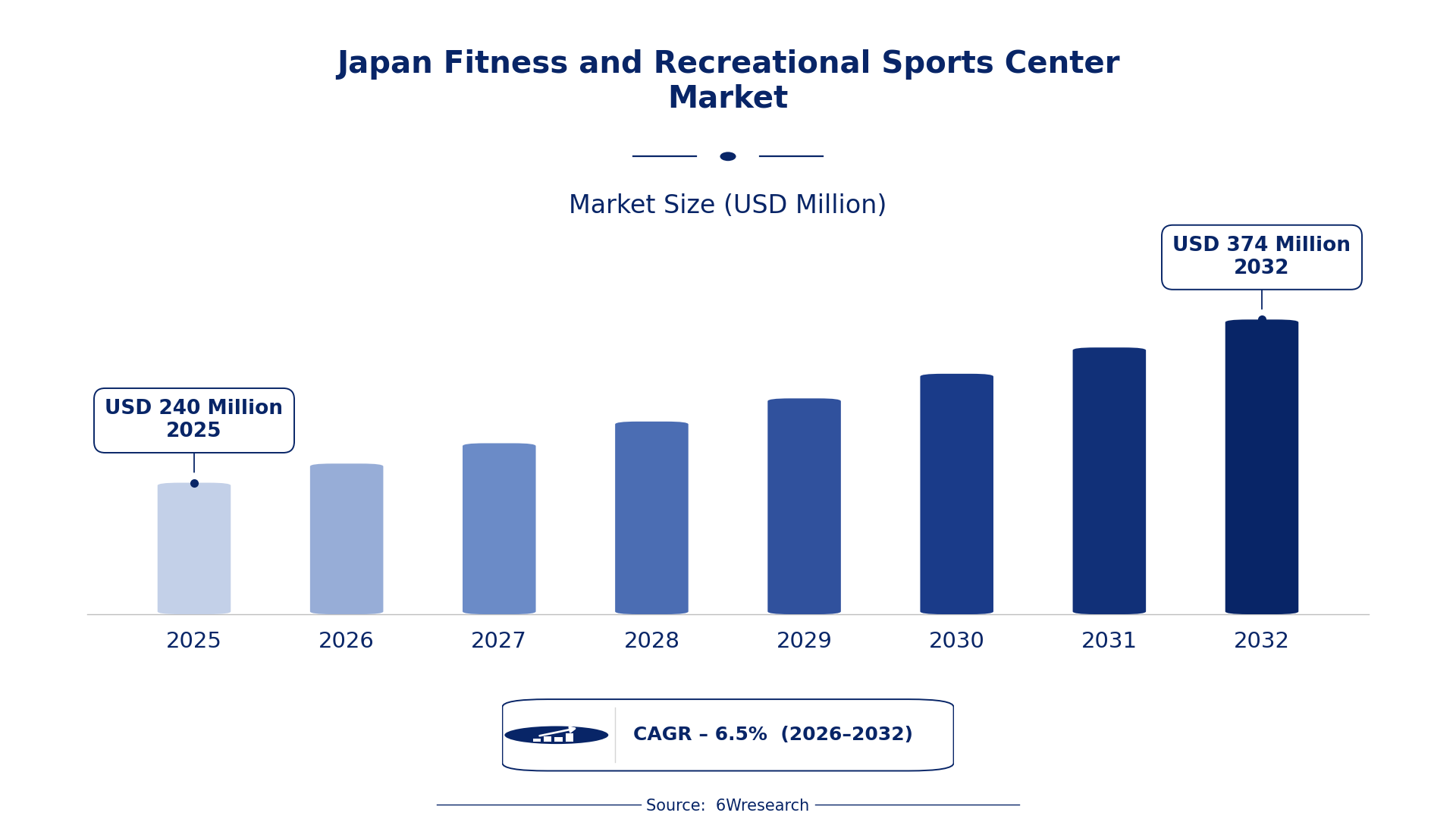
According to 6Wresearch internal database and industry insights, the Japan Fitness and Recreational Sports Center Market was valued at USD 240 Million in 2025 and is projected to reach USD 374 Million by 2032, growing at a CAGR of approximately 6.5% during 2026–2032.
Japan Fitness and Recreational Sports Center Market Highlights
| Report Metric | Details |
| Report Name | Japan Fitness and Recreational Sports Center Market (2026-2032) |
| Market Size 2025 | USD 240 Million |
| Market Size 2032 | USD 374 Million |
| Absolute Growth 2025–2032 | USD 134 Million |
| CAGR 2026–2032 | 6.5% |
| Peak Annual Growth | 7.5% in 2027 |
| Forecast Period | 2026–2032 |
| Historical Data | 2022–2025 |
| Base Year | 2025 |
| Leading Type, 2025 | Fitness Centers (42% share) |
| Leading Application, 2025 | Fitness Training (49% share) |
| Leading End User, 2025 | Individual Members (47% share) |
| Fastest-Growing Type | Sports Complexes (9.2% CAGR) |
| Fastest-Growing Application | Sports Activities (8.7% CAGR) |
| Fastest-Growing End User | Corporate Clients (8.5% CAGR) |
| Growing Sector | Fitness and wellness programs |
| Key End Users | Individual members, corporate clients, schools, colleges |
Japan Fitness and Recreational Sports Center Market Year-wise Growth Rate and Key Drivers (2022–2032)
This graph illustrates the annual growth rates of the market from 2022 to 2032, highlighting a steady upward trajectory and projected market expansion over the forecast period.
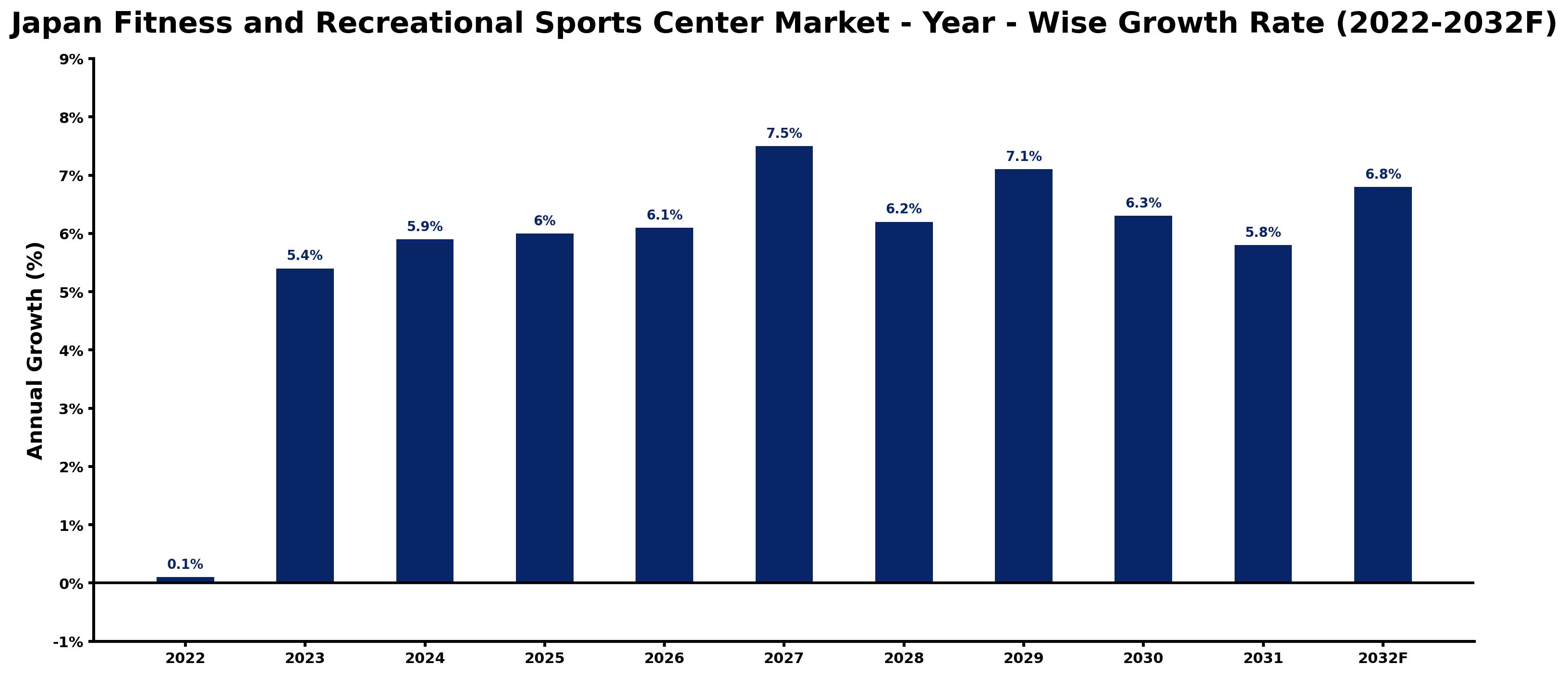
The table below sets out the estimated growth rate for each year and the main factor behind it.
| Year | Estimated Annual Growth (%) | Market Rationale |
| 2022 | 0.1 | The market showed minimal growth due to limited consumer engagement in fitness activities. |
| 2023 | 5.4 | Increased awareness of health led to a rise in fitness center memberships. |
| 2024 | 5.9 | The Tokyo 2020 Olympics spurred interest in sports participation and facility usage. |
| 2025 | 6.0 | Growth continued as more individuals sought fitness services for improved health. |
| 2026 | 6.1 | Investment in fitness infrastructure is expected to create new demand for recreational activities. |
| 2027 | 7.5 | The peak growth year will see heightened interest in wellness programs and fitness training. |
| 2028 | 6.2 | A slight slowdown is projected as market saturation begins to take effect. |
| 2029 | 7.1 | Demand is expected to rebound as corporate wellness initiatives gain traction among large firms. |
| 2030 | 6.3 | Market growth is projected to slow again as competition intensifies among fitness centers. |
| 2031 | 5.8 | A further slowdown is expected as consumer preferences shift towards specialized services. |
| 2032 | 6.8 | Growth is projected to pick up again with advancements in fitness technology and wellness integration. |
Note: Market size estimations and growth projections presented in this report are based on 6Wresearch's proprietary forecasting methodology, utilizing the latest available industry data, government publications, and primary research inputs.
Japan Fitness and Recreational Sports Center Market Synopsis
Fitness and Recreational Sports Centers in Japan are facilities designed for physical fitness and wellness activities, catering to diverse users. The Japan Fitness and Recreational Sports Center Market is expanding due to rising health awareness, with over 30,000 fitness centers operational as of 2023. The Tokyo Metropolitan area remains the largest hub, while initiatives like Health Japan 21 promote wellness programs. Corporate clients increasingly adopt fitness services, driving demand for health-focused facilities and services. This growth is supported by a growing population and increasing investment in fitness infrastructure.
Market Dynamics Impact Analysis (2026–2032)
| Factor | Type | Impact | Primary Segment Affected |
| Growing health consciousness among the population | Driver | High | Fitness Centers |
| Increased corporate investment in employee wellness programs | Driver | High | Health Clubs |
| Rising demand for sports complexes for community events | Opportunity | Medium | Sports Complexes |
| Expansion of wellness programs in educational institutions | Opportunity | Medium | Wellness Programs |
| High operational costs for maintaining fitness facilities | Restraint | High | Health Clubs |
| Limited availability of skilled trainers in rural areas | Restraint | Medium | Fitness Centers |
| Intense competition among fitness service providers | Challenge | High | Fitness Centers |
| Fluctuating consumer spending on fitness memberships | Challenge | Medium | Health Clubs |
Evaluation of Drivers in Japan Fitness and Recreational Sports Center Market (2026–2032)
The table below links each growth driver to the segment it affects and the evidence for it.
| Drivers | Primary Segment Affected | Why It Matters (Evidence) |
| Increased investment in fitness infrastructure | Fitness Centers | This investment has led to the establishment of over 30,000 fitness centers, improving accessibility for consumers. |
| Growth in corporate wellness programs | Health Clubs | With over 60% of large companies adopting these programs, demand for health club memberships has surged. |
| Rising interest in organized sports activities | Sports Activities | The Tokyo 2020 Olympics significantly boosted participation in sports events and training. |
| Expansion of health and wellness initiatives | Wellness Programs | Programs like Health Japan 21 promote structured wellness initiatives, increasing consumer engagement. |
| Growing population interested in fitness | Fitness Centers | Japan's population of approximately 125 million shows a growing interest in fitness and health. |
Spending rises because investment in fitness infrastructure has increased, resulting in over 30,000 fitness centers across Japan. The Tokyo 2020 Olympics boosted interest in organized sports, leading to a surge in sports activities. With a population of approximately 125 million, the growing interest in fitness is reflected across various demographics.
Evaluation of Restraints in Japan Fitness and Recreational Sports Center Market
The following restraints limit how fast demand can grow.
| Market Restraint | Primary Segment Affected | Why It Matters (Evidence) |
| High operational costs associated with fitness centers | Health Clubs | Maintaining facilities incurs high expenses, impacting profitability for service providers. |
| Limited access to fitness services in rural areas | Fitness Centers | The scarcity of skilled trainers in these regions restricts service availability for potential clients. |
| Intense competition leading to price wars | Fitness Centers | As many centers vie for the same clientele, pricing strategies can erode profit margins. |
| Fluctuating consumer spending patterns | Health Clubs | Economic uncertainties can lead consumers to cut back on discretionary spending, affecting memberships. |
| Regulatory compliance costs for fitness facilities | Health Clubs | Adhering to JIS standards for fitness equipment increases operational costs for health clubs. |
Japan Fitness and Recreational Sports Center Market Challenges
Many fitness centers in Japan struggle with outdated technology, limiting their ability to attract and retain members. This challenge exists due to the high costs of upgrading equipment, which can consume over 30% of a center's annual budget, delaying necessary improvements for owners. Rising operational costs also burden facilities, with energy expenses increasing by 15% in the past year, reducing profitability for operators. A shortage of qualified trainers affects service quality, as more than 40% of centers report difficulties in hiring skilled staff, resulting in lower customer satisfaction. Supply chain disruptions complicate operations, causing delays of up to six months for new equipment, frustrating both operators and users.
Trends in the Japan Fitness and Recreational Sports Center Market
These developments are changing demand patterns in the Japan Fitness and Recreational Sports Center Market.
- Shift Towards Corporate Wellness Programs: Corporate clients are increasingly prioritising wellness programs, with over 60% of large companies adopting these initiatives. This trend is reshaping fitness service offerings, driving demand for tailored health solutions.
- Emergence of Community Sports Complexes: Since 2020, there has been a notable rise in community sports complexes, enhancing local engagement in sports activities. This shift is evident in urban areas, where facilities are being developed to host events.
- Integration of Technology in Fitness Training: The adoption of fitness technology is transforming training methods, with smart equipment becoming more common in health clubs. This trend is driven by consumer demand for personalised fitness experiences.
- Focus on Wellness Programs in Educational Institutions: Educational institutions are increasingly integrating wellness programs into their curricula, promoting health among students. This movement is supported by initiatives from the Japan Sports Agency.
Investment Opportunities in the Japan Fitness and Recreational Sports Center Market
The following areas offer the clearest openings for investors and suppliers in the Japan Fitness and Recreational Sports Center Market.
- Gap in Rural Fitness Services: With over 125 million people in Japan, there is a notable gap in fitness services in rural areas. Investing in mobile fitness units can address this need, targeting underserved communities.
- Expansion of Sports Complexes in Urban Areas: Urban regions are witnessing a surge in demand for sports complexes, driven by community engagement. Investing in these facilities can cater to local sports events and training needs.
- Supply of Wellness Programs for Corporates: The growing trend of corporate wellness programs presents an opportunity to supply tailored fitness solutions. Partnering with large corporations can facilitate entry into this expanding market.
- Development of Fitness Apps and Technology: The increasing integration of technology in fitness presents opportunities for app development. Collaborating with tech firms can enhance service offerings in health clubs.
Government Initiatives in the Japan Fitness and Recreational Sports Center Market
The Next-Generation Medical Infrastructure Act of 2017 impacts fitness and wellness program providers by allowing anonymised medical data use for research, facilitating the development of targeted health initiatives that improve service delivery and consumer engagement. Additionally, the Clinical Trials Act sets rules for research, ensuring that fitness programs align with health standards and practices.
The Japan Sports Agency oversees funding for community fitness initiatives, approving projects that aim to improve public health. This includes support for local fitness centers and wellness projects, enhancing access to fitness services for residents.
Future Insight of the Japan Fitness and Recreational Sports Center Market
By 2032, smart technology will reshape demand in fitness facilities, with connected equipment becoming standard. AI-driven personal training programs will enhance user experiences, drawing in new members. Local governments will boost funding for community fitness initiatives, expanding access to exercise options for residents. The Health Japan 21 initiative will continue to encourage health engagement, leading to increased participation in fitness activities and improving overall community well-being.
Market Segmentation Analysis
Japan Fitness and Recreational Sports Center Market report covers a detailed analysis of the following market segments:
By Type – Fitness Centers Lead, Sports Complexes Expected to Grow Fastest
According to Sachin Kumar Rai, Senior Research Analyst at 6Wresearch, with 42% of type revenue in 2025, Fitness Centers was the largest category. Fitness Centers hold the largest share due to their extensive availability, with over 30,000 facilities across Japan catering to diverse users. They are essential for individuals and corporate clients seeking structured fitness services and wellness initiatives. Sports Complexes are set to record the highest CAGR in this split, 9.2% over 2026–2032. Sports Complexes are experiencing rapid growth, particularly following the Tokyo 2020 Olympics, which significantly increased interest in sports venues. This trend is illustrated by the rising number of facilities being developed for various sports events and training. Suppliers should focus on expanding their offerings to Sports Complexes to capitalise on this growing market segment.
By Application – Fitness Training Leads, Sports Activities Expected to Grow Fastest
Fitness Training held 49% of the Japan Fitness and Recreational Sports Center Market by application in 2025. Fitness Training is the leading application as it represents the core service provided by fitness centers aimed at improving physical health. This focus aligns with national health initiatives that promote active lifestyles and wellness. Over 2026–2032, Sports Activities are expected to post the fastest growth, at a CAGR of 8.7%. Sports Activities are growing quickly, driven by increased participation in organised sports, especially in schools and community settings. The support from the Japan Sports Agency for sports initiatives further accelerates this trend. Buyers should prioritise facilities that offer robust sports activities to meet the rising demand for organised sports participation.
By End User – Individual Members Lead, Corporate Clients Expected to Grow Fastest
Individual Members took 47% of end user revenue in 2025, more than any other category. Individual Members form the largest segment, as they are the main users of fitness services focused on personal health improvement. This demographic is supported by a growing interest in fitness among Japan's population of approximately 125 million. Corporate Clients are projected to grow fastest, at a CAGR of 8.5% during 2026–2032. Corporate Clients represent the fastest-growing segment, with more than 60% of large companies implementing wellness programs for their workforce. This trend highlights the increasing recognition of the value of employee health and fitness. Suppliers should customise their offerings to address the specific requirements of corporate clients to tap into this expanding market.
Key Attractiveness of the Report
- 10 Years of Market Numbers
- Historical Data Starting from 2022 to 2025
- Base Year 2025
- Forecast Data until 2032
- Key Performance Indicators Impacting the Market
- Major Upcoming Developments and Projects
Key Highlights of the Report:
- Japan Fitness and Recreational Sports Center Market Outlook
- Market Size of Japan Fitness and Recreational Sports Center Market,2025
- Forecast of Japan Fitness and Recreational Sports Center Market, 2032
- Historical Data and Forecast of Japan Fitness and Recreational Sports Center Revenues & Volume for the Period 2022-2032
- Japan Fitness and Recreational Sports Center Market Trend Evolution
- Japan Fitness and Recreational Sports Center Market Drivers and Challenges
- Japan Fitness and Recreational Sports Center Price Trends
- Japan Fitness and Recreational Sports Center Porter's Five Forces
- Japan Fitness and Recreational Sports Center Industry Life Cycle
- Historical Data and Forecast of Japan Fitness and Recreational Sports Center Market Revenues & Volume By Type for the Period 2022-2032
- Historical Data and Forecast of Japan Fitness and Recreational Sports Center Market Revenues & Volume By Fitness Centers for the Period 2022-2032
- Historical Data and Forecast of Japan Fitness and Recreational Sports Center Market Revenues & Volume By Sports Complexes for the Period 2022-2032
- Historical Data and Forecast of Japan Fitness and Recreational Sports Center Market Revenues & Volume By Health Clubs for the Period 2022-2032
- Historical Data and Forecast of Japan Fitness and Recreational Sports Center Market Revenues & Volume By Recreation Centers for the Period 2022-2032
- Historical Data and Forecast of Japan Fitness and Recreational Sports Center Market Revenues & Volume By Application for the Period 2022-2032
- Historical Data and Forecast of Japan Fitness and Recreational Sports Center Market Revenues & Volume By Fitness Training for the Period 2022-2032
- Historical Data and Forecast of Japan Fitness and Recreational Sports Center Market Revenues & Volume By Sports Activities for the Period 2022-2032
- Historical Data and Forecast of Japan Fitness and Recreational Sports Center Market Revenues & Volume By Wellness Programs for the Period 2022-2032
- Historical Data and Forecast of Japan Fitness and Recreational Sports Center Market Revenues & Volume By End User for the Period 2022-2032
- Historical Data and Forecast of Japan Fitness and Recreational Sports Center Market Revenues & Volume By Individual Members for the Period 2022-2032
- Historical Data and Forecast of Japan Fitness and Recreational Sports Center Market Revenues & Volume By Corporate Clients for the Period 2022-2032
- Historical Data and Forecast of Japan Fitness and Recreational Sports Center Market Revenues & Volume By Schools/Colleges for the Period 2022-2032
- Japan Fitness and Recreational Sports Center Import Export Trade Statistics
- Market Opportunity Assessment By Type
- Market Opportunity Assessment By Application
- Market Opportunity Assessment By End User
- Japan Fitness and Recreational Sports Center Top Companies Market Share
- Japan Fitness and Recreational Sports Center Competitive Benchmarking By Technical and Operational Parameters
- Japan Fitness and Recreational Sports Center Company Profiles
- Japan Fitness and Recreational Sports Center Key Strategic Recommendations
Market Covered
The report covers the following segments.
By Type
- Fitness Centers
- Sports Complexes
- Health Clubs
- Recreation Centers
By Application
- Fitness Training
- Sports Activities
- Wellness Programs
By End User
- Individual Members
- Corporate Clients
- Schools/Colleges































