Japan Fleet Optimization AI Market Size & Growth Rate
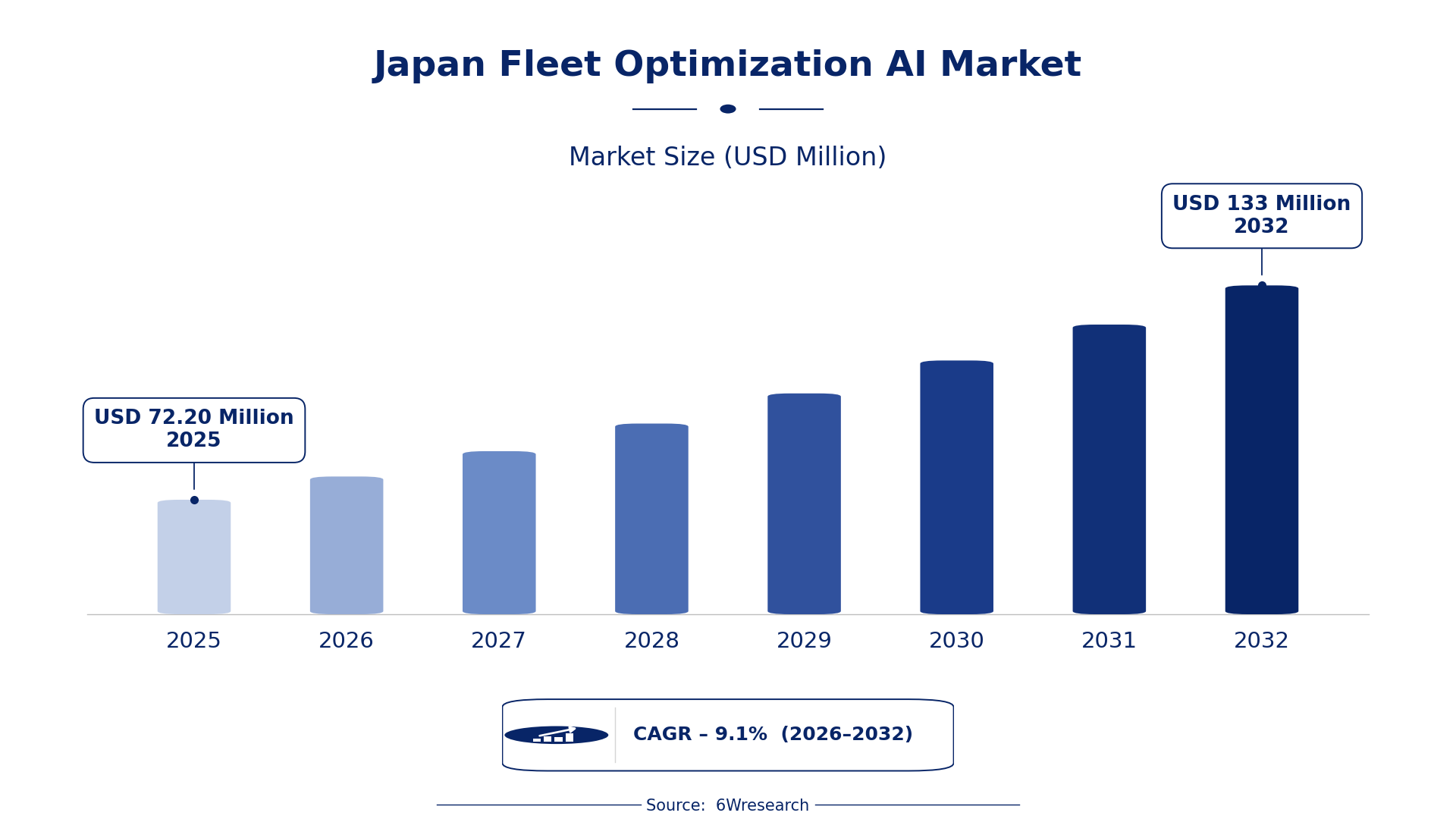
According to 6Wresearch internal database and industry insights, the Japan Fleet Optimization AI Market was valued at USD 72.20 Million in 2025 and is projected to reach USD 133 Million by 2032, growing at a CAGR of approximately 9.1% during 2026–2032.
Japan Fleet Optimization AI Market Highlights
| Report Metric | Details |
| Report Name | Japan Fleet Optimization AI Market (2026-2032) |
| Market Size 2025 | USD 72.20 Million |
| Market Size 2032 | USD 133 Million |
| Absolute Growth 2025–2032 | USD 60.80 Million |
| CAGR 2026–2032 | 9.1% |
| Peak Annual Growth | 9.5% in 2027 |
| Forecast Period | 2026–2032 |
| Historical Data | 2022–2025 |
| Base Year | 2025 |
| Leading AI Functionality, 2025 | Route Optimization (52% share) |
| Leading Feature Area, 2025 | Traffic Prediction (53% share) |
| Leading Distribution Channel, 2025 | SaaS (42% share) |
| Leading End User, 2025 | Courier Companies (39% share) |
| Fastest-Growing AI Functionality | Predictive Maintenance (11.7% CAGR) |
| Fastest-Growing Distribution Channel | Cloud Platforms (11.8% CAGR) |
| Fastest-Growing End User | Delivery Startups (11.6% CAGR) |
| Growing Sector | logistics and transportation |
| Key End Users | courier companies, freight operators, delivery startups, municipal services |
Japan Fleet Optimization AI Market Year-wise Growth Rate and Key Drivers (2022–2032)
This graph illustrates the annual growth rates of the market from 2022 to 2032, highlighting a steady upward trajectory and projected market expansion over the forecast period.
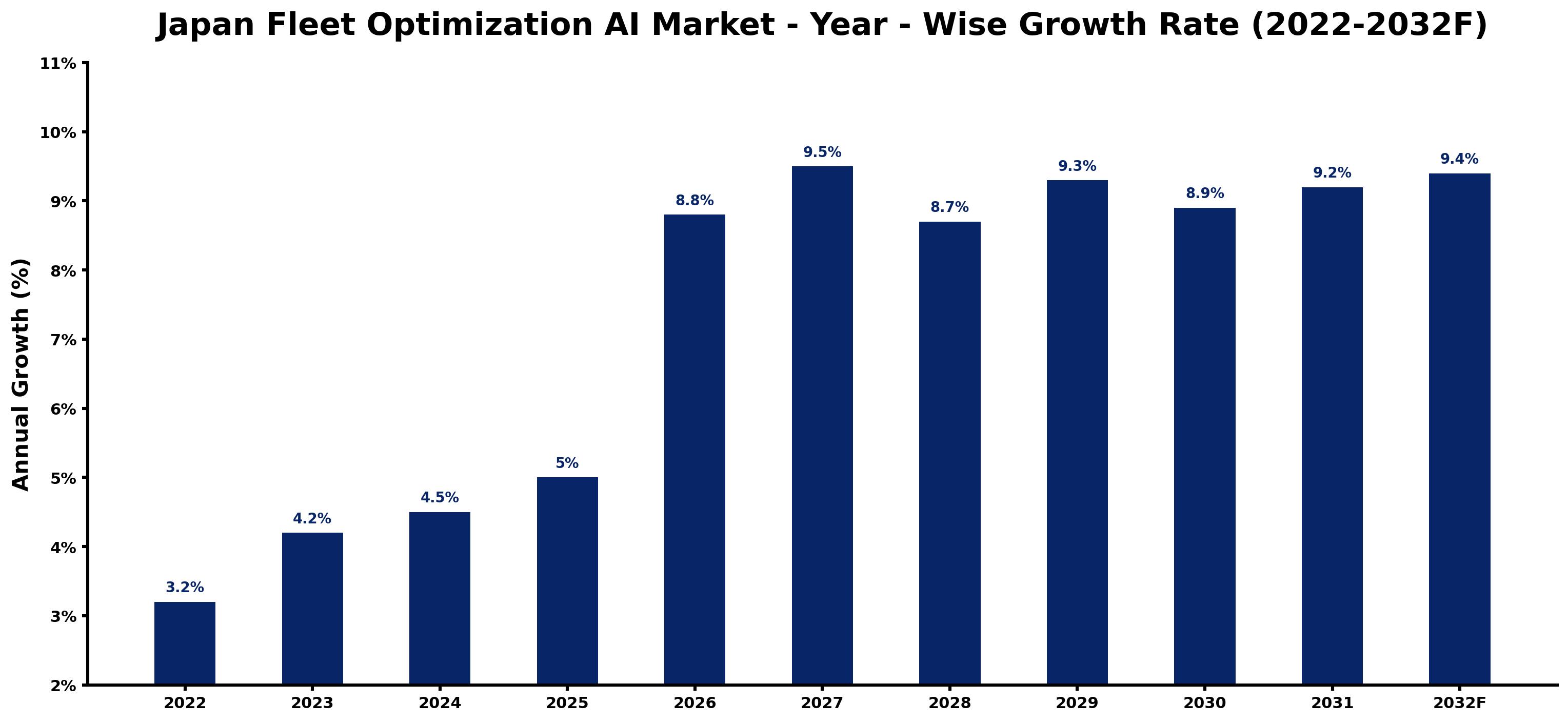
For each year, the table pairs the estimated growth rate with the leading influence on demand, showing how the drivers changed across the period.
| Year | Estimated Annual Growth (%) | Market Rationale |
| 2022 | 3.2 | The logistics sector showed steady demand, driven by urbanisation and e-commerce growth. |
| 2023 | 4.2 | Demand for fleet optimization solutions increased as logistics efficiency became a priority. |
| 2024 | 4.5 | The rise in delivery startups further accelerated the need for advanced fleet management. |
| 2025 | 5.0 | Growth was supported by the Tokyo 2020 Olympics, highlighting logistics challenges. |
| 2026 | 8.8 | The market is set to expand rapidly as more companies adopt AI technologies for operations. |
| 2027 | 9.5 | Fleet optimization AI will gain traction due to increasing e-commerce demands and competition. |
| 2028 | 8.7 | Growth is projected to slow slightly as market maturity sets in, but demand will remain strong. |
| 2029 | 9.3 | The market is anticipated to rebound with renewed investments in technology and infrastructure. |
| 2030 | 8.9 | Growth is expected to decelerate as companies focus on optimising existing solutions rather than new investments. |
| 2031 | 9.2 | A resurgence in demand is projected as logistics companies seek efficiency improvements. |
| 2032 | 9.4 | The market will continue to grow, driven by ongoing digital transformation in logistics. |
Note: Market size estimations and growth projections presented in this report are based on 6Wresearch's proprietary forecasting methodology, utilizing the latest available industry data, government publications, and primary research inputs.
Japan Fleet Optimization AI Market Synopsis
Fleet Optimization AI refers to advanced software solutions that improve fleet operations through artificial intelligence. These systems optimize routes, predict maintenance needs, and improve asset utilization, benefiting the logistics and transportation sectors. The Japan Fleet Optimization AI Market is expanding due to rising demand from courier companies and delivery startups, driven by the e-commerce market projected to reach 20 trillion yen by 2025. The government's focus on logistics digitalization, with 5 billion yen allocated for projects, further supports this expansion.
Market Dynamics Impact Analysis (2026–2032)
| Factor | Type | Impact | Primary Segment Affected |
| Growing e-commerce market driving demand for efficient delivery solutions | Driver | High | Route Optimization |
| Increased adoption of AI technologies in logistics operations | Driver | High | Predictive Maintenance |
| Emerging delivery startups seeking advanced fleet management solutions | Opportunity | High | Delivery Startups |
| Urban areas like Tokyo requiring faster delivery services | Opportunity | High | Courier Companies |
| High competition leading to price pressures in logistics | Restraint | Medium | Freight Operators |
| Limited awareness of fleet optimization benefits among smaller firms | Restraint | Medium | Municipal Services |
| Challenges in integrating AI solutions with existing systems | Challenge | High | Freight Operators |
| High initial investment costs for advanced fleet optimization systems | Challenge | Medium | Delivery Startups |
Evaluation of Drivers in Japan Fleet Optimization AI Market (2026–2032)
The main growth drivers and the segments they affect most are set out below.
| Drivers | Primary Segment Affected | Why It Matters (Evidence) |
| Expansion of e-commerce requiring efficient logistics | Route Optimization | The e-commerce market in Japan is projected to reach 20 trillion yen by 2025, driving demand for optimized delivery routes. |
| Increased focus on predictive maintenance to reduce downtime | Predictive Maintenance | Fleet optimization solutions can reduce downtime by anticipating vehicle issues, essential for operational efficiency. |
| Growth of delivery startups demanding advanced fleet management | Delivery Startups | The rise in delivery startups in Kyoto Prefecture is increasing the need for fleet optimization solutions. |
| Government initiatives promoting smart logistics solutions | Cost Optimization | Support for logistics digitalization encourages cost-effective fleet management, improving operational efficiency. |
| Rising fuel costs prompting cost-cutting measures | Asset Utilization | Fleet optimization solutions can reduce fuel costs by up to 15%, appealing to cost-sensitive operators. |
A wider customer base explains much of the growth, as the e-commerce market in Japan is projected to reach 20 trillion yen by 2025, driving demand for efficient logistics solutions. Logistics companies are increasingly adopting AI technologies to reduce costs and improve service reliability. In urban areas, delivery startups are utilizing predictive maintenance to minimize downtime, enhancing their operational efficiency. Fleet optimization solutions are also reducing fuel costs significantly, prompting logistics firms to invest in advanced technologies that improve asset utilization and overall profitability.
Evaluation of Restraints in Japan Fleet Optimization AI Market
These are the pressures that could keep growth below its potential.
| Market Restraint | Primary Segment Affected | Why It Matters (Evidence) |
| High competition resulting in price pressures in logistics | Freight Operators | In a competitive market, logistics firms face pressure to lower prices, negatively impacting profitability. |
| Limited awareness of fleet optimization benefits among smaller firms | Municipal Services | Many smaller firms lack knowledge about AI solutions, hindering their adoption and overall operational efficiency. |
| Integration challenges with existing fleet management systems | Predictive Maintenance | Logistics companies struggle to incorporate new AI solutions into established processes, delaying implementation. |
| High initial investment costs for advanced fleet optimization systems | Delivery Startups | The upfront costs associated with implementing AI technologies can deter startups from making necessary investments. |
| Regulatory compliance requirements impacting deployment speed | Route Optimization | Fleet operators must navigate complex regulations, which can slow down the adoption of new technologies. |
Japan Fleet Optimization AI Market Challenges
In 2023, 40% of logistics companies report a workforce shortage, complicating the hiring of skilled drivers and delaying deliveries for e-commerce businesses. Technology adoption is slow, with only 30% of fleet operators implementing AI solutions, leading to inefficiencies that inflate operational costs by 15% for logistics providers. Supply chain disruptions continue, as the average delivery time for courier services in urban areas hovers around 2 hours, frustrating consumers and affecting service reliability. Rising fuel costs are straining budgets, with expenses increasing by 10% annually, impacting profitability for logistics firms.
Trends in the Japan Fleet Optimization AI Market
The following changes are redrawing the Japan Fleet Optimization AI Market.
- Courier Companies Prioritising AI Solutions: Courier companies are increasingly adopting AI-driven fleet optimization solutions to improve delivery efficiency. In urban areas like Tokyo, the average delivery time is around 2 hours, necessitating faster logistics to meet customer expectations.
- Rise of Delivery Startups Utilising AI: Delivery startups are adopting AI for fleet management, with Kyoto Prefecture seeing growth in this area. These startups are essential for meeting the demands of the expanding e-commerce market, projected to reach 20 trillion yen by 2025.
- Shift Towards Predictive Maintenance: The logistics sector is moving towards predictive maintenance solutions to reduce downtime and repair costs. This shift is prompted by the need for efficiency, as fleet optimization solutions can significantly improve operational performance.
- Increased Focus on Cost Optimization: Logistics firms are prioritising cost optimization to remain competitive in a challenging market. Initiatives supporting digitalization are promoting strategies that cut operational costs and improve service delivery.
Investment Opportunities in the Japan Fleet Optimization AI Market
The opportunities below stand out in the Japan Fleet Optimization AI Market for new entrants and existing suppliers.
- Kyoto Prefecture as a Hub for Delivery Startups: Kyoto Prefecture is emerging as a hub for delivery startups, with investments in AI technologies. The local market is primed for fleet optimisation solutions, with a projected growth rate of 11.6% for this segment.
- Government Funding for Logistics Digitalization: The Japanese government has allocated 5 billion yen for logistics digitalisation projects, creating opportunities for suppliers of fleet optimisation AI. Companies can collaborate with local firms to access this funding and expand their market presence.
- Urban Areas Demanding Faster Delivery Solutions: Urban areas like Tokyo, with over 14 million residents, are driving the need for efficient delivery services. Suppliers can target this market by offering tailored fleet optimisation solutions to meet local demands.
- E-commerce Growth Creating Demand for Fleet Solutions: The projected growth of the e-commerce market to 20 trillion yen by 2025 presents an opportunity for fleet optimisation AI suppliers. Companies can penetrate this market by partnering with logistics providers to improve delivery efficiency.
Government Initiatives in the Japan Fleet Optimization AI Market
The Logistics Improvement Act, enacted in 2018, established guidelines for enhancing logistics efficiency, influencing fleet optimisation AI by promoting the adoption of advanced technologies. The government also allocated 5 billion yen for logistics digitalisation projects, supporting initiatives that improve operational efficiency in the logistics sector. These measures encourage fleet operators to invest in AI solutions that streamline their operations and reduce costs.
The Ministry of Land, Infrastructure, Transport and Tourism oversees logistics digitalisation initiatives, approving projects that enhance operational efficiency. This agency supports technology adoption, ensuring compliance with standards like ISO 9001 to improve quality management among fleet operators.
Future Insight of the Japan Fleet Optimization AI Market
A policy shift towards smart logistics will reshape the market by 2032, as the government allocates 5 billion yen for digitalization projects. This investment will prompt suppliers to embrace advanced AI technologies, improving fleet management efficiency. The e-commerce market is projected to reach 20 trillion yen by 2025, creating a need for faster delivery solutions. Adoption of ISO 9001 standards will enhance quality management practices among fleet operators, leading to improved service delivery and greater customer satisfaction.
Market Segmentation Analysis
Japan Fleet Optimization AI Market report covers a detailed analysis of the following market segments:
By AI Functionality – Route Optimization Leads, Predictive Maintenance Expected to Grow Fastest
According to Saurav Kr Singh, Senior Research Analyst at 6Wresearch, the largest ai functionality category in 2025 was Route Optimization, at 52% of revenue. Route optimization holds the largest share as it directly improves delivery efficiency and reduces fuel costs, which are essential for logistics operations. The substantial value of Japan's logistics sector, approximately 10 trillion yen, underscores the importance of this functionality. Over 2026–2032, Predictive Maintenance is expected to post the fastest growth, at a CAGR of 11.7%. Predictive maintenance is witnessing rapid growth due to its ability to anticipate vehicle issues, thereby minimising downtime and repair costs. With over 78 million registered vehicles in Japan, the demand for such solutions is increasing significantly. Suppliers should focus on enhancing predictive maintenance features to meet the growing requirements of fleet operators.
By Feature Area – Traffic Prediction Leads and Records the Fastest Growth
Traffic Prediction held 53% of the Japan Fleet Optimization AI Market by feature area in 2025. Traffic prediction is the leading feature area as it enhances various functionalities, contributing to overall fleet efficiency. Its importance is particularly evident in densely populated areas like Tokyo, which has over 14 million residents, where efficient logistics are critical. The same category is also set to grow fastest, at a CAGR of 10.8% during 2026–2032. Traffic prediction is also the fastest-growing feature area, as its integration into fleet management solutions becomes increasingly vital. The Tokyo 2020 Olympics showcased the necessity for real-time traffic insights to optimise logistics operations. Suppliers must invest in advanced traffic prediction capabilities to remain competitive in the market.
By Distribution Channel – SaaS Lead, Cloud Platforms Expected to Grow Fastest
SaaS took 42% of distribution channel revenue in 2025, more than any other category. SaaS captures the largest share in this segment due to its scalable and flexible access to fleet optimization solutions, appealing to a diverse user base. This model aligns with the digitalisation initiatives backed by the Japanese government, which allocated 5 billion yen in 2023. Cloud Platforms are projected to grow fastest, at a CAGR of 11.8% during 2026–2032. Cloud platforms are rapidly growing as they enable the deployment and accessibility of fleet optimization solutions, catering to the rising demand for digital tools. The expanding e-commerce market, projected to reach 20 trillion yen by 2025, drives this trend. Suppliers should prioritise cloud-based solutions to effectively capitalise on emerging market opportunities.
By End User – Courier Companies Lead, Delivery Startups Expected to Grow Fastest
Courier Companies accounted for 39% of the market by end user in 2025. Courier companies dominate this segment as they heavily rely on fleet optimization for timely deliveries, which is crucial in urban environments with high demand. The average delivery time for courier services in Japan is around 2 hours, necessitating effective fleet management. Delivery Startups are set to record the highest CAGR in this split, 11.6% over 2026–2032. Delivery startups are the fastest-growing end user group, as they require efficient fleet management for a competitive advantage in the rapidly changing e-commerce landscape. The increasing demand for swift delivery services in Japan propels the growth of these startups. Suppliers should tailor their offerings to specifically address the needs of delivery startups to leverage this growth.
Key Attractiveness of the Report
- 10 Years of Market Numbers
- Historical Data Starting from 2022 to 2025
- Base Year 2025
- Forecast Data until 2032
- Key Performance Indicators Impacting the Market
- Major Upcoming Developments and Projects
Key Highlights of the Report:
- Japan Fleet Optimization AI Market Outlook
- Market Size of Japan Fleet Optimization AI Market, 2025
- Forecast of Japan Fleet Optimization AI Market, 2032
- Historical Data and Forecast of Japan Fleet Optimization AI Revenues & Volume for the Period 2022-2032F
- Japan Fleet Optimization AI Market Trend Evolution
- Japan Fleet Optimization AI Market Drivers and Challenges
- Japan Fleet Optimization AI Price Trends
- Japan Fleet Optimization AI Porter's Five Forces
- Japan Fleet Optimization AI Industry Life Cycle
- Historical Data and Forecast of Japan Fleet Optimization AI Market Revenues & Volume By AI Functionality for the Period 2022-2032F
- Historical Data and Forecast of Japan Fleet Optimization AI Market Revenues & Volume By Route Optimization for the Period 2022-2032F
- Historical Data and Forecast of Japan Fleet Optimization AI Market Revenues & Volume By Predictive Maintenance for the Period 2022-2032F
- Historical Data and Forecast of Japan Fleet Optimization AI Market Revenues & Volume By Cost Optimization for the Period 2022-2032F
- Historical Data and Forecast of Japan Fleet Optimization AI Market Revenues & Volume By Asset Utilization for the Period 2022-2032F
- Historical Data and Forecast of Japan Fleet Optimization AI Market Revenues & Volume By Feature Area for the Period 2022-2032F
- Historical Data and Forecast of Japan Fleet Optimization AI Market Revenues & Volume By Traffic Prediction for the Period 2022-2032F
- Historical Data and Forecast of Japan Fleet Optimization AI Market Revenues & Volume By Vehicle Health for the Period 2022-2032F
- Historical Data and Forecast of Japan Fleet Optimization AI Market Revenues & Volume By Fuel Efficiency for the Period 2022-2032F
- Historical Data and Forecast of Japan Fleet Optimization AI Market Revenues & Volume By Vehicle Allocation for the Period 2022-2032F
- Historical Data and Forecast of Japan Fleet Optimization AI Market Revenues & Volume By Distribution Channel for the Period 2022-2032F
- Historical Data and Forecast of Japan Fleet Optimization AI Market Revenues & Volume By SaaS for the Period 2022-2032F
- Historical Data and Forecast of Japan Fleet Optimization AI Market Revenues & Volume By Cloud Platforms for the Period 2022-2032F
- Historical Data and Forecast of Japan Fleet Optimization AI Market Revenues & Volume By AI Vendors for the Period 2022-2032F
- Historical Data and Forecast of Japan Fleet Optimization AI Market Revenues & Volume By Direct Enterprise Sales for the Period 2022-2032F
- Historical Data and Forecast of Japan Fleet Optimization AI Market Revenues & Volume By End User for the Period 2022-2032F
- Historical Data and Forecast of Japan Fleet Optimization AI Market Revenues & Volume By Courier Companies for the Period 2022-2032F
- Historical Data and Forecast of Japan Fleet Optimization AI Market Revenues & Volume By Freight Operators for the Period 2022-2032F
- Historical Data and Forecast of Japan Fleet Optimization AI Market Revenues & Volume By Municipal Services for the Period 2022-2032F
- Historical Data and Forecast of Japan Fleet Optimization AI Market Revenues & Volume By Delivery Startups for the Period 2022-2032F
- Japan Fleet Optimization AI Import Export Trade Statistics
- Market Opportunity Assessment By AI Functionality
- Market Opportunity Assessment By Feature Area
- Market Opportunity Assessment By Distribution Channel
- Market Opportunity Assessment By End User
- Japan Fleet Optimization AI Top Companies Market Share
- Japan Fleet Optimization AI Competitive Benchmarking By Technical and Operational Parameters
- Japan Fleet Optimization AI Company Profiles
- Japan Fleet Optimization AI Key Strategic Recommendations
Market Covered
Segments analysed in this report are listed below.
By AI Functionality
- Route Optimization
- Predictive Maintenance
- Cost Optimization
- Asset Utilization
By Feature Area
- Traffic Prediction
- Vehicle Health
- Fuel Efficiency
- Vehicle Allocation
By Distribution Channel
- SaaS
- Cloud Platforms
- AI Vendors
- Direct Enterprise Sales
By End User
- Courier Companies
- Freight Operators
- Municipal Services
- Delivery Startups































