Japan Fleet Optimization Systems Market Size & Growth Rate
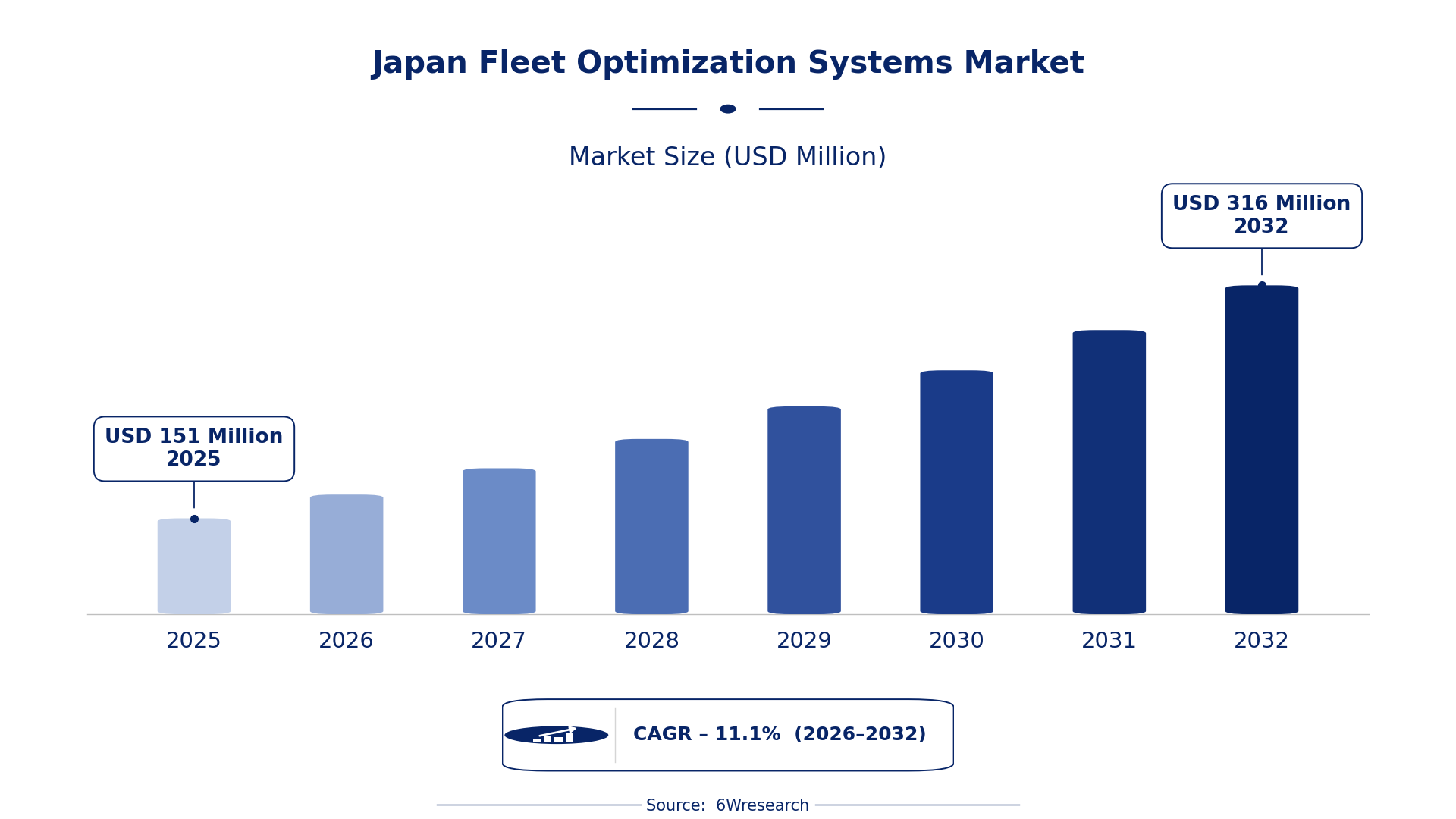
According to 6Wresearch internal database and industry insights, the Japan Fleet Optimization Systems Market was valued at USD 151 Million in 2025 and is projected to reach USD 316 Million by 2032, growing at a CAGR of approximately 11.1% during 2026–2032.
Japan Fleet Optimization Systems Market Highlights
| Report Metric | Details |
| Report Name | Japan Fleet Optimization Systems Market (2026-2032) |
| Market Size 2025 | USD 151 Million |
| Market Size 2032 | USD 316 Million |
| Absolute Growth 2025–2032 | USD 165 Million |
| CAGR 2026–2032 | 11.1% |
| Peak Annual Growth | 11.5% in 2028 |
| Forecast Period | 2026–2032 |
| Historical Data | 2022–2025 |
| Base Year | 2025 |
| Leading System Type, 2025 | Integrated Platforms (39% share) |
| Leading Application Area, 2025 | Route & Load Balancing (39% share) |
| Leading Deployment Mode, 2025 | Cloud (52% share) |
| Leading End User, 2025 | E-commerce Logistics (50% share) |
| Fastest-Growing System Type | Standalone Tools (16.0% CAGR) |
| Fastest-Growing Application Area | Fuel Tracking (13.3% CAGR) |
| Fastest-Growing Deployment Mode | On-Premise (16.3% CAGR) |
| Fastest-Growing End User | Rental Fleets (14.3% CAGR) |
| Growing Sector | logistics |
| Key End Users | logistics companies, e-commerce firms, public transport operators, waste management providers |
Japan Fleet Optimization Systems Market Year-wise Growth Rate and Key Drivers (2022–2032)
This graph illustrates the annual growth rates of the market from 2022 to 2032, highlighting a steady upward trajectory and projected market expansion over the forecast period.
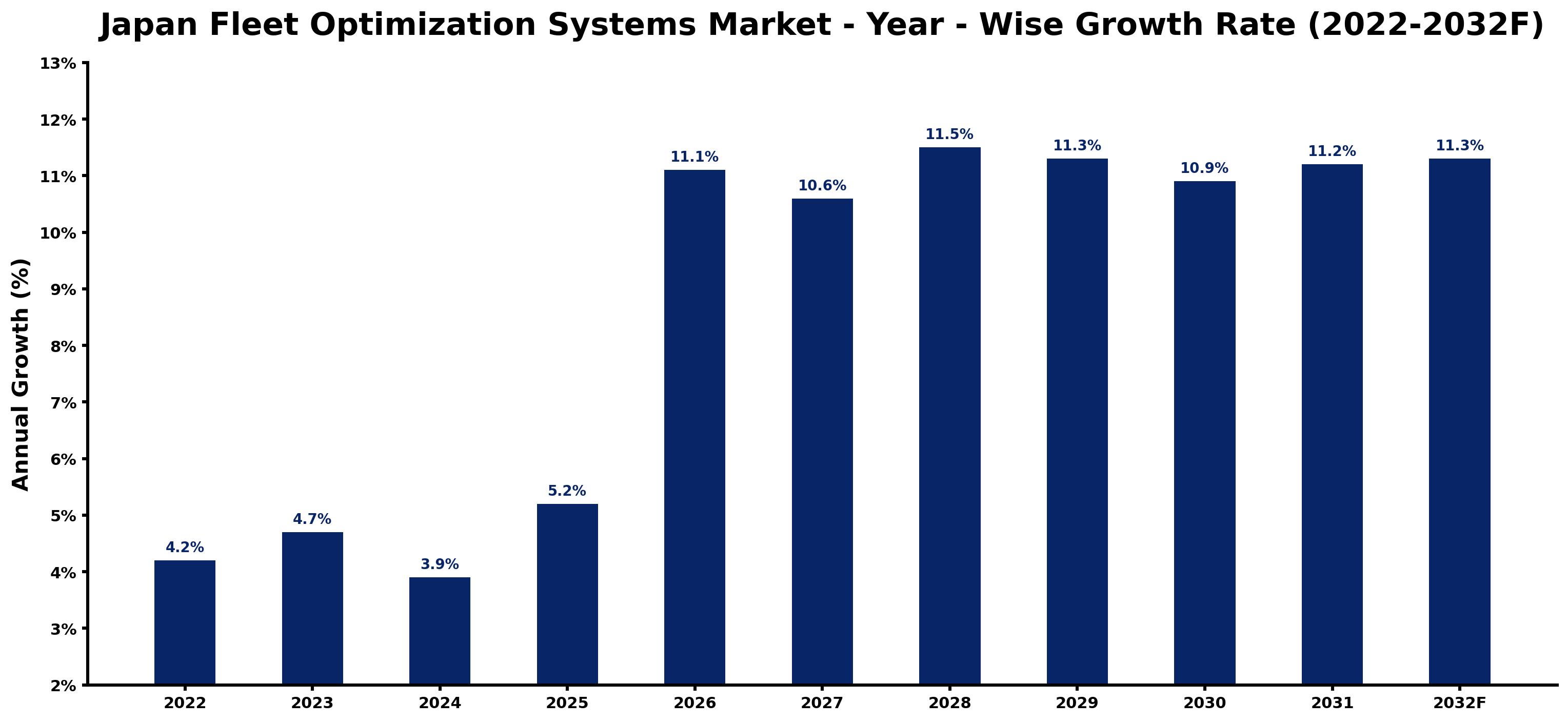
The table below sets out the estimated growth rate for each year and the main factor behind it.
| Year | Estimated Annual Growth (%) | Market Rationale |
| 2022 | 4.2 | The market showed steady growth, reflecting ongoing investments in fleet technology. |
| 2023 | 4.7 | Demand increased due to heightened interest in efficiency and sustainability initiatives. |
| 2024 | 3.9 | Growth slowed as companies adjusted to market changes and economic conditions. |
| 2025 | 5.2 | A surge in adoption was driven by advancements in technology and logistics needs. |
| 2026 | 11.1 | The market will accelerate as e-commerce logistics expands and drives demand. |
| 2027 | 10.6 | Growth is projected to slow as the market matures and stabilises. |
| 2028 | 11.5 | A peak in growth is anticipated as new technologies and solutions gain traction. |
| 2029 | 11.3 | The market will see a slight slowdown as competitive pressures increase. |
| 2030 | 10.9 | Growth is expected to moderate as the market reaches a more stable phase. |
| 2031 | 11.2 | Demand will rise again as innovations in fleet management attract new users. |
| 2032 | 11.3 | The market is projected to maintain steady growth due to ongoing technological advancements. |
Note: Market size estimations and growth projections presented in this report are based on 6Wresearch's proprietary forecasting methodology, utilizing the latest available industry data, government publications, and primary research inputs.
Japan Fleet Optimization Systems Market Synopsis
Fleet Optimization Systems are advanced technology solutions that improve vehicle fleet efficiency through data analysis and real-time monitoring. Tokyo serves as a major hub for fleet optimization technology development, with the logistics sector valued at approximately ¥20 trillion. Factors such as the increasing need for efficient logistics, the adoption of cloud solutions, and government green transport initiatives are propelling market growth, leading to substantial investments in fleet optimization technologies.
Market Dynamics Impact Analysis (2026–2032)
| Factor | Type | Impact | Primary Segment Affected |
| Growing demand for efficient logistics solutions | Driver | High | Route & Load Balancing |
| Increased adoption of cloud-based systems | Driver | High | Cloud |
| Expansion of e-commerce logistics | Opportunity | High | E-commerce Logistics |
| Investment in green transport initiatives | Opportunity | High | Public Transport Fleets |
| Regulatory compliance costs | Restraint | Medium | Integrated Platforms |
| High initial investment for advanced systems | Restraint | Medium | Standalone Tools |
| Competition from alternative technologies | Challenge | High | Modular Solutions |
| Rapid technological advancements requiring constant updates | Challenge | Medium | Custom Software |
Evaluation of Drivers in Japan Fleet Optimization Systems Market (2026–2032)
The factors lifting demand, and the evidence behind each, are summarised below.
| Drivers | Primary Segment Affected | Why It Matters (Evidence) |
| Increased logistics efficiency demands | Route & Load Balancing | The logistics sector, valued at ¥20 trillion, drives demand for optimized routing solutions. |
| Cloud adoption for scalability | Cloud | Cloud deployment is preferred by 70% of fleet management users, improving accessibility. |
| Growth in e-commerce logistics | E-commerce Logistics | E-commerce logistics is projected to grow significantly, increasing the need for fleet optimization systems. |
| Real-time monitoring requirements | Real-Time Monitoring | Over 80% of logistics companies in Japan require real-time monitoring for operational efficiency. |
| Fuel cost management | Fuel Tracking | Users report average fuel savings of around 15%, driving demand for tracking solutions. |
The strongest pull on demand comes from the logistics sector, valued at approximately ¥20 trillion, necessitating improved efficiency through fleet optimization systems. The preference for cloud deployment, adopted by 70% of users, supports scalability and accessibility. E-commerce logistics is projected to grow significantly, further driving demand for these systems. Additionally, over 80% of logistics companies require real-time monitoring to ensure operational efficiency. Users report average fuel savings of around 15%, incentivising the adoption of fuel tracking solutions.
Evaluation of Restraints in Japan Fleet Optimization Systems Market
Several factors work against faster growth; the main ones are summarised below.
| Market Restraint | Primary Segment Affected | Why It Matters (Evidence) |
| Compliance with JIS standards | Integrated Platforms | Producers must ensure their fleet management software meets JIS standards, increasing costs. |
| High initial investment costs | Standalone Tools | The need for advanced technology solutions requires substantial upfront investments, limiting adoption. |
| Market saturation in urban areas | Route & Load Balancing | High competition in major cities restricts growth opportunities for new entrants in fleet optimization. |
| Rapid technological changes | Custom Software | Frequent updates are necessary to keep pace with advancements, straining resources for developers. |
| Competition from alternative technologies | Modular Solutions | Emerging technologies may divert investment away from traditional fleet optimization systems. |
Japan Fleet Optimization Systems Market Challenges
High costs of implementing advanced technology hinder many logistics companies from upgrading fleet optimization systems. This situation results in outdated practices, causing average fuel consumption to exceed potential savings by 15%, which strains operational budgets for producers. Intense competition among logistics firms forces buyers to accept lower service quality, negatively affecting their operational efficiency. Rising maintenance costs for public transport vehicles, which average over 10 years old, further strain budgets, impacting service reliability and customer satisfaction. A shortage of skilled personnel in technology integration delays necessary upgrades, stalling innovation for producers.
Trends in the Japan Fleet Optimization Systems Market
The trends below show where the Japan Fleet Optimization Systems Market is heading.
- Shift from On-Premise to Cloud Solutions: Since 2023, there has been a notable shift towards cloud-based fleet optimization solutions, with 70% of users preferring this model. This transition allows for greater scalability and accessibility, benefiting logistics companies across Japan.
- Increased Focus on Real-Time Monitoring: In 2023, the demand for real-time monitoring systems surged, with over 80% of logistics companies prioritising this feature. This trend reflects the need for improved operational efficiency and fleet management.
- E-commerce Logistics Driving Fleet Optimization: As of 2023, e-commerce logistics has emerged as a key driver for fleet optimization systems, projected to grow significantly. This growth is pushing logistics providers to invest in advanced fleet management solutions.
- Adoption of Green Transport Initiatives: In 2023, the government launched a green transport initiative aimed at reducing emissions. This programme encourages fleet operators to adopt eco-friendly optimization systems, aligning with national sustainability goals.
Investment Opportunities in the Japan Fleet Optimization Systems Market
Where to invest in the Japan Fleet Optimization Systems Market: the main openings are set out below.
- Gap in Advanced Fleet Solutions: With the logistics sector valued at ¥20 trillion, there is a gap for advanced fleet optimization solutions. E-commerce logistics firms are particularly well-positioned to invest in these technologies.
- Investment in Public Transport Fleets: Tokyo's high density of public transport fleets presents an opportunity for investment in fleet optimization systems. Collaborating with local authorities can facilitate market entry.
- Partnerships for Cloud Solutions: With 70% of users preferring cloud deployment, forming partnerships with technology providers can strengthen market presence. This approach is particularly beneficial for companies targeting logistics firms.
- Supply of Fuel Tracking Systems: The average fuel savings of around 15% reported by users indicates a strong demand for fuel tracking systems. Focusing on this product type can attract logistics companies seeking efficiency.
Government Initiatives in the Japan Fleet Optimization Systems Market
The Waste Management and Public Cleansing Act of 1970 regulates waste treatment and disposal, impacting fleet optimization systems used by waste management firms. Compliance with this law ensures that producers align their systems with environmental standards, promoting eco-friendly practices. Additionally, the Ministry of the Environment supports initiatives aimed at reducing emissions, which further encourages the adoption of advanced fleet optimization technologies.
The Digital Agency, established in September 2021, oversees the implementation of digital transformation initiatives. It funds projects that improve the efficiency of logistics operations, supporting the adoption of fleet optimization technologies. This agency plays a crucial role in ensuring that fleet optimization systems meet common standards and enhance operational capabilities.
Future Insight of the Japan Fleet Optimization Systems Market
The introduction of advanced technology will reshape fleet optimization systems in Japan by 2032. The government’s green transport initiative will increase demand for eco-friendly solutions that meet new environmental standards. E-commerce growth will necessitate improved routing algorithms, prompting suppliers to develop innovative solutions. Fleet management practices will evolve towards more sustainable approaches, with the logistics sector employing approximately 1.5 million people adapting to these changes.
Market Segmentation Analysis
Japan Fleet Optimization Systems Market report covers a detailed analysis of the following market segments:
By System Type – Integrated Platforms Lead, Standalone Tools Expected to Grow Fastest
According to Saurav Kr Singh, Senior Research Analyst at 6Wresearch, in 2025, Integrated Platforms led the system type split with a 39% share. Integrated Platforms dominate the market as they provide comprehensive solutions for fleet management, catering to the diverse needs of logistics companies. Their extensive functionalities are particularly beneficial for large-scale operations found in Tokyo's logistics sector. Over 2026–2032, Standalone Tools are expected to post the fastest growth, at a CAGR of 16.0%. Standalone Tools are witnessing rapid growth due to their focus on specific functions like fuel tracking, which is crucial for companies aiming to reduce operational costs. This surge is propelled by logistics firms seeking precise enhancements in efficiency. Suppliers should prioritise the development of standalone tools to address the increasing demand for specialised fleet management solutions.
By Application Area – Route & Load Balancing Leads, Fuel Tracking Expected to Grow Fastest
Route & Load Balancing accounted for 39% of the market by application area in 2025. Route & Load Balancing holds the largest share because it is essential for optimising fleet operations, particularly in high-density areas like Tokyo. Effective route planning is critical for logistics firms managing significant delivery volumes. Fuel Tracking is set to record the highest CAGR in this split, 13.3% over 2026–2032. Fuel Tracking is growing at the fastest rate as businesses focus on monitoring fuel efficiency and costs amid rising fuel prices. This trend aligns with the government's green transport initiative, which aims to reduce emissions. Buyers will increasingly seek solutions that enhance fuel tracking capabilities to align with their sustainability goals.
By Deployment Mode – Cloud Leads, On-Premise Expected to Grow Fastest
Cloud held 52% of the Japan Fleet Optimization Systems Market by deployment mode in 2025. Cloud deployment is preferred by 70% of fleet management users in Japan due to its accessibility and scalability, making it the leading mode. This preference reflects the need for real-time data access and flexibility in fleet operations. On-Premise is projected to grow fastest, at a CAGR of 16.3% during 2026–2032. On-Premise solutions are growing as some companies prefer control over their data and systems, particularly in sectors with stringent regulatory requirements. This growth indicates a shift towards more traditional deployment methods for specific user needs. Suppliers must offer both cloud and on-premise options to cater to diverse customer preferences.
By End User – E-commerce Logistics Leads, Rental Fleets Expected to Grow Fastest
E-commerce Logistics took 50% of end user revenue in 2025, more than any other category. E-commerce Logistics is the leading end user of fleet optimization systems, driven by the sector's rapid growth and demand for efficient delivery solutions. The logistics sector's value of approximately ¥20 trillion highlights the importance of optimising fleet operations in this area. The quickest growth will come from Rental Fleets, forecast to expand at a CAGR of 14.3% between 2026 and 2032. Rental Fleets are seeing the fastest growth as they increasingly utilise systems for efficient fleet management to meet fluctuating demand. This trend is fuelled by the rise in e-commerce and the need for flexible transport solutions. Suppliers should tailor their offerings to meet the unique needs of rental fleets as their demand for optimisation solutions grows.
Key Attractiveness of the Report
- 10 Years of Market Numbers
- Historical Data Starting from 2022 to 2025
- Base Year 2025
- Forecast Data until 2032
- Key Performance Indicators Impacting the Market
- Major Upcoming Developments and Projects
Key Highlights of the Report:
- Japan Fleet Optimization Systems Market Outlook
- Market Size of Japan Fleet Optimization Systems Market, 2025
- Forecast of Japan Fleet Optimization Systems Market, 2032
- Historical Data and Forecast of Japan Fleet Optimization Systems Revenues & Volume for the Period 2022-2032F
- Japan Fleet Optimization Systems Market Trend Evolution
- Japan Fleet Optimization Systems Market Drivers and Challenges
- Japan Fleet Optimization Systems Price Trends
- Japan Fleet Optimization Systems Porter's Five Forces
- Japan Fleet Optimization Systems Industry Life Cycle
- Historical Data and Forecast of Japan Fleet Optimization Systems Market Revenues & Volume By System Type for the Period 2022-2032F
- Historical Data and Forecast of Japan Fleet Optimization Systems Market Revenues & Volume By Integrated Platforms for the Period 2022-2032F
- Historical Data and Forecast of Japan Fleet Optimization Systems Market Revenues & Volume By Standalone Tools for the Period 2022-2032F
- Historical Data and Forecast of Japan Fleet Optimization Systems Market Revenues & Volume By Modular Solutions for the Period 2022-2032F
- Historical Data and Forecast of Japan Fleet Optimization Systems Market Revenues & Volume By Custom Software for the Period 2022-2032F
- Historical Data and Forecast of Japan Fleet Optimization Systems Market Revenues & Volume By Application Area for the Period 2022-2032F
- Historical Data and Forecast of Japan Fleet Optimization Systems Market Revenues & Volume By Route & Load Balancing for the Period 2022-2032F
- Historical Data and Forecast of Japan Fleet Optimization Systems Market Revenues & Volume By Fuel Tracking for the Period 2022-2032F
- Historical Data and Forecast of Japan Fleet Optimization Systems Market Revenues & Volume By Real-Time Monitoring for the Period 2022-2032F
- Historical Data and Forecast of Japan Fleet Optimization Systems Market Revenues & Volume By Dispatch Scheduling for the Period 2022-2032F
- Historical Data and Forecast of Japan Fleet Optimization Systems Market Revenues & Volume By Deployment Mode for the Period 2022-2032F
- Historical Data and Forecast of Japan Fleet Optimization Systems Market Revenues & Volume By Cloud for the Period 2022-2032F
- Historical Data and Forecast of Japan Fleet Optimization Systems Market Revenues & Volume By On-Premise for the Period 2022-2032F
- Historical Data and Forecast of Japan Fleet Optimization Systems Market Revenues & Volume By Hybrid for the Period 2022-2032F
- Historical Data and Forecast of Japan Fleet Optimization Systems Market Revenues & Volume By SaaS for the Period 2022-2032F
- Historical Data and Forecast of Japan Fleet Optimization Systems Market Revenues & Volume By End User for the Period 2022-2032F
- Historical Data and Forecast of Japan Fleet Optimization Systems Market Revenues & Volume By E-commerce Logistics for the Period 2022-2032F
- Historical Data and Forecast of Japan Fleet Optimization Systems Market Revenues & Volume By Rental Fleets for the Period 2022-2032F
- Historical Data and Forecast of Japan Fleet Optimization Systems Market Revenues & Volume By Public Transport Fleets for the Period 2022-2032F
- Historical Data and Forecast of Japan Fleet Optimization Systems Market Revenues & Volume By Waste Management Firms for the Period 2022-2032F
- Japan Fleet Optimization Systems Import Export Trade Statistics
- Market Opportunity Assessment By System Type
- Market Opportunity Assessment By Application Area
- Market Opportunity Assessment By Deployment Mode
- Market Opportunity Assessment By End User
- Japan Fleet Optimization Systems Top Companies Market Share
- Japan Fleet Optimization Systems Competitive Benchmarking By Technical and Operational Parameters
- Japan Fleet Optimization Systems Company Profiles
- Japan Fleet Optimization Systems Key Strategic Recommendations
Market Covered
The report covers the following segments.
By System Type
- Integrated Platforms
- Standalone Tools
- Modular Solutions
- Custom Software
By Application Area
- Route & Load Balancing
- Fuel Tracking
- Real-Time Monitoring
- Dispatch Scheduling
By Deployment Mode
- Cloud
- On-Premise
- Hybrid
- SaaS
By End User
- E-commerce Logistics
- Rental Fleets
- Public Transport Fleets
- Waste Management Firms































