Japan Flexible Automation Market Size & Growth Rate
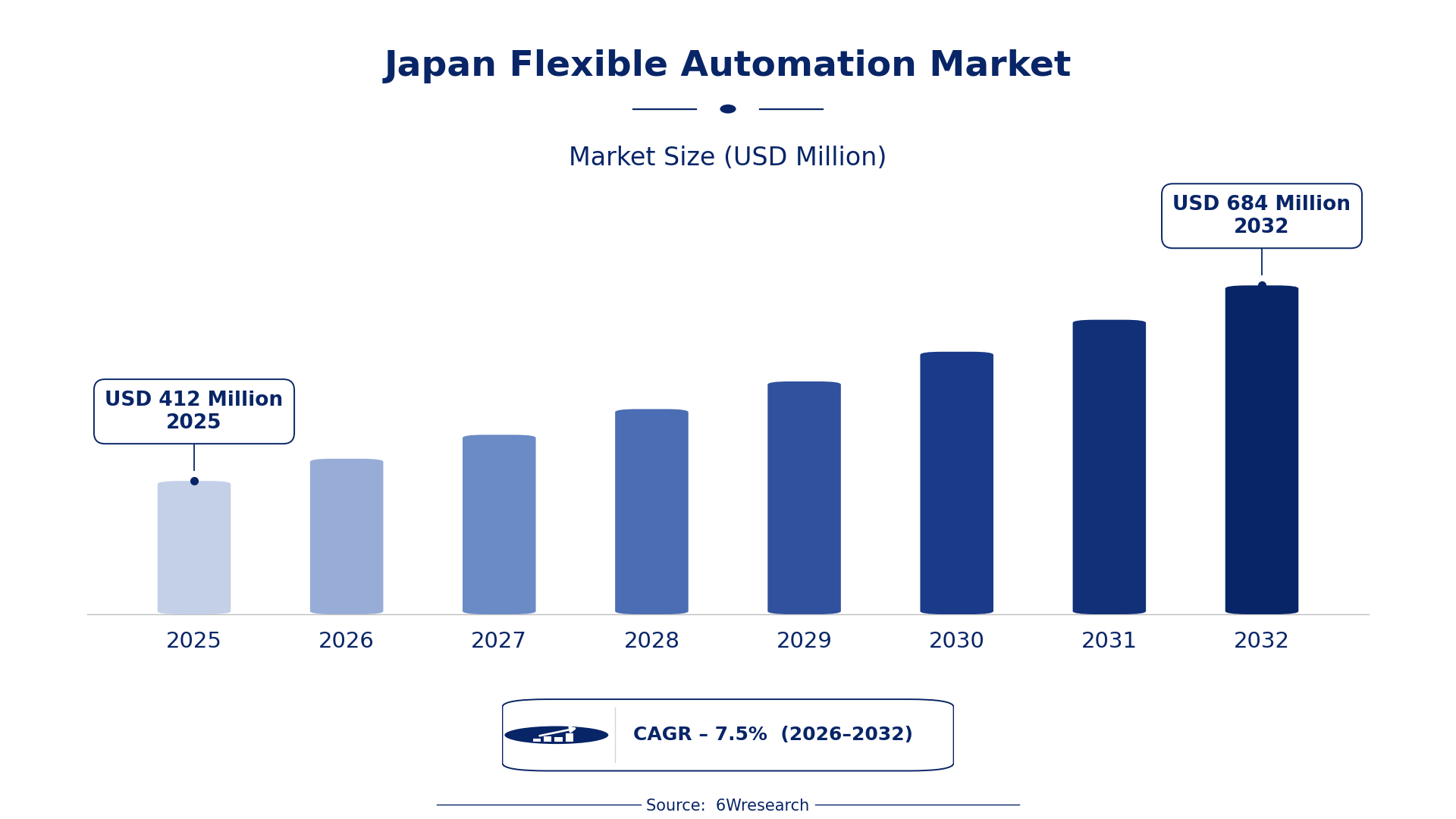
According to 6Wresearch internal database and industry insights, the Japan Flexible Automation Market was valued at USD 412 Million in 2025 and is projected to reach USD 684 Million by 2032, growing at a CAGR of approximately 7.5% during 2026–2032.
Japan Flexible Automation Market Highlights
| Report Metric | Details |
| Report Name | Japan Flexible Automation Market (2026-2032) |
| Market Size 2025 | USD 412 Million |
| Market Size 2032 | USD 684 Million |
| Absolute Growth 2025–2032 | USD 272 Million |
| CAGR 2026–2032 | 7.5% |
| Peak Annual Growth | 8.8% in 2028 |
| Forecast Period | 2026–2032 |
| Historical Data | 2022–2025 |
| Base Year | 2025 |
| Leading Automation Type, 2025 | Robotic Systems (38% share) |
| Leading System Design, 2025 | Reprogrammable (34% share) |
| Leading Distribution Channel, 2025 | OEMs (41% share) |
| Leading End User, 2025 | Automotive Plants (45% share) |
| Fastest-Growing Automation Type | AGVs (10.5% CAGR) |
| Fastest-Growing System Design | Modular Control (10.9% CAGR) |
| Fastest-Growing Distribution Channel | System Integrators (9.3% CAGR) |
| Fastest-Growing End User | Warehousing Facilities (9.5% CAGR) |
| Growing Sector | Warehousing Facilities |
| Key End Users | Automotive Plants, Electronics Manufacturers, Packaging Industry, Warehousing Facilities |
Japan Flexible Automation Market Year-wise Growth Rate and Key Drivers (2022–2032)
This graph illustrates the annual growth rates of the market from 2022 to 2032, highlighting a steady upward trajectory and projected market expansion over the forecast period.
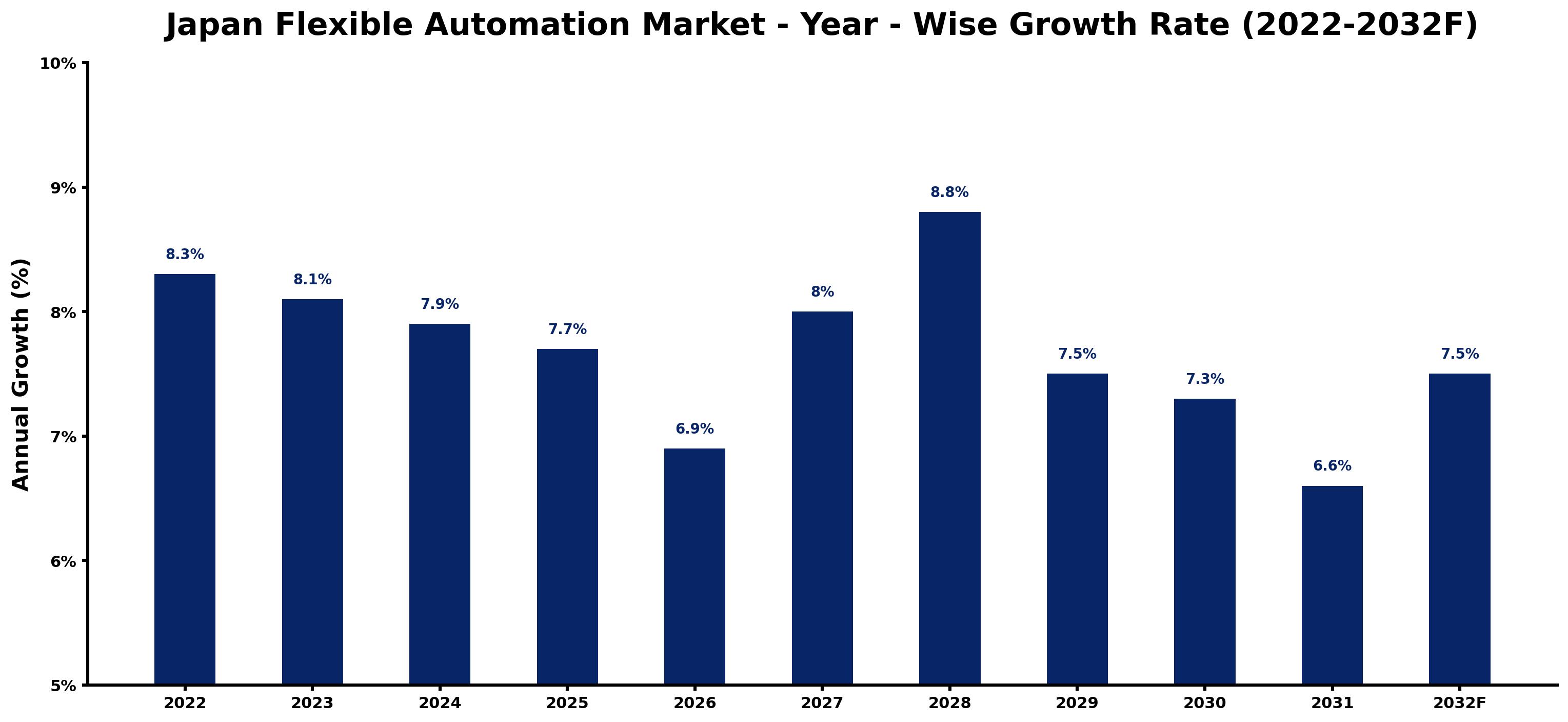
Below, each year's estimated growth is shown next to the factor that most influenced it.
| Year | Estimated Annual Growth (%) | Market Rationale |
| 2022 | 8.3 | The market experienced strong growth due to high production in the automotive sector. |
| 2023 | 8.1 | Growth slowed as manufacturers adjusted to supply chain challenges from the previous year. |
| 2024 | 7.9 | Demand continued to rise, although at a slower rate as companies focused on efficiency. |
| 2025 | 7.7 | The market maintained steady growth driven by ongoing investments in automation technologies. |
| 2026 | 6.9 | Growth is expected to slow as firms begin to consolidate their automation investments and strategies. |
| 2027 | 8.0 | Demand is projected to rise again as companies resume expansion plans and increase automation adoption. |
| 2028 | 8.8 | The peak growth year is driven by substantial investments in advanced robotics and automation. |
| 2029 | 7.5 | Growth is expected to slow as market saturation begins to affect new investments in automation. |
| 2030 | 7.3 | Demand is projected to continue to slow as companies focus on optimising existing systems. |
| 2031 | 6.6 | The market is expected to see a further slowdown as firms prioritise cost control over new investments. |
| 2032 | 7.5 | Growth is projected to resume as new technologies and applications in automation emerge. |
Note: Market size estimations and growth projections presented in this report are based on 6Wresearch's proprietary forecasting methodology, utilizing the latest available industry data, government publications, and primary research inputs.
Japan Flexible Automation Market Synopsis
Flexible automation systems improve production efficiency and product quality by integrating adaptable hardware and software solutions. The Japan Flexible Automation Market is expanding, driven by the automotive industry's production of 8.3 million vehicles in 2022 and a projected robotics market value of 1.2 trillion JPY by 2025. Japan's commitment to reducing greenhouse gas emissions and substantial investments in decarbonisation are propelling demand for flexible automation across various sectors.
Market Dynamics Impact Analysis (2026–2032)
| Factor | Type | Impact | Primary Segment Affected |
| High demand from the automotive sector for efficient production systems | Driver | High | Robotic Systems |
| Increased investment in automation technologies by SMEs | Driver | High | CNC Machines |
| Growing need for automation in logistics facilities to enhance efficiency | Opportunity | Medium | AGVs |
| Rising adoption of modular control systems for flexible manufacturing | Opportunity | Medium | Modular Control |
| High initial investment costs for advanced automation systems | Restraint | High | Conveyor Systems |
| Limited availability of skilled workforce to operate advanced systems | Restraint | Medium | Robotic Systems |
| Supply chain disruptions affecting component availability for automation | Challenge | High | CNC Machines |
| Technological advancements outpacing current workforce skills | Challenge | Medium | AGVs |
Evaluation of Drivers in Japan Flexible Automation Market (2026–2032)
The main growth drivers and the segments they affect most are set out below.
| Drivers | Primary Segment Affected | Why It Matters (Evidence) |
| Increased vehicle production in the automotive sector | Robotic Systems | Japan's automotive industry produced 8.3 million vehicles in 2022, driving demand for advanced robotics. |
| Investment in decarbonisation initiatives | CNC Machines | Japan targets JPY 150 trillion for decarbonisation, encouraging automation in manufacturing. |
| Rising demand for efficiency in logistics | AGVs | The government aims to increase automation in manufacturing by 30% by 2025, boosting AGV adoption. |
| Growing focus on reducing labor costs | Modular Control | The average minimum wage in Japan rose to JPY 1,055 per hour, prompting companies to invest in automation. |
| Technological advancements in robotics | Conveyor Systems | The robotics market in Japan is projected to reach 1.2 trillion JPY by 2025, enhancing conveyor system capabilities. |
Most of the extra volume comes from increased vehicle production in the automotive sector, which produced 8.3 million vehicles in 2022, driving demand for robotic systems. The average minimum wage in Japan, now JPY 1,055 per hour, prompts a focus on reducing labor costs through modular control systems. Technological advancements in robotics are projected to elevate the robotics market to 1.2 trillion JPY by 2025, improving conveyor system capabilities.
Evaluation of Restraints in Japan Flexible Automation Market
The main factors holding the market back are set out below.
| Market Restraint | Primary Segment Affected | Why It Matters (Evidence) |
| Rising minimum wage pressures producers to invest more in automation | Robotic Systems | The average minimum wage in Japan reached JPY 1,055 per hour, increasing operational costs. |
| Skills shortages in advanced robotics hinder producers | CNC Machines | Limited talent in robotics leads to inefficiencies, costing buyers up to 20% in operational delays. |
| Regulatory compliance adds complexity for producers | AGVs | Standards like ISO 10218 require testing and certification, extending lead times for automation solutions. |
| High initial investment costs for automation technologies | Modular Control | The upfront costs deter some manufacturers from adopting advanced automation solutions. |
| Market saturation limits new investments | Conveyor Systems | As more companies automate, the potential for new entrants decreases, slowing overall market growth. |
Japan Flexible Automation Market Challenges
Rising minimum wage pressures buyers to seek flexible automation solutions, as costs reached JPY 1,055 per hour in October 2024. This situation forces producers to invest heavily in new technologies, delaying implementation timelines for buyers. Skills shortages in advanced robotics restrict producers' ability to fully utilise existing systems, leading to inefficiencies that can cost buyers up to 20% in operational delays. Compliance with standards like JIS B 8430 complicates processes for producers, resulting in extended lead times that hinder buyers' access to timely automation solutions.
Trends in the Japan Flexible Automation Market
Several trends are reshaping the Japan Flexible Automation Market; the most important are set out below.
- Shift in Automotive Production Techniques: Automotive plants are increasingly adopting flexible automation systems to improve efficiency, with 8.3 million vehicles produced in 2022. This shift reflects a growing trend towards automation in manufacturing.
- Transition to Advanced Robotics in Logistics: Since 2023, logistics facilities have begun integrating AGVs to streamline operations. The government aims for a 30% increase in automation by 2025, highlighting this shift.
- Emergence of Modular Control Systems: In 2023, modular control systems gained traction as manufacturers sought to optimise production. This trend aligns with rising labour costs, prompting investments in automation.
- Prioritisation of Decarbonisation Investments: With a target of JPY 150 trillion for decarbonisation by 2030, industries are increasingly investing in flexible automation. This focus supports sustainability goals across sectors.
Investment Opportunities in the Japan Flexible Automation Market
The openings below show where demand in the Japan Flexible Automation Market is visible and how suppliers can enter.
- Investment in Automotive Manufacturing Facilities: Tokyo and Aichi Prefecture are key regions for automotive manufacturing, with a projected increase in automation adoption. Companies can enter through local partnerships to meet growing demand.
- Expansion of Robotics in Electronics Manufacturing: The electronics sector, valued at approximately 10 trillion JPY, presents a gap for automation solutions. Collaborating with system integrators can facilitate market entry.
- Growth in Warehousing Facilities: The warehousing sector is increasingly adopting automation technologies, with a focus on AGVs. Investing in this area can meet the demand for efficiency in logistics.
- Support for SMEs in Automation Adoption: The Ministry of Economy, Trade and Industry's program for SMEs aims to boost automation. Engaging with this initiative can provide opportunities for suppliers.
Government Initiatives in the Japan Flexible Automation Market
The New Robot Strategy (2015) enhances the framework established by previous laws by encouraging producers to adopt advanced robotics and automation technologies across various sectors. This measure aims to expand robot use in manufacturing, services, agriculture, and care, supporting innovation and productivity.
In 2023, the government allocated 5 billion JPY for research in automation technologies, administered by the Ministry of Economy, Trade and Industry. This funding supports innovation and development in flexible automation, benefiting producers and buyers alike.
Future Insight of the Japan Flexible Automation Market
The government has allocated 5 billion JPY for research in automation technologies, which will stimulate demand across various sectors. By 2032, the robotics market is projected to reach 1.2 trillion JPY, indicating strong growth potential. The 'Society 5.0' initiative will push for a 30% rise in manufacturing automation, enhancing productivity for suppliers. As SMEs increasingly embrace flexible automation, buyers will benefit from improved operational efficiency and reduced lead times, fundamentally transforming their production processes.
Market Segmentation Analysis
Japan Flexible Automation Market report covers a detailed analysis of the following market segments:
By Automation Type – Robotic Systems Lead, AGVs Expected to Grow Fastest
According to Saurav Kr Singh, Senior Research Analyst at 6Wresearch, Robotic Systems accounted for 38% of the market by automation type in 2025. Robotic systems hold the largest market share due to their extensive use in manufacturing, particularly in the automotive sector, which produced 8.3 million vehicles in 2022. The high installed base of over 200,000 operational industrial robots in Japan highlights their critical role in enhancing production processes. The quickest growth will come from AGVs, forecast to expand at a CAGR of 10.5% between 2026 and 2032. AGVs are experiencing rapid growth as their adoption for material transport aligns with the government's target of a 30% increase in manufacturing automation by 2025. This trend reflects a significant shift towards optimising logistics across various sectors. Suppliers should focus on developing AGV solutions to meet the rising demand for automated logistics.
By System Design – Reprogrammable Leads, Modular Control Expected to Grow Fastest
The largest system design category in 2025 was Reprogrammable, at 34% of revenue. Reprogrammable systems dominate the market as they enable quick changes in production lines, essential for manufacturers facing fluctuating demands. This flexibility is particularly vital in industries like automotive, where production requirements frequently evolve. Modular Control is projected to grow fastest, at a CAGR of 10.9% during 2026–2032. Modular control systems are growing swiftly due to their capacity to facilitate easy adjustments in automation setups, allowing manufacturers to adapt rapidly to market changes. This adaptability is crucial for maintaining competitiveness in fast-paced industries. Buyers should invest in modular control systems to enhance their operational adaptability.
By Distribution Channel – OEMs Lead, System Integrators Expected to Grow Fastest
OEMs took 41% of distribution channel revenue in 2025, more than any other category. OEMs lead the distribution channel as they are key providers of automation solutions, ensuring manufacturers have access to advanced technologies. Their established connections within the automotive industry further solidify their dominant position in the market. System Integrators are set to record the highest CAGR in this split, 9.3% over 2026–2032. System integrators are the fastest-growing channel, effectively combining various automation components for clients, which addresses the increasing complexity of automation systems. Their importance is rising as manufacturers seek tailored solutions. Suppliers should enhance partnerships with system integrators to broaden their market presence and service capabilities.
By End User – Automotive Plants Lead, Warehousing Facilities Expected to Grow Fastest
Automotive Plants held 45% of the Japan Flexible Automation Market by end user in 2025. Automotive plants are the largest end users of flexible automation technologies, underscoring the sector's reliance on advanced automation for improving production efficiency. This dependence is evident in the substantial vehicle production figures that drive automation demand. Over 2026–2032, Warehousing Facilities are expected to post the fastest growth, at a CAGR of 9.5%. Warehousing facilities are rapidly adopting flexible automation to boost logistics efficiency, particularly in light of the growing need for streamlined operations. This trend is supported by government initiatives promoting automation in logistics. Investing in automation solutions designed for warehousing will be crucial for suppliers to tap into this expanding market.
Key Attractiveness of the Report
- 10 Years of Market Numbers
- Historical Data Starting from 2022 to 2025
- Base Year 2025
- Forecast Data until 2032
- Key Performance Indicators Impacting the Market
- Major Upcoming Developments and Projects
Key Highlights of the Report:
- Japan Flexible Automation Market Outlook
- Market Size of Japan Flexible Automation Market, 2025
- Forecast of Japan Flexible Automation Market, 2032
- Historical Data and Forecast of Japan Flexible Automation Revenues & Volume for the Period 2022-2032F
- Japan Flexible Automation Market Trend Evolution
- Japan Flexible Automation Market Drivers and Challenges
- Japan Flexible Automation Price Trends
- Japan Flexible Automation Porter's Five Forces
- Japan Flexible Automation Industry Life Cycle
- Historical Data and Forecast of Japan Flexible Automation Market Revenues & Volume By Automation Type for the Period 2022-2032F
- Historical Data and Forecast of Japan Flexible Automation Market Revenues & Volume By Robotic Systems for the Period 2022-2032F
- Historical Data and Forecast of Japan Flexible Automation Market Revenues & Volume By CNC Machines for the Period 2022-2032F
- Historical Data and Forecast of Japan Flexible Automation Market Revenues & Volume By Conveyor Systems for the Period 2022-2032F
- Historical Data and Forecast of Japan Flexible Automation Market Revenues & Volume By AGVs for the Period 2022-2032F
- Historical Data and Forecast of Japan Flexible Automation Market Revenues & Volume By System Design for the Period 2022-2032F
- Historical Data and Forecast of Japan Flexible Automation Market Revenues & Volume By Reprogrammable for the Period 2022-2032F
- Historical Data and Forecast of Japan Flexible Automation Market Revenues & Volume By Modular Control for the Period 2022-2032F
- Historical Data and Forecast of Japan Flexible Automation Market Revenues & Volume By Adaptive Systems for the Period 2022-2032F
- Historical Data and Forecast of Japan Flexible Automation Market Revenues & Volume By Sensor-driven for the Period 2022-2032F
- Historical Data and Forecast of Japan Flexible Automation Market Revenues & Volume By Distribution Channel for the Period 2022-2032F
- Historical Data and Forecast of Japan Flexible Automation Market Revenues & Volume By OEMs for the Period 2022-2032F
- Historical Data and Forecast of Japan Flexible Automation Market Revenues & Volume By System Integrators for the Period 2022-2032F
- Historical Data and Forecast of Japan Flexible Automation Market Revenues & Volume By Direct Sales for the Period 2022-2032F
- Historical Data and Forecast of Japan Flexible Automation Market Revenues & Volume By B2B Portals for the Period 2022-2032F
- Historical Data and Forecast of Japan Flexible Automation Market Revenues & Volume By End User for the Period 2022-2032F
- Historical Data and Forecast of Japan Flexible Automation Market Revenues & Volume By Automotive Plants for the Period 2022-2032F
- Historical Data and Forecast of Japan Flexible Automation Market Revenues & Volume By Electronics Manufacturers for the Period 2022-2032F
- Historical Data and Forecast of Japan Flexible Automation Market Revenues & Volume By Packaging Industry for the Period 2022-2032F
- Historical Data and Forecast of Japan Flexible Automation Market Revenues & Volume By Warehousing Facilities for the Period 2022-2032F
- Japan Flexible Automation Import Export Trade Statistics
- Market Opportunity Assessment By Automation Type
- Market Opportunity Assessment By System Design
- Market Opportunity Assessment By Distribution Channel
- Market Opportunity Assessment By End User
- Japan Flexible Automation Top Companies Market Share
- Japan Flexible Automation Competitive Benchmarking By Technical and Operational Parameters
- Japan Flexible Automation Company Profiles
- Japan Flexible Automation Key Strategic Recommendations
Market Covered
Segments analysed in this report are listed below.
By Automation Type
- Robotic Systems
- CNC Machines
- Conveyor Systems
- AGVs
By System Design
- Reprogrammable
- Modular Control
- Adaptive Systems
- Sensor-driven
By Distribution Channel
- OEMs
- System Integrators
- Direct Sales
- B2B Portals
By End User
- Automotive Plants
- Electronics Manufacturers
- Packaging Industry
- Warehousing Facilities































