Japan Flexible Food Packaging Market Size & Growth Rate
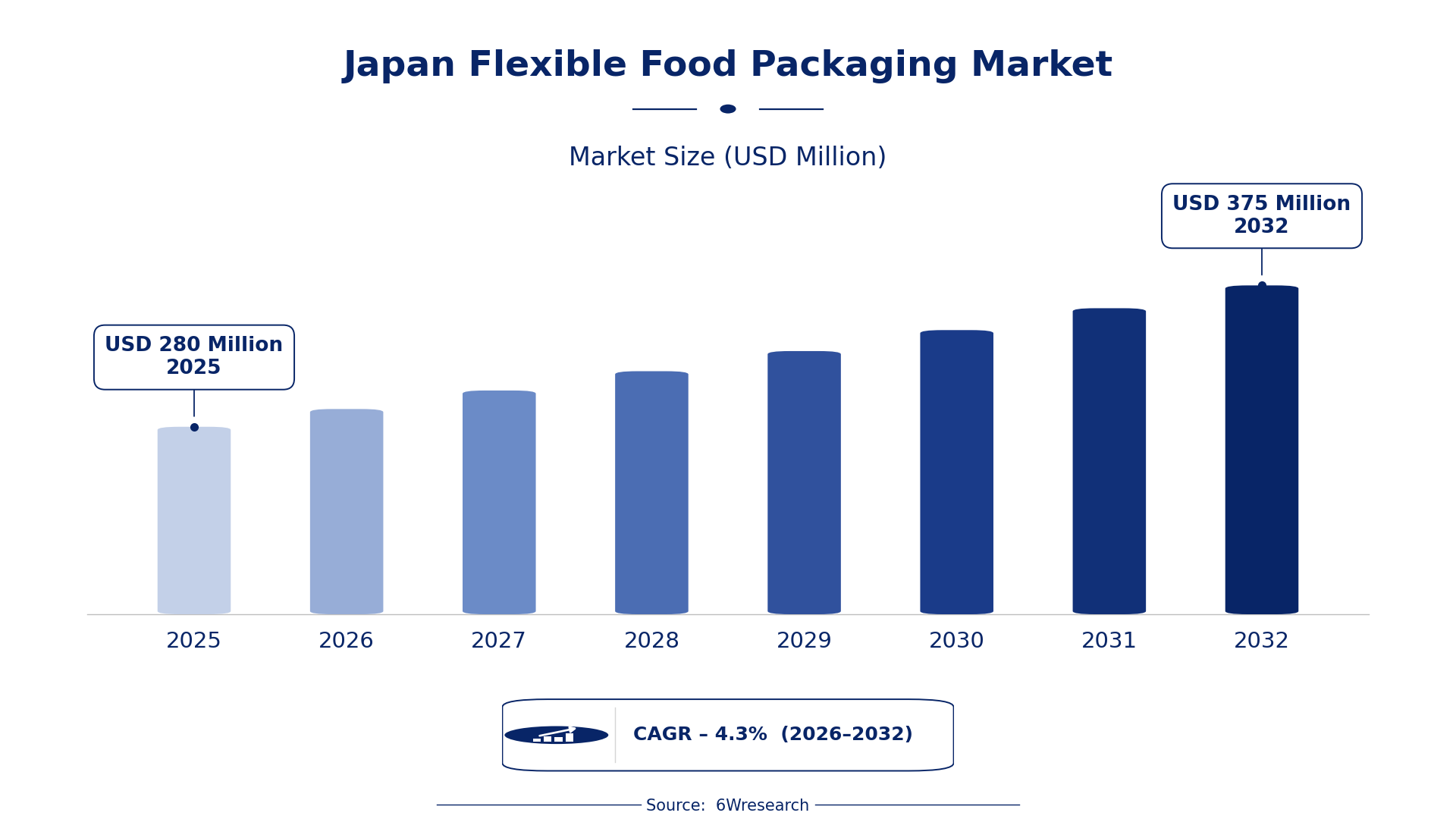
According to 6Wresearch internal database and industry insights, the Japan Flexible Food Packaging Market was valued at USD 280 Million in 2025 and is projected to reach USD 375 Million by 2032, growing at a CAGR of approximately 4.3% during 2026–2032.
Japan Flexible Food Packaging Market Highlights
| Report Metric | Details |
| Report Name | Japan Flexible Food Packaging Market (2026-2032) |
| Market Size 2025 | USD 280 Million |
| Market Size 2032 | USD 375 Million |
| Absolute Growth 2025–2032 | USD 95 Million |
| CAGR 2026–2032 | 4.3% |
| Peak Annual Growth | 5.1% in 2027 |
| Forecast Period | 2026–2032 |
| Historical Data | 2022–2025 |
| Base Year | 2025 |
| Leading Material Type, 2025 | Polyethylene (39% share) |
| Leading Product Type, 2025 | Snack Packs (37% share) |
| Leading Distribution Channel, 2025 | Packaging Distributors (37% share) |
| Leading End User, 2025 | FMCG Brands (52% share) |
| Fastest-Growing Material Type | BOPP Films (6.1% CAGR) |
| Fastest-Growing Product Type | Frozen Food Wraps (6.4% CAGR) |
| Fastest-Growing Distribution Channel | Online Retailers (5.8% CAGR) |
| Fastest-Growing End User | Dairy Producers (5.6% CAGR) |
| Growing Sector | Sustainable Packaging |
| Key End Users | FMCG Brands, Dairy Producers, Bakery Chains, Eco-food Brands |
Japan Flexible Food Packaging Market Year-wise Growth Rate and Key Drivers (2022–2032)
This graph illustrates the annual growth rates of the market from 2022 to 2032, highlighting a steady upward trajectory and projected market expansion over the forecast period.
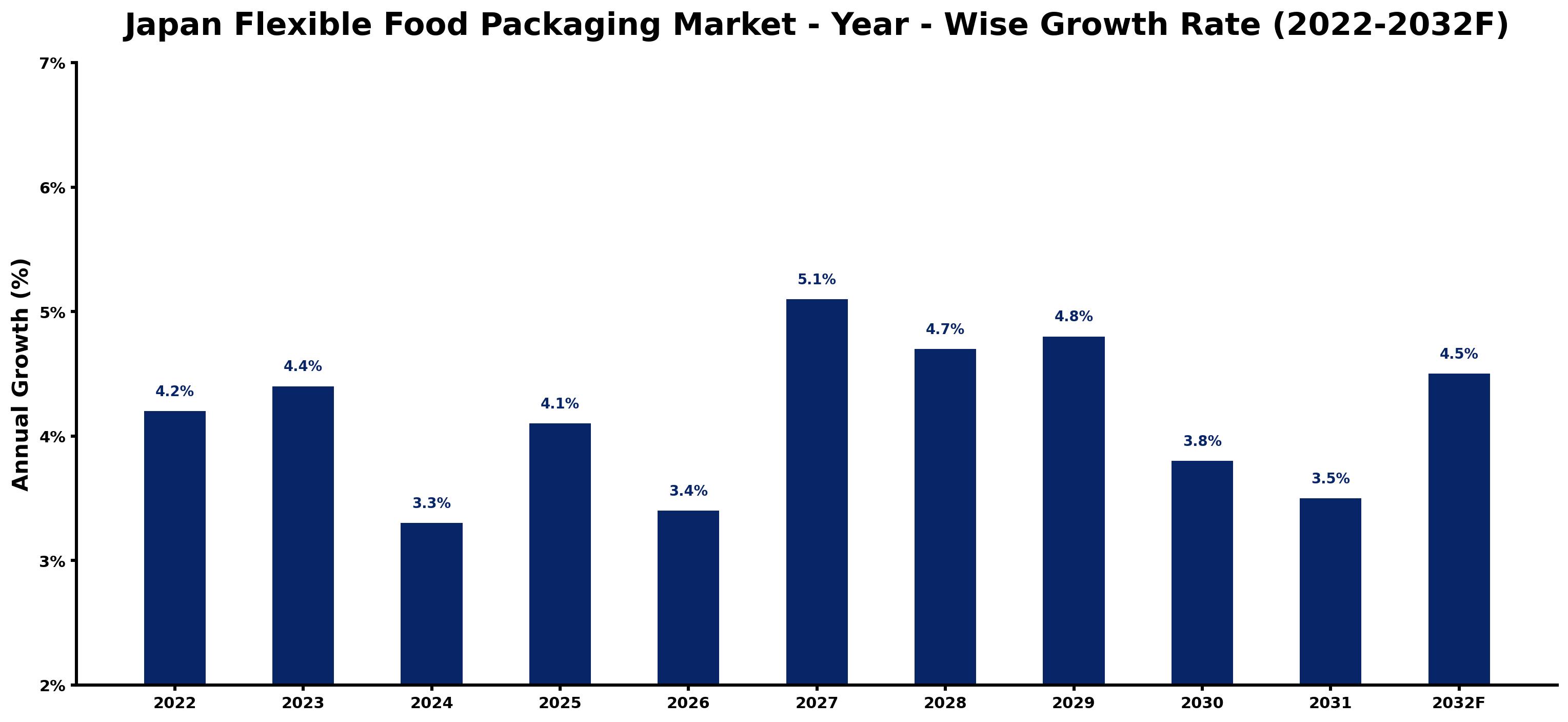
Below, each year's estimated growth is shown next to the factor that most influenced it.
| Year | Estimated Annual Growth (%) | Market Rationale |
| 2022 | 4.2 | The market experienced steady growth due to increased demand for convenient food packaging. |
| 2023 | 4.4 | Growth accelerated as consumer preferences shifted towards flexible packaging solutions. |
| 2024 | 3.3 | The market saw a slowdown as competition intensified among packaging providers. |
| 2025 | 4.1 | Demand increased again, driven by rising snack consumption and convenience trends. |
| 2026 | 3.4 | Growth is expected to slow as manufacturers face challenges in sourcing sustainable materials. |
| 2027 | 5.1 | The market is projected to rebound with investments in innovative packaging technologies. |
| 2028 | 4.7 | Growth will decelerate slightly as market saturation begins to impact sales. |
| 2029 | 4.8 | Demand is expected to rise again, supported by the expansion of online retail channels. |
| 2030 | 3.8 | Growth is projected to slow as economic factors influence consumer spending habits. |
| 2031 | 3.5 | The market is expected to continue growing, driven by health-conscious consumer trends. |
| 2032 | 4.5 | Demand will increase as sustainability initiatives gain traction among consumers. |
Note: Market size estimations and growth projections presented in this report are based on 6Wresearch's proprietary forecasting methodology, utilizing the latest available industry data, government publications, and primary research inputs.
Japan Flexible Food Packaging Market Synopsis
Flexible food packaging includes materials like polyethylene and BOPP films, which preserve food quality and extend shelf life. The Japan Flexible Food Packaging Market is valued at approximately 1.5 trillion yen, driven by domestic food producers and retailers. Rising health consciousness and sustainability initiatives are adding new demand, particularly for organic and eco-friendly packaging solutions. With the average consumer using about 50 flexible packaging items monthly, the market is set for continued growth as consumer preferences evolve.
Market Dynamics Impact Analysis (2026–2032)
| Factor | Type | Impact | Primary Segment Affected |
| Growing demand for sustainable packaging solutions | Driver | High | Sustainable Packaging |
| Increased consumption of convenience foods | Driver | High | Snack Packs |
| Rising health consciousness among consumers | Opportunity | High | Organic Foods |
| Expansion of online retail channels for packaging | Opportunity | Medium | Online Retailers |
| Challenges in sourcing sustainable materials | Restraint | High | Sustainable Packaging |
| Intense competition among packaging providers | Restraint | Medium | Polyethylene |
| Rising costs of raw materials | Challenge | High | BOPP Films |
| Regulatory compliance costs for packaging materials | Challenge | Medium | Polyethylene |
Evaluation of Drivers in Japan Flexible Food Packaging Market (2026–2032)
These are the developments adding the most demand over the forecast period.
| Drivers | Primary Segment Affected | Why It Matters (Evidence) |
| Investment in advanced packaging technologies | BOPP Films | This investment improves production efficiency, leading to increased demand from manufacturers for high-quality films. |
| Rising consumer demand for convenience foods | Snack Packs | As consumers seek quick meal options, manufacturers are increasing production of snack packs to meet this need. |
| Growth of the organic food segment | Organic Foods | Health-conscious consumers are driving demand for organic packaging, prompting suppliers to offer more sustainable solutions. |
| Expansion of e-commerce platforms | Online Retailers | The rise of online shopping is boosting demand for flexible packaging solutions tailored for shipping. |
| Government initiatives promoting sustainable practices | Sustainable Packaging | These initiatives encourage manufacturers to adopt eco-friendly materials, increasing demand for sustainable packaging options. |
A wider customer base explains much of the growth, as investments in advanced packaging technologies are improving production efficiency. The average Japanese consumer uses about 50 flexible packaging items monthly, driving demand for convenient snack packs. Health-conscious consumers are prioritising organic foods, prompting manufacturers to respond with sustainable packaging solutions. The expansion of e-commerce platforms is also boosting demand for flexible packaging tailored for shipping.
Evaluation of Restraints in Japan Flexible Food Packaging Market
Below are the constraints most often cited by buyers and suppliers, with the segment each affects.
| Market Restraint | Primary Segment Affected | Why It Matters (Evidence) |
| Challenges in sourcing sustainable materials | Sustainable Packaging | Manufacturers face difficulties in obtaining eco-friendly materials, impacting production timelines and costs. |
| Intense competition among packaging providers | Polyethylene | This competition results in price wars, reducing profit margins for manufacturers and suppliers. |
| Rising costs of raw materials | BOPP Films | Increased prices for raw materials are squeezing profit margins and affecting pricing strategies. |
| Regulatory compliance costs for packaging materials | Polyethylene | Compliance with stringent regulations increases operational costs for manufacturers, impacting pricing. |
| Market saturation in certain packaging segments | Snack Packs | As the market matures, growth potential diminishes, leading to increased competition and pricing pressure. |
Japan Flexible Food Packaging Market Challenges
Snack packs in Japan often face delays due to fluctuating raw material prices, raising costs for buyers by up to 15% within a quarter. Producers encounter rising expenses as compliance with new plastic waste regulations can lead to a 20% increase in redesign costs. Buyers struggle with sourcing sustainable materials, as the average cost of eco-friendly options is 25% higher than traditional alternatives, straining budgets. Supply chain disruptions in major industrial regions like Tokyo and Osaka can lead to delays in delivery times, affecting retailers' ability to meet consumer demand.
Trends in the Japan Flexible Food Packaging Market
The shifts below are changing how Japan Flexible Food Packaging Market products are bought and supplied.
- Shift towards Sustainable Packaging Solutions: The trend towards sustainable packaging solutions is gaining traction, particularly in urban areas like Tokyo. In 2023, the government launched a program to reduce plastic waste in food packaging, prompting manufacturers to adopt eco-friendly materials.
- Increase in Online Retail Packaging: Since 2022, there has been a marked increase in online retail packaging solutions, particularly in Osaka. Approximately 30% of consumers now prefer to purchase food products online, driving demand for flexible packaging.
- Growing Demand for Organic Food Packaging: The increasing health consciousness among consumers has led to a surge in demand for organic food packaging. In 2023, organic food packaging solutions saw a 10% increase in sales, reflecting changing consumer preferences.
- Expansion of Snack Pack Offerings: In 2022, snack packs gained popularity among consumers seeking convenience. The average bakery chain in Japan uses around 1 million units of flexible packaging annually, indicating strong demand for portable food options.
Investment Opportunities in the Japan Flexible Food Packaging Market
Investors looking at the Japan Flexible Food Packaging Market should consider the following areas.
- Tokyo's Food Packaging Production Facilities: Tokyo's food packaging production facilities are expanding, creating opportunities for suppliers of sustainable materials. With a projected growth rate of 10% annually through 2025, there is a clear gap for eco-friendly packaging solutions.
- Rising Demand from FMCG Brands: FMCG brands are increasingly seeking unique packaging solutions, with a market potential of 1.5 trillion yen. Collaborating with local packaging distributors can help suppliers tap into this expanding market.
- Investment in Eco-friendly Packaging Solutions: With sustainability becoming a priority, there is an opportunity for investment in eco-friendly packaging solutions. The Japan Packaging Institute is promoting best practices, creating avenues for new entrants.
- Growth of Dairy Producers in Japan: Dairy producers are expanding their operations, necessitating increased flexible packaging solutions. With over 300 registered dairy producers, there is strong demand for innovative packaging options.
Government Initiatives in the Japan Flexible Food Packaging Market
The Food Sanitation Act amendment of 2018 introduced a system ensuring the safety of synthetic resins used in food packaging. This measure requires producers to adhere to strict hygiene standards, impacting their operational processes and costs. Compliance with these standards is vital for maintaining market access and consumer trust.
The Ministry of the Environment oversees the implementation of the Food Recycling Law, which mandates food businesses to reduce waste. This law promotes recycling initiatives, encouraging manufacturers to adopt sustainable practices and improve their packaging designs, benefiting both producers and consumers.
Future Insight of the Japan Flexible Food Packaging Market
Investment in advanced flexible food packaging technologies will create substantial demand for new solutions, benefiting suppliers. By 2032, the government’s initiative to reduce single-use plastics by 25% will shift design preferences towards eco-friendly options. The average bakery chain will require around 1 million units of flexible packaging annually, reflecting the growing trend towards convenience. New standards from the Japan Packaging Institute will promote best practices, ensuring that suppliers align with industry expectations.
Market Segmentation Analysis
Japan Flexible Food Packaging Market report covers a detailed analysis of the following market segments:
By Material Type – Polyethylene Leads, BOPP Films Expected to Grow Fastest
According to Saurav Kr Singh, Senior Research Analyst at 6Wresearch, Polyethylene accounted for 39% of the market by material type in 2025. Polyethylene dominates the market due to its widespread application in food packaging, particularly appreciated for its moisture barrier properties. It is extensively used in packaging for snacks and frozen foods, which are staples in the Japanese diet. BOPP Films are set to record the highest CAGR in this split, 6.1% over 2026–2032. BOPP films are experiencing rapid growth driven by their clarity and strength, making them ideal for visually appealing packaging. The rising consumer demand for attractive product presentation is significantly boosting the use of BOPP films in flexible packaging. Suppliers should prioritise the development of BOPP films to take advantage of this upward trend.
By Product Type – Snack Packs Lead, Frozen Food Wraps Expected to Grow Fastest
With 37% of product type revenue in 2025, Snack Packs was the largest category. Snack packs dominate the market as they cater to the rising demand for convenience and portability among consumers. The average Japanese consumer utilises multiple snack packs each month, highlighting their popularity. Over 2026–2032, Frozen Food Wraps are expected to post the fastest growth, at a CAGR of 6.4%. Frozen food wraps are experiencing the fastest growth due to their critical role in preserving the quality of frozen foods. As more consumers opt for frozen meal solutions, the demand for effective packaging is increasing. Buyers should consider investing in high-quality frozen food wraps to meet consumer expectations for product quality.
By Distribution Channel – Packaging Distributors Lead, Online Retailers Expected to Grow Fastest
In 2025, Packaging Distributors led the distribution channel split with a 37% share. Packaging distributors hold the largest share as they are essential for supplying a variety of packaging materials to manufacturers throughout Japan. Their established networks ensure that food producers receive timely and reliable access to necessary packaging solutions. The quickest growth will come from Online Retailers, forecast to expand at a CAGR of 5.8% between 2026 and 2032. Online retailers are rapidly emerging as a preferred distribution channel for packaging solutions, fuelled by the convenience of online shopping. The shift towards e-commerce is encouraging more buyers to seek packaging options through online platforms. Suppliers need to strengthen their online presence to engage the growing number of buyers who favour online purchasing.
By End User – FMCG Brands Lead, Dairy Producers Expected to Grow Fastest
FMCG Brands took 52% of end user revenue in 2025, more than any other category. FMCG brands represent the largest segment of flexible packaging users, leveraging it for product differentiation in a competitive landscape. Their substantial volume of packaging requirements drives the overall demand for various flexible packaging solutions. Dairy Producers are projected to grow fastest, at a CAGR of 5.6% during 2026–2032. Dairy producers are witnessing the fastest growth in flexible packaging usage, as they depend on it to ensure product freshness and prolong shelf life. The increasing emphasis on quality within the dairy sector is significantly enhancing this demand. Suppliers should customise their offerings to address the specific requirements of dairy producers to capitalise on this growth opportunity.
Key Attractiveness of the Report
- 10 Years of Market Numbers
- Historical Data Starting from 2022 to 2025
- Base Year 2025
- Forecast Data until 2032
- Key Performance Indicators Impacting the Market
- Major Upcoming Developments and Projects
Key Highlights of the Report:
- Japan Flexible Food Packaging Market Outlook
- Market Size of Japan Flexible Food Packaging Market, 2025
- Forecast of Japan Flexible Food Packaging Market, 2032
- Historical Data and Forecast of Japan Flexible Food Packaging Revenues & Volume for the Period 2022-2032F
- Japan Flexible Food Packaging Market Trend Evolution
- Japan Flexible Food Packaging Market Drivers and Challenges
- Japan Flexible Food Packaging Price Trends
- Japan Flexible Food Packaging Porter's Five Forces
- Japan Flexible Food Packaging Industry Life Cycle
- Historical Data and Forecast of Japan Flexible Food Packaging Market Revenues & Volume By Material Type for the Period 2022-2032F
- Historical Data and Forecast of Japan Flexible Food Packaging Market Revenues & Volume By Polyethylene for the Period 2022-2032F
- Historical Data and Forecast of Japan Flexible Food Packaging Market Revenues & Volume By BOPP Films for the Period 2022-2032F
- Historical Data and Forecast of Japan Flexible Food Packaging Market Revenues & Volume By Paper Laminates for the Period 2022-2032F
- Historical Data and Forecast of Japan Flexible Food Packaging Market Revenues & Volume By PLA Films for the Period 2022-2032F
- Historical Data and Forecast of Japan Flexible Food Packaging Market Revenues & Volume By Product Type for the Period 2022-2032F
- Historical Data and Forecast of Japan Flexible Food Packaging Market Revenues & Volume By Snack Packs for the Period 2022-2032F
- Historical Data and Forecast of Japan Flexible Food Packaging Market Revenues & Volume By Frozen Food Wraps for the Period 2022-2032F
- Historical Data and Forecast of Japan Flexible Food Packaging Market Revenues & Volume By Baked Goods Wraps for the Period 2022-2032F
- Historical Data and Forecast of Japan Flexible Food Packaging Market Revenues & Volume By Organic Foods for the Period 2022-2032F
- Historical Data and Forecast of Japan Flexible Food Packaging Market Revenues & Volume By Distribution Channel for the Period 2022-2032F
- Historical Data and Forecast of Japan Flexible Food Packaging Market Revenues & Volume By Packaging Distributors for the Period 2022-2032F
- Historical Data and Forecast of Japan Flexible Food Packaging Market Revenues & Volume By Online Retailers for the Period 2022-2032F
- Historical Data and Forecast of Japan Flexible Food Packaging Market Revenues & Volume By OEM Supply Chains for the Period 2022-2032F
- Historical Data and Forecast of Japan Flexible Food Packaging Market Revenues & Volume By Sustainable Packaging for the Period 2022-2032F
- Historical Data and Forecast of Japan Flexible Food Packaging Market Revenues & Volume By End User for the Period 2022-2032F
- Historical Data and Forecast of Japan Flexible Food Packaging Market Revenues & Volume By FMCG Brands for the Period 2022-2032F
- Historical Data and Forecast of Japan Flexible Food Packaging Market Revenues & Volume By Dairy Producers for the Period 2022-2032F
- Historical Data and Forecast of Japan Flexible Food Packaging Market Revenues & Volume By Bakery Chains for the Period 2022-2032F
- Historical Data and Forecast of Japan Flexible Food Packaging Market Revenues & Volume By Eco-food Brands for the Period 2022-2032F
- Japan Flexible Food Packaging Import Export Trade Statistics
- Market Opportunity Assessment By Material Type
- Market Opportunity Assessment By Product Type
- Market Opportunity Assessment By Distribution Channel
- Market Opportunity Assessment By End User
- Japan Flexible Food Packaging Top Companies Market Share
- Japan Flexible Food Packaging Competitive Benchmarking By Technical and Operational Parameters
- Japan Flexible Food Packaging Company Profiles
- Japan Flexible Food Packaging Key Strategic Recommendations
Market Covered
Coverage by segment is as follows.
By Material Type
- Polyethylene
- BOPP Films
- Paper Laminates
- PLA Films
By Product Type
- Snack Packs
- Frozen Food Wraps
- Baked Goods Wraps
- Organic Foods
By Distribution Channel
- Packaging Distributors
- Online Retailers
- OEM Supply Chains
- Sustainable Packaging
By End User
- FMCG Brands
- Dairy Producers
- Bakery Chains
- Eco-food Brands































