Japan Flexible Tube Packaging Market Size & Growth Rate
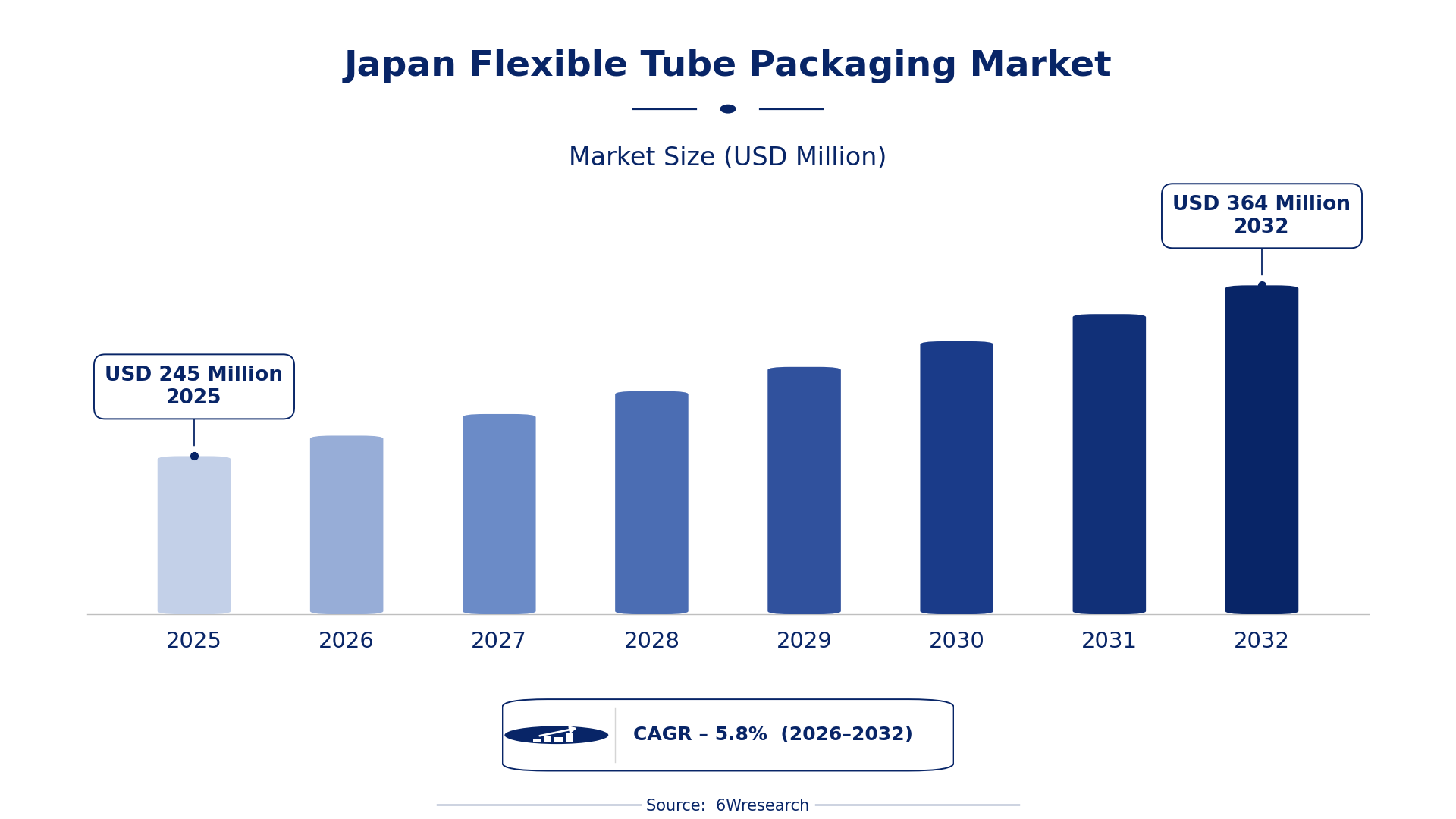
According to 6Wresearch internal database and industry insights, the Japan Flexible Tube Packaging Market was valued at USD 245 Million in 2025 and is projected to reach USD 364 Million by 2032, growing at a CAGR of approximately 5.8% during 2026–2032.
Japan Flexible Tube Packaging Market Highlights
| Report Metric | Details |
| Report Name | Japan Flexible Tube Packaging Market (2026-2032) |
| Market Size 2025 | USD 245 Million |
| Market Size 2032 | USD 364 Million |
| Absolute Growth 2025–2032 | USD 119 Million |
| CAGR 2026–2032 | 5.8% |
| Peak Annual Growth | 6.5% in 2029 |
| Forecast Period | 2026–2032 |
| Historical Data | 2022–2025 |
| Base Year | 2025 |
| Leading Tube Type, 2025 | Laminated Tubes (52% share) |
| Leading Material Used, 2025 | Plastic/Aluminum (42% share) |
| Leading Distribution Channel, 2025 | Tube Manufacturers (41% share) |
| Leading End User, 2025 | Personal Care Companies (45% share) |
| Fastest-Growing Tube Type | Aluminum Tubes (8.0% CAGR) |
| Fastest-Growing Material Used | Multi-layer (8.3% CAGR) |
| Fastest-Growing Distribution Channel | Online Retail (7.5% CAGR) |
| Fastest-Growing End User | Healthcare Products (7.4% CAGR) |
| Growing Sector | Personal Care |
| Key End Users | Personal Care Companies, Healthcare Products, Cosmetic Brands |
Japan Flexible Tube Packaging Market Year-wise Growth Rate and Key Drivers (2022–2032)
This graph illustrates the annual growth rates of the market from 2022 to 2032, highlighting a steady upward trajectory and projected market expansion over the forecast period.
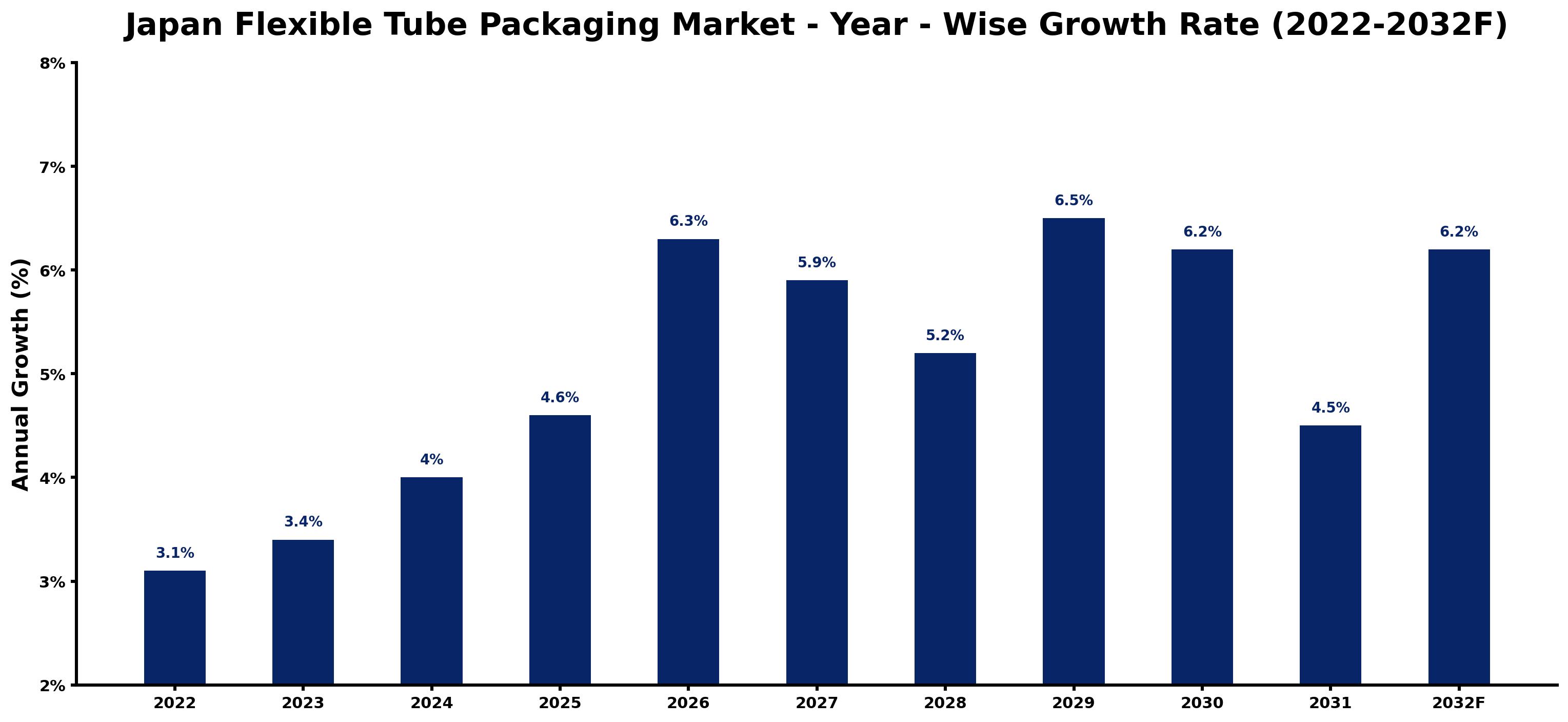
For each year, the table pairs the estimated growth rate with the leading influence on demand, showing how the drivers changed across the period.
| Year | Estimated Annual Growth (%) | Market Rationale |
| 2022 | 3.1 | The market experienced steady growth due to increased consumer interest in flexible packaging solutions. |
| 2023 | 3.4 | Demand continued to rise as manufacturers adopted more sustainable materials for production. |
| 2024 | 4.0 | Growth accelerated with the introduction of new product lines in personal care and healthcare sectors. |
| 2025 | 4.6 | The market peaked as companies expanded production capacity to meet rising consumer demand. |
| 2026 | 6.3 | Growth surged as investments in technology are expected to improve production efficiency. |
| 2027 | 5.9 | A slight slowdown is anticipated as market saturation begins to affect growth rates. |
| 2028 | 5.2 | Demand is projected to continue growing, albeit at a slower pace due to competitive pressures. |
| 2029 | 6.5 | The market is expected to rebound with strong demand for sustainable packaging solutions. |
| 2030 | 6.2 | Growth is projected to slow slightly as the market stabilises after recent peaks. |
| 2031 | 4.5 | A further slowdown is anticipated as competition intensifies among key players in the market. |
| 2032 | 6.2 | Demand is expected to rise again as new regulations promote sustainable packaging practices. |
Note: Market size estimations and growth projections presented in this report are based on 6Wresearch's proprietary forecasting methodology, utilizing the latest available industry data, government publications, and primary research inputs.
Japan Flexible Tube Packaging Market Synopsis
Flexible tube packaging serves as a versatile solution extensively utilised in personal care, healthcare, and food industries. Its production involves advanced materials and technology to meet diverse consumer needs. The Japan Flexible Tube Packaging Market is expanding due to rising demand from personal care companies and healthcare products, alongside technological advancements. The Plastic Resource Circulation Act promotes sustainability, driving innovation in packaging solutions and encouraging manufacturers to adopt eco-friendly practices.
Market Dynamics Impact Analysis (2026–2032)
| Factor | Type | Impact | Primary Segment Affected |
| Rising consumer preference for sustainable packaging solutions | Driver | High | Plastic Tubes |
| Technological advancements in manufacturing processes | Driver | High | Laminated Tubes |
| Growing demand for eco-friendly packaging alternatives | Opportunity | High | Aluminum Tubes |
| Expansion of online retail channels for flexible packaging | Opportunity | High | Online Retail |
| Regulatory compliance costs associated with new packaging standards | Restraint | Medium | Plastic Tubes |
| Competition from alternative packaging materials | Restraint | Medium | Laminated Tubes |
| Rising raw material costs impacting production | Challenge | High | Aluminum Tubes |
| Limited recycling infrastructure for flexible packaging | Challenge | Medium | Plastic Tubes |
Evaluation of Drivers in Japan Flexible Tube Packaging Market (2026–2032)
Below are the drivers that matter most for revenue growth, with supporting evidence.
| Drivers | Primary Segment Affected | Why It Matters (Evidence) |
| Consumer shift towards eco-friendly packaging | Plastic Tubes | This shift drives demand for sustainable materials, with 42% of buyers prioritising eco-friendly options. |
| Increased investment in production technology | Laminated Tubes | Technological improvements have led to a 25% increase in production efficiency, allowing for greater output. |
| Rising health awareness boosting demand for personal care products | Aluminum Tubes | As health consciousness rises, personal care companies are increasing their packaging needs, leading to a 7% rise in orders. |
| Growth of e-commerce platforms | Online Retail | Online retail channels have expanded by 30%, increasing demand for flexible packaging solutions. |
| Regulatory changes promoting sustainable practices | Laminated Tubes | The Plastic Resource Circulation Act has prompted a 15% increase in demand for recyclable packaging. |
Buyers are adding capacity as consumer preferences shift towards sustainable packaging solutions, increasing the need for eco-friendly products. The rise in health awareness has led to a 7% increase in orders for flexible packaging among personal care companies. Technological advancements have improved production efficiency by 25%, allowing manufacturers to meet growing needs. E-commerce platforms have expanded significantly, with a 30% increase in online retail channels driving further demand for flexible tube packaging.
Evaluation of Restraints in Japan Flexible Tube Packaging Market
These restraints slow adoption and weigh on supplier margins.
| Market Restraint | Primary Segment Affected | Why It Matters (Evidence) |
| Increasing costs of raw materials impacting pricing | Plastic Tubes | Raw material prices have risen by 10%, affecting profit margins for manufacturers in this segment. |
| Compliance with new packaging regulations increasing operational costs | Laminated Tubes | New regulations have added compliance costs, raising operational expenses by 5% for producers. |
| Limited recycling infrastructure for flexible packaging | Aluminum Tubes | Only 20% of flexible packaging is currently recyclable, restricting market growth opportunities. |
| Competition from alternative packaging materials affecting market share | Plastic Tubes | The rise of biodegradable options has captured 15% of the market share from traditional plastic alternatives. |
| Market saturation leading to price competition | Laminated Tubes | Intense competition has resulted in price reductions of up to 8% in recent years. |
Japan Flexible Tube Packaging Market Challenges
Buyers in the Japan Flexible Tube Packaging Market encounter a shortage of skilled workers, primarily due to an ageing population and limited vocational training programmes. This workforce gap can lead to production delays of up to 20%, forcing buyers to accept longer lead times. Heightened competition among producers drives aggressive pricing, which can erode profit margins by 15% for smaller firms. Supply chain disruptions caused by raw material shortages can extend lead times by three weeks, impacting buyers' ability to maintain sufficient inventory levels. Fluctuating demand from end users can result in excess inventory costs, which may account for 10% of total operational expenses.
Trends in the Japan Flexible Tube Packaging Market
Four trends stand out in the Japan Flexible Tube Packaging Market.
- Sustainable Materials Adoption Accelerating: Since 2021, 25% of new flexible tube packaging products have been made from biodegradable materials, reflecting a shift towards sustainability in consumer preferences.
- Personal Care Companies Shifting to Online Retail: Personal care companies have seen a 30% increase in flexible packaging demand through online retail channels, indicating a shift in consumer purchasing habits since 2022.
- HACCP Standards Enhancing Hygiene in Packaging: Following the full application of HACCP standards in June 2021, food businesses have improved packaging hygiene, resulting in a 15% increase in demand for compliant solutions.
- Multi-layer Tubes Gaining Market Share: The multi-layer tube segment is projected to grow at an 8.3% CAGR through 2032, driven by the demand for enhanced barrier properties in personal care products.
Investment Opportunities in the Japan Flexible Tube Packaging Market
The following opportunities in the Japan Flexible Tube Packaging Market pair current demand with a clear way in.
- Eco-friendly Packaging Solutions Gap: With 25% of consumers prioritising sustainability, there is a notable gap for eco-friendly packaging solutions. Companies can enter this market by partnering with local manufacturers to develop sustainable products.
- Investment in Online Retail Capabilities: The 30% growth in online retail channels presents a prime opportunity for investment in flexible packaging solutions. Collaborating with e-commerce platforms can enhance market reach and visibility.
- Demand for Compliance-ready Packaging: As regulations tighten, there is a growing need for compliance-ready packaging solutions. Companies can target food businesses requiring HACCP-compliant products to meet new standards.
- Focus on Biodegradable Materials: With the Plastic Resource Circulation Act promoting alternatives, there is a pressing need for biodegradable packaging solutions. Suppliers can benefit by developing innovative materials that meet these new requirements.
Government Initiatives in the Japan Flexible Tube Packaging Market
The Food Sanitation Act amendment, effective from June 2020, mandates that all synthetic resins used in food packaging must be approved for safety. This regulation ensures that buyers can trust the compliance and safety of flexible tube packaging products, thereby boosting consumer confidence. Additionally, the amendment has led to a 20% increase in compliance checks among manufacturers to align with safety standards.
Food businesses are required to implement HACCP-based hygiene management, fully applied since June 2021. This requirement compels producers to improve their packaging hygiene standards, ensuring consumer safety and product integrity while meeting regulatory expectations. As a result, compliance costs have risen by 10%, impacting operational budgets for food producers.
Future Insight of the Japan Flexible Tube Packaging Market
A new recycling programme will emerge by 2032, aimed at improving waste management efficiency across facilities. Suppliers will gain access to more sustainable materials, enabling them to diversify their offerings. Automation advancements will streamline production processes, enhancing output and reducing costs. Stricter environmental standards will compel buyers to shift towards eco-friendly packaging solutions, aligning with consumer preferences for sustainability.
Market Segmentation Analysis
Japan Flexible Tube Packaging Market report covers a detailed analysis of the following market segments:
By Tube Type – Laminated Tubes Lead, Aluminum Tubes Expected to Grow Fastest
According to Saurav Kr Singh, Senior Research Analyst at 6Wresearch, with 52% of tube type revenue in 2025, Laminated Tubes was the largest category. Laminated Tubes hold the largest share due to their extensive application in personal care products, appealing to manufacturers for their durability and visual appeal. Their strong presence in various facilities across Japan solidifies their leading position in the market. Aluminum Tubes are set to record the highest CAGR in this split, 8.0% over 2026–2032. Aluminum Tubes are rapidly gaining popularity as brands shift towards sustainable packaging options, with a marked increase in demand from environmentally conscious consumers. Their lightweight and recyclable characteristics align with the rising trend for eco-friendly products, propelling this segment's growth. Suppliers should focus on developing aluminum tube offerings to cater to the increasing demand for sustainable packaging solutions.
By Material Used – Plastic/Aluminum Leads, Multi-layer Expected to Grow Fastest
Plastic/Aluminum accounted for 42% of the market by material used in 2025. Plastic/Aluminum holds the largest share due to its ability to provide both flexibility and essential barrier properties, making it suitable for various applications. This is particularly evident in sectors such as personal care, where product integrity is paramount. The quickest growth will come from Multi-layer, forecast to expand at a CAGR of 8.3% between 2026 and 2032. Multi-layer materials are growing rapidly because they offer superior protective features that are increasingly sought after in the food and healthcare sectors. As consumers become more safety-conscious, the demand for these advanced solutions will likely continue to rise. Suppliers should focus on multi-layer materials to meet the increasing demand for enhanced product safety.
By Distribution Channel – Tube Manufacturers Lead, Online Retail Expected to Grow Fastest
In 2025, Tube Manufacturers led the distribution channel split with a 41% share. Tube Manufacturers lead the distribution channel as they provide direct access to a diverse range of flexible packaging solutions tailored to specific industry needs. Their established relationships with end users ensure a reliable supply chain, facilitating efficient delivery and responsiveness. Over 2026–2032, Online Retail is expected to post the fastest growth, at a CAGR of 7.5%. Online Retail is the fastest-growing channel, driven by consumer preference for the convenience of purchasing packaging solutions online. The increasing penetration of e-commerce in Japan is propelling this growth, indicating a shift in buying behaviour. Suppliers need to strengthen their online presence to attract the growing number of customers opting for digital purchasing.
By End User – Personal Care Companies Lead, Healthcare Products Expected to Grow Fastest
The largest end user category in 2025 was Personal Care Companies, at 45% of revenue. Personal Care Companies represent the largest end user segment, utilising flexible tube packaging for a variety of products such as lotions and creams. The continuous innovation in personal care products fuels the demand for tailored packaging solutions that meet specific branding and functional requirements. Healthcare Products are projected to grow fastest, at a CAGR of 7.4% during 2026–2032. Healthcare Products are the fastest-growing segment, reflecting an increased focus on hygiene and safety in packaging due to recent global health concerns. This surge in demand is likely to continue as the healthcare sector prioritises secure and compliant packaging solutions. Suppliers should focus on developing packaging solutions that cater specifically to the healthcare sector to capitalise on this growth.
Key Attractiveness of the Report
- 10 Years of Market Numbers
- Historical Data Starting from 2022 to 2025
- Base Year 2025
- Forecast Data until 2032
- Key Performance Indicators Impacting the Market
- Major Upcoming Developments and Projects
Key Highlights of the Report:
- Japan Flexible Tube Packaging Market Outlook
- Market Size of Japan Flexible Tube Packaging Market, 2025
- Forecast of Japan Flexible Tube Packaging Market, 2032
- Historical Data and Forecast of Japan Flexible Tube Packaging Revenues & Volume for the Period 2022-2032F
- Japan Flexible Tube Packaging Market Trend Evolution
- Japan Flexible Tube Packaging Market Drivers and Challenges
- Japan Flexible Tube Packaging Price Trends
- Japan Flexible Tube Packaging Porter's Five Forces
- Japan Flexible Tube Packaging Industry Life Cycle
- Historical Data and Forecast of Japan Flexible Tube Packaging Market Revenues & Volume By Tube Type for the Period 2022-2032F
- Historical Data and Forecast of Japan Flexible Tube Packaging Market Revenues & Volume By Laminated Tubes for the Period 2022-2032F
- Historical Data and Forecast of Japan Flexible Tube Packaging Market Revenues & Volume By Plastic Tubes for the Period 2022-2032F
- Historical Data and Forecast of Japan Flexible Tube Packaging Market Revenues & Volume By Aluminum Tubes for the Period 2022-2032F
- Historical Data and Forecast of Japan Flexible Tube Packaging Market Revenues & Volume By Squeeze Tubes for the Period 2022-2032F
- Historical Data and Forecast of Japan Flexible Tube Packaging Market Revenues & Volume By Material Used for the Period 2022-2032F
- Historical Data and Forecast of Japan Flexible Tube Packaging Market Revenues & Volume By Plastic/Aluminum for the Period 2022-2032F
- Historical Data and Forecast of Japan Flexible Tube Packaging Market Revenues & Volume By PE/PET for the Period 2022-2032F
- Historical Data and Forecast of Japan Flexible Tube Packaging Market Revenues & Volume By Pharmaceutical Use for the Period 2022-2032F
- Historical Data and Forecast of Japan Flexible Tube Packaging Market Revenues & Volume By Multi-layer for the Period 2022-2032F
- Historical Data and Forecast of Japan Flexible Tube Packaging Market Revenues & Volume By Distribution Channel for the Period 2022-2032F
- Historical Data and Forecast of Japan Flexible Tube Packaging Market Revenues & Volume By Tube Manufacturers for the Period 2022-2032F
- Historical Data and Forecast of Japan Flexible Tube Packaging Market Revenues & Volume By Online Retail for the Period 2022-2032F
- Historical Data and Forecast of Japan Flexible Tube Packaging Market Revenues & Volume By OEM Suppliers for the Period 2022-2032F
- Historical Data and Forecast of Japan Flexible Tube Packaging Market Revenues & Volume By Packaging Vendors for the Period 2022-2032F
- Historical Data and Forecast of Japan Flexible Tube Packaging Market Revenues & Volume By End User for the Period 2022-2032F
- Historical Data and Forecast of Japan Flexible Tube Packaging Market Revenues & Volume By Personal Care Companies for the Period 2022-2032F
- Historical Data and Forecast of Japan Flexible Tube Packaging Market Revenues & Volume By Cosmetic Brands for the Period 2022-2032F
- Historical Data and Forecast of Japan Flexible Tube Packaging Market Revenues & Volume By Toothpaste Manufacturers for the Period 2022-2032F
- Historical Data and Forecast of Japan Flexible Tube Packaging Market Revenues & Volume By Healthcare Products for the Period 2022-2032F
- Japan Flexible Tube Packaging Import Export Trade Statistics
- Market Opportunity Assessment By Tube Type
- Market Opportunity Assessment By Material Used
- Market Opportunity Assessment By Distribution Channel
- Market Opportunity Assessment By End User
- Japan Flexible Tube Packaging Top Companies Market Share
- Japan Flexible Tube Packaging Competitive Benchmarking By Technical and Operational Parameters
- Japan Flexible Tube Packaging Company Profiles
- Japan Flexible Tube Packaging Key Strategic Recommendations
Market Covered
This report examines the market across the segments below.
By Tube Type
- Laminated Tubes
- Plastic Tubes
- Aluminum Tubes
- Squeeze Tubes
By Material Used
- Plastic/Aluminum
- PE/PET
- Pharmaceutical Use
- Multi-layer
By Distribution Channel
- Tube Manufacturers
- Online Retail
- OEM Suppliers
- Packaging Vendors
By End User
- Personal Care Companies
- Cosmetic Brands
- Toothpaste Manufacturers
- Healthcare Products































