Japan Flight Connectivity Provider Market Size & Growth Rate
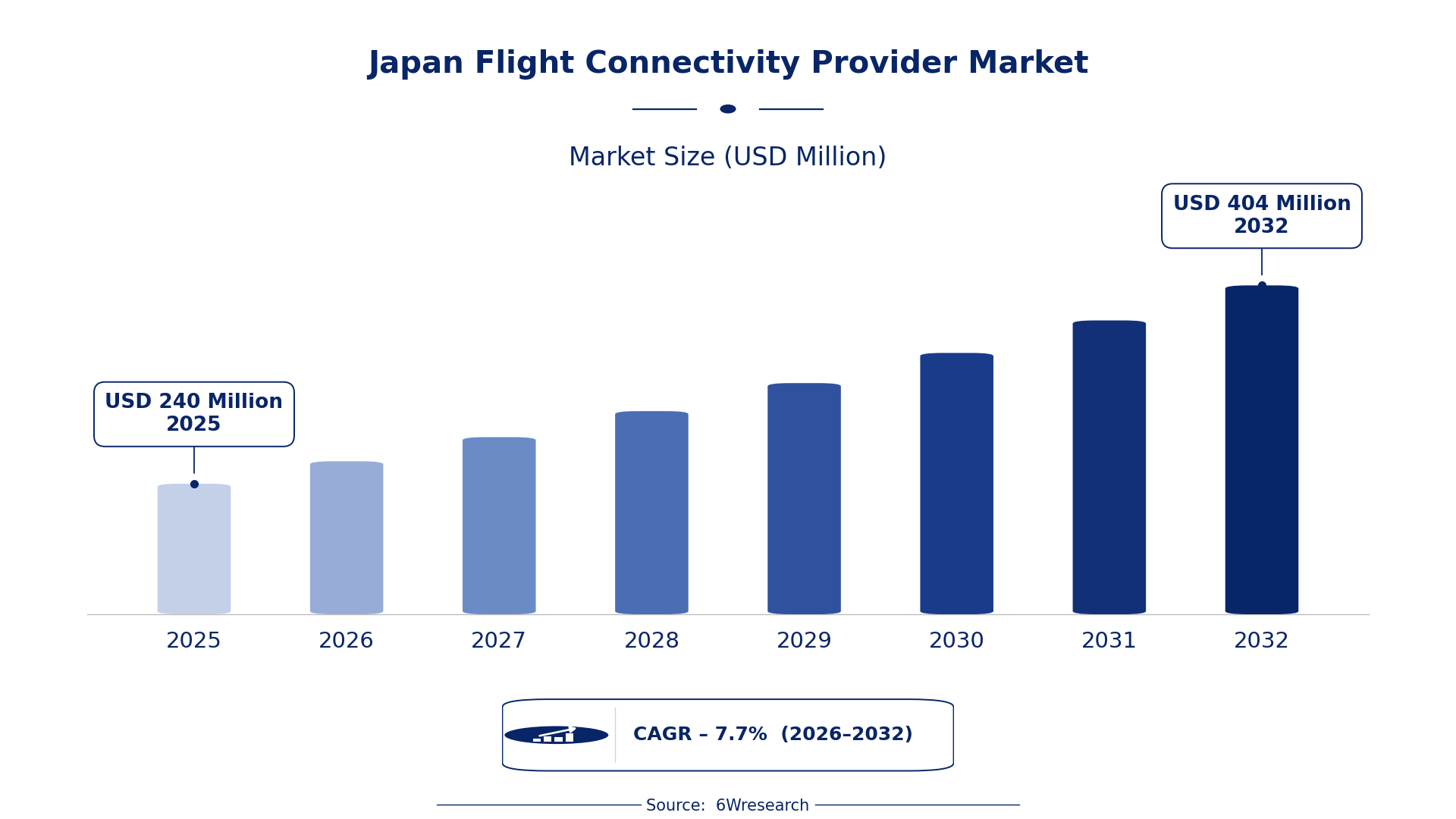
According to 6Wresearch internal database and industry insights, the Japan Flight Connectivity Provider Market was valued at USD 240 Million in 2025 and is projected to reach USD 404 Million by 2032, growing at a CAGR of approximately 7.7% during 2026–2032.
Japan Flight Connectivity Provider Market Highlights
| Report Metric | Details |
| Report Name | Japan Flight Connectivity Provider Market (2026-2032) |
| Market Size 2025 | USD 240 Million |
| Market Size 2032 | USD 404 Million |
| Absolute Growth 2025–2032 | USD 164 Million |
| CAGR 2026–2032 | 7.7% |
| Peak Annual Growth | 9.1% in 2031 |
| Forecast Period | 2026–2032 |
| Historical Data | 2022–2025 |
| Base Year | 2025 |
| Leading Connectivity Type, 2025 | In-flight Wi-Fi (52% share) |
| Leading Technology Used, 2025 | Satellite (Ka/Ku) (39% share) |
| Leading Service Model, 2025 | Subscription-based (49% share) |
| Leading End User, 2025 | Airlines (44% share) |
| Fastest-Growing Connectivity Type | Cellular Connectivity (11.0% CAGR) |
| Fastest-Growing Technology Used | LTE/5G Onboard (11.5% CAGR) |
| Fastest-Growing Service Model | Pay-per-use (12.0% CAGR) |
| Fastest-Growing End User | Aviation Services (10.0% CAGR) |
| Growing Sector | Aviation Services |
| Key End Users | Airlines, Aviation Services, Business Jet Operators, Commercial Carriers |
Japan Flight Connectivity Provider Market Year-wise Growth Rate and Key Drivers (2022–2032)
This graph illustrates the annual growth rates of the market from 2022 to 2032, highlighting a steady upward trajectory and projected market expansion over the forecast period.
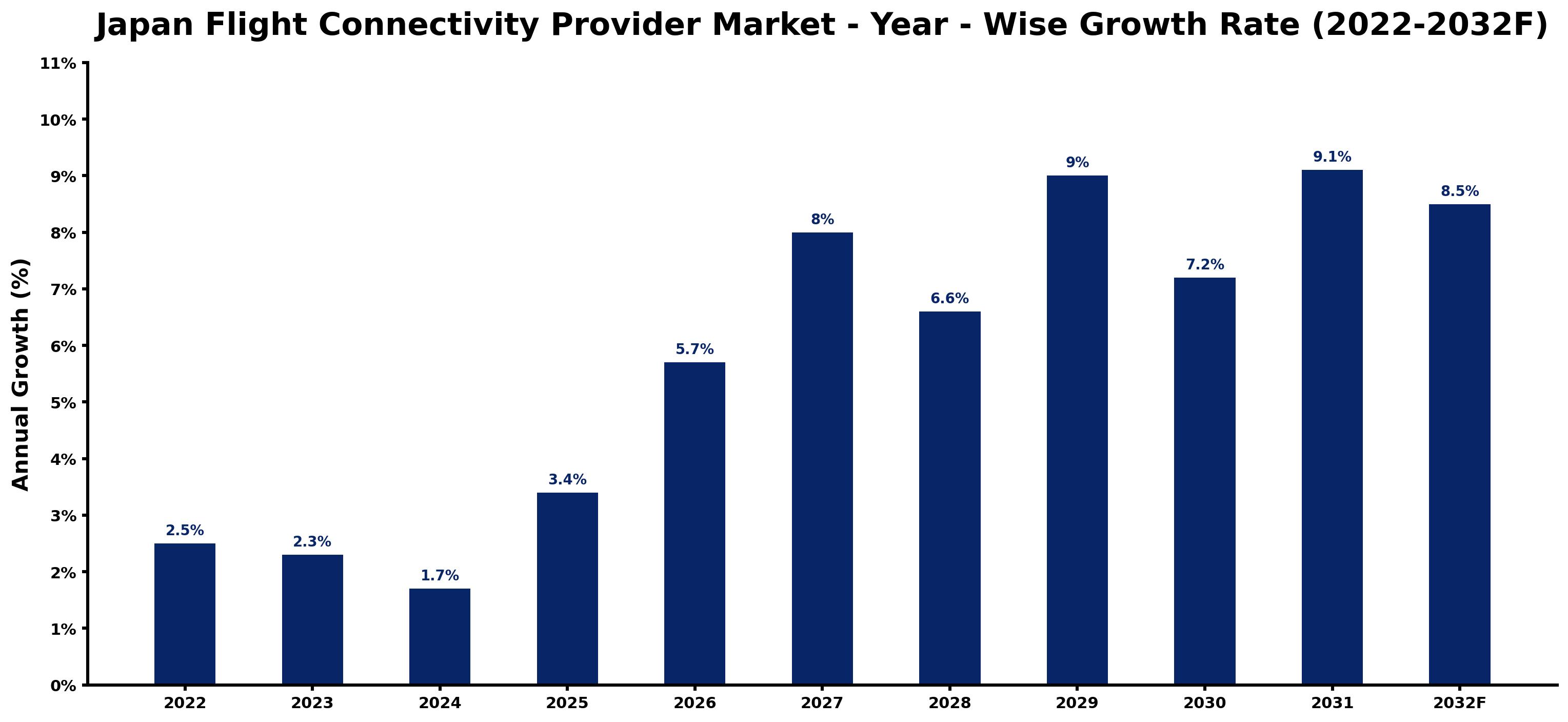
For each year, the table pairs the estimated growth rate with the leading influence on demand, showing how the drivers changed across the period.
| Year | Estimated Annual Growth (%) | Market Rationale |
| 2022 | 2.5 | The market showed steady growth, reflecting ongoing investments in connectivity services. |
| 2023 | 2.3 | Growth slowed due to market saturation and increased competition among service providers. |
| 2024 | 1.7 | A further slowdown occurred as airlines reassessed their connectivity budgets. |
| 2025 | 3.4 | Demand surged as airlines upgraded their connectivity offerings in response to passenger expectations. |
| 2026 | 5.7 | Growth is expected to accelerate with new technology adoption, particularly in LTE and 5G services. |
| 2027 | 8.0 | The market will continue to expand as airlines invest in improved passenger experiences. |
| 2028 | 6.6 | Growth is projected to slow again as the market matures and competition intensifies. |
| 2029 | 9.0 | Demand is expected to increase sharply as live TV streaming gains popularity during major sports events. |
| 2030 | 7.2 | The growth rate will moderate as airlines focus on optimizing existing services. |
| 2031 | 9.1 | A peak in growth is projected as airlines fully embrace advanced connectivity solutions. |
| 2032 | 8.5 | Growth is expected to slow slightly as the market stabilises after rapid advancements. |
Note: Market size estimations and growth projections presented in this report are based on 6Wresearch's proprietary forecasting methodology, utilizing the latest available industry data, government publications, and primary research inputs.
Japan Flight Connectivity Provider Market Synopsis
Flight connectivity providers in Japan deliver in-flight internet access and communication services primarily through satellite and cellular technologies. The Tokyo metropolitan area demonstrates the highest demand, with over 70% of domestic flights offering in-flight Wi-Fi. This market is growing due to substantial investments by airlines, projected to exceed 1 billion yen, and increasing passenger expectations for connectivity during flights. The ongoing adoption of LTE and 5G technologies further fuels this growth, improving the overall travel experience.
Market Dynamics Impact Analysis (2026–2032)
| Factor | Type | Impact | Primary Segment Affected |
| Increased passenger demand for connectivity during flights drives service upgrades. | Driver | High | In-flight Wi-Fi |
| Airlines are investing heavily in connectivity technology to enhance customer experience. | Driver | High | Cellular Connectivity |
| Growing demand for live TV streaming during flights presents new opportunities. | Opportunity | High | Live TV Streaming |
| The expansion of LTE and 5G technology creates new service offerings. | Opportunity | High | LTE/5G Onboard |
| High costs associated with upgrading existing systems can limit service expansion. | Restraint | Medium | In-flight Wi-Fi |
| Limited bandwidth availability affects the quality of connectivity services. | Restraint | Medium | Cellular Connectivity |
| Technological integration challenges can delay service implementation. | Challenge | High | Aviation Services |
| Competition among providers can lead to price wars, impacting profitability. | Challenge | Medium | Commercial Carriers |
Evaluation of Drivers in Japan Flight Connectivity Provider Market (2026–2032)
The table below links each growth driver to the segment it affects and the evidence for it.
| Drivers | Primary Segment Affected | Why It Matters (Evidence) |
| High passenger volume in the Tokyo metropolitan area drives demand for connectivity. | In-flight Wi-Fi | With over 100 million passengers annually, airlines are compelled to improve services. |
| Airlines are investing over 1 billion yen in connectivity upgrades to meet passenger expectations. | Cellular Connectivity | This investment leads to improved service offerings and customer satisfaction. |
| The average speed of in-flight Wi-Fi at around 10 Mbps attracts tech-savvy passengers. | Satellite (Ka/Ku) | Higher speeds encourage more passengers to use in-flight connectivity services. |
| The JIS Z 8401 standard ensures quality and reliability in connectivity services. | LTE/5G Onboard | Compliance with this standard boosts consumer confidence in service offerings. |
| The Tokyo 2020 Olympics heightened awareness and demand for connectivity services. | Live TV Streaming | Increased visibility during the event led to higher expectations for in-flight entertainment. |
Much of the new demand traces back to the Tokyo metropolitan area, which supports over 100 million passengers annually, compelling airlines to improve connectivity services. Airlines are investing more than 1 billion yen in upgrades, leading to better in-flight Wi-Fi availability on over 70% of domestic flights. The heightened awareness from the Tokyo 2020 Olympics also increased demand for live TV streaming, particularly during major sports events. As airlines focus on service quality, compliance with the JIS Z 8401 standard ensures that consumers receive dependable offerings.
Evaluation of Restraints in Japan Flight Connectivity Provider Market
The main factors holding the market back are set out below.
| Market Restraint | Primary Segment Affected | Why It Matters (Evidence) |
| High costs associated with upgrading existing systems limit service expansion. | In-flight Wi-Fi | Airlines face budget constraints, which can hinder their ability to invest in new technologies. |
| Limited bandwidth availability affects the quality of connectivity services. | Cellular Connectivity | Geographical constraints in Japan can restrict the effectiveness of certain technologies. |
| Integration challenges can delay service implementation. | Aviation Services | Complex systems require time and resources to integrate effectively. |
| Regulatory compliance can slow down the deployment of new services. | Satellite (Ka/Ku) | Strict aviation regulations necessitate thorough testing and certification processes. |
| Market saturation leads to intense competition, impacting profitability. | Commercial Carriers | As more providers enter the market, price competition can reduce margins. |
Japan Flight Connectivity Provider Market Challenges
High costs for in-flight Wi-Fi services average around 1,500 yen per flight, which limits access for passengers and affects overall satisfaction scores. A shortage of skilled technicians delays the deployment of advanced connectivity technologies, resulting in lower service quality for airlines. Many airlines continue to use outdated systems while testing LTE/5G technology, failing to meet the growing demand for faster internet speeds among passengers. Increased competition among connectivity providers, with over 70% of domestic flights offering Wi-Fi, forces providers to invest heavily to differentiate their services.
Trends in the Japan Flight Connectivity Provider Market
The shifts below are changing how Japan Flight Connectivity Provider Market products are bought and supplied.
- Shift from Traditional to Advanced Connectivity Solutions: Since 2020, airlines have increasingly adopted advanced connectivity solutions, such as LTE and 5G, to meet passenger expectations. This shift is reflected as over 70% of domestic flights now offer in-flight Wi-Fi, improving overall travel experiences.
- Emergence of Live TV Streaming Services: The Tokyo 2020 Olympics catalysed the rise of live TV streaming services on flights, with growing demand for real-time sports coverage. Airlines are now exploring options to incorporate these services, reflecting changing passenger preferences.
- Transition from Pay-per-use to Subscription-based Models: In recent years, airlines have transitioned from pay-per-use to subscription-based models for in-flight Wi-Fi services, driven by customer preferences for predictable pricing. This change has led to increased adoption of connectivity services among frequent flyers.
- Increased Collaboration on Satellite Technology: Collaboration among aviation stakeholders on satellite technology has intensified since 2021, with the Japan Aerospace Exploration Agency leading research efforts. This cooperation aims to improve connectivity solutions and expand coverage across Japan.
Investment Opportunities in the Japan Flight Connectivity Provider Market
Several openings in the Japan Flight Connectivity Provider Market merit attention from investors.
- Airlines seeking improved passenger experience: Airlines are increasingly looking to improve passenger experiences through connectivity upgrades, with budgets exceeding 1 billion yen. Collaborating with technology providers can help meet these demands effectively.
- Tokyo metropolitan area as a growth hub: The Tokyo metropolitan area presents a significant opportunity for connectivity providers, given its high passenger volume. Investing in advanced connectivity solutions can capture this expanding market.
- Supply of LTE and 5G technology solutions: With the ongoing testing of LTE and 5G technologies, there is a gap in supply for these solutions. Connectivity providers can partner with airlines to offer these advanced services.
- Growing interest in live TV streaming: The increasing interest in live TV streaming during flights represents a substantial market opportunity. Airlines can invest in partnerships to provide these services, capitalising on passenger demand.
Government Initiatives in the Japan Flight Connectivity Provider Market
The Industrial Standardization Act, amended in 2019, governs product and test standards for aviation connectivity services. This law ensures that connectivity providers adhere to quality and safety regulations, promoting consumer confidence. Additionally, the Act against Unjustifiable Premiums and Misleading Representations, established in 1962, prohibits misleading advertising practices, ensuring that consumers receive accurate information about connectivity services.
The Civil Aviation Bureau oversees aviation regulations, ensuring compliance with safety standards. This agency is responsible for approving new technologies and services, facilitating the implementation of advanced connectivity solutions in the aviation sector. These agencies play a critical role in supporting airlines as they invest in connectivity upgrades.
Future Insight of the Japan Flight Connectivity Provider Market
Investment in connectivity upgrades will exceed 1 billion yen, driving demand for enhanced in-flight services by 2032. The implementation of the JIS Z 8401 standard will improve service quality, benefiting both buyers and suppliers. Advances in satellite technology will increase coverage and speed, leading to better passenger experiences. As the demand for live TV streaming grows, especially during sports events, suppliers will need to innovate to satisfy evolving passenger expectations.
Market Segmentation Analysis
Japan Flight Connectivity Provider Market report covers a detailed analysis of the following market segments:
By Connectivity Type – In-flight Wi-Fi Leads, Cellular Connectivity Expected to Grow Fastest
According to Saurav Kr Singh, Senior Research Analyst at 6Wresearch, in 2025, In-flight Wi-Fi led the connectivity type split with a 52% share. In-flight Wi-Fi holds the largest share as it is available on over 70% of domestic flights, catering to the high demand for internet access among passengers. The Tokyo metropolitan area exemplifies this trend, where the need for reliable connectivity services is particularly pronounced. The quickest growth will come from Cellular Connectivity, forecast to expand at a CAGR of 11.0% between 2026 and 2032. Cellular Connectivity is experiencing rapid growth as airlines invest in LTE/5G technology for in-flight use, aiming to provide passengers with enhanced mobile services. This segment's expansion is further supported by the increasing desire for uninterrupted connectivity during flights. Suppliers should focus on developing cellular solutions to meet the growing expectations of airlines and their passengers.
By Technology Used – Satellite (Ka/Ku) Leads, LTE/5G Onboard Expected to Grow Fastest
The largest technology used category in 2025 was Satellite (Ka/Ku), at 39% of revenue. Satellite (Ka/Ku) technology dominates the market as it serves as the primary means of delivering in-flight connectivity, ensuring reliable internet access for passengers. Its established performance and reliability make it the preferred choice for airlines operating in Japan. LTE/5G Onboard is projected to grow fastest, at a CAGR of 11.5% during 2026–2032. LTE/5G Onboard technology is gaining traction due to its potential for faster connectivity, with several airlines currently testing this technology for in-flight applications. As demand for high-speed internet rises, this segment is expected to see accelerated adoption. Buyers should anticipate advancements in LTE/5G technology that could greatly improve in-flight connectivity experiences.
By Service Model – Subscription-based Leads, Pay-per-use Expected to Grow Fastest
Subscription-based accounted for 49% of the market by service model in 2025. The Subscription-based model is prevalent as it aligns with the common practice of offering in-flight Wi-Fi services, allowing passengers to access the internet for a fixed fee. This model appeals to airlines seeking predictable revenue streams from connectivity services. Over 2026–2032, Pay-per-use is expected to post the fastest growth, at a CAGR of 12.0%. Pay-per-use is emerging as a faster-growing model despite being less preferred, as it provides flexibility for passengers who may not want to commit to a subscription. The increasing trend of on-demand services is likely to drive this segment's growth. Suppliers may need to consider offering flexible pricing models to cater to diverse passenger preferences.
By End User – Airlines Lead, Aviation Services Expected to Grow Fastest
Airlines took 44% of end user revenue in 2025, more than any other category. Airlines constitute the largest user group of connectivity services, as they are the main providers of in-flight Wi-Fi to passengers. Their substantial investments in connectivity upgrades underscore the importance of these services in improving customer satisfaction. Aviation Services are set to record the highest CAGR in this split, 10.0% over 2026–2032. Aviation Services are experiencing rapid growth as they offer essential support to airlines, including connectivity solutions and operational communications. This segment's expansion reflects the increasing complexity and demand for integrated aviation services. Suppliers should consider forming partnerships with aviation service providers to expand their market presence.
Key Attractiveness of the Report
- 10 Years of Market Numbers
- Historical Data Starting from 2022 to 2025
- Base Year 2025
- Forecast Data until 2032
- Key Performance Indicators Impacting the Market
- Major Upcoming Developments and Projects
Key Highlights of the Report:
- Japan Flight Connectivity Provider Market Outlook
- Market Size of Japan Flight Connectivity Provider Market, 2025
- Forecast of Japan Flight Connectivity Provider Market, 2032
- Historical Data and Forecast of Japan Flight Connectivity Provider Revenues & Volume for the Period 2022-2032F
- Japan Flight Connectivity Provider Market Trend Evolution
- Japan Flight Connectivity Provider Market Drivers and Challenges
- Japan Flight Connectivity Provider Price Trends
- Japan Flight Connectivity Provider Porter's Five Forces
- Japan Flight Connectivity Provider Industry Life Cycle
- Historical Data and Forecast of Japan Flight Connectivity Provider Market Revenues & Volume By Connectivity Type for the Period 2022-2032F
- Historical Data and Forecast of Japan Flight Connectivity Provider Market Revenues & Volume By In-flight Wi-Fi for the Period 2022-2032F
- Historical Data and Forecast of Japan Flight Connectivity Provider Market Revenues & Volume By Cellular Connectivity for the Period 2022-2032F
- Historical Data and Forecast of Japan Flight Connectivity Provider Market Revenues & Volume By Live TV Streaming for the Period 2022-2032F
- Historical Data and Forecast of Japan Flight Connectivity Provider Market Revenues & Volume By Text/Voice Over IP for the Period 2022-2032F
- Historical Data and Forecast of Japan Flight Connectivity Provider Market Revenues & Volume By Technology Used for the Period 2022-2032F
- Historical Data and Forecast of Japan Flight Connectivity Provider Market Revenues & Volume By Satellite (Ka/Ku) for the Period 2022-2032F
- Historical Data and Forecast of Japan Flight Connectivity Provider Market Revenues & Volume By LTE/5G Onboard for the Period 2022-2032F
- Historical Data and Forecast of Japan Flight Connectivity Provider Market Revenues & Volume By Broadband Satellite for the Period 2022-2032F
- Historical Data and Forecast of Japan Flight Connectivity Provider Market Revenues & Volume By Air-to-Ground for the Period 2022-2032F
- Historical Data and Forecast of Japan Flight Connectivity Provider Market Revenues & Volume By Service Model for the Period 2022-2032F
- Historical Data and Forecast of Japan Flight Connectivity Provider Market Revenues & Volume By Subscription-based for the Period 2022-2032F
- Historical Data and Forecast of Japan Flight Connectivity Provider Market Revenues & Volume By Pay-per-use for the Period 2022-2032F
- Historical Data and Forecast of Japan Flight Connectivity Provider Market Revenues & Volume By Integrated with Ticketing for the Period 2022-2032F
- Historical Data and Forecast of Japan Flight Connectivity Provider Market Revenues & Volume By SaaS for the Period 2022-2032F
- Historical Data and Forecast of Japan Flight Connectivity Provider Market Revenues & Volume By End User for the Period 2022-2032F
- Historical Data and Forecast of Japan Flight Connectivity Provider Market Revenues & Volume By Airlines for the Period 2022-2032F
- Historical Data and Forecast of Japan Flight Connectivity Provider Market Revenues & Volume By Aviation Services for the Period 2022-2032F
- Historical Data and Forecast of Japan Flight Connectivity Provider Market Revenues & Volume By Business Jet Operators for the Period 2022-2032F
- Historical Data and Forecast of Japan Flight Connectivity Provider Market Revenues & Volume By Commercial Carriers for the Period 2022-2032F
- Japan Flight Connectivity Provider Import Export Trade Statistics
- Market Opportunity Assessment By Connectivity Type
- Market Opportunity Assessment By Technology Used
- Market Opportunity Assessment By Service Model
- Market Opportunity Assessment By End User
- Japan Flight Connectivity Provider Top Companies Market Share
- Japan Flight Connectivity Provider Competitive Benchmarking By Technical and Operational Parameters
- Japan Flight Connectivity Provider Company Profiles
- Japan Flight Connectivity Provider Key Strategic Recommendations
Market Covered
The report covers the following segments.
By Connectivity Type
- In-flight Wi-Fi
- Cellular Connectivity
- Live TV Streaming
- Text/Voice Over IP
By Technology Used
- Satellite (Ka/Ku)
- LTE/5G Onboard
- Broadband Satellite
- Air-to-Ground
By Service Model
- Subscription-based
- Pay-per-use
- Integrated with Ticketing
- SaaS
By End User
- Airlines
- Aviation Services
- Business Jet Operators
- Commercial Carriers































