Japan Floating Power Plant Market Size & Growth Rate
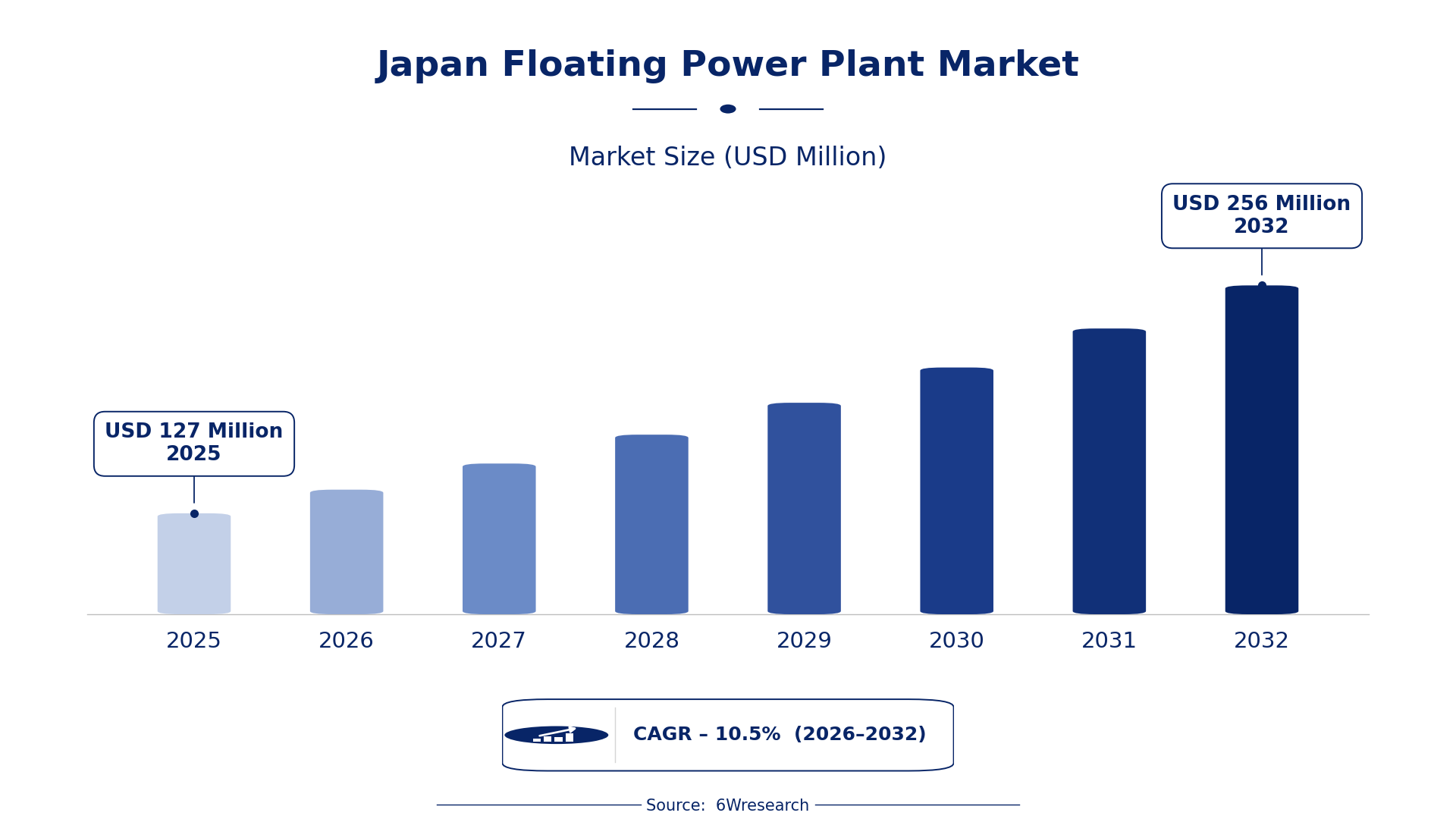
According to 6Wresearch internal database and industry insights, the Japan Floating Power Plant Market was valued at USD 127 Million in 2025 and is projected to reach USD 256 Million by 2032, growing at a CAGR of approximately 10.5% during 2026–2032.
Japan Floating Power Plant Market Highlights
| Report Metric | Details |
| Report Name | Japan Floating Power Plant Market (2026-2032) |
| Market Size 2025 | USD 127 Million |
| Market Size 2032 | USD 256 Million |
| Absolute Growth 2025–2032 | USD 129 Million |
| CAGR 2026–2032 | 10.5% |
| Peak Annual Growth | 11.8% in 2029 |
| Forecast Period | 2026–2032 |
| Historical Data | 2022–2025 |
| Base Year | 2025 |
| Leading Power Source, 2025 | Non-Renewable Gas Turbines (68% share) |
| Leading Capacity, 2025 | 1 MW“5 MW (44% share) |
| Fastest-Growing Power Source | IC Engines (14.3% CAGR) |
| Fastest-Growing Capacity | 5.1 MW“20 MW (12.4% CAGR) |
| Growing Sector | Energy generation |
| Key End Users | Energy providers, government agencies, industrial users |
Japan Floating Power Plant Market Year-wise Growth Rate and Key Drivers (2022–2032)
This graph illustrates the annual growth rates of the market from 2022 to 2032, highlighting a steady upward trajectory and projected market expansion over the forecast period.
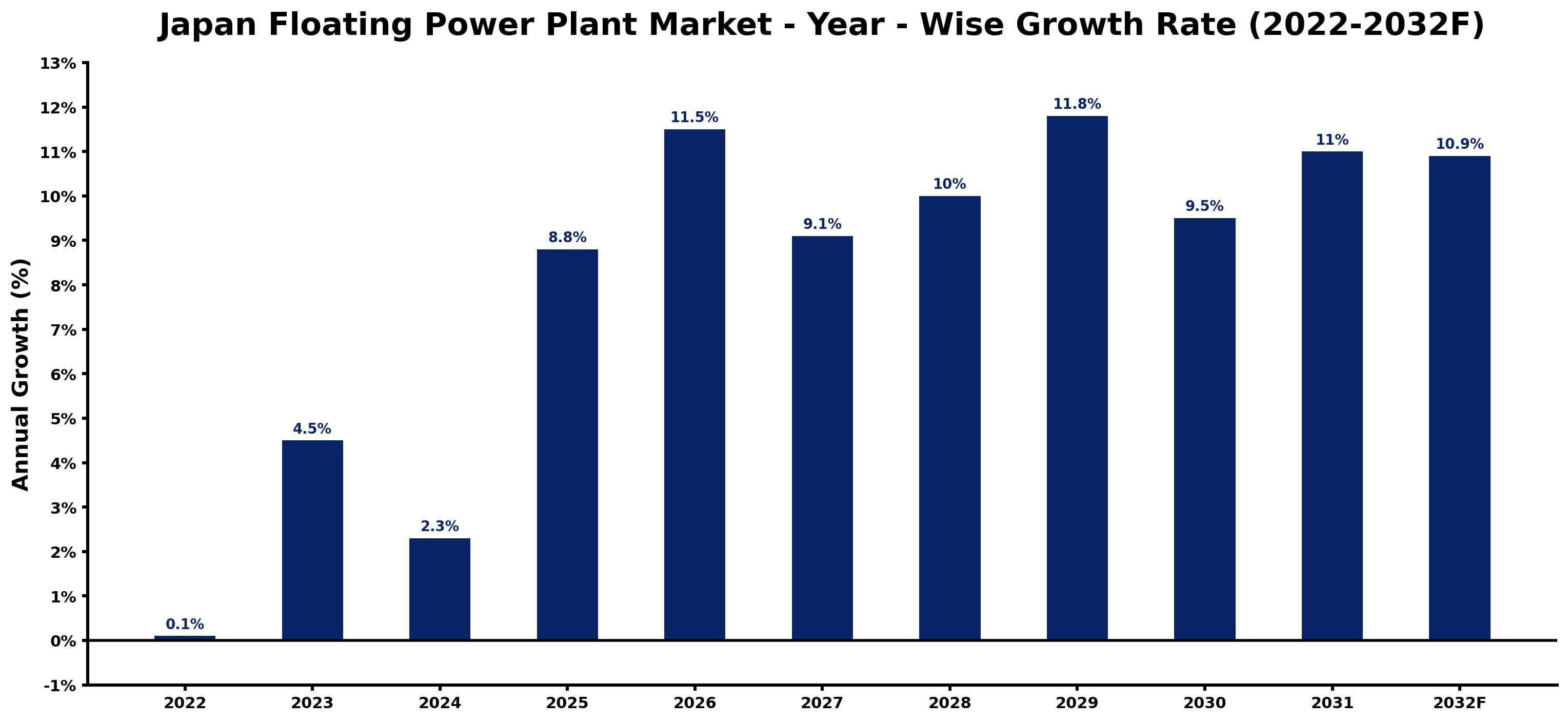
The following figures match every annual growth estimate with the main market development of that year, giving the reasoning behind each rise or slowdown.
| Year | Estimated Annual Growth (%) | Market Rationale |
| 2022 | 0.1 | The market showed minimal activity with a slight growth rate. |
| 2023 | 4.5 | Demand increased due to rising energy needs and initiatives for renewable integration. |
| 2024 | 2.3 | Growth slowed as the market adjusted after earlier expansions. |
| 2025 | 8.8 | A surge in demand was driven by government energy policies and investments. |
| 2026 | 11.5 | The market is expected to experience growth due to increased investments in floating power technologies. |
| 2027 | 9.1 | Growth is projected to slow as the market adjusts to previous high levels of expansion. |
| 2028 | 10.0 | Demand is expected to rise again, supported by ongoing energy transition initiatives. |
| 2029 | 11.8 | The market will peak as investments in offshore projects reach their highest levels. |
| 2030 | 9.5 | Growth is projected to moderate as the market stabilises following peak investment phases. |
| 2031 | 11.0 | Demand will increase again due to new projects and technology advancements. |
| 2032 | 10.9 | The market is expected to continue growing, supported by ongoing energy transition efforts. |
Note: Market size estimations and growth projections presented in this report are based on 6Wresearch's proprietary forecasting methodology, utilizing the latest available industry data, government publications, and primary research inputs.
Japan Floating Power Plant Market Synopsis
Floating power plants are marine structures that generate electricity using gas turbines or internal combustion engines, primarily deployed in coastal regions. They provide power to remote areas, support grid stability, and facilitate energy transition. The Japan Floating Power Plant Market is growing due to rising energy demand, government initiatives targeting renewable energy, and substantial investments in decarbonisation.
Market Dynamics Impact Analysis (2026–2032)
| Factor | Type | Impact | Primary Segment Affected |
| Rising energy demand from Japan's population drives the need for floating power plants. | Driver | High | Non-Renewable Gas Turbines |
| Government initiatives for renewable energy integration boost floating power plant deployment. | Driver | High | Non-Renewable Gas Turbines |
| Growing interest in offshore renewable energy projects opens new market opportunities. | Opportunity | High | IC Engines |
| Investment in innovative marine energy technologies presents significant growth potential. | Opportunity | High | 5.1 MW“20 MW |
| High operational costs of floating power plants limit widespread adoption. | Restraint | Medium | Non-Renewable Gas Turbines |
| Limited applications for smaller floating power plants restrict market expansion. | Restraint | Medium | 1 MW“5 MW |
| Technological challenges in marine energy systems can delay project implementation. | Challenge | High | Non-Renewable Gas Turbines |
| Competition from traditional energy sources affects floating power plant adoption. | Challenge | Medium | Non-Renewable Gas Turbines |
Evaluation of Drivers in Japan Floating Power Plant Market (2026–2032)
The table below links each growth driver to the segment it affects and the evidence for it.
| Drivers | Primary Segment Affected | Why It Matters (Evidence) |
| Increasing population and energy needs drive demand for floating power plants. | Non-Renewable Gas Turbines | Japan's population of approximately 126 million necessitates reliable energy sources. |
| Government policies promote renewable energy integration, boosting floating power plant projects. | Non-Renewable Gas Turbines | Aiming for a 46% cut in greenhouse gas emissions by 2030 drives investments. |
| Investment in offshore renewable energy initiatives creates market opportunities. | IC Engines | The Ministry of the Environment promotes offshore renewable energy projects. |
| Technological advancements in floating power generation systems attract investment. | 5.1 MW“20 MW | Japan launched a program with a budget of ¥10 billion to support innovative marine technologies. |
| Public-private partnerships facilitate funding for floating power plant projects. | Non-Renewable Gas Turbines | The GX Basic Policy targets JPY 150 trillion in decarbonisation investment over ten years. |
A wider customer base explains much of the growth, as Japan's population of approximately 126 million drives energy demand, necessitating reliable power sources. Recent government initiatives aim to increase renewable energy usage, supporting floating power plant projects. Investment in offshore renewable energy initiatives is creating new market opportunities. A program with a budget of ¥10 billion supports the development of marine energy technologies, attracting substantial investments in floating power generation systems. Public-private partnerships are facilitating significant funding for these projects, targeting JPY 150 trillion in decarbonisation investment over the next decade.
Evaluation of Restraints in Japan Floating Power Plant Market
The key brakes on demand, and where they bite hardest, are shown below.
| Market Restraint | Primary Segment Affected | Why It Matters (Evidence) |
| High operational costs of floating power plants limit their adoption. | Non-Renewable Gas Turbines | Operational costs can reach up to 30% higher than traditional plants, deterring investment. |
| Limited applications for smaller floating power plants restrict market growth. | 1 MW“5 MW | The capacity range is primarily suited for niche projects, limiting broader deployment. |
| Technological challenges in marine energy systems can delay project timelines. | Non-Renewable Gas Turbines | Complexity in design and construction can lead to delays of up to two years. |
| Competition from traditional energy sources affects floating power plant adoption. | Non-Renewable Gas Turbines | Conventional energy sources often have established infrastructure, making them more appealing. |
| Regulatory hurdles can slow down project approvals for floating power plants. | Non-Renewable Gas Turbines | Compliance with the JIS 8001 standard can extend approval timelines significantly. |
Japan Floating Power Plant Market Challenges
Buyers face delays in deploying floating power plants due to slow technological advancements in marine energy systems, extending project timelines by up to 18 months. Suppliers encounter difficulties sourcing materials that meet the JIS 8001 standard, leading to increased costs and potential project overruns for producers. Regulatory requirements under the GX Basic Policy necessitate extensive documentation, which can delay project approvals by an average of six months for buyers. Buyers also grapple with fluctuating energy prices, which can raise operational costs by 15% during peak demand periods, directly impacting their profitability.
Trends in the Japan Floating Power Plant Market
Four trends stand out in the Japan Floating Power Plant Market.
- Focus on Offshore Renewable Energy Projects: Japan is increasingly focusing on offshore renewable energy projects, with five operational floating power plants as of 2023. This shift is driven by the need to harness marine resources effectively, supporting the energy transition.
- Transition from Traditional Power Sources to Floating Power Plants: The demand for floating power plants is rising as Japan aims for a 36-38% renewable energy share by 2030. This transition reflects a broader commitment to reducing reliance on fossil fuels.
- Development of Marine Energy Technologies: With a budget of ¥10 billion allocated in 2022, Japan is supporting the development of marine energy technologies. This investment is essential for improving the efficiency and deployment of floating power plants.
- Growth of Public-Private Partnerships in Energy Sector: Increasing public-private partnerships are facilitating substantial investments in floating power plants. The GX Basic Policy targets JPY 150 trillion in decarbonisation investment over the next decade.
Investment Opportunities in the Japan Floating Power Plant Market
Several openings in the Japan Floating Power Plant Market merit attention from investors.
- Supply of Floating Power Plants for Remote Areas: There is a growing opportunity to supply floating power plants to remote coastal areas in Japan, where energy access is limited. Collaborating with local governments can streamline project approvals.
- Investment in Marine Energy Technologies: Investing in marine energy technologies presents a strong opportunity, especially under the ¥10 billion program launched in 2022. Engaging with research institutions can enhance development efforts.
- Floating Power Plants for Grid Stability: Floating power plants can support grid stability in Japan, particularly in coastal regions. Partnering with energy providers can facilitate market entry.
- Supply of Backup Power Solutions: There is significant demand for backup power solutions using IC engines in floating power plants. Targeting energy-intensive industries can create new business opportunities.
Government Initiatives in the Japan Floating Power Plant Market
The GX Promotion Act, enacted in 2023, serves as the legal foundation for Japan's energy transition strategy, which includes ambitious targets for greenhouse gas emissions reduction. The Act aims for a 46% cut in emissions from fiscal 2013 levels by fiscal 2030, driving investments in renewable technologies and infrastructure development.
The Agency for Natural Resources and Energy oversees energy policy and development in Japan, approving projects that align with national energy goals. The agency supports initiatives that promote offshore renewable energy projects, ensuring funding and resources are allocated effectively.
Future Insight of the Japan Floating Power Plant Market
Technological advancements in marine energy systems will reshape demand for floating power plants by 2032, aligning with Japan's target for a 36-38% renewable energy share. The government's budget of ¥10 trillion for decarbonisation initiatives will support the development of hybrid systems, benefiting buyers and suppliers. Increased investment in offshore renewable projects will improve operational capacity, leading to more efficient electricity generation. Continued backing from the New Energy and Industrial Technology Development Organization will drive the transition towards sustainable energy solutions.
Market Segmentation Analysis
Japan Floating Power Plant Market report covers a detailed analysis of the following market segments:
By Power Source – Non-Renewable Gas Turbines Lead, IC Engines Expected to Grow Fastest
According to Sachin Kumar Rai, Senior Research Analyst at 6Wresearch, Non-Renewable Gas Turbines held 68% of the Japan Floating Power Plant Market by power source in 2025. Non-renewable gas turbines hold the largest share in Japan's floating power plant market due to their extensive use in generating electricity, particularly in coastal areas like Chiba and Kanagawa. Their established presence and reliability make them the preferred choice for meeting the energy demands of Japan's population of approximately 126 million. IC Engines are set to record the highest CAGR in this split, 14.3% over 2026–2032. The internal combustion engines segment is experiencing rapid growth as they are increasingly utilised as backup power sources in floating installations, which is essential during the transition to renewable energy. The government's backing for innovative marine energy technologies is propelling this segment's expansion further. Suppliers must focus on enhancing gas turbine technologies to maintain competitiveness in a growing market.
By Capacity – 1 MW“5 MW Leads, 5.1 MW“20 MW Expected to Grow Fastest
1 MW“5 MW accounted for 44% of the market by capacity in 2025. The 1 MW to 5 MW capacity range leads the market because it is well-suited for smaller floating power projects, which are vital for providing energy to remote areas. This capacity is particularly effective in Japan's coastal regions, where larger installations may encounter spatial limitations. 5.1 MW“20 MW is projected to grow fastest, at a CAGR of 12.4% during 2026–2032. The 5.1 MW to 20 MW capacity segment is growing swiftly as it aligns with the typical applications of floating power plants, supporting Japan's energy policy goals. This range offers an optimal balance between efficiency and output, making it attractive for new projects. Buyers should consider mid-range capacity plants to optimise energy generation in constrained environments.
Key Attractiveness of the Report
- 10 Years of Market Numbers
- Historical Data Starting from 2022 to 2025
- Base Year 2025
- Forecast Data until 2032
- Key Performance Indicators Impacting the Market
- Major Upcoming Developments and Projects
Key Highlights of the Report:
- Japan Floating Power Plant Market Outlook
- Market Size of Japan Floating Power Plant Market, 2025
- Forecast of Japan Floating Power Plant Market, 2032
- Historical Data and Forecast of Japan Floating Power Plant Revenues & Volume for the Period 2022-2032
- Japan Floating Power Plant Market Trend Evolution
- Japan Floating Power Plant Market Drivers and Challenges
- Japan Floating Power Plant Price Trends
- Japan Floating Power Plant Porter's Five Forces
- Japan Floating Power Plant Industry Life Cycle
- Historical Data and Forecast of Japan Floating Power Plant Market Revenues & Volume By Power Source for the Period 2022-2032
- Historical Data and Forecast of Japan Floating Power Plant Market Revenues & Volume By Non-Renewable Gas Turbines for the Period 2022-2032
- Historical Data and Forecast of Japan Floating Power Plant Market Revenues & Volume By IC Engines for the Period 2022-2032
- Historical Data and Forecast of Japan Floating Power Plant Market Revenues & Volume By Capacity for the Period 2022-2032
- Historical Data and Forecast of Japan Floating Power Plant Market Revenues & Volume By 1 MW??5 MW for the Period 2022-2032
- Historical Data and Forecast of Japan Floating Power Plant Market Revenues & Volume By 5.1 MW??20 MW for the Period 2022-2032
- Historical Data and Forecast of Japan Floating Power Plant Market Revenues & Volume By 20.1 MW??100 MW for the Period 2022-2032
- Historical Data and Forecast of Japan Floating Power Plant Market Revenues & Volume By 100.1 MW??250 MW for the Period 2022-2032
- Historical Data and Forecast of Japan Floating Power Plant Market Revenues & Volume By Above 250 MW for the Period 2022-2032
- Japan Floating Power Plant Import Export Trade Statistics
- Market Opportunity Assessment By Power Source
- Market Opportunity Assessment By Capacity
- Japan Floating Power Plant Top Companies Market Share
- Japan Floating Power Plant Competitive Benchmarking By Technical and Operational Parameters
- Japan Floating Power Plant Company Profiles
- Japan Floating Power Plant Key Strategic Recommendations
Market Covered
Segments analysed in this report are listed below.
By Power Source
- Non-Renewable Gas Turbines
- IC Engines
By Capacity
- 1 MW“5 MW
- 5.1 MW“20 MW
- 20.1 MW“100 MW
- 100.1 MW“250 MW
- Above 250 MW






































