Japan Food & Beverage Processing Equipment Market Size & Growth Rate
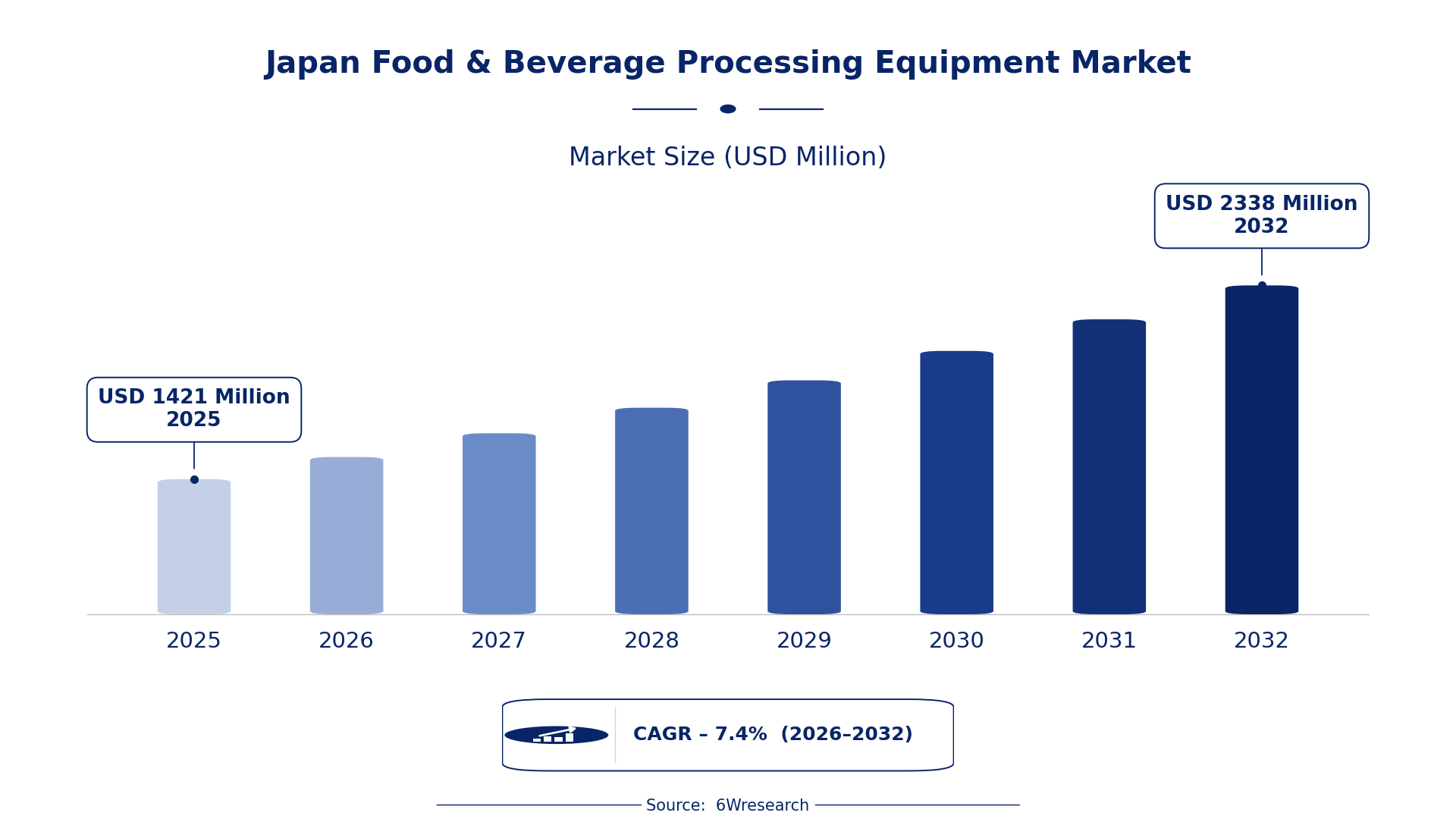
According to 6Wresearch internal database and industry insights, the Japan Food & Beverage Processing Equipment Market was valued at USD 1,421 Million in 2025 and is projected to reach USD 2,338 Million by 2032, growing at a CAGR of approximately 7.4% during 2026–2032.
Japan Food & Beverage Processing Equipment Market Highlights
| Report Metric | Details |
| Report Name | Japan Food & Beverage Processing Equipment Market (2026-2032) |
| Market Size 2025 | USD 1,421 Million |
| Market Size 2032 | USD 2,338 Million |
| Absolute Growth 2025–2032 | USD 917 Million |
| CAGR 2026–2032 | 7.4% |
| Peak Annual Growth | 8.1% in 2029 |
| Forecast Period | 2026–2032 |
| Historical Data | 2022–2025 |
| Base Year | 2025 |
| Leading Equipment Type, 2025 | Mixing Equipment (47% share) |
| Leading Application, 2025 | Bakery (47% share) |
| Leading Operation Mode, 2025 | Automatic (36% share) |
| Leading Material, 2025 | Stainless Steel (49% share) |
| Leading End User, 2025 | Food Manufacturers (39% share) |
| Fastest-Growing Equipment Type | Cutting Equipment (10.3% CAGR) |
| Fastest-Growing Application | Meat Processing (9.9% CAGR) |
| Fastest-Growing Operation Mode | Semi-Automatic (10.1% CAGR) |
| Fastest-Growing Material | Aluminum (10.8% CAGR) |
| Fastest-Growing End User | Beverage Industry (9.5% CAGR) |
| Growing Sector | Food Manufacturing |
| Key End Users | Food Manufacturers, Beverage Industry, Dairy Producers, Snack Producers |
Japan Food & Beverage Processing Equipment Market Year-wise Growth Rate and Key Drivers (2022–2032)
This graph illustrates the annual growth rates of the market from 2022 to 2032, highlighting a steady upward trajectory and projected market expansion over the forecast period.
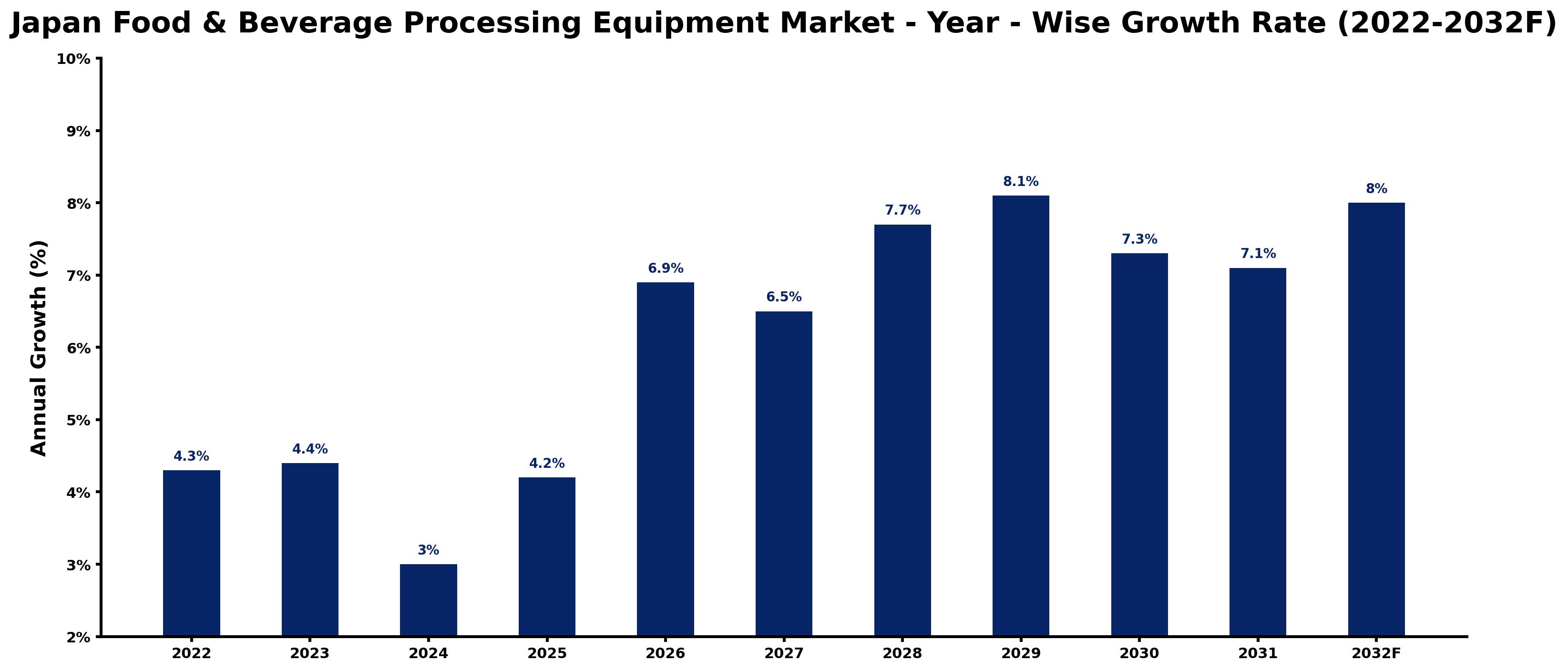
Each row of the following table gives one year's estimated growth and the event or demand shift that explains it.
| Year | Estimated Annual Growth (%) | Market Rationale |
| 2022 | 4.3 | The food processing industry experienced steady demand from various sectors. |
| 2023 | 4.4 | Growth was driven by increased investments in food technology and automation. |
| 2024 | 3.0 | A slowdown in growth occurred due to market saturation in some segments. |
| 2025 | 4.2 | Demand rose again as food manufacturers upgraded their processing equipment. |
| 2026 | 6.9 | The market will see faster growth as automation becomes a priority for producers. |
| 2027 | 6.5 | Growth is projected to slow slightly as manufacturers adjust to new technologies. |
| 2028 | 7.7 | Increased consumer interest in convenience foods will spur demand for processing equipment. |
| 2029 | 8.1 | The market will peak as food safety standards drive equipment upgrades. |
| 2030 | 7.3 | Growth will moderate as manufacturers focus on sustainability and efficiency. |
| 2031 | 7.1 | Continued investments in food processing technology will support steady growth. |
| 2032 | 8.0 | Rising demand for high-quality food products will boost market expansion. |
Note: Market size estimations and growth projections presented in this report are based on 6Wresearch's proprietary forecasting methodology, utilizing the latest available industry data, government publications, and primary research inputs.
Japan Food & Beverage Processing Equipment Market Synopsis
Food & Beverage Processing Equipment includes machinery essential for producing and packaging food and beverages, primarily made from durable materials like stainless steel. The market is valued at approximately 20 trillion JPY, driven by domestic demand from food manufacturers and the beverage industry, alongside a growing focus on automation. Factors such as technological advancements and increased consumer interest in convenience foods are propelling market growth. The food processing industry in Japan is projected to expand steadily, reflecting ongoing investments and innovations in processing technologies.
Market Dynamics Impact Analysis (2026–2032)
| Factor | Type | Impact | Primary Segment Affected |
| Growing demand for automation in food production processes | Driver | High | Automatic |
| Increasing consumer preference for convenience foods | Driver | High | Bakery |
| Expansion of food processing facilities in urban areas | Opportunity | High | Food Manufacturers |
| Investment in food safety technologies and equipment | Opportunity | High | Dairy |
| High costs associated with equipment maintenance and upgrades | Restraint | Medium | Cutting Equipment |
| Limited availability of skilled workforce in food processing | Restraint | Medium | Meat Processing |
| Rising energy costs affecting operational expenses | Challenge | High | Packaging Machines |
| Compliance with stringent food safety regulations | Challenge | High | Blending Equipment |
Evaluation of Drivers in Japan Food & Beverage Processing Equipment Market (2026–2032)
Key forces behind demand, with the segment each one moves most, are listed below.
| Drivers | Primary Segment Affected | Why It Matters (Evidence) |
| Increased investment in automation technologies | Automatic | This trend leads food manufacturers to purchase more automated equipment, improving production efficiency and reducing labor costs. |
| Rising consumer demand for convenience foods | Snacks | As more consumers seek ready-to-eat products, manufacturers invest in advanced processing equipment to meet this demand. |
| Expansion of food processing facilities in urban areas | Food Manufacturers | Urbanisation drives the establishment of new processing plants, increasing the need for processing equipment. |
| Focus on food safety and quality assurance | Dairy | Compliance with food safety standards necessitates investment in advanced processing technologies to ensure product safety. |
| Technological advancements in food processing | Cutting Equipment | Innovations in cutting technologies enable manufacturers to improve product consistency and reduce waste. |
Behind the steady rise in orders sits a growing investment in automation technologies, which is expected to increase efficiency in food production. In 2022, Japan's food processing industry was valued at approximately 20 trillion JPY, prompting manufacturers to adopt advanced equipment. The expansion of food processing facilities in urban areas is leading to heightened demand for processing machinery. The focus on food safety and quality assurance drives investments in processing technologies, ensuring compliance with stringent standards. As consumer demand for convenience foods rises, manufacturers are increasingly investing in equipment to meet evolving preferences.
Evaluation of Restraints in Japan Food & Beverage Processing Equipment Market
Several factors work against faster growth; the main ones are summarised below.
| Market Restraint | Primary Segment Affected | Why It Matters (Evidence) |
| High costs associated with equipment maintenance and upgrades | Cutting Equipment | These costs can deter smaller manufacturers from investing in modern machinery, limiting their operational capacity. |
| Limited availability of skilled workforce in food processing | Meat Processing | The shortage of skilled workers can slow down production rates and affect product quality. |
| Rising energy costs affecting operational expenses | Packaging Machines | Increased energy prices can lead to higher operational costs, impacting profitability for food processors. |
| Compliance with stringent food safety regulations | Blending Equipment | Meeting these regulations requires substantial investments in equipment and training, straining resources for smaller firms. |
| Market saturation in certain segments | Bakery | As competition increases, profit margins may shrink, making it challenging for new entrants. |
Japan Food & Beverage Processing Equipment Market Challenges
In Hokkaido, the dairy processing sector faces intense competition, compelling producers to spend 15% more on blending equipment annually. Japan's ageing population, with 29.3% over 65, results in a declining workforce that delays production timelines for food manufacturers, causing a 20% drop in output capacity. Logistical inefficiencies in Tokyo, which hosts 25% of food manufacturing facilities, lead to supply chain disruptions that extend delivery times by 10%. Rising wages, with the national minimum wage at JPY 1,055 per hour, inflate production costs, squeezing profit margins for small-scale producers.
Trends in the Japan Food & Beverage Processing Equipment Market
The trends below show where the Japan Food & Beverage Processing Equipment Market is heading.
- Shift towards Automation in Food Processing: In Japan, the food processing sector is increasingly adopting automated systems to improve efficiency. In 2023, 36% of food processing operations were fully automated, reflecting a growing trend towards reducing labour dependency.
- Emergence of Sustainable Packaging Solutions: The focus on sustainability is driving the development of eco-friendly packaging solutions in Japan. By 2025, it is projected that 50% of packaging materials used in food processing will be recyclable or biodegradable.
- Growth in Demand for Convenience Foods: Consumer preferences are shifting towards convenience foods, leading to increased production in the bakery segment. In 2022, the bakery sector accounted for 47% of food processing equipment sales, highlighting this trend.
- Expansion of Food Processing Facilities in Urban Areas: Urbanisation is prompting the establishment of new food processing facilities, particularly in Tokyo, which houses 25% of Japan's food manufacturing facilities. This trend is expected to continue as demand for processed foods rises.
Investment Opportunities in the Japan Food & Beverage Processing Equipment Market
Below are the investment opportunities with the strongest case in the Japan Food & Beverage Processing Equipment Market.
- Investment in Automation Technologies: With 20 trillion JPY in the food processing industry, there is an opportunity to supply automation solutions. Food manufacturers in urban areas are increasingly seeking partners for advanced equipment.
- Development of Sustainable Packaging Solutions: As sustainability becomes a priority, the demand for eco-friendly packaging solutions is growing. The beverage industry is looking for suppliers who can provide materials that meet these needs.
- Expansion of Food Safety Technologies: The focus on food safety presents an opportunity to supply advanced processing equipment. The dairy sector is particularly interested in technologies that comply with ISO 22000 standards.
- Growth of Snack Food Production: With the Snack Food Association promoting innovation, there is a gap in supplying advanced processing equipment for snack production. This sector is expanding rapidly, creating opportunities for new suppliers.
Government Initiatives in the Japan Food & Beverage Processing Equipment Market
The Food Sanitation Act amendment introduced in 2018 mandates HACCP-based hygiene management for food businesses, improving food safety standards. This law requires producers to implement rigorous hygiene protocols, ensuring consumer safety and confidence in food products.
In 2022, the Ministry of Agriculture, Forestry and Fisheries allocated 5 billion JPY to support food tech startups through subsidies. This initiative aims to promote innovation in the food processing sector, overseen by the Ministry of Agriculture, Forestry and Fisheries.
Future Insight of the Japan Food & Beverage Processing Equipment Market
Producers in the food processing sector will undergo notable transformations by 2032, as technology adoption enhances efficiency and minimises waste. The integration of ISO 22000 standards will improve food safety management, ensuring higher quality for consumers. Support for food tech startups in Tokyo will drive innovation in processing methods, leading to a wider range of products. By 2025, the food processing equipment market is expected to grow steadily, with a projected increase of 10% in sustainable equipment adoption, appealing to environmentally conscious buyers.
Market Segmentation Analysis
Japan Food & Beverage Processing Equipment Market report covers a detailed analysis of the following market segments:
By Equipment Type – Mixing Equipment Leads, Cutting Equipment Expected to Grow Fastest
According to Summon Dutta, Assistant Manager at 6Wresearch, Mixing Equipment held 47% of the Japan Food & Beverage Processing Equipment Market by equipment type in 2025. Mixing equipment holds the largest share because it is essential for combining ingredients in food production, particularly in facilities throughout Japan. Its widespread application in Tokyo's food manufacturing sector highlights its critical role in the industry. Cutting Equipment is projected to grow fastest, at a CAGR of 10.3% during 2026–2032. Cutting equipment is experiencing rapid growth as it becomes increasingly vital for portioning and preparing raw materials, especially in the meat processing sector. The rising demand for efficiency and precision in meat preparation is driving this segment's expansion. Suppliers should focus on enhancing their cutting equipment offerings to meet the increasing market demand.
By Application – Bakery Leads, Meat Processing Expected to Grow Fastest
Bakery accounted for 47% of the market by application in 2025. The bakery segment leads the market as it is crucial for producing a variety of baked goods, which are staples in Japanese cuisine. The steady demand for bread and pastries ensures that bakery applications remain dominant in the food processing sector. Over 2026–2032, Meat Processing is expected to post the fastest growth, at a CAGR of 9.9%. Meat processing is the fastest-growing application, fuelled by the rising consumption of meat products, which reached 1.2 million tons in 2022. This trend reflects a shift towards more advanced processing techniques within the meat sector. Buyers in the meat processing industry should invest in modern equipment to keep pace with the rapid market growth.
By Operation Mode – Automatic Leads, Semi-Automatic Expected to Grow Fastest
The largest operation mode category in 2025 was Automatic, at 36% of revenue. Automatic operation mode holds the largest share as it is increasingly favoured for its efficiency in production processes across various food sectors. The drive for higher productivity in facilities, particularly in Tokyo, reinforces the prevalence of automatic systems. The quickest growth will come from Semi-Automatic, forecast to expand at a CAGR of 10.1% between 2026 and 2032. Semi-automatic systems are experiencing rapid growth as they provide flexibility for smaller operations, enabling them to adapt to changing production needs. This adaptability is becoming increasingly important as consumer preferences evolve. Suppliers should consider developing semi-automatic solutions to cater to smaller operations seeking greater flexibility.
By Material – Stainless Steel Leads, Aluminum Expected to Grow Fastest
In 2025, Stainless Steel led the material split with a 49% share. Stainless steel is the leading material due to its preferred characteristics of hygiene and durability, which are essential for food processing equipment. Its extensive use across Japan's facilities underscores its importance in maintaining food safety standards. Aluminum is set to record the highest CAGR in this split, 10.8% over 2026–2032. Aluminum is witnessing the fastest growth as it is increasingly used in specific applications where lightweight materials are advantageous. This trend is particularly relevant in sectors where operational efficiency is crucial. Manufacturers should explore aluminium options to meet the rising demand for lightweight processing equipment.
By End User – Food Manufacturers Lead, Beverage Industry Expected to Grow Fastest
Food Manufacturers took 39% of end user revenue in 2025, more than any other category. Food manufacturers represent the largest user group of processing equipment, as they are the primary producers of various food products in Japan. Their extensive operations require a wide range of processing machinery to satisfy consumer demand. Beverage Industry is projected to grow fastest, at a CAGR of 9.5% during 2026–2032. The beverage industry is the fastest-growing end user, driven by an increase in demand for diverse beverage options. This growth indicates a pressing need for specialised machinery tailored to beverage production. Suppliers should tailor their offerings to address the specific requirements of the expanding beverage sector.
Key Attractiveness of the Report
- 10 Years of Market Numbers
- Historical Data Starting from 2022 to 2025
- Base Year 2025
- Forecast Data until 2032
- Key Performance Indicators Impacting the Market
- Major Upcoming Developments and Projects
Key Highlights of the Report:
- Japan Food & Beverage Processing Equipment Market Outlook
- Market Size of Japan Food & Beverage Processing Equipment Market,2025
- Forecast of Japan Food & Beverage Processing Equipment Market, 2032
- Historical Data and Forecast of Japan Food & Beverage Processing Equipment Revenues & Volume for the Period 2022-2032
- Japan Food & Beverage Processing Equipment Market Trend Evolution
- Japan Food & Beverage Processing Equipment Market Drivers and Challenges
- Japan Food & Beverage Processing Equipment Price Trends
- Japan Food & Beverage Processing Equipment Porter's Five Forces
- Japan Food & Beverage Processing Equipment Industry Life Cycle
- Historical Data and Forecast of Japan Food & Beverage Processing Equipment Market Revenues & Volume By Equipment Type for the Period 2022-2032
- Historical Data and Forecast of Japan Food & Beverage Processing Equipment Market Revenues & Volume By Mixing Equipment for the Period 2022-2032
- Historical Data and Forecast of Japan Food & Beverage Processing Equipment Market Revenues & Volume By Cutting Equipment for the Period 2022-2032
- Historical Data and Forecast of Japan Food & Beverage Processing Equipment Market Revenues & Volume By Blending Equipment for the Period 2022-2032
- Historical Data and Forecast of Japan Food & Beverage Processing Equipment Market Revenues & Volume By Packaging Machines for the Period 2022-2032
- Historical Data and Forecast of Japan Food & Beverage Processing Equipment Market Revenues & Volume By Application for the Period 2022-2032
- Historical Data and Forecast of Japan Food & Beverage Processing Equipment Market Revenues & Volume By Bakery for the Period 2022-2032
- Historical Data and Forecast of Japan Food & Beverage Processing Equipment Market Revenues & Volume By Meat Processing for the Period 2022-2032
- Historical Data and Forecast of Japan Food & Beverage Processing Equipment Market Revenues & Volume By Dairy for the Period 2022-2032
- Historical Data and Forecast of Japan Food & Beverage Processing Equipment Market Revenues & Volume By Snacks for the Period 2022-2032
- Historical Data and Forecast of Japan Food & Beverage Processing Equipment Market Revenues & Volume By Operation Mode for the Period 2022-2032
- Historical Data and Forecast of Japan Food & Beverage Processing Equipment Market Revenues & Volume By Automatic for the Period 2022-2032
- Historical Data and Forecast of Japan Food & Beverage Processing Equipment Market Revenues & Volume By Semi-Automatic for the Period 2022-2032
- Historical Data and Forecast of Japan Food & Beverage Processing Equipment Market Revenues & Volume By Manual for the Period 2022-2032
- Historical Data and Forecast of Japan Food & Beverage Processing Equipment Market Revenues & Volume By Fully Automatic for the Period 2022-2032
- Historical Data and Forecast of Japan Food & Beverage Processing Equipment Market Revenues & Volume By Material for the Period 2022-2032
- Historical Data and Forecast of Japan Food & Beverage Processing Equipment Market Revenues & Volume By Stainless Steel for the Period 2022-2032
- Historical Data and Forecast of Japan Food & Beverage Processing Equipment Market Revenues & Volume By Aluminum for the Period 2022-2032
- Historical Data and Forecast of Japan Food & Beverage Processing Equipment Market Revenues & Volume By Plastic for the Period 2022-2032
- Historical Data and Forecast of Japan Food & Beverage Processing Equipment Market Revenues & Volume By Carbon Steel for the Period 2022-2032
- Historical Data and Forecast of Japan Food & Beverage Processing Equipment Market Revenues & Volume By End User for the Period 2022-2032
- Historical Data and Forecast of Japan Food & Beverage Processing Equipment Market Revenues & Volume By Food Manufacturers for the Period 2022-2032
- Historical Data and Forecast of Japan Food & Beverage Processing Equipment Market Revenues & Volume By Beverage Industry for the Period 2022-2032
- Historical Data and Forecast of Japan Food & Beverage Processing Equipment Market Revenues & Volume By Commercial Kitchens for the Period 2022-2032
- Historical Data and Forecast of Japan Food & Beverage Processing Equipment Market Revenues & Volume By Industrial Use for the Period 2022-2032
- Japan Food & Beverage Processing Equipment Import Export Trade Statistics
- Market Opportunity Assessment By Equipment Type
- Market Opportunity Assessment By Application
- Market Opportunity Assessment By Operation Mode
- Market Opportunity Assessment By Material
- Market Opportunity Assessment By End User
- Japan Food & Beverage Processing Equipment Top Companies Market Share
- Japan Food & Beverage Processing Equipment Competitive Benchmarking By Technical and Operational Parameters
- Japan Food & Beverage Processing Equipment Company Profiles
- Japan Food & Beverage Processing Equipment Key Strategic Recommendations
Market Covered
Coverage by segment is as follows.
By Equipment Type
- Mixing Equipment
- Cutting Equipment
- Blending Equipment
- Packaging Machines
By Application
- Bakery
- Meat Processing
- Dairy
- Snacks
By Operation Mode
- Automatic
- Semi-Automatic
- Manual
- Fully Automatic
By Material
- Stainless Steel
- Aluminum
- Plastic
- Carbon Steel
By End User
- Food Manufacturers
- Beverage Industry
- Commercial Kitchens
- Industrial Use































