Japan Food Industry Market Size & Growth Rate
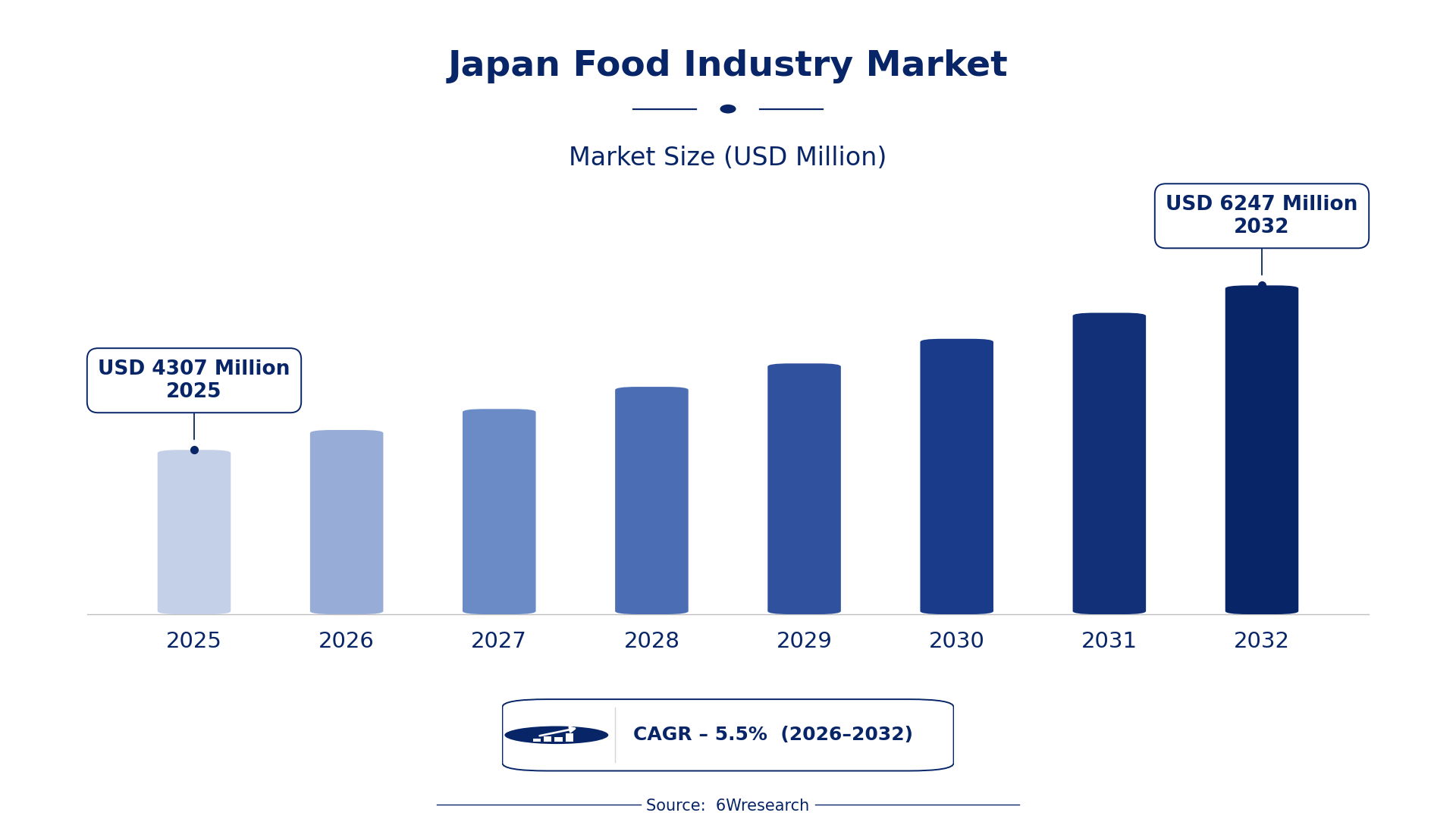
According to 6Wresearch internal database and industry insights, the Japan Food Industry Market was valued at USD 4,307 Million in 2025 and is projected to reach USD 6,247 Million by 2032, growing at a CAGR of approximately 5.5% during 2026–2032.
Japan Food Industry Market Highlights
| Report Metric | Details |
| Report Name | Japan Food Industry Market (2026-2032) |
| Market Size 2025 | USD 4,307 Million |
| Market Size 2032 | USD 6,247 Million |
| Absolute Growth 2025–2032 | USD 1,940 Million |
| CAGR 2026–2032 | 5.5% |
| Peak Annual Growth | 6.3% in 2028 |
| Forecast Period | 2026–2032 |
| Historical Data | 2022–2025 |
| Base Year | 2025 |
| Leading Segment, 2025 | Frozen & Refrigerated (45% share) |
| Leading Channel, 2025 | Retail & e-commerce (42% share) |
| Leading Distribution Channel, 2025 | Retail Chains (45% share) |
| Leading End User, 2025 | Supermarkets & Consumers (41% share) |
| Fastest-Growing Segment | Processed Meats (7.4% CAGR) |
| Fastest-Growing Channel | Cold Chain Logistics (7.2% CAGR) |
| Fastest-Growing Distribution Channel | Wholesalers (6.9% CAGR) |
| Fastest-Growing End User | Foodservice & Catering (7.5% CAGR) |
| Growing Sector | Foodservice |
| Key End Users | Supermarkets, Foodservice Providers, Consumers |
Japan Food Industry Market Year-wise Growth Rate and Key Drivers (2022–2032)
This graph illustrates the annual growth rates of the market from 2022 to 2032, highlighting a steady upward trajectory and projected market expansion over the forecast period.
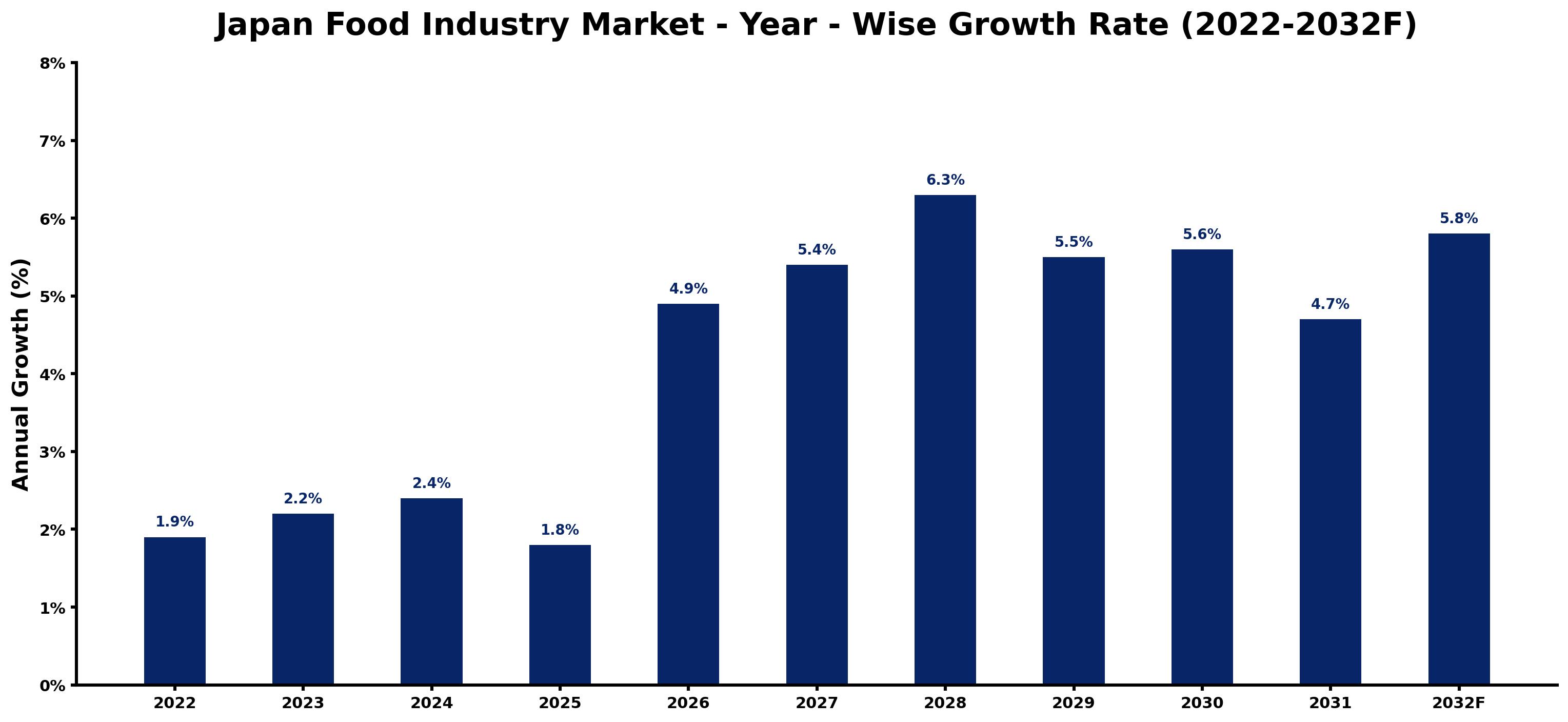
The following figures match every annual growth estimate with the main market development of that year, giving the reasoning behind each rise or slowdown.
| Year | Estimated Annual Growth (%) | Market Rationale |
| 2022 | 1.9 | The market showed steady growth, reflecting ongoing consumer demand for food products. |
| 2023 | 2.2 | Growth accelerated as consumer preferences shifted towards convenience foods and ready-to-eat meals. |
| 2024 | 2.4 | The market continued to expand with increased processed meat consumption and frozen food popularity. |
| 2025 | 1.8 | Growth slowed slightly due to market saturation in certain segments and changing consumer habits. |
| 2026 | 4.9 | The market is expected to rebound with rising demand for diverse food options and efficient distribution. |
| 2027 | 5.4 | Growth will continue as foodservice establishments increase their offerings and expand operations. |
| 2028 | 6.3 | The market is projected to peak with heightened consumer interest in quality standards and variety. |
| 2029 | 5.5 | Growth will slow as competition intensifies among food producers and retailers. |
| 2030 | 5.6 | Demand is expected to increase again with a focus on sustainability and local food sourcing initiatives. |
| 2031 | 4.7 | Growth will moderate as the market adjusts to evolving consumer preferences and economic conditions. |
| 2032 | 5.8 | The market is set to grow with continued investment in food technology and safety standards. |
Note: Market size estimations and growth projections presented in this report are based on 6Wresearch's proprietary forecasting methodology, utilizing the latest available industry data, government publications, and primary research inputs.
Japan Food Industry Market Synopsis
The food industry in Japan encompasses various sectors including frozen foods, processed meats, confectionery, and dairy products. With a population of approximately 126 million, the demand for food products remains strong, particularly in the frozen food market, valued at over 1 trillion JPY. Factors driving growth include the rise in processed meat consumption, the increasing focus on food safety, and the expansion of foodservice establishments. These elements influence purchasing across both retail and foodservice channels.
Market Dynamics Impact Analysis (2026–2032)
| Factor | Type | Impact | Primary Segment Affected |
| Increasing demand for frozen foods due to convenience and preservation needs | Driver | High | Frozen & Refrigerated |
| Rising consumption of processed meats driven by culinary trends | Driver | High | Processed Meats |
| Growing interest in sustainable food practices creates opportunities for local producers | Opportunity | High | Dairy & Beverages |
| Expansion of foodservice establishments offers new market avenues for suppliers | Opportunity | High | Foodservice & Catering |
| Strict food safety regulations increase compliance costs for producers | Restraint | Medium | General Retail |
| Saturation in certain food segments limits growth potential for new entrants | Restraint | Medium | Retail Chains |
| High competition among food producers pressures pricing strategies | Challenge | High | Processed Meats |
| Evolving consumer preferences require constant innovation in product offerings | Challenge | Medium | Confectionery |
Evaluation of Drivers in Japan Food Industry Market (2026–2032)
The factors lifting demand, and the evidence behind each, are summarised below.
| Drivers | Primary Segment Affected | Why It Matters (Evidence) |
| Rising demand for convenience foods among busy consumers | Frozen & Refrigerated | In 2023, the frozen food market was valued at over 1 trillion JPY, prompting retailers to stock more options. |
| Increased popularity of ready-to-eat meals in urban areas | Processed Meats | Processed meat consumption in Japan is around 5 million tons annually, driving demand for diverse products. |
| Growing focus on food safety and quality standards | Dairy & Beverages | The dairy industry adheres to JIS standards, ensuring safety and quality, which attracts health-conscious consumers. |
| Expansion of foodservice channels to meet dining demands | Foodservice & Catering | The foodservice sector is projected to grow with an increasing number of dining establishments. |
| Investment in cold chain logistics to maintain product integrity | Cold Chain Logistics | Over 70% of perishable goods in Japan are transported under temperature control, improving supply chain efficiency. |
A wider customer base explains much of the growth, as the frozen food market in Japan is valued at over 1 trillion JPY, prompting retailers to expand their offerings. The processed meat sector sees around 5 million tons consumed annually, driven by culinary trends that favour convenience. The dairy industry adheres to JIS standards, attracting health-conscious consumers seeking quality. The foodservice sector is expected to grow, with more dining establishments emerging to meet diverse consumer preferences. Investment in logistics ensures that over 70% of perishable goods maintain their integrity during transport, further boosting demand.
Evaluation of Restraints in Japan Food Industry Market
These are the pressures that could keep growth below its potential.
| Market Restraint | Primary Segment Affected | Why It Matters (Evidence) |
| Compliance with strict food safety regulations raises operational costs | General Retail | Japan's food safety laws require investments in quality control, impacting profit margins for producers. |
| Market saturation in certain segments limits new product introductions | Retail Chains | With many established brands, new entrants face challenges in gaining shelf space and consumer attention. |
| High competition among food producers pressures pricing strategies | Processed Meats | Intense rivalry leads to price wars, affecting profitability for smaller producers. |
| Changing consumer preferences necessitate constant product innovation | Confectionery | Failure to adapt to trends can result in lost market share to more agile competitors. |
| Economic fluctuations can impact consumer spending on premium food products | Dairy & Beverages | In times of economic uncertainty, consumers may opt for cheaper alternatives, affecting sales. |
Japan Food Industry Market Challenges
In Japan, over 70% of perishable goods require temperature-controlled transport, creating supply chain challenges for producers who face higher operational costs. This inefficiency leads buyers to pay up to 15% more for food products, straining household budgets. Strict food safety regulations necessitate compliance with JIS standards, causing delays that can extend delivery times for producers by several weeks, impacting restaurants and retailers. Rising minimum wages, now at JPY 1,055 per hour, compel producers to raise prices, which may discourage price-sensitive consumers from purchasing premium items.
Trends in the Japan Food Industry Market
These developments are changing demand patterns in the Japan Food Industry Market.
- Shift towards Sustainable Food Practices: Food producers are increasingly adopting sustainable practices, as seen in the Japanese government's program to reduce food waste by 50% by 2030. This initiative encourages local sourcing and waste reduction, appealing to environmentally conscious consumers.
- Growing Demand for Ready-to-Eat Meals: The trend towards convenience has led to an increase in ready-to-eat meal options, particularly in urban areas. In 2023, processed meat consumption reached around 5 million tons, reflecting this shift in consumer behaviour.
- Expansion of Cold Chain Logistics: Cold chain logistics is becoming essential for food distribution, with over 70% of perishable goods transported under temperature control. This trend is particularly evident in major regions like Tokyo and Osaka, improving product integrity.
- Increase in Foodservice Establishments: The number of dining establishments in Japan is on the rise, reflecting changing consumer preferences. The foodservice sector is set to grow as more consumers seek diverse dining experiences.
Investment Opportunities in the Japan Food Industry Market
The openings below show where demand in the Japan Food Industry Market is visible and how suppliers can enter.
- Investment in Cold Chain Facilities: With over 70% of perishable goods requiring temperature control, there is an opportunity to invest in cold chain logistics facilities. This is particularly relevant in regions like Tokyo, where demand for efficient distribution is high.
- Supply of Sustainable Food Products: The Japanese government's program to reduce food waste creates opportunities for suppliers of sustainable food products. This is an ideal time for local producers to partner with retailers to meet growing consumer demand.
- Development of Ready-to-Eat Meal Solutions: The increasing demand for convenience foods presents an opportunity to develop ready-to-eat meal solutions. Collaborating with foodservice providers can broaden market reach and consumer access.
- Expansion into Foodservice Sector: With the foodservice sector expected to grow, there is a chance to supply innovative food products. Engaging with local dining establishments can facilitate market entry and establish strong partnerships.
Government Initiatives in the Japan Food Industry Market
The Food Recycling Law, enacted in 2000, mandates food businesses to reduce waste and recycle it into feed, fertiliser, and energy. This law has encouraged producers to adopt more sustainable practices and lessen their environmental impact. The Food Sanitation Act amendment in 2018 introduced a system for regulating synthetic resins used in food packaging, improving safety standards for consumers.
The Ministry of Health, Labour and Welfare oversees the implementation of food safety regulations, including the HACCP-based hygiene management system. This agency funds training programs for food businesses to comply with safety standards, ensuring that products meet consumer expectations for quality and safety.
Future Insight of the Japan Food Industry Market
The introduction of advanced food preservation facilities by 2032 will reduce waste and extend product shelf life. Enhanced logistics systems will improve the efficiency of transporting perishable goods, benefiting both suppliers and buyers. The implementation of ISO 22000 standards will elevate food safety, ensuring that higher quality products reach consumers. As the foodservice sector expands, a growing number of dining establishments will create opportunities for suppliers to meet diverse culinary preferences.
Market Segmentation Analysis
Japan Food Industry Market report covers a detailed analysis of the following market segments:
By Segment – Frozen & Refrigerated Leads, Processed Meats Expected to Grow Fastest
According to Uttkarsh, Research Associate at 6Wresearch, Frozen & Refrigerated accounted for 45% of the market by segment in 2025. The frozen and refrigerated food segment holds the largest share due to its essential role in preserving food quality and safety. This is highlighted by the significant value of the frozen food market in Japan, which exceeds 1 trillion JPY, showcasing robust consumer demand. Processed Meats are set to record the highest CAGR in this split, 7.4% over 2026–2032. Processed meats are experiencing rapid growth driven by their versatility in culinary applications, with annual consumption reaching approximately 5 million tons. This trend towards convenience indicates that the lead of frozen and refrigerated foods will continue to widen as consumer preferences evolve. Suppliers should focus on expanding their frozen and refrigerated product offerings to meet increasing consumer demands.
By Channel – Retail & e-commerce Leads, Cold Chain Logistics Expected to Grow Fastest
Retail & e-commerce took 42% of channel revenue in 2025, more than any other category. Retail and e-commerce dominate the channel segment as they provide critical access to food products for consumers across Japan. The rise of online shopping has further solidified this segment's position, catering to the needs of a large population. The quickest growth will come from Cold Chain Logistics, forecast to expand at a CAGR of 7.2% between 2026 and 2032. Cold chain logistics is the fastest-growing channel, driven by the necessity to maintain product integrity during transport, especially for perishable goods. As over 70% of perishable items require temperature control, this growth reflects the increasing emphasis on food safety and quality. Suppliers must invest in cold chain capabilities to ensure product quality and meet consumer expectations.
By Distribution Channel – Retail Chains Lead, Wholesalers Expected to Grow Fastest
Retail Chains held 45% of the Japan Food Industry Market by distribution channel in 2025. Retail chains lead the distribution channel due to their role as primary outlets for consumer purchases, providing a wide range of food products. Their strong presence in major urban areas like Tokyo and Osaka ensures consistent access to consumers. Wholesalers are projected to grow fastest, at a CAGR of 6.9% during 2026–2032. Wholesalers are the fastest-growing distribution channel, playing a crucial role in efficient bulk distribution to retailers. The rising demand for streamlined supply chains is driving this growth, allowing retailers to offer a broader selection of products. Suppliers must strengthen their partnerships with wholesalers to enhance distribution efficiency.
By End User – Supermarkets & Consumers Lead, Foodservice & Catering Expected to Grow Fastest
In 2025, Supermarkets & Consumers led the end user split with a 41% share. Supermarkets and consumers represent the largest end-user group, acting as key purchasers of food products in Japan. This is underscored by the large population and significant consumer spending on food items. Over 2026–2032, Foodservice & Catering is expected to post the fastest growth, at a CAGR of 7.5%. Foodservice and catering are the fastest-growing end-user segments, vital for meal preparation and service in a rapidly expanding dining market. The projected increase in dining establishments suggests a shift towards more diverse food offerings. Suppliers should tailor their products to meet the specific needs of the foodservice sector.
Key Attractiveness of the Report
- 10 Years of Market Numbers
- Historical Data Starting from 2022 to 2025
- Base Year 2025
- Forecast Data until 2032
- Key Performance Indicators Impacting the Market
- Major Upcoming Developments and Projects
Key Highlights of the Report:
- Japan Food Industry Market Outlook
- Market Size of Japan Food Industry Market, 2025
- Forecast of Japan Food Industry Market, 2032
- Historical Data and Forecast of Japan Food Industry Revenues & Volume for the Period 2022-2032F
- Japan Food Industry Market Trend Evolution
- Japan Food Industry Market Drivers and Challenges
- Japan Food Industry Price Trends
- Japan Food Industry Porter's Five Forces
- Japan Food Industry Industry Life Cycle
- Historical Data and Forecast of Japan Food Industry Market Revenues & Volume By Segment for the Period 2022-2032F
- Historical Data and Forecast of Japan Food Industry Market Revenues & Volume By Frozen & Refrigerated for the Period 2022-2032F
- Historical Data and Forecast of Japan Food Industry Market Revenues & Volume By Processed Meats for the Period 2022-2032F
- Historical Data and Forecast of Japan Food Industry Market Revenues & Volume By Confectionery for the Period 2022-2032F
- Historical Data and Forecast of Japan Food Industry Market Revenues & Volume By Dairy & Beverages for the Period 2022-2032F
- Historical Data and Forecast of Japan Food Industry Market Revenues & Volume By Channel for the Period 2022-2032F
- Historical Data and Forecast of Japan Food Industry Market Revenues & Volume By Retail & e-commerce for the Period 2022-2032F
- Historical Data and Forecast of Japan Food Industry Market Revenues & Volume By Cold Chain Logistics for the Period 2022-2032F
- Historical Data and Forecast of Japan Food Industry Market Revenues & Volume By General Retail for the Period 2022-2032F
- Historical Data and Forecast of Japan Food Industry Market Revenues & Volume By Modern Trade for the Period 2022-2032F
- Historical Data and Forecast of Japan Food Industry Market Revenues & Volume By Distribution Channel for the Period 2022-2032F
- Historical Data and Forecast of Japan Food Industry Market Revenues & Volume By Retail Chains for the Period 2022-2032F
- Historical Data and Forecast of Japan Food Industry Market Revenues & Volume By Wholesalers for the Period 2022-2032F
- Historical Data and Forecast of Japan Food Industry Market Revenues & Volume By OEMs for the Period 2022-2032F
- Historical Data and Forecast of Japan Food Industry Market Revenues & Volume By Direct Sales for the Period 2022-2032F
- Historical Data and Forecast of Japan Food Industry Market Revenues & Volume By End User for the Period 2022-2032F
- Historical Data and Forecast of Japan Food Industry Market Revenues & Volume By Supermarkets & Consumers for the Period 2022-2032F
- Historical Data and Forecast of Japan Food Industry Market Revenues & Volume By Foodservice & Catering for the Period 2022-2032F
- Historical Data and Forecast of Japan Food Industry Market Revenues & Volume By End Consumers for the Period 2022-2032F
- Historical Data and Forecast of Japan Food Industry Market Revenues & Volume By Food & Beverage Companies for the Period 2022-2032F
- Japan Food Industry Import Export Trade Statistics
- Market Opportunity Assessment By Segment
- Market Opportunity Assessment By Channel
- Market Opportunity Assessment By Distribution Channel
- Market Opportunity Assessment By End User
- Japan Food Industry Top Companies Market Share
- Japan Food Industry Competitive Benchmarking By Technical and Operational Parameters
- Japan Food Industry Company Profiles
- Japan Food Industry Key Strategic Recommendations
Market Covered
The following segment groups are covered in the report.
By Segment
- Frozen & Refrigerated
- Processed Meats
- Confectionery
- Dairy & Beverages
By Channel
- Retail & e-commerce
- Cold Chain Logistics
- General Retail
- Modern Trade
By Distribution Channel
- Retail Chains
- Wholesalers
- OEMs
- Direct Sales
By End User
- Supermarkets & Consumers
- Foodservice & Catering
- End Consumers
- Food & Beverage Companies































