Japan Food Service Restaurant Market Size & Growth Rate
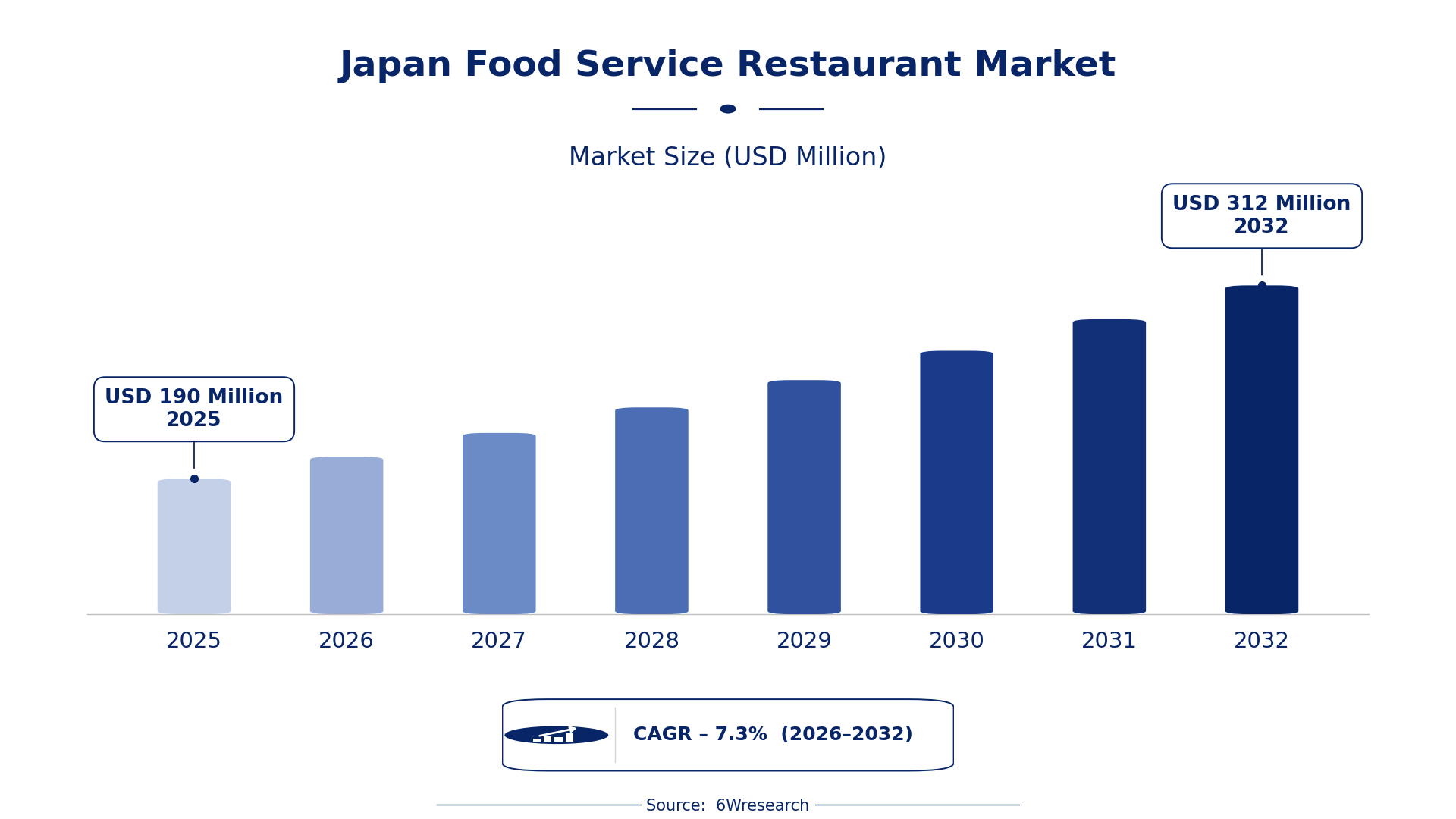
According to 6Wresearch internal database and industry insights, the Japan Food Service Restaurant Market was valued at USD 190 Million in 2025 and is projected to reach USD 312 Million by 2032, growing at a CAGR of approximately 7.3% during 2026–2032.
Japan Food Service Restaurant Market Highlights
| Report Metric | Details |
| Report Name | Japan Food Service Restaurant Market (2026-2032) |
| Market Size 2025 | USD 190 Million |
| Market Size 2032 | USD 312 Million |
| Absolute Growth 2025–2032 | USD 122 Million |
| CAGR 2026–2032 | 7.3% |
| Peak Annual Growth | 8.6% in 2026 |
| Forecast Period | 2026–2032 |
| Historical Data | 2022–2025 |
| Base Year | 2025 |
| Leading Restaurant Type, 2025 | Fast Food (44% share) |
| Leading Service Type, 2025 | Dine-In (41% share) |
| Leading Cuisine Type, 2025 | Continental (40% share) |
| Leading Pricing Model, 2025 | Premium (44% share) |
| Leading Ownership Type, 2025 | Independent (46% share) |
| Fastest-Growing Restaurant Type | Casual Dining (10.0% CAGR) |
| Fastest-Growing Service Type | Takeout (9.5% CAGR) |
| Fastest-Growing Cuisine Type | Asian (10.5% CAGR) |
| Fastest-Growing Pricing Model | Mid-Range (9.1% CAGR) |
| Fastest-Growing Ownership Type | Chain-Owned (8.9% CAGR) |
| Growing Sector | Dine-In services |
| Key End Users | Consumers, tourists, event planners, corporate clients |
Japan Food Service Restaurant Market Year-wise Growth Rate and Key Drivers (2022–2032)
This graph illustrates the annual growth rates of the market from 2022 to 2032, highlighting a steady upward trajectory and projected market expansion over the forecast period.
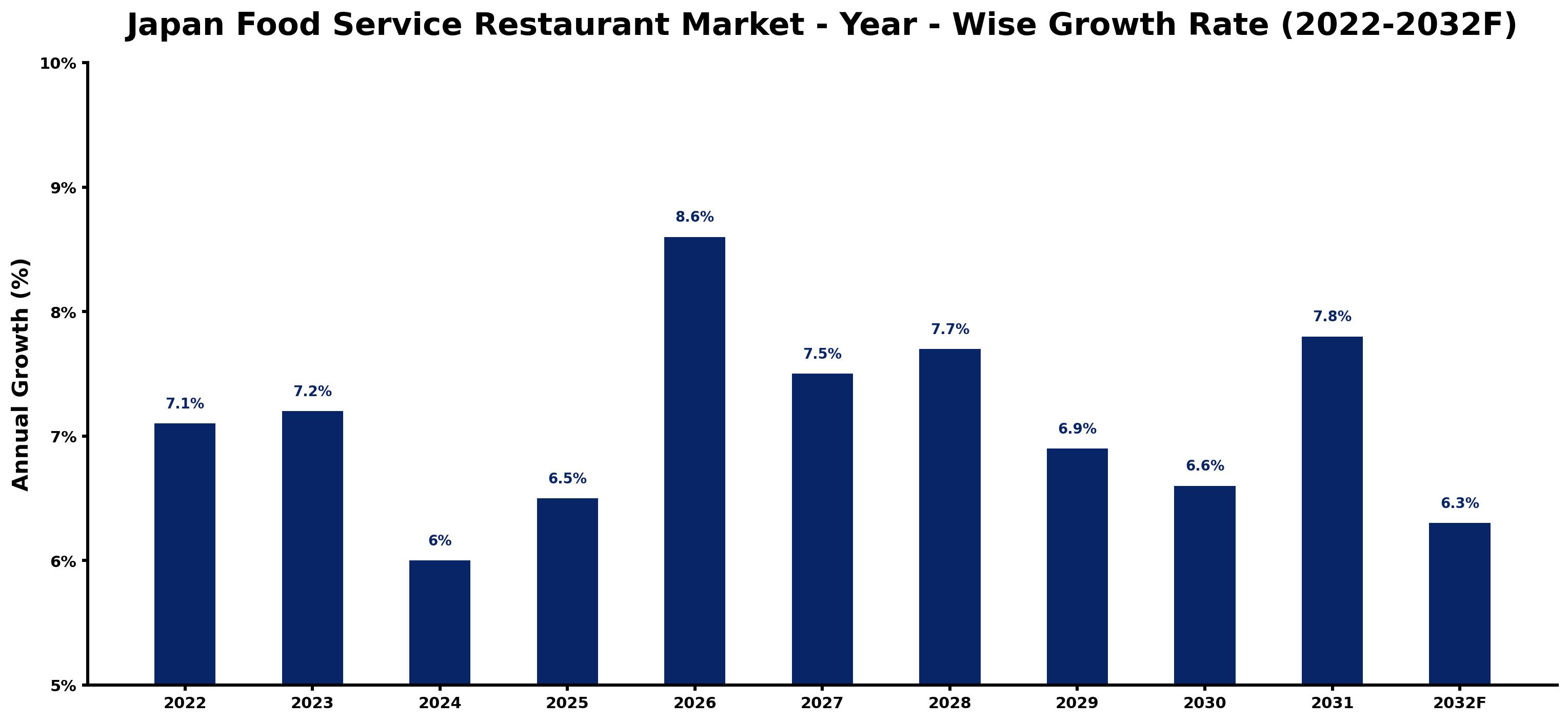
Each row of the following table gives one year's estimated growth and the event or demand shift that explains it.
| Year | Estimated Annual Growth (%) | Market Rationale |
| 2022 | 7.1 | Consumer spending on dining out remained strong, reflecting ongoing recovery from previous challenges. |
| 2023 | 7.2 | Increased restaurant openings contributed to a faster growth rate compared to 2022. |
| 2024 | 6.0 | Growth slowed as inflation impacted household spending on dining options. |
| 2025 | 6.5 | A resurgence in tourism boosted demand for dining experiences, leading to faster growth. |
| 2026 | 8.6 | Peak growth is anticipated as rising disposable incomes and consumer confidence drive spending. |
| 2027 | 7.5 | Growth is projected to slow slightly as inflationary pressures begin to affect consumer choices. |
| 2028 | 7.7 | A rebound in tourism and local events is expected to increase dining out frequency, boosting growth. |
| 2029 | 6.9 | Growth is anticipated to slow again as consumer spending faces new economic challenges. |
| 2030 | 6.6 | Economic uncertainties will lead to cautious spending, resulting in slower growth. |
| 2031 | 7.8 | A renewed interest in dining experiences is projected to drive faster growth as restrictions ease. |
| 2032 | 6.3 | Growth is expected to slow as market saturation begins to limit new restaurant openings. |
Note: Market size estimations and growth projections presented in this report are based on 6Wresearch's proprietary forecasting methodology, utilizing the latest available industry data, government publications, and primary research inputs.
Japan Food Service Restaurant Market Synopsis
The Food Service Restaurant in Japan includes establishments that prepare and serve food and beverages, ranging from fast food to fine dining. The market is expanding, driven by increased consumer spending, a growing tourism sector, and a focus on local culinary experiences. Valued at approximately 17 trillion yen in 2022, the restaurant industry saw a 5% increase in openings in 2023, reflecting a vibrant market. Initiatives promoting local food sourcing are attracting diners, catering to evolving consumer preferences.
Market Dynamics Impact Analysis (2026–2032)
| Factor | Type | Impact | Primary Segment Affected |
| Rising disposable incomes are encouraging consumers to dine out more frequently. | Driver | High | Dine-In |
| The growth of the tourism sector is increasing demand for diverse dining options. | Driver | High | Casual Dining |
| The trend towards eco-friendly dining practices presents opportunities for sustainable restaurants. | Opportunity | High | Fine Dining |
| The increasing popularity of takeout services creates new market entry points for restaurants. | Opportunity | High | Takeout |
| Inflationary pressures are impacting consumer spending on dining out. | Restraint | High | Casual Dining |
| Labor shortages in the hospitality sector are limiting restaurant operations. | Restraint | Medium | Fast Food |
| Competition among restaurants is intensifying, affecting profit margins. | Challenge | High | Dine-In |
| Changing consumer preferences towards health-conscious options are challenging traditional menus. | Challenge | Medium | Fine Dining |
Evaluation of Drivers in Japan Food Service Restaurant Market (2026–2032)
Key forces behind demand, with the segment each one moves most, are listed below.
| Drivers | Primary Segment Affected | Why It Matters (Evidence) |
| Rising disposable incomes are leading to increased spending on dining out. | Dine-In | Households are spending an average of 40,000 yen monthly on dining out, driving demand for restaurants. |
| The resurgence of tourism is boosting demand for diverse dining experiences. | Casual Dining | Tokyo, with over 160,000 restaurants, attracts tourists seeking varied culinary options. |
| Growing interest in local cuisine is shaping restaurant offerings. | Local Cuisine | Local cuisine accounts for 60% of menu offerings, appealing to both locals and tourists. |
| The rise of delivery services is transforming consumer dining habits. | Delivery | The average wait time for delivery services in urban areas is around 30 minutes, increasing convenience. |
| Health-conscious dining trends are influencing menu changes. | Fine Dining | 25% of restaurants are now offering vegan options, catering to health-conscious consumers. |
Purchasing is picking up as disposable incomes rise, unlocking increased spending on dining out. Households are now spending an average of 40,000 yen monthly, driving demand for various restaurant types. The tourism sector is rebounding, with Tokyo attracting millions of visitors and further boosting casual dining establishments. The trend towards local cuisine is strong, with 60% of menu offerings reflecting regional tastes. The average wait time for delivery services is around 30 minutes, increasing convenience for consumers.
Evaluation of Restraints in Japan Food Service Restaurant Market
The key brakes on demand, and where they bite hardest, are shown below.
| Market Restraint | Primary Segment Affected | Why It Matters (Evidence) |
| Inflation is impacting consumer spending power, affecting dining choices. | Casual Dining | As inflation rises, consumers are reducing discretionary spending, with an average household expenditure of 40,000 yen monthly on dining. |
| Labor shortages are hindering restaurant operations and service quality. | Fast Food | The average age of restaurant owners is 50 years, contributing to workforce challenges. |
| Intense competition is squeezing profit margins for many establishments. | Dine-In | With over 160,000 restaurants in Tokyo, price competition is fierce. |
| Changing consumer preferences are pushing traditional restaurants to adapt. | Fine Dining | Restaurants must innovate to meet the growing demand for health-conscious options, with 25% offering vegan choices. |
| Regulatory compliance costs are rising for food safety standards. | Delivery | Food safety regulations enforced by the Ministry of Health, Labour and Welfare add operational costs. |
Japan Food Service Restaurant Market Challenges
Buyers face rising menu prices as Japan's national minimum wage increased to JPY 1,055 per hour in October 2024, reducing dining affordability. Regulatory hurdles emerge from stringent food safety laws enforced by the Ministry of Health, Labour and Welfare, which require continuous training and can delay restaurant operations. Producers encounter difficulties sourcing local ingredients as the Ministry of Agriculture, Forestry and Fisheries promotes local food sourcing, limiting options and extending supply lead times. Cost pressures mount for buyers since the average Japanese household spends about 40,000 yen monthly on dining out, pushing some to seek more affordable dining options.
Trends in the Japan Food Service Restaurant Market
Below are the shifts with the largest effect on the Japan Food Service Restaurant Market.
- Shift Towards Sustainable Dining Practices: Eco-friendly dining is gaining traction, with the Tokyo Metropolitan Government supporting sustainable practices. In 2023, a subsidy was introduced for restaurants adopting these methods, reflecting a growing consumer preference for sustainability.
- Increase in Takeout Services: Takeout services have surged in popularity, particularly among urban professionals. In 2023, the casual dining segment saw a 9.5% growth rate in takeout options, driven by busy consumers seeking convenience.
- Rise of Health-Conscious Dining: Health-conscious dining options are becoming more prevalent, with 25% of restaurants now offering vegan choices. This shift began gaining momentum in 2022 as consumers increasingly prioritised healthier lifestyles.
- Growth of Local Cuisine Offerings: Local cuisine is becoming a focal point for many restaurants, with 60% of menus featuring regional dishes. This trend reflects a broader cultural appreciation for traditional culinary practices.
Investment Opportunities in the Japan Food Service Restaurant Market
Investors looking at the Japan Food Service Restaurant Market should consider the following areas.
- Collaborate with Local Suppliers for Sustainable Sourcing: Restaurants should invest in local food sourcing, with the Ministry of Agriculture, Forestry and Fisheries promoting this initiative. This approach can attract eco-conscious consumers and build brand loyalty.
- Enhance Takeout Services for Urban Professionals: Takeout options are increasingly in demand, especially among urban professionals. With Tokyo's high population density, restaurants can tap into this market by improving their takeout offerings.
- Invest in Health-Conscious Menu Development: The growing trend towards health-conscious dining presents a strong opportunity, with 25% of restaurants already offering vegan options. Restaurants should consider expanding their menus to cater to this demographic.
- Improve Technology for Delivery Efficiency: The average delivery wait time is around 30 minutes, indicating a need for efficient logistics. Restaurants can invest in technology to streamline their delivery processes and improve customer satisfaction.
Government Initiatives in the Japan Food Service Restaurant Market
The Food Recycling Law, enacted in 2000, mandates food businesses to reduce waste and recycle it into feed, fertiliser, and energy. This law has encouraged restaurants to adopt more sustainable practices, aligning with consumer preferences for eco-friendly dining options. The Food Sanitation Act amendment in 2018 introduced a system for safer food packaging materials, which became fully applicable in June 2021, ensuring safer food handling in restaurants.
The enforcement of food safety regulations by the Ministry of Health, Labour and Welfare includes mandatory hygiene management introduced in 2018. This measure ensures that restaurants maintain high hygiene standards, which is critical for consumer trust. Additionally, the Ministry of Agriculture, Forestry and Fisheries supports local food sourcing initiatives, providing funding for restaurants that adopt sustainable practices.
Future Insight of the Japan Food Service Restaurant Market
The introduction of sustainable dining initiatives will reshape restaurant operations, focusing on eco-friendly practices. By 2032, catering services will expand, spurred by increased demand from corporate events and weddings. The implementation of ISO 22000 standards will strengthen food safety management, ensuring higher customer confidence in dining experiences. The average wait time for delivery services is expected to drop to around 20 minutes in urban areas, significantly enhancing customer satisfaction.
Market Segmentation Analysis
Japan Food Service Restaurant Market report covers a detailed analysis of the following market segments:
By Restaurant Type – Fast Food Leads, Casual Dining Expected to Grow Fastest
According to Ravi Bhandari, Research Head at 6Wresearch, Fast Food held 44% of the Japan Food Service Restaurant Market by restaurant type in 2025. Fast food restaurants attract a broad demographic by providing quick meals that suit the fast-paced lifestyles of urban consumers. With over 160,000 restaurants in Tokyo, this segment thrives on high foot traffic and the convenience of accessible dining options. Over 2026–2032, Casual Dining is expected to post the fastest growth, at a CAGR of 10.0%. Casual dining is witnessing rapid growth as consumers increasingly seek relaxed dining experiences that offer a balance of quality and affordability. The average Japanese household spends about 40,000 yen monthly on dining out, demonstrating strong demand for this segment. Suppliers should prioritise product offerings for casual dining to align with evolving consumer preferences.
By Service Type – Dine-In Leads, Takeout Expected to Grow Fastest
The largest service type category in 2025 was Dine-In, at 41% of revenue. Dine-in services remain fundamental to the restaurant experience, allowing customers to enjoy meals in a social atmosphere. Most restaurants focus on this service to create a welcoming environment that enhances customer satisfaction. Takeout is set to record the highest CAGR in this split, 9.5% over 2026–2032. Takeout options are becoming more popular as busy consumers prefer convenience without sacrificing quality. The average wait time for takeout services in urban areas is around 30 minutes, indicating a strong demand for efficient meal solutions. Restaurants must adapt their operations to effectively meet the increasing demand for takeout services.
By Cuisine Type – Continental Leads, Asian Expected to Grow Fastest
Continental accounted for 40% of the market by cuisine type in 2025. Continental cuisine is favoured for its diverse offerings and versatility across different dining formats. This segment appeals to both local and international customers seeking familiar flavours and dining experiences. Asian is projected to grow fastest, at a CAGR of 10.5% during 2026–2032. Asian cuisine is gaining popularity, reflecting local tastes and preferences that resonate with a significant portion of the population. The rise of health-conscious dining, with 25% of restaurants offering vegan options, further supports this segment's growth. Culinary suppliers should consider expanding their Asian product lines to better meet consumer preferences.
By Pricing Model – Premium Leads, Mid-Range Expected to Grow Fastest
Premium took 44% of pricing model revenue in 2025, more than any other category. Premium pricing attracts discerning customers seeking high-end dining experiences that offer exceptional quality and service. This segment thrives in urban areas where consumers are willing to pay more for unique culinary experiences. The quickest growth will come from Mid-Range, forecast to expand at a CAGR of 9.1% between 2026 and 2032. Mid-range pricing is appealing to a broader customer base, as it balances quality with affordability. This pricing strategy aligns with the average household spending on dining out, making it a popular choice. Restaurants should evaluate their pricing strategies to capture the mid-range market effectively.
By Ownership Type – Independent Leads, Chain-Owned Expected to Grow Fastest
In 2025, Independent led the ownership type split with a 46% share. Independent restaurants significantly influence local dining scenes, providing unique culinary experiences that cater to community tastes. Their presence supports local economies and encourages culinary diversity and innovation. Over 2026–2032, Chain-Owned is expected to post the fastest growth, at a CAGR of 8.9%. Chain-owned establishments are rapidly expanding, particularly in the fast food sector, due to their ability to standardise offerings and streamline operations. This growth is reflected in the reported increase in restaurant openings in 2023. Suppliers should explore partnerships with chain-owned restaurants to leverage their established market presence.
Key Attractiveness of the Report
- 10 Years of Market Numbers
- Historical Data Starting from 2022 to 2025
- Base Year 2025
- Forecast Data until 2032
- Key Performance Indicators Impacting the Market
- Major Upcoming Developments and Projects
Key Highlights of the Report:
- Japan Food Service Restaurant Market Outlook
- Market Size of Japan Food Service Restaurant Market,2025
- Forecast of Japan Food Service Restaurant Market, 2032
- Historical Data and Forecast of Japan Food Service Restaurant Revenues & Volume for the Period 2022-2032
- Japan Food Service Restaurant Market Trend Evolution
- Japan Food Service Restaurant Market Drivers and Challenges
- Japan Food Service Restaurant Price Trends
- Japan Food Service Restaurant Porter's Five Forces
- Japan Food Service Restaurant Industry Life Cycle
- Historical Data and Forecast of Japan Food Service Restaurant Market Revenues & Volume By Restaurant Type for the Period 2022-2032
- Historical Data and Forecast of Japan Food Service Restaurant Market Revenues & Volume By Fast Food for the Period 2022-2032
- Historical Data and Forecast of Japan Food Service Restaurant Market Revenues & Volume By Casual Dining for the Period 2022-2032
- Historical Data and Forecast of Japan Food Service Restaurant Market Revenues & Volume By Fine Dining for the Period 2022-2032
- Historical Data and Forecast of Japan Food Service Restaurant Market Revenues & Volume By Cafeteria for the Period 2022-2032
- Historical Data and Forecast of Japan Food Service Restaurant Market Revenues & Volume By Service Type for the Period 2022-2032
- Historical Data and Forecast of Japan Food Service Restaurant Market Revenues & Volume By Dine-In for the Period 2022-2032
- Historical Data and Forecast of Japan Food Service Restaurant Market Revenues & Volume By Takeout for the Period 2022-2032
- Historical Data and Forecast of Japan Food Service Restaurant Market Revenues & Volume By Delivery for the Period 2022-2032
- Historical Data and Forecast of Japan Food Service Restaurant Market Revenues & Volume By Catering for the Period 2022-2032
- Historical Data and Forecast of Japan Food Service Restaurant Market Revenues & Volume By Cuisine Type for the Period 2022-2032
- Historical Data and Forecast of Japan Food Service Restaurant Market Revenues & Volume By Continental for the Period 2022-2032
- Historical Data and Forecast of Japan Food Service Restaurant Market Revenues & Volume By Asian for the Period 2022-2032
- Historical Data and Forecast of Japan Food Service Restaurant Market Revenues & Volume By Mediterranean for the Period 2022-2032
- Historical Data and Forecast of Japan Food Service Restaurant Market Revenues & Volume By Local Cuisine for the Period 2022-2032
- Historical Data and Forecast of Japan Food Service Restaurant Market Revenues & Volume By Pricing Model for the Period 2022-2032
- Historical Data and Forecast of Japan Food Service Restaurant Market Revenues & Volume By Premium for the Period 2022-2032
- Historical Data and Forecast of Japan Food Service Restaurant Market Revenues & Volume By Mid-Range for the Period 2022-2032
- Historical Data and Forecast of Japan Food Service Restaurant Market Revenues & Volume By Budget-Friendly for the Period 2022-2032
- Historical Data and Forecast of Japan Food Service Restaurant Market Revenues & Volume By Luxury for the Period 2022-2032
- Historical Data and Forecast of Japan Food Service Restaurant Market Revenues & Volume By Ownership Type for the Period 2022-2032
- Historical Data and Forecast of Japan Food Service Restaurant Market Revenues & Volume By Independent for the Period 2022-2032
- Historical Data and Forecast of Japan Food Service Restaurant Market Revenues & Volume By Chain-Owned for the Period 2022-2032
- Historical Data and Forecast of Japan Food Service Restaurant Market Revenues & Volume By Family-Owned for the Period 2022-2032
- Historical Data and Forecast of Japan Food Service Restaurant Market Revenues & Volume By Multi-Unit for the Period 2022-2032
- Japan Food Service Restaurant Import Export Trade Statistics
- Market Opportunity Assessment By Restaurant Type
- Market Opportunity Assessment By Service Type
- Market Opportunity Assessment By Cuisine Type
- Market Opportunity Assessment By Pricing Model
- Market Opportunity Assessment By Ownership Type
- Japan Food Service Restaurant Top Companies Market Share
- Japan Food Service Restaurant Competitive Benchmarking By Technical and Operational Parameters
- Japan Food Service Restaurant Company Profiles
- Japan Food Service Restaurant Key Strategic Recommendations
Market Covered
The report covers the following segments.
By Restaurant Type
- Fast Food
- Casual Dining
- Fine Dining
- Cafeteria
By Service Type
- Dine-In
- Takeout
- Delivery
- Catering
By Cuisine Type
- Continental
- Asian
- Mediterranean
- Local Cuisine
By Pricing Model
- Premium
- Mid-Range
- Budget-Friendly
- Luxury
By Ownership Type
- Independent
- Chain-Owned
- Family-Owned
- Multi-Unit






































