Japan Forage Harvesters Market Size & Growth Rate
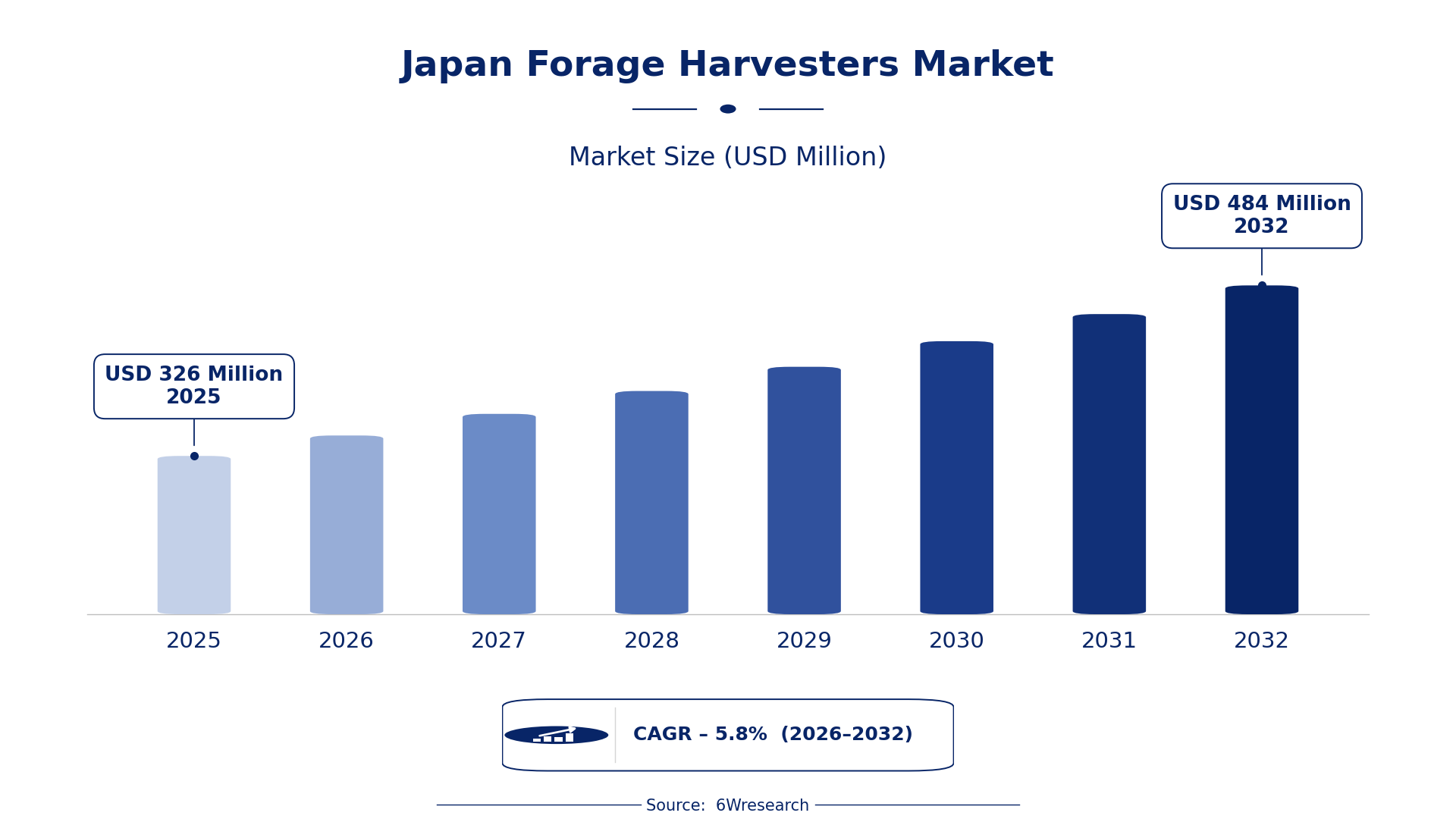
According to 6Wresearch internal database and industry insights, the Japan Forage Harvesters Market was valued at USD 326 Million in 2025 and is projected to reach USD 484 Million by 2032, growing at a CAGR of approximately 5.8% during 2026–2032.
Japan Forage Harvesters Market Highlights
| Report Metric | Details |
| Report Name | Japan Forage Harvesters Market (2026-2032) |
| Market Size 2025 | USD 326 Million |
| Market Size 2032 | USD 484 Million |
| Absolute Growth 2025–2032 | USD 158 Million |
| CAGR 2026–2032 | 5.8% |
| Peak Annual Growth | 6.7% in 2028 |
| Forecast Period | 2026–2032 |
| Historical Data | 2022–2025 |
| Base Year | 2025 |
| Leading Product Type, 2025 | Self-Propelled (48% share) |
| Leading Drive Type, 2025 | Diesel (55% share) |
| Leading Harvesting Mechanism, 2025 | Rotary Cutter (47% share) |
| Leading Distribution Channel, 2025 | Direct Sales (44% share) |
| Leading End User, 2025 | Commercial Farmers (41% share) |
| Fastest-Growing Product Type | Electric Harvester (8.5% CAGR) |
| Fastest-Growing Drive Type | Electric Motor (8.4% CAGR) |
| Fastest-Growing Harvesting Mechanism | Disc Cutter (7.5% CAGR) |
| Fastest-Growing Distribution Channel | Online Platforms (7.6% CAGR) |
| Fastest-Growing End User | Small-Scale Farmers (7.4% CAGR) |
| Growing Sector | Dairy farming |
| Key End Users | Commercial Farmers, Small-Scale Farmers, Dairy Farms, Agricultural Co-ops |
Japan Forage Harvesters Market Year-wise Growth Rate and Key Drivers (2022–2032)
This graph illustrates the annual growth rates of the market from 2022 to 2032, highlighting a steady upward trajectory and projected market expansion over the forecast period.
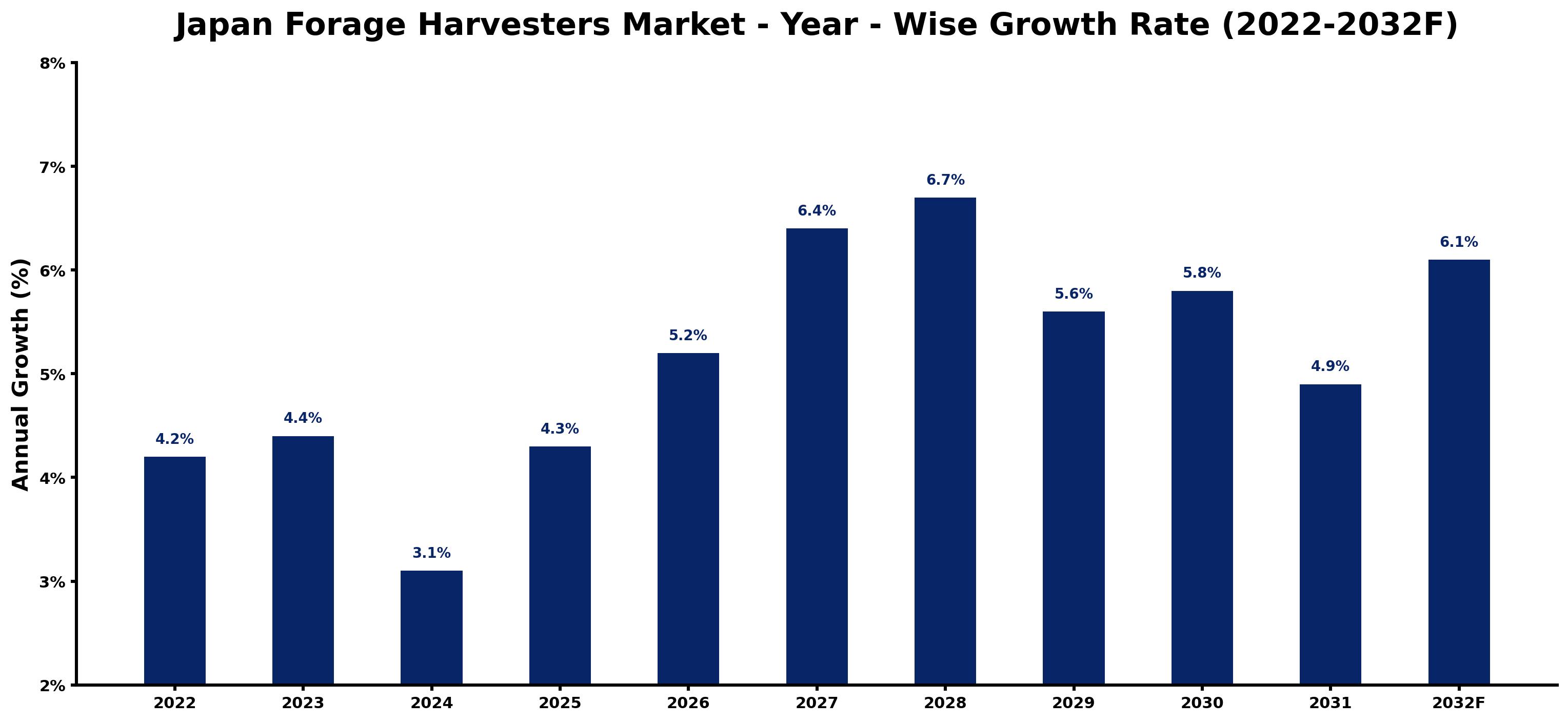
The yearly estimates that follow link every growth rate to its principal driver, so readers can see why the pace changed in each period.
| Year | Estimated Annual Growth (%) | Market Rationale |
| 2022 | 4.2 | The market experienced steady growth due to consistent demand from dairy farmers. |
| 2023 | 4.4 | Demand increased as dairy output remained strong, leading to higher forage harvester purchases. |
| 2024 | 3.1 | Growth slowed as farmers faced challenges in adopting new technologies amid rising costs. |
| 2025 | 4.3 | The market saw a resurgence in growth driven by improved agricultural practices and equipment. |
| 2026 | 5.2 | Demand is expected to rise as farmers invest in modern machinery to boost productivity and efficiency. |
| 2027 | 6.4 | Growth is projected to accelerate with rising interest in advanced harvesting techniques among large farms. |
| 2028 | 6.7 | The market is expected to peak as technological advancements in forage harvesting attract new investment. |
| 2029 | 5.6 | Growth will slow as market saturation begins to affect new equipment purchases among farmers. |
| 2030 | 5.8 | Demand is expected to increase again due to renewed focus on sustainable farming practices and eco-friendly machinery. |
| 2031 | 4.9 | Growth will slow as the average age of farmers impacts machinery replacement rates. |
| 2032 | 6.1 | Demand is projected to rise as electric harvesters gain traction in urban farming initiatives. |
Note: Market size estimations and growth projections presented in this report are based on 6Wresearch's proprietary forecasting methodology, utilizing the latest available industry data, government publications, and primary research inputs.
Japan Forage Harvesters Market Synopsis
Forage harvesters are machines used to harvest forage plants for silage, hay, or fodder, primarily in the dairy and livestock industries. In 2022, Japan had approximately 1.2 million dairy cows, driving demand for these machines. The Japan Forage Harvesters Market is expanding due to the increasing number of dairy farms and government support for modern agricultural practices, aiming to improve agricultural efficiency by 20% by 2025. The Tohoku region plays a crucial role in dairy farming, utilising forage harvesters extensively.
Market Dynamics Impact Analysis (2026–2032)
| Factor | Type | Impact | Primary Segment Affected |
| Growing dairy farming sector | Driver | High | Commercial Farmers |
| Investment in advanced machinery | Driver | High | Self-Propelled |
| Rising interest in eco-friendly machinery | Opportunity | Medium | Electric Harvester |
| Increased demand for efficient harvesting solutions | Opportunity | Medium | Pull-Type |
| High average age of farmers | Restraint | High | Self-Propelled |
| Limited adoption of electric harvesters due to technology constraints | Restraint | Medium | Electric Harvester |
| Rising costs of agricultural machinery | Challenge | High | Self-Propelled |
| Compliance with new environmental regulations | Challenge | Medium | Hybrid Harvester |
Evaluation of Drivers in Japan Forage Harvesters Market (2026–2032)
Key forces behind demand, with the segment each one moves most, are listed below.
| Drivers | Primary Segment Affected | Why It Matters (Evidence) |
| Increasing dairy production | Commercial Farmers | In 2022, dairy farms accounted for approximately 30% of agricultural output, driving higher forage harvester demand. |
| Government subsidies for modern equipment | Self-Propelled | In 2023, a subsidy program was launched to support farmers purchasing eco-friendly machinery. |
| Growing agricultural cooperatives | Pull-Type | Approximately 1,000 agricultural cooperatives facilitate equipment sharing among farmers, enhancing access to modern machinery. |
| Rising farm sizes | Diesel | The average farm size in Japan is about 1.5 hectares, promoting the use of larger, efficient harvesters. |
| Technological advancements in harvesting | Electric Harvester | Pilot projects in urban farming initiatives are increasing interest in electric harvesters. |
A wider customer base explains much of the growth, as increasing dairy production drives demand for forage harvesters. In 2022, approximately 1.2 million dairy cows in Japan contributed to this trend, leading to higher purchases. Agricultural cooperatives promote equipment sharing, improving access for small-scale farmers. The average farm size encourages the use of larger diesel-powered harvesters for efficiency.
Evaluation of Restraints in Japan Forage Harvesters Market
The main factors holding the market back are set out below.
| Market Restraint | Primary Segment Affected | Why It Matters (Evidence) |
| High average age of farmers | Self-Propelled | The average age of farmers in Japan is around 67, affecting machinery adoption rates. |
| Limited adoption of electric harvesters | Electric Harvester | Electric harvesters face constraints due to battery technology limitations, hindering widespread use. |
| Rising costs of agricultural machinery | Self-Propelled | Increasing costs of machinery impact purchasing decisions among farmers, slowing market growth. |
| Compliance with environmental regulations | Hybrid Harvester | New regulations require investments in eco-friendly technologies, posing challenges for some farmers. |
| Market saturation in large farms | Self-Propelled | As large farms reach efficiency, new equipment purchases are slowing down. |
Japan Forage Harvesters Market Challenges
Dairy farms in the Tohoku region face intense competition, forcing producers to lower prices and eroding profit margins. Regulatory requirements from the Ministry of Agriculture, Forestry and Fisheries complicate operations, leading to production delays for manufacturers, which can extend timelines by up to three months. The average age of farmers, approximately 67, results in a skills gap, hindering the adoption of modern machinery among younger generations. Rising costs of eco-friendly machinery, driven by recent subsidy programs, can burden small-scale farmers, making it difficult for them to invest in necessary upgrades.
Trends in the Japan Forage Harvesters Market
The following changes are redrawing the Japan Forage Harvesters Market.
- Shift towards Electric Harvesters: In 2023, pilot projects in urban farming initiatives are increasing interest in electric harvesters, which are gaining traction among farmers looking for sustainable options.
- Growth of Agricultural Cooperatives: The Tohoku region is seeing a rise in agricultural cooperatives, with around 1,000 facilitating equipment sharing, allowing small-scale farmers to access modern machinery.
- Focus on Eco-Friendly Machinery: The government launched a subsidy program in 2023 to support the purchase of eco-friendly machinery, reflecting a growing trend towards sustainability in agriculture.
- Technological Advancements in Harvesting: The annual agricultural machinery fair in Tokyo showcases innovations in forage harvesting technology, highlighting the industry's shift towards more efficient solutions.
Investment Opportunities in the Japan Forage Harvesters Market
The following areas offer the clearest openings for investors and suppliers in the Japan Forage Harvesters Market.
- Electric Harvesters: With rising interest in eco-friendly machinery, there is an opportunity to supply electric harvesters, particularly in urban farming projects, which are gaining traction in Japan.
- Advanced Harvesting Technology: The growing number of agricultural cooperatives creates a demand for advanced harvesting technology, allowing suppliers to enter through partnerships with local cooperatives.
- Sustainable Machinery Solutions: The 2023 subsidy program encourages investments in sustainable machinery solutions, presenting an opportunity for suppliers to target eco-conscious farmers.
- Support for Small-Scale Farmers: With small-scale farmers increasingly adopting efficient harvesting solutions, there is a gap in the market for affordable, versatile harvesting equipment.
Government Initiatives in the Japan Forage Harvesters Market
The Electrical Appliance and Material Safety Act regulates the safety of electrical appliances, ensuring that forage harvesters meet safety standards. This law complements existing regulations by adding safety measures for agricultural machinery, benefiting producers and buyers alike. In 2023, the government allocated funds to improve rural infrastructure, enhancing access to advanced machinery for farmers.
The Digital Agency leads government digital transformation efforts, approving funding for projects that improve agricultural productivity through modern equipment. This agency supports initiatives aimed at improving access to advanced machinery for farmers. In 2023, the government launched a subsidy program to support farmers purchasing eco-friendly machinery.
Future Insight of the Japan Forage Harvesters Market
Electric harvesters will transform demand by 2032, as urban farming initiatives gain traction and government support for eco-friendly machinery increases. The Ministry of Agriculture, Forestry and Fisheries has set a target to boost agricultural productivity by 20% by 2025, which will drive the adoption of advanced technology. Stricter environmental regulations will likely increase the prevalence of hybrid harvesters. With dairy farms accounting for approximately 30% of total agricultural output, the need for efficient forage harvesting solutions will continue to rise.
Market Segmentation Analysis
Japan Forage Harvesters Market report covers a detailed analysis of the following market segments:
By Product Type – Self-Propelled Leads, Electric Harvester Expected to Grow Fastest
According to Anjali Gupta, Research Analyst at 6Wresearch, Self-Propelled accounted for 48% of the market by product type in 2025. Self-propelled forage harvesters dominate the market due to their efficiency in large-scale operations, particularly in regions like Tohoku where dairy farming is prevalent. Their ability to handle extensive harvesting tasks makes them the preferred choice among commercial farmers. Over 2026–2032, Electric Harvester is expected to post the fastest growth, at a CAGR of 8.5%. Electric harvesters are gaining traction as urban farming initiatives explore sustainable practices, with pilot projects demonstrating their potential. As technology advances, the adoption rate is expected to increase, further diversifying the market. Suppliers should focus on developing electric models to meet the growing demand for sustainable farming solutions.
By Drive Type – Diesel Leads, Electric Motor Expected to Grow Fastest
In 2025, Diesel led the drive type split with a 55% share. Diesel serves as the main power source for forage harvesters, valued for its reliability in demanding farming environments. In regions like Hokkaido, commercial farmers rely heavily on diesel-powered machines for effective livestock operations. Electric Motor is projected to grow fastest, at a CAGR of 8.4% during 2026–2032. Electric motors are increasingly appealing as farmers seek sustainable options, bolstered by government initiatives promoting eco-friendly machinery. This trend indicates a shift towards greener practices in agriculture, likely accelerating the adoption of electric models. Suppliers must consider diversifying their product lines to include electric models to meet the rising demand for sustainable machinery.
By Harvesting Mechanism – Rotary Cutter Leads, Disc Cutter Expected to Grow Fastest
Rotary Cutter held 47% of the Japan Forage Harvesters Market by harvesting mechanism in 2025. Rotary cutters are favoured for their effectiveness in cutting forage, making them the go-to choice for many commercial operations. Their widespread acceptance among farmers is evidenced by their common use in various harvesting scenarios. Disc Cutter is set to record the highest CAGR in this split, 7.5% over 2026–2032. Disc cutters are emerging as a popular choice due to their precision in cutting, appealing to farmers focused on optimising yield quality. This growing preference indicates a shift towards more specialised harvesting mechanisms in the market. Suppliers should consider diversifying their offerings to include advanced cutting mechanisms that cater to evolving farmer preferences.
By Distribution Channel – Direct Sales Leads, Online Platforms Expected to Grow Fastest
With 44% of distribution channel revenue in 2025, Direct Sales was the largest category. Direct sales dominate the distribution of forage harvesters, providing essential support and tailored solutions for large equipment purchases. This channel is particularly crucial for commercial farmers who require dependable machinery for their extensive operations. The quickest growth will come from Online Platforms, forecast to expand at a CAGR of 7.6% between 2026 and 2032. Online platforms are slowly gaining traction as farmers become more accustomed to digital purchasing, though they still represent a smaller segment of the market. The convenience offered by online transactions may lead to increased adoption as technology becomes more prevalent in agriculture. Suppliers should focus on strengthening their online sales strategies to accommodate the growing number of buyers who prefer digital purchasing options.
By End User – Commercial Farmers Lead, Small-Scale Farmers Expected to Grow Fastest
The largest end user category in 2025 was Commercial Farmers, at 41% of revenue. Commercial farmers represent the largest user group for forage harvesters, driven by their extensive operations and the necessity for efficient harvesting solutions. Their critical role in the dairy sector, which constitutes around 30% of agricultural output, underscores the significance of this segment. Over 2026–2032, Small-Scale Farmers are expected to post the fastest growth, at a CAGR of 7.4%. Small-scale farmers are increasingly adopting forage harvesters to improve productivity on their limited land, indicating a trend towards mechanisation in smaller farming operations. This shift reflects a broader recognition of the advantages of modern harvesting technology even among smaller farms. Suppliers should tailor their product offerings and marketing strategies to cater to the specific needs of small-scale farmers entering the market.
Key Attractiveness of the Report
- 10 Years of Market Numbers
- Historical Data Starting from 2022 to 2025
- Base Year 2025
- Forecast Data until 2032
- Key Performance Indicators Impacting the Market
- Major Upcoming Developments and Projects
Key Highlights of the Report:
- Japan Forage Harvesters Market Outlook
- Market Size of Japan Forage Harvesters Market, 2025
- Forecast of Japan Forage Harvesters Market, 2032
- Historical Data and Forecast of Japan Forage Harvesters Revenues & Volume for the Period 2022-2032F
- Japan Forage Harvesters Market Trend Evolution
- Japan Forage Harvesters Market Drivers and Challenges
- Japan Forage Harvesters Price Trends
- Japan Forage Harvesters Porter's Five Forces
- Japan Forage Harvesters Industry Life Cycle
- Historical Data and Forecast of Japan Forage Harvesters Market Revenues & Volume By Product Type for the Period 2022-2032F
- Historical Data and Forecast of Japan Forage Harvesters Market Revenues & Volume By Self-Propelled for the Period 2022-2032F
- Historical Data and Forecast of Japan Forage Harvesters Market Revenues & Volume By Pull-Type for the Period 2022-2032F
- Historical Data and Forecast of Japan Forage Harvesters Market Revenues & Volume By Electric Harvester for the Period 2022-2032F
- Historical Data and Forecast of Japan Forage Harvesters Market Revenues & Volume By Hybrid Harvester for the Period 2022-2032F
- Historical Data and Forecast of Japan Forage Harvesters Market Revenues & Volume By Drive Type for the Period 2022-2032F
- Historical Data and Forecast of Japan Forage Harvesters Market Revenues & Volume By Diesel for the Period 2022-2032F
- Historical Data and Forecast of Japan Forage Harvesters Market Revenues & Volume By Tractor-Powered for the Period 2022-2032F
- Historical Data and Forecast of Japan Forage Harvesters Market Revenues & Volume By Electric Motor for the Period 2022-2032F
- Historical Data and Forecast of Japan Forage Harvesters Market Revenues & Volume By Diesel-Electric for the Period 2022-2032F
- Historical Data and Forecast of Japan Forage Harvesters Market Revenues & Volume By Harvesting Mechanism for the Period 2022-2032F
- Historical Data and Forecast of Japan Forage Harvesters Market Revenues & Volume By Rotary Cutter for the Period 2022-2032F
- Historical Data and Forecast of Japan Forage Harvesters Market Revenues & Volume By Flail Cutter for the Period 2022-2032F
- Historical Data and Forecast of Japan Forage Harvesters Market Revenues & Volume By Drum Cutter for the Period 2022-2032F
- Historical Data and Forecast of Japan Forage Harvesters Market Revenues & Volume By Disc Cutter for the Period 2022-2032F
- Historical Data and Forecast of Japan Forage Harvesters Market Revenues & Volume By Distribution Channel for the Period 2022-2032F
- Historical Data and Forecast of Japan Forage Harvesters Market Revenues & Volume By Direct Sales for the Period 2022-2032F
- Historical Data and Forecast of Japan Forage Harvesters Market Revenues & Volume By Equipment Dealers for the Period 2022-2032F
- Historical Data and Forecast of Japan Forage Harvesters Market Revenues & Volume By Online Platforms for the Period 2022-2032F
- Historical Data and Forecast of Japan Forage Harvesters Market Revenues & Volume By Industrial Suppliers for the Period 2022-2032F
- Historical Data and Forecast of Japan Forage Harvesters Market Revenues & Volume By End User for the Period 2022-2032F
- Historical Data and Forecast of Japan Forage Harvesters Market Revenues & Volume By Commercial Farmers for the Period 2022-2032F
- Historical Data and Forecast of Japan Forage Harvesters Market Revenues & Volume By Small-Scale Farmers for the Period 2022-2032F
- Historical Data and Forecast of Japan Forage Harvesters Market Revenues & Volume By Dairy Farms for the Period 2022-2032F
- Historical Data and Forecast of Japan Forage Harvesters Market Revenues & Volume By Agricultural Co-ops for the Period 2022-2032F
- Japan Forage Harvesters Import Export Trade Statistics
- Market Opportunity Assessment By Product Type
- Market Opportunity Assessment By Drive Type
- Market Opportunity Assessment By Harvesting Mechanism
- Market Opportunity Assessment By Distribution Channel
- Market Opportunity Assessment By End User
- Japan Forage Harvesters Top Companies Market Share
- Japan Forage Harvesters Competitive Benchmarking By Technical and Operational Parameters
- Japan Forage Harvesters Company Profiles
- Japan Forage Harvesters Key Strategic Recommendations
Market Covered
Coverage by segment is as follows.
By Product Type
- Self-Propelled
- Pull-Type
- Electric Harvester
- Hybrid Harvester
By Drive Type
- Diesel
- Tractor-Powered
- Electric Motor
- Diesel-Electric
By Harvesting Mechanism
- Rotary Cutter
- Flail Cutter
- Drum Cutter
- Disc Cutter
By Distribution Channel
- Direct Sales
- Equipment Dealers
- Online Platforms
- Industrial Suppliers
By End User
- Commercial Farmers
- Small-Scale Farmers
- Dairy Farms
- Agricultural Co-ops






































