Japan Forage Harvesting Equipment Market Size & Growth Rate
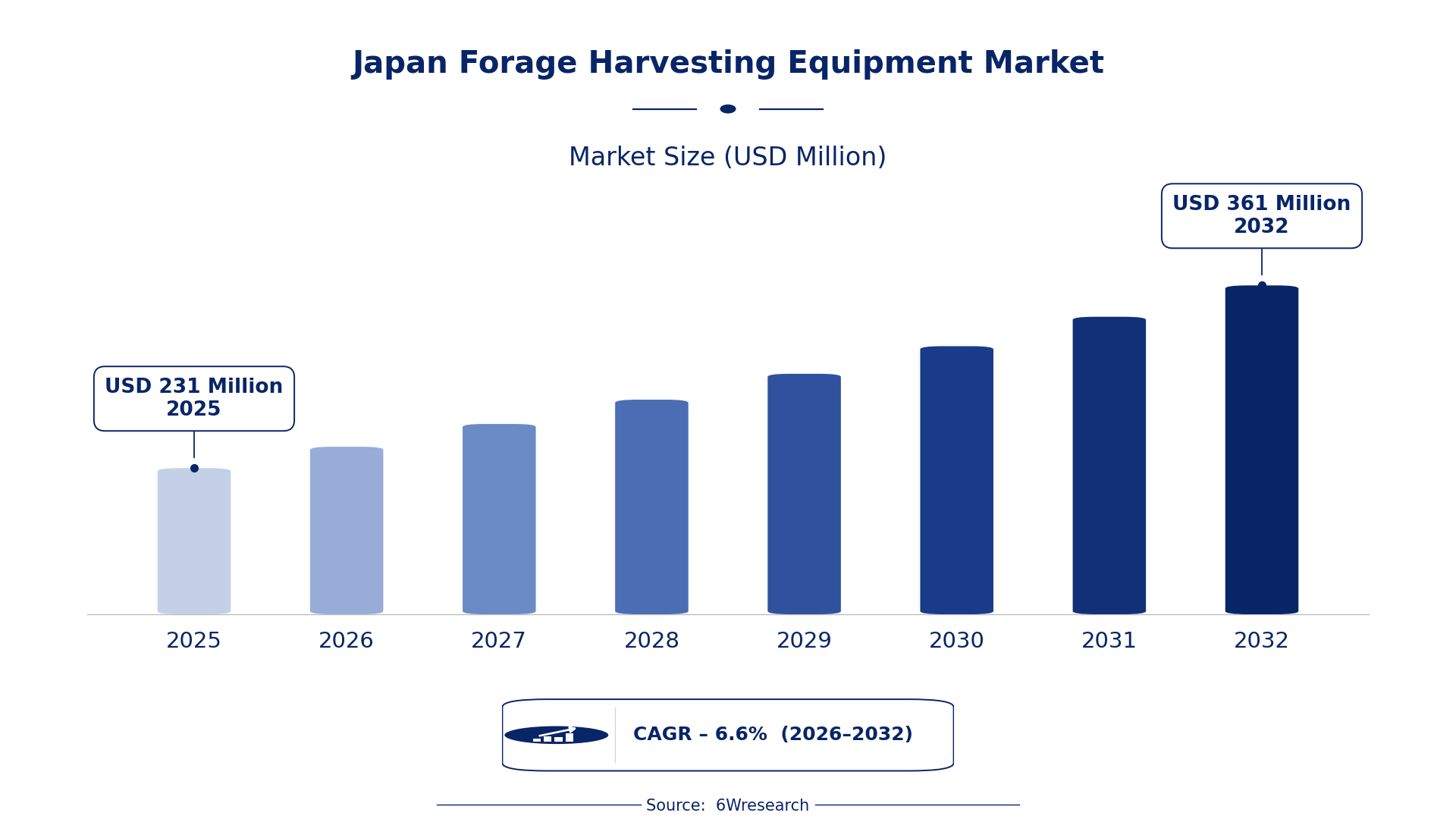
According to 6Wresearch internal database and industry insights, the Japan Forage Harvesting Equipment Market was valued at USD 231 Million in 2025 and is projected to reach USD 361 Million by 2032, growing at a CAGR of approximately 6.6% during 2026–2032.
Japan Forage Harvesting Equipment Market Highlights
| Report Metric | Details |
| Report Name | Japan Forage Harvesting Equipment Market (2026-2032) |
| Market Size 2025 | USD 231 Million |
| Market Size 2032 | USD 361 Million |
| Absolute Growth 2025–2032 | USD 130 Million |
| CAGR 2026–2032 | 6.6% |
| Peak Annual Growth | 7.3% in 2028 |
| Forecast Period | 2026–2032 |
| Historical Data | 2022–2025 |
| Base Year | 2025 |
| Leading Equipment Type, 2025 | Balers (40% share) |
| Leading Operation Mode, 2025 | Automatic (40% share) |
| Leading Application Type, 2025 | Grass Harvesting (48% share) |
| Leading Distribution Channel, 2025 | Equipment Dealers (39% share) |
| Leading End User, 2025 | Farm Owners (46% share) |
| Fastest-Growing Equipment Type | Mowers (9.2% CAGR) |
| Fastest-Growing Application Type | Hay Packing (9.0% CAGR) |
| Fastest-Growing Distribution Channel | Direct Sales (8.7% CAGR) |
| Fastest-Growing End User | Livestock Farms (8.9% CAGR) |
| Growing Sector | Hay Packing |
| Key End Users | Grass Harvesting, Hay Packing, Forage Gathering, Drying & Fluffing |
Japan Forage Harvesting Equipment Market Year-wise Growth Rate and Key Drivers (2022–2032)
This graph illustrates the annual growth rates of the market from 2022 to 2032, highlighting a steady upward trajectory and projected market expansion over the forecast period.
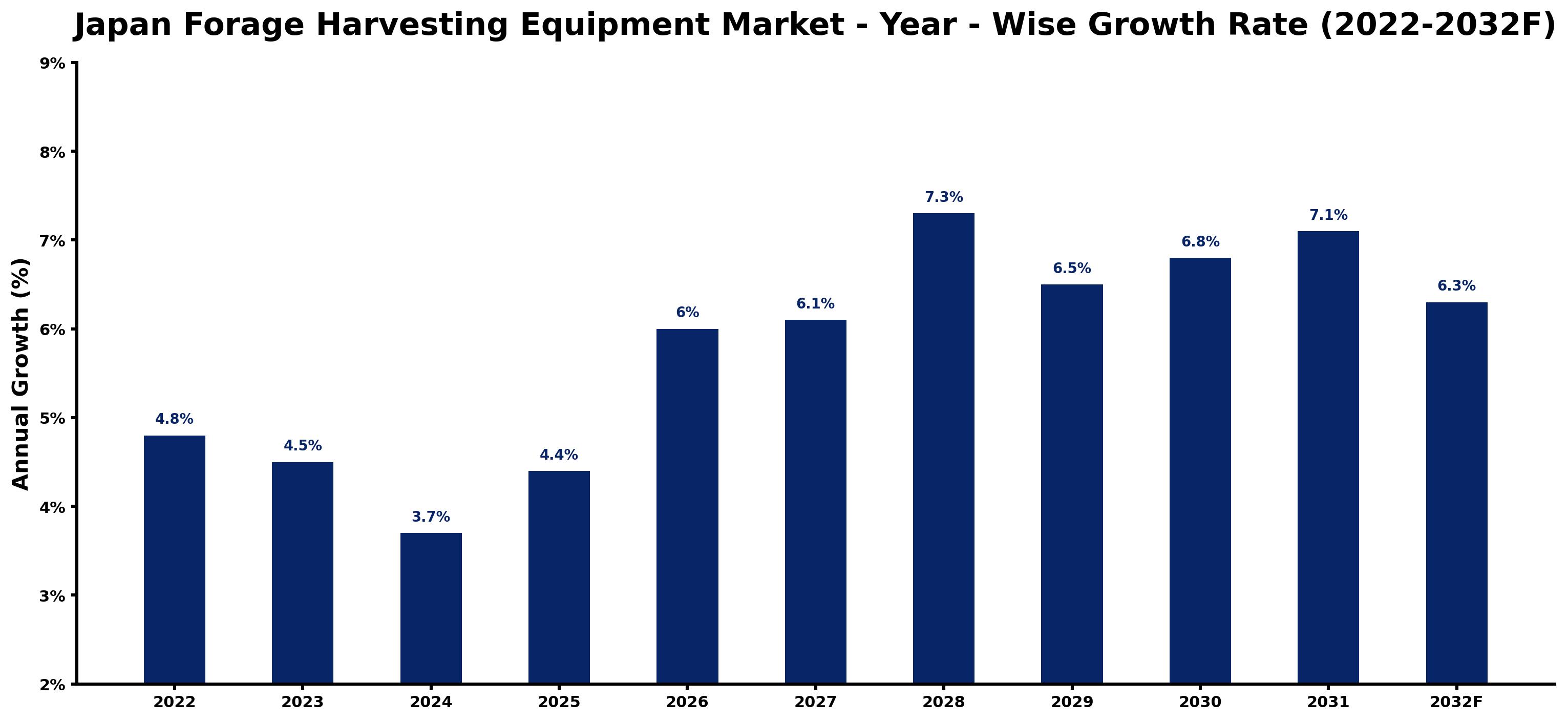
The following figures match every annual growth estimate with the main market development of that year, giving the reasoning behind each rise or slowdown.
| Year | Estimated Annual Growth (%) | Market Rationale |
| 2022 | 4.8 | The market experienced solid growth, reflecting stable demand from livestock farmers. |
| 2023 | 4.5 | Growth slowed slightly as suppliers adjusted to market conditions and competition increased. |
| 2024 | 3.7 | Continued growth was driven by the rising adoption of automatic harvesting technology. |
| 2025 | 4.4 | Growth accelerated as farmers invested in modernising their machinery for improved efficiency. |
| 2026 | 6.0 | Demand is expected to rise with a focus on sustainable practices and technological advancements. |
| 2027 | 6.1 | The market will continue to grow as larger farms expand operations and upgrade equipment. |
| 2028 | 7.3 | Peak growth is projected, driven by significant investments in agricultural technology. |
| 2029 | 6.5 | Growth is expected to slow as market saturation begins to affect new equipment purchases. |
| 2030 | 6.8 | Demand will increase again as precision agriculture becomes more prevalent among farmers. |
| 2031 | 7.1 | The market is projected to grow further as innovations in equipment design attract more buyers. |
| 2032 | 6.3 | Growth is expected to slow slightly due to market maturity and evolving buyer preferences. |
Note: Market size estimations and growth projections presented in this report are based on 6Wresearch's proprietary forecasting methodology, utilizing the latest available industry data, government publications, and primary research inputs.
Japan Forage Harvesting Equipment Market Synopsis
Forage harvesting equipment plays a crucial role in the efficient harvesting of crops like grass and legumes, designed for optimal cutting and processing. The Japan Forage Harvesting Equipment Market is growing as livestock farmers and agricultural contractors prioritise modernising their machinery. Government investments in agricultural innovation, along with a rising livestock population of approximately 4.5 million, are propelling market growth. With over 4 million hectares dedicated to forage crops, the market is set for steady expansion as technology adoption rises, improving productivity for farmers.
Market Dynamics Impact Analysis (2026–2032)
| Factor | Type | Impact | Primary Segment Affected |
| Increasing investment in modern agricultural technology | Driver | High | Automatic |
| Rising livestock population driving feed demand | Driver | High | Grass Harvesting |
| Growing interest in sustainable farming practices | Opportunity | High | Mowers |
| Expansion of direct sales channels for equipment | Opportunity | Medium | Direct Sales |
| High average age of farmers affecting adoption rates | Restraint | High | Balers |
| Limited awareness of advanced equipment benefits | Restraint | Medium | Balers |
| Supply chain disruptions affecting equipment availability | Challenge | High | Balers |
| Competition from alternative farming methods | Challenge | Medium | Balers |
Evaluation of Drivers in Japan Forage Harvesting Equipment Market (2026–2032)
The factors lifting demand, and the evidence behind each, are summarised below.
| Drivers | Primary Segment Affected | Why It Matters (Evidence) |
| Investment in automatic harvesting technology | Automatic | This technology improves efficiency, leading to increased purchases by larger farms, projected to grow at 8.8%. |
| Rising livestock population | Grass Harvesting | The livestock population reached approximately 4.5 million, increasing the demand for efficient forage harvesting solutions. |
| Government support for agricultural modernization | Mowers | In 2023, ¥10 billion was allocated for modernization, encouraging farmers to upgrade their equipment. |
| Expansion of direct sales channels | Direct Sales | Direct sales account for about 30% of all equipment sales, providing immediate access to farmers. |
| Increased focus on sustainable farming practices | Balers | The Ministry of Agriculture promotes sustainability, driving demand for efficient baling equipment. |
Orders keep climbing as investments in automatic harvesting technology rise, improving efficiency for larger farms. The livestock population, approximately 4.5 million, fuels demand for efficient grass harvesting solutions. In 2023, ¥10 billion was allocated for agricultural modernization, encouraging farmers to upgrade their machinery. Direct sales, accounting for about 30% of equipment sales, provide immediate access to farmers, boosting purchasing. The promotion of sustainable practices is driving demand for balers and other agricultural machinery.
Evaluation of Restraints in Japan Forage Harvesting Equipment Market
The main factors holding the market back are set out below.
| Market Restraint | Primary Segment Affected | Why It Matters (Evidence) |
| High average age of farmers limiting equipment adoption | Balers | With the average farmer over 67 years old, many hesitate to adopt new technologies, affecting overall market growth. |
| Limited awareness of advanced equipment benefits | Balers | Many farmers lack knowledge about the advantages of modern forage harvesting equipment, which slows adoption rates. |
| Supply chain disruptions affecting equipment availability | Balers | Recent global supply chain issues have delayed equipment deliveries, impacting farmers' purchasing decisions. |
| Competition from alternative farming methods | Balers | Farmers exploring alternative methods may postpone investments in traditional forage harvesting equipment. |
| High costs associated with advanced machinery | Balers | The initial investment for modern equipment can be prohibitive for smaller farms, limiting market penetration. |
Japan Forage Harvesting Equipment Market Challenges
Japan's ageing farmer population, with an average age over 67 years, limits the adoption of modern forage harvesting equipment, resulting in reduced efficiency for producers. Compliance with the JIS B 8001 standard increases manufacturing costs, which can lead to higher prices for buyers needing safe machinery. Local suppliers struggle with inconsistent stock levels, causing delays in equipment availability for producers who depend on timely harvesting. Heightened competition from international markets pressures local manufacturers to reduce prices, potentially compromising the quality of machinery accessible to buyers.
Trends in the Japan Forage Harvesting Equipment Market
Four trends stand out in the Japan Forage Harvesting Equipment Market.
- Growth in Automatic Harvesting Equipment Adoption: By 2025, automatic harvesting equipment is expected to capture a 40% market share, indicating a shift towards improved operational efficiency and reduced labour costs for farmers.
- Surge in Direct Sales Channels: Direct sales represented about 30% of all equipment sales in 2023, enabling farmers quicker access to essential machinery and improving purchasing convenience.
- Increased Focus on Sustainable Practices: Since 2023, there has been a growing interest in sustainable farming, resulting in heightened demand for efficient harvesting equipment supported by government initiatives.
- Rising Livestock Population: Japan's livestock population reached approximately 4.5 million in 2022, increasing the need for more efficient forage harvesting solutions as demand for livestock feed continues to rise.
Investment Opportunities in the Japan Forage Harvesting Equipment Market
Where to invest in the Japan Forage Harvesting Equipment Market: the main openings are set out below.
- Livestock Farms Seeking Modern Equipment: Livestock farms are increasingly in search of advanced harvesting solutions, with an estimated annual demand of 20,000 units. Collaborating with agricultural contractors can ease market entry.
- Hokkaido Region's Forage Production: The Hokkaido region, renowned for its substantial forage production, offers opportunities for suppliers to provide advanced equipment. Engaging local dealers can improve market penetration.
- Government Investment in Precision Agriculture: With an emphasis on precision agriculture, there is a growing demand for technology-driven harvesting equipment. Suppliers can gain from aligning with training programmes for farmers.
- Expansion of Online Sales Platforms: The growth of online platforms for agricultural equipment, with a 15% increase in usage since 2021, presents suppliers with opportunities to connect with a broader audience directly.
Government Initiatives in the Japan Forage Harvesting Equipment Market
The Act on the Rational Use of Energy, enacted in 1979, mandates large energy users to improve energy efficiency, impacting producers of forage harvesting equipment by requiring compliance with energy standards. This law complements existing regulations, encouraging sustainable practices among manufacturers. The Industrial Safety and Health Act (1972) also enforces safety measures for machinery, ensuring that equipment meets safety protocols, which is important for both producers and buyers.
In 2023, the Japanese government allocated ¥10 billion for agricultural modernisation, overseen by the Ministry of Agriculture, Forestry and Fisheries. This funding supports initiatives aimed at enhancing the efficiency and sustainability of agricultural practices, benefiting both producers and buyers.
Future Insight of the Japan Forage Harvesting Equipment Market
Advancements in precision agriculture technology will reshape demand for forage harvesting equipment by 2032, allowing farmers to boost productivity. The average yield of forage crops in Japan, estimated at 8 tons per hectare, will drive the adoption of more efficient machinery. Improved online platforms will simplify the purchasing process, providing buyers with better access to a range of equipment. Training programmes will equip younger farmers with essential skills, facilitating a shift to modern agricultural practices and increasing overall efficiency.
Market Segmentation Analysis
Japan Forage Harvesting Equipment Market report covers a detailed analysis of the following market segments:
By Equipment Type – Balers Lead, Mowers Expected to Grow Fastest
According to Anjali Gupta, Research Analyst at 6Wresearch, Balers took 40% of equipment type revenue in 2025, more than any other category. Balers hold the largest share as they are crucial for compacting harvested forage into manageable bales, essential for efficient storage and transport. The annual demand estimate of 20,000 units in Japan underscores their importance in the market. Over 2026–2032, Mowers are expected to post the fastest growth, at a CAGR of 9.2%. Mowers are experiencing rapid growth due to their vital role in efficiently cutting forage crops, which is increasingly important for livestock farmers. The trend of larger farms adopting automatic forage harvesting equipment further accelerates this growth. Suppliers should focus on improving mower technology to capture the expanding market segment.
By Operation Mode – Automatic Leads and Records the Fastest Growth
Automatic accounted for 40% of the market by operation mode in 2025. Automatic modes dominate the market as they significantly improve operational efficiency and ease of use, especially for Japan's ageing farmer population. This trend is evident as farmers seek to modernise their operations with advanced equipment to enhance productivity. The same category is also set to grow fastest, at a CAGR of 8.8% during 2026–2032. The automatic operation mode is also the fastest-growing segment, aligning with the government's push for precision agriculture. This growth will likely continue as farmers increasingly invest in technology to optimise their farming practices. Suppliers should prioritise the development of automatic features to cater to the rising demand for efficient farming solutions.
By Application Type – Grass Harvesting Leads, Hay Packing Expected to Grow Fastest
With 48% of application type revenue in 2025, Grass Harvesting was the largest category. Grass harvesting is the primary application for forage harvesting equipment, driven by Japan's substantial livestock population that requires high-quality feed. The emphasis on grass harvesting is particularly strong in regions like Tohoku, known for its significant forage production. Hay Packing is set to record the highest CAGR in this split, 9.0% over 2026–2032. Hay packing is rapidly gaining traction as a key process facilitated by balers, driven by the need for effective storage solutions for harvested forage. The growing focus on efficient feed management in livestock farms is propelling this segment's growth. Suppliers should consider expanding their product offerings to include advanced hay packing solutions.
By Distribution Channel – Equipment Dealers Lead, Direct Sales Expected to Grow Fastest
The largest distribution channel category in 2025 was Equipment Dealers, at 39% of revenue. Equipment dealers serve as the main sales channels, providing essential support and access to farmers who rely on their expertise for purchasing decisions. This channel's significance is underscored by the necessity for reliable service in the agricultural sector. The quickest growth will come from Direct Sales, forecast to expand at a CAGR of 8.7% between 2026 and 2032. Direct sales are experiencing rapid growth as they provide immediate access to farmers, allowing them to purchase equipment directly. This trend is reinforced by the increasing use of direct sales strategies among manufacturers to effectively reach customers. Suppliers should enhance their direct sales strategies to better connect with farmers and address their needs.
By End User – Farm Owners Lead, Livestock Farms Expected to Grow Fastest
Farm Owners held 46% of the Japan Forage Harvesting Equipment Market by end user in 2025. Farm owners represent the largest user group for forage harvesting equipment, as they are directly involved in the cultivation and management of forage crops. This segment's size is influenced by the high number of livestock farms in Japan that rely on efficient forage management. Over 2026–2032, Livestock Farms are expected to post the fastest growth, at a CAGR of 8.9%. Livestock farms are the fastest-growing end-user segment, driven by the increasing need for effective feed management solutions to support the livestock population. As these farms expand, their demand for advanced harvesting equipment will likely rise. Suppliers should tailor their products to meet the specific needs of livestock farms to capitalise on this growth.
Key Attractiveness of the Report
- 10 Years of Market Numbers
- Historical Data Starting from 2022 to 2025
- Base Year 2025
- Forecast Data until 2032
- Key Performance Indicators Impacting the Market
- Major Upcoming Developments and Projects
Key Highlights of the Report:
- Japan Forage Harvesting Equipment Market Outlook
- Market Size of Japan Forage Harvesting Equipment Market, 2025
- Forecast of Japan Forage Harvesting Equipment Market, 2032
- Historical Data and Forecast of Japan Forage Harvesting Equipment Revenues & Volume for the Period 2022-2032F
- Japan Forage Harvesting Equipment Market Trend Evolution
- Japan Forage Harvesting Equipment Market Drivers and Challenges
- Japan Forage Harvesting Equipment Price Trends
- Japan Forage Harvesting Equipment Porter's Five Forces
- Japan Forage Harvesting Equipment Industry Life Cycle
- Historical Data and Forecast of Japan Forage Harvesting Equipment Market Revenues & Volume By Equipment Type for the Period 2022-2032F
- Historical Data and Forecast of Japan Forage Harvesting Equipment Market Revenues & Volume By Mowers for the Period 2022-2032F
- Historical Data and Forecast of Japan Forage Harvesting Equipment Market Revenues & Volume By Balers for the Period 2022-2032F
- Historical Data and Forecast of Japan Forage Harvesting Equipment Market Revenues & Volume By Tedders for the Period 2022-2032F
- Historical Data and Forecast of Japan Forage Harvesting Equipment Market Revenues & Volume By Rakes for the Period 2022-2032F
- Historical Data and Forecast of Japan Forage Harvesting Equipment Market Revenues & Volume By Operation Mode for the Period 2022-2032F
- Historical Data and Forecast of Japan Forage Harvesting Equipment Market Revenues & Volume By Manual for the Period 2022-2032F
- Historical Data and Forecast of Japan Forage Harvesting Equipment Market Revenues & Volume By Automatic for the Period 2022-2032F
- Historical Data and Forecast of Japan Forage Harvesting Equipment Market Revenues & Volume By Tractor-Attached for the Period 2022-2032F
- Historical Data and Forecast of Japan Forage Harvesting Equipment Market Revenues & Volume By Hydraulic for the Period 2022-2032F
- Historical Data and Forecast of Japan Forage Harvesting Equipment Market Revenues & Volume By Application Type for the Period 2022-2032F
- Historical Data and Forecast of Japan Forage Harvesting Equipment Market Revenues & Volume By Grass Harvesting for the Period 2022-2032F
- Historical Data and Forecast of Japan Forage Harvesting Equipment Market Revenues & Volume By Hay Packing for the Period 2022-2032F
- Historical Data and Forecast of Japan Forage Harvesting Equipment Market Revenues & Volume By Drying & Fluffing for the Period 2022-2032F
- Historical Data and Forecast of Japan Forage Harvesting Equipment Market Revenues & Volume By Forage Gathering for the Period 2022-2032F
- Historical Data and Forecast of Japan Forage Harvesting Equipment Market Revenues & Volume By Distribution Channel for the Period 2022-2032F
- Historical Data and Forecast of Japan Forage Harvesting Equipment Market Revenues & Volume By Equipment Dealers for the Period 2022-2032F
- Historical Data and Forecast of Japan Forage Harvesting Equipment Market Revenues & Volume By Direct Sales for the Period 2022-2032F
- Historical Data and Forecast of Japan Forage Harvesting Equipment Market Revenues & Volume By Online Platforms for the Period 2022-2032F
- Historical Data and Forecast of Japan Forage Harvesting Equipment Market Revenues & Volume By Industrial Suppliers for the Period 2022-2032F
- Historical Data and Forecast of Japan Forage Harvesting Equipment Market Revenues & Volume By End User for the Period 2022-2032F
- Historical Data and Forecast of Japan Forage Harvesting Equipment Market Revenues & Volume By Farm Owners for the Period 2022-2032F
- Historical Data and Forecast of Japan Forage Harvesting Equipment Market Revenues & Volume By Ranchers & Farmers for the Period 2022-2032F
- Historical Data and Forecast of Japan Forage Harvesting Equipment Market Revenues & Volume By Livestock Farms for the Period 2022-2032F
- Historical Data and Forecast of Japan Forage Harvesting Equipment Market Revenues & Volume By Agricultural Contractors for the Period 2022-2032F
- Japan Forage Harvesting Equipment Import Export Trade Statistics
- Market Opportunity Assessment By Equipment Type
- Market Opportunity Assessment By Operation Mode
- Market Opportunity Assessment By Application Type
- Market Opportunity Assessment By Distribution Channel
- Market Opportunity Assessment By End User
- Japan Forage Harvesting Equipment Top Companies Market Share
- Japan Forage Harvesting Equipment Competitive Benchmarking By Technical and Operational Parameters
- Japan Forage Harvesting Equipment Company Profiles
- Japan Forage Harvesting Equipment Key Strategic Recommendations
Market Covered
Coverage by segment is as follows.
By Equipment Type
- Mowers
- Balers
- Tedders
- Rakes
By Operation Mode
- Manual
- Automatic
- Tractor-Attached
- Hydraulic
By Application Type
- Grass Harvesting
- Hay Packing
- Drying & Fluffing
- Forage Gathering
By Distribution Channel
- Equipment Dealers
- Direct Sales
- Online Platforms
- Industrial Suppliers
By End User
- Farm Owners
- Ranchers & Farmers
- Livestock Farms
- Agricultural Contractors






































