Japan Forestry LiDAR Analytics Market Size & Growth Rate
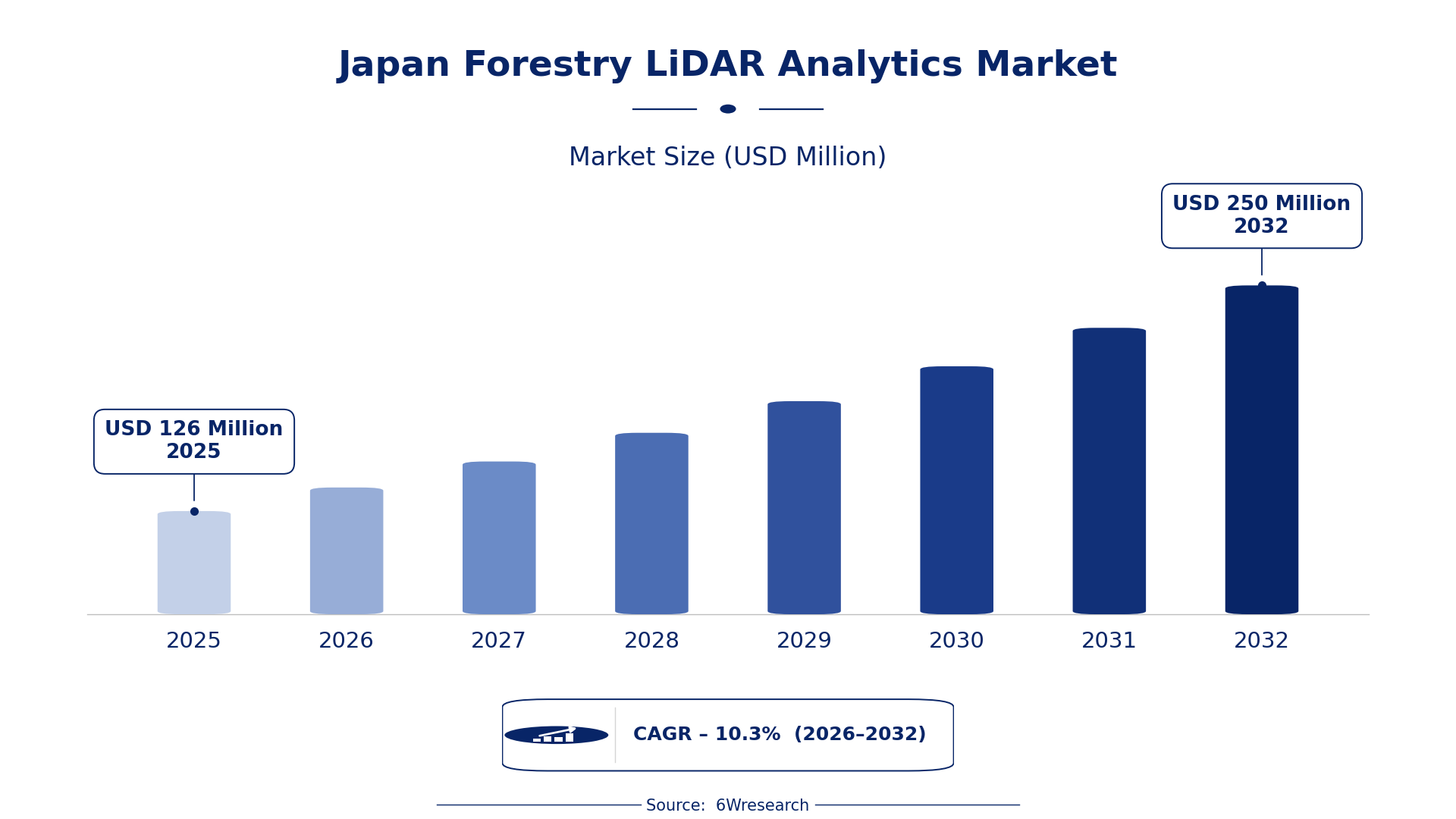
According to 6Wresearch internal database and industry insights, the Japan Forestry LiDAR Analytics Market was valued at USD 126 Million in 2025 and is projected to reach USD 250 Million by 2032, growing at a CAGR of approximately 10.3% during 2026–2032.
Japan Forestry LiDAR Analytics Market Highlights
| Report Metric | Details |
| Report Name | Japan Forestry LiDAR Analytics Market (2026-2032) |
| Market Size 2025 | USD 126 Million |
| Market Size 2032 | USD 250 Million |
| Absolute Growth 2025–2032 | USD 124 Million |
| CAGR 2026–2032 | 10.3% |
| Peak Annual Growth | 11.5% in 2026 |
| Forecast Period | 2026–2032 |
| Historical Data | 2022–2025 |
| Base Year | 2025 |
| Leading Solution Type, 2025 | Aerial LiDAR Mapping (34% share) |
| Leading Deployment Model, 2025 | Cloud-Based (44% share) |
| Leading Data Processing Type, 2025 | Real-Time Analysis (45% share) |
| Leading Distribution Channel, 2025 | SaaS Providers (46% share) |
| Leading End User, 2025 | Forestry Research Bodies (42% share) |
| Fastest-Growing Solution Type | Terrain Modelling (14.5% CAGR) |
| Fastest-Growing Deployment Model | On-Premise (14.7% CAGR) |
| Fastest-Growing Data Processing Type | Post-Processing (15.2% CAGR) |
| Fastest-Growing Distribution Channel | Direct Sales (13.1% CAGR) |
| Fastest-Growing End User | Environmental Agencies (12.8% CAGR) |
| Growing Sector | Forestry management |
| Key End Users | Forestry Research Bodies, Environmental Agencies, Forestry Management Firms, Government Forestry Programs |
Japan Forestry LiDAR Analytics Market Year-wise Growth Rate and Key Drivers (2022–2032)
This graph illustrates the annual growth rates of the market from 2022 to 2032, highlighting a steady upward trajectory and projected market expansion over the forecast period.
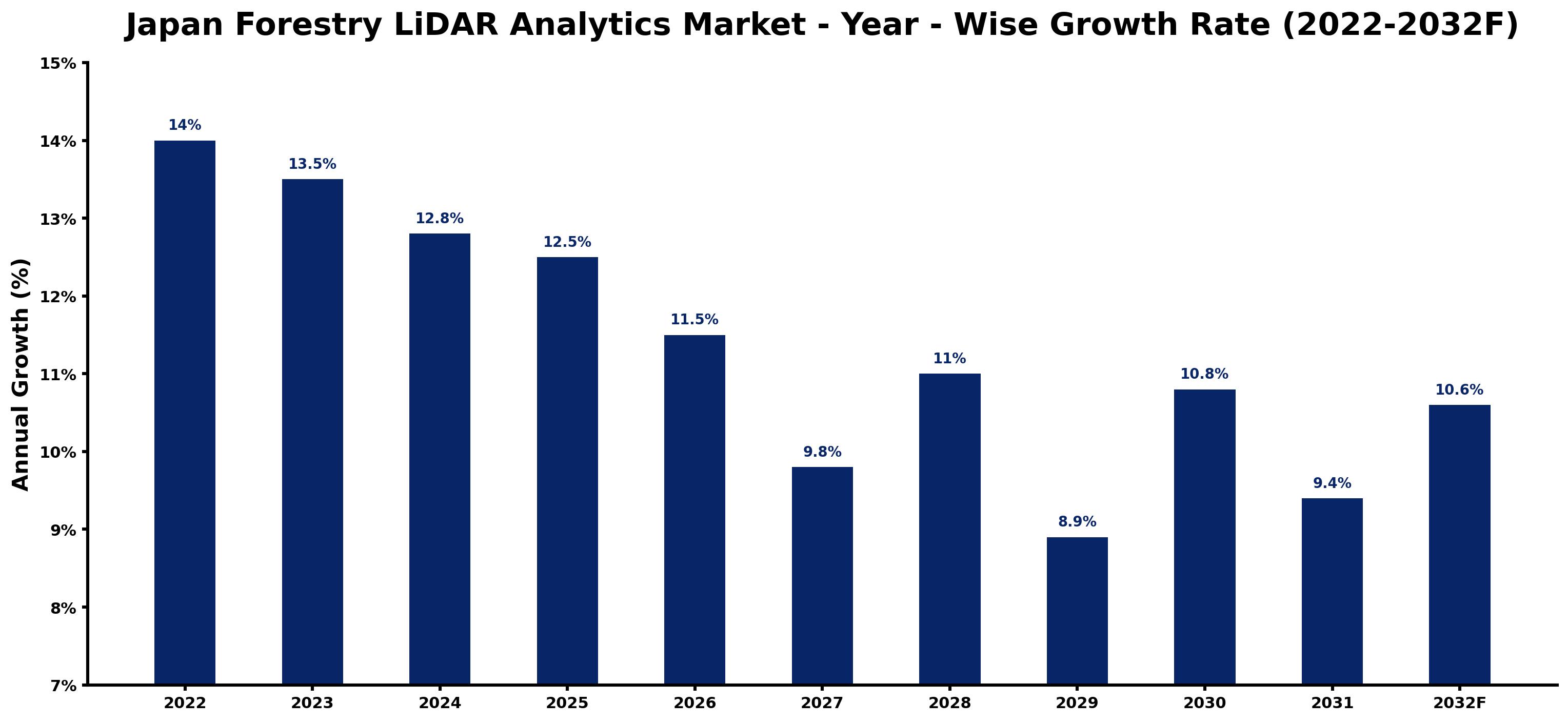
Annual growth estimates for each year appear below with the principal reason behind them, explaining the shifts that set the pace of the market.
| Year | Estimated Annual Growth (%) | Market Rationale |
| 2022 | 14.0 | The forestry sector experienced strong demand driven by sustainable management practices and technology adoption. |
| 2023 | 13.5 | Growth slowed as the market adjusted to previous high levels of investment in forestry technology. |
| 2024 | 12.8 | Demand continued to rise, albeit at a slower pace, as companies adopted advanced analytics solutions. |
| 2025 | 12.5 | The market maintained steady growth, supported by ongoing forestry management initiatives and environmental policies. |
| 2026 | 11.5 | Growth is expected to slow further as companies focus on optimizing existing technologies rather than new investments. |
| 2027 | 9.8 | The market will see a continued slowdown as the focus shifts towards efficiency rather than expansion. |
| 2028 | 11.0 | Demand is expected to rise again as new technologies and methodologies gain traction in forestry analytics. |
| 2029 | 8.9 | Growth is projected to slow as market saturation begins to affect new investments in LiDAR solutions. |
| 2030 | 10.8 | Increased adoption of AI-driven insights is anticipated to boost demand for analytics solutions in forestry. |
| 2031 | 9.4 | The market will experience a slowdown as companies consolidate their positions in analytics. |
| 2032 | 10.6 | Demand is expected to rise as the focus on carbon sequestration and sustainable practices intensifies. |
Note: Market size estimations and growth projections presented in this report are based on 6Wresearch's proprietary forecasting methodology, utilizing the latest available industry data, government publications, and primary research inputs.
Japan Forestry LiDAR Analytics Market Synopsis
Forestry LiDAR Analytics utilises Light Detection and Ranging technology to gather detailed data on forest structures and biomass through aerial surveys. This market is expanding rapidly, driven by Japan's commitment to sustainable forestry management and environmental conservation. In 2023, a new initiative was launched to improve forest carbon sequestration. The increasing adoption of cloud-based solutions and AI-driven insights further fuels this growth, reflecting a strong demand for efficient forest management practices.
Market Dynamics Impact Analysis (2026–2032)
| Factor | Type | Impact | Primary Segment Affected |
| Growing demand for sustainable forestry management practices | Driver | High | Aerial LiDAR Mapping |
| Increased investment in advanced technology for forest monitoring | Driver | High | Cloud-Based |
| Rising need for accurate biomass estimation for carbon accounting | Opportunity | High | Biomass Estimation |
| Expansion of environmental agencies focusing on forest health | Opportunity | Medium | Environmental Agencies |
| Aging workforce in the forestry sector leading to skill shortages | Restraint | High | Forestry Management Firms |
| High initial costs associated with LiDAR technology implementation | Restraint | Medium | Cloud-Based |
| Limited awareness of LiDAR benefits among smaller forestry firms | Challenge | High | Forestry Research Bodies |
| Competition from alternative forest monitoring technologies | Challenge | Medium | Aerial LiDAR Mapping |
Evaluation of Drivers in Japan Forestry LiDAR Analytics Market (2026–2032)
Below are the drivers that matter most for revenue growth, with supporting evidence.
| Drivers | Primary Segment Affected | Why It Matters (Evidence) |
| Increased government investment in forestry technology | Cloud-Based | In 2023, Japan launched a program to improve forest carbon sequestration, driving demand for cloud-based analytics. |
| Rising need for precise forest inventory management | Aerial LiDAR Mapping | Japan's forest area covers approximately 25 million hectares, necessitating accurate data collection. |
| Growing emphasis on ecological monitoring | Biomass Estimation | The average annual timber production in Japan is about 4 million cubic meters, highlighting the need for accurate biomass assessments. |
| Adoption of AI for data analysis | AI-Driven Insights | The 2023 initiative to integrate AI in forestry analytics is expected to improve data processing capabilities. |
| Demand for real-time decision-making tools | Real-Time Analysis | Aerial surveys using LiDAR can reduce survey time by up to 80%, improving operational efficiency. |
The average annual timber production of about 4 million cubic meters drives the need for precise forest inventory management. The emphasis on ecological monitoring encourages the use of biomass estimation tools, as accurate assessments are essential for sustainability. The integration of AI in forestry analytics, initiated in 2023, improves data analysis capabilities, while the efficiency of real-time analysis tools, which can reduce survey time by up to 80%, boosts demand.
Evaluation of Restraints in Japan Forestry LiDAR Analytics Market
The table below lists the restraints and the evidence behind each.
| Market Restraint | Primary Segment Affected | Why It Matters (Evidence) |
| Aging workforce leading to skill shortages | Forestry Management Firms | The average age of forestry workers in Japan is increasing, creating challenges in workforce sustainability. |
| High initial costs for LiDAR technology implementation | Cloud-Based | The investment required for advanced technology can deter smaller firms from adopting these solutions. |
| Limited awareness of LiDAR benefits among smaller firms | Forestry Research Bodies | Many smaller organizations lack knowledge about the advantages of LiDAR analytics, hindering adoption. |
| Competition from alternative forest monitoring technologies | Aerial LiDAR Mapping | Emerging technologies may provide cost-effective alternatives, impacting the market share of LiDAR solutions. |
| Regulatory compliance challenges for new technologies | Environmental Agencies | Organizations must navigate complex regulations, which can slow the adoption of advanced analytics. |
Japan Forestry LiDAR Analytics Market Challenges
In the Shikoku region, the rising average age of forestry workers creates a skills gap, delaying project timelines for producers who struggle to find qualified personnel. Regulatory compliance with ISO 19650 increases administrative costs, causing suppliers to allocate up to 15% more of their budgets for training and documentation. High operational expenses, stemming from the necessity for advanced technology, compel research bodies to redirect budgets, often restricting their capacity to invest in new initiatives. Supply chain disruptions arise from reliance on specific technologies, causing data collection delays for buyers who require timely forest inventory assessments, potentially extending project timelines by 20%.
Trends in the Japan Forestry LiDAR Analytics Market
Below are the shifts with the largest effect on the Japan Forestry LiDAR Analytics Market.
- Shift towards AI-Driven Forestry Analytics: Japan is increasingly adopting AI-driven insights in forestry analytics, improving data processing capabilities. In 2023, a new initiative was launched to integrate AI, enhancing decision-making efficiency in forest management.
- Transition from On-Premise to Cloud-Based Solutions: The forestry sector is moving towards cloud-based solutions for their flexibility and accessibility. In 2023, cloud-based LiDAR solutions gained traction, reflecting a shift in data management preferences.
- Emergence of Real-Time Analysis Tools: Real-time analysis tools are becoming essential for immediate decision-making in forestry operations. Aerial surveys using LiDAR can reduce survey time by up to 80%, making these tools increasingly popular.
- Focus on Sustainable Forestry Practices: There is a growing emphasis on sustainable forestry management practices in Japan. The Forestry Agency of Japan promotes these practices, aligning with the government's goal to increase forest biomass utilization by 20% by 2030.
Investment Opportunities in the Japan Forestry LiDAR Analytics Market
The opportunities below stand out in the Japan Forestry LiDAR Analytics Market for new entrants and existing suppliers.
- Environmental Agencies Seeking Advanced Analytics: Environmental agencies are increasingly interested in advanced analytics for forest monitoring. With a projected growth in demand, partnerships with local technology providers can facilitate entry into this sector.
- Forestry Research Bodies Needing Accurate Data: Forestry research bodies require precise data for studies, creating opportunities for analytics providers. Collaborating with these organizations can lead to successful joint ventures.
- Cloud-Based Solutions for Remote Access: Cloud-based solutions are in high demand for their flexibility. The Tokyo region, with increased investment in forestry technology, presents a key opportunity for suppliers.
- Investment in AI-Driven Insights: The integration of AI in forestry analytics is gaining momentum, with potential for growth. Suppliers can enter this market by obtaining necessary certifications and collaborating with research institutions.
Government Initiatives in the Japan Forestry LiDAR Analytics Market
The Next-Generation Medical Infrastructure Act (2017) has established a framework for integrating advanced technologies in various sectors, including forestry. This law complements existing regulations by promoting the use of effective solutions for forest management, improving data accuracy and sustainability practices. In 2023, Japan launched a program to improve forest carbon sequestration, allocating resources to support technology integration in forestry operations.
The Ministry of Agriculture, Forestry and Fisheries oversees the implementation of forestry technology initiatives, approving funding for projects aimed at improving forest management. In 2023, the agency allocated significant resources to support the integration of advanced analytics in forestry operations.
Future Insight of the Japan Forestry LiDAR Analytics Market
Investment in advanced forestry technologies will increase as the Japanese government aims to boost forest biomass utilization by 20% by 2030, creating demand for innovative solutions. By 2032, the integration of AI in forestry analytics will improve data accuracy and operational efficiency, benefiting both buyers and suppliers. The Forestry Agency's initiatives will stimulate demand for advanced solutions, improving forest management practices. Aerial surveys using LiDAR can reduce survey time by up to 80%, streamlining processes for all stakeholders involved.
Market Segmentation Analysis
Japan Forestry LiDAR Analytics Market report covers a detailed analysis of the following market segments:
By Solution Type – Aerial LiDAR Mapping Leads, Terrain Modelling Expected to Grow Fastest
According to Anjali Gupta, Research Analyst at 6Wresearch, in 2025, Aerial LiDAR Mapping led the solution type split with a 34% share. Aerial LiDAR Mapping holds the largest share as it is essential for capturing accurate forest data, crucial for effective management. The Shikoku region extensively employs this technology to enhance its forestry management programs. Terrain Modelling is set to record the highest CAGR in this split, 14.5% over 2026–2032. Terrain Modelling is rapidly growing due to its critical role in understanding landforms and vegetation, which aids in better land-use planning. The recent programme launched to enhance forest carbon sequestration is expected to further accelerate this segment's expansion. Suppliers should focus on improving their offerings in Terrain Modelling to capitalise on the increasing demand.
By Deployment Model – Cloud-Based Leads, On-Premise Expected to Grow Fastest
With 44% of deployment model revenue in 2025, Cloud-Based was the largest category. Cloud-Based solutions dominate the market as they facilitate remote access and data sharing, making them ideal for forestry analytics. This model is particularly beneficial for organisations aiming to streamline their data management processes effectively. On-Premise is projected to grow fastest, at a CAGR of 14.7% during 2026–2032. On-Premise deployment is growing quickly as it caters to organisations with specific data security needs, which are becoming more prominent in the forestry sector. Rising concerns about data privacy are likely to further boost this segment's growth. Buyers prioritising data security should consider investing in On-Premise solutions to meet their requirements.
By Data Processing Type – Real-Time Analysis Leads, Post-Processing Expected to Grow Fastest
Real-Time Analysis held 45% of the Japan Forestry LiDAR Analytics Market by data processing type in 2025. Real-Time Analysis leads the market as it enables immediate decision-making in forestry operations, vital for timely interventions. The Forestry Agency of Japan relies on this analysis type to enhance forest management practices effectively. The quickest growth will come from Post-Processing, forecast to expand at a CAGR of 15.2% between 2026 and 2032. Post-Processing is witnessing rapid growth as it is essential for refining raw LiDAR data into usable formats, necessary for comprehensive analysis. The increasing complexity of data analytics in forestry is driving this demand. Suppliers should ensure their solutions include robust Post-Processing capabilities to align with market needs.
By Distribution Channel – SaaS Providers Lead, Direct Sales Expected to Grow Fastest
The largest distribution channel category in 2025 was SaaS Providers, at 46% of revenue. SaaS Providers capture the largest share as they offer scalable solutions for forestry analytics, appealing to a broad range of users. This model is particularly advantageous for smaller organisations looking to adopt advanced technologies without significant upfront costs. Over 2026–2032, Direct Sales is expected to post the fastest growth, at a CAGR of 13.1%. Direct Sales is growing quickly as it remains a traditional method of acquiring software solutions, allowing for personalised customer engagement. The preference for tailored solutions is likely to sustain this growth trajectory. Suppliers should strengthen their direct sales strategies to better connect with potential clients and enhance customer relationships.
By End User – Forestry Research Bodies Lead, Environmental Agencies Expected to Grow Fastest
Forestry Research Bodies took 42% of end user revenue in 2025, more than any other category. Forestry Research Bodies dominate the market as they conduct studies using LiDAR data, essential for advancing forestry science. Their reliance on accurate data for research purposes drives the demand for advanced analytics solutions. Environmental Agencies are set to record the highest CAGR in this split, 12.8% over 2026–2032. Environmental Agencies are experiencing rapid growth as they monitor forest health and compliance, increasingly important amid conservation efforts. Recent government initiatives to enhance forest carbon sequestration will likely fuel this segment's expansion. Suppliers should target Environmental Agencies to align their offerings with growing regulatory and conservation needs.
Key Attractiveness of the Report
- 10 Years of Market Numbers
- Historical Data Starting from 2022 to 2025
- Base Year 2025
- Forecast Data until 2032
- Key Performance Indicators Impacting the Market
- Major Upcoming Developments and Projects
Key Highlights of the Report:
- Japan Forestry LiDAR Analytics Market Outlook
- Market Size of Japan Forestry LiDAR Analytics Market, 2025
- Forecast of Japan Forestry LiDAR Analytics Market, 2032
- Historical Data and Forecast of Japan Forestry LiDAR Analytics Revenues & Volume for the Period 2022-2032F
- Japan Forestry LiDAR Analytics Market Trend Evolution
- Japan Forestry LiDAR Analytics Market Drivers and Challenges
- Japan Forestry LiDAR Analytics Price Trends
- Japan Forestry LiDAR Analytics Porter's Five Forces
- Japan Forestry LiDAR Analytics Industry Life Cycle
- Historical Data and Forecast of Japan Forestry LiDAR Analytics Market Revenues & Volume By Solution Type for the Period 2022-2032F
- Historical Data and Forecast of Japan Forestry LiDAR Analytics Market Revenues & Volume By Aerial LiDAR Mapping for the Period 2022-2032F
- Historical Data and Forecast of Japan Forestry LiDAR Analytics Market Revenues & Volume By Terrain Modelling for the Period 2022-2032F
- Historical Data and Forecast of Japan Forestry LiDAR Analytics Market Revenues & Volume By Biomass Estimation for the Period 2022-2032F
- Historical Data and Forecast of Japan Forestry LiDAR Analytics Market Revenues & Volume By Canopy Analysis Tools for the Period 2022-2032F
- Historical Data and Forecast of Japan Forestry LiDAR Analytics Market Revenues & Volume By Deployment Model for the Period 2022-2032F
- Historical Data and Forecast of Japan Forestry LiDAR Analytics Market Revenues & Volume By Cloud-Based for the Period 2022-2032F
- Historical Data and Forecast of Japan Forestry LiDAR Analytics Market Revenues & Volume By On-Premise for the Period 2022-2032F
- Historical Data and Forecast of Japan Forestry LiDAR Analytics Market Revenues & Volume By Hybrid for the Period 2022-2032F
- Historical Data and Forecast of Japan Forestry LiDAR Analytics Market Revenues & Volume By Cloud-Based for the Period 2022-2032F
- Historical Data and Forecast of Japan Forestry LiDAR Analytics Market Revenues & Volume By Data Processing Type for the Period 2022-2032F
- Historical Data and Forecast of Japan Forestry LiDAR Analytics Market Revenues & Volume By Real-Time Analysis for the Period 2022-2032F
- Historical Data and Forecast of Japan Forestry LiDAR Analytics Market Revenues & Volume By Post-Processing for the Period 2022-2032F
- Historical Data and Forecast of Japan Forestry LiDAR Analytics Market Revenues & Volume By 3D Point Cloud for the Period 2022-2032F
- Historical Data and Forecast of Japan Forestry LiDAR Analytics Market Revenues & Volume By AI-Driven Insights for the Period 2022-2032F
- Historical Data and Forecast of Japan Forestry LiDAR Analytics Market Revenues & Volume By Distribution Channel for the Period 2022-2032F
- Historical Data and Forecast of Japan Forestry LiDAR Analytics Market Revenues & Volume By SaaS Providers for the Period 2022-2032F
- Historical Data and Forecast of Japan Forestry LiDAR Analytics Market Revenues & Volume By Direct Sales for the Period 2022-2032F
- Historical Data and Forecast of Japan Forestry LiDAR Analytics Market Revenues & Volume By Online Platforms for the Period 2022-2032F
- Historical Data and Forecast of Japan Forestry LiDAR Analytics Market Revenues & Volume By Technology Integrators for the Period 2022-2032F
- Historical Data and Forecast of Japan Forestry LiDAR Analytics Market Revenues & Volume By End User for the Period 2022-2032F
- Historical Data and Forecast of Japan Forestry LiDAR Analytics Market Revenues & Volume By Forestry Research Bodies for the Period 2022-2032F
- Historical Data and Forecast of Japan Forestry LiDAR Analytics Market Revenues & Volume By Environmental Agencies for the Period 2022-2032F
- Historical Data and Forecast of Japan Forestry LiDAR Analytics Market Revenues & Volume By Forestry Management Firms for the Period 2022-2032F
- Historical Data and Forecast of Japan Forestry LiDAR Analytics Market Revenues & Volume By Government Forestry Programs for the Period 2022-2032F
- Japan Forestry LiDAR Analytics Import Export Trade Statistics
- Market Opportunity Assessment By Solution Type
- Market Opportunity Assessment By Deployment Model
- Market Opportunity Assessment By Data Processing Type
- Market Opportunity Assessment By Distribution Channel
- Market Opportunity Assessment By End User
- Japan Forestry LiDAR Analytics Top Companies Market Share
- Japan Forestry LiDAR Analytics Competitive Benchmarking By Technical and Operational Parameters
- Japan Forestry LiDAR Analytics Company Profiles
- Japan Forestry LiDAR Analytics Key Strategic Recommendations
Market Covered
The report covers the following segments.
By Solution Type
- Aerial LiDAR Mapping
- Terrain Modelling
- Biomass Estimation
- Canopy Analysis Tools
By Deployment Model
- Cloud-Based
- On-Premise
- Hybrid
By Data Processing Type
- Real-Time Analysis
- Post-Processing
- 3D Point Cloud
- AI-Driven Insights
By Distribution Channel
- SaaS Providers
- Direct Sales
- Online Platforms
- Technology Integrators
By End User
- Forestry Research Bodies
- Environmental Agencies
- Forestry Management Firms
- Government Forestry Programs






































