Japan Foundry Products Market Size & Growth Rate
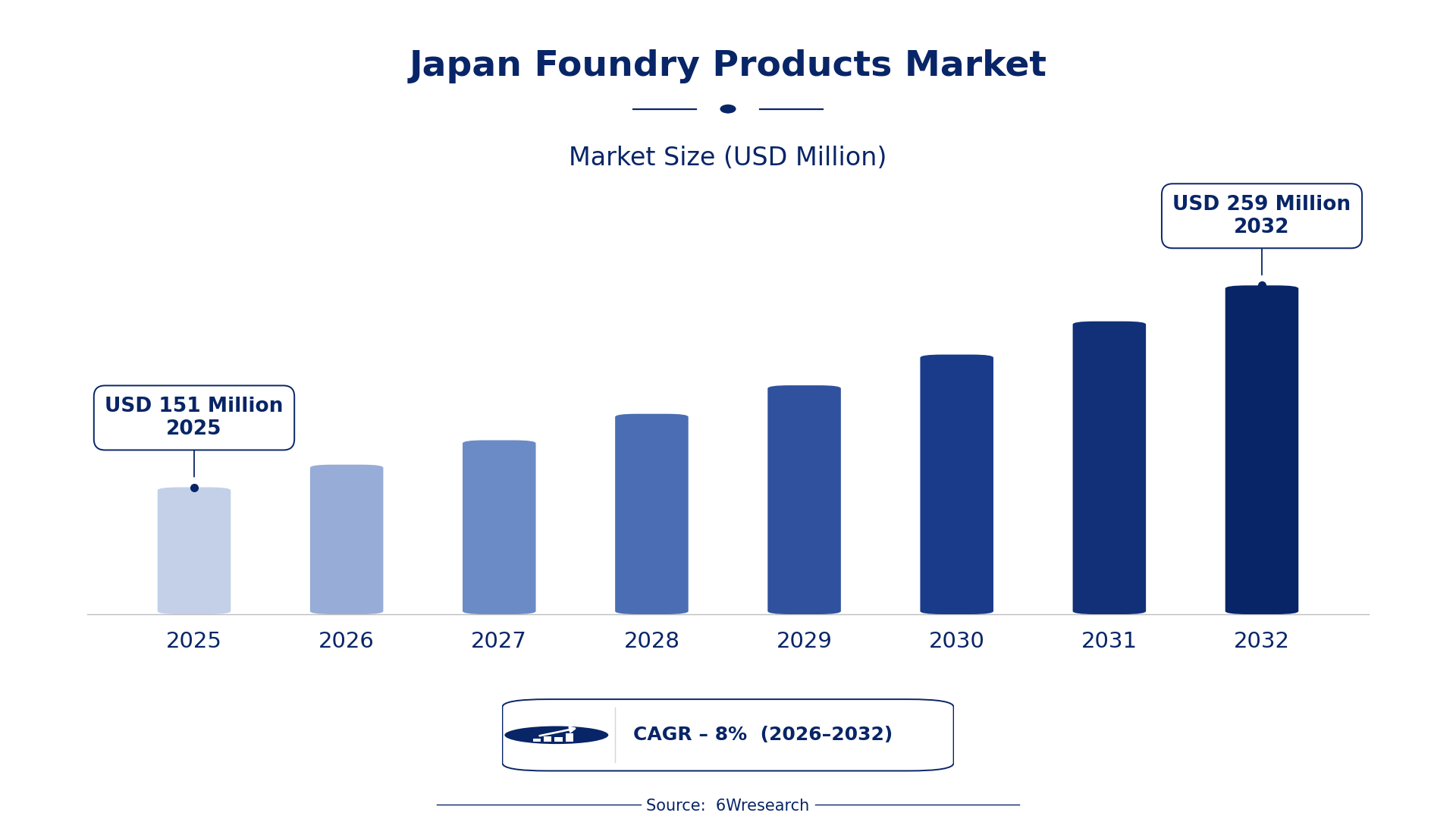
According to 6Wresearch internal database and industry insights, the Japan Foundry Products Market was valued at USD 151 Million in 2025 and is projected to reach USD 259 Million by 2032, growing at a CAGR of approximately 8% during 2026–2032.
Japan Foundry Products Market Highlights
| Report Metric | Details |
| Report Name | Japan Foundry Products Market (2026-2032) |
| Market Size 2025 | USD 151 Million |
| Market Size 2032 | USD 259 Million |
| Absolute Growth 2025–2032 | USD 108 Million |
| CAGR 2026–2032 | 8% |
| Peak Annual Growth | 8.7% in 2029 |
| Forecast Period | 2026–2032 |
| Historical Data | 2022–2025 |
| Base Year | 2025 |
| Leading Product Type, 2025 | Gray Iron Castings (45% share) |
| Leading Material Type, 2025 | Iron (41% share) |
| Leading Casting Process, 2025 | Sand Casting (43% share) |
| Leading Distribution Channel, 2025 | Direct Sales (40% share) |
| Leading End User Sector, 2025 | Automotive Industry (50% share) |
| Fastest-Growing Product Type | Aluminum Castings (11.1% CAGR) |
| Fastest-Growing Material Type | Aluminum Alloys (11.6% CAGR) |
| Fastest-Growing Casting Process | Investment Casting (12.1% CAGR) |
| Fastest-Growing Distribution Channel | OEM Supply Chains (10.6% CAGR) |
| Fastest-Growing End User Sector | Aerospace (10.2% CAGR) |
| Growing Sector | Automotive Industry |
| Key End Users | Automotive manufacturers, construction equipment producers, aerospace companies, agricultural machinery manufacturers |
Japan Foundry Products Market Year-wise Growth Rate and Key Drivers (2022–2032)
This graph illustrates the annual growth rates of the market from 2022 to 2032, highlighting a steady upward trajectory and projected market expansion over the forecast period.
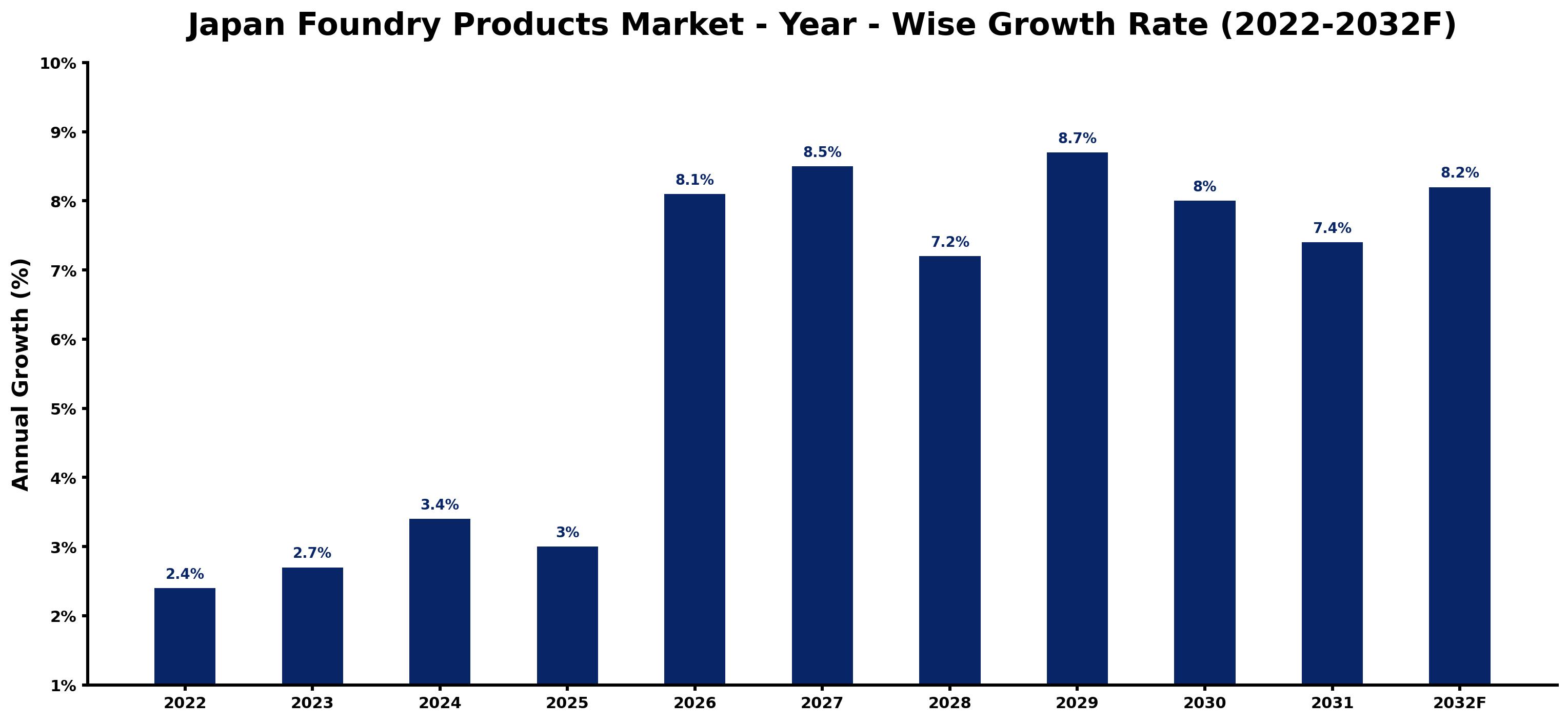
Year by year, the estimates below pair each growth rate with the development that shaped it.
| Year | Estimated Annual Growth (%) | Market Rationale |
| 2022 | 2.4 | The market showed steady demand from the automotive sector, reflecting ongoing production needs. |
| 2023 | 2.7 | Demand increased due to the recovery in manufacturing activities following economic challenges. |
| 2024 | 3.4 | Growth accelerated as automotive production ramped up, benefiting foundry product sales. |
| 2025 | 3.0 | The market experienced a slowdown as growth rates stabilised after previous peaks. |
| 2026 | 8.1 | Demand surged with rising investments in electric vehicle manufacturing and related components. |
| 2027 | 8.5 | Continued growth was driven by increased production capacities in the automotive sector. |
| 2028 | 7.2 | A slight slowdown occurred as the market adjusted to previous high growth rates. |
| 2029 | 8.7 | The peak growth year saw heightened demand driven by innovations in casting technologies. |
| 2030 | 8.0 | Growth moderated as market conditions stabilised following peak demand years. |
| 2031 | 7.4 | The market continued to grow, albeit at a slower pace due to saturation effects. |
| 2032 | 8.2 | Demand is expected to rise again with new applications in lightweight automotive components. |
Note: Market size estimations and growth projections presented in this report are based on 6Wresearch's proprietary forecasting methodology, utilizing the latest available industry data, government publications, and primary research inputs.
Japan Foundry Products Market Synopsis
Foundry products are materials created through casting processes, primarily used in manufacturing metal components such as automotive parts and machinery components. The Japan Foundry Products Market is experiencing growth due to increasing demand from the automotive sector, which accounts for 40% of total demand, alongside investments in electric vehicle manufacturing. The Kanto region serves as a major hub for production, supported by innovation initiatives from the Ministry of Economy, Trade and Industry, which has funded projects to improve production efficiency and sustainability in the foundry sector.
Market Dynamics Impact Analysis (2026–2032)
| Factor | Type | Impact | Primary Segment Affected |
| Rising automotive production | Driver | High | Gray Iron Castings |
| Growing demand for lightweight materials | Driver | High | Aluminum Castings |
| Investment in electric vehicle manufacturing | Opportunity | High | Aluminum Castings |
| Expansion of foundry capabilities in the Kanto region | Opportunity | Medium | Sand Casting |
| High operational costs in foundries | Restraint | High | Ductile Iron Castings |
| Limited availability of skilled labour | Restraint | Medium | Steel Castings |
| Supply chain disruptions affecting raw materials | Challenge | High | Iron |
| Competition from alternative manufacturing processes | Challenge | Medium | Investment Casting |
Evaluation of Drivers in Japan Foundry Products Market (2026–2032)
The following drivers explain most of the expected growth.
| Drivers | Primary Segment Affected | Why It Matters (Evidence) |
| Increased automotive production | Gray Iron Castings | The automotive sector, accounting for 40% of foundry demand, drives purchases of gray iron castings for engine components. |
| Demand for lightweight materials | Aluminum Castings | The rise in electric vehicle production, which uses aluminum castings, has increased demand in recent years. |
| Technological advancements in casting processes | Investment Casting | Improvements in precision casting techniques have led to a rise in investment casting orders from the aerospace sector. |
| Infrastructure development projects | Ductile Iron Castings | Government-funded construction projects have boosted demand for ductile iron castings in heavy machinery. |
| Focus on quality and certification | Steel Castings | The prevalence of certification among foundries has raised buyer confidence, increasing orders. |
Most of the extra volume comes from the automotive sector, which accounted for 40% of foundry product demand in 2022. This has led to a notable increase in aluminum casting orders as electric vehicle production rises. The emphasis on quality, propelled by certification standards, has boosted buyer confidence, resulting in increased purchases of steel castings.
Evaluation of Restraints in Japan Foundry Products Market
Below are the constraints most often cited by buyers and suppliers, with the segment each affects.
| Market Restraint | Primary Segment Affected | Why It Matters (Evidence) |
| High operational costs in foundries | Ductile Iron Castings | Rising energy prices have increased operational costs by 20%, impacting profitability for foundries producing ductile iron castings. |
| Limited availability of skilled labour | Steel Castings | The foundry industry faces a shortage of skilled workers, which has slowed production rates by approximately 15%. |
| Supply chain disruptions affecting raw materials | Iron | Recent global supply chain issues have delayed raw material deliveries, impacting production schedules by 10%. |
| Competition from alternative manufacturing processes | Investment Casting | The rise of 3D printing technologies has created competition, reducing investment casting orders by 8%. |
| Regulatory compliance costs | Aluminum Castings | New environmental regulations have increased compliance costs for aluminum casting manufacturers by 12%. |
Japan Foundry Products Market Challenges
Buyers face rising casting prices, which have surged by 15% due to escalating energy and labour costs. Regulatory pressures from stringent emissions laws compel producers to invest in cleaner technologies, delaying production timelines by an average of three months. Local foundries encounter fierce competition from low-cost international suppliers, forcing them to reduce prices, which can compromise quality for buyers. Limited access to raw materials, particularly specialty alloys, disrupts supply chains, causing delays in delivery for manufacturers that rely on timely sourcing.
Trends in the Japan Foundry Products Market
Four trends stand out in the Japan Foundry Products Market.
- Investment Casting Standards Evolving: Japan's investment casting standards are following JIS H 5302, improving precision and quality. This has led to a 10% increase in orders from the aerospace sector, reflecting a shift towards higher quality requirements.
- Kanto Region Leading Foundry Production: The Kanto region has emerged as a major hub for foundry production, contributing to 60% of total output. This concentration supports economies of scale, driving efficiency and innovation in the sector.
- Rising Demand for Aluminum Castings: Aluminum castings are increasingly used in electric vehicle manufacturing, with a projected growth of 15%. This shift reflects the automotive industry's focus on lightweight materials for improved efficiency.
- Aerospace Sector Driving Precision Castings: The aerospace sector is significantly increasing its demand for precision castings, with a growth rate of 10.2%. This trend highlights the need for high-quality components in safety-critical applications.
Investment Opportunities in the Japan Foundry Products Market
Several openings in the Japan Foundry Products Market merit attention from investors.
- Foundry Products for Electric Vehicles: The growing electric vehicle market presents an opportunity for aluminum castings, projected to grow by 15%. Suppliers can engage with automotive manufacturers in the Kanto region to meet this demand.
- Expansion of Foundry Capabilities: Investment in advanced foundry technologies can improve production efficiency, with the Kanto region showing a 10% increase in capacity. Collaborating with local foundries can facilitate entry into this market.
- Precision Castings for Aerospace: The aerospace sector's increasing demand for precision castings offers opportunities for investment casting suppliers. With a projected growth of 12%, entering this market requires adherence to stringent quality standards.
- Sustainable Foundry Practices: The shift towards sustainable practices in foundries is creating demand for eco-friendly materials. Suppliers can target foundries looking to comply with new regulations, especially in urban areas with high population density.
Government Initiatives in the Japan Foundry Products Market
The Economic Security Promotion Act, enacted in 2022, supports supply-chain resilience for critical products, including foundry materials. This law requires foundries to improve their operational capabilities and invest in technology to maintain competitiveness in the global market. Additionally, it mandates reporting on material sourcing to enhance transparency in the supply chain.
The Ministry of Economy, Trade and Industry oversees the approval of funding for innovation programs aimed at advancing foundry technologies. These initiatives support projects that improve production efficiency and promote sustainable practices within the industry. In 2023, the ministry allocated USD 10 million for such projects, benefiting over 50 foundries.
Future Insight of the Japan Foundry Products Market
The automotive sector will shift towards lightweight materials, driving advancements in casting techniques by 2032. Foundries will adopt advanced automation technologies to enhance production efficiency and lower costs. Stricter environmental standards will require suppliers to invest in sustainable practices, reinforcing their market position. The foundry industry is expected to produce 3 million tons of castings by 2032, indicating a move towards more efficient and eco-friendly production methods.
Market Segmentation Analysis
Japan Foundry Products Market report covers a detailed analysis of the following market segments:
By Product Type – Gray Iron Castings Lead, Aluminum Castings Expected to Grow Fastest
According to Anjali Gupta, Research Analyst at 6Wresearch, Gray Iron Castings took 45% of product type revenue in 2025, more than any other category. Gray iron castings hold the largest share as they are extensively utilised in automotive and machinery parts, which are crucial for Japan's manufacturing sector. Their widespread application in engine blocks and cylinder heads highlights their importance to the automotive industry. Over 2026–2032, Aluminum Castings are expected to post the fastest growth, at a CAGR of 11.1%. Aluminum castings are rapidly gaining popularity, particularly in the electric vehicle segment, which is a significant growth area within the automotive market. The shift towards lightweight materials is expected to further increase demand in the near future. Suppliers must enhance their production capabilities for aluminum castings to meet the rising demand from the automotive sector.
By Material Type – Iron Leads, Aluminum Alloys Expected to Grow Fastest
The largest material type category in 2025 was Iron, at 41% of revenue. Iron is the leading material due to its fundamental role in various casting processes, making it essential for many foundry applications. Its strength and adaptability ensure it remains the preferred choice across a broad range of products. The quickest growth will come from Aluminum Alloys, forecast to expand at a CAGR of 11.6% between 2026 and 2032. Aluminum alloys are experiencing the fastest growth, primarily due to their importance in lightweight and corrosion-resistant applications, especially in the automotive sector. This trend is likely to continue as manufacturers seek to enhance fuel efficiency and performance. Buyers should prioritise sourcing aluminum alloys to capitalise on the increasing demand for lightweight components in their products.
By Casting Process – Sand Casting Leads, Investment Casting Expected to Grow Fastest
In 2025, Sand Casting led the casting process split with a 43% share. Sand casting is the most common method for producing large castings, making it the leading process in the foundry industry. Its widespread application across various sectors ensures a steady demand for this technique. Investment Casting is projected to grow fastest, at a CAGR of 12.1% during 2026–2032. Investment casting is growing rapidly due to its suitability for producing precision parts required in aerospace and automotive applications. The increasing focus on safety and performance in these sectors is driving this trend. Suppliers should invest in advanced technologies for investment casting to cater to the precision requirements of high-demand industries.
By Distribution Channel – Direct Sales Leads, OEM Supply Chains Expected to Grow Fastest
Direct Sales held 40% of the Japan Foundry Products Market by distribution channel in 2025. Direct sales dominate the distribution channel as they are the preferred method for large volume orders, allowing manufacturers to establish strong relationships with their clients. This approach is particularly effective in the foundry sector, where customisation is often required. OEM Supply Chains are set to record the highest CAGR in this split, 10.6% over 2026–2032. OEM supply chains are growing quickly as they are critical for the automotive and machinery sectors, which rely on timely and precise delivery of components. This trend reflects the increasing integration of suppliers within these industries. Suppliers must strengthen their partnerships with OEMs to secure a stable position in the competitive market.
By End User Sector – Automotive Industry Leads, Aerospace Expected to Grow Fastest
With 50% of end user sector revenue in 2025, Automotive Industry was the largest category. The automotive industry is the largest consumer of foundry products, accounting for a substantial portion of overall demand. Its continuous growth and reliance on high-quality components reinforce its leading position in the market. Over 2026–2032, Aerospace is expected to post the fastest growth, at a CAGR of 10.2%. The aerospace sector is witnessing the fastest growth, mainly due to its requirement for precision castings that meet stringent safety and performance standards. As air travel continues to expand, this demand is expected to rise further. Suppliers should explore opportunities within the aerospace sector to diversify their customer base and enhance revenue potential.
Key Attractiveness of the Report
- 10 Years of Market Numbers
- Historical Data Starting from 2022 to 2025
- Base Year 2025
- Forecast Data until 2032
- Key Performance Indicators Impacting the Market
- Major Upcoming Developments and Projects
Key Highlights of the Report:
- Japan Foundry Products Market Outlook
- Market Size of Japan Foundry Products Market, 2025
- Forecast of Japan Foundry Products Market, 2032
- Historical Data and Forecast of Japan Foundry Products Revenues & Volume for the Period 2022-2032F
- Japan Foundry Products Market Trend Evolution
- Japan Foundry Products Market Drivers and Challenges
- Japan Foundry Products Price Trends
- Japan Foundry Products Porter's Five Forces
- Japan Foundry Products Industry Life Cycle
- Historical Data and Forecast of Japan Foundry Products Market Revenues & Volume By Product Type for the Period 2022-2032F
- Historical Data and Forecast of Japan Foundry Products Market Revenues & Volume By Gray Iron Castings for the Period 2022-2032F
- Historical Data and Forecast of Japan Foundry Products Market Revenues & Volume By Steel Castings for the Period 2022-2032F
- Historical Data and Forecast of Japan Foundry Products Market Revenues & Volume By Aluminum Castings for the Period 2022-2032F
- Historical Data and Forecast of Japan Foundry Products Market Revenues & Volume By Ductile Iron Castings for the Period 2022-2032F
- Historical Data and Forecast of Japan Foundry Products Market Revenues & Volume By Material Type for the Period 2022-2032F
- Historical Data and Forecast of Japan Foundry Products Market Revenues & Volume By Iron for the Period 2022-2032F
- Historical Data and Forecast of Japan Foundry Products Market Revenues & Volume By Alloy Steel for the Period 2022-2032F
- Historical Data and Forecast of Japan Foundry Products Market Revenues & Volume By Aluminum Alloys for the Period 2022-2032F
- Historical Data and Forecast of Japan Foundry Products Market Revenues & Volume By Iron for the Period 2022-2032F
- Historical Data and Forecast of Japan Foundry Products Market Revenues & Volume By Casting Process for the Period 2022-2032F
- Historical Data and Forecast of Japan Foundry Products Market Revenues & Volume By Sand Casting for the Period 2022-2032F
- Historical Data and Forecast of Japan Foundry Products Market Revenues & Volume By Investment Casting for the Period 2022-2032F
- Historical Data and Forecast of Japan Foundry Products Market Revenues & Volume By Die Casting for the Period 2022-2032F
- Historical Data and Forecast of Japan Foundry Products Market Revenues & Volume By Centrifugal Casting for the Period 2022-2032F
- Historical Data and Forecast of Japan Foundry Products Market Revenues & Volume By Distribution Channel for the Period 2022-2032F
- Historical Data and Forecast of Japan Foundry Products Market Revenues & Volume By Direct Sales for the Period 2022-2032F
- Historical Data and Forecast of Japan Foundry Products Market Revenues & Volume By Distributors for the Period 2022-2032F
- Historical Data and Forecast of Japan Foundry Products Market Revenues & Volume By OEM Supply Chains for the Period 2022-2032F
- Historical Data and Forecast of Japan Foundry Products Market Revenues & Volume By Online Platforms for the Period 2022-2032F
- Historical Data and Forecast of Japan Foundry Products Market Revenues & Volume By End User Sector for the Period 2022-2032F
- Historical Data and Forecast of Japan Foundry Products Market Revenues & Volume By Automotive Industry for the Period 2022-2032F
- Historical Data and Forecast of Japan Foundry Products Market Revenues & Volume By Construction Equipment for the Period 2022-2032F
- Historical Data and Forecast of Japan Foundry Products Market Revenues & Volume By Aerospace for the Period 2022-2032F
- Historical Data and Forecast of Japan Foundry Products Market Revenues & Volume By Agriculture Machinery for the Period 2022-2032F
- Japan Foundry Products Import Export Trade Statistics
- Market Opportunity Assessment By Product Type
- Market Opportunity Assessment By Material Type
- Market Opportunity Assessment By Casting Process
- Market Opportunity Assessment By Distribution Channel
- Market Opportunity Assessment By End User Sector
- Japan Foundry Products Top Companies Market Share
- Japan Foundry Products Competitive Benchmarking By Technical and Operational Parameters
- Japan Foundry Products Company Profiles
- Japan Foundry Products Key Strategic Recommendations
Market Covered
The following segment groups are covered in the report.
By Product Type
- Gray Iron Castings
- Steel Castings
- Aluminum Castings
- Ductile Iron Castings
By Material Type
- Iron
- Alloy Steel
- Aluminum Alloys
By Casting Process
- Sand Casting
- Investment Casting
- Die Casting
- Centrifugal Casting
By Distribution Channel
- Direct Sales
- Distributors
- OEM Supply Chains
- Online Platforms
By End User Sector
- Automotive Industry
- Construction Equipment
- Aerospace
- Agriculture Machinery






































