Japan Fruit & Vegetable Seeds Market Size & Growth Rate
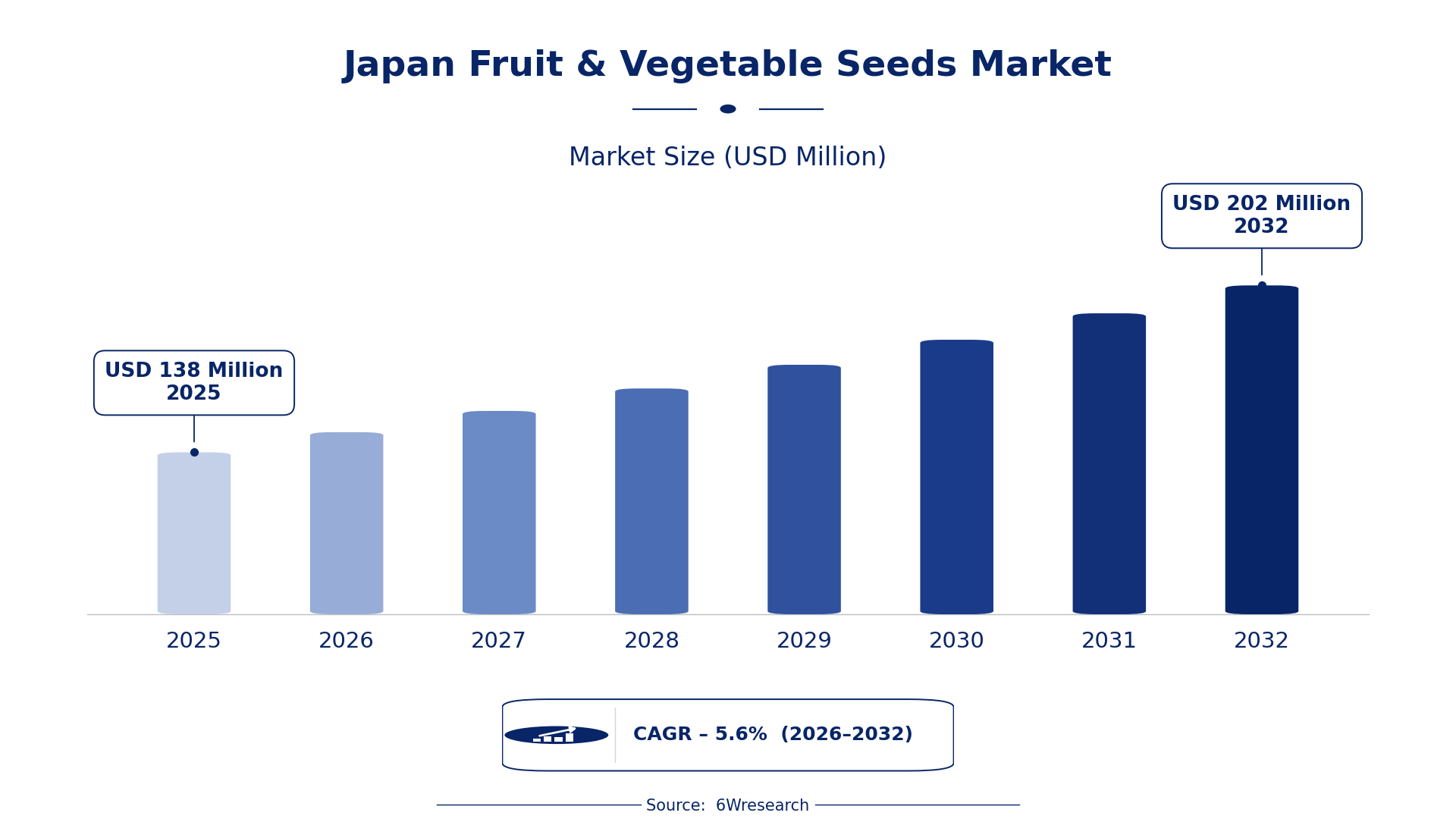
According to 6Wresearch internal database and industry insights, the Japan Fruit & Vegetable Seeds Market was valued at USD 138 Million in 2025 and is projected to reach USD 202 Million by 2032, growing at a CAGR of approximately 5.6% during 2026–2032.
Japan Fruit & Vegetable Seeds Market Highlights
| Report Metric | Details |
| Report Name | Japan Fruit & Vegetable Seeds Market (2026-2032) |
| Market Size 2025 | USD 138 Million |
| Market Size 2032 | USD 202 Million |
| Absolute Growth 2025–2032 | USD 64 Million |
| CAGR 2026–2032 | 5.6% |
| Peak Annual Growth | 6.2% in 2028 |
| Forecast Period | 2026–2032 |
| Historical Data | 2022–2025 |
| Base Year | 2025 |
| Leading Type, 2025 | Brassica (50% share) |
| Leading Trait, 2025 | Genetically Modified (62% share) |
| Leading Category, 2025 | Organic (55% share) |
| Fastest-Growing Type | Cucurbits (7.9% CAGR) |
| Fastest-Growing Trait | Non-Genetically Modified (7.3% CAGR) |
| Fastest-Growing Category | Conventional (7.2% CAGR) |
| Growing Sector | Organic farming |
| Key End Users | Farmers, horticulturists, urban gardeners |
Japan Fruit & Vegetable Seeds Market Year-wise Growth Rate and Key Drivers (2022–2032)
This graph illustrates the annual growth rates of the market from 2022 to 2032, highlighting a steady upward trajectory and projected market expansion over the forecast period.
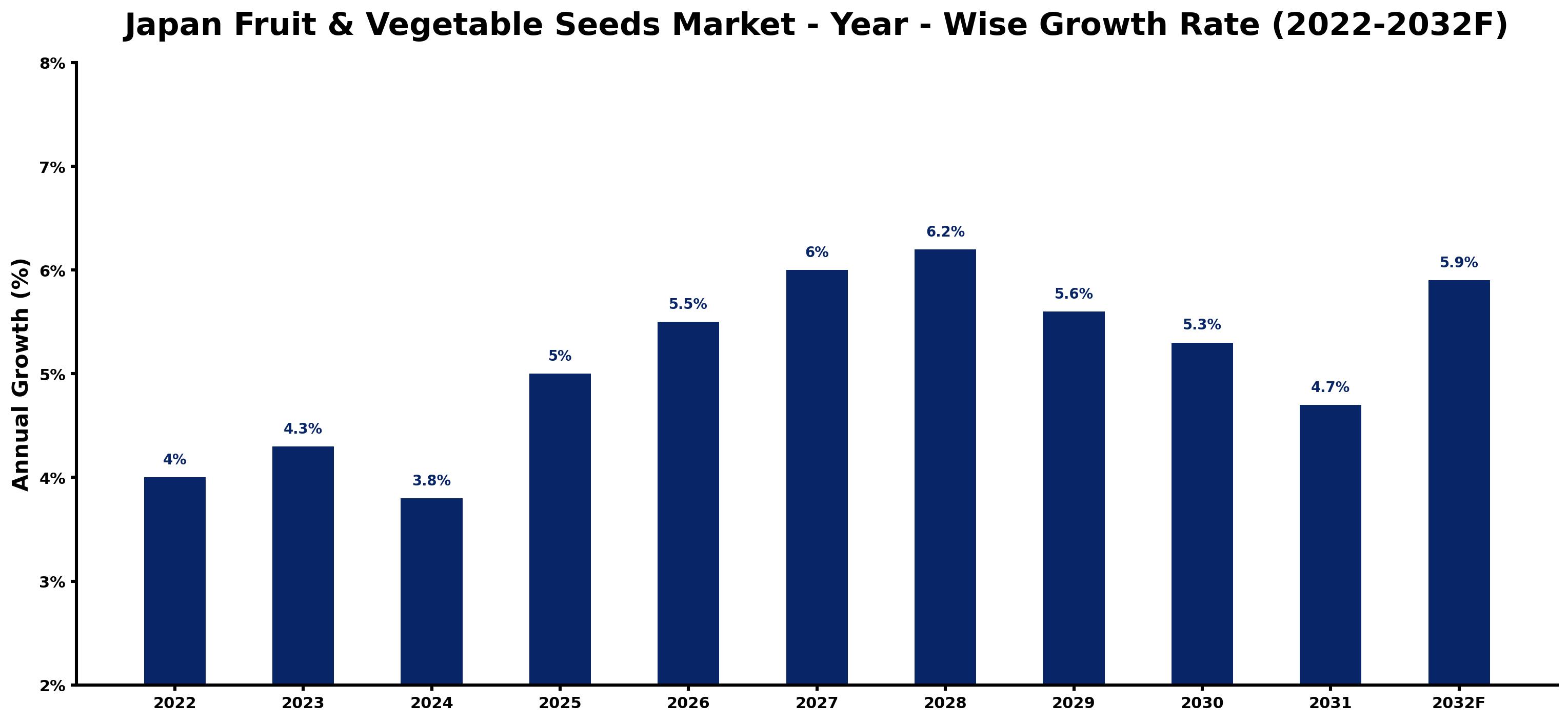
Annual growth estimates for each year appear below with the principal reason behind them, explaining the shifts that set the pace of the market.
| Year | Estimated Annual Growth (%) | Market Rationale |
| 2022 | 4.0 | The market experienced steady growth, supported by consistent agricultural practices and demand from farmers. |
| 2023 | 4.3 | Growth accelerated as farmers increasingly adopted modern seed varieties to improve yields and productivity. |
| 2024 | 3.8 | A slowdown occurred as market preferences shifted towards more selective seed choices and varieties. |
| 2025 | 5.0 | The market rebounded with stronger demand for diverse vegetable crops and improved farming techniques among growers. |
| 2026 | 5.5 | Growth is expected to continue as investments in agricultural technology increase among local farmers. |
| 2027 | 6.0 | Demand is projected to rise further due to heightened interest in sustainable farming practices and organic options. |
| 2028 | 6.2 | The peak growth year will see a surge in organic produce consumption and innovations in seed varieties. |
| 2029 | 5.6 | Growth is expected to slow slightly as market saturation begins to affect new seed introductions and options. |
| 2030 | 5.3 | A further slowdown is projected as farmers adjust to market conditions and crop rotations in response to demand. |
| 2031 | 4.7 | The market will maintain growth due to ongoing interest in diverse vegetable production and sustainable practices. |
| 2032 | 5.9 | Growth is expected to pick up again as consumer preferences shift towards organic and non-GM products, enhancing demand. |
Note: Market size estimations and growth projections presented in this report are based on 6Wresearch's proprietary forecasting methodology, utilizing the latest available industry data, government publications, and primary research inputs.
Japan Fruit & Vegetable Seeds Market Synopsis
Fruit and vegetable seeds are essential biological materials for planting crops, produced through selective breeding or genetic modification to improve traits such as yield and disease resistance. The Japan Fruit & Vegetable Seeds Market is expanding due to rising demand from domestic farmers and horticulturists, alongside increasing interest in organic produce, which has seen a 10% annual growth since 2020. Government initiatives to promote organic farming, including a target to increase organic farmland to 3% by 2025, are stimulating market expansion and encouraging farmers to adopt more sustainable practices.
Market Dynamics Impact Analysis (2026–2032)
| Factor | Type | Impact | Primary Segment Affected |
| Growing interest in organic produce | Driver | High | Organic |
| Increased adoption of genetically modified seeds | Driver | High | Genetically Modified |
| High demand for Cucurbits seeds | Opportunity | Medium | Cucurbits |
| Expansion of urban gardening initiatives | Opportunity | Medium | Others |
| Aging farmer population affecting productivity | Restraint | High | Conventional |
| Limited awareness of seed varieties among new farmers | Restraint | Medium | Organic |
| High production costs for organic seeds | Challenge | High | Organic |
| Regulatory hurdles for genetically modified seeds | Challenge | Medium | Genetically Modified |
Evaluation of Drivers in Japan Fruit & Vegetable Seeds Market (2026–2032)
The factors lifting demand, and the evidence behind each, are summarised below.
| Drivers | Primary Segment Affected | Why It Matters (Evidence) |
| Rising interest in organic farming | Organic | The increasing demand for organic produce drives farmers to seek organic seeds, with organic vegetable consumption growing by 10% annually since 2020. |
| Technological advancements in seed production | Genetically Modified | Improvements in seed technology enhance yield and disease resistance, attracting more buyers looking for reliable and high-quality seeds. |
| Urban gardening trends | Cucurbits | The popularity of urban gardening in regions like Tokyo boosts demand for diverse seed varieties, including cucumbers and melons. |
| Government initiatives promoting organic farming | Non-Genetically Modified | Support for organic farming encourages producers to adopt non-GM seeds, aligning with consumer preferences for organic products. |
| Increased vegetable production | Brassica | The production of vegetables reached around 8.5 million tons in 2022, prompting farmers to invest in high-yield Brassica seeds. |
Purchasing is picking up as the production of vegetables reached around 8.5 million tons in 2022, prompting farmers to seek high-yield seeds. The rising interest in organic produce, which has increased by 10% annually since 2020, drives demand for organic seeds among producers. Technological advancements in seed production ensure quality and reliability, attracting more buyers to the market. Urban gardening trends in the Tokyo region are also contributing to the demand for diverse seed varieties. Support for sustainable practices encourages farmers to adopt organic seeds, increasing overall market activity and engagement.
Evaluation of Restraints in Japan Fruit & Vegetable Seeds Market
Below are the constraints most often cited by buyers and suppliers, with the segment each affects.
| Market Restraint | Primary Segment Affected | Why It Matters (Evidence) |
| Aging farmer population | Conventional | The average age of farmers in Japan is over 67 years, impacting productivity and seed demand significantly. |
| Limited awareness of seed varieties | Organic | New farmers often lack knowledge about diverse seed options, limiting their purchasing decisions and market engagement. |
| High production costs for organic seeds | Organic | Organic seeds typically incur higher production costs, which can deter farmers from transitioning to organic practices. |
| Regulatory hurdles for GM seeds | Genetically Modified | Strict regulations surrounding genetically modified seeds hinder their adoption among farmers, limiting choices available. |
| Market saturation for traditional seeds | Conventional | The dominance of conventional seeds limits opportunities for introducing new varieties and innovations in the market. |
Japan Fruit & Vegetable Seeds Market Challenges
Producers encounter fierce competition from imported seeds, which may reduce local farmers' revenues by 15%. Rising production costs, exacerbated by the average age of farmers exceeding 67 years, can delay planting schedules and inflate seed prices, affecting buyers who depend on timely crop yields. Importers face unpredictable seed availability due to regulatory changes from the Ministry of Agriculture, Forestry and Fisheries, potentially extending procurement times by 20%. Skills shortages among younger workers impede innovation in seed production, limiting options for producers and threatening their market viability.
Trends in the Japan Fruit & Vegetable Seeds Market
Several trends are reshaping the Japan Fruit & Vegetable Seeds Market; the most important are set out below.
- Shift Towards Organic Farming: Farmers are increasingly embracing organic farming practices, with a 10% annual rise in organic vegetable consumption since 2020. The government's goal to increase organic farmland to 3% by 2025 supports this movement, encouraging more farmers to make the transition.
- Rise of Urban Gardening: Urban gardening initiatives are gaining popularity in the Tokyo region, leading to a marked increase in demand for diverse seed varieties. This shift mirrors changing consumer preferences as local community gardens expand and flourish.
- Growing Popularity of Non-GM Seeds: Non-genetically modified seeds are gaining traction among organic farmers, driven by consumer demand for natural products. This trend aligns with the heightened focus on health and sustainability in food production throughout Japan.
- Technological Advancements in Seed Production: Technological advancements are enhancing seed quality and production efficiency. Adhering to quality standards is crucial for meeting the evolving needs of farmers and consumers, ensuring reliable seed options.
Investment Opportunities in the Japan Fruit & Vegetable Seeds Market
Investors looking at the Japan Fruit & Vegetable Seeds Market should consider the following areas.
- Gap in Organic Seed Supply: With organic vegetable consumption increasing by 10% annually, a gap in organic seed supply has emerged. Farmers in rural areas are seeking reliable sources of organic seeds to satisfy this growing demand.
- Urban Gardening Facilities Expansion: The Tokyo region is expanding urban gardening facilities, presenting opportunities for seed suppliers to offer diverse seed varieties. Engaging with local community gardens can facilitate market entry and growth.
- Investment in Non-GM Seed Production: The rising popularity of non-GM seeds offers suppliers an opportunity to invest in production. Organic farmers are increasingly in search of these seeds to align with consumer preferences for natural products.
- Support for Sustainable Practices: The government's target to increase organic farmland to 3% by 2025 generates demand for sustainable farming practices. Suppliers can collaborate with farmers to provide suitable seed varieties that meet this need.
Government Initiatives in the Japan Fruit & Vegetable Seeds Market
The Industrial Standardization Act, amended in 2019, governs product and test standards for seeds, ensuring quality and safety for buyers. Compliance with these standards is essential for producers to access the market and meet consumer expectations effectively. Additionally, the Act promotes transparency in seed production, benefiting both producers and consumers.
The Consumer Affairs Agency oversees regulations that prohibit misleading labelling of seeds. This regulation protects buyers by ensuring transparency and accuracy in seed marketing, fostering trust in the market. The agency also conducts regular inspections to ensure compliance, enhancing consumer confidence.
Future Insight of the Japan Fruit & Vegetable Seeds Market
Farmers will experience a shift in seed variety as the government aims to increase organic farmland to 3% by 2025, creating more organic options. By 2032, advancements in seed production technology will improve disease resistance, potentially raising vegetable output to 10 million tons. The growing trend in organic vegetable consumption will encourage suppliers to expand their product lines. Enhanced distribution networks in the Tokyo region will streamline access to a broader range of seeds for producers and buyers.
Market Segmentation Analysis
Japan Fruit & Vegetable Seeds Market report covers a detailed analysis of the following market segments:
By Type – Brassica Leads, Cucurbits Expected to Grow Fastest
According to Summon Dutta, Assistant Manager at 6Wresearch, Brassica took 50% of type revenue in 2025, more than any other category. Brassica seeds hold the largest share as they are essential for popular vegetable crops like cabbage and broccoli, which are staples in Japanese cuisine. The established distribution network in the Tokyo region enhances the accessibility and availability of these seeds for farmers. Cucurbits are projected to grow fastest, at a CAGR of 7.9% during 2026–2032. Cucurbits are experiencing rapid growth due to shifting consumer preferences towards fresh vegetables like cucumbers and melons, reflecting an increasing focus on health and nutrition. As farmers respond to this trend, the demand for Cucurbits is expected to continue rising. Suppliers should focus on expanding their Cucurbits offerings to align with the growing consumer interest in fresh produce.
By Trait – Genetically Modified Leads, Non-Genetically Modified Expected to Grow Fastest
In 2025, Genetically Modified led the trait split with a 62% share. Genetically Modified seeds lead the market as they offer enhanced traits that improve yield and disease resistance, making them attractive to large-scale agricultural operations. This preference is particularly strong among farmers looking to optimise productivity in a competitive landscape. Over 2026–2032, Non-Genetically Modified is expected to post the fastest growth, at a CAGR of 7.3%. Non-Genetically Modified seeds are rapidly gaining popularity, driven by the rising demand for organic produce from health-conscious consumers. As more farmers transition to organic practices, this segment's growth is set to accelerate further. Buyers may need to revise their procurement strategies to include Non-Genetically Modified seeds in response to changing consumer preferences.
By Category – Organic Leads, Conventional Expected to Grow Fastest
The largest category category in 2025 was Organic, at 55% of revenue. Organic seeds dominate the market, propelled by a growing consumer demand for organic produce, especially among health-conscious individuals. Government initiatives aimed at promoting organic farming further strengthen this segment's position. Conventional is set to record the highest CAGR in this split, 7.2% over 2026–2032. Conventional seeds are witnessing notable growth as traditional farming practices remain widespread, supported by established infrastructure and farmer familiarity. This segment is expected to continue expanding as it plays a key role in satisfying food production needs. Suppliers should ensure their product range includes both Organic and Conventional seeds to cater to diverse market demands.
Key Attractiveness of the Report
- 10 Years of Market Numbers
- Historical Data Starting from 2022 to 2025
- Base Year 2025
- Forecast Data until 2032
- Key Performance Indicators Impacting the Market
- Major Upcoming Developments and Projects
Key Highlights of the Report:
- Japan Fruit & Vegetable Seeds Market Outlook
- Market Size of Japan Fruit & Vegetable Seeds Market, 2025
- Forecast of Japan Fruit & Vegetable Seeds Market, 2032
- Historical Data and Forecast of Japan Fruit & Vegetable Seeds Revenues & Volume for the Period 2022-2032
- Japan Fruit & Vegetable Seeds Market Trend Evolution
- Japan Fruit & Vegetable Seeds Market Drivers and Challenges
- Japan Fruit & Vegetable Seeds Price Trends
- Japan Fruit & Vegetable Seeds Porter's Five Forces
- Japan Fruit & Vegetable Seeds Industry Life Cycle
- Historical Data and Forecast of Japan Fruit & Vegetable Seeds Market Revenues & Volume By Type for the Period 2022-2032
- Historical Data and Forecast of Japan Fruit & Vegetable Seeds Market Revenues & Volume By Brassica for the Period 2022-2032
- Historical Data and Forecast of Japan Fruit & Vegetable Seeds Market Revenues & Volume By Cucurbits for the Period 2022-2032
- Historical Data and Forecast of Japan Fruit & Vegetable Seeds Market Revenues & Volume By Solanaceae for the Period 2022-2032
- Historical Data and Forecast of Japan Fruit & Vegetable Seeds Market Revenues & Volume By Amaryllidaceous for the Period 2022-2032
- Historical Data and Forecast of Japan Fruit & Vegetable Seeds Market Revenues & Volume By Citrus Family for the Period 2022-2032
- Historical Data and Forecast of Japan Fruit & Vegetable Seeds Market Revenues & Volume By Others for the Period 2022-2032
- Historical Data and Forecast of Japan Fruit & Vegetable Seeds Market Revenues & Volume By Trait for the Period 2022-2032
- Historical Data and Forecast of Japan Fruit & Vegetable Seeds Market Revenues & Volume By Genetically Modified for the Period 2022-2032
- Historical Data and Forecast of Japan Fruit & Vegetable Seeds Market Revenues & Volume By Non-Genetically Modified for the Period 2022-2032
- Historical Data and Forecast of Japan Fruit & Vegetable Seeds Market Revenues & Volume By Category for the Period 2022-2032
- Historical Data and Forecast of Japan Fruit & Vegetable Seeds Market Revenues & Volume By Organic for the Period 2022-2032
- Historical Data and Forecast of Japan Fruit & Vegetable Seeds Market Revenues & Volume By Conventional for the Period 2022-2032
- Japan Fruit & Vegetable Seeds Import Export Trade Statistics
- Market Opportunity Assessment By Type
- Market Opportunity Assessment By Trait
- Market Opportunity Assessment By Category
- Japan Fruit & Vegetable Seeds Top Companies Market Share
- Japan Fruit & Vegetable Seeds Competitive Benchmarking By Technical and Operational Parameters
- Japan Fruit & Vegetable Seeds Company Profiles
- Japan Fruit & Vegetable Seeds Key Strategic Recommendations
Market Covered
The following segment groups are covered in the report.
By Type
- Brassica
- Cucurbits
- Solanaceae
- Amaryllidaceous
- Citrus Family
- Others
By Trait
- Genetically Modified
- Non-Genetically Modified
By Category
- Organic
- Conventional






































