Japan Geotextiles for Agriculture Market Size & Growth Rate
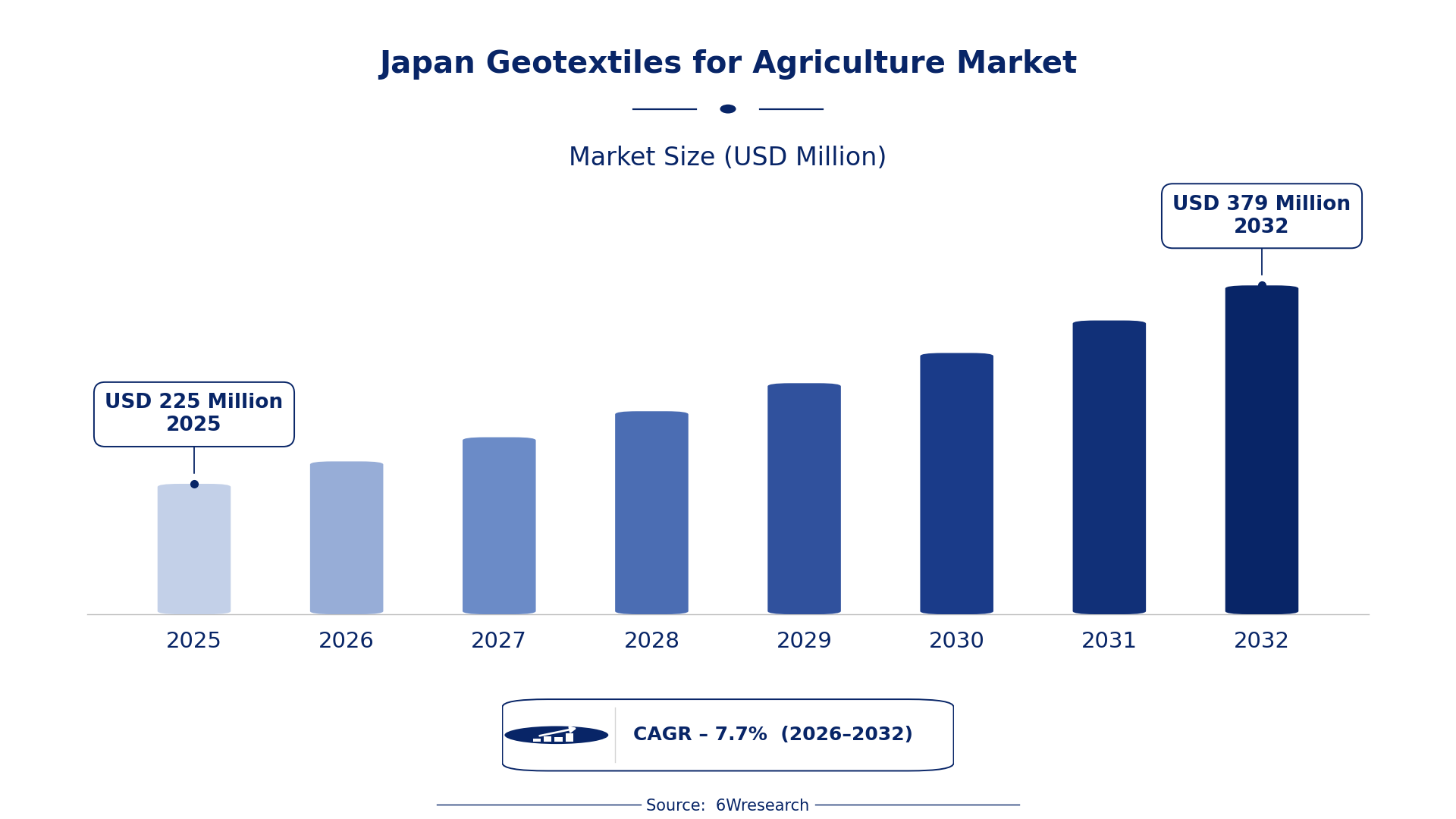
According to 6Wresearch internal database and industry insights, the Japan Geotextiles for Agriculture Market was valued at USD 225 Million in 2025 and is projected to reach USD 379 Million by 2032, growing at a CAGR of approximately 7.7% during 2026–2032.
Japan Geotextiles for Agriculture Market Highlights
| Report Metric | Details |
| Report Name | Japan Geotextiles for Agriculture Market (2026-2032) |
| Market Size 2025 | USD 225 Million |
| Market Size 2032 | USD 379 Million |
| Absolute Growth 2025–2032 | USD 154 Million |
| CAGR 2026–2032 | 7.7% |
| Peak Annual Growth | 9.1% in 2032 |
| Forecast Period | 2026–2032 |
| Historical Data | 2022–2025 |
| Base Year | 2025 |
| Leading Product Type, 2025 | Woven Geotextiles (37% share) |
| Leading Material Type, 2025 | Polypropylene (40% share) |
| Leading End User, 2025 | Farmers (36% share) |
| Leading Function, 2025 | Soil Stabilization (41% share) |
| Fastest-Growing Product Type | Biodegradable Mats (11.3% CAGR) |
| Fastest-Growing Material Type | Jute (10.9% CAGR) |
| Fastest-Growing End User | Greenhouses (10.4% CAGR) |
| Fastest-Growing Function | Weed Suppression (10.1% CAGR) |
| Growing Sector | Agriculture |
| Key End Users | Farmers, Agricultural Co-ops, Greenhouses, Agro Engineering Firms |
Japan Geotextiles for Agriculture Market Year-wise Growth Rate and Key Drivers (2022–2032)
This graph illustrates the annual growth rates of the market from 2022 to 2032, highlighting a steady upward trajectory and projected market expansion over the forecast period.
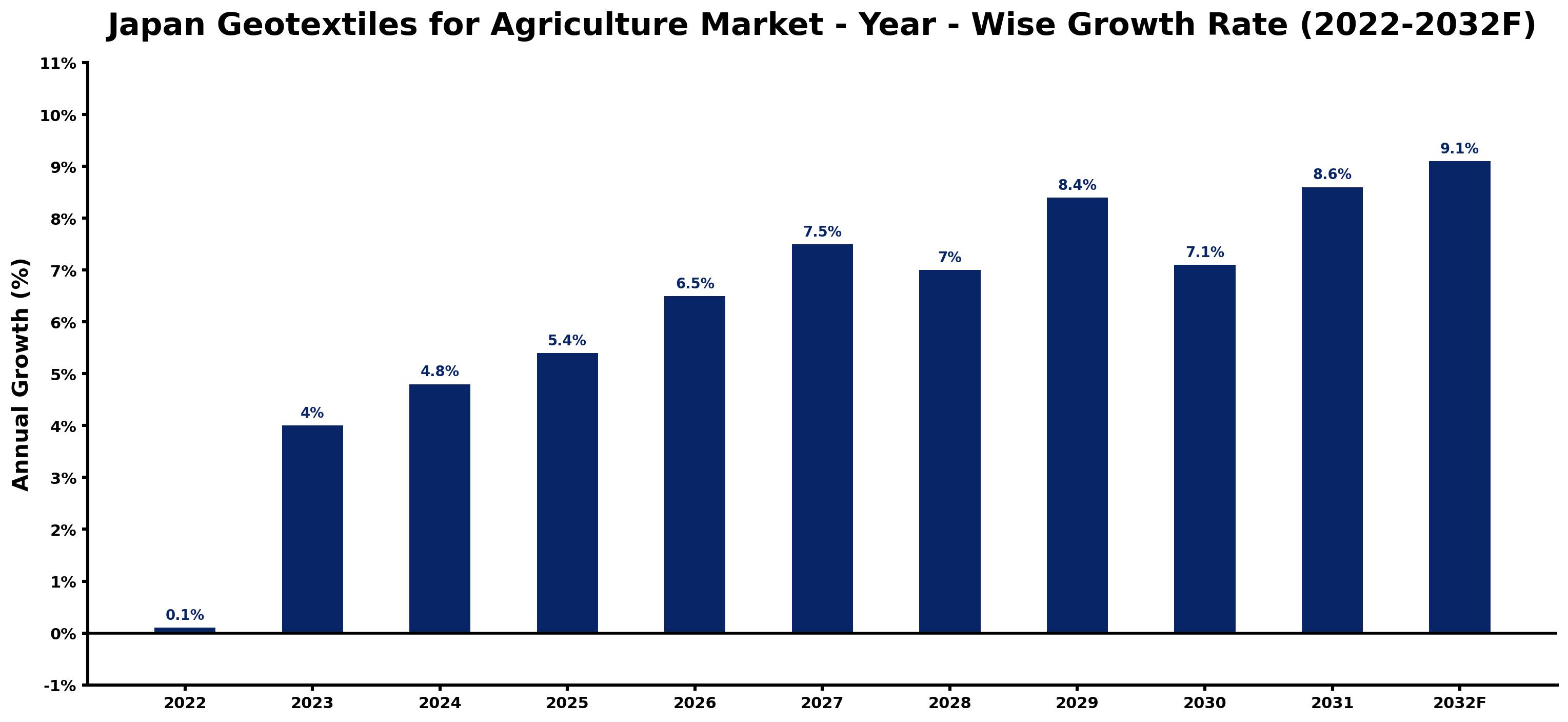
Below, each year's estimated growth is shown next to the factor that most influenced it.
| Year | Estimated Annual Growth (%) | Market Rationale |
| 2022 | 0.1 | The agricultural sector showed minimal growth with ongoing adaptation to geotextile technologies. |
| 2023 | 4.0 | Increased awareness of soil management techniques led to faster growth in geotextile adoption. |
| 2024 | 4.8 | Rising demand for efficient farming practices contributed to continued growth in the sector. |
| 2025 | 5.4 | The agricultural output's value prompted further investment in geotextile solutions for soil stability. |
| 2026 | 6.5 | Demand for sustainable farming practices is expected to drive higher geotextile usage. |
| 2027 | 7.5 | Growing interest in agricultural solutions will support increased spending on geotextiles. |
| 2028 | 7.0 | The market experiences a slowdown as growth stabilises after rapid increases in previous years. |
| 2029 | 8.4 | Enhanced focus on erosion control measures will lead to renewed interest in geotextiles. |
| 2030 | 7.1 | Market growth is projected to slow slightly as adoption rates reach a more mature phase. |
| 2031 | 8.6 | Increased collaboration between agro engineering firms and farmers fuels demand for geotextiles. |
| 2032 | 9.1 | The market peaks as geotextile applications expand significantly in sustainable agriculture. |
Note: Market size estimations and growth projections presented in this report are based on 6Wresearch's proprietary forecasting methodology, utilizing the latest available industry data, government publications, and primary research inputs.
Japan Geotextiles for Agriculture Market Synopsis
Geotextiles for agriculture are synthetic or natural fabrics designed to improve soil stability, manage water drainage, and control erosion in farming. In Japan, these materials are increasingly adopted, particularly in rice paddies and for weed suppression. The Japan Geotextiles for Agriculture Market is expanding due to rising agricultural output valued at approximately 8 trillion yen and government support for sustainable practices. The average age of farmers, around 66 years, drives demand for easier farming solutions, leading to more investments in geotextiles.
Market Dynamics Impact Analysis (2026–2032)
| Factor | Type | Impact | Primary Segment Affected |
| Increased focus on sustainable farming practices | Driver | High | Woven Geotextiles |
| Rising agricultural output value | Driver | High | Non-Woven Geotextiles |
| Growing demand for biodegradable options | Opportunity | High | Biodegradable Mats |
| Expansion of agricultural cooperatives supporting farmers | Opportunity | Medium | Agricultural Co-ops |
| Aging farmer population affecting adoption rates | Restraint | High | Farmers |
| Limited awareness of geotextile benefits among new farmers | Restraint | Medium | Greenhouses |
| High initial investment costs for geotextile installation | Challenge | High | Agro Engineering Firms |
| Competition from traditional soil management methods | Challenge | Medium | Soil Stabilization |
Evaluation of Drivers in Japan Geotextiles for Agriculture Market (2026–2032)
Key forces behind demand, with the segment each one moves most, are listed below.
| Drivers | Primary Segment Affected | Why It Matters (Evidence) |
| Increased adoption of sustainable farming practices | Woven Geotextiles | Government initiatives promoting eco-friendly agriculture are driving higher demand among farmers. |
| Rising agricultural output value | Non-Woven Geotextiles | As the annual agricultural output reaches approximately 8 trillion yen, farmers invest in effective water drainage solutions. |
| Growing popularity of biodegradable mats | Biodegradable Mats | Support for organic farming is increasing the adoption of biodegradable mats among eco-conscious farmers. |
| Collaboration between agro engineering firms and universities | Agro Engineering Firms | Research partnerships are creating new geotextile applications, improving product offerings for farmers. |
| Increased focus on erosion control measures | Erosion Control | The need for effective erosion control in landslide-prone prefectures drives demand for geotextiles. |
Spending rises because the annual agricultural output in Japan is valued at approximately 8 trillion yen, prompting farmers to invest in effective soil management solutions. The average age of farmers, around 66 years, increases demand for easier farming methods, which boosts geotextile adoption. Research partnerships between agro engineering firms and universities lead to tailored solutions for specific agricultural needs. Consequently, there is a notable rise in demand for woven and non-woven geotextiles.
Evaluation of Restraints in Japan Geotextiles for Agriculture Market
The key brakes on demand, and where they bite hardest, are shown below.
| Market Restraint | Primary Segment Affected | Why It Matters (Evidence) |
| High initial investment costs for geotextile installation | Woven Geotextiles | Farmers face financial barriers when adopting new technologies, limiting their ability to invest in geotextiles. |
| Limited awareness of geotextile benefits among new farmers | Non-Woven Geotextiles | Many new farmers lack knowledge about the advantages of geotextiles, slowing market growth. |
| Aging farmer population affecting adoption rates | Biodegradable Mats | As the average age of farmers increases, the willingness to adopt new technologies may decline. |
| Competition from traditional soil management methods | Soil Stabilization | Farmers often prefer established practices, which can hinder the adoption of geotextiles. |
| Regulatory hurdles in material approval processes | UV-Stabilized Fabrics | Complex testing and certification requirements can delay market entry for new geotextile products. |
Japan Geotextiles for Agriculture Market Challenges
Producers face fierce competition from cheaper imports, which forces local manufacturers to reduce prices and affects profit margins. Importers struggle with high logistics costs due to Japan's geographical layout, raising prices for agricultural cooperatives reliant on timely product delivery. Strict compliance with ISO 9001 and JIS standards complicates supplier operations, often causing delays that hinder farmers' access to necessary materials. A shortage of skilled workers proficient in modern farming techniques limits the effective use of geotextiles, potentially impacting crop yields for small-scale farmers managing an average of 1.5 hectares.
Trends in the Japan Geotextiles for Agriculture Market
The trends below show where the Japan Geotextiles for Agriculture Market is heading.
- Shift towards Biodegradable Mats: The adoption of biodegradable mats is increasing in organic farming, supported by government initiatives. In 2023, funding for research into advanced materials was allocated, encouraging farmers to choose eco-friendly options.
- Greenhouses Embracing UV-Stabilized Fabrics: Greenhouses are increasingly utilizing UV-stabilized fabrics for crop protection, improving yield quality. The Tohoku region has seen a rise in such applications, with a notable increase in adoption rates.
- Rise of Non-Woven Geotextiles: Non-woven geotextiles are gaining popularity for their drainage capabilities, especially in rice paddies. This trend is evident in the agricultural practices of the Tohoku region, where effective water management is essential.
- Focus on Erosion Control Practices: Erosion control practices are mandated in certain prefectures prone to landslides, driving demand for geotextiles. This regulatory push is evident in areas with significant agricultural activity.
Investment Opportunities in the Japan Geotextiles for Agriculture Market
Investors looking at the Japan Geotextiles for Agriculture Market should consider the following areas.
- Timing for Sustainable Practices: With the Japanese government targeting increased adoption of sustainable agricultural practices by 2025, there is an opportunity for suppliers of geotextiles. Farmers are looking for solutions to improve soil management.
- Investment in Research Facilities: The Tohoku region is becoming a hub for agricultural innovation, creating opportunities for investment in geotextile research facilities. Collaborating with local universities can lead to advancements in material technology.
- Growing Demand from Agricultural Co-ops: Agricultural cooperatives are expanding their support for farmers, creating opportunities for geotextile suppliers. By partnering with these co-ops, suppliers can gain access to a broader customer base.
- Expansion of Greenhouse Applications: As greenhouses increasingly adopt geotextiles for soil management, there is an opportunity to supply UV-stabilized fabrics. This trend is particularly strong in the Tohoku region, where crop protection is essential.
Government Initiatives in the Japan Geotextiles for Agriculture Market
The Waste Management and Public Cleansing Act of 1970 governs the treatment and disposal of waste, affecting geotextile production by ensuring adherence to environmental standards. The Water Supply Act of 1957 establishes quality standards for water management in agriculture, influencing the use of geotextiles in farming.
In 2023, funding for research into advanced geotextile materials was allocated, overseen by the Ministry of Agriculture, Forestry and Fisheries. This initiative aims to drive innovation in agricultural practices, providing farmers with improved soil management solutions.
Future Insight of the Japan Geotextiles for Agriculture Market
By 2032, domestic farmers will increasingly adopt advanced geotextile materials as government programs promote agricultural innovation. The integration of smart farming technologies will streamline geotextile application processes, enhancing soil management practices. A heightened focus on biodegradable geotextiles will support sustainability targets set for 2025, creating new opportunities for suppliers. These advancements are expected to boost productivity across Japan's agricultural sector, delivering substantial benefits for both buyers and suppliers.
Market Segmentation Analysis
Japan Geotextiles for Agriculture Market report covers a detailed analysis of the following market segments:
By Product Type – Woven Geotextiles Lead, Biodegradable Mats Expected to Grow Fastest
According to Vasu Joshi, Associate Consultant at 6Wresearch, Woven Geotextiles took 37% of product type revenue in 2025, more than any other category. Woven geotextiles dominate the market due to their essential role in soil stabilization and erosion control, particularly in the Tohoku region where agricultural activities are prevalent. Their widespread application across over 4 million hectares of arable land highlights their importance to local farmers. Biodegradable Mats are projected to grow fastest, at a CAGR of 11.3% during 2026–2032. The growth of biodegradable mats is propelled by the increasing focus on sustainable farming practices, with government initiatives encouraging organic agriculture. This shift is evident as farmers actively seek eco-friendly solutions to improve their operations. Suppliers should prioritise the development of biodegradable options to meet the rising demand from environmentally conscious farmers.
By Material Type – Polypropylene Leads, Jute Expected to Grow Fastest
Polypropylene accounted for 40% of the market by material type in 2025. Polypropylene holds the largest share in the market because of its durability and cost-effectiveness, making it the preferred material for various agricultural applications. Its extensive use aligns well with the practical needs of Japan's agricultural sector. Over 2026–2032, Jute is expected to post the fastest growth, at a CAGR of 10.9%. Jute is experiencing rapid growth as a biodegradable alternative, particularly in organic farming, where its environmental benefits are gaining recognition. The government's support for sustainable practices is further driving its adoption among farmers. Buyers will benefit from a broader selection of material options as suppliers expand their product ranges to include more sustainable alternatives.
By End User – Farmers Lead, Greenhouses Expected to Grow Fastest
With 36% of end user revenue in 2025, Farmers was the largest category. Farmers represent the largest segment of end users as they are the primary consumers of geotextiles for soil management and crop protection. With approximately 1.5 million individuals employed in the agricultural sector, their demand significantly drives the market. Greenhouses are set to record the highest CAGR in this split, 10.4% over 2026–2032. Greenhouses are increasingly utilising geotextiles, particularly for soil management and plant protection, as they seek to optimise growing conditions. This trend is influenced by the average farm size of 1.5 hectares, necessitating efficient land management solutions. Suppliers should focus on developing tailored products for greenhouse operators to capitalise on this expanding segment.
By Function – Soil Stabilization Leads, Weed Suppression Expected to Grow Fastest
The largest function category in 2025 was Soil Stabilization, at 41% of revenue. Soil stabilization is the key function of geotextiles, crucial for maintaining soil integrity and preventing erosion in agricultural fields. This function is especially vital in regions prone to landslides, where effective soil management practices are essential. The quickest growth will come from Weed Suppression, forecast to expand at a CAGR of 10.1% between 2026 and 2032. Weed suppression is becoming increasingly important as it minimises competition with crops, particularly in organic farming contexts. The growing emphasis on sustainable practices is further accelerating this trend. Suppliers should enhance their product offerings in weed suppression solutions to address the rising demand from farmers prioritising sustainable agriculture.
Key Attractiveness of the Report
- 10 Years of Market Numbers
- Historical Data Starting from 2022 to 2025
- Base Year 2025
- Forecast Data until 2032
- Key Performance Indicators Impacting the Market
- Major Upcoming Developments and Projects
Key Highlights of the Report:
- Japan Geotextiles for Agriculture Market Outlook
- Market Size of Japan Geotextiles for Agriculture Market, 2025
- Forecast of Japan Geotextiles for Agriculture Market, 2032
- Historical Data and Forecast of Japan Geotextiles for Agriculture Revenues & Volume for the Period 2022-2032F
- Japan Geotextiles for Agriculture Market Trend Evolution
- Japan Geotextiles for Agriculture Market Drivers and Challenges
- Japan Geotextiles for Agriculture Price Trends
- Japan Geotextiles for Agriculture Porter's Five Forces
- Japan Geotextiles for Agriculture Industry Life Cycle
- Historical Data and Forecast of Japan Geotextiles for Agriculture Market Revenues & Volume By Product Type for the Period 2022-2032F
- Historical Data and Forecast of Japan Geotextiles for Agriculture Market Revenues & Volume By Woven Geotextiles for the Period 2022-2032F
- Historical Data and Forecast of Japan Geotextiles for Agriculture Market Revenues & Volume By Non-Woven Geotextiles for the Period 2022-2032F
- Historical Data and Forecast of Japan Geotextiles for Agriculture Market Revenues & Volume By Biodegradable Mats for the Period 2022-2032F
- Historical Data and Forecast of Japan Geotextiles for Agriculture Market Revenues & Volume By UV-Stabilized Fabrics for the Period 2022-2032F
- Historical Data and Forecast of Japan Geotextiles for Agriculture Market Revenues & Volume By Material Type for the Period 2022-2032F
- Historical Data and Forecast of Japan Geotextiles for Agriculture Market Revenues & Volume By Polypropylene for the Period 2022-2032F
- Historical Data and Forecast of Japan Geotextiles for Agriculture Market Revenues & Volume By Polyester for the Period 2022-2032F
- Historical Data and Forecast of Japan Geotextiles for Agriculture Market Revenues & Volume By Jute for the Period 2022-2032F
- Historical Data and Forecast of Japan Geotextiles for Agriculture Market Revenues & Volume By HDPE for the Period 2022-2032F
- Historical Data and Forecast of Japan Geotextiles for Agriculture Market Revenues & Volume By End User for the Period 2022-2032F
- Historical Data and Forecast of Japan Geotextiles for Agriculture Market Revenues & Volume By Farmers for the Period 2022-2032F
- Historical Data and Forecast of Japan Geotextiles for Agriculture Market Revenues & Volume By Agricultural Co-ops for the Period 2022-2032F
- Historical Data and Forecast of Japan Geotextiles for Agriculture Market Revenues & Volume By Greenhouses for the Period 2022-2032F
- Historical Data and Forecast of Japan Geotextiles for Agriculture Market Revenues & Volume By Agro Engineering Firms for the Period 2022-2032F
- Historical Data and Forecast of Japan Geotextiles for Agriculture Market Revenues & Volume By Function for the Period 2022-2032F
- Historical Data and Forecast of Japan Geotextiles for Agriculture Market Revenues & Volume By Soil Stabilization for the Period 2022-2032F
- Historical Data and Forecast of Japan Geotextiles for Agriculture Market Revenues & Volume By Water Drainage for the Period 2022-2032F
- Historical Data and Forecast of Japan Geotextiles for Agriculture Market Revenues & Volume By Erosion Control for the Period 2022-2032F
- Historical Data and Forecast of Japan Geotextiles for Agriculture Market Revenues & Volume By Weed Suppression for the Period 2022-2032F
- Japan Geotextiles for Agriculture Import Export Trade Statistics
- Market Opportunity Assessment By Product Type
- Market Opportunity Assessment By Material Type
- Market Opportunity Assessment By End User
- Market Opportunity Assessment By Function
- Japan Geotextiles for Agriculture Top Companies Market Share
- Japan Geotextiles for Agriculture Competitive Benchmarking By Technical and Operational Parameters
- Japan Geotextiles for Agriculture Company Profiles
- Japan Geotextiles for Agriculture Key Strategic Recommendations
Market Covered
The following segment groups are covered in the report.
By Product Type
- Woven Geotextiles
- Non-Woven Geotextiles
- Biodegradable Mats
- UV-Stabilized Fabrics
By Material Type
- Polypropylene
- Polyester
- Jute
- HDPE
By End User
- Farmers
- Agricultural Co-ops
- Greenhouses
- Agro Engineering Firms
By Function
- Soil Stabilization
- Water Drainage
- Erosion Control
- Weed Suppression






































