Japan Gesture Recognition For Smart TV Market Size & Growth Rate
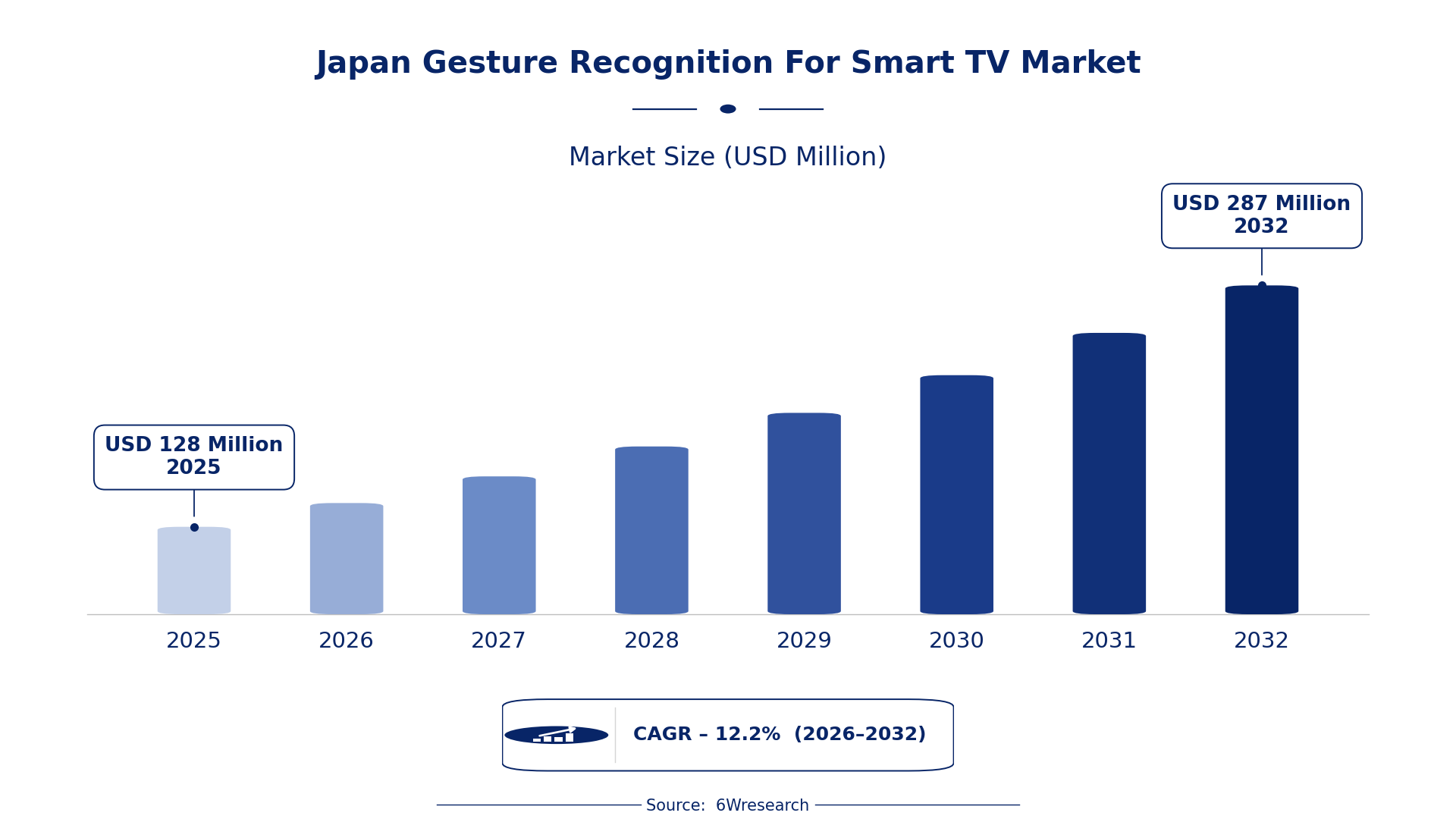
According to 6Wresearch internal database and industry insights, the Japan Gesture Recognition For Smart TV Market was valued at USD 128 Million in 2025 and is projected to reach USD 287 Million by 2032, growing at a CAGR of approximately 12.2% during 2026–2032.
Japan Gesture Recognition For Smart TV Market Highlights
| Report Metric | Details |
| Report Name | Japan Gesture Recognition For Smart TV Market (2026-2032) |
| Market Size 2025 | USD 128 Million |
| Market Size 2032 | USD 287 Million |
| Absolute Growth 2025–2032 | USD 159 Million |
| CAGR 2026–2032 | 12.2% |
| Peak Annual Growth | 15.6% in 2032 |
| Forecast Period | 2026–2032 |
| Historical Data | 2022–2025 |
| Base Year | 2025 |
| Leading Product Type, 2025 | Software (2D and 3D Image Sensor) (65% share) |
| Leading Application, 2025 | Commercial (58% share) |
| Fastest-Growing Product Type | Hardware(Image Sensor, IR Proximity Sensor, IR Temperature Sensor) (13.5% CAGR) |
| Fastest-Growing Application | Household (16.0% CAGR) |
| Growing Sector | Household |
| Key End Users | Commercial, Household |
Japan Gesture Recognition For Smart TV Market Year-wise Growth Rate and Key Drivers (2022–2032)
This graph illustrates the annual growth rates of the market from 2022 to 2032, highlighting a steady upward trajectory and projected market expansion over the forecast period.
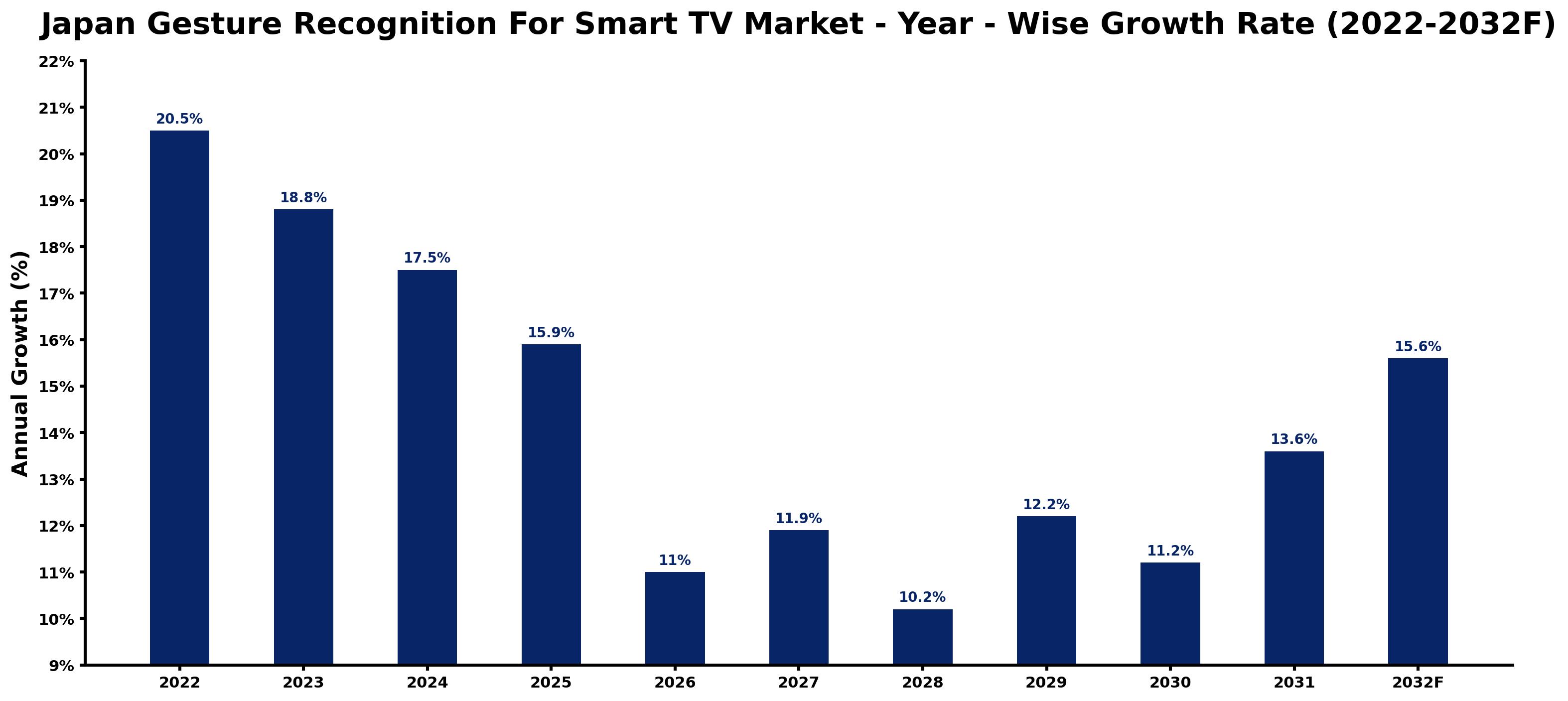
Year by year, the estimates below pair each growth rate with the development that shaped it.
| Year | Estimated Annual Growth (%) | Market Rationale |
| 2022 | 20.5 | The market showed strong momentum with high consumer interest in smart TVs. |
| 2023 | 18.8 | Growth slowed as market saturation began to affect new purchases. |
| 2024 | 17.5 | Consumer interest remained, but the pace of growth continued to decelerate. |
| 2025 | 15.9 | A further slowdown occurred as competition intensified among brands. |
| 2026 | 11.0 | Growth is expected to slow due to market maturity and limited new technological advancements. |
| 2027 | 11.9 | Increased adoption of gesture recognition technology is projected to spur renewed interest. |
| 2028 | 10.2 | A slight slowdown is anticipated as consumers become more selective. |
| 2029 | 12.2 | A resurgence in demand is expected as new features attract buyers' attention. |
| 2030 | 11.2 | Growth will slow again as the market begins to stabilise after rapid changes. |
| 2031 | 13.6 | A rise in consumer engagement with smart TVs is expected to drive demand higher. |
| 2032 | 15.6 | The market is projected to peak as gesture recognition becomes a standard feature. |
Note: Market size estimations and growth projections presented in this report are based on 6Wresearch's proprietary forecasting methodology, utilizing the latest available industry data, government publications, and primary research inputs.
Japan Gesture Recognition For Smart TV Market Synopsis
Gesture recognition for smart TVs interprets human gestures through sensors and advanced image processing algorithms, allowing hands-free control. The Japan Gesture Recognition For Smart TV Market is growing, with a 25% adoption rate in 2023, driven by a tech-savvy population and substantial investments in smart home technology. Annual investment in smart TV technology is estimated at 1 billion yen, reflecting the increasing demand for features that improve user interaction with devices and convenience in households.
Market Dynamics Impact Analysis (2026–2032)
| Factor | Type | Impact | Primary Segment Affected |
| Growing consumer interest in smart home technology | Driver | High | Software (2D and 3D Image Sensor) |
| Increased investment in gesture recognition technology | Driver | High | Hardware(Image Sensor, IR Proximity Sensor, IR Temperature Sensor) |
| Expansion of commercial applications in retail environments | Opportunity | Medium | Commercial |
| Rising demand for smart TVs in urban areas | Opportunity | High | Household |
| Market saturation limiting growth potential | Restraint | High | Software (2D and 3D Image Sensor) |
| High competition among manufacturers affecting pricing strategies | Restraint | Medium | Hardware(Image Sensor, IR Proximity Sensor, IR Temperature Sensor) |
| Supply chain challenges impacting component availability | Challenge | High | Software (2D and 3D Image Sensor) |
| Technological advancements requiring continuous investment | Challenge | Medium | Hardware(Image Sensor, IR Proximity Sensor, IR Temperature Sensor) |
Evaluation of Drivers in Japan Gesture Recognition For Smart TV Market (2026–2032)
Demand rests on the following drivers, each shown with the segment it touches most.
| Drivers | Primary Segment Affected | Why It Matters (Evidence) |
| High consumer engagement with smart home technology | Software (2D and 3D Image Sensor) | Japan's average household owns 1.5 smart TVs, leading to increased interest in gesture recognition features. |
| Growing investment in smart TV technology | Hardware(Image Sensor, IR Proximity Sensor, IR Temperature Sensor) | Annual investment in smart TV technology is estimated at 1 billion yen, driving demand for components. |
| Increased adoption of gesture recognition features | Software (2D and 3D Image Sensor) | With a 25% adoption rate, consumers are seeking improved user experiences in smart TVs. |
| Technological advancements in image processing | Hardware(Image Sensor, IR Proximity Sensor, IR Temperature Sensor) | New sensors enhance gesture recognition accuracy, attracting buyers to advanced smart TVs. |
| Rising interest in hands-free control in smart TVs | Software (2D and 3D Image Sensor) | Promotions of smart home technology boost consumer interest in gesture-controlled devices. |
Several shifts outside the market lift sales. The average age of smart TV users in Japan is 35 years, indicating a tech-savvy demographic that drives demand for advanced features. The annual investment in smart TV technology is estimated at 1 billion yen, reflecting strong consumer engagement. New sensors are improving gesture recognition accuracy, attracting buyers who seek enhanced functionalities. The adoption rate of gesture recognition technology in smart TVs reached 25% in 2023, indicating a growing preference for hands-free control among consumers.
Evaluation of Restraints in Japan Gesture Recognition For Smart TV Market
These are the pressures that could keep growth below its potential.
| Market Restraint | Primary Segment Affected | Why It Matters (Evidence) |
| Market saturation limiting growth potential | Software (2D and 3D Image Sensor) | As the smart TV market reached 20 million units, growth potential diminishes. |
| High competition among manufacturers affecting pricing strategies | Hardware(Image Sensor, IR Proximity Sensor, IR Temperature Sensor) | Intense competition leads to price wars, impacting profitability for suppliers. |
| Supply chain challenges impacting component availability | Software (2D and 3D Image Sensor) | Global supply chain issues lead to delays in component delivery, affecting production timelines. |
| Technological advancements requiring continuous investment | Hardware(Image Sensor, IR Proximity Sensor, IR Temperature Sensor) | Manufacturers must invest heavily to keep pace with rapid technological changes in the market. |
| Consumer hesitation due to market maturity | Commercial | As the market matures, consumers become more selective in their purchases, affecting sales. |
Japan Gesture Recognition For Smart TV Market Challenges
Integration of gesture recognition technology into smart TVs remains a critical challenge, as many existing models lack the required sensors, delaying functionality for producers. High development costs for advanced image processing algorithms can inflate retail prices, making smart TVs less affordable for consumers. A shortage of skilled technicians in the field hampers innovation and slows the introduction of new features, frustrating suppliers. Compliance with ISO/IEC 30170 adds further requirements on manufacturers, extending development cycles and delaying product launches for retailers.
Trends in the Japan Gesture Recognition For Smart TV Market
The shifts below are changing how Japan Gesture Recognition For Smart TV Market products are bought and supplied.
- Tokyo Leading Adoption of Gesture Recognition Features: Tokyo is at the forefront of adopting gesture recognition features in smart TVs, with 40% of sales originating from this region. This trend reflects the increasing consumer preference for intuitive user interfaces.
- 25% Adoption Rate of Gesture Recognition Technology: The adoption rate of gesture recognition technology in smart TVs has reached 25% as of 2023. This increase highlights the growing consumer preference for hands-free control in households.
- Shift from Traditional Remote Controls to Gesture-Based Systems: Consumers are increasingly favouring gesture-based systems over traditional remote controls, improving user interaction. This shift is evident in the rising sales of smart TVs equipped with gesture recognition features.
- Retail Environments Expanding Gesture Recognition Applications: Retail environments are increasingly adopting gesture recognition technology for displays and presentations. This trend is supported by the growing demand for interactive customer experiences.
Investment Opportunities in the Japan Gesture Recognition For Smart TV Market
The following opportunities in the Japan Gesture Recognition For Smart TV Market pair current demand with a clear way in.
- Collaborate with Local Manufacturers: Local manufacturers in Japan are seeking advanced gesture recognition components. By forming partnerships, suppliers can tap into the growing smart TV market, projected to reach USD 128 million by 2025.
- Provide Gesture Recognition Software Solutions: Households in Japan are increasingly adopting gesture recognition technology. Suppliers can focus on offering software solutions to improve user experiences in smart TVs, particularly in urban areas.
- Target Commercial Applications: Retail environments are adopting gesture recognition technology for displays. Suppliers can target this market segment, which is growing due to the demand for interactive customer experiences.
- Invest in Advanced Image Processing Technologies: The market for gesture recognition is expanding, with an estimated investment of 1 billion yen in smart TV technology. Suppliers can invest in advanced image processing solutions to meet this demand.
Government Initiatives in the Japan Gesture Recognition For Smart TV Market
The Semiconductor and Digital Industry Strategy, introduced by METI in June 2021, aims to secure domestic semiconductor manufacturing. This initiative supports producers by ensuring a stable supply of essential components for gesture recognition technology in smart TVs, which is crucial for growth in the sector. The strategy also targets an increase in domestic production capacity by 30% by 2025, benefiting the entire electronics industry.
The Digital Agency, established in September 2021, leads the government's digital transformation efforts. This agency supports initiatives that improve digital home technologies, benefiting consumers by promoting the adoption of advanced features in smart TVs. The agency has allocated 10 billion yen for projects aimed at enhancing smart home technology by 2025, which will directly impact user experiences.
Future Insight of the Japan Gesture Recognition For Smart TV Market
Tech-savvy users will increasingly embrace gesture recognition technology by 2032, driven by government initiatives to enhance digital home technologies. The adoption rate is expected to reach 60%, reflecting a shift towards hands-free control in homes. Investment in smart TV technology will rise to 1.5 billion yen, facilitating advancements in user interaction. Retail environments will increasingly implement gesture recognition, improving customer experiences and driving demand for innovative solutions.
Market Segmentation Analysis
Japan Gesture Recognition For Smart TV Market report covers a detailed analysis of the following market segments:
By Product Type – Software (2D and 3D Image Sensor) Leads, Hardware(Image Sensor, IR Proximity Sensor, IR Temperature Sensor) Expected to Grow Fastest
According to Shubham Padhi, Research Analyst at 6Wresearch, Software (2D and 3D Image Sensor) accounted for 65% of the market by product type in 2025. The software segment holds the largest share as it is crucial for processing gesture inputs in smart TVs, enabling seamless user interaction. With 20 million smart TVs installed in Japan, there is a strong demand for advanced software solutions to enhance functionality. Over 2026–2032, Hardware(Image Sensor, IR Proximity Sensor, IR Temperature Sensor) is expected to post the fastest growth, at a CAGR of 13.5%. The hardware segment is experiencing rapid growth due to increased investments in image and proximity sensors, which are essential for accurate gesture detection. As the annual investment in smart TV technology reaches 1 billion yen, hardware advancements are likely to accelerate further. Suppliers should focus on developing advanced hardware solutions to meet the rising demand for gesture recognition in smart TVs.
By Application – Commercial Leads, Household Expected to Grow Fastest
With 58% of application revenue in 2025, Commercial was the largest category. The commercial application leads the market due to its extensive use in business environments for presentations and displays, serving a variety of sectors. This segment benefits from the Tokyo region's significant contribution to smart TV sales, indicating strong demand in commercial settings. The quickest growth will come from Household, forecast to expand at a CAGR of 16.0% between 2026 and 2032. The household application is growing quickly as more users adopt gesture recognition technology for convenience in their homes. With a 25% adoption rate among smart TVs, this segment is poised for substantial expansion. Buyers in the household segment will increasingly seek smart TVs equipped with gesture recognition features to enhance their viewing experience.
Key Attractiveness of the Report
- 10 Years of Market Numbers
- Historical Data Starting from 2022 to 2025
- Base Year 2025
- Forecast Data until 2032
- Key Performance Indicators Impacting the Market
- Major Upcoming Developments and Projects
Key Highlights of the Report:
- Japan Gesture Recognition For Smart TV Market Outlook
- Market Size of Japan Gesture Recognition For Smart TV Market, 2025
- Forecast of Japan Gesture Recognition For Smart TV Market, 2032
- Historical Data and Forecast of Japan Gesture Recognition For Smart TV Revenues & Volume for the Period 2022-2032
- Japan Gesture Recognition For Smart TV Market Trend Evolution
- Japan Gesture Recognition For Smart TV Market Drivers and Challenges
- Japan Gesture Recognition For Smart TV Price Trends
- Japan Gesture Recognition For Smart TV Porter's Five Forces
- Japan Gesture Recognition For Smart TV Industry Life Cycle
- Historical Data and Forecast of Japan Gesture Recognition For Smart TV Market Revenues & Volume By Product Type for the Period 2022-2032
- Historical Data and Forecast of Japan Gesture Recognition For Smart TV Market Revenues & Volume By Software (2D and 3D Image Sensor) for the Period 2022-2032
- Historical Data and Forecast of Japan Gesture Recognition For Smart TV Market Revenues & Volume By Hardware(Image Sensor) for the Period 2022-2032
- Historical Data and Forecast of Japan Gesture Recognition For Smart TV Market Revenues & Volume By IR Proximity Sensor for the Period 2022-2032
- Historical Data and Forecast of Japan Gesture Recognition For Smart TV Market Revenues & Volume By IR Temperature Sensor) for the Period 2022-2032
- Historical Data and Forecast of Japan Gesture Recognition For Smart TV Market Revenues & Volume By Application for the Period 2022-2032
- Historical Data and Forecast of Japan Gesture Recognition For Smart TV Market Revenues & Volume By Commercial for the Period 2022-2032
- Historical Data and Forecast of Japan Gesture Recognition For Smart TV Market Revenues & Volume By Household for the Period 2022-2032
- Japan Gesture Recognition For Smart TV Import Export Trade Statistics
- Market Opportunity Assessment By Product Type
- Market Opportunity Assessment By Application
- Japan Gesture Recognition For Smart TV Top Companies Market Share
- Japan Gesture Recognition For Smart TV Competitive Benchmarking By Technical and Operational Parameters
- Japan Gesture Recognition For Smart TV Company Profiles
- Japan Gesture Recognition For Smart TV Key Strategic Recommendations
Market Covered
The following segment groups are covered in the report.
By Product Type
- Software (2D and 3D Image Sensor)
- Hardware(Image Sensor, IR Proximity Sensor, IR Temperature Sensor)
By Application
- Commercial
- Household































