Japan Glucagon like Peptide 1 (GLP 1) Agonists Market Size & Growth Rate
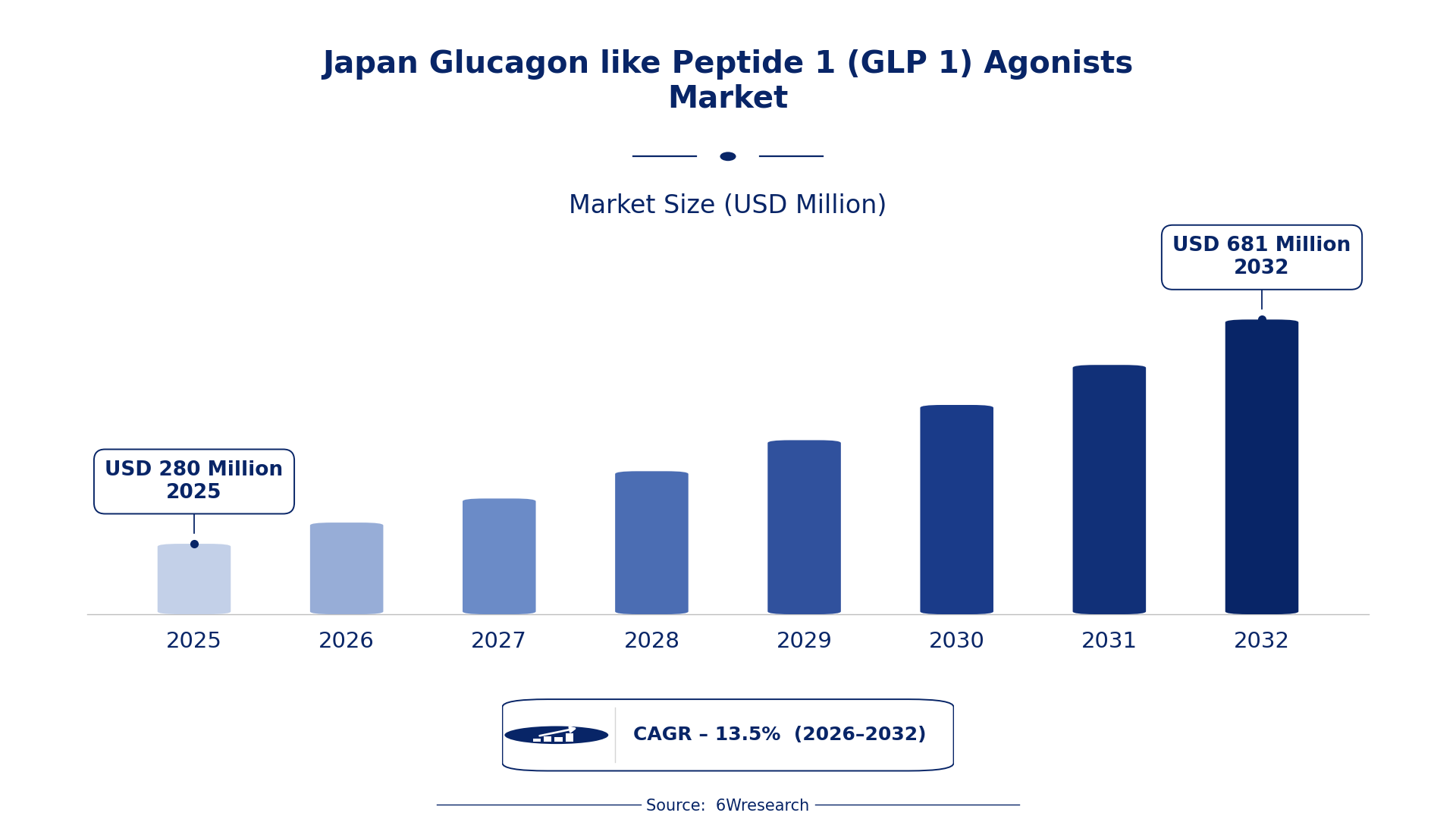
According to 6Wresearch internal database and industry insights, the Japan Glucagon like Peptide 1 (GLP 1) Agonists Market was valued at USD 280 Million in 2025 and is projected to reach USD 681 Million by 2032, growing at a CAGR of approximately 13.5% during 2026–2032.
Japan Glucagon like Peptide 1 (GLP 1) Agonists Market Highlights
| Report Metric | Details |
| Report Name | Japan Glucagon like Peptide 1 (GLP 1) Agonists Market (2026-2032) |
| Market Size 2025 | USD 280 Million |
| Market Size 2032 | USD 681 Million |
| Absolute Growth 2025–2032 | USD 401 Million |
| CAGR 2026–2032 | 13.5% |
| Peak Annual Growth | 14.7% in 2029 |
| Forecast Period | 2026–2032 |
| Historical Data | 2022–2025 |
| Base Year | 2025 |
| Leading Drugs, 2025 | Dulaglutide (49% share) |
| Leading Brands, 2025 | Byetta (40% share) |
| Fastest-Growing Drugs | Exenatide (17.8% CAGR) |
| Fastest-Growing Brands | Bydureon (18.1% CAGR) |
| Growing Sector | Diabetes management |
| Key End Users | Healthcare providers, patients, pharmaceutical companies |
Japan Glucagon like Peptide 1 (GLP 1) Agonists Market Year-wise Growth Rate and Key Drivers (2022–2032)
This graph illustrates the annual growth rates of the market from 2022 to 2032, highlighting a steady upward trajectory and projected market expansion over the forecast period.
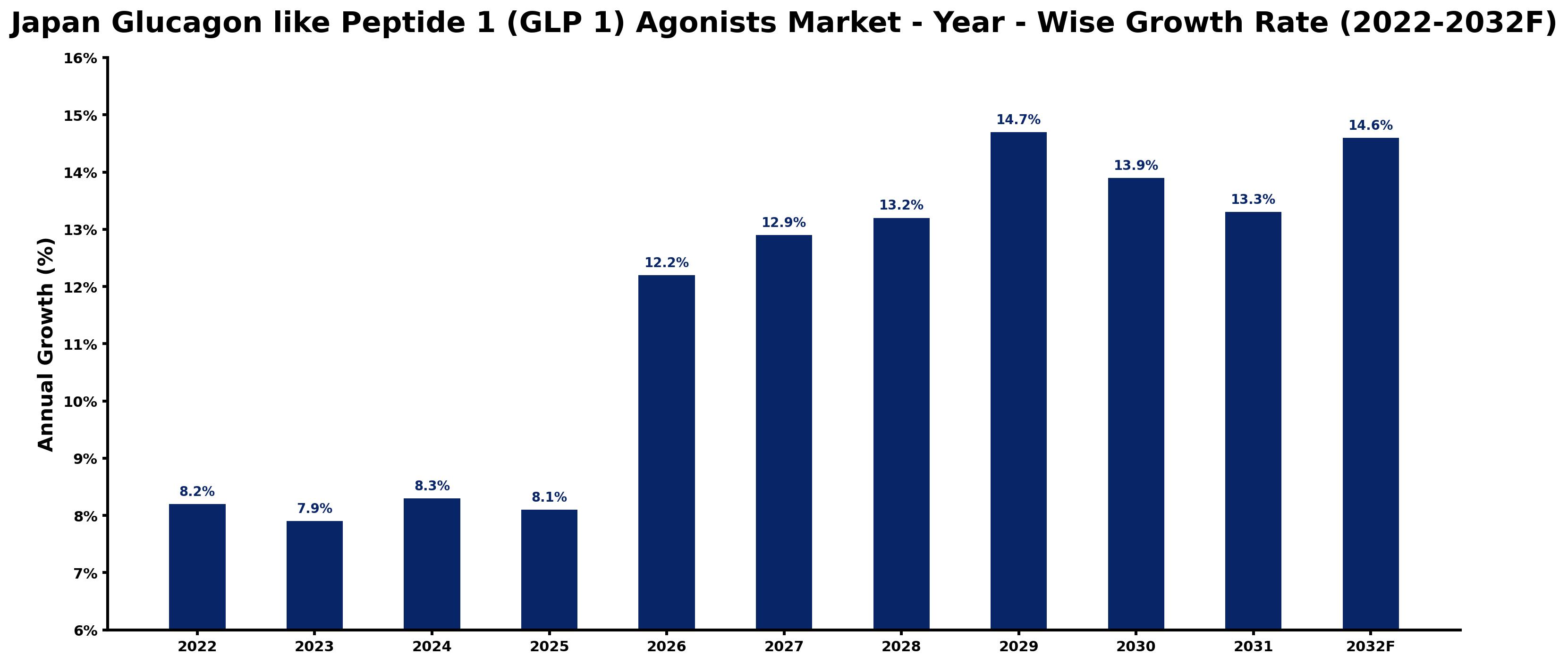
Each row of the following table gives one year's estimated growth and the event or demand shift that explains it.
| Year | Estimated Annual Growth (%) | Market Rationale |
| 2022 | 8.2 | The market showed steady growth due to increased diabetes diagnoses and treatment options. |
| 2023 | 7.9 | Growth slowed as the market adjusted to new treatment protocols and patient needs. |
| 2024 | 8.3 | Demand increased as more patients sought effective diabetes management solutions. |
| 2025 | 8.1 | Growth slowed again as market saturation began to affect new prescriptions. |
| 2026 | 12.2 | Demand is expected to surge with the introduction of new GLP-1 agonists and increased patient awareness. |
| 2027 | 12.9 | The market will continue to grow as healthcare providers expand treatment options. |
| 2028 | 13.2 | Demand is projected to rise further as patient education on diabetes management improves. |
| 2029 | 14.7 | The peak growth year will be driven by heightened awareness and new product launches. |
| 2030 | 13.9 | Growth is expected to slow slightly as the market matures and competition intensifies. |
| 2031 | 13.3 | Demand will continue to grow, albeit at a slower rate, as treatment options become standard. |
| 2032 | 14.6 | A resurgence in growth is projected as new therapies gain approval and market share. |
Note: Market size estimations and growth projections presented in this report are based on 6Wresearch's proprietary forecasting methodology, utilizing the latest available industry data, government publications, and primary research inputs.
Japan Glucagon like Peptide 1 (GLP 1) Agonists Market Synopsis
Glucagon-like peptide-1 (GLP-1) agonists are a class of medications used for managing type 2 diabetes, mimicking the GLP-1 hormone to stimulate insulin secretion. In Japan, approximately 7 million individuals are diagnosed with diabetes, creating a substantial demand for these treatments. The Japan Glucagon like Peptide 1 (GLP 1) Agonists Market is expanding due to factors such as the approval of new medications like Semaglutide in 2020 and the national diabetes prevention program targeting 1 million individuals. With an annual budget of approximately 500 million yen for diabetes management, the market is set for growth.
Market Dynamics Impact Analysis (2026–2032)
| Factor | Type | Impact | Primary Segment Affected |
| Growing prevalence of diabetes in Japan | Driver | High | Dulaglutide |
| Increased patient awareness and education | Driver | High | Semaglutide |
| Rising demand for effective diabetes management solutions | Opportunity | High | Exenatide |
| Expansion of healthcare infrastructure supporting diabetes care | Opportunity | Medium | Liraglutide |
| Market saturation affecting new prescriptions | Restraint | High | Lixisenatide |
| Competition from alternative diabetes treatments | Restraint | Medium | Dulaglutide |
| Limited supply capacity for new medications | Challenge | High | Semaglutide |
| Regulatory hurdles for new product approvals | Challenge | Medium | Exenatide |
Evaluation of Drivers in Japan Glucagon like Peptide 1 (GLP 1) Agonists Market (2026–2032)
The following drivers explain most of the expected growth.
| Drivers | Primary Segment Affected | Why It Matters (Evidence) |
| Increasing diabetes diagnoses | Dulaglutide | In 2022, approximately 7 million people in Japan were diagnosed with diabetes, resulting in higher demand for effective treatments. |
| Growing healthcare spending on diabetes management | Exenatide | Japan's annual budget for diabetes management programs is approximately 500 million yen, boosting investment in effective treatments. |
| National diabetes prevention initiatives | Liraglutide | The launch of a national diabetes prevention program in 2023 aims to target 1 million individuals, increasing awareness and treatment uptake. |
| Rising average age of diabetes patients | Lixisenatide | The average age of diabetes patients in Japan is around 65 years, leading to a higher demand for suitable treatment options. |
| Approval of new GLP-1 agonists | Semaglutide | The approval of Semaglutide in 2020 has expanded treatment options, encouraging more prescriptions among healthcare providers. |
Behind the steady rise in orders sits the increasing prevalence of diabetes, with approximately 7 million diagnosed individuals in Japan. The average age of diabetes patients around 65 years creates a growing need for effective management solutions. The approval of new GLP-1 agonists has further expanded treatment options, prompting healthcare providers to prescribe more GLP-1 agonists.
Evaluation of Restraints in Japan Glucagon like Peptide 1 (GLP 1) Agonists Market
These are the pressures that could keep growth below its potential.
| Market Restraint | Primary Segment Affected | Why It Matters (Evidence) |
| Market saturation affecting new prescriptions | Dulaglutide | As the market matures, the number of new prescriptions is slowing due to saturation in treatment options. |
| High costs associated with GLP-1 agonists | Lixisenatide | The cost of GLP-1 agonists can be a barrier for some patients, limiting their accessibility. |
| Limited supply capacity for new medications | Exenatide | Manufacturers face challenges in scaling production to meet rising demand for new GLP-1 agonists. |
| Competition from alternative diabetes treatments | Semaglutide | The presence of alternative treatments is limiting the market share of GLP-1 agonists. |
| Regulatory hurdles for new product approvals | Liraglutide | Stringent regulations can delay the introduction of new treatments, impacting market growth. |
Japan Glucagon like Peptide 1 (GLP 1) Agonists Market Challenges
In 2023, 1.5 million prescriptions for GLP-1 agonists were issued, yet high prices restrict access for many buyers, particularly in rural areas. Regulatory hurdles impede the swift introduction of new treatments, causing delays in patient access to potentially more effective options. Supply chain disruptions can lead to shortages, forcing clinics to postpone treatment for diabetes patients, which can worsen their health outcomes. Limited technological integration in drug development slows innovation, restricting the availability of effective therapies for buyers seeking better management options.
Trends in the Japan Glucagon like Peptide 1 (GLP 1) Agonists Market
Buyers and suppliers in the Japan Glucagon like Peptide 1 (GLP 1) Agonists Market are adjusting to the following trends.
- Shift from Traditional to Modern Diabetes Treatments: Since 2020, healthcare providers have increasingly adopted GLP-1 agonists, resulting in a rise in prescriptions. In 2023, the installed base of GLP-1 agonists reached 1.5 million prescriptions, indicating a notable shift in treatment preferences.
- Increased Focus on Preventive Diabetes Care: The national diabetes prevention program launched in 2023 targets 1 million individuals, highlighting a shift towards preventive care. This initiative aims to reduce diabetes incidence and improve overall health outcomes in Japan.
- Expansion of Healthcare Infrastructure for Diabetes Management: Japan has invested heavily in healthcare infrastructure, enhancing diabetes care services. The annual budget for diabetes management programs is approximately 500 million yen, supporting better access to treatments.
- Growing Patient Awareness of Diabetes Management: Since 2022, patient education initiatives have increased awareness of diabetes management options. This has led to a higher demand for GLP-1 agonists, as more patients seek effective treatment solutions.
Investment Opportunities in the Japan Glucagon like Peptide 1 (GLP 1) Agonists Market
Investors looking at the Japan Glucagon like Peptide 1 (GLP 1) Agonists Market should consider the following areas.
- Healthcare Providers Seeking Effective Treatments: Healthcare providers in Japan are increasingly looking for effective diabetes management solutions. With approximately 7 million diagnosed individuals, there is a notable opportunity to supply GLP-1 agonists.
- Partnerships with Local Manufacturers: Now is an ideal time to establish partnerships with local manufacturers to improve distribution. Collaborating with Japanese pharmaceutical companies can facilitate market entry and compliance with local regulations.
- Investment in Diabetes Management Programs: With an annual budget of approximately 500 million yen for diabetes management, there is an opportunity to invest in developing new treatments and technologies. Engaging with healthcare providers can improve product visibility.
- Focus on Urban Regions with High Demand: The Tokyo region accounts for the highest demand for diabetes medications. Targeting urban healthcare facilities can yield substantial returns as they seek to meet patient needs.
Government Initiatives in the Japan Glucagon like Peptide 1 (GLP 1) Agonists Market
The GX Basic Policy adopted in 2023 aims to mobilise about JPY 150 trillion for public-private decarbonisation investment, indirectly supporting the healthcare sector. This policy encourages investments in diabetes treatments, ensuring better access for patients and improving the overall healthcare infrastructure.
In 2023, the Japan Pharmaceutical Manufacturers Association received funding to support the development of diabetes treatments. The Consumer Affairs Agency oversees regulations ensuring that diabetes medications are marketed transparently and accurately.
Future Insight of the Japan Glucagon like Peptide 1 (GLP 1) Agonists Market
Diabetes clinics will see improved access to GLP-1 agonists as Japan's national diabetes prevention program targets 1 million individuals for earlier intervention. By 2032, advancements in recombinant DNA technology will increase production efficiency, benefiting suppliers. The implementation of ISO 9001 standards will ensure higher quality in manufacturing, reassuring buyers about product safety. Enhanced collaboration between the pharmaceutical industry and health authorities will streamline regulatory processes, enabling quicker approvals for new treatments.
Market Segmentation Analysis
Japan Glucagon like Peptide 1 (GLP 1) Agonists Market report covers a detailed analysis of the following market segments:
By Drugs – Dulaglutide Leads, Exenatide Expected to Grow Fastest
According to Dhaval Chaurasia, Assistant Manager at 6Wresearch, Dulaglutide held 49% of the Japan Glucagon like Peptide 1 (GLP 1) Agonists Market by drugs in 2025. Dulaglutide holds the largest share as it is extensively prescribed for diabetes management, supported by the recommendations of the Japanese Diabetes Society. The strong acceptance is evident with 1.5 million prescriptions recorded in 2023, highlighting its established role in treatment protocols. The quickest growth will come from Exenatide, forecast to expand at a CAGR of 17.8% between 2026 and 2032. Exenatide is experiencing rapid growth due to its integration into Japan's national diabetes prevention programme, which targets 1 million individuals. This initiative, along with Exenatide's proven efficacy, accelerates its adoption among healthcare providers. Suppliers should focus on enhancing their offerings to meet the increasing demand for Exenatide as part of national health initiatives.
By Brands – Byetta Leads, Bydureon Expected to Grow Fastest
Byetta took 40% of brands revenue in 2025, more than any other category. Byetta leads the market as the brand name for Exenatide, which is widely prescribed for diabetes management in Japan. Its established presence and recognition among healthcare professionals ensure a strong patient base. Over 2026–2032, Bydureon is expected to post the fastest growth, at a CAGR of 18.1%. Bydureon is rapidly gaining traction due to its extended-release formulation, appealing to patients seeking more convenient dosing options. This trend is likely to continue as patient adherence becomes a priority in diabetes care. Buyers may benefit from exploring options like Bydureon that offer improved convenience and adherence.
Key Attractiveness of the Report
- 10 Years of Market Numbers
- Historical Data Starting from 2022 to 2025
- Base Year 2025
- Forecast Data until 2032
- Key Performance Indicators Impacting the Market
- Major Upcoming Developments and Projects
Key Highlights of the Report:
- Japan Glucagon like Peptide 1 (GLP 1) Agonists Market Outlook
- Market Size of Japan Glucagon like Peptide 1 (GLP 1) Agonists Market, 2025
- Forecast of Japan Glucagon like Peptide 1 (GLP 1) Agonists Market, 2032
- Historical Data and Forecast of Japan Glucagon like Peptide 1 (GLP 1) Agonists Revenues & Volume for the Period 2022-2032
- Japan Glucagon like Peptide 1 (GLP 1) Agonists Market Trend Evolution
- Japan Glucagon like Peptide 1 (GLP 1) Agonists Market Drivers and Challenges
- Japan Glucagon like Peptide 1 (GLP 1) Agonists Price Trends
- Japan Glucagon like Peptide 1 (GLP 1) Agonists Porter's Five Forces
- Japan Glucagon like Peptide 1 (GLP 1) Agonists Industry Life Cycle
- Historical Data and Forecast of Japan Glucagon like Peptide 1 (GLP 1) Agonists Market Revenues & Volume By Drugs for the Period 2022-2032
- Historical Data and Forecast of Japan Glucagon like Peptide 1 (GLP 1) Agonists Market Revenues & Volume By Dulaglutide for the Period 2022-2032
- Historical Data and Forecast of Japan Glucagon like Peptide 1 (GLP 1) Agonists Market Revenues & Volume By Exenatide for the Period 2022-2032
- Historical Data and Forecast of Japan Glucagon like Peptide 1 (GLP 1) Agonists Market Revenues & Volume By Liraglutide for the Period 2022-2032
- Historical Data and Forecast of Japan Glucagon like Peptide 1 (GLP 1) Agonists Market Revenues & Volume By Lixisenatide for the Period 2022-2032
- Historical Data and Forecast of Japan Glucagon like Peptide 1 (GLP 1) Agonists Market Revenues & Volume By Semaglutide for the Period 2022-2032
- Historical Data and Forecast of Japan Glucagon like Peptide 1 (GLP 1) Agonists Market Revenues & Volume By Brands for the Period 2022-2032
- Historical Data and Forecast of Japan Glucagon like Peptide 1 (GLP 1) Agonists Market Revenues & Volume By Byetta for the Period 2022-2032
- Historical Data and Forecast of Japan Glucagon like Peptide 1 (GLP 1) Agonists Market Revenues & Volume By Bydureon for the Period 2022-2032
- Historical Data and Forecast of Japan Glucagon like Peptide 1 (GLP 1) Agonists Market Revenues & Volume By Victoza for the Period 2022-2032
- Historical Data and Forecast of Japan Glucagon like Peptide 1 (GLP 1) Agonists Market Revenues & Volume By Trulicity for the Period 2022-2032
- Historical Data and Forecast of Japan Glucagon like Peptide 1 (GLP 1) Agonists Market Revenues & Volume By Lyxumia for the Period 2022-2032
- Historical Data and Forecast of Japan Glucagon like Peptide 1 (GLP 1) Agonists Market Revenues & Volume By Ozempic for the Period 2022-2032
- Japan Glucagon like Peptide 1 (GLP 1) Agonists Import Export Trade Statistics
- Market Opportunity Assessment By Drugs
- Market Opportunity Assessment By Brands
- Japan Glucagon like Peptide 1 (GLP 1) Agonists Top Companies Market Share
- Japan Glucagon like Peptide 1 (GLP 1) Agonists Competitive Benchmarking By Technical and Operational Parameters
- Japan Glucagon like Peptide 1 (GLP 1) Agonists Company Profiles
- Japan Glucagon like Peptide 1 (GLP 1) Agonists Key Strategic Recommendations
Market Covered
The following segment groups are covered in the report.
By Drugs
- Dulaglutide
- Exenatide
- Liraglutide
- Lixisenatide
- Semaglutide
By Brands
- Byetta
- Bydureon
- Victoza
- Trulicity
- Lyxumia
- Ozempic






































