Japan GPS-Based Seeding Systems Market Size & Growth Rate
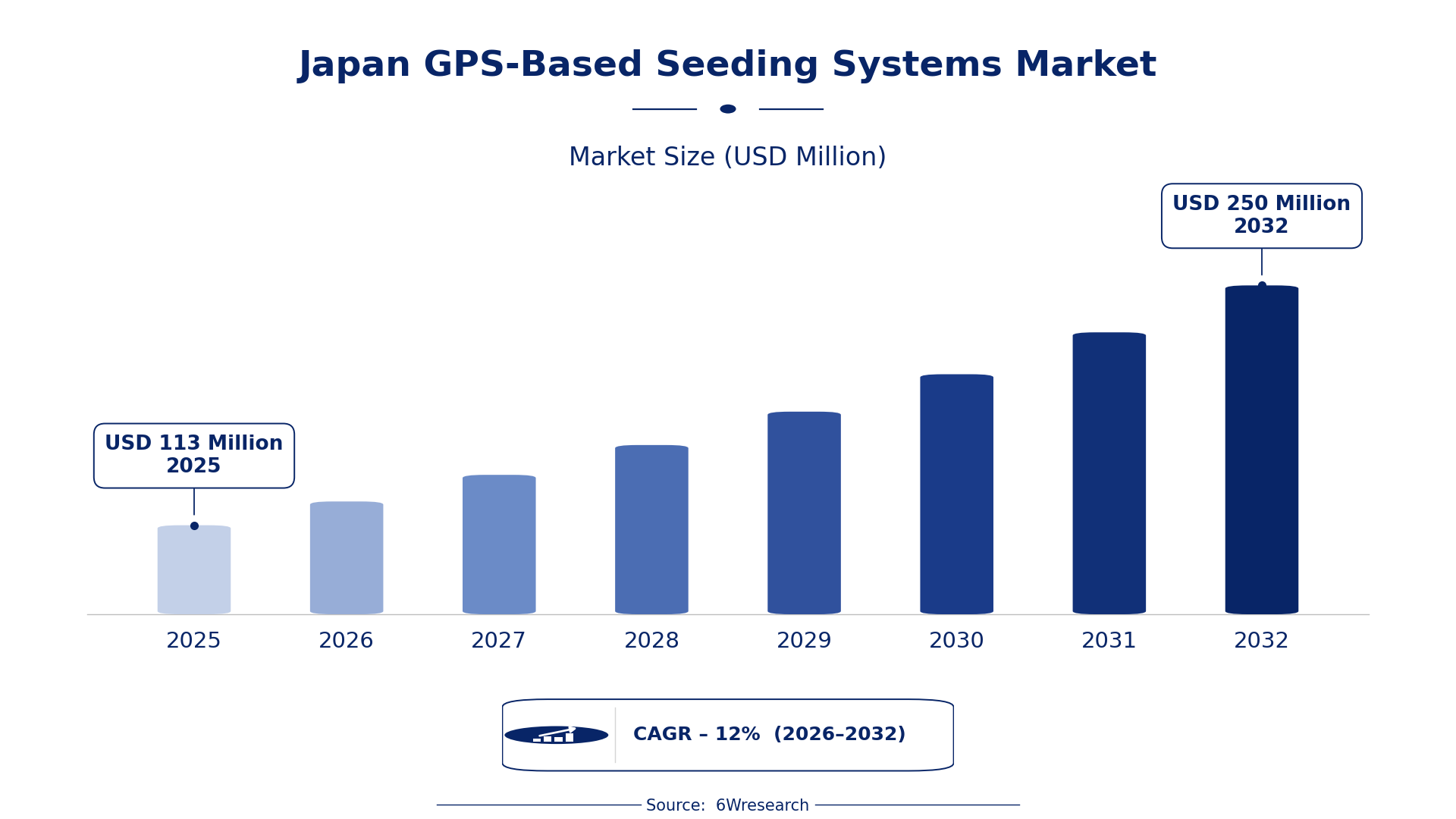
According to 6Wresearch internal database and industry insights, the Japan GPS-Based Seeding Systems Market was valued at USD 113 Million in 2025 and is projected to reach USD 250 Million by 2032, growing at a CAGR of approximately 12% during 2026–2032.
Japan GPS-Based Seeding Systems Market Highlights
| Report Metric | Details |
| Report Name | Japan GPS-Based Seeding Systems Market (2026-2032) |
| Market Size 2025 | USD 113 Million |
| Market Size 2032 | USD 250 Million |
| Absolute Growth 2025–2032 | USD 137 Million |
| CAGR 2026–2032 | 12% |
| Peak Annual Growth | 13.8% in 2028 |
| Forecast Period | 2026–2032 |
| Historical Data | 2022–2025 |
| Base Year | 2025 |
| Leading System Type, 2025 | Precision Seeders (47% share) |
| Leading Technology Used, 2025 | GNSS Integration (37% share) |
| Leading End User, 2025 | Large-Scale Farmers (37% share) |
| Leading Application Area, 2025 | Crop Optimization (54% share) |
| Fastest-Growing System Type | Auto-Steer Planters (17.6% CAGR) |
| Fastest-Growing Technology Used | Real-Time Kinematic (18.1% CAGR) |
| Fastest-Growing End User | Agro-Tech Companies (15.4% CAGR) |
| Fastest-Growing Application Area | Row Accuracy (15.2% CAGR) |
| Growing Sector | Agricultural Technology |
| Key End Users | Large-Scale Farmers, Agro-Tech Companies, Farm Contractors, Agricultural Enterprises |
Japan GPS-Based Seeding Systems Market Year-wise Growth Rate and Key Drivers (2022–2032)
This graph illustrates the annual growth rates of the market from 2022 to 2032, highlighting a steady upward trajectory and projected market expansion over the forecast period.
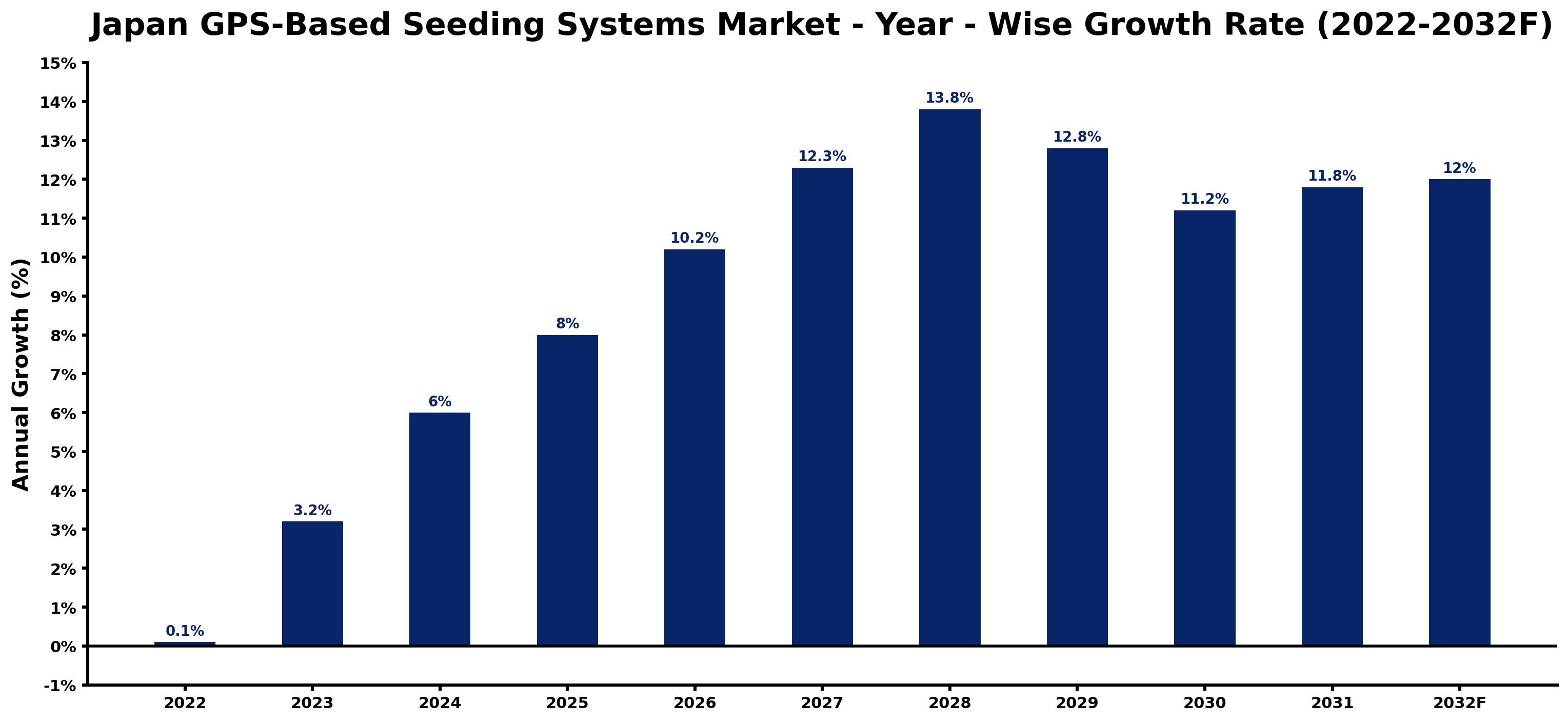
The following figures match every annual growth estimate with the main market development of that year, giving the reasoning behind each rise or slowdown.
| Year | Estimated Annual Growth (%) | Market Rationale |
| 2022 | 0.1 | The agricultural sector showed minimal growth as GPS systems were still being integrated into farming practices. |
| 2023 | 3.2 | Adoption of GPS-based systems increased due to rising awareness among farmers about precision agriculture benefits. |
| 2024 | 6.0 | Investment in agricultural technology expanded as more farmers recognised the efficiency of GPS-based seeding systems. |
| 2025 | 8.0 | The market experienced strong growth as large-scale farmers began to fully implement these advanced technologies. |
| 2026 | 10.2 | Demand surged as the government promoted smart farming initiatives to improve agricultural productivity. |
| 2027 | 12.3 | Increased investment from agro-tech companies supported the growing adoption of precision farming technologies. |
| 2028 | 13.8 | The market peaked due to widespread acceptance of GPS systems among farmers, driven by high accuracy and efficiency. |
| 2029 | 12.8 | Growth slowed slightly as the market began to stabilise after rapid adoption in previous years. |
| 2030 | 11.2 | The market continued to grow as farmers sought to maintain competitive yields amidst changing climate conditions. |
| 2031 | 11.8 | Demand increased again as technology advancements made GPS systems more accessible to smaller farming operations. |
| 2032 | 12.0 | The market is expected to grow steadily as ongoing investments in agricultural technology continue to drive adoption. |
Note: Market size estimations and growth projections presented in this report are based on 6Wresearch's proprietary forecasting methodology, utilizing the latest available industry data, government publications, and primary research inputs.
Japan GPS-Based Seeding Systems Market Synopsis
GPS-Based Seeding Systems are advanced agricultural technologies that utilise GPS for precise planting and crop management. In Japan, the agricultural sector, which includes over 1.3 million farms, is increasingly adopting these systems, particularly among large-scale farmers and agro-tech companies. The growth is driven by the need for improved crop yields, reduced seed waste, and efficient farm management, supported by government initiatives and increasing investments in precision agriculture technologies.
Market Dynamics Impact Analysis (2026–2032)
| Factor | Type | Impact | Primary Segment Affected |
| Growing adoption of precision agriculture practices among large-scale farmers | Driver | High | Precision Seeders |
| Increased investment in agricultural technology from agro-tech companies | Driver | High | Variable Rate Systems |
| Expansion of smart farming initiatives in the Tohoku region | Opportunity | High | Auto-Steer Planters |
| Rising demand for high-accuracy planting solutions in Hokkaido | Opportunity | Medium | Real-Time Kinematic |
| High initial costs of GPS-based systems limiting small farmer adoption | Restraint | High | Autonomous Systems |
| Limited awareness of advanced technologies among older farmers | Restraint | Medium | Sensor-Based |
| Aging farmer population leading to workforce shortages | Challenge | High | Agro-Tech Companies |
| Dependence on technology may lead to operational risks during system failures | Challenge | Medium | Agricultural Enterprises |
Evaluation of Drivers in Japan GPS-Based Seeding Systems Market (2026–2032)
The factors lifting demand, and the evidence behind each, are summarised below.
| Drivers | Primary Segment Affected | Why It Matters (Evidence) |
| Increased crop yields through precise planting | Precision Seeders | Precision seeders can reduce seed usage by up to 20%, encouraging large-scale farmers to adopt these systems. |
| Improved planting efficiency with automated steering | Auto-Steer Planters | This technology allows farmers to plant more accurately, resulting in better crop management and higher yields. |
| Growing investment in precision agriculture technologies | Variable Rate Systems | Agro-tech companies are increasing their investments, driving demand for systems that adjust seed rates based on field variability. |
| Demand for high-accuracy planting solutions | Real-Time Kinematic | Real-time kinematic systems can achieve centimeter-level accuracy, appealing to farmers seeking optimal planting conditions. |
| Government support for smart farming initiatives | Autonomous Systems | The Ministry of Agriculture, Forestry and Fisheries promotes smart farming, encouraging the adoption of fully automated planting processes. |
Volumes grow on the back of increased crop yields achieved through precise planting, with precision seeders reducing seed usage by up to 20%. Automated steering technologies improve planting efficiency, enabling farmers to manage crops more effectively. Investment in precision agriculture technologies is rising, as agro-tech companies increase funding for variable rate systems that adjust seed rates based on field variability. Demand for high-accuracy planting solutions drives the adoption of real-time kinematic systems, which can achieve centimeter-level accuracy.
Evaluation of Restraints in Japan GPS-Based Seeding Systems Market
Several factors work against faster growth; the main ones are summarised below.
| Market Restraint | Primary Segment Affected | Why It Matters (Evidence) |
| High initial costs of GPS-based systems | Autonomous Systems | The investment required for advanced systems limits their adoption among smaller farmers, impacting overall market growth. |
| Limited awareness of advanced technologies | Sensor-Based | Older farmers, averaging over 67 years, may not fully understand the benefits of these technologies, hindering adoption. |
| Dependence on technology leading to operational risks | Agro-Tech Companies | Reliance on GPS systems can create vulnerabilities during failures, affecting service delivery for farm contractors. |
| Aging farmer population causing workforce shortages | Agricultural Enterprises | As the average age of farmers rises, fewer workers are available to implement and manage advanced technologies. |
| Regulatory hurdles in technology adoption | Variable Rate Systems | Compliance with standards like ISO 18400 can delay the integration of new systems into farming practices. |
Japan GPS-Based Seeding Systems Market Challenges
Limited distribution channels for GPS-based seeding systems hinder supply for farmers in rural Japan. Many areas lack access, delaying system availability for over 1.3 million farms and increasing operational costs. Competitive pressures among agro-tech companies lead to aggressive pricing, which can compromise product quality and deter investment in necessary advancements. A shortage of skilled labour in precision agriculture restricts effective system use, causing inefficiencies for suppliers and farmers. Slow technology adoption in rural regions further exacerbates these issues, preventing optimal crop yields and reducing overall productivity.
Trends in the Japan GPS-Based Seeding Systems Market
Buyers and suppliers in the Japan GPS-Based Seeding Systems Market are adjusting to the following trends.
- Shift from Traditional to Precision Agriculture: Since 2022, the Tohoku region has seen a shift towards precision agriculture, with over 50% of large-scale farmers adopting GPS-based systems to improve productivity.
- Emergence of Real-Time Kinematic Systems: In 2023, real-time kinematic systems gained traction among farmers, achieving centimeter-level accuracy and improving planting precision, particularly in Hokkaido.
- Increased Adoption of Automated Planting Solutions: Farm contractors are increasingly utilising autonomous systems, with a notable rise in adoption rates as farmers seek efficiencies in planting operations.
- Focus on Smart Farming Initiatives: The Smart Agriculture Promotion Project, initiated in 2023, aims to improve technology use in farming, driving demand for advanced seeding systems.
Investment Opportunities in the Japan GPS-Based Seeding Systems Market
The openings below show where demand in the Japan GPS-Based Seeding Systems Market is visible and how suppliers can enter.
- Investment in Precision Agriculture Technologies: The Tohoku region is a key area for investment, with ¥10 billion allocated for agricultural technology development, creating opportunities for suppliers of GPS-based systems.
- Growing Demand for High-Accuracy Solutions: With over 50% of large-scale farmers using GPS systems, there is an opportunity to supply real-time kinematic technologies to improve planting accuracy.
- Partnerships with Agro-Tech Companies: Now is the time to form joint ventures with agro-tech companies focusing on precision farming, as they are increasing investments in advanced technologies.
- Expansion of Smart Farming Initiatives: The ongoing Smart Agriculture Promotion Project provides avenues for suppliers to enter the market by aligning with government-supported technology initiatives.
Government Initiatives in the Japan GPS-Based Seeding Systems Market
The Agricultural Land Act supports the use of advanced farming technologies, ensuring that producers can integrate GPS-based seeding systems into their operations. This act, alongside the Semiconductor and Digital Industry Strategy from June 2021, aims to boost domestic agricultural technology development, with a target of increasing productivity by 30% by 2030.
The Economic Security Promotion Act (2022) supports supply-chain resilience for critical agricultural products. This act encourages the adoption of GPS-based systems, as it aims to improve the overall efficiency and sustainability of agricultural practices.
Future Insight of the Japan GPS-Based Seeding Systems Market
The Smart Agriculture Promotion Project will advance technology deployment in farming by 2032, benefiting both buyers and suppliers. Japan's government has allocated ¥10 billion for agricultural technology development, propelling innovation in GPS-based systems. With over 50% of large-scale farmers already utilising these technologies, the installed base is set to expand, particularly in the Hokkaido and Kyushu regions. By 2032, precision agriculture will integrate advanced sensor technology, facilitating more accurate planting and improved crop management.
Market Segmentation Analysis
Japan GPS-Based Seeding Systems Market report covers a detailed analysis of the following market segments:
By System Type – Precision Seeders Lead, Auto-Steer Planters Expected to Grow Fastest
According to Vasu Joshi, Associate Consultant at 6Wresearch, Precision Seeders accounted for 47% of the market by system type in 2025. Precision Seeders dominate the market as they are critical for accurate seed placement, essential for maximising crop yields. Their prevalent adoption among large-scale farmers in regions like Tohoku underscores their role in enhancing agricultural productivity. Auto-Steer Planters are set to record the highest CAGR in this split, 17.6% over 2026–2032. Auto-Steer Planters are witnessing rapid growth due to their capacity to automate steering, significantly improving planting precision. This technology is particularly appealing to farmers looking to optimise operations and minimise labour costs, thus driving its swift uptake. Suppliers should focus on developing automated features to cater to the increasing demand for precision in planting.
By Technology Used – GNSS Integration Leads, Real-Time Kinematic Expected to Grow Fastest
In 2025, GNSS Integration led the technology used split with a 37% share. GNSS Integration holds the largest share as it is vital for positioning and navigation in GPS-based seeding systems, ensuring precise planting. This integration is particularly important for large-scale farmers who rely on accuracy to optimise their crop yields. Real-Time Kinematic is projected to grow fastest, at a CAGR of 18.1% during 2026–2032. Real-Time Kinematic technology is growing quickly due to its ability to provide high-accuracy positioning data, which is essential for precision agriculture. The demand for centimetre-level accuracy is pushing farmers to adopt this technology rapidly. Buyers will benefit from investing in high-accuracy technologies to improve their farming efficiency and productivity.
By End User – Large-Scale Farmers Lead, Agro-Tech Companies Expected to Grow Fastest
With 37% of end user revenue in 2025, Large-Scale Farmers was the largest category. Large-Scale Farmers represent the largest user group as they seek to maximise production efficiency through advanced seeding systems. With over 50% of these farmers already utilising GPS-based systems, their established presence drives market share. The quickest growth will come from Agro-Tech Companies, forecast to expand at a CAGR of 15.4% between 2026 and 2032. Agro-Tech Companies are rapidly expanding their use of GPS-based systems as they develop and implement advanced farming technologies. Their investment in precision farming solutions is a key factor in the market's growth. Suppliers should tailor their offerings to meet the specific needs of agro-tech companies to capitalise on this growth.
By Application Area – Crop Optimization Leads, Row Accuracy Expected to Grow Fastest
Crop Optimization took 54% of application area revenue in 2025, more than any other category. Crop Optimization leads the application area as it is focused on maximising yield through precise planting techniques, which are vital for large-scale farmers in Japan. This emphasis aligns with the government's objectives to boost agricultural productivity significantly by 2030. Over 2026–2032, Row Accuracy is expected to post the fastest growth, at a CAGR of 15.2%. Row Accuracy is experiencing rapid growth because it ensures correct spacing for optimal crop development, a necessity for effective farm management. The increasing emphasis on precision in planting practices is driving this segment's expansion. Suppliers ought to invest in technologies that enhance row accuracy to appeal to farmers aiming to improve their crop management strategies.
Key Attractiveness of the Report
- 10 Years of Market Numbers
- Historical Data Starting from 2022 to 2025
- Base Year 2025
- Forecast Data until 2032
- Key Performance Indicators Impacting the Market
- Major Upcoming Developments and Projects
Key Highlights of the Report:
- Japan GPS-Based Seeding Systems Market Outlook
- Market Size of Japan GPS-Based Seeding Systems Market, 2025
- Forecast of Japan GPS-Based Seeding Systems Market, 2032
- Historical Data and Forecast of Japan GPS-Based Seeding Systems Revenues & Volume for the Period 2022-2032F
- Japan GPS-Based Seeding Systems Market Trend Evolution
- Japan GPS-Based Seeding Systems Market Drivers and Challenges
- Japan GPS-Based Seeding Systems Price Trends
- Japan GPS-Based Seeding Systems Porter's Five Forces
- Japan GPS-Based Seeding Systems Industry Life Cycle
- Historical Data and Forecast of Japan GPS-Based Seeding Systems Market Revenues & Volume By System Type for the Period 2022-2032F
- Historical Data and Forecast of Japan GPS-Based Seeding Systems Market Revenues & Volume By Precision Seeders for the Period 2022-2032F
- Historical Data and Forecast of Japan GPS-Based Seeding Systems Market Revenues & Volume By Auto-Steer Planters for the Period 2022-2032F
- Historical Data and Forecast of Japan GPS-Based Seeding Systems Market Revenues & Volume By Variable Rate Systems for the Period 2022-2032F
- Historical Data and Forecast of Japan GPS-Based Seeding Systems Market Revenues & Volume By Autonomous Systems for the Period 2022-2032F
- Historical Data and Forecast of Japan GPS-Based Seeding Systems Market Revenues & Volume By Technology Used for the Period 2022-2032F
- Historical Data and Forecast of Japan GPS-Based Seeding Systems Market Revenues & Volume By GNSS Integration for the Period 2022-2032F
- Historical Data and Forecast of Japan GPS-Based Seeding Systems Market Revenues & Volume By Real-Time Kinematic for the Period 2022-2032F
- Historical Data and Forecast of Japan GPS-Based Seeding Systems Market Revenues & Volume By Sensor-Based for the Period 2022-2032F
- Historical Data and Forecast of Japan GPS-Based Seeding Systems Market Revenues & Volume By AI-Enabled GPS for the Period 2022-2032F
- Historical Data and Forecast of Japan GPS-Based Seeding Systems Market Revenues & Volume By End User for the Period 2022-2032F
- Historical Data and Forecast of Japan GPS-Based Seeding Systems Market Revenues & Volume By Large-Scale Farmers for the Period 2022-2032F
- Historical Data and Forecast of Japan GPS-Based Seeding Systems Market Revenues & Volume By Agro-Tech Companies for the Period 2022-2032F
- Historical Data and Forecast of Japan GPS-Based Seeding Systems Market Revenues & Volume By Farm Contractors for the Period 2022-2032F
- Historical Data and Forecast of Japan GPS-Based Seeding Systems Market Revenues & Volume By Agricultural Enterprises for the Period 2022-2032F
- Historical Data and Forecast of Japan GPS-Based Seeding Systems Market Revenues & Volume By Application Area for the Period 2022-2032F
- Historical Data and Forecast of Japan GPS-Based Seeding Systems Market Revenues & Volume By Crop Optimization for the Period 2022-2032F
- Historical Data and Forecast of Japan GPS-Based Seeding Systems Market Revenues & Volume By Row Accuracy for the Period 2022-2032F
- Historical Data and Forecast of Japan GPS-Based Seeding Systems Market Revenues & Volume By Seed Savings for the Period 2022-2032F
- Historical Data and Forecast of Japan GPS-Based Seeding Systems Market Revenues & Volume By Smart Farming for the Period 2022-2032F
- Japan GPS-Based Seeding Systems Import Export Trade Statistics
- Market Opportunity Assessment By System Type
- Market Opportunity Assessment By Technology Used
- Market Opportunity Assessment By End User
- Market Opportunity Assessment By Application Area
- Japan GPS-Based Seeding Systems Top Companies Market Share
- Japan GPS-Based Seeding Systems Competitive Benchmarking By Technical and Operational Parameters
- Japan GPS-Based Seeding Systems Company Profiles
- Japan GPS-Based Seeding Systems Key Strategic Recommendations
Market Covered
The study includes the following segmentation.
By System Type
- Precision Seeders
- Auto-Steer Planters
- Variable Rate Systems
- Autonomous Systems
By Technology Used
- GNSS Integration
- Real-Time Kinematic
- Sensor-Based
- AI-Enabled GPS
By End User
- Large-Scale Farmers
- Agro-Tech Companies
- Farm Contractors
- Agricultural Enterprises
By Application Area
- Crop Optimization
- Row Accuracy
- Seed Savings
- Smart Farming






































