Japan Granular Urea Market Size & Growth Rate
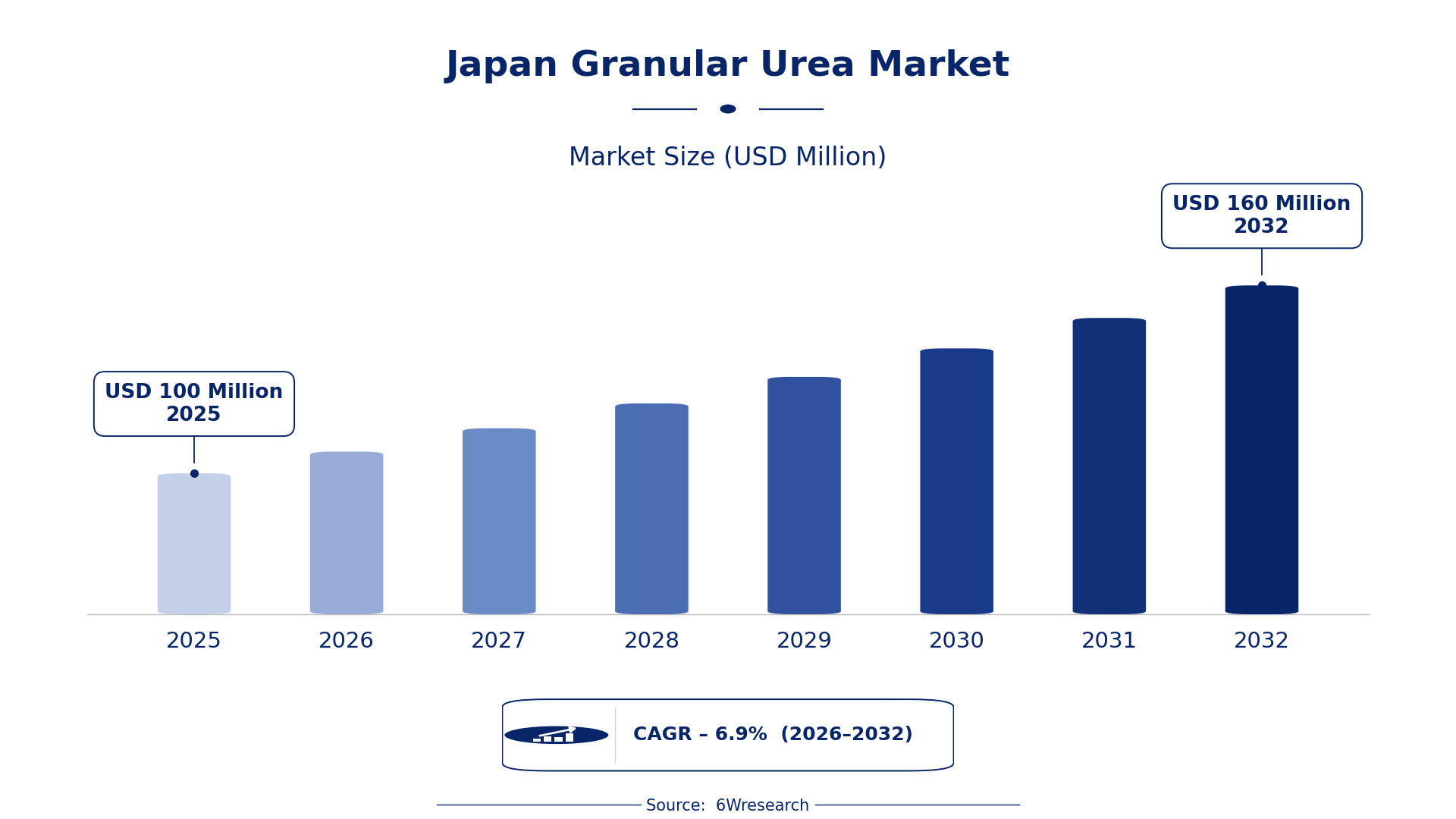
According to 6Wresearch internal database and industry insights, the Japan Granular Urea Market was valued at USD 100 Million in 2025 and is projected to reach USD 160 Million by 2032, growing at a CAGR of approximately 6.9% during 2026–2032.
Japan Granular Urea Market Highlights
| Report Metric | Details |
| Report Name | Japan Granular Urea Market (2026-2032) |
| Market Size 2025 | USD 100 Million |
| Market Size 2032 | USD 160 Million |
| Absolute Growth 2025–2032 | USD 60 Million |
| CAGR 2026–2032 | 6.9% |
| Peak Annual Growth | 7.4% in 2028 |
| Forecast Period | 2026–2032 |
| Historical Data | 2022–2025 |
| Base Year | 2025 |
| Leading Product Type, 2025 | Granular Urea (39% share) |
| Leading Nutrient Content, 2025 | Nitrogen Fertilizer (39% share) |
| Leading Application Area, 2025 | Croplands (42% share) |
| Leading Distribution Channel, 2025 | Direct Sales (52% share) |
| Leading End User, 2025 | Farmers (36% share) |
| Fastest-Growing Product Type | Coated Urea (9.5% CAGR) |
| Fastest-Growing Nutrient Content | Slow Release (8.8% CAGR) |
| Fastest-Growing Application Area | Horticulture (8.1% CAGR) |
| Fastest-Growing Distribution Channel | Online Platforms (9.0% CAGR) |
| Fastest-Growing End User | Agri-Cooperatives (8.7% CAGR) |
| Growing Sector | Agricultural sector |
| Key End Users | Farmers, Agri-Cooperatives, Agribusinesses |
Japan Granular Urea Market Year-wise Growth Rate and Key Drivers (2022–2032)
This graph illustrates the annual growth rates of the market from 2022 to 2032, highlighting a steady upward trajectory and projected market expansion over the forecast period.
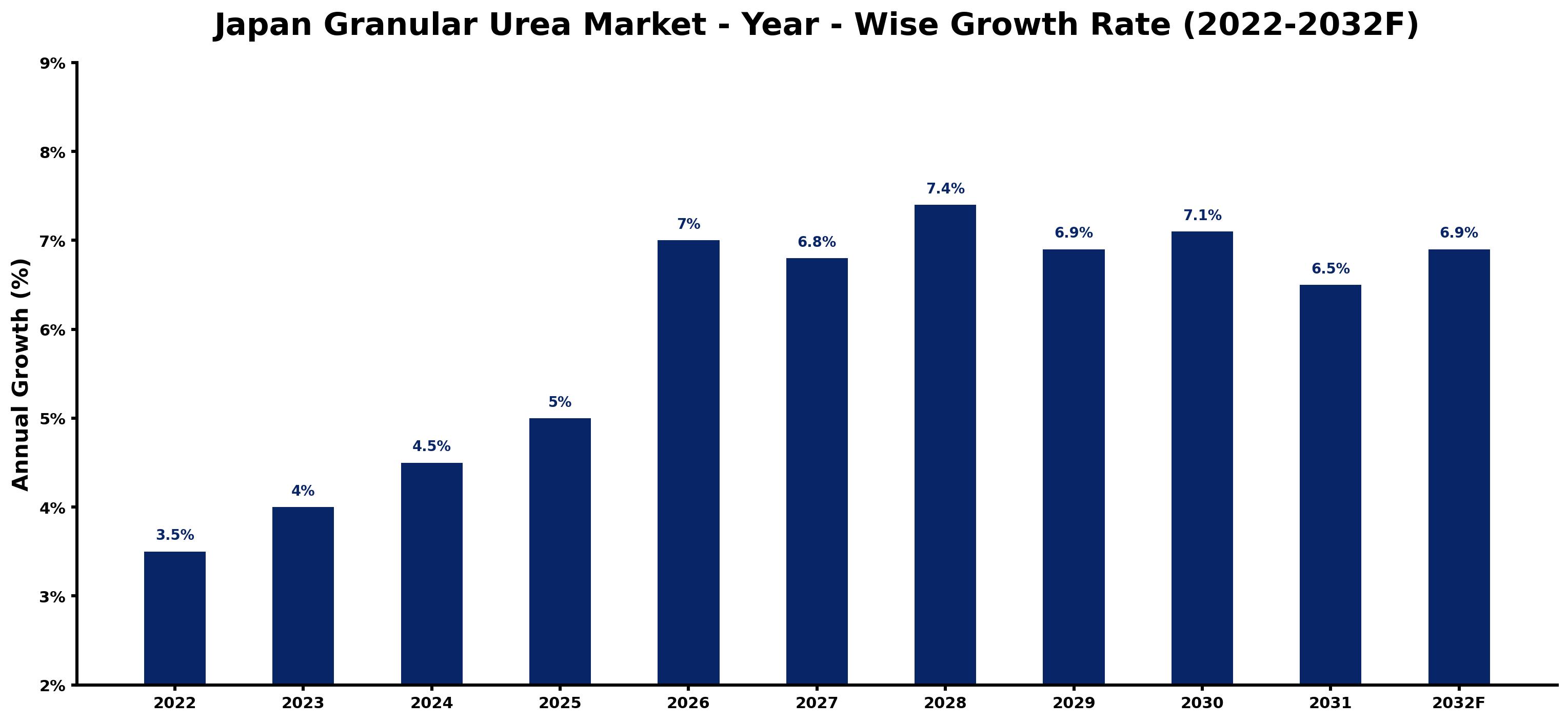
For each year, the table pairs the estimated growth rate with the leading influence on demand, showing how the drivers changed across the period.
| Year | Estimated Annual Growth (%) | Market Rationale |
| 2022 | 3.5 | The market showed steady demand from agricultural users, particularly farmers. |
| 2023 | 4.0 | Growth accelerated as farmers increased fertilizer application for crop yield. |
| 2024 | 4.5 | Higher production levels in agricultural regions contributed to demand. |
| 2025 | 5.0 | The market reached a historical peak as adoption of fertilizers rose. |
| 2026 | 7.0 | Demand surged due to new sustainable farming practices being implemented. |
| 2027 | 6.8 | Growth slowed slightly as farmers adjusted to new fertilizer regulations. |
| 2028 | 7.4 | The market peaked again as investments in agricultural technology increased. |
| 2029 | 6.9 | Growth decelerated as market saturation began to affect demand. |
| 2030 | 7.1 | Increased focus on efficiency led to a rise in controlled release fertilizer usage. |
| 2031 | 6.5 | Demand stabilised as farmers adapted to new agricultural standards. |
| 2032 | 6.9 | Growth is projected to continue as the agricultural sector seeks sustainable solutions. |
Note: Market size estimations and growth projections presented in this report are based on 6Wresearch's proprietary forecasting methodology, utilizing the latest available industry data, government publications, and primary research inputs.
Japan Granular Urea Market Synopsis
Granular urea is a nitrogen-rich fertilizer produced from ammonia and carbon dioxide, primarily used in agriculture to improve crop yield and soil fertility. The Japan Granular Urea Market is expanding due to rising agricultural activities and government initiatives promoting sustainable fertilizer use. With approximately 2 million farmers in Japan, the increasing adoption of efficient fertilizers is driving demand. The market is projected to grow, reaching USD 160 million by 2032, supported by technological advancements and changing agricultural practices.
Market Dynamics Impact Analysis (2026–2032)
| Factor | Type | Impact | Primary Segment Affected |
| Rising agricultural productivity demands | Driver | High | Granular Urea |
| Government initiatives promoting sustainable fertilizer use | Driver | High | Granular Urea |
| Increasing demand for nitrogen-rich fertilizers | Opportunity | High | Nitrogen Fertilizer |
| Expansion of agricultural fields in Hokkaido and Tohoku | Opportunity | High | Croplands |
| High production costs for fertilizers | Restraint | Medium | Granular Urea |
| Aging farmer population affecting fertilizer application | Restraint | Medium | Granular Urea |
| Regulatory compliance costs for manufacturers | Challenge | High | Granular Urea |
| Limited adoption of advanced fertilizer technologies | Challenge | Medium | Granular Urea |
Evaluation of Drivers in Japan Granular Urea Market (2026–2032)
Demand rests on the following drivers, each shown with the segment it touches most.
| Drivers | Primary Segment Affected | Why It Matters (Evidence) |
| Increased crop yield requirements | Granular Urea | Farmers are purchasing more granular urea to meet rising yield targets, with an average nitrogen content of 46%. |
| Government support for sustainable practices | Granular Urea | The government promotes sustainable fertilizer use, encouraging farmers to invest in granular urea. |
| Growing agricultural sector in Japan | Nitrogen Fertilizer | With the agricultural sector contributing 1% to GDP, demand for nitrogen fertilizers is increasing. |
| Expansion of arable land | Croplands | The total arable land in Japan is approximately 4.5 million hectares, driving fertilizer demand. |
| Rising awareness of soil fertility | Granular Urea | Farmers are increasingly recognising the importance of soil health, leading to higher purchases of granular urea. |
The strongest pull on demand comes from the increasing crop yield requirements, with farmers purchasing more granular urea to meet these targets. In 2022, Japan produced 1.5 million tons of granular urea, reflecting the agricultural sector's reliance on nitrogen-rich fertilizers. The push for sustainable practices has encouraged farmers to invest in granular urea, which has an average nitrogen content of 46%. The expansion of arable land, approximately 4.5 million hectares, is driving fertilizer demand, as farmers seek to maximise productivity across their fields. Awareness of soil fertility among farmers is also contributing to higher purchases of granular urea, as they strive to improve soil health.
Evaluation of Restraints in Japan Granular Urea Market
These are the pressures that could keep growth below its potential.
| Market Restraint | Primary Segment Affected | Why It Matters (Evidence) |
| High production costs for fertilizers | Granular Urea | The average cost of granular urea is approximately ¥50,000 per ton, impacting affordability for farmers. |
| Aging farmer population affecting fertilizer application | Granular Urea | With an average age of 67 years, many farmers may struggle to adopt new practices. |
| Regulatory compliance costs for manufacturers | Granular Urea | Manufacturers face increased costs to comply with existing fertilizer regulations, affecting pricing. |
| Limited adoption of advanced fertilizer technologies | Granular Urea | The slow uptake of controlled release fertilizers hampers market growth despite their benefits. |
| Market saturation in key regions | Granular Urea | As markets mature, growth in established agricultural regions may slow down. |
Japan Granular Urea Market Challenges
The ageing workforce presents a critical issue, as the average age of farmers in Japan is 67 years, limiting the skilled labour pool and reducing agricultural productivity. Regulatory hurdles stem from strict compliance measures enforced by the Ministry of Agriculture, Forestry and Fisheries, complicating operations for over 100 registered manufacturers and potentially delaying product introductions by several months. Technology adoption is hindered, particularly for controlled release fertilizers, restricting efficiency improvements for large farms that could otherwise boost crop yields. Buyers face financial pressure, with granular urea costing around ¥50,000 per ton, forcing farmers to reconsider their fertilisation strategies amidst rising expenses.
Trends in the Japan Granular Urea Market
Below are the shifts with the largest effect on the Japan Granular Urea Market.
- Shift towards Sustainable Fertilizer Practices: Japan is increasingly adopting sustainable fertilizer practices, particularly in Hokkaido, where farmers are encouraged to reduce fertilizer use by 20% by 2030. This shift is prompting suppliers to innovate and offer eco-friendly products.
- Transition from Conventional to Controlled Release Fertilizers: The adoption rate of controlled release fertilizers is rising among large farms, with an increasing focus on efficiency and sustainability. In 2023, the government supported research on these fertilizers, enhancing their market presence.
- Growing Online Sales Channels for Fertilizers: Online platforms are emerging as a significant sales channel for fertilizers, with a projected CAGR of 9.0% from 2026 to 2032. This trend is reshaping how farmers access and purchase granular urea.
- Increased Focus on Soil Health Awareness: Farmers are becoming more aware of soil health, leading to a greater emphasis on nutrient-rich fertilizers. This trend is evident in the growing demand for granular urea, especially in vegetable cultivation.
Investment Opportunities in the Japan Granular Urea Market
The opportunities below stand out in the Japan Granular Urea Market for new entrants and existing suppliers.
- Expansion in Hokkaido's Agricultural Sector: Hokkaido is expanding its agricultural fields, creating a demand for granular urea. The region's farmers are looking for reliable suppliers to meet their needs.
- Investment in Sustainable Fertilizer Technologies: With the aim to reduce fertilizer use by 20% by 2030, there is an opportunity for investment in sustainable technologies. Collaborating with agri-cooperatives can facilitate market entry.
- Growing Demand for Controlled Release Fertilizers: As the adoption rate of controlled release fertilizers increases, there is a market gap to fill. Large farms are seeking suppliers who can provide these advanced products.
- Partnerships with Agri-Cooperatives: Agri-cooperatives are important for bulk purchasing of fertilizers, representing a key opportunity for suppliers. Establishing partnerships can enhance market reach.
Government Initiatives in the Japan Granular Urea Market
The GX Basic Policy, adopted in 2023, aims for about JPY 150 trillion of public-private decarbonisation investment over 10 years, adding to existing regulations. This policy encourages producers to invest in sustainable practices and improve product offerings, aligning with environmental goals.
In 2023, the Ministry of Agriculture, Forestry and Fisheries launched a program to promote sustainable fertilizer use, overseeing its implementation. This initiative supports research and development for eco-friendly fertilizers, ensuring compliance with current regulations.
Future Insight of the Japan Granular Urea Market
By 2032, the government's initiative to cut fertilizer use by 20% by 2030 will drive suppliers to innovate and produce more efficient fertilizers. The increasing adoption of slow-release fertilizers will benefit large farms, supported by government research grants aimed at enhancing soil health. Suppliers will likely focus on developing advanced technologies to comply with evolving regulations, ensuring product effectiveness. Enhanced collaboration among agricultural stakeholders will promote innovation, leading to improved productivity and sustainability in the sector.
Market Segmentation Analysis
Japan Granular Urea Market report covers a detailed analysis of the following market segments:
By Product Type – Granular Urea Leads, Coated Urea Expected to Grow Fastest
According to Vasu Joshi, Associate Consultant at 6Wresearch, the largest product type category in 2025 was Granular Urea, at 39% of revenue. Granular urea commands the largest share as it is extensively utilised directly by farmers, especially in key agricultural regions such as Hokkaido and Tohoku. Its high nitrogen content of 46% makes it a preferred choice for improving crop yields across various crops. Coated Urea is set to record the highest CAGR in this split, 9.5% over 2026–2032. The rapid growth of coated urea is attributed to the rising demand for slow-release fertilizers, which are becoming more popular despite their higher costs. As sustainable agricultural practices gain traction, the market for these fertilizers is expected to expand further. Suppliers should prioritise educating farmers on the advantages of coated urea to align with their shifting preferences.
By Nutrient Content – Nitrogen Fertilizer Leads, Slow Release Expected to Grow Fastest
Nitrogen Fertilizer accounted for 39% of the market by nutrient content in 2025. Nitrogen fertilizer dominates the market as it serves as the primary source of nitrogen for crops, essential for their growth and development. The high demand from farmers for effective fertilisation solutions ensures its leading position. The quickest growth will come from Slow Release, forecast to expand at a CAGR of 8.8% between 2026 and 2032. Slow release fertilizers are experiencing rapid growth due to the push for prolonged nutrient availability, aligning with the government's initiatives for sustainable agriculture. This trend is likely to continue as farmers adapt to more efficient fertilisation methods. Buyers should consider integrating slow release options into their fertilisation strategies to optimise crop yield and sustainability.
By Application Area – Croplands Lead, Horticulture Expected to Grow Fastest
With 42% of application area revenue in 2025, Croplands was the largest category. Croplands represent the primary application area for granular urea, significantly improving the yield of staple crops. The vast agricultural regions, particularly in Hokkaido and Tohoku, contribute to this leading position. Over 2026–2032, Horticulture is expected to post the fastest growth, at a CAGR of 8.1%. Horticulture is experiencing the fastest growth due to an increasing focus on specialised plant cultivation and the rising consumer demand for high-quality produce. This trend reflects a broader shift towards premium and organic agricultural products. Suppliers should focus on developing tailored solutions for the horticulture sector to capitalise on the growing interest in specialised fertilisation.
By Distribution Channel – Direct Sales Leads, Online Platforms Expected to Grow Fastest
In 2025, Direct Sales led the distribution channel split with a 52% share. Direct sales represent the most prevalent distribution method for fertilizers, allowing manufacturers to connect directly with farmers. This method ensures that farmers receive essential guidance and support for effective product usage. Online Platforms are projected to grow fastest, at a CAGR of 9.0% during 2026–2032. Online platforms are emerging as the fastest-growing distribution channel, particularly as more farmers seek convenient purchasing solutions. This trend reflects a broader shift in consumer behaviour towards digital engagement and technology adoption. Suppliers must strengthen their online strategies to engage the growing number of tech-savvy farmers looking for efficient purchasing options.
By End User – Farmers Lead, Agri-Cooperatives Expected to Grow Fastest
Farmers held 36% of the Japan Granular Urea Market by end user in 2025. Farmers are the predominant end users of granular urea, with approximately 2 million farmers in Japan relying on this fertilizer for effective crop production. Their essential role in agriculture ensures a stable demand for granular urea in the market. Agri-Cooperatives are set to record the highest CAGR in this split, 8.7% over 2026–2032. Agri-cooperatives are the fastest-growing end user segment, as they play a crucial role in bulk purchasing and distribution for farmers. This growth is likely to continue as cooperatives seek to enhance cost efficiency and access to quality fertilizers. Suppliers should align their strategies with the needs of agri-cooperatives to enhance market reach and support bulk purchasing efforts.
Key Attractiveness of the Report
- 10 Years of Market Numbers
- Historical Data Starting from 2022 to 2025
- Base Year 2025
- Forecast Data until 2032
- Key Performance Indicators Impacting the Market
- Major Upcoming Developments and Projects
Key Highlights of the Report:
- Japan Granular Urea Market Outlook
- Market Size of Japan Granular Urea Market, 2025
- Forecast of Japan Granular Urea Market, 2032
- Historical Data and Forecast of Japan Granular Urea Market Revenues & Volume for the Period 2022-2032F
- Japan Granular Urea Market Trend Evolution
- Japan Granular Urea Market Drivers and Challenges
- Japan Granular Urea Market Price Trends
- Japan Granular Urea Market Porter's Five Forces
- Japan Granular Urea Market Industry Life Cycle
- Historical Data and Forecast of Japan Granular Urea Market Revenues & Volume By Product Type for the Period 2022-2032F
- Historical Data and Forecast of Japan Granular Urea Market Revenues & Volume By Granular Urea for the Period 2022-2032F
- Historical Data and Forecast of Japan Granular Urea Market Revenues & Volume By Prilled Urea for the Period 2022-2032F
- Historical Data and Forecast of Japan Granular Urea Market Revenues & Volume By Coated Urea for the Period 2022-2032F
- Historical Data and Forecast of Japan Granular Urea Market Revenues & Volume By Granular NPK Urea for the Period 2022-2032F
- Historical Data and Forecast of Japan Granular Urea Market Revenues & Volume By Nutrient Content for the Period 2022-2032F
- Historical Data and Forecast of Japan Granular Urea Market Revenues & Volume By Nitrogen Fertilizer for the Period 2022-2032F
- Historical Data and Forecast of Japan Granular Urea Market Revenues & Volume By Slow Release for the Period 2022-2032F
- Historical Data and Forecast of Japan Granular Urea Market Revenues & Volume By Controlled Release for the Period 2022-2032F
- Historical Data and Forecast of Japan Granular Urea Market Revenues & Volume By Multi-nutrient for the Period 2022-2032F
- Historical Data and Forecast of Japan Granular Urea Market Revenues & Volume By Application Area for the Period 2022-2032F
- Historical Data and Forecast of Japan Granular Urea Market Revenues & Volume By Croplands for the Period 2022-2032F
- Historical Data and Forecast of Japan Granular Urea Market Revenues & Volume By Agricultural Fields for the Period 2022-2032F
- Historical Data and Forecast of Japan Granular Urea Market Revenues & Volume By Horticulture for the Period 2022-2032F
- Historical Data and Forecast of Japan Granular Urea Market Revenues & Volume By Plant Growth for the Period 2022-2032F
- Historical Data and Forecast of Japan Granular Urea Market Revenues & Volume By Distribution Channel for the Period 2022-2032F
- Historical Data and Forecast of Japan Granular Urea Market Revenues & Volume By Direct Sales for the Period 2022-2032F
- Historical Data and Forecast of Japan Granular Urea Market Revenues & Volume By Distributors for the Period 2022-2032F
- Historical Data and Forecast of Japan Granular Urea Market Revenues & Volume By Retail Stores for the Period 2022-2032F
- Historical Data and Forecast of Japan Granular Urea Market Revenues & Volume By Online Platforms for the Period 2022-2032F
- Historical Data and Forecast of Japan Granular Urea Market Revenues & Volume By End User for the Period 2022-2032F
- Historical Data and Forecast of Japan Granular Urea Market Revenues & Volume By Farmers for the Period 2022-2032F
- Historical Data and Forecast of Japan Granular Urea Market Revenues & Volume By Agri-Cooperatives for the Period 2022-2032F
- Historical Data and Forecast of Japan Granular Urea Market Revenues & Volume By Agribusinesses for the Period 2022-2032F
- Historical Data and Forecast of Japan Granular Urea Market Revenues & Volume By Agro Firms for the Period 2022-2032F
- Japan Granular Urea Market Import Export Trade Statistics
- Market Opportunity Assessment By Product Type
- Market Opportunity Assessment By Nutrient Content
- Market Opportunity Assessment By Application Area
- Market Opportunity Assessment By Distribution Channel
- Market Opportunity Assessment By End User
- Japan Granular Urea Market Top Companies Market Share
- Japan Granular Urea Market Competitive Benchmarking By Technical and Operational Parameters
- Japan Granular Urea Market Company Profiles
- Japan Granular Urea Market Key Strategic Recommendations
Market Covered
This report examines the market across the segments below.
By Product Type
- Granular Urea
- Prilled Urea
- Coated Urea
- Granular NPK Urea
By Nutrient Content
- Nitrogen Fertilizer
- Slow Release
- Controlled Release
- Multi-nutrient
By Application Area
- Croplands
- Agricultural Fields
- Horticulture
- Plant Growth
By Distribution Channel
- Direct Sales
- Distributors
- Retail Stores
- Online Platforms
By End User
- Farmers
- Agri-Cooperatives
- Agribusinesses
- Agro Firms






































