Japan Green Information Technology Service Market Size & Growth Rate
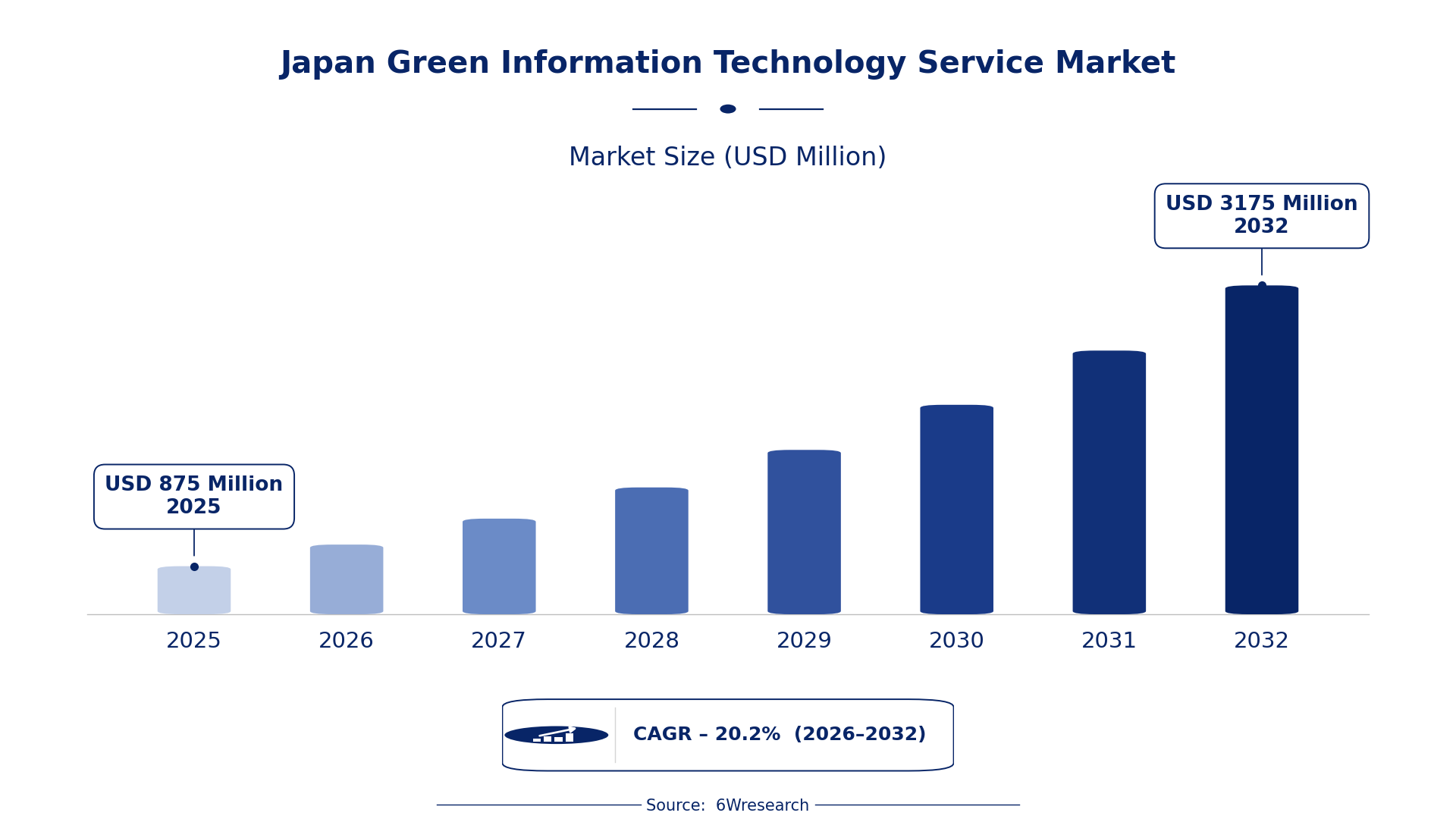
According to 6Wresearch internal database and industry insights, the Japan Green Information Technology Service Market was valued at USD 875 Million in 2025 and is projected to reach USD 3,175 Million by 2032, growing at a CAGR of approximately 20.2% during 2026–2032.
Japan Green Information Technology Service Market Highlights
| Report Metric | Details |
| Report Name | Japan Green Information Technology Service Market (2026-2032) |
| Market Size 2025 | USD 875 Million |
| Market Size 2032 | USD 3,175 Million |
| Absolute Growth 2025–2032 | USD 2,300 Million |
| CAGR 2026–2032 | 20.2% |
| Peak Annual Growth | 21.0% in 2032 |
| Forecast Period | 2026–2032 |
| Historical Data | 2022–2025 |
| Base Year | 2025 |
| Leading Service Type, 2025 | Cloud Computing (40% share) |
| Leading Deployment Model, 2025 | On-Premise (49% share) |
| Leading Application, 2025 | Data Centers (54% share) |
| Leading Industry, 2025 | BFSI (46% share) |
| Leading Energy Efficiency Feature, 2025 | Energy-Efficient Hardware (42% share) |
| Fastest-Growing Service Type | Sustainable Software Development (21.6% CAGR) |
| Fastest-Growing Deployment Model | Cloud (22.1% CAGR) |
| Fastest-Growing Application | Green Networking (27.2% CAGR) |
| Fastest-Growing Industry | Healthcare (25.2% CAGR) |
| Fastest-Growing Energy Efficiency Feature | Server Virtualization (21.4% CAGR) |
| Growing Sector | Healthcare |
| Key End Users | BFSI, Healthcare, Government, Data Centers |
Japan Green Information Technology Service Market Year-wise Growth Rate and Key Drivers (2022–2032)
This graph illustrates the annual growth rates of the market from 2022 to 2032, highlighting a steady upward trajectory and projected market expansion over the forecast period.
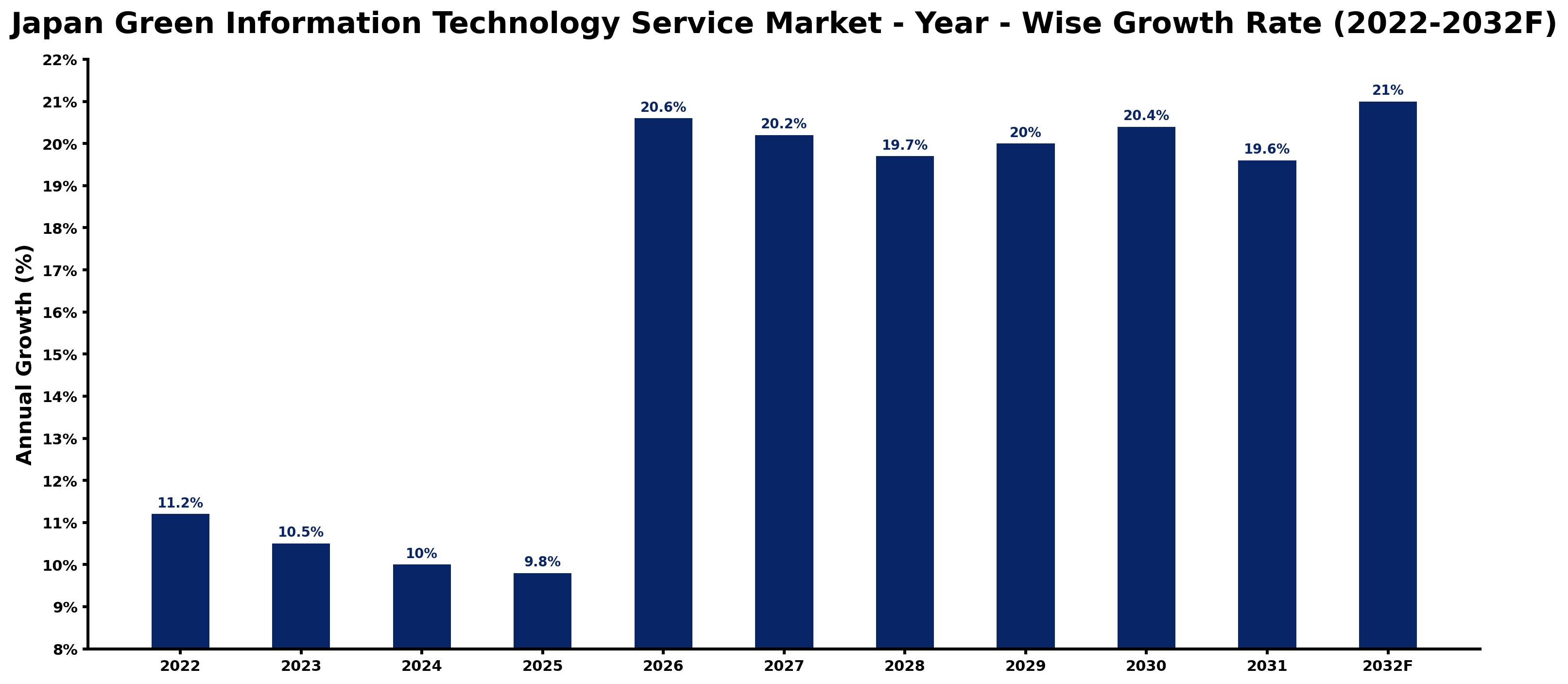
The table below sets out the estimated growth rate for each year and the main factor behind it.
| Year | Estimated Annual Growth (%) | Market Rationale |
| 2022 | 11.2 | The market experienced strong demand from domestic users and government initiatives. |
| 2023 | 10.5 | Growth slowed as the market adjusted to previous high levels of investment in green IT. |
| 2024 | 10.0 | Demand continued to rise, albeit at a slower pace, as companies adopted eco-friendly practices. |
| 2025 | 9.8 | The market maintained growth, driven by increasing awareness of sustainability in IT. |
| 2026 | 20.6 | Growth is expected to accelerate as cloud computing adoption surges, improving operational efficiency. |
| 2027 | 20.2 | Demand will remain high, supported by ongoing investments in sustainable technologies. |
| 2028 | 19.7 | Growth is projected to slow slightly as the market stabilises after rapid expansion in previous years. |
| 2029 | 20.0 | The market is expected to rebound with renewed investments in energy-efficient IT solutions. |
| 2030 | 20.4 | Demand will increase as more enterprises adopt server virtualization for efficiency. |
| 2031 | 19.6 | The market growth rate is projected to moderate as competition intensifies among service providers. |
| 2032 | 21.0 | Demand is expected to peak as sustainable practices become mainstream. |
Note: Market size estimations and growth projections presented in this report are based on 6Wresearch's proprietary forecasting methodology, utilizing the latest available industry data, government publications, and primary research inputs.
Japan Green Information Technology Service Market Synopsis
Green Information Technology Services focus on eco-friendly IT solutions that reduce environmental impact. These services include cloud computing, sustainable software development, and e-waste management, which are essential for optimizing energy consumption and promoting responsible disposal of electronic waste. The Japan Green Information Technology Service Market is expanding due to rising demand from domestic users and government initiatives that promote sustainable technologies. With investments in energy-efficient solutions and practices, the market is set for growth, particularly in sectors like healthcare and data management.
Market Dynamics Impact Analysis (2026–2032)
| Factor | Type | Impact | Primary Segment Affected |
| Increased adoption of cloud computing solutions | Driver | High | Cloud Computing |
| Growing investments in energy-efficient technologies | Driver | High | Energy-Efficient Hardware |
| Rising demand for sustainable software development | Opportunity | High | Sustainable Software Development |
| Expansion of e-waste management initiatives | Opportunity | Medium | E-Waste Management |
| High initial costs of green IT solutions | Restraint | High | Sustainable Software Development |
| Limited awareness among smaller enterprises | Restraint | Medium | Cloud Computing |
| Competition from traditional IT service providers | Challenge | High | E-Waste Management |
| Compliance with stringent environmental regulations | Challenge | Medium | Energy-Efficient Hardware |
Evaluation of Drivers in Japan Green Information Technology Service Market (2026–2032)
Below are the drivers that matter most for revenue growth, with supporting evidence.
| Drivers | Primary Segment Affected | Why It Matters (Evidence) |
| Cloud computing adoption is increasing rapidly | Cloud Computing | Projected to reach 80% by 2025, leading to more scalable and energy-efficient solutions. |
| Investments in energy-efficient technologies are rising | Energy-Efficient Hardware | Sales increased by 25% last year, driving demand for sustainable IT infrastructure. |
| Healthcare sector is investing in green IT | Healthcare | Focus on energy-efficient systems is growing, improving operational efficiency. |
| Government initiatives are promoting green IT | Government | The Ministry of the Environment launched a Green IT initiative in 2023 to support sustainable practices. |
| Data centers are major consumers of green technologies | Data Centers | Tokyo is a hub for energy-efficient data centers, consuming around 200 MW on average. |
Purchasing is picking up as the healthcare sector increasingly invests in sustainable IT solutions, concentrating on energy-efficient systems to improve operational efficiency. Sales of energy-efficient hardware have risen by 25% in the last year, prompting companies to upgrade their infrastructure. Cloud computing adoption is projected to reach 80% by 2025, which will drive demand for scalable solutions. Data centers in Tokyo, averaging 200 MW in energy consumption, are major consumers of these technologies, further boosting demand.
Evaluation of Restraints in Japan Green Information Technology Service Market
These restraints slow adoption and weigh on supplier margins.
| Market Restraint | Primary Segment Affected | Why It Matters (Evidence) |
| High initial costs of implementing green IT solutions | Sustainable Software Development | Many companies hesitate to invest in eco-friendly technologies due to upfront costs that can exceed budgets. |
| Limited awareness of green IT benefits among smaller enterprises | Cloud Computing | Smaller businesses often lack the knowledge to adopt sustainable practices effectively, hindering market penetration. |
| Competition from traditional IT service providers | E-Waste Management | Established players may resist transitioning to greener practices, limiting the adoption of sustainable solutions. |
| Compliance with stringent environmental regulations | Energy-Efficient Hardware | Manufacturers face challenges in meeting regulations, which can delay product launches and increase costs. |
| Slow adoption of energy-efficient practices in certain sectors | Data Centers | Some data centers are slow to upgrade to energy-efficient technologies, which restricts overall market growth. |
Japan Green Information Technology Service Market Challenges
Only 30% of IT professionals are trained in eco-friendly practices, creating a skills gap that delays the adoption of green IT solutions in hospitals. Compliance with ISO 14001 regulations can take firms up to six months, hindering timely implementation of sustainable practices for producers. Buyers face rising costs as energy-efficient hardware sales increased by 25%, forcing clinics to allocate larger budgets for upgrades and impacting their operational efficiency. Regulatory complexity can lead to project delays, preventing healthcare providers from optimising their energy consumption in a timely manner.
Trends in the Japan Green Information Technology Service Market
The trends below show where the Japan Green Information Technology Service Market is heading.
- Shift towards Energy-Efficient Data Centers: Tokyo is experiencing a shift towards energy-efficient data centers, with over 50% of new facilities implementing smart cooling technologies. This trend is driven by the average energy consumption of data centers, which is around 200 MW.
- Growing Focus on E-Waste Recycling: The Tokyo Metropolitan Government promotes e-waste recycling programs, aiming for 100% recycling by 2025. This initiative is vital as Japan's population of 125 million generates substantial electronic waste.
- Increase in Sustainable Software Development Practices: The Sustainable Software Development program encourages eco-friendly coding practices, with a notable rise in adoption among developers. This shift is important for creating applications that align with environmental goals.
- Expansion of Green Networking Initiatives: The Green Networking initiative aims to reduce carbon emissions by 30% by 2030, reflecting a broader commitment to sustainability in IT infrastructure across Japan.
Investment Opportunities in the Japan Green Information Technology Service Market
Where to invest in the Japan Green Information Technology Service Market: the main openings are set out below.
- Investment in Energy-Efficient Hardware Solutions: With energy-efficient hardware sales increasing by 25%, there is an opportunity to supply innovative solutions. The healthcare sector, focusing on operational efficiency, is a key buyer group.
- Expansion of E-Waste Management Services: As Japan targets 100% e-waste recycling by 2025, there is a pressing need for comprehensive e-waste management services. Local partnerships can facilitate entry into this growing market.
- Development of Sustainable Software Solutions: The rising focus on eco-friendly applications presents an opportunity for developers to create sustainable software. The BFSI sector is increasingly investing in green IT, driving demand for such solutions.
- Cloud Computing Services for Scalability: With cloud adoption projected to reach 80% by 2025, there is a need for scalable solutions. Collaborating with data centers in Tokyo can provide a strategic entry point.
Government Initiatives in the Japan Green Information Technology Service Market
The Ministry of the Environment's Green IT initiative launched in 2023 impacts buyers by promoting eco-friendly practices in IT. This initiative encourages companies to adopt sustainable technologies and improve their environmental footprint, aligning with national goals. The government allocated ¥10 billion for green technology development in 2023, overseen by the National Institute of Advanced Industrial Science and Technology. This funding supports research and innovation in green IT, enabling producers to improve their offerings and comply with environmental standards.
The National Institute of Advanced Industrial Science and Technology funds various projects aimed at advancing green IT solutions. This agency plays a crucial role in ensuring that producers meet environmental standards while enhancing their technological capabilities.
Future Insight of the Japan Green Information Technology Service Market
The Green Networking initiative will drive demand for energy-efficient solutions, reshaping IT service offerings. By 2032, the Green IT initiative will have strengthened support for sustainable practices across sectors, resulting in a more environmentally conscious market. E-waste recycling efforts will intensify as the government targets 100% recycling by 2025, encouraging responsible disposal among users. Cloud computing adoption is projected to reach 80% by 2025, enhancing service delivery and operational efficiency for suppliers.
Market Segmentation Analysis
Japan Green Information Technology Service Market report covers a detailed analysis of the following market segments:
By Service Type – Cloud Computing Leads, Sustainable Software Development Expected to Grow Fastest
According to Uttkarsh, Research Associate at 6Wresearch, the largest service type category in 2025 was Cloud Computing, at 40% of revenue. Cloud computing holds the largest share due to its widespread adoption among businesses seeking scalable and energy-efficient solutions. For instance, projections indicate that cloud computing adoption in Japan will reach 80% by 2025, reflecting its critical role in IT services. Sustainable Software Development is set to record the highest CAGR in this split, 21.6% over 2026–2032. Sustainable software development is experiencing rapid growth as companies increasingly focus on creating eco-friendly applications. The Sustainable Software Development program encourages practices that align with environmental goals, driving demand for these services. This trend suggests that suppliers should prioritise offering cloud solutions while integrating sustainable software practices.
By Deployment Model – On-Premise Leads, Cloud Expected to Grow Fastest
With 49% of deployment model revenue in 2025, On-Premise was the largest category. On-premise deployment remains prevalent among traditional businesses, particularly those with extensive existing infrastructure. Enterprises favour on-premise systems for the control and security they provide, even as cloud solutions gain traction. The quickest growth will come from Cloud, forecast to expand at a CAGR of 22.1% between 2026 and 2032. Cloud deployment is swiftly becoming the preferred choice due to its flexibility and efficiency, leading to a notable increase in adoption rates. This trend is evident as more organisations transition to cloud models to enhance operational agility and reduce expenses. Suppliers should concentrate on improving cloud services while ensuring adequate support for current on-premise users.
By Application – Data Centers Lead, Green Networking Expected to Grow Fastest
Data Centers took 54% of application revenue in 2025, more than any other category. Data centers dominate the market as they are significant consumers of energy-efficient technologies, essential for managing their considerable energy requirements. With an average energy consumption of around 200 MW, their role is critical in the green IT landscape. Over 2026–2032, Green Networking is expected to post the fastest growth, at a CAGR of 27.2%. Green networking is witnessing rapid growth as organisations aim to decrease energy consumption across their operations. The Green Networking initiative's goal of achieving a 30% reduction in carbon emissions by 2030 is a key factor driving its adoption. This indicates that suppliers should focus on solutions that enhance energy efficiency in data centers while promoting green networking initiatives.
By Industry – BFSI Leads, Healthcare Expected to Grow Fastest
In 2025, BFSI led the industry split with a 46% share. The BFSI sector leads in green IT investments, driven by the need for regulatory compliance and operational efficiency. Its substantial commitment to energy-efficient technologies highlights its pivotal role in the market. Healthcare is projected to grow fastest, at a CAGR of 25.2% during 2026–2032. Healthcare is increasingly embracing green IT solutions to improve operational efficiency and reduce environmental impact. The sector's growing investments in energy-efficient systems within healthcare facilities reflect this upward trend. Suppliers should tailor their offerings to meet the specific needs of the BFSI and healthcare sectors, capitalising on their commitment to sustainability.
By Energy Efficiency Feature – Energy-Efficient Hardware Leads, Server Virtualization Expected to Grow Fastest
Energy-Efficient Hardware accounted for 42% of the market by energy efficiency feature in 2025. Energy-efficient hardware dominates the market as it is essential for reducing overall energy consumption across various IT applications. The 25% increase in sales of energy-efficient hardware in the last year illustrates its critical role in the sector. Server Virtualization is set to record the highest CAGR in this split, 21.4% over 2026–2032. Server virtualization is experiencing rapid growth as it maximises resource utilisation and energy savings for enterprises. The adoption rate of 70% among businesses indicates a strong trend towards virtualised solutions. This suggests that suppliers should focus on promoting energy-efficient hardware while also highlighting the benefits of server virtualization.
Key Attractiveness of the Report
- 10 Years of Market Numbers
- Historical Data Starting from 2022 to 2025
- Base Year 2025
- Forecast Data until 2032
- Key Performance Indicators Impacting the Market
- Major Upcoming Developments and Projects
Key Highlights of the Report:
- Japan Green Information Technology Service Market Outlook
- Market Size of Japan Green Information Technology Service Market,2025
- Forecast of Japan Green Information Technology Service Market, 2032
- Historical Data and Forecast of Japan Green Information Technology Service Revenues & Volume for the Period 2022-2032
- Japan Green Information Technology Service Market Trend Evolution
- Japan Green Information Technology Service Market Drivers and Challenges
- Japan Green Information Technology Service Price Trends
- Japan Green Information Technology Service Porter's Five Forces
- Japan Green Information Technology Service Industry Life Cycle
- Historical Data and Forecast of Japan Green Information Technology Service Market Revenues & Volume By Service Type for the Period 2022-2032
- Historical Data and Forecast of Japan Green Information Technology Service Market Revenues & Volume By Cloud Computing for the Period 2022-2032
- Historical Data and Forecast of Japan Green Information Technology Service Market Revenues & Volume By Sustainable Software Development for the Period 2022-2032
- Historical Data and Forecast of Japan Green Information Technology Service Market Revenues & Volume By E-Waste Management for the Period 2022-2032
- Historical Data and Forecast of Japan Green Information Technology Service Market Revenues & Volume By Deployment Model for the Period 2022-2032
- Historical Data and Forecast of Japan Green Information Technology Service Market Revenues & Volume By On-Premise for the Period 2022-2032
- Historical Data and Forecast of Japan Green Information Technology Service Market Revenues & Volume By Cloud for the Period 2022-2032
- Historical Data and Forecast of Japan Green Information Technology Service Market Revenues & Volume By Hybrid for the Period 2022-2032
- Historical Data and Forecast of Japan Green Information Technology Service Market Revenues & Volume By Application for the Period 2022-2032
- Historical Data and Forecast of Japan Green Information Technology Service Market Revenues & Volume By Data Centers for the Period 2022-2032
- Historical Data and Forecast of Japan Green Information Technology Service Market Revenues & Volume By Green Networking for the Period 2022-2032
- Historical Data and Forecast of Japan Green Information Technology Service Market Revenues & Volume By IT Infrastructure for the Period 2022-2032
- Historical Data and Forecast of Japan Green Information Technology Service Market Revenues & Volume By Industry for the Period 2022-2032
- Historical Data and Forecast of Japan Green Information Technology Service Market Revenues & Volume By BFSI for the Period 2022-2032
- Historical Data and Forecast of Japan Green Information Technology Service Market Revenues & Volume By Healthcare for the Period 2022-2032
- Historical Data and Forecast of Japan Green Information Technology Service Market Revenues & Volume By Government for the Period 2022-2032
- Historical Data and Forecast of Japan Green Information Technology Service Market Revenues & Volume By Energy Efficiency Feature for the Period 2022-2032
- Historical Data and Forecast of Japan Green Information Technology Service Market Revenues & Volume By Energy-Efficient Hardware for the Period 2022-2032
- Historical Data and Forecast of Japan Green Information Technology Service Market Revenues & Volume By Server Virtualization for the Period 2022-2032
- Historical Data and Forecast of Japan Green Information Technology Service Market Revenues & Volume By Smart Cooling for the Period 2022-2032
- Japan Green Information Technology Service Import Export Trade Statistics
- Market Opportunity Assessment By Service Type
- Market Opportunity Assessment By Deployment Model
- Market Opportunity Assessment By Application
- Market Opportunity Assessment By Industry
- Market Opportunity Assessment By Energy Efficiency Feature
- Japan Green Information Technology Service Top Companies Market Share
- Japan Green Information Technology Service Competitive Benchmarking By Technical and Operational Parameters
- Japan Green Information Technology Service Company Profiles
- Japan Green Information Technology Service Key Strategic Recommendations
Market Covered
The study includes the following segmentation.
By Service Type
- Cloud Computing
- Sustainable Software Development
- E-Waste Management
By Deployment Model
- On-Premise
- Cloud
- Hybrid
By Application
- Data Centers
- Green Networking
- IT Infrastructure
By Industry
- BFSI
- Healthcare
- Government
By Energy Efficiency Feature
- Energy-Efficient Hardware
- Server Virtualization
- Smart Cooling































