Japan Greenhouse Bioprotection Market Size & Growth Rate
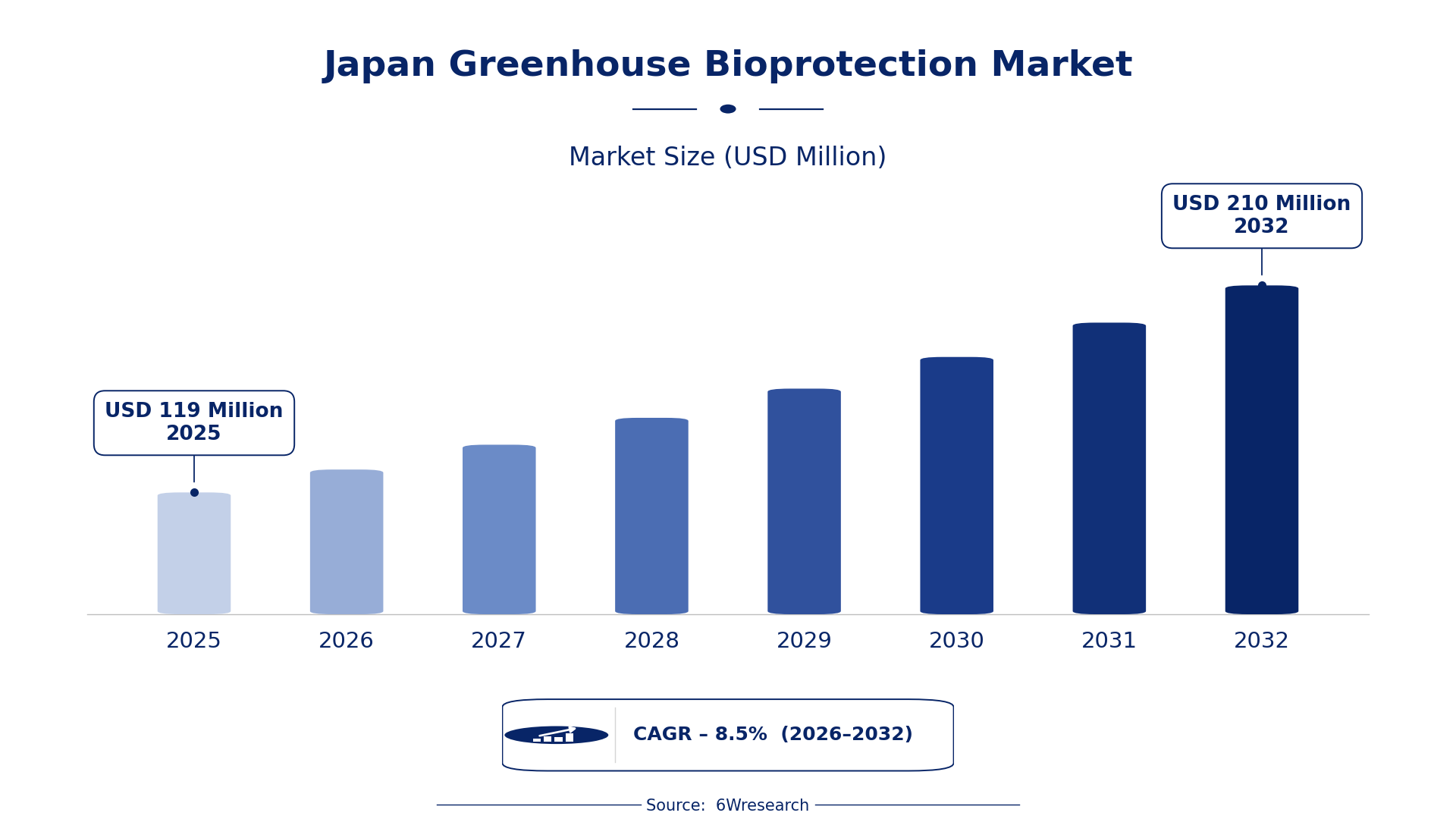
According to 6Wresearch internal database and industry insights, the Japan Greenhouse Bioprotection Market was valued at USD 119 Million in 2025 and is projected to reach USD 210 Million by 2032, growing at a CAGR of approximately 8.5% during 2026–2032.
Japan Greenhouse Bioprotection Market Highlights
| Report Metric | Details |
| Report Name | Japan Greenhouse Bioprotection Market (2026-2032) |
| Market Size 2025 | USD 119 Million |
| Market Size 2032 | USD 210 Million |
| Absolute Growth 2025–2032 | USD 91 Million |
| CAGR 2026–2032 | 8.5% |
| Peak Annual Growth | 9.8% in 2026 |
| Forecast Period | 2026–2032 |
| Historical Data | 2022–2025 |
| Base Year | 2025 |
| Leading Product Type, 2025 | Beneficial Nematodes (41% share) |
| Leading Source Type, 2025 | Biological Agents (43% share) |
| Leading Application Method, 2025 | Foliar Spray (40% share) |
| Leading End User, 2025 | Greenhouse Growers (55% share) |
| Fastest-Growing Product Type | Trichoderma Fungi (11.7% CAGR) |
| Fastest-Growing Source Type | Bacterial Bioinsecticide (12.1% CAGR) |
| Fastest-Growing End User | Horticulture Companies (11.0% CAGR) |
| Growing Sector | sustainable agriculture |
| Key End Users | greenhouse growers, organic farms, horticulture companies, agri-tech firms |
Japan Greenhouse Bioprotection Market Year-wise Growth Rate and Key Drivers (2022–2032)
This graph illustrates the annual growth rates of the market from 2022 to 2032, highlighting a steady upward trajectory and projected market expansion over the forecast period.
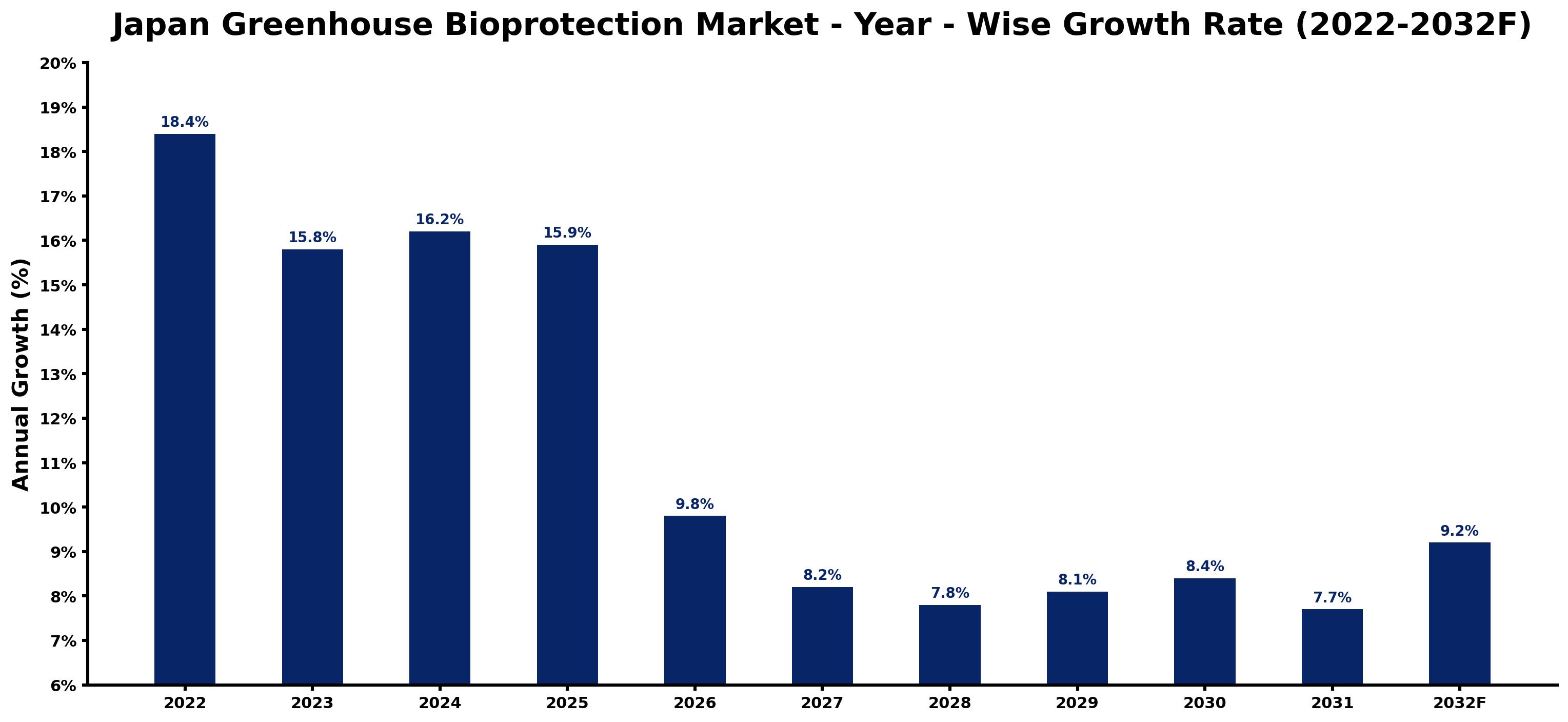
For each year, the table pairs the estimated growth rate with the leading influence on demand, showing how the drivers changed across the period.
| Year | Estimated Annual Growth (%) | Market Rationale |
| 2022 | 18.4 | The market experienced significant growth due to heightened awareness of sustainable practices. |
| 2023 | 15.8 | Demand growth slowed as market saturation began to affect new investments. |
| 2024 | 16.2 | Increased adoption of bioprotectants in organic farms spurred growth rates. |
| 2025 | 15.9 | Market growth decelerated as competition intensified among bioproducts. |
| 2026 | 9.8 | The peak growth year was driven by heightened government support for bioprotectants. |
| 2027 | 8.2 | Growth continued to slow as market maturity set in and innovation slowed. |
| 2028 | 7.8 | Demand stabilised as buyers adjusted to the available bioprotectant options. |
| 2029 | 8.1 | Growth accelerated again as new bioproducts entered the market. |
| 2030 | 8.4 | Increased awareness of environmental impacts boosted demand for bioprotectants. |
| 2031 | 7.7 | Growth slowed as the market began to reach a saturation point. |
| 2032 | 9.2 | A resurgence in interest for sustainable farming methods led to increased purchases. |
Note: Market size estimations and growth projections presented in this report are based on 6Wresearch's proprietary forecasting methodology, utilizing the latest available industry data, government publications, and primary research inputs.
Japan Greenhouse Bioprotection Market Synopsis
Greenhouse bioprotection utilises natural organisms to manage pests and diseases in crops, promoting yield and health sustainably. The Japan Greenhouse Bioprotection Market is growing due to the rise of organic farming, with approximately 30% adoption of bioprotectants. Greenhouse growers and organic farms are the main buyers, supported by government initiatives like the Green Food System that encourage biopesticide use. With an increasing emphasis on sustainable agriculture, the market is projected to expand considerably in the coming years.
Market Dynamics Impact Analysis (2026–2032)
| Factor | Type | Impact | Primary Segment Affected |
| Increased adoption of bioprotectants in organic farming | Driver | High | Biological Agents |
| Government support for sustainable agricultural practices | Driver | High | Bacterial Bioinsecticide |
| Growing demand for eco-friendly pest control solutions | Opportunity | High | Predatory Insects |
| Rising interest in organic farming practices | Opportunity | High | Trichoderma Fungi |
| Limited awareness of bioprotectant benefits among growers | Restraint | Medium | Beneficial Nematodes |
| High initial costs associated with bioprotectant adoption | Restraint | Medium | Fungal Bioprotectant |
| Competition from synthetic pesticides | Challenge | High | Bacterial Bioinsecticide |
| Slow pace of regulatory approvals for new bioproducts | Challenge | Medium | Biological Agents |
Evaluation of Drivers in Japan Greenhouse Bioprotection Market (2026–2032)
Key forces behind demand, with the segment each one moves most, are listed below.
| Drivers | Primary Segment Affected | Why It Matters (Evidence) |
| Rising organic farming area | Beneficial Nematodes | Japan's organic farming area reached 0.5 million hectares in 2022, increasing demand for effective pest control. |
| Government initiatives promoting biopesticides | Bacillus Thuringiensis | The Ministry of Agriculture, Forestry and Fisheries promotes biopesticide use under the Green Food System, driving market growth with increased adoption rates. |
| Increased focus on sustainable agriculture | Trichoderma Fungi | Trichoderma applications increased by 15% in horticulture in 2023, reflecting growing acceptance of bioprotectants. |
| Rising consumer demand for organic produce | Predatory Insects | Greenhouse growers in Japan account for 25% of total vegetable production, driving the need for effective pest management solutions. |
| Growing awareness of environmental impacts | Bacterial Bioinsecticide | The adoption rate of bioprotectants in organic farms is approximately 30%, showcasing a shift towards eco-friendly solutions. |
Orders keep climbing as Japan's organic farming area reached 0.5 million hectares in 2022, leading to increased demand for pest control solutions. The focus on sustainable agriculture is clear, as applications of Trichoderma increased by 15% in horticulture in 2023. Greenhouse growers, accounting for a significant portion of total vegetable production, are driving the need for effective pest management solutions. Growing awareness of environmental impacts supports the adoption of bioprotectants, with a considerable number of organic farms now using these products.
Evaluation of Restraints in Japan Greenhouse Bioprotection Market
These restraints slow adoption and weigh on supplier margins.
| Market Restraint | Primary Segment Affected | Why It Matters (Evidence) |
| Limited awareness of bioprotectant benefits | Beneficial Nematodes | Many growers remain unaware of the advantages of bioprotectants, hindering adoption rates. Approximately 70% of growers have not adopted these methods. |
| High initial costs associated with adoption | Fungal Bioprotectant | The costs associated with implementing bioprotectants can deter growers from switching from traditional methods, with initial investments averaging ¥500,000. |
| Competition from synthetic pesticides | Bacterial Bioinsecticide | Synthetic alternatives often offer lower upfront costs, making them more appealing to some growers, with prices up to 30% lower than bioproducts. |
| Slow regulatory approvals for new products | Biological Agents | The lengthy approval process for new bioproducts can delay market entry, often taking over 18 months, limiting options for growers. |
| Limited availability of specific bioprotectants | Trichoderma Fungi | The market lacks a diverse range of bioprotectants, restricting choices for growers, with only 5-6 options widely available. |
Japan Greenhouse Bioprotection Market Challenges
Low adoption of bioprotectants is a critical issue, with only 30% of organic farms implementing these solutions, which limits crop health improvements for producers. High research costs, estimated at ¥1 billion, hinder the development of effective bioprotection methods, delaying benefits for buyers. A skills gap in bioprotection techniques complicates training for producers, resulting in operational inefficiencies. Regulatory challenges, including compliance with ISO 22000, extend approval times for suppliers, ultimately increasing costs and reducing product availability for buyers.
Trends in the Japan Greenhouse Bioprotection Market
The shifts below are changing how Japan Greenhouse Bioprotection Market products are bought and supplied.
- Shift towards Biopesticide Adoption: The Ministry of Agriculture, Forestry and Fisheries has promoted biopesticide use under the Green Food System since 2020, resulting in a notable increase in adoption rates among organic farms. Approximately 30% of organic farms have begun using bioprotectants, reflecting a significant shift in pest management practices.
- Transition from Chemical to Biological Control: Since 2021, there has been a marked change in pest management strategies, with greenhouse growers increasingly opting for biological agents. The adoption of bioprotectants has risen, with beneficial nematodes used in over 10% of organic farms, indicating a growing preference for eco-friendly solutions.
- Emergence of Integrated Pest Management: The integration of bioprotectants into pest management strategies has gained traction since 2022. This approach combines various methods, with predatory insects being promoted in the Hokkaido region, improving pest control effectiveness and sustainability.
- Increase in Research Funding for Bioprotection: In 2023, the government allocated ¥1 billion for research on bioprotection methods, underscoring a commitment to advancing sustainable agricultural practices. This funding is expected to drive innovation and enhance product availability in the market.
Investment Opportunities in the Japan Greenhouse Bioprotection Market
The opportunities below stand out in the Japan Greenhouse Bioprotection Market for new entrants and existing suppliers.
- Organic Farms Seeking Sustainable Solutions: Organic farms in Japan are increasingly searching for effective pest control solutions, with 30% adopting bioprotectants. Suppliers can enter this market by forming partnerships with local growers to satisfy this demand.
- Horticulture Companies Expanding Bioproduct Use: Horticulture companies are actively pursuing bioprotectants to improve crop resilience. With a projected growth rate of 11.0%, suppliers should consider targeting this segment with tailored products.
- Greenhouse Growers Adopting Eco-Friendly Practices: Greenhouse growers are prioritising sustainable pest management, accounting for 55% of the market. Suppliers can benefit by offering customised bioprotectant solutions to meet their specific needs.
- Research Institutions Focusing on Bioprotection: Research institutions are increasingly investing in bioprotection methods, with ¥1 billion allocated for research in 2023. Collaborating with these institutions can provide opportunities for product development and validation.
Government Initiatives in the Japan Greenhouse Bioprotection Market
The Next-Generation Medical Infrastructure Act (2017) enhances existing regulations by allowing certified bodies to anonymise agricultural data for research purposes. This measure complements previous laws by promoting innovation in bioproduct development and ensuring compliance with safety standards.
Buyers, particularly organic farms, benefit from the Green Food System, which promotes biopesticide use. This initiative encourages growers to adopt bioprotectants, ensuring they meet the necessary standards for organic certification.
Future Insight of the Japan Greenhouse Bioprotection Market
New bioprotection research centres will emerge by 2032, aimed at advancing pest management solutions. The government’s ¥1 billion investment will stimulate innovation in bioprotectant technologies. Increased use of beneficial nematodes in organic farms will improve pest management strategies. Enhanced training initiatives will equip producers with essential skills, ensuring a more competent workforce in the bioprotection sector.
Market Segmentation Analysis
Japan Greenhouse Bioprotection Market report covers a detailed analysis of the following market segments:
By Product Type – Beneficial Nematodes Lead, Trichoderma Fungi Expected to Grow Fastest
According to Vasu Joshi, Associate Consultant at 6Wresearch, the largest product type category in 2025 was Beneficial Nematodes, at 41% of revenue. Beneficial nematodes hold the largest market share due to their widespread use for pest control in soil, particularly among organic farms. Their effectiveness is endorsed by the Ministry of Agriculture, Forestry and Fisheries, which actively promotes their application in sustainable practices. Over 2026–2032, Trichoderma Fungi is expected to post the fastest growth, at a CAGR of 11.7%. Trichoderma fungi are experiencing rapid growth, as indicated by a 15% increase in their application in horticulture during 2023 for disease suppression. The ongoing leadership of Beneficial nematodes suggests that their market share will continue to widen alongside increasing adoption rates. Suppliers should focus on enhancing the availability and knowledge of beneficial nematodes to meet the rising demand effectively.
By Source Type – Biological Agents Lead, Bacterial Bioinsecticide Expected to Grow Fastest
With 43% of source type revenue in 2025, Biological Agents was the largest category. Biological agents dominate the market because they are integral to integrated pest management strategies, which are widely adopted by greenhouse growers. Their contribution to sustainable agriculture aligns with Japan's organic farming goals, ensuring strong demand. The quickest growth will come from Bacterial Bioinsecticide, forecast to expand at a CAGR of 12.1% between 2026 and 2032. Bacterial bioinsecticides are rapidly emerging as a preferred eco-friendly pest control method, appealing to growers who prioritise sustainability. This shift towards environmentally responsible practices will likely accelerate the adoption of biological agents in the market. Buyers are likely to increasingly prefer suppliers that provide effective biological solutions in line with sustainable agriculture practices.
By Application Method – Foliar Spray Leads and Records the Fastest Growth
In 2025, Foliar Spray led the application method split with a 40% share. Foliar spray is the leading application method due to its common use for pest control, allowing for efficient coverage of crops. This method is preferred by greenhouse growers for its ease of application and effectiveness. Foliar Spray is also forecast to expand faster than any other category, at a CAGR of 11.1% over 2026–2032. Foliar spray remains the fastest-growing method as it is versatile and can be adapted for various bioprotectants. Its established position as the leader ensures that it will continue to dominate the market. Suppliers should invest in developing foliar spray formulations to meet the increasing demand for effective pest control solutions.
By End User – Greenhouse Growers Lead, Horticulture Companies Expected to Grow Fastest
Greenhouse Growers took 55% of end user revenue in 2025, more than any other category. Greenhouse growers represent the largest user group for bioprotection solutions, accounting for 25% of total vegetable production in Japan. Their reliance on effective crop protection methods drives the demand for bioprotectants. Horticulture Companies are projected to grow fastest, at a CAGR of 11.0% during 2026–2032. Horticulture companies are the fastest-growing end user segment as they increasingly utilise bioprotectants for diverse crops, reflecting a shift towards sustainable practices. The growth of greenhouse growers will further support this trend. Suppliers must tailor their offerings to meet the specific needs of horticulture companies to capitalise on this growth opportunity.
Key Attractiveness of the Report
- 10 Years of Market Numbers
- Historical Data Starting from 2022 to 2025
- Base Year 2025
- Forecast Data until 2032
- Key Performance Indicators Impacting the Market
- Major Upcoming Developments and Projects
Key Highlights of the Report:
- Japan Greenhouse Bioprotection Market Outlook
- Market Size of Japan Greenhouse Bioprotection Market, 2025
- Forecast of Japan Greenhouse Bioprotection Market, 2032
- Historical Data and Forecast of Japan Greenhouse Bioprotection Revenues & Volume for the Period 2022-2032F
- Japan Greenhouse Bioprotection Market Trend Evolution
- Japan Greenhouse Bioprotection Market Drivers and Challenges
- Japan Greenhouse Bioprotection Price Trends
- Japan Greenhouse Bioprotection Porter's Five Forces
- Japan Greenhouse Bioprotection Industry Life Cycle
- Historical Data and Forecast of Japan Greenhouse Bioprotection Market Revenues & Volume By Product Type for the Period 2022-2032F
- Historical Data and Forecast of Japan Greenhouse Bioprotection Market Revenues & Volume By Beneficial Nematodes for the Period 2022-2032F
- Historical Data and Forecast of Japan Greenhouse Bioprotection Market Revenues & Volume By Bacillus Thuringiensis for the Period 2022-2032F
- Historical Data and Forecast of Japan Greenhouse Bioprotection Market Revenues & Volume By Trichoderma Fungi for the Period 2022-2032F
- Historical Data and Forecast of Japan Greenhouse Bioprotection Market Revenues & Volume By Predatory Insects for the Period 2022-2032F
- Historical Data and Forecast of Japan Greenhouse Bioprotection Market Revenues & Volume By Source Type for the Period 2022-2032F
- Historical Data and Forecast of Japan Greenhouse Bioprotection Market Revenues & Volume By Biological Agents for the Period 2022-2032F
- Historical Data and Forecast of Japan Greenhouse Bioprotection Market Revenues & Volume By Bacterial Bioinsecticide for the Period 2022-2032F
- Historical Data and Forecast of Japan Greenhouse Bioprotection Market Revenues & Volume By Fungal Bioprotectant for the Period 2022-2032F
- Historical Data and Forecast of Japan Greenhouse Bioprotection Market Revenues & Volume By Natural Predators for the Period 2022-2032F
- Historical Data and Forecast of Japan Greenhouse Bioprotection Market Revenues & Volume By Application Method for the Period 2022-2032F
- Historical Data and Forecast of Japan Greenhouse Bioprotection Market Revenues & Volume By Soil Injection for the Period 2022-2032F
- Historical Data and Forecast of Japan Greenhouse Bioprotection Market Revenues & Volume By Foliar Spray for the Period 2022-2032F
- Historical Data and Forecast of Japan Greenhouse Bioprotection Market Revenues & Volume By Drip Irrigation for the Period 2022-2032F
- Historical Data and Forecast of Japan Greenhouse Bioprotection Market Revenues & Volume By Controlled Release for the Period 2022-2032F
- Historical Data and Forecast of Japan Greenhouse Bioprotection Market Revenues & Volume By End User for the Period 2022-2032F
- Historical Data and Forecast of Japan Greenhouse Bioprotection Market Revenues & Volume By Organic Farms for the Period 2022-2032F
- Historical Data and Forecast of Japan Greenhouse Bioprotection Market Revenues & Volume By Greenhouse Growers for the Period 2022-2032F
- Historical Data and Forecast of Japan Greenhouse Bioprotection Market Revenues & Volume By Horticulture Companies for the Period 2022-2032F
- Historical Data and Forecast of Japan Greenhouse Bioprotection Market Revenues & Volume By Agri-Tech Firms for the Period 2022-2032F
- Japan Greenhouse Bioprotection Import Export Trade Statistics
- Market Opportunity Assessment By Product Type
- Market Opportunity Assessment By Source Type
- Market Opportunity Assessment By Application Method
- Market Opportunity Assessment By End User
- Japan Greenhouse Bioprotection Top Companies Market Share
- Japan Greenhouse Bioprotection Competitive Benchmarking By Technical and Operational Parameters
- Japan Greenhouse Bioprotection Company Profiles
- Japan Greenhouse Bioprotection Key Strategic Recommendations
Market Covered
Segments analysed in this report are listed below.
By Product Type
- Beneficial Nematodes
- Bacillus Thuringiensis
- Trichoderma Fungi
- Predatory Insects
By Source Type
- Biological Agents
- Bacterial Bioinsecticide
- Fungal Bioprotectant
- Natural Predators
By Application Method
- Soil Injection
- Foliar Spray
- Drip Irrigation
- Controlled Release
By End User
- Organic Farms
- Greenhouse Growers
- Horticulture Companies
- Agri-Tech Firms






































