Japan Greenhouse Fertilizer Market Size & Growth Rate
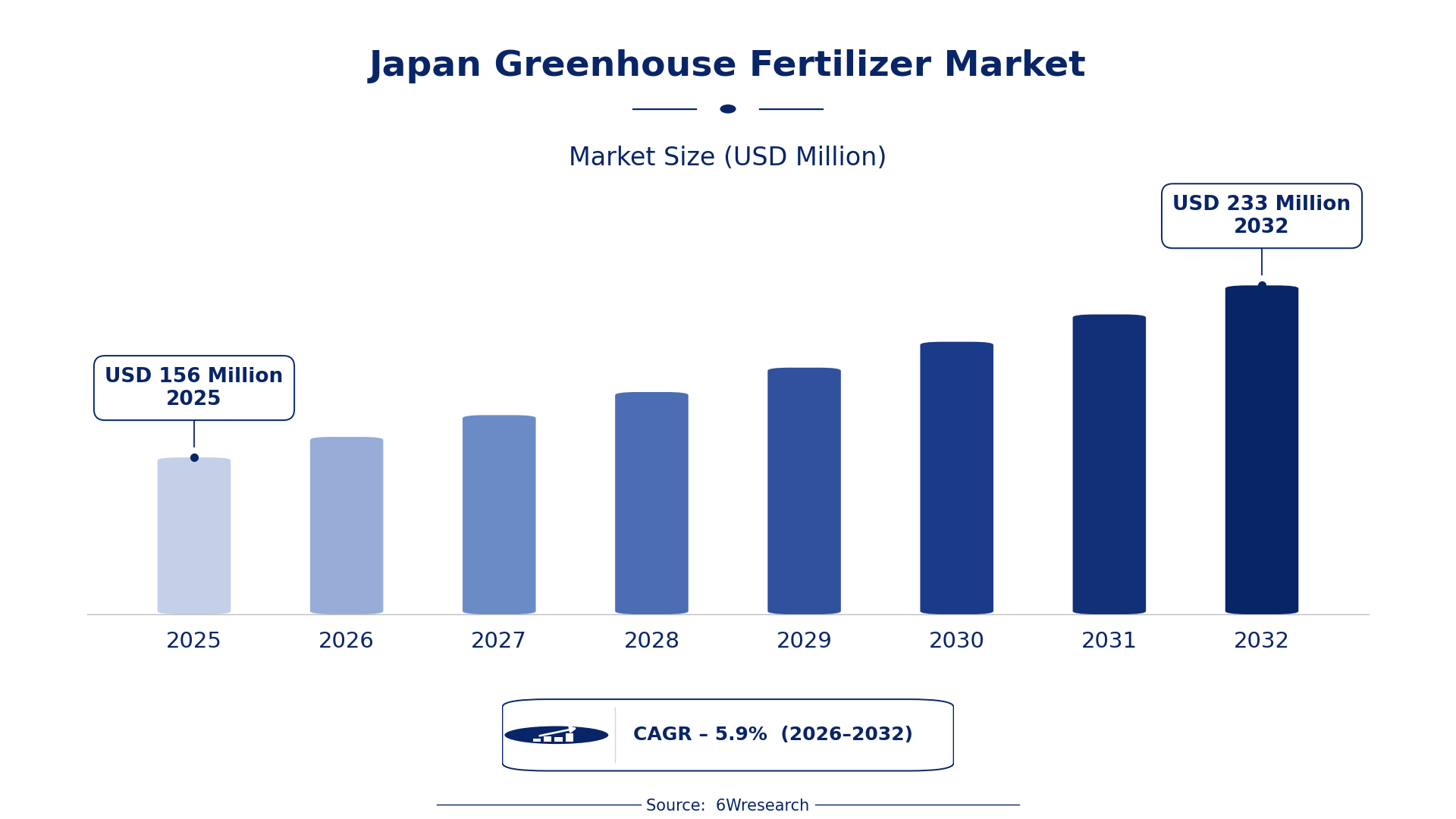
According to 6Wresearch internal database and industry insights, the Japan Greenhouse Fertilizer Market was valued at USD 156 Million in 2025 and is projected to reach USD 233 Million by 2032, growing at a CAGR of approximately 5.9% during 2026–2032.
Japan Greenhouse Fertilizer Market Highlights
| Report Metric | Details |
| Report Name | Japan Greenhouse Fertilizer Market (2026-2032) |
| Market Size 2025 | USD 156 Million |
| Market Size 2032 | USD 233 Million |
| Absolute Growth 2025–2032 | USD 77 Million |
| CAGR 2026–2032 | 5.9% |
| Peak Annual Growth | 6.9% in 2032 |
| Forecast Period | 2026–2032 |
| Historical Data | 2022–2025 |
| Base Year | 2025 |
| Leading Fertilizer Type, 2025 | Organic Liquid Fertilizers (45% share) |
| Leading Composition Source, 2025 | Seaweed/Compost Extracts (39% share) |
| Leading Application Mode, 2025 | Drip Systems (39% share) |
| Leading End User, 2025 | Organic Farmers (53% share) |
| Fastest-Growing Fertilizer Type | Biofertilizers (8.5% CAGR) |
| Fastest-Growing Application Mode | Foliar Spray (7.9% CAGR) |
| Fastest-Growing End User | Hydroponic Growers (7.8% CAGR) |
| Growing Sector | Foliar Spray |
| Key End Users | Drip Systems, Foliar Spray, Soil Mixing, Manual Application |
Japan Greenhouse Fertilizer Market Year-wise Growth Rate and Key Drivers (2022–2032)
This graph illustrates the annual growth rates of the market from 2022 to 2032, highlighting a steady upward trajectory and projected market expansion over the forecast period.
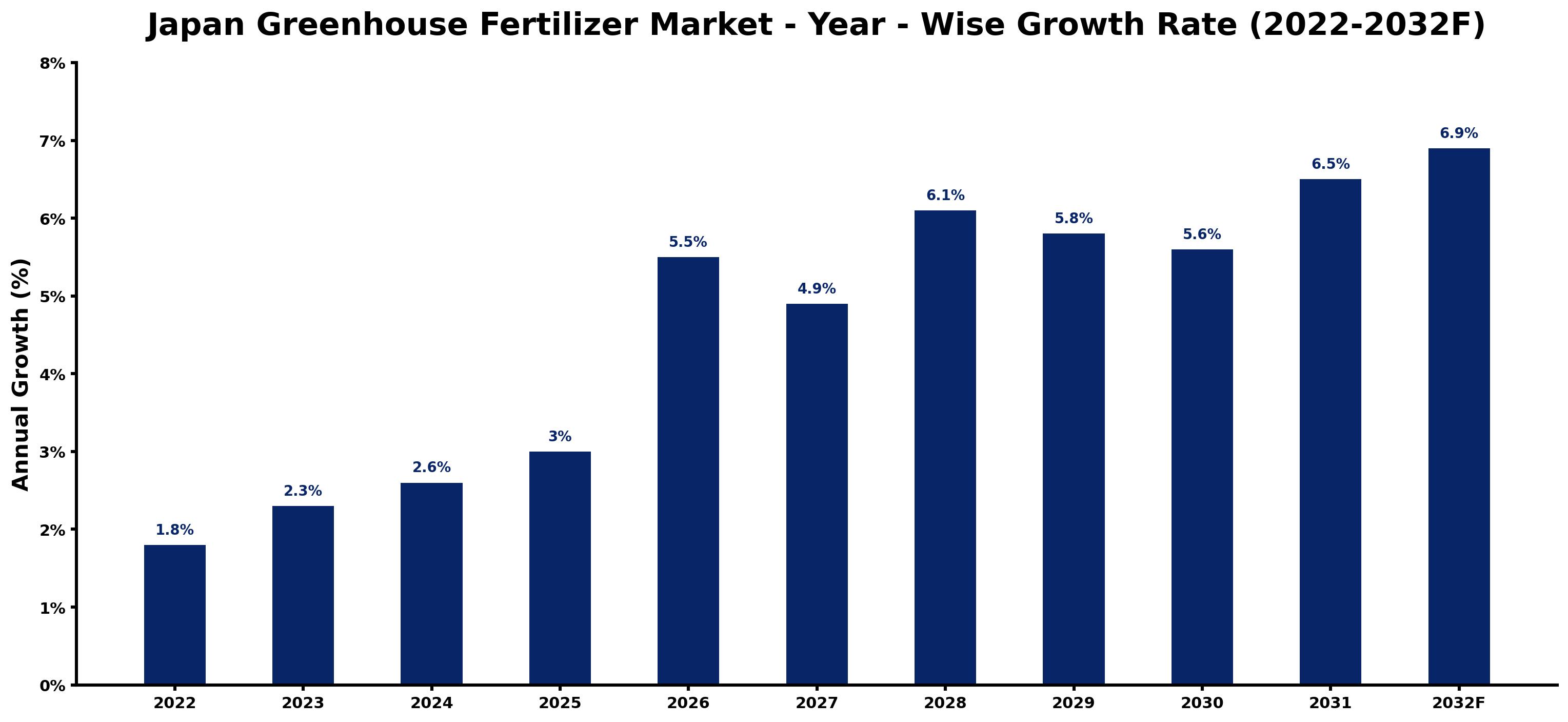
The following figures match every annual growth estimate with the main market development of that year, giving the reasoning behind each rise or slowdown.
| Year | Estimated Annual Growth (%) | Market Rationale |
| 2022 | 1.8 | The market showed steady demand from organic farmers and cooperatives. |
| 2023 | 2.3 | Growth accelerated as urban hydroponic systems gained popularity in Tokyo. |
| 2024 | 2.6 | Increased awareness of sustainable practices supported higher fertilizer use. |
| 2025 | 3.0 | Organic farming initiatives expanded, boosting demand for greenhouse fertilizers. |
| 2026 | 5.5 | The introduction of new biofertilizer products is expected to stimulate market activity. |
| 2027 | 4.9 | Growth is projected to slow as market saturation begins to affect new purchases. |
| 2028 | 6.1 | Rising interest in organic produce will lead to renewed demand for fertilizers. |
| 2029 | 5.8 | A decrease in farmer numbers will limit growth despite ongoing demand. |
| 2030 | 5.6 | Market growth is expected to slow as competition increases among suppliers. |
| 2031 | 6.5 | Demand will surge due to new regulations promoting organic farming practices. |
| 2032 | 6.9 | The market is projected to peak as urban agriculture initiatives expand. |
Note: Market size estimations and growth projections presented in this report are based on 6Wresearch's proprietary forecasting methodology, utilizing the latest available industry data, government publications, and primary research inputs.
Japan Greenhouse Fertilizer Market Synopsis
Greenhouse fertilizers, primarily organic and bio-based, support plant growth in controlled environments. Made from natural sources like seaweed and compost, they are essential for organic farming and hydroponic systems. The Japan Greenhouse Fertilizer Market is expanding, driven by rising domestic demand from organic farmers and agricultural cooperatives, along with increased interest in hydroponic systems, particularly in urban areas like Tokyo. Supported by sustainable agricultural practices and government initiatives for organic farming, the market is set for continued growth.
Market Dynamics Impact Analysis (2026–2032)
| Factor | Type | Impact | Primary Segment Affected |
| Growing demand for organic produce | Driver | High | Organic Liquid Fertilizers |
| Expansion of hydroponic systems in urban areas | Driver | High | Biofertilizers |
| Increased investment in organic farming initiatives | Opportunity | High | Compost-Based Granules |
| Rising interest in sustainable agriculture | Opportunity | Medium | Seaweed/Compost Extracts |
| Aging farmer population affecting adoption rates | Restraint | High | Vermicompost |
| Limited awareness of biofertilizers among growers | Restraint | Medium | Biofertilizers |
| High costs of organic certification | Challenge | High | Organic Farmers |
| Competition from imported fertilizers | Challenge | Medium | Hydroponic Growers |
Evaluation of Drivers in Japan Greenhouse Fertilizer Market (2026–2032)
The table below links each growth driver to the segment it affects and the evidence for it.
| Drivers | Primary Segment Affected | Why It Matters (Evidence) |
| Rising consumer preference for organic products | Organic Liquid Fertilizers | This shift encourages organic farmers to increase their use of organic fertilizers, resulting in higher purchases in the market. |
| Growth of urban agriculture initiatives | Biofertilizers | Urban areas are adopting hydroponic systems, contributing to a demand increase for biofertilizers. |
| Government support for organic farming | Compost-Based Granules | The Waste Management and Public Cleansing Act promotes organic practices, prompting agricultural cooperatives to invest in compost-based fertilizers. |
| Increased awareness of environmental sustainability | Seaweed/Compost Extracts | Sustainable practices are driving demand for seaweed extracts, especially in regions where local recycling efforts thrive. |
| Technological advancements in fertilizer formulations | Vermicompost | Improvements in vermicomposting technology enhance nutrient delivery, appealing to organic farmers seeking better soil health. |
The strongest pull on demand comes from the rising consumer preference for organic products, which encourages organic farmers to increase their use of fertilizers. Growing awareness of environmental sustainability is pushing demand for seaweed extracts, particularly in regions where local recycling efforts thrive. Technological advancements in fertilizer formulations improve nutrient delivery in vermicomposting, appealing to farmers seeking better soil health.
Evaluation of Restraints in Japan Greenhouse Fertilizer Market
These are the pressures that could keep growth below its potential.
| Market Restraint | Primary Segment Affected | Why It Matters (Evidence) |
| Regulatory hurdles slow the approval process for new organic fertilizers | Organic Liquid Fertilizers | Delays for producers seeking to innovate impact their ability to meet market demands. |
| Competition from imported fertilizers pressures local suppliers | Biofertilizers | This reduces profit margins and makes it difficult for them to invest in quality improvements. |
| Skills shortages among younger farmers hinder the adoption of advanced fertilizer techniques | Compost-Based Granules | This impacts productivity for agricultural cooperatives and limits market growth. |
| Rising production costs, linked to an aging workforce and limited access to modern technology | Vermicompost | These factors result in higher prices for organic fertilizers, affecting affordability for buyers. |
| Limited awareness of new fertilizer technologies among traditional farmers | Seaweed/Compost Extracts | This restricts the adoption of solutions that could enhance crop yields. |
Japan Greenhouse Fertilizer Market Challenges
Regulatory hurdles slow the approval process for new fertilizers, causing delays that prevent producers from meeting the growing demand among organic farmers. Competition from lower-priced imports pressures local suppliers, resulting in reduced profit margins that hinder their ability to improve product quality. An aging farmer demographic, with the average age exceeding 66 years, limits the adoption of modern fertilizer techniques, leading to decreased productivity for agricultural cooperatives. Rising production costs, driven by outdated technology, force suppliers to increase prices, making organic fertilizers less accessible for buyers in the market.
Trends in the Japan Greenhouse Fertilizer Market
Four trends stand out in the Japan Greenhouse Fertilizer Market.
- Shift Towards Hydroponic Systems in Urban Areas: In Tokyo, over 30% of new urban farms are adopting hydroponic systems, reshaping the demand for greenhouse fertilizers, particularly biofertilizers.
- Increased Use of Compost-Based Fertilizers: Agricultural cooperatives in the Tohoku region are increasingly using compost-based fertilizers, supported by local waste recycling efforts. This trend promotes sustainable farming practices and soil health.
- Growing Popularity of Seaweed Extracts: Seaweed extracts are becoming more popular among organic farmers, particularly in coastal regions. This trend reflects a 15% increase in usage over the past two years, indicating a shift towards natural solutions.
- Rise of Organic Certifications: The Japan Organic Agriculture Association is promoting organic certifications, resulting in a 20% increase in certified organic farms. This trend drives demand for organic fertilizers as farmers seek to meet certification standards.
Investment Opportunities in the Japan Greenhouse Fertilizer Market
Investors looking at the Japan Greenhouse Fertilizer Market should consider the following areas.
- Investing in Biofertilizer Production: With the market expanding, there is a strong opportunity to invest in biofertilizer production facilities, particularly in urban areas where demand is rising. Collaborating with local agricultural cooperatives can facilitate market entry.
- Expanding Compost-Based Fertilizer Offerings: Now is the time to develop new compost-based fertilizer products, as agricultural cooperatives are increasingly looking for sustainable options. Partnering with local waste management facilities can improve supply chains.
- Enhancing Distribution Channels for Organic Fertilizers: The growing number of organic farmers presents an opportunity to improve distribution channels for organic fertilizers. Establishing partnerships with agricultural cooperatives can enhance market reach.
- Development of Innovative Fertilizer Technologies: Investing in innovative fertilizer technologies is timely, as the market seeks solutions that improve nutrient delivery. Collaborating with research institutions can support advancements in this area.
Government Initiatives in the Japan Greenhouse Fertilizer Market
The Organic Farming Promotion Law, enacted in 2000, significantly impacts organic farmers by providing guidelines and support for organic fertilizer use. This law encourages the adoption of sustainable practices, helping to increase the market for greenhouse fertilizers. Additionally, the Green Food System Strategy, launched in 2020, aims to enhance sustainable agriculture, including fertilizer application, which is expected to boost organic farming practices across Japan.
The Ministry of Agriculture, Forestry and Fisheries plays a crucial role in implementing agricultural policies and funding initiatives that support organic fertilizer use. Through various programmes, the ministry allocates approximately 10 billion yen annually to promote organic farming, ensuring that producers have access to necessary resources and certifications. This funding helps improve the overall quality and availability of greenhouse fertilizers for domestic farmers.
Future Insight of the Japan Greenhouse Fertilizer Market
New hydroponic facilities will emerge by 2032, responding to urban demand and government initiatives supporting sustainable agriculture. Japan is expected to produce over 1 million tons of organic fertilizers by 2030, catering to the expanding organic farming sector. The Ministry of Agriculture, Forestry and Fisheries will implement programmes to promote efficient fertilizer use. Adoption of ISO 14001 standards will improve environmental management across operations, benefiting suppliers and buyers through increased market credibility.
Market Segmentation Analysis
Japan Greenhouse Fertilizer Market report covers a detailed analysis of the following market segments:
By Fertilizer Type – Organic Liquid Fertilizers Lead, Biofertilizers Expected to Grow Fastest
According to Vasu Joshi, Associate Consultant at 6Wresearch, Organic Liquid Fertilizers took 45% of fertilizer type revenue in 2025, more than any other category. Organic liquid fertilizers play a vital role in nutrient delivery for hydroponic systems, which are increasingly favoured by urban farmers. Their widespread application in the Kanto region, a major hub for greenhouse agriculture, reinforces their leading position in the market. Biofertilizers are projected to grow fastest, at a CAGR of 8.5% during 2026–2032. The rapid rise of biofertilizers is driven by the increasing demand for sustainable farming practices, particularly in urban areas like Tokyo where hydroponic systems are gaining traction. The ability of biofertilizers to enhance soil fertility and plant growth will likely sustain their growth momentum. Suppliers must focus on developing organic liquid fertilizers to meet the rising demand from urban hydroponic farmers.
By Composition Source – Seaweed/Compost Extracts Lead and Record the Fastest Growth
In 2025, Seaweed/Compost Extracts led the composition source split with a 39% share. Seaweed and compost extracts dominate the market due to their effectiveness in foliar applications, essential for maintaining plant health in greenhouse environments. Their popularity is further supported by local waste recycling efforts, especially in the Tohoku region. The same category are also set to grow fastest, at a CAGR of 8.9% during 2026–2032. The rapid expansion of seaweed and compost extracts is linked to their adaptability in both organic and hydroponic farming, making them increasingly sought after. This segment's continued success will likely reinforce its market leadership. Buyers will benefit from a diverse range of seaweed and compost extracts that cater to the needs of both organic and hydroponic farming.
By Application Mode – Drip Systems Lead, Foliar Spray Expected to Grow Fastest
The largest application mode category in 2025 was Drip Systems, at 39% of revenue. Drip systems are the preferred application mode as they provide efficient water and nutrient delivery, which is vital for the productivity of greenhouse crops. Their effectiveness is particularly valued in regions with intensive agricultural practices. The quickest growth will come from Foliar Spray, forecast to expand at a CAGR of 7.9% between 2026 and 2032. Foliar spray is experiencing the fastest growth due to its ability to facilitate quick nutrient uptake, appealing to growers looking for immediate results. As more farmers adopt this method, the gap between it and drip systems may narrow. Suppliers should consider expanding their offerings to include foliar spray solutions to cater to the growing interest in rapid nutrient application.
By End User – Organic Farmers Lead, Hydroponic Growers Expected to Grow Fastest
With 53% of end user revenue in 2025, Organic Farmers was the largest category. Organic farmers represent the largest user group of greenhouse fertilizers, as they are the primary adopters of sustainable practices in agriculture. Their commitment to organic farming is further supported by government initiatives promoting organic practices. Hydroponic Growers are set to record the highest CAGR in this split, 7.8% over 2026–2032. Hydroponic growers are the fastest-growing user segment, driven by the increasing popularity of hydroponic systems in urban settings. This trend indicates a shift towards more controlled and efficient farming methods, which will likely continue to expand. Suppliers should tailor their products to meet the specific needs of hydroponic growers to capitalise on this rapidly expanding market.
Key Attractiveness of the Report
- 10 Years of Market Numbers
- Historical Data Starting from 2022 to 2025
- Base Year 2025
- Forecast Data until 2032
- Key Performance Indicators Impacting the Market
- Major Upcoming Developments and Projects
Key Highlights of the Report:
- Japan Greenhouse Fertilizer Market Outlook
- Market Size of Japan Greenhouse Fertilizer Market, 2025
- Forecast of Japan Greenhouse Fertilizer Market, 2032
- Historical Data and Forecast of Japan Greenhouse Fertilizer Revenues & Volume for the Period 2022-2032F
- Japan Greenhouse Fertilizer Market Trend Evolution
- Japan Greenhouse Fertilizer Market Drivers and Challenges
- Japan Greenhouse Fertilizer Price Trends
- Japan Greenhouse Fertilizer Porter's Five Forces
- Japan Greenhouse Fertilizer Industry Life Cycle
- Historical Data and Forecast of Japan Greenhouse Fertilizer Market Revenues & Volume By Fertilizer Type for the Period 2022-2032F
- Historical Data and Forecast of Japan Greenhouse Fertilizer Market Revenues & Volume By Organic Liquid Fertilizers for the Period 2022-2032F
- Historical Data and Forecast of Japan Greenhouse Fertilizer Market Revenues & Volume By Biofertilizers for the Period 2022-2032F
- Historical Data and Forecast of Japan Greenhouse Fertilizer Market Revenues & Volume By Compost-Based Granules for the Period 2022-2032F
- Historical Data and Forecast of Japan Greenhouse Fertilizer Market Revenues & Volume By Vermicompost for the Period 2022-2032F
- Historical Data and Forecast of Japan Greenhouse Fertilizer Market Revenues & Volume By Composition Source for the Period 2022-2032F
- Historical Data and Forecast of Japan Greenhouse Fertilizer Market Revenues & Volume By Seaweed/Compost Extracts for the Period 2022-2032F
- Historical Data and Forecast of Japan Greenhouse Fertilizer Market Revenues & Volume By Rhizobium/Azotobacter for the Period 2022-2032F
- Historical Data and Forecast of Japan Greenhouse Fertilizer Market Revenues & Volume By Decomposed Green Waste for the Period 2022-2032F
- Historical Data and Forecast of Japan Greenhouse Fertilizer Market Revenues & Volume By Worm-Based Fertilizer for the Period 2022-2032F
- Historical Data and Forecast of Japan Greenhouse Fertilizer Market Revenues & Volume By Application Mode for the Period 2022-2032F
- Historical Data and Forecast of Japan Greenhouse Fertilizer Market Revenues & Volume By Drip Systems for the Period 2022-2032F
- Historical Data and Forecast of Japan Greenhouse Fertilizer Market Revenues & Volume By Foliar Spray for the Period 2022-2032F
- Historical Data and Forecast of Japan Greenhouse Fertilizer Market Revenues & Volume By Manual Application for the Period 2022-2032F
- Historical Data and Forecast of Japan Greenhouse Fertilizer Market Revenues & Volume By Soil Mixing for the Period 2022-2032F
- Historical Data and Forecast of Japan Greenhouse Fertilizer Market Revenues & Volume By End User for the Period 2022-2032F
- Historical Data and Forecast of Japan Greenhouse Fertilizer Market Revenues & Volume By Organic Farmers for the Period 2022-2032F
- Historical Data and Forecast of Japan Greenhouse Fertilizer Market Revenues & Volume By Hydroponic Growers for the Period 2022-2032F
- Historical Data and Forecast of Japan Greenhouse Fertilizer Market Revenues & Volume By Agricultural Cooperatives for the Period 2022-2032F
- Historical Data and Forecast of Japan Greenhouse Fertilizer Market Revenues & Volume By Indoor Crop Growers for the Period 2022-2032F
- Japan Greenhouse Fertilizer Import Export Trade Statistics
- Market Opportunity Assessment By Fertilizer Type
- Market Opportunity Assessment By Composition Source
- Market Opportunity Assessment By Application Mode
- Market Opportunity Assessment By End User
- Japan Greenhouse Fertilizer Top Companies Market Share
- Japan Greenhouse Fertilizer Competitive Benchmarking By Technical and Operational Parameters
- Japan Greenhouse Fertilizer Company Profiles
- Japan Greenhouse Fertilizer Key Strategic Recommendations
Market Covered
The following segment groups are covered in the report.
By Fertilizer Type
- Organic Liquid Fertilizers
- Biofertilizers
- Compost-Based Granules
- Vermicompost
By Composition Source
- Seaweed/Compost Extracts
- Rhizobium/Azotobacter
- Decomposed Green Waste
- Worm-Based Fertilizer
By Application Mode
- Drip Systems
- Foliar Spray
- Manual Application
- Soil Mixing
By End User
- Organic Farmers
- Hydroponic Growers
- Agricultural Cooperatives
- Indoor Crop Growers






































