Japan Greenhouse Pest Control Market Size & Growth Rate
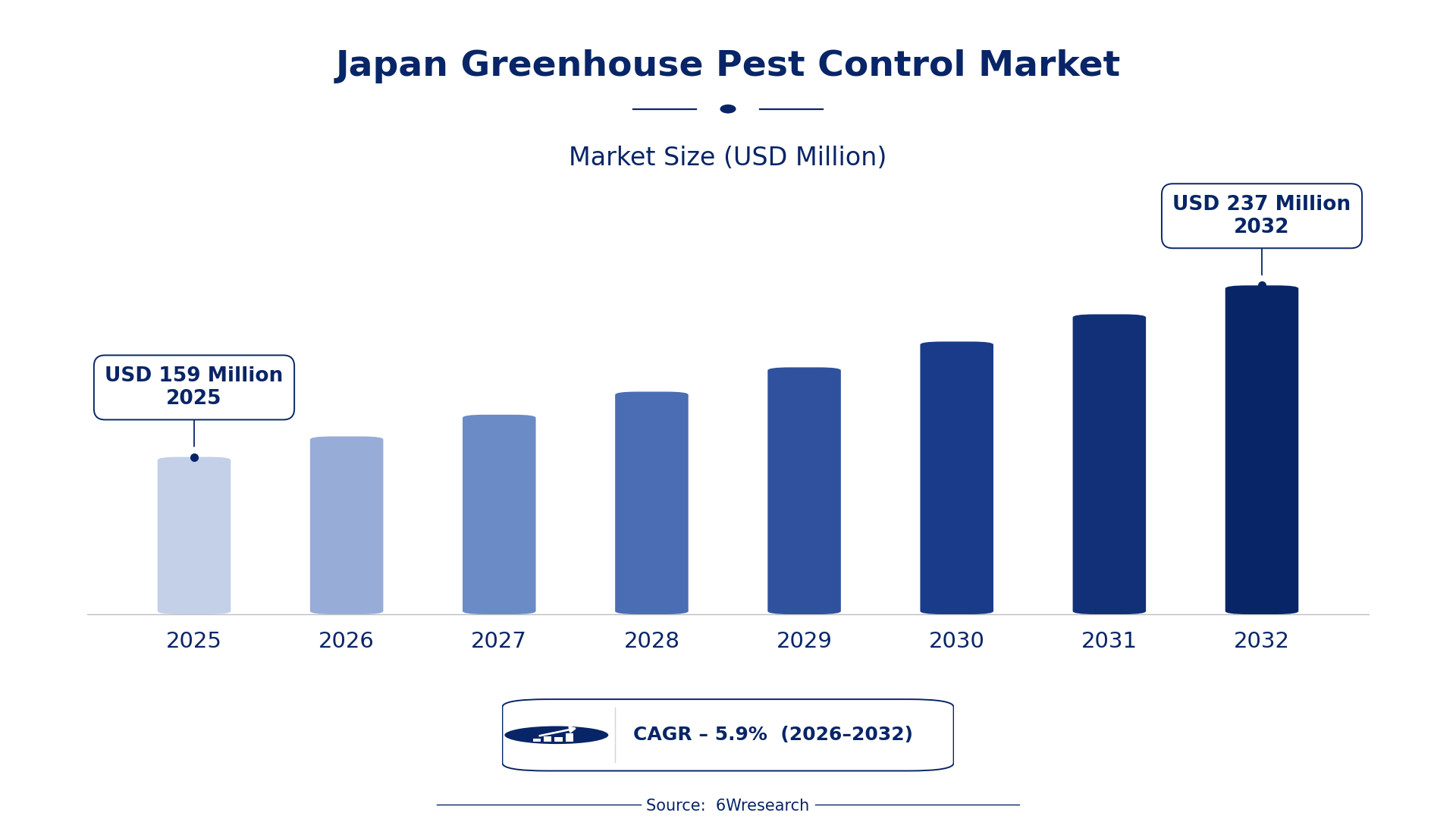
According to 6Wresearch internal database and industry insights, the Japan Greenhouse Pest Control Market was valued at USD 159 Million in 2025 and is projected to reach USD 237 Million by 2032, growing at a CAGR of approximately 5.9% during 2026–2032.
Japan Greenhouse Pest Control Market Highlights
| Report Metric | Details |
| Report Name | Japan Greenhouse Pest Control Market (2026-2032) |
| Market Size 2025 | USD 159 Million |
| Market Size 2032 | USD 237 Million |
| Absolute Growth 2025–2032 | USD 78 Million |
| CAGR 2026–2032 | 5.9% |
| Peak Annual Growth | 6.9% in 2032 |
| Forecast Period | 2026–2032 |
| Historical Data | 2022–2025 |
| Base Year | 2025 |
| Leading Pest Control Method, 2025 | Botanical Insecticides (50% share) |
| Leading Active Ingredient, 2025 | Neem Oil/Rotenone (49% share) |
| Leading Application Area, 2025 | Leaf Surface (46% share) |
| Leading End User, 2025 | Greenhouse Farms (45% share) |
| Fastest-Growing Pest Control Method | Insect Growth Regulators (8.7% CAGR) |
| Fastest-Growing Active Ingredient | Hormone-Based (7.9% CAGR) |
| Fastest-Growing Application Area | Entire Plant (7.2% CAGR) |
| Fastest-Growing End User | Crop Protection Companies (8.0% CAGR) |
| Growing Sector | Greenhouse Farming |
| Key End Users | Greenhouse Farms, Agri-Tech Greenhouses, Floriculture Units |
Japan Greenhouse Pest Control Market Year-wise Growth Rate and Key Drivers (2022–2032)
This graph illustrates the annual growth rates of the market from 2022 to 2032, highlighting a steady upward trajectory and projected market expansion over the forecast period.
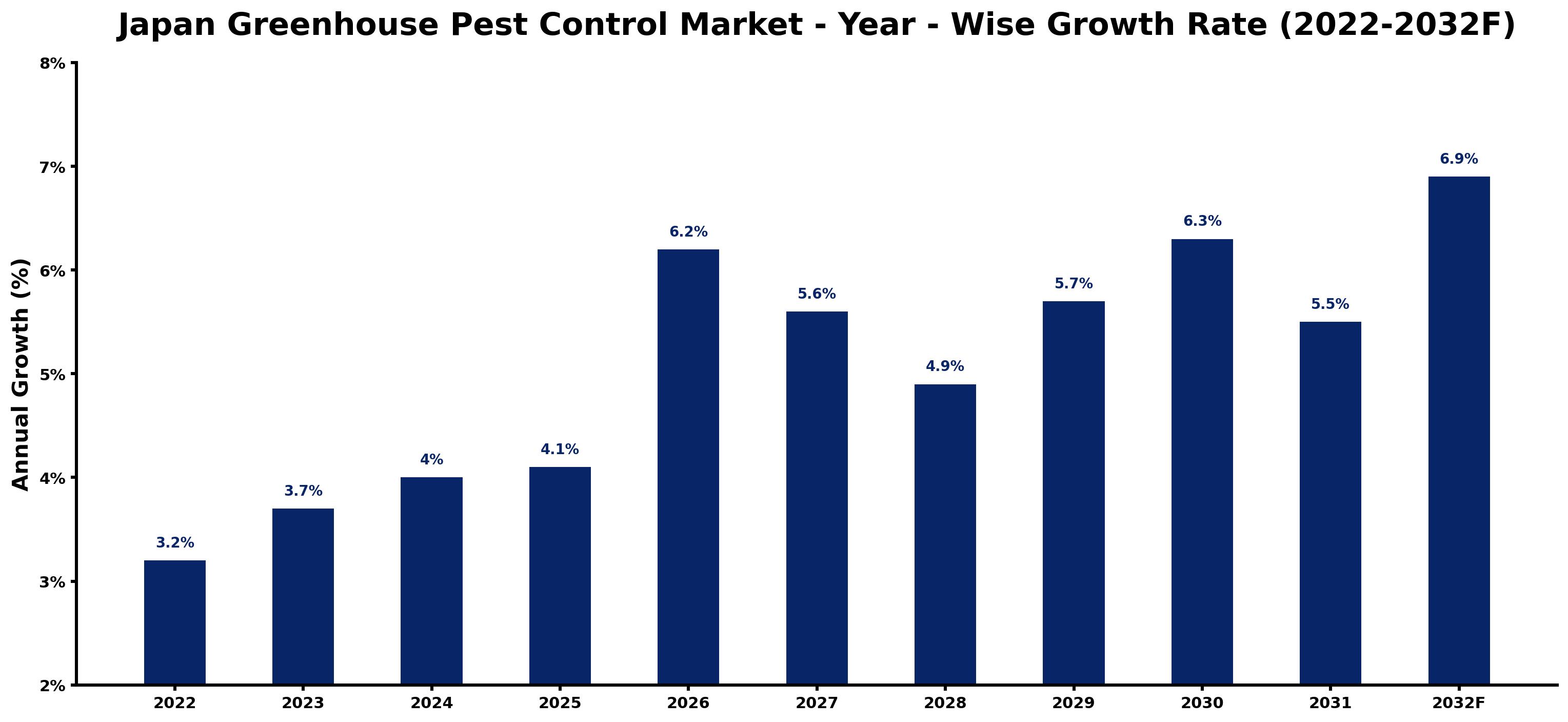
Below, each year's estimated growth is shown next to the factor that most influenced it.
| Year | Estimated Annual Growth (%) | Market Rationale |
| 2022 | 3.2 | The market experienced steady growth due to increasing awareness of sustainable farming practices. |
| 2023 | 3.7 | Demand rose as more greenhouse farms adopted biological control agents for pest management. |
| 2024 | 4.0 | The introduction of new pest control technologies contributed to a faster growth rate. |
| 2025 | 4.1 | Growth continued as the greenhouse area expanded, reaching 21,000 hectares. |
| 2026 | 6.2 | The market is expected to see a surge in demand driven by the adoption of IoT in agri-tech greenhouses. |
| 2027 | 5.6 | Growth is projected to slow as some farms face challenges in implementing advanced pest control measures. |
| 2028 | 4.9 | The market is anticipated to maintain growth, supported by ongoing education on pest management techniques. |
| 2029 | 5.7 | Increased use of insect growth regulators among farmers is expected to boost demand once again. |
| 2030 | 6.3 | The introduction of new organic pesticides will further stimulate market growth. |
| 2031 | 5.5 | Growth is projected to slow slightly as competition intensifies among pest control product providers. |
| 2032 | 6.9 | The market is expected to peak as greenhouse farms increasingly adopt integrated pest management strategies. |
Note: Market size estimations and growth projections presented in this report are based on 6Wresearch's proprietary forecasting methodology, utilizing the latest available industry data, government publications, and primary research inputs.
Japan Greenhouse Pest Control Market Synopsis
Greenhouse pest control encompasses various methods to safeguard crops in controlled environments, employing both natural and synthetic substances. Demand from greenhouse farms, particularly in regions like Tokyo, is driving the Japan Greenhouse Pest Control Market, where eco-friendly practices are increasingly popular. The use of biological control agents and organic pesticides is on the rise, with 30% of farms reporting their implementation.
Market Dynamics Impact Analysis (2026–2032)
| Factor | Type | Impact | Primary Segment Affected |
| Growing adoption of biological control agents among greenhouse farms | Driver | High | Biological Control Agents |
| Rising demand for organic pesticides driven by consumer preferences | Driver | High | Organic Pesticides |
| Expansion of greenhouse farming areas in regions like Tokyo | Opportunity | High | Greenhouse Farms |
| Increased investment in pest control technologies by agri-tech greenhouses | Opportunity | High | Agri-Tech Greenhouses |
| Regulatory challenges surrounding pesticide approvals | Restraint | Medium | Organic Pesticides |
| Limited awareness of integrated pest management practices among farmers | Restraint | Medium | Biological Control Agents |
| High costs associated with advanced pest control technologies | Challenge | High | Agri-Tech Greenhouses |
| Competition from imported pest control products affecting local suppliers | Challenge | Medium | Crop Protection Companies |
Evaluation of Drivers in Japan Greenhouse Pest Control Market (2026–2032)
Below are the drivers that matter most for revenue growth, with supporting evidence.
| Drivers | Primary Segment Affected | Why It Matters (Evidence) |
| Increased awareness of sustainable farming practices | Biological Control Agents | This awareness has led to 30% of greenhouse farms adopting biological control agents for pest management. |
| Growing consumer preference for organic produce | Organic Pesticides | As consumers demand organic products, farmers are investing more in organic pesticides to meet this need. |
| Expansion of greenhouse areas in Japan | Greenhouse Farms | With 21,000 hectares dedicated to greenhouse farming, demand for pest control solutions is rising. |
| Technological advancements in pest control | Agri-Tech Greenhouses | The integration of IoT for pest monitoring is improving pest management efficiency among agri-tech greenhouses. |
| Increased training and workshops on pest management | Floriculture Units | Workshops held in 10 prefectures have improved knowledge on pest control, leading to higher adoption rates. |
Much of the new demand traces back to the growing awareness of sustainable farming practices, with 30% of greenhouse farms adopting biological control agents for pest management. The expansion of greenhouse areas, now covering 21,000 hectares, has also driven the need for effective pest control solutions. The integration of IoT in agri-tech greenhouses is improving pest monitoring capabilities. Increased training through workshops across 10 prefectures has enhanced knowledge and adoption of pest control methods among floriculture units. Consumer preferences for organic produce are pushing farmers to invest in organic pesticides, further driving market growth.
Evaluation of Restraints in Japan Greenhouse Pest Control Market
The main factors holding the market back are set out below.
| Market Restraint | Primary Segment Affected | Why It Matters (Evidence) |
| Regulatory hurdles in obtaining approvals for new pesticides | Organic Pesticides | These hurdles can delay product launches, affecting supply and availability for greenhouse farms. |
| Limited understanding of integrated pest management practices | Biological Control Agents | This lack of knowledge can hinder the adoption of effective pest control methods among farmers. |
| High costs associated with advanced pest control technologies | Agri-Tech Greenhouses | These costs can deter smaller farms from investing in necessary pest control solutions. |
| Competition from imported pest control products | Crop Protection Companies | Local suppliers may struggle to compete with lower-priced imports, affecting their market share. |
| Inconsistent quality of pest control products | Greenhouse Farms | Variability in product effectiveness can lead to reluctance in purchasing from certain suppliers. |
Japan Greenhouse Pest Control Market Challenges
A shortage of skilled workers in pest management leads to inefficiencies, causing a 15% decrease in crop yields for producers. Rising operational costs, driven by an increase in Japan's national minimum wage to JPY 1,055 per hour, impose higher expenses on buyers, reducing their profit margins. Stringent JAS standards for organic pesticides complicate compliance for producers, often delaying product availability and increasing costs by up to 20%. Limited adoption of integrated pest management practices among buyers can lead to crop losses, undermining market stability and profitability for all stakeholders.
Trends in the Japan Greenhouse Pest Control Market
These developments are changing demand patterns in the Japan Greenhouse Pest Control Market.
- Shift towards Integrated Pest Management in Tokyo: Greenhouse farms in Tokyo are increasingly adopting integrated pest management strategies, with 30% of farms reporting their use in 2023. This shift promotes sustainable practices and improves crop yields.
- Growing Preference for Organic Pesticides: The use of organic pesticides is on the rise, with 40% of greenhouse farms employing them in 2023. This trend reflects consumer demand for eco-friendly produce and sustainable farming practices.
- Increased Adoption of IoT in Agri-Tech Greenhouses: Agri-tech greenhouses are investing in IoT for pest monitoring, with significant investments in technology. This trend is expected to improve pest management efficiency and effectiveness.
- Expansion of Pest Control Workshops Across Japan: Pest control workshops were held in 10 prefectures in 2023, improving knowledge among farmers. This initiative is resulting in higher adoption rates of effective pest management techniques.
Investment Opportunities in the Japan Greenhouse Pest Control Market
Below are the investment opportunities with the strongest case in the Japan Greenhouse Pest Control Market.
- Greenhouse Farms Seeking Sustainable Solutions: Greenhouse farms are increasingly looking for sustainable pest control solutions, with a significant number already using biological control agents. Suppliers can meet this demand by offering eco-friendly products.
- Investment in Organic Pesticides: With 40% of greenhouse farms using organic pesticides, there is a strong opportunity to supply these products. Local distributors can partner with manufacturers to strengthen market presence.
- Agri-Tech Greenhouses Adopting New Technologies: Agri-tech greenhouses are investing in advanced pest control technologies, presenting opportunities for suppliers of IoT solutions. This is a timely investment as the market expands.
- Floriculture Units Expanding Pest Control Measures: Floriculture units are increasingly adopting pest control measures, with over 1,500 units in Japan. Suppliers can enter this market by providing tailored pest management solutions.
Government Initiatives in the Japan Greenhouse Pest Control Market
The Waste Management and Public Cleansing Act (1970) regulates the treatment and disposal of waste from pest control products, ensuring environmental safety. This law mandates that producers adhere to strict guidelines for waste management, impacting how pest control products are handled in Japan. Furthermore, the Electrical Appliance and Material Safety Act (1961) oversees the safety of materials used in pest control, requiring compliance from manufacturers to ensure product safety for users.
Various schemes promote sustainable pest management practices among greenhouse farms. In 2023, the government allocated 500 million yen for research on pest control technologies, benefiting farmers seeking effective solutions. The Japan Agricultural Cooperatives also provide resources for pest control education, assisting farmers in understanding and implementing effective pest management strategies.
Future Insight of the Japan Greenhouse Pest Control Market
Buyers will increasingly demand IoT technologies for pest monitoring, enhancing management efficiency by 2032. The government's allocation of 500 million yen for pest control research will stimulate the development of advanced solutions, creating new opportunities for suppliers. As 30% of greenhouse farms adopt biological control agents, suppliers must innovate to meet evolving market needs. Educational workshops across 10 prefectures will equip buyers with sustainable practices, fostering a shift towards eco-friendly pest control methods.
Market Segmentation Analysis
Japan Greenhouse Pest Control Market report covers a detailed analysis of the following market segments:
By Pest Control Method – Botanical Insecticides Lead, Insect Growth Regulators Expected to Grow Fastest
According to Vasu Joshi, Associate Consultant at 6Wresearch, Botanical Insecticides accounted for 50% of the market by pest control method in 2025. Botanical insecticides are prevalent in Japan's organic farming sector, making them the top choice for many growers. Their compatibility with sustainable practices is particularly notable in regions like Tokyo, where organic farming is on the rise. Insect Growth Regulators are projected to grow fastest, at a CAGR of 8.7% during 2026–2032. Insect growth regulators are experiencing rapid adoption due to their precision in managing pest populations, essential for crop health. In 2023, 40% of greenhouse farms reported using these products, indicating their increasing relevance. Suppliers should prioritise the distribution and training on insect growth regulators to align with the growing market demand.
By Active Ingredient – Neem Oil/Rotenone Leads, Hormone-Based Expected to Grow Fastest
Neem Oil/Rotenone held 49% of the Japan Greenhouse Pest Control Market by active ingredient in 2025. Neem oil and rotenone are commonly used in organic pest control, appealing to environmentally conscious farmers across Japan. Their established presence in the market supports a strong user base, particularly among greenhouse operators. Over 2026–2032, Hormone-Based is expected to post the fastest growth, at a CAGR of 7.9%. Hormone-based products, while less common, offer effective solutions for specific pests and are being increasingly recognised for their potential. This niche effectiveness is expected to drive their adoption in targeted pest management strategies. Buyers may benefit from exploring hormone-based options to address specific pest challenges more effectively.
By Application Area – Leaf Surface Leads, Entire Plant Expected to Grow Fastest
Leaf Surface took 46% of application area revenue in 2025, more than any other category. The leaf surface is crucial for pest control applications, allowing for precise treatments that effectively manage pest populations. This method is particularly important in greenhouse environments where targeted interventions are essential for protecting crops. Entire Plant is set to record the highest CAGR in this split, 7.2% over 2026–2032. The shift towards managing pests on the entire plant is rapidly gaining popularity, as it ensures comprehensive coverage and reduces the chances of pest resurgence. This holistic approach is increasingly preferred by greenhouse operators seeking to optimise pest management. Suppliers should focus on developing solutions that cater to entire plant applications to meet the evolving preferences of users.
By End User – Greenhouse Farms Lead, Crop Protection Companies Expected to Grow Fastest
In 2025, Greenhouse Farms led the end user split with a 45% share. Greenhouse farms represent the primary consumers of pest control solutions, relying on these products to protect their crops effectively. Their significant presence in regions like Tokyo underscores the importance of pest management in sustaining agricultural productivity. The quickest growth will come from Crop Protection Companies, forecast to expand at a CAGR of 8.0% between 2026 and 2032. Crop protection companies are quickly expanding their offerings for greenhouse farms, driven by the rising demand for effective pest control solutions. Their role as intermediaries enhances the distribution and accessibility of pest management products. Suppliers should consider forming alliances with crop protection companies to improve their reach within the greenhouse farming sector.
Key Attractiveness of the Report
- 10 Years of Market Numbers
- Historical Data Starting from 2022 to 2025
- Base Year 2025
- Forecast Data until 2032
- Key Performance Indicators Impacting the Market
- Major Upcoming Developments and Projects
Key Highlights of the Report:
- Japan Greenhouse Pest Control Market Outlook
- Market Size of Japan Greenhouse Pest Control Market, 2025
- Forecast of Japan Greenhouse Pest Control Market, 2032
- Historical Data and Forecast of Japan Greenhouse Pest Control Revenues & Volume for the Period 2022-2032F
- Japan Greenhouse Pest Control Market Trend Evolution
- Japan Greenhouse Pest Control Market Drivers and Challenges
- Japan Greenhouse Pest Control Price Trends
- Japan Greenhouse Pest Control Porter's Five Forces
- Japan Greenhouse Pest Control Industry Life Cycle
- Historical Data and Forecast of Japan Greenhouse Pest Control Market Revenues & Volume By Pest Control Method for the Period 2022-2032F
- Historical Data and Forecast of Japan Greenhouse Pest Control Market Revenues & Volume By Botanical Insecticides for the Period 2022-2032F
- Historical Data and Forecast of Japan Greenhouse Pest Control Market Revenues & Volume By Insect Growth Regulators for the Period 2022-2032F
- Historical Data and Forecast of Japan Greenhouse Pest Control Market Revenues & Volume By Biological Control Agents for the Period 2022-2032F
- Historical Data and Forecast of Japan Greenhouse Pest Control Market Revenues & Volume By Organic Pesticides for the Period 2022-2032F
- Historical Data and Forecast of Japan Greenhouse Pest Control Market Revenues & Volume By Active Ingredient for the Period 2022-2032F
- Historical Data and Forecast of Japan Greenhouse Pest Control Market Revenues & Volume By Neem Oil/Rotenone for the Period 2022-2032F
- Historical Data and Forecast of Japan Greenhouse Pest Control Market Revenues & Volume By Hormone-Based for the Period 2022-2032F
- Historical Data and Forecast of Japan Greenhouse Pest Control Market Revenues & Volume By Predator Insects for the Period 2022-2032F
- Historical Data and Forecast of Japan Greenhouse Pest Control Market Revenues & Volume By Plant Extracts for the Period 2022-2032F
- Historical Data and Forecast of Japan Greenhouse Pest Control Market Revenues & Volume By Application Area for the Period 2022-2032F
- Historical Data and Forecast of Japan Greenhouse Pest Control Market Revenues & Volume By Leaf Surface for the Period 2022-2032F
- Historical Data and Forecast of Japan Greenhouse Pest Control Market Revenues & Volume By Entire Plant for the Period 2022-2032F
- Historical Data and Forecast of Japan Greenhouse Pest Control Market Revenues & Volume By Insect Zones for the Period 2022-2032F
- Historical Data and Forecast of Japan Greenhouse Pest Control Market Revenues & Volume By Plant Beds for the Period 2022-2032F
- Historical Data and Forecast of Japan Greenhouse Pest Control Market Revenues & Volume By End User for the Period 2022-2032F
- Historical Data and Forecast of Japan Greenhouse Pest Control Market Revenues & Volume By Greenhouse Farms for the Period 2022-2032F
- Historical Data and Forecast of Japan Greenhouse Pest Control Market Revenues & Volume By Crop Protection Companies for the Period 2022-2032F
- Historical Data and Forecast of Japan Greenhouse Pest Control Market Revenues & Volume By Agri-Tech Greenhouses for the Period 2022-2032F
- Historical Data and Forecast of Japan Greenhouse Pest Control Market Revenues & Volume By Floriculture Units for the Period 2022-2032F
- Japan Greenhouse Pest Control Import Export Trade Statistics
- Market Opportunity Assessment By Pest Control Method
- Market Opportunity Assessment By Active Ingredient
- Market Opportunity Assessment By Application Area
- Market Opportunity Assessment By End User
- Japan Greenhouse Pest Control Top Companies Market Share
- Japan Greenhouse Pest Control Competitive Benchmarking By Technical and Operational Parameters
- Japan Greenhouse Pest Control Company Profiles
- Japan Greenhouse Pest Control Key Strategic Recommendations
Market Covered
The study includes the following segmentation.
By Pest Control Method
- Botanical Insecticides
- Insect Growth Regulators
- Biological Control Agents
- Organic Pesticides
By Active Ingredient
- Neem Oil/Rotenone
- Hormone-Based
- Predator Insects
- Plant Extracts
By Application Area
- Leaf Surface
- Entire Plant
- Insect Zones
- Plant Beds
By End User
- Greenhouse Farms
- Crop Protection Companies
- Agri-Tech Greenhouses
- Floriculture Units






































