Japan Growth Promoters in Feed Market Size & Growth Rate
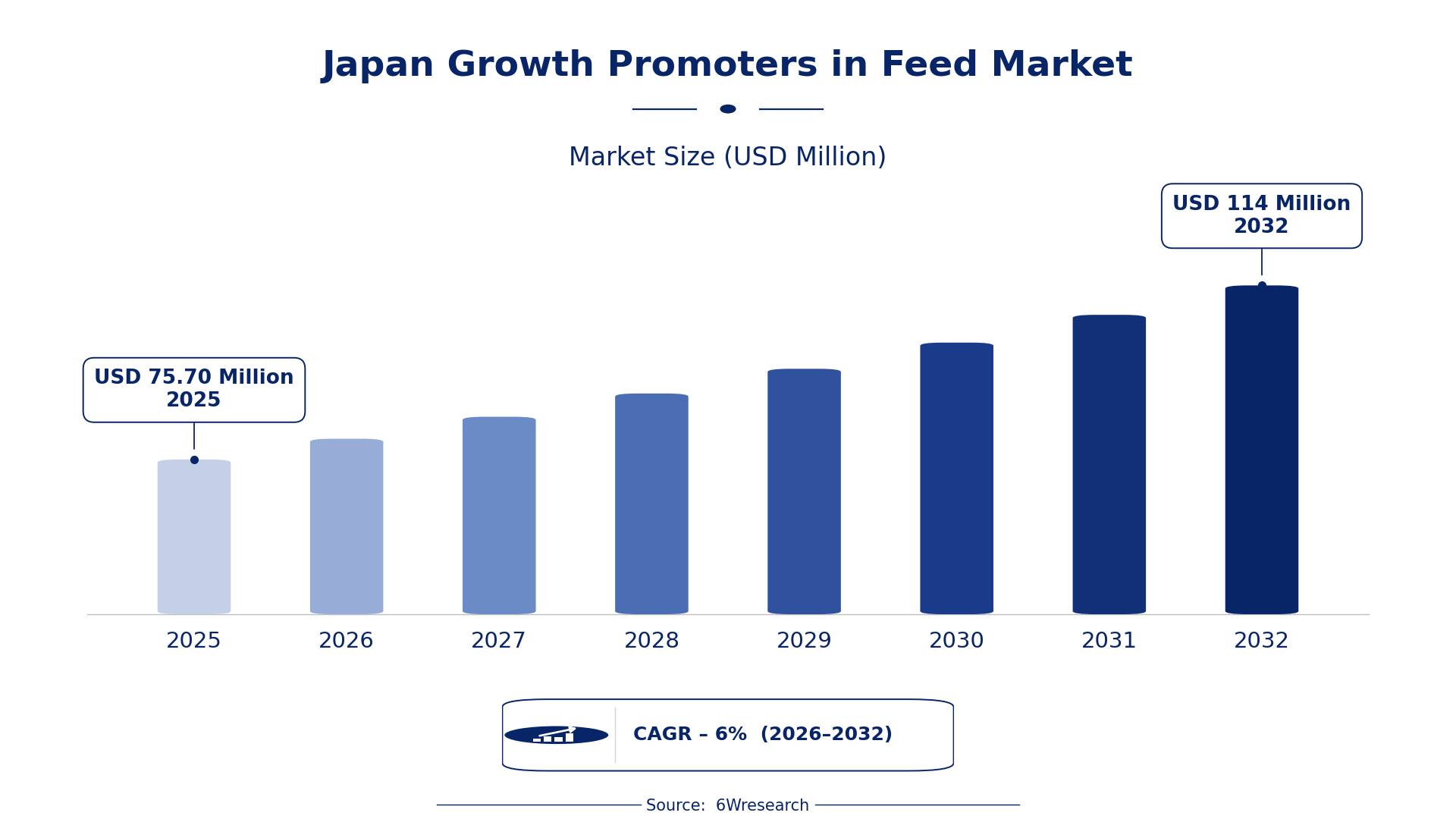
According to 6Wresearch internal database and industry insights, the Japan Growth Promoters in Feed Market was valued at USD 75.70 Million in 2025 and is projected to reach USD 114 Million by 2032, growing at a CAGR of approximately 6% during 2026–2032.
Japan Growth Promoters in Feed Market Highlights
| Report Metric | Details |
| Report Name | Japan Growth Promoters in Feed Market (2026-2032) |
| Market Size 2025 | USD 75.70 Million |
| Market Size 2032 | USD 114 Million |
| Absolute Growth 2025–2032 | USD 38.30 Million |
| CAGR 2026–2032 | 6% |
| Peak Annual Growth | 7.5% in 2027 |
| Forecast Period | 2026–2032 |
| Historical Data | 2022–2025 |
| Base Year | 2025 |
| Leading Promoter Type, 2025 | Antibiotic Growth Promoters (44% share) |
| Leading Source Type, 2025 | Synthetic/Pharmaceutical (35% share) |
| Leading Distribution Channel, 2025 | Veterinary Suppliers (41% share) |
| Leading End User, 2025 | Poultry & Livestock Farms (36% share) |
| Fastest-Growing Promoter Type | Probiotic Feed Additives (8.3% CAGR) |
| Fastest-Growing Source Type | Microbial Cultures (8.2% CAGR) |
| Fastest-Growing Distribution Channel | Online Platforms (7.5% CAGR) |
| Fastest-Growing End User | Aquaculture & Ruminant Farms (8.0% CAGR) |
| Growing Sector | Aquaculture |
| Key End Users | Poultry Farms, Livestock Farms, Aquaculture Producers, Dairy Farmers |
Japan Growth Promoters in Feed Market Year-wise Growth Rate and Key Drivers (2022–2032)
This graph illustrates the annual growth rates of the market from 2022 to 2032, highlighting a steady upward trajectory and projected market expansion over the forecast period.
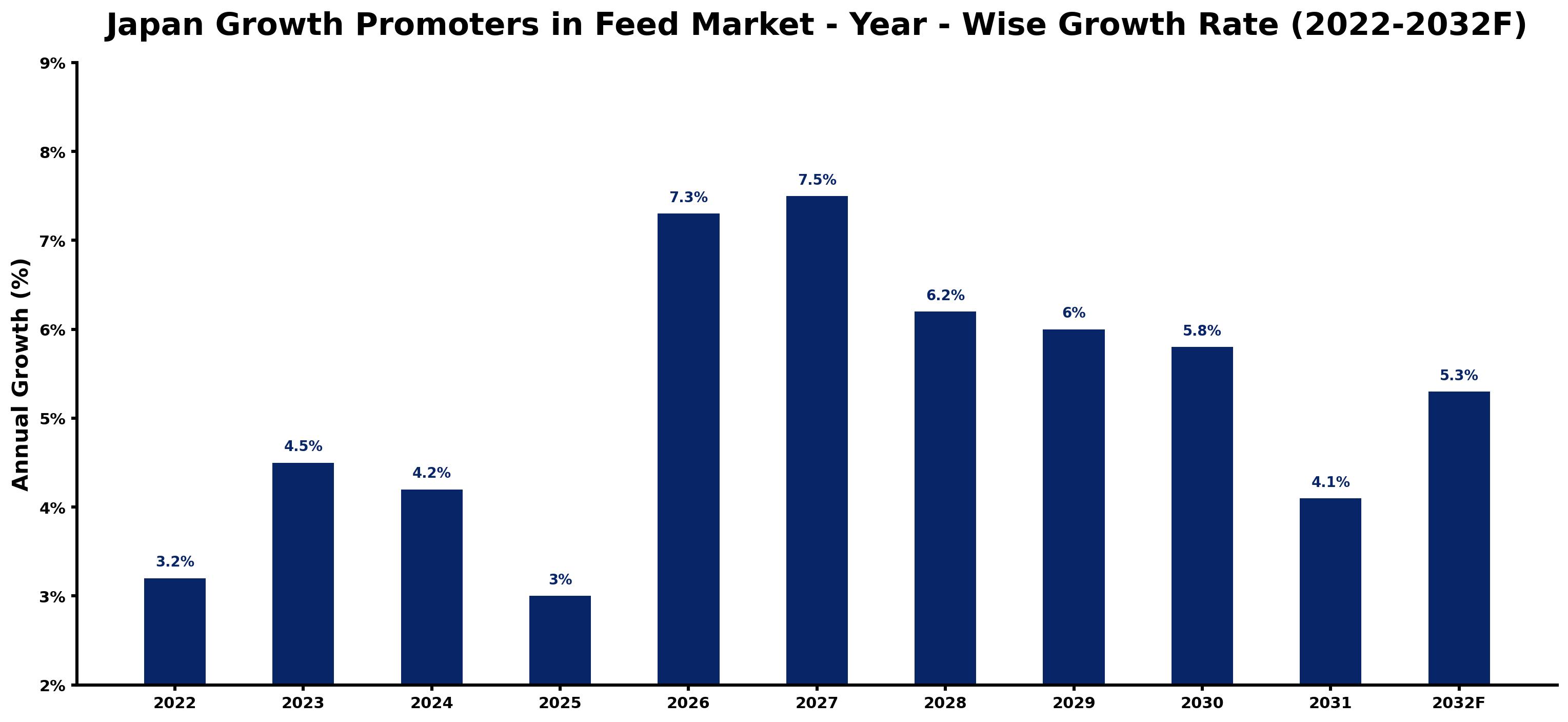
Year by year, the estimates below pair each growth rate with the development that shaped it.
| Year | Estimated Annual Growth (%) | Market Rationale |
| 2022 | 3.2 | The market saw steady growth due to consistent demand from poultry farms. |
| 2023 | 4.5 | Growth accelerated as poultry populations increased, driving higher feed requirements. |
| 2024 | 4.2 | Demand growth slowed slightly as feed prices rose, impacting purchasing decisions. |
| 2025 | 3.0 | The market continued to grow, but at a reduced rate amid rising costs. |
| 2026 | 7.3 | Growth surged as producers adopted more efficient feed strategies and products. |
| 2027 | 7.5 | The market peaked with strong demand for growth promoters in livestock. |
| 2028 | 6.2 | Growth moderated as the market adjusted to previous high levels of demand. |
| 2029 | 6.0 | Demand continued to slow as producers focused on cost management. |
| 2030 | 5.8 | The market growth rate is expected to decrease further as competition intensifies. |
| 2031 | 4.1 | Growth is projected to slow as the industry faces challenges from regulatory changes. |
| 2032 | 5.3 | Demand is projected to rise again as new products gain acceptance. |
Note: Market size estimations and growth projections presented in this report are based on 6Wresearch's proprietary forecasting methodology, utilizing the latest available industry data, government publications, and primary research inputs.
Japan Growth Promoters in Feed Market Synopsis
Growth promoters in feed are substances that enhance the growth rate and feed efficiency of livestock, including antibiotics, probiotics, and phytogenic compounds. The Japan Growth Promoters in Feed Market is experiencing growth due to a poultry population of approximately 150 million, which drives demand. The rising adoption of probiotics in livestock feed, now accounting for 30%, along with investments in aquaculture valued at over 500 billion yen, are contributing to market expansion.
Market Dynamics Impact Analysis (2026–2032)
| Factor | Type | Impact | Primary Segment Affected |
| Increasing poultry population drives demand for growth promoters. | Driver | High | Antibiotic Growth Promoters |
| Rising awareness of animal health and nutrition boosts probiotic use. | Driver | High | Probiotic Feed Additives |
| The aquaculture sector's growth presents opportunities for new products. | Opportunity | High | Aquaculture & Ruminant Farms |
| Growing demand for natural growth promoters opens market potential. | Opportunity | Medium | Phytogenic Promoters |
| Regulatory changes may restrict certain growth promoter types. | Restraint | High | Synthetic/Pharmaceutical |
| The average age of livestock farmers limits adoption of new products. | Restraint | Medium | Probiotic Feed Additives |
| Rising competition among suppliers may pressure pricing strategies. | Challenge | High | Veterinary Suppliers |
| Shifts in consumer preferences towards organic products affect demand. | Challenge | Medium | Organic Livestock Farmers |
Evaluation of Drivers in Japan Growth Promoters in Feed Market (2026–2032)
The following drivers explain most of the expected growth.
| Drivers | Primary Segment Affected | Why It Matters (Evidence) |
| Increased poultry population drives demand for growth promoters. | Antibiotic Growth Promoters | Japan's poultry population is approximately 150 million, leading to higher feed requirements. |
| Growing awareness of animal health boosts probiotic usage. | Probiotic Feed Additives | Probiotics are increasingly used in 30% of livestock feed across Japan. |
| Rising aquaculture sector value boosts demand for growth promoters. | Aquaculture & Ruminant Farms | The aquaculture sector in Japan is valued at over 500 billion yen, utilising growth promoters. |
| Adoption of phytogenic compounds is increasing among producers. | Phytogenic Promoters | The Japanese market for phytogenic feed additives is expected to grow by 2025. |
| Regulatory compliance drives the need for certified products. | Synthetic/Pharmaceutical | ISO 22000 standards are applicable for feed safety management in Japan. |
Volumes grow on the back of Japan's substantial poultry population, which is approximately 150 million, creating a strong demand for growth promoters. The aquaculture sector, valued at over 500 billion yen, increasingly utilises these products to improve livestock health and productivity. The phytogenic feed additives market is projected to grow significantly by 2025, indicating a shift towards natural solutions. Compliance with ISO 22000 standards further drives the need for certified growth promoters, ensuring safety and efficacy in livestock production. Producers are adopting more efficient feed strategies, resulting in increased purchases of growth promoters.
Evaluation of Restraints in Japan Growth Promoters in Feed Market
These restraints slow adoption and weigh on supplier margins.
| Market Restraint | Primary Segment Affected | Why It Matters (Evidence) |
| Regulatory changes may limit the use of certain growth promoters. | Synthetic/Pharmaceutical | The Food Sanitation Act amendment in 2018 made HACCP-based hygiene management mandatory for food businesses. |
| The average age of livestock farmers affects product adoption rates. | Probiotic Feed Additives | The average age of livestock farmers in Japan is over 60, impacting their willingness to adopt new products. |
| Rising costs of feed ingredients may restrict growth promoter usage. | Enzyme-Based Promoters | The average feed conversion ratio in poultry is around 1.5, compelling reliance on growth promoters. |
| Consumer preferences are shifting towards organic farming practices. | Organic Livestock Farmers | Organic livestock farming in Japan is regulated, limiting growth promoter use. |
| Competition among suppliers may lead to price wars. | Veterinary Suppliers | The livestock industry employs around 1 million people, increasing competition for market share. |
Japan Growth Promoters in Feed Market Challenges
Producers encounter lengthy approval processes for new technology, as regulations from the Ministry of Agriculture, Forestry and Fisheries can delay feed additive approvals by six months, impacting timely product launches. Buyers face rising costs, with the average feed conversion ratio in poultry at around 1.5, compelling them to rely on growth promoters for profitability. A skills gap exists among younger farmers, as the average age exceeds 60, limiting their ability to adopt modern feed solutions and hindering market growth. Suppliers experience intensified competition, particularly from the aquaculture sector, valued at over 500 billion yen, which demands more sustainable growth promoter alternatives.
Trends in the Japan Growth Promoters in Feed Market
Buyers and suppliers in the Japan Growth Promoters in Feed Market are adjusting to the following trends.
- Shift towards Sustainable Aquaculture Practices: In 2023, a new government program was launched to promote sustainable livestock farming practices. This initiative aims to increase the adoption of natural growth promoters, aligning with global trends towards sustainability, particularly in aquaculture.
- Transition from Antibiotics to Probiotics: The use of probiotics in livestock feed has increased, with 30% of feed now incorporating these additives. This shift reflects a growing emphasis on animal health and nutrition, driven by consumer demand for safer meat products.
- Emergence of Microbial Cultures: Microbial cultures are gaining traction as a preferred growth promoter type in Japan. This trend is supported by an 8.2% CAGR projected for this segment, responding to the demand for natural alternatives in livestock feed.
- Veterinary Suppliers Prioritised over Direct Sales: Veterinary suppliers accounted for 60% of the distribution of growth promoters in Japan. This trend underscores the importance of professional guidance in selecting appropriate feed additives for livestock.
Investment Opportunities in the Japan Growth Promoters in Feed Market
Several openings in the Japan Growth Promoters in Feed Market merit attention from investors.
- Supply of Probiotic Feed Additives: With 30% of livestock feed incorporating probiotics, there is a strong opportunity to supply these additives. The growing awareness of gut health among producers supports this trend, particularly in poultry and livestock farms.
- Investment in Phytogenic Promoters: The expected growth of the phytogenic feed additives market by 2025 presents an opportunity for investment. Suppliers can partner with feed distributors in regions like Hokkaido to meet rising demand.
- Expansion into Online Distribution Channels: The growing trend of online platforms for purchasing feed additives indicates a gap in the market. Suppliers can capitalise on this by establishing partnerships with local distributors to enhance their reach.
- Focus on Sustainable Practices in Aquaculture: The aquaculture sector's emphasis on sustainability opens avenues for supplying natural growth promoters. With a market valued at over 500 billion yen, suppliers can enter through joint ventures with local farms.
Government Initiatives in the Japan Growth Promoters in Feed Market
The 2018 amendment to the Food Sanitation Act made HACCP-based hygiene management mandatory for food businesses, requiring producers to comply with safety standards. This measure aims to improve the overall quality of livestock feed in Japan, ensuring that growth promoters meet stringent criteria for health and safety. The amendment has led to increased investments in quality assurance processes among producers, boosting consumer confidence in feed products.
The Ministry of Agriculture, Forestry and Fisheries (MAFF) oversees the approval of feed additives, ensuring they meet safety and efficacy standards. This agency plays a key role in regulating the use of growth promoters, providing guidance to producers and ensuring consumer safety. MAFF's initiatives include funding for research on alternative growth promoters, which supports innovation in the sector.
Future Insight of the Japan Growth Promoters in Feed Market
Poultry and livestock farms will shift towards natural growth promoters by 2032, as the government’s goal to cut antibiotic use by 30% by 2025 will drive suppliers to innovate. The aquaculture industry will increasingly adopt sustainable practices, leading to a rise in the use of phytogenic additives. ISO 22000 standards will gain traction, improving safety management in feed production. By 2025, the market for probiotics is expected to expand, providing buyers with a broader selection of effective growth promoter options.
Market Segmentation Analysis
Japan Growth Promoters in Feed Market report covers a detailed analysis of the following market segments:
By Promoter Type – Antibiotic Growth Promoters Lead, Probiotic Feed Additives Expected to Grow Fastest
According to Saurav Kr Singh, Senior Research Analyst at 6Wresearch, Antibiotic Growth Promoters held 44% of the Japan Growth Promoters in Feed Market by promoter type in 2025. Antibiotic growth promoters hold the largest share due to their extensive use in enhancing growth and feed efficiency across livestock sectors. Their critical role in supporting Japan's poultry population of approximately 150 million underpins consistent demand. The quickest growth will come from Probiotic Feed Additives, forecast to expand at a CAGR of 8.3% between 2026 and 2032. Probiotic feed additives are experiencing rapid growth as they significantly improve gut health and digestion in animals. With their incorporation into around 30% of livestock feed, this trend reflects a growing recognition of their nutritional value among farmers. Suppliers should focus on developing probiotic products to align with the rising demand in the market.
By Source Type – Synthetic/Pharmaceutical Leads, Microbial Cultures Expected to Grow Fastest
The largest source type category in 2025 was Synthetic/Pharmaceutical, at 35% of revenue. Synthetic and pharmaceutical sources lead the market as they are widely used for growth promotion in livestock. Their proven effectiveness and adherence to the Feed Safety Law make them a trusted choice for farmers seeking reliable solutions. Over 2026–2032, Microbial Cultures are expected to post the fastest growth, at a CAGR of 8.2%. Microbial cultures are swiftly gaining popularity as they enhance gut microbiota in animals, driven by increasing awareness of their benefits. This trend presents suppliers with opportunities to expand their product offerings to include these beneficial additives. Buyers should explore integrating microbial culture products into their livestock management practices to enhance overall health.
By Distribution Channel – Veterinary Suppliers Lead, Online Platforms Expected to Grow Fastest
In 2025, Veterinary Suppliers led the distribution channel split with a 41% share. Veterinary suppliers dominate the distribution of growth promoters, holding 60% of the market share. Their established relationships with livestock farmers ensure a consistent demand for these vital products, solidifying their market presence. Online Platforms are projected to grow fastest, at a CAGR of 7.5% during 2026–2032. Online platforms are emerging as the fastest-growing channel for small-scale purchases, indicating a shift towards digital solutions within the industry. This trend is likely to attract farmers seeking convenient access to growth promoters and related products. Suppliers should refine their online sales strategies to leverage the increasing preference for digital purchasing options.
By End User – Poultry & Livestock Farms Lead, Aquaculture & Ruminant Farms Expected to Grow Fastest
With 36% of end user revenue in 2025, Poultry & Livestock Farms was the largest category. Poultry and livestock farms represent the largest end-user segment for growth promoters, driven by the substantial poultry population and livestock industry in Japan. Their consistent demand underscores the importance of these products in maintaining productivity. Aquaculture & Ruminant Farms are set to record the highest CAGR in this split, 8.0% over 2026–2032. Aquaculture and ruminant farms are rapidly increasing their use of growth promoters to improve health and growth outcomes. This sector's focus on sustainable practices further fuels the demand for natural growth promoters. Suppliers should target aquaculture and ruminant farms to capture emerging opportunities in the market.
Key Attractiveness of the Report
- 10 Years of Market Numbers
- Historical Data Starting from 2022 to 2025
- Base Year 2025
- Forecast Data until 2032
- Key Performance Indicators Impacting the Market
- Major Upcoming Developments and Projects
Key Highlights of the Report:
- Japan Growth Promoters in Feed Market Outlook
- Market Size of Japan Growth Promoters in Feed Market, 2025
- Forecast of Japan Growth Promoters in Feed Market, 2032
- Historical Data and Forecast of Japan Growth Promoters in Feed Revenues & Volume for the Period 2022-2032F
- Japan Growth Promoters in Feed Market Trend Evolution
- Japan Growth Promoters in Feed Market Drivers and Challenges
- Japan Growth Promoters in Feed Price Trends
- Japan Growth Promoters in Feed Porter's Five Forces
- Japan Growth Promoters in Feed Industry Life Cycle
- Historical Data and Forecast of Japan Growth Promoters in Feed Market Revenues & Volume By Promoter Type for the Period 2022-2032F
- Historical Data and Forecast of Japan Growth Promoters in Feed Market Revenues & Volume By Antibiotic Growth Promoters for the Period 2022-2032F
- Historical Data and Forecast of Japan Growth Promoters in Feed Market Revenues & Volume By Probiotic Feed Additives for the Period 2022-2032F
- Historical Data and Forecast of Japan Growth Promoters in Feed Market Revenues & Volume By Phytogenic Promoters for the Period 2022-2032F
- Historical Data and Forecast of Japan Growth Promoters in Feed Market Revenues & Volume By Enzyme-Based Promoters for the Period 2022-2032F
- Historical Data and Forecast of Japan Growth Promoters in Feed Market Revenues & Volume By Source Type for the Period 2022-2032F
- Historical Data and Forecast of Japan Growth Promoters in Feed Market Revenues & Volume By Synthetic/Pharmaceutical for the Period 2022-2032F
- Historical Data and Forecast of Japan Growth Promoters in Feed Market Revenues & Volume By Microbial Cultures for the Period 2022-2032F
- Historical Data and Forecast of Japan Growth Promoters in Feed Market Revenues & Volume By Herbal Extracts for the Period 2022-2032F
- Historical Data and Forecast of Japan Growth Promoters in Feed Market Revenues & Volume By Fermentation-Derived for the Period 2022-2032F
- Historical Data and Forecast of Japan Growth Promoters in Feed Market Revenues & Volume By Distribution Channel for the Period 2022-2032F
- Historical Data and Forecast of Japan Growth Promoters in Feed Market Revenues & Volume By Veterinary Suppliers for the Period 2022-2032F
- Historical Data and Forecast of Japan Growth Promoters in Feed Market Revenues & Volume By Direct Sales for the Period 2022-2032F
- Historical Data and Forecast of Japan Growth Promoters in Feed Market Revenues & Volume By Online Platforms for the Period 2022-2032F
- Historical Data and Forecast of Japan Growth Promoters in Feed Market Revenues & Volume By Feed Distributors for the Period 2022-2032F
- Historical Data and Forecast of Japan Growth Promoters in Feed Market Revenues & Volume By End User for the Period 2022-2032F
- Historical Data and Forecast of Japan Growth Promoters in Feed Market Revenues & Volume By Poultry & Livestock Farms for the Period 2022-2032F
- Historical Data and Forecast of Japan Growth Promoters in Feed Market Revenues & Volume By Dairy and Swine Producers for the Period 2022-2032F
- Historical Data and Forecast of Japan Growth Promoters in Feed Market Revenues & Volume By Organic Livestock Farmers for the Period 2022-2032F
- Historical Data and Forecast of Japan Growth Promoters in Feed Market Revenues & Volume By Aquaculture & Ruminant Farms for the Period 2022-2032F
- Japan Growth Promoters in Feed Import Export Trade Statistics
- Market Opportunity Assessment By Promoter Type
- Market Opportunity Assessment By Source Type
- Market Opportunity Assessment By Distribution Channel
- Market Opportunity Assessment By End User
- Japan Growth Promoters in Feed Top Companies Market Share
- Japan Growth Promoters in Feed Competitive Benchmarking By Technical and Operational Parameters
- Japan Growth Promoters in Feed Company Profiles
- Japan Growth Promoters in Feed Key Strategic Recommendations
Market Covered
Segments analysed in this report are listed below.
By Promoter Type
- Antibiotic Growth Promoters
- Probiotic Feed Additives
- Phytogenic Promoters
- Enzyme-Based Promoters
By Source Type
- Synthetic/Pharmaceutical
- Microbial Cultures
- Herbal Extracts
- Fermentation-Derived
By Distribution Channel
- Veterinary Suppliers
- Direct Sales
- Online Platforms
- Feed Distributors
By End User
- Poultry & Livestock Farms
- Dairy and Swine Producers
- Organic Livestock Farmers
- Aquaculture & Ruminant Farms






































