Japan Gut Health Feed Additives Market Size & Growth Rate
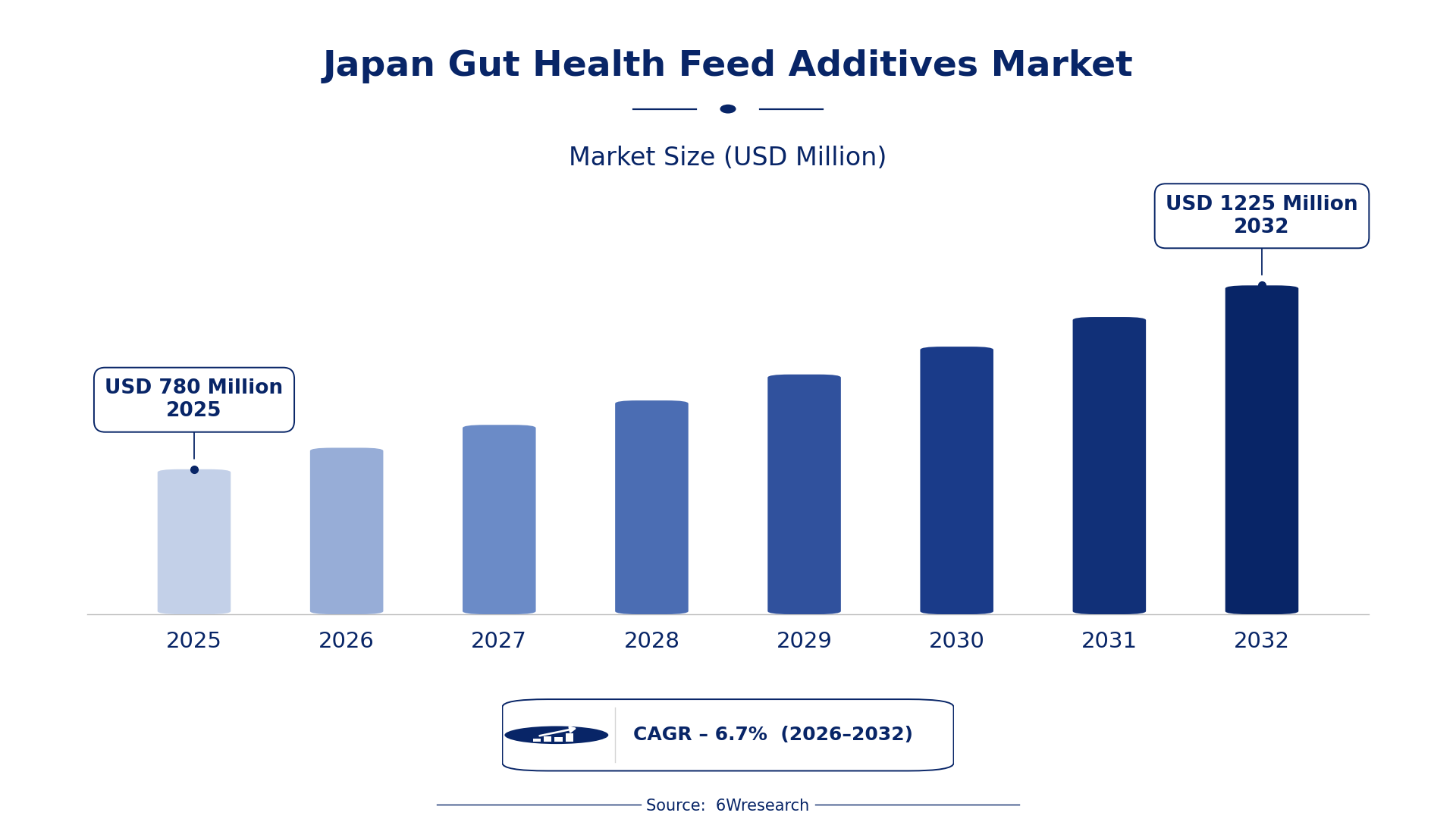
According to 6Wresearch internal database and industry insights, the Japan Gut Health Feed Additives Market was valued at USD 780 Million in 2025 and is projected to reach USD 1,225 Million by 2032, growing at a CAGR of approximately 6.7% during 2026–2032.
Japan Gut Health Feed Additives Market Highlights
| Report Metric | Details |
| Report Name | Japan Gut Health Feed Additives Market (2026-2032) |
| Market Size 2025 | USD 780 Million |
| Market Size 2032 | USD 1,225 Million |
| Absolute Growth 2025–2032 | USD 445 Million |
| CAGR 2026–2032 | 6.7% |
| Peak Annual Growth | 7.3% in 2026 |
| Forecast Period | 2026–2032 |
| Historical Data | 2022–2025 |
| Base Year | 2025 |
| Leading Additive Type, 2025 | Probiotics (47% share) |
| Leading Ingredient Source, 2025 | Microbial Cultures (42% share) |
| Leading Distribution Channel, 2025 | Veterinary Distributors (36% share) |
| Leading End User, 2025 | Poultry & Swine Farmers (49% share) |
| Fastest-Growing Additive Type | Prebiotics (9.5% CAGR) |
| Fastest-Growing Distribution Channel | Direct Sales (8.6% CAGR) |
| Fastest-Growing End User | Commercial Feed Producers (8.7% CAGR) |
| Growing Sector | Poultry and Swine Farming |
| Key End Users | Poultry Farmers, Swine Farmers, Aquaculture Producers, Livestock Feed Mills |
Japan Gut Health Feed Additives Market Year-wise Growth Rate and Key Drivers (2022–2032)
This graph illustrates the annual growth rates of the market from 2022 to 2032, highlighting a steady upward trajectory and projected market expansion over the forecast period.
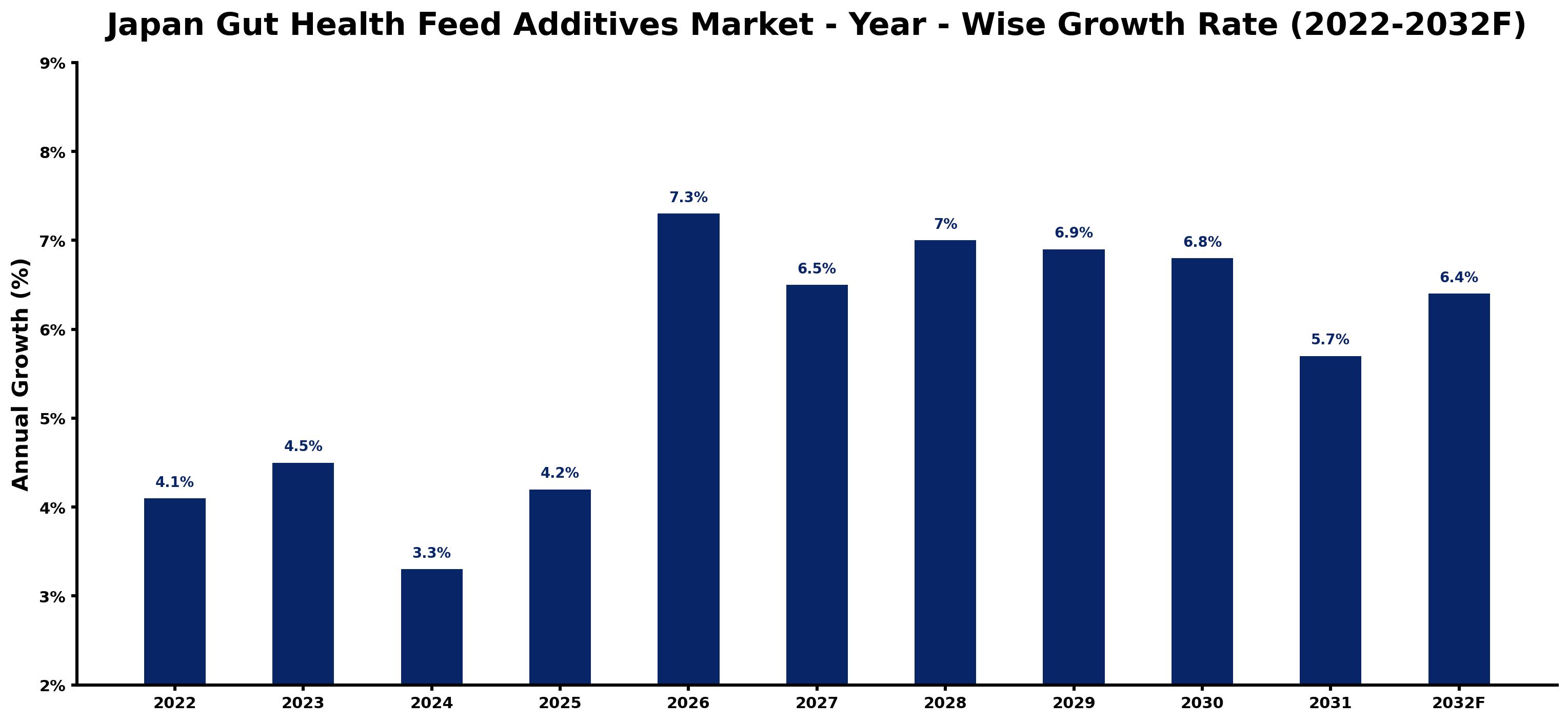
Year by year, the estimates below pair each growth rate with the development that shaped it.
| Year | Estimated Annual Growth (%) | Market Rationale |
| 2022 | 4.1 | The market experienced steady growth, reflecting ongoing demand from local feed mills. |
| 2023 | 4.5 | Growth accelerated due to increased awareness of gut health benefits among farmers. |
| 2024 | 3.3 | The growth rate slowed as market saturation began to influence purchasing decisions. |
| 2025 | 4.2 | Demand picked up again as farmers sought to improve feed efficiency further. |
| 2026 | 7.3 | The peak growth year is expected to reflect substantial investments in gut health technologies. |
| 2027 | 6.5 | Growth is projected to moderate as the market adjusts to the previous year's peak. |
| 2028 | 7.0 | A resurgence in growth is anticipated as new product innovations enter the market. |
| 2029 | 6.9 | The market is expected to continue growing, albeit at a slower pace as competition intensifies. |
| 2030 | 6.8 | Growth is projected to slow as the market matures and price competition increases. |
| 2031 | 5.7 | The market is expected to experience a further slowdown as buyers become more price-sensitive. |
| 2032 | 6.4 | Growth is projected to rebound as new regulations encourage the adoption of advanced additives. |
Note: Market size estimations and growth projections presented in this report are based on 6Wresearch's proprietary forecasting methodology, utilizing the latest available industry data, government publications, and primary research inputs.
Japan Gut Health Feed Additives Market Synopsis
Gut health feed additives are substances added to animal feed to promote digestive health and nutrient absorption. These additives, including probiotics and organic acids, play a crucial role in improving gut microbiota and overall animal health. The Japan Gut Health Feed Additives Market is expanding due to rising poultry and swine populations, with approximately 150 million poultry and 9 million swine driving demand. Increased focus on sustainable livestock practices and feed efficiency is propelling market growth, supported by initiatives such as the enhancement of feed safety standards for livestock and the promotion of natural acidifiers.
Market Dynamics Impact Analysis (2026–2032)
| Factor | Type | Impact | Primary Segment Affected |
| Increasing poultry population | Driver | High | Probiotics |
| Rising awareness of gut health benefits | Driver | High | Organic Acids |
| Growing demand for sustainable livestock practices | Opportunity | High | Natural Acidifiers |
| Expansion of the aquaculture sector | Opportunity | Medium | Microbial Cultures |
| Market saturation in certain segments | Restraint | High | Prebiotics |
| Price sensitivity among farmers | Restraint | Medium | Enzymes |
| Limited supply capacity for certain additives | Challenge | High | Organic Acids |
| Competition from alternative feed solutions | Challenge | Medium | Probiotics |
Evaluation of Drivers in Japan Gut Health Feed Additives Market (2026–2032)
Key forces behind demand, with the segment each one moves most, are listed below.
| Drivers | Primary Segment Affected | Why It Matters (Evidence) |
| Rising poultry population | Probiotics | Japan's poultry population is approximately 150 million, increasing demand for gut health additives among farmers. |
| Focus on feed efficiency | Organic Acids | The average feed conversion ratio in poultry is improving, resulting in higher purchases of organic acids as farmers seek better performance. |
| Sustainable livestock practices | Natural Acidifiers | The promotion of sustainable practices drives demand for natural acidifiers in livestock feed, with a growing number of producers adopting these solutions. |
| Growth in aquaculture | Microbial Cultures | The expanding aquaculture industry in Japan is increasingly adopting microbial cultures for fish farming, enhancing overall productivity. |
| Awareness of gut health | Prebiotics | Farmers are becoming more aware of the benefits of prebiotics, resulting in increased sales as they aim to improve livestock health. |
Most of the extra volume comes from Japan's poultry population, which is approximately 150 million, driving higher purchases of probiotics. The average feed conversion ratio in poultry is improving, indicating better feed efficiency due to organic acids, which farmers are increasingly purchasing. The aquaculture sector is expanding, with a strong focus on microbial cultures for fish farming, leading to higher adoption rates. As awareness of gut health benefits among farmers rises, sales of prebiotics are increasing as they seek to improve livestock health. Sustainable livestock practices are gaining traction, prompting more farmers to invest in natural acidifiers to enhance feed quality.
Evaluation of Restraints in Japan Gut Health Feed Additives Market
The table below lists the restraints and the evidence behind each.
| Market Restraint | Primary Segment Affected | Why It Matters (Evidence) |
| Market saturation in certain segments | Prebiotics | As prebiotics gain popularity, the market is becoming saturated, limiting growth opportunities for suppliers. |
| Price sensitivity among farmers | Enzymes | Farmers are increasingly price-sensitive, affecting their willingness to invest in enzyme additives. |
| Regulatory hurdles for new products | Natural Acidifiers | New product approvals can take time, slowing down market entry for natural acidifiers. |
| Competition from alternative feed solutions | Probiotics | Emerging alternative feed solutions create competition that can impact probiotic sales. |
| Limited supply capacity for certain additives | Organic Acids | Supply constraints for organic acids can delay availability and affect purchasing decisions. |
Japan Gut Health Feed Additives Market Challenges
Producers face rising costs from natural ingredient prices, which can increase feed expenses by 15% within a year. Skills shortages in the livestock sector hinder the adoption of modern technologies, delaying productivity improvements for farmers. Many producers depend on outdated technology, leading to a 20% lower feed conversion ratio compared to contemporary methods. Regulatory changes from the Ministry of Agriculture, Forestry and Fisheries can impose compliance costs, affecting profitability for feed mills and limiting their ability to invest in better production methods.
Trends in the Japan Gut Health Feed Additives Market
Buyers and suppliers in the Japan Gut Health Feed Additives Market are adjusting to the following trends.
- Shift towards Natural Additives: Natural additives are becoming more popular among farmers, with natural acidifiers gaining traction for their effectiveness. Approximately 30% of farmers are now opting for these alternatives, reflecting a shift in purchasing preferences towards sustainable solutions.
- Increase in Direct Sales Channels: Veterinary distributors are increasingly complemented by direct sales channels, projected to grow by 8.6% through 2032. This shift allows for more direct engagement with farmers, improving product availability and accessibility.
- Growing Focus on Feed Efficiency: The emphasis on improving feed efficiency is driving the adoption of gut health additives, particularly probiotics. Farmers are now more inclined to invest in these solutions to boost productivity, with a notable increase in uptake among poultry producers.
- Expansion of Aquaculture Applications: Aquaculture is increasingly adopting gut health additives, with a 15% rise in usage among fish farmers. This trend highlights the growing recognition of the importance of gut health in aquatic species, leading to enhanced growth rates.
Investment Opportunities in the Japan Gut Health Feed Additives Market
The opportunities below stand out in the Japan Gut Health Feed Additives Market for new entrants and existing suppliers.
- Probiotics for Poultry: There is a growing opportunity to supply probiotics, particularly as poultry farmers seek to improve gut health. With 150 million poultry in Japan, suppliers can enter the market through partnerships with local feed mills.
- Natural Acidifiers for Livestock: Natural acidifiers are gaining traction, presenting an opportunity for suppliers to meet the rising demand. With the push for sustainable practices, local feed producers are increasingly interested in these additives.
- Prebiotics for Enhanced Feed Efficiency: The demand for prebiotics is increasing, particularly as farmers focus on improving feed efficiency. Suppliers can target poultry and swine farmers looking to enhance their feed formulations.
- Microbial Cultures in Aquaculture: The growth of the aquaculture sector creates an opportunity to supply microbial cultures, with a notable increase in adoption among fish farmers. Suppliers can enter this market by collaborating with aquaculture feed producers.
Government Initiatives in the Japan Gut Health Feed Additives Market
The Ministry of Agriculture, Forestry and Fisheries oversees regulations for animal feed additives, ensuring that producers maintain high safety standards. The ISO 22000 standard, applicable to feed safety management systems, is crucial for ensuring quality. The Next-Generation Medical Infrastructure Act (2017) supports the development of safe feed products, improving overall industry standards and facilitating market entry for new additives.
The Pharmaceuticals and Medical Devices Agency (PMDA) reviews and approves feed additives, ensuring that products meet safety and quality standards. Additionally, the Animal Feed Association of Japan supports the development of safe feed products, providing funding for research and development initiatives that improve feed safety and innovation in the market.
Future Insight of the Japan Gut Health Feed Additives Market
Emerging technologies will reshape the demand for gut health additives by 2032, especially in poultry and swine farming. The implementation of ISO 22000 standards will improve product safety, benefiting both producers and consumers. As Japan's poultry population is projected to grow to approximately 150 million, the demand for effective additives will rise. The government's programme to enhance feed safety standards will stimulate innovation in formulations, creating opportunities for suppliers to introduce new products.
Market Segmentation Analysis
Japan Gut Health Feed Additives Market report covers a detailed analysis of the following market segments:
By Additive Type – Probiotics Lead, Prebiotics Expected to Grow Fastest
According to Saurav Kr Singh, Senior Research Analyst at 6Wresearch, the largest additive type category in 2025 was Probiotics, at 47% of revenue. Probiotics hold the largest share due to their direct role in improving gut health in livestock, especially for poultry and swine farmers. The substantial poultry population of approximately 150 million illustrates the strong demand for these effective additives. Prebiotics are set to record the highest CAGR in this split, 9.5% over 2026–2032. Prebiotics are experiencing rapid growth as they support the development of beneficial gut bacteria, crucial for animal health. The increasing recognition of gut health's importance among livestock farmers is propelling this segment's expansion. Suppliers should prioritise the development of prebiotic products to capitalise on the rising market demand.
By Ingredient Source – Microbial Cultures Lead and Record the Fastest Growth
With 42% of ingredient source revenue in 2025, Microbial Cultures was the largest category. Microbial Cultures dominate the market as they are essential for enhancing gut health in livestock, making them a preferred choice among farmers. Their widespread acceptance is evident from the robust demand across both poultry and swine sectors. The same category are also set to grow fastest, at a CAGR of 9.7% during 2026–2032. Microbial Cultures are also the fastest-growing segment, as their effectiveness in promoting gut health is increasingly recognised within the industry. This dual role will likely solidify their market position further. Suppliers should invest in advanced microbial culture products to meet the growing demand.
By Distribution Channel – Veterinary Distributors Lead, Direct Sales Expected to Grow Fastest
Veterinary Distributors held 36% of the Japan Gut Health Feed Additives Market by distribution channel in 2025. Veterinary Distributors lead the distribution channel as they play a crucial role in supplying feed additives directly to farmers, ensuring product availability. Their established relationships with farmers facilitate a consistent flow of these essential products. The quickest growth will come from Direct Sales, forecast to expand at a CAGR of 8.6% between 2026 and 2032. Direct Sales are rapidly growing, providing a straightforward purchasing option for farmers seeking to acquire additives directly. This trend reflects a shift towards more accessible purchasing methods in the market. Suppliers may need to enhance their direct sales strategies to capture the increasing interest from farmers.
By End User – Poultry & Swine Farmers Lead, Commercial Feed Producers Expected to Grow Fastest
In 2025, Poultry & Swine Farmers led the end user split with a 49% share. Poultry & Swine Farmers are the primary end users of gut health additives, directly utilising these products to improve the health and efficiency of their livestock. Their significant market presence is underscored by the large populations of both poultry and swine in Japan. Commercial Feed Producers are projected to grow fastest, at a CAGR of 8.7% during 2026–2032. Commercial Feed Producers are the fastest-growing end user segment, as they manufacture feed that incorporates these additives to enhance overall feed quality. This trend indicates a shift towards more integrated feed solutions within the livestock industry. Suppliers should target commercial feed producers to align with the changing market dynamics.
Key Attractiveness of the Report
- 10 Years of Market Numbers
- Historical Data Starting from 2022 to 2025
- Base Year 2025
- Forecast Data until 2032
- Key Performance Indicators Impacting the Market
- Major Upcoming Developments and Projects
Key Highlights of the Report:
- Japan Gut Health Feed Additives Market Outlook
- Market Size of Japan Gut Health Feed Additives Market, 2025
- Forecast of Japan Gut Health Feed Additives Market, 2032
- Historical Data and Forecast of Japan Gut Health Feed Additives Revenues & Volume for the Period 2022-2032F
- Japan Gut Health Feed Additives Market Trend Evolution
- Japan Gut Health Feed Additives Market Drivers and Challenges
- Japan Gut Health Feed Additives Price Trends
- Japan Gut Health Feed Additives Porter's Five Forces
- Japan Gut Health Feed Additives Industry Life Cycle
- Historical Data and Forecast of Japan Gut Health Feed Additives Market Revenues & Volume By Additive Type for the Period 2022-2032F
- Historical Data and Forecast of Japan Gut Health Feed Additives Market Revenues & Volume By Probiotics for the Period 2022-2032F
- Historical Data and Forecast of Japan Gut Health Feed Additives Market Revenues & Volume By Prebiotics for the Period 2022-2032F
- Historical Data and Forecast of Japan Gut Health Feed Additives Market Revenues & Volume By Organic Acids for the Period 2022-2032F
- Historical Data and Forecast of Japan Gut Health Feed Additives Market Revenues & Volume By Enzymes for the Period 2022-2032F
- Historical Data and Forecast of Japan Gut Health Feed Additives Market Revenues & Volume By Ingredient Source for the Period 2022-2032F
- Historical Data and Forecast of Japan Gut Health Feed Additives Market Revenues & Volume By Microbial Cultures for the Period 2022-2032F
- Historical Data and Forecast of Japan Gut Health Feed Additives Market Revenues & Volume By Plant-Based Compounds for the Period 2022-2032F
- Historical Data and Forecast of Japan Gut Health Feed Additives Market Revenues & Volume By Natural Acidifiers for the Period 2022-2032F
- Historical Data and Forecast of Japan Gut Health Feed Additives Market Revenues & Volume By Bioengineered Proteins for the Period 2022-2032F
- Historical Data and Forecast of Japan Gut Health Feed Additives Market Revenues & Volume By Distribution Channel for the Period 2022-2032F
- Historical Data and Forecast of Japan Gut Health Feed Additives Market Revenues & Volume By Veterinary Distributors for the Period 2022-2032F
- Historical Data and Forecast of Japan Gut Health Feed Additives Market Revenues & Volume By Direct Sales for the Period 2022-2032F
- Historical Data and Forecast of Japan Gut Health Feed Additives Market Revenues & Volume By Online Platforms for the Period 2022-2032F
- Historical Data and Forecast of Japan Gut Health Feed Additives Market Revenues & Volume By Animal Health Suppliers for the Period 2022-2032F
- Historical Data and Forecast of Japan Gut Health Feed Additives Market Revenues & Volume By End User for the Period 2022-2032F
- Historical Data and Forecast of Japan Gut Health Feed Additives Market Revenues & Volume By Poultry & Swine Farmers for the Period 2022-2032F
- Historical Data and Forecast of Japan Gut Health Feed Additives Market Revenues & Volume By Aquaculture & Dairy Farms for the Period 2022-2032F
- Historical Data and Forecast of Japan Gut Health Feed Additives Market Revenues & Volume By Livestock Feed Mills for the Period 2022-2032F
- Historical Data and Forecast of Japan Gut Health Feed Additives Market Revenues & Volume By Commercial Feed Producers for the Period 2022-2032F
- Japan Gut Health Feed Additives Import Export Trade Statistics
- Market Opportunity Assessment By Additive Type
- Market Opportunity Assessment By Ingredient Source
- Market Opportunity Assessment By Distribution Channel
- Market Opportunity Assessment By End User
- Japan Gut Health Feed Additives Top Companies Market Share
- Japan Gut Health Feed Additives Competitive Benchmarking By Technical and Operational Parameters
- Japan Gut Health Feed Additives Company Profiles
- Japan Gut Health Feed Additives Key Strategic Recommendations
Market Covered
The study includes the following segmentation.
By Additive Type
- Probiotics
- Prebiotics
- Organic Acids
- Enzymes
By Ingredient Source
- Microbial Cultures
- Plant-Based Compounds
- Natural Acidifiers
- Bioengineered Proteins
By Distribution Channel
- Veterinary Distributors
- Direct Sales
- Online Platforms
- Animal Health Suppliers
By End User
- Poultry & Swine Farmers
- Aquaculture & Dairy Farms
- Livestock Feed Mills
- Commercial Feed Producers






































