Japan Gypsum Plaster Market Size & Growth Rate
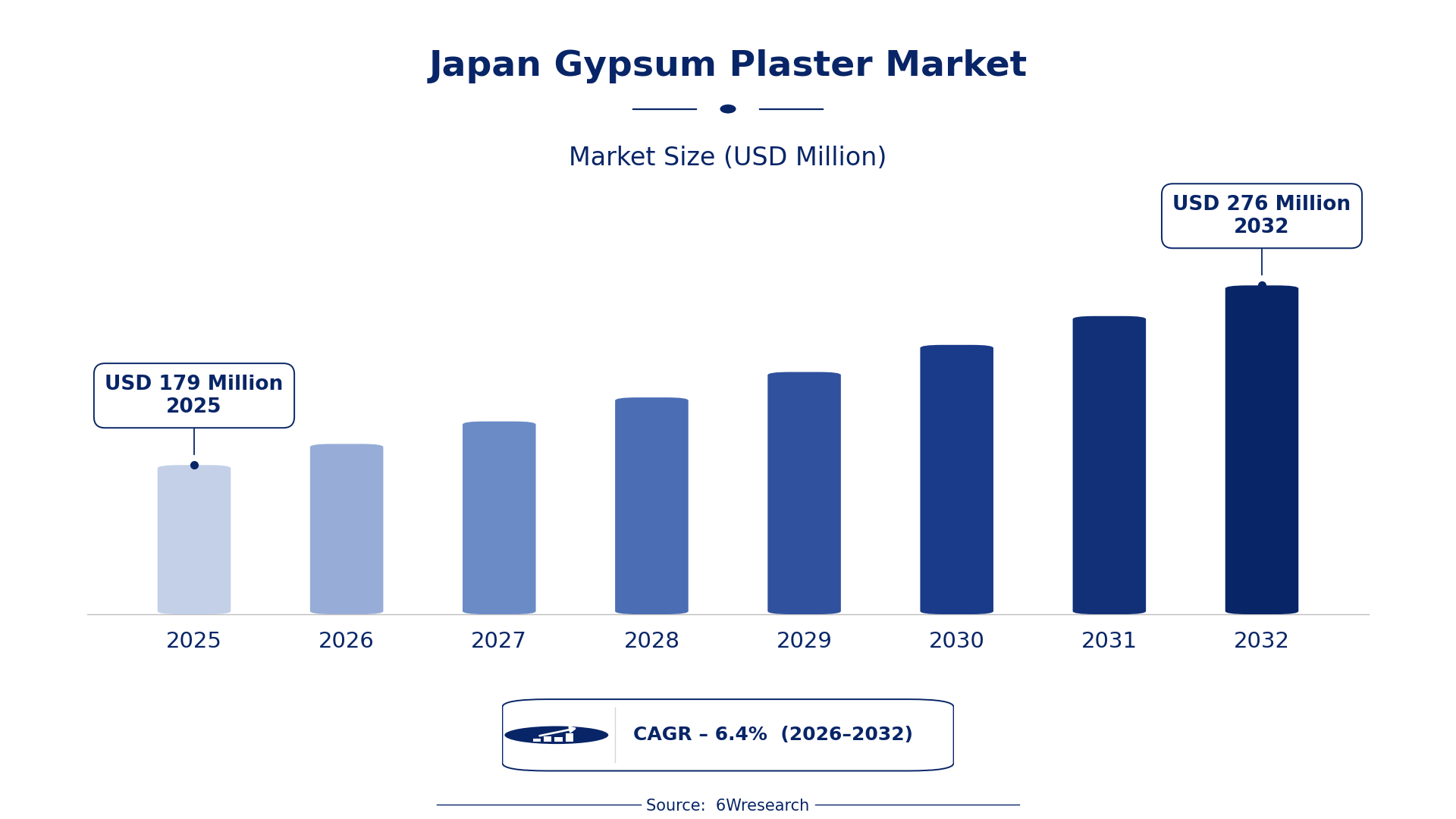
According to 6Wresearch internal database and industry insights, the Japan Gypsum Plaster Market was valued at USD 179 Million in 2025 and is projected to reach USD 276 Million by 2032, growing at a CAGR of approximately 6.4% during 2026–2032.
Japan Gypsum Plaster Market Highlights
| Report Metric | Details |
| Report Name | Japan Gypsum Plaster Market (2026-2032) |
| Market Size 2025 | USD 179 Million |
| Market Size 2032 | USD 276 Million |
| Absolute Growth 2025–2032 | USD 97 Million |
| CAGR 2026–2032 | 6.4% |
| Peak Annual Growth | 7.1% in 2028 |
| Forecast Period | 2026–2032 |
| Historical Data | 2022–2025 |
| Base Year | 2025 |
| Leading Plaster System, 2025 | Machine-applied Plaster (43% share) |
| Leading Raw Material, 2025 | Natural Gypsum (62% share) |
| Leading End-use, 2025 | Residential (54% share) |
| Fastest-Growing Raw Material | Synthetic Gypsum (9.0% CAGR) |
| Fastest-Growing End-use | Non-residential (7.8% CAGR) |
| Growing Sector | Residential |
| Key End Users | contractors, builders, developers |
Japan Gypsum Plaster Market Year-wise Growth Rate and Key Drivers (2022–2032)
This graph illustrates the annual growth rates of the market from 2022 to 2032, highlighting a steady upward trajectory and projected market expansion over the forecast period.
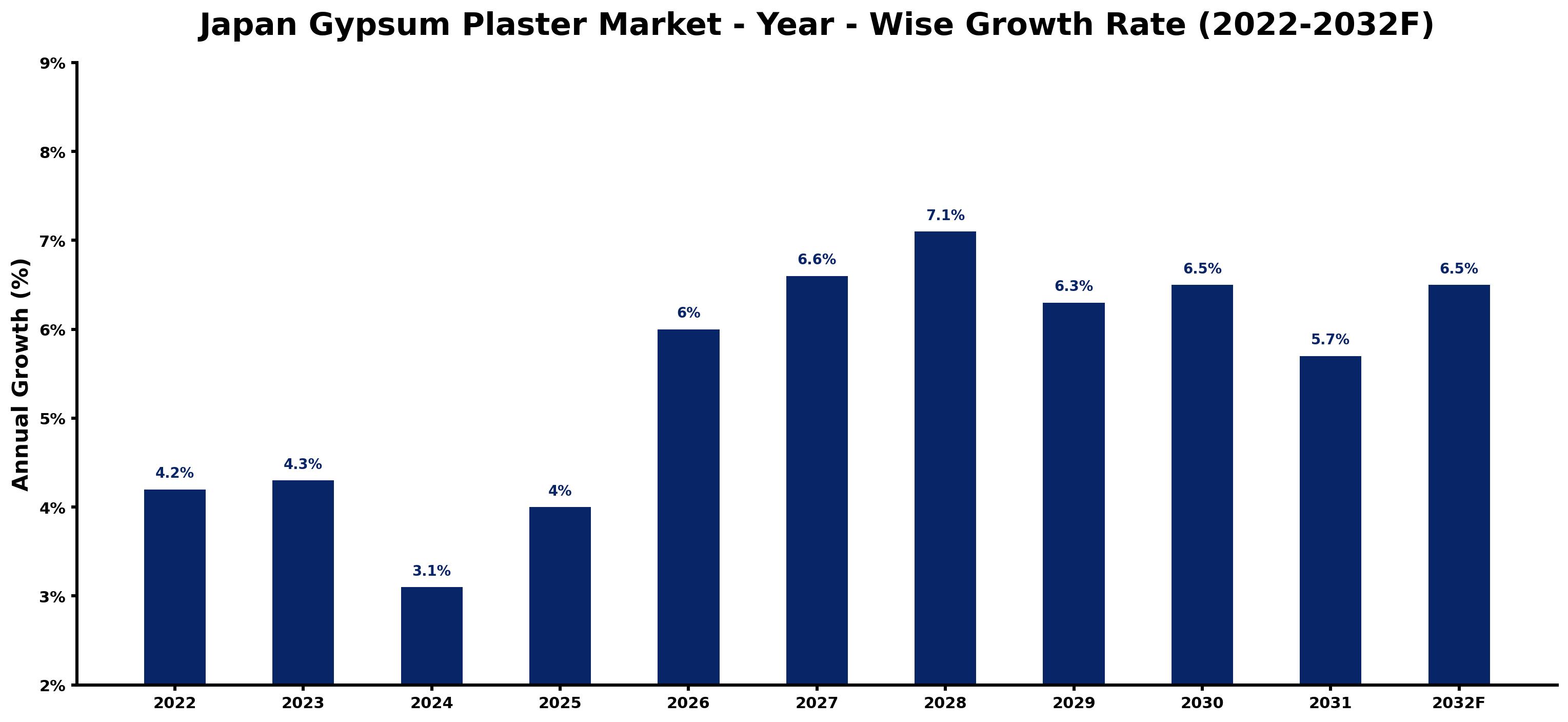
The table below sets out the estimated growth rate for each year and the main factor behind it.
| Year | Estimated Annual Growth (%) | Market Rationale |
| 2022 | 4.2 | The market experienced steady growth due to ongoing construction activities. |
| 2023 | 4.3 | Demand rose as residential projects increased, reflecting positive market sentiment. |
| 2024 | 3.1 | Growth slowed as some projects faced delays amid rising material costs. |
| 2025 | 4.0 | The market rebounded with renewed investment in residential developments. |
| 2026 | 6.0 | Demand surged as urban areas adopted machine-applied plaster systems. |
| 2027 | 6.6 | Growth continued as renovation projects gained traction in older buildings. |
| 2028 | 7.1 | The market peaked with a significant rise in non-residential construction. |
| 2029 | 6.3 | Growth slowed slightly as the market stabilised after peak activity. |
| 2030 | 6.5 | Demand increased again with new sustainability initiatives in construction. |
| 2031 | 5.7 | Growth moderated as the market adjusted to new building standards. |
| 2032 | 6.5 | The market is expected to grow steadily with ongoing urban development. |
Note: Market size estimations and growth projections presented in this report are based on 6Wresearch's proprietary forecasting methodology, utilizing the latest available industry data, government publications, and primary research inputs.
Japan Gypsum Plaster Market Synopsis
Gypsum plaster, a building material derived from heating gypsum, is primarily used for interior wall finishing, fire resistance, and sound insulation. The Japan Gypsum Plaster Market is expanding due to rising residential construction, valued at approximately 5 trillion yen, and the increasing adoption of machine-applied plaster systems. The Tokyo metropolitan area, accounting for 30% of national demand, is a key growth driver, alongside the government's green building initiative launched in 2023, which focuses on sustainable materials.
Market Dynamics Impact Analysis (2026–2032)
| Factor | Type | Impact | Primary Segment Affected |
| Rising residential construction projects drive demand for gypsum plaster. | Driver | High | Residential |
| The shift towards machine-applied plaster systems enhances efficiency in construction. | Driver | High | Machine-applied Plaster |
| The growing trend of renovating older buildings creates opportunities for plaster suppliers. | Opportunity | High | Residential |
| Urban areas are increasingly adopting sustainable building materials. | Opportunity | High | Non-residential |
| Rising costs of raw materials may limit profit margins for producers. | Restraint | High | Machine-applied Plaster |
| Labor shortages in urban areas could slow plaster application processes. | Restraint | Medium | Machine-applied Plaster |
| High costs of compliance with safety regulations can deter new entrants. | Challenge | High | Machine-applied Plaster |
| Competition from alternative wall finishing materials may affect market share. | Challenge | Medium | Finishes |
Evaluation of Drivers in Japan Gypsum Plaster Market (2026–2032)
The following drivers explain most of the expected growth.
| Drivers | Primary Segment Affected | Why It Matters (Evidence) |
| Increased residential construction projects boost plaster demand. | Residential | The residential construction sector in Japan is valued at approximately 5 trillion yen, leading to higher plaster purchases. |
| Growing popularity of machine-applied plaster systems improves efficiency. | Machine-applied Plaster | Machine-applied plaster systems are gaining traction in urban areas, resulting in faster application and reduced labour costs. |
| Rising renovation demand for older buildings fuels plaster usage. | Finishes | The average age of residential buildings in Japan is over 30 years, driving the need for renovation and plastering. |
| Sustainability initiatives promote the use of eco-friendly materials. | Non-residential | The government's green building initiative launched in 2023 encourages the adoption of sustainable materials in construction. |
| Urbanisation increases demand for plaster in metropolitan areas. | Residential | The Tokyo metropolitan area accounts for 30% of national gypsum demand, driving local plaster consumption. |
What keeps demand rising is the increasing value of the residential construction sector, estimated at approximately 5 trillion yen, which drives higher plaster purchases. The average age of residential buildings, over 30 years, creates a strong need for renovation, leading to increased plaster usage. In urban areas, the popularity of machine-applied plaster systems is growing due to labour shortages, resulting in faster application and improved efficiency. Urbanisation, particularly in the Tokyo metropolitan area, significantly influences local market trends and plaster consumption.
Evaluation of Restraints in Japan Gypsum Plaster Market
The main factors holding the market back are set out below.
| Market Restraint | Primary Segment Affected | Why It Matters (Evidence) |
| Rising raw material costs may limit profit margins for producers. | Synthetic Gypsum | The production of synthetic gypsum reached 500,000 tons in 2022, increasing competition for natural gypsum. |
| Labor shortages in urban areas slow plaster application processes. | Machine-applied Plaster | The demand for machine-applied plaster systems is rising, but the lack of skilled workers can delay project timelines. |
| Compliance with safety regulations incurs additional costs for manufacturers. | Machine-applied Plaster | The Industrial Safety and Health Act requires manufacturers to implement safety measures, increasing operational costs for producers by approximately 15%. |
| Competition from alternative wall finishing materials affects market share. | Finishes | The rise of alternative materials may divert demand away from traditional gypsum plaster, impacting sales. |
| Economic fluctuations can impact construction investments. | Residential | Economic uncertainties may lead to reduced spending on new housing developments, affecting plaster demand. |
Japan Gypsum Plaster Market Challenges
Natural gypsum sourcing from Aomori Prefecture restricts supply options, causing delivery delays for producers. Competition from synthetic gypsum, which reached 500,000 tons in 2022, pressures prices, squeezing profit margins for suppliers. Regulatory changes from the green building initiative necessitate compliance investments, raising operational costs for producers by approximately 15%. The average age of residential buildings, over 30 years, results in a renovation backlog, pushing project timelines for buyers by as much as six months.
Trends in the Japan Gypsum Plaster Market
The following changes are redrawing the Japan Gypsum Plaster Market.
- Shift towards Machine-applied Plaster Systems: In 2023, urban areas have increasingly adopted machine-applied plaster systems to address labour shortages. This shift has led to a 30% rise in efficiency in plaster application, benefiting contractors and suppliers.
- Emergence of Sustainable Building Practices: Since 2023, the government's green building initiative has spurred the use of sustainable materials in construction. This trend is expected to increase plaster demand by 20% as builders seek eco-friendly options.
- Growing Renovation Market for Older Buildings: Starting in 2022, the demand for renovating older residential buildings has surged, with over 1.2 million tons of gypsum produced in 2022. This trend is reshaping the plaster market, as contractors focus on restoration projects.
- Increased Focus on Fire Resistance in Construction: Since 2023, there has been a heightened emphasis on fire-resistant materials in construction. This focus aligns with safety standards, increasing plaster demand for fireproofing applications.
Investment Opportunities in the Japan Gypsum Plaster Market
Below are the investment opportunities with the strongest case in the Japan Gypsum Plaster Market.
- Residential Developers Seeking Renovation Solutions: Residential developers are currently focused on renovating older buildings, creating an opportunity for plaster suppliers. With the average age of buildings over 30 years, suppliers can partner with contractors to meet this demand.
- Non-residential Sector Embracing Sustainable Materials: With the government's green building initiative launched in 2023, non-residential builders are now prioritising sustainable materials. This presents a chance for suppliers to invest in eco-friendly plaster options to meet new standards.
- Urban Areas Adopting Machine-applied Systems: Urban areas are increasingly adopting machine-applied plaster systems to combat labour shortages. Suppliers can enter this market by partnering with local contractors to provide necessary materials and training.
- Aomori Prefecture's Natural Gypsum Resources: With natural gypsum primarily sourced from Aomori Prefecture, there is an opportunity for suppliers to invest in local mining operations. This can strengthen supply chains and reduce costs for producers.
Government Initiatives in the Japan Gypsum Plaster Market
The Japan Gypsum Plaster Market is influenced by the Act on the Rational Use of Energy (1979), which mandates large energy users to improve energy efficiency. This law compels producers to adopt energy-efficient practices in manufacturing gypsum plaster, thereby reducing operational costs. Additionally, the New Robot Strategy (2015) promotes automation in production processes, enhancing efficiency and reducing labour dependency. This strategy aligns with the industry's shift towards machine-applied plaster systems, ensuring compliance with modern energy standards while meeting growing demand in the construction sector.
In 2023, the government allocated funding for the green building initiative, aiming to promote sustainable materials in construction. The Ministry of the Environment oversees this programme, which supports projects that incorporate eco-friendly practices. With a target to reduce carbon emissions in construction by 2030, the initiative encourages buyers to invest in sustainable gypsum plaster solutions, enhancing market growth and compliance with environmental standards.
Future Insight of the Japan Gypsum Plaster Market
The investment pipeline for green building initiatives will stimulate demand for sustainable gypsum plaster, benefiting suppliers. Advanced plaster systems will enhance construction efficiency and lower labour costs. New standards from the Japan Gypsum Association will ensure quality across the industry. With a government goal to reduce carbon emissions by 2030, buyers will increasingly seek eco-friendly materials, driving innovation in product development.
Market Segmentation Analysis
Japan Gypsum Plaster Market report covers a detailed analysis of the following market segments:
By Plaster System – Machine-applied Plaster Leads and Records the Fastest Growth
According to Shubham Padhi, Research Analyst at 6Wresearch, with 43% of plaster system revenue in 2025, Machine-applied Plaster was the largest category. Machine-applied plaster holds the largest share due to its efficiency and preference among builders, particularly in urban areas facing labour shortages. This method is increasingly adopted in construction projects, especially in the Tokyo metropolitan area, which significantly influences overall demand. Machine-applied Plaster is also forecast to expand faster than any other category, at a CAGR of 8.7% over 2026–2032. The growth of machine-applied plaster is propelled by its ability to meet the rising need for efficient construction methods, particularly as renovation projects become more prevalent due to the ageing residential building stock. This trend will likely solidify its market position as builders seek faster solutions. Suppliers should prioritise the development of machine-applied plaster products to meet the growing demand in urban construction.
By Raw Material – Natural Gypsum Leads, Synthetic Gypsum Expected to Grow Fastest
In 2025, Natural Gypsum led the raw material split with a 62% share. Natural gypsum dominates the market as it is the primary raw material sourced locally, particularly from Aomori Prefecture, ensuring a steady supply for manufacturers. Its widespread use in construction makes it essential for various plaster applications across Japan. Synthetic Gypsum is projected to grow fastest, at a CAGR of 9.0% during 2026–2032. Synthetic gypsum is experiencing rapid growth due to its production as a byproduct of industrial processes, which aligns with the government's green building initiative promoting sustainable materials. This trend is expected to accelerate as more manufacturers adopt eco-friendly practices. Buyers may benefit from exploring synthetic gypsum options as sustainability becomes a priority in construction.
By End-use – Residential Leads, Non-residential Expected to Grow Fastest
Residential took 54% of end-use revenue in 2025, more than any other category. The residential sector leads the market, driven by extensive new housing developments valued at approximately 5 trillion yen. The demand for renovations in older buildings, which constitute a significant portion of the housing stock, further bolsters this segment's position. Over 2026–2032, Non-residential is expected to post the fastest growth, at a CAGR of 7.8%. Non-residential construction is witnessing the fastest growth, fuelled by substantial demand for commercial buildings, which accounted for 40% of total plaster usage in 2022. This shift towards larger-scale projects indicates a need for robust plaster solutions. Suppliers should focus on the non-residential sector to capitalise on the increasing demand for commercial construction.
Key Attractiveness of the Report
- 10 Years of Market Numbers
- Historical Data Starting from 2022 to 2025
- Base Year 2025
- Forecast Data until 2032
- Key Performance Indicators Impacting the Market
- Major Upcoming Developments and Projects
Key Highlights of the Report:
- Japan Gypsum Plaster Market Outlook
- Market Size of Japan Gypsum Plaster Market, 2025
- Forecast of Japan Gypsum Plaster Market, 2032
- Historical Data and Forecast of Japan Gypsum Plaster Revenues & Volume for the Period 2022-2032
- Japan Gypsum Plaster Market Trend Evolution
- Japan Gypsum Plaster Market Drivers and Challenges
- Japan Gypsum Plaster Price Trends
- Japan Gypsum Plaster Porter's Five Forces
- Japan Gypsum Plaster Industry Life Cycle
- Historical Data and Forecast of Japan Gypsum Plaster Market Revenues & Volume By Plaster System for the Period 2022-2032
- Historical Data and Forecast of Japan Gypsum Plaster Market Revenues & Volume By Manually-applied Plaster for the Period 2022-2032
- Historical Data and Forecast of Japan Gypsum Plaster Market Revenues & Volume By Machine-applied Plaster for the Period 2022-2032
- Historical Data and Forecast of Japan Gypsum Plaster Market Revenues & Volume By Finishes for the Period 2022-2032
- Historical Data and Forecast of Japan Gypsum Plaster Market Revenues & Volume By Raw Material for the Period 2022-2032
- Historical Data and Forecast of Japan Gypsum Plaster Market Revenues & Volume By Natural Gypsum for the Period 2022-2032
- Historical Data and Forecast of Japan Gypsum Plaster Market Revenues & Volume By Synthetic Gypsum for the Period 2022-2032
- Historical Data and Forecast of Japan Gypsum Plaster Market Revenues & Volume By End-use for the Period 2022-2032
- Historical Data and Forecast of Japan Gypsum Plaster Market Revenues & Volume By Residential for the Period 2022-2032
- Historical Data and Forecast of Japan Gypsum Plaster Market Revenues & Volume By Non-residential for the Period 2022-2032
- Japan Gypsum Plaster Import Export Trade Statistics
- Market Opportunity Assessment By Plaster System
- Market Opportunity Assessment By Raw Material
- Market Opportunity Assessment By End-use
- Japan Gypsum Plaster Top Companies Market Share
- Japan Gypsum Plaster Competitive Benchmarking By Technical and Operational Parameters
- Japan Gypsum Plaster Company Profiles
- Japan Gypsum Plaster Key Strategic Recommendations
Market Covered
The report covers the following segments.
By Plaster System
- Manually-applied Plaster
- Machine-applied Plaster
- Finishes
By Raw Material
- Natural Gypsum
- Synthetic Gypsum
By End-use
- Residential
- Non-residential































