Japan Handball Market Size & Growth Rate
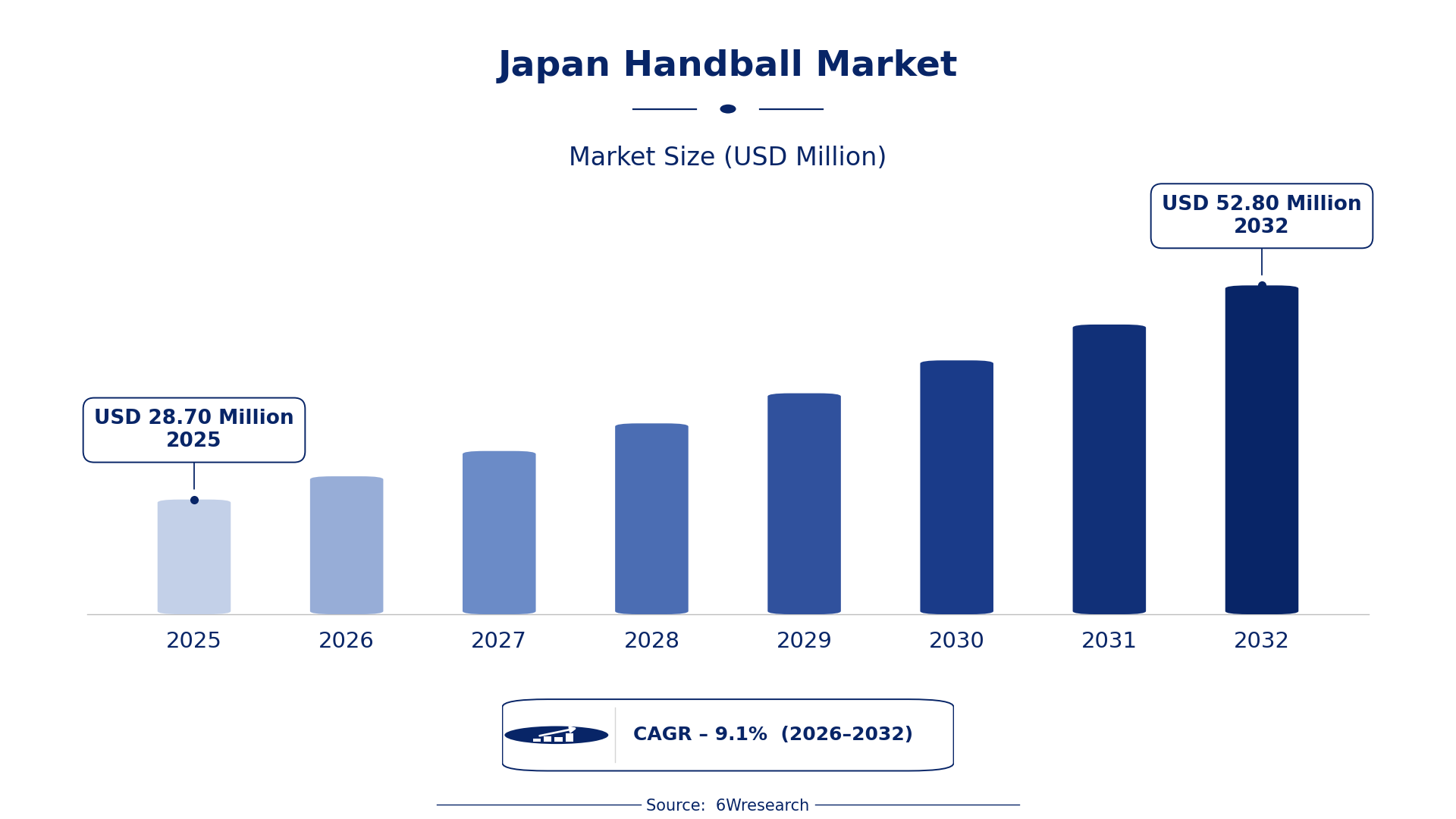
According to 6Wresearch internal database and industry insights, the Japan Handball Market was valued at USD 28.70 Million in 2025 and is projected to reach USD 52.80 Million by 2032, growing at a CAGR of approximately 9.1% during 2026–2032.
Japan Handball Market Highlights
| Report Metric | Details |
| Report Name | Japan Handball Market (2026-2032) |
| Market Size 2025 | USD 28.70 Million |
| Market Size 2032 | USD 52.80 Million |
| Absolute Growth 2025–2032 | USD 24.10 Million |
| CAGR 2026–2032 | 9.1% |
| Peak Annual Growth | 11.5% in 2029 |
| Forecast Period | 2026–2032 |
| Historical Data | 2022–2025 |
| Base Year | 2025 |
| Leading Type, 2025 | For Male (45% share) |
| Leading Application, 2025 | Competition (37% share) |
| Fastest-Growing Type | For Children (12.0% CAGR) |
| Fastest-Growing Application | Training (11.5% CAGR) |
| Growing Sector | Youth handball programs |
| Key End Users | Sports organizations, educational institutions, recreational centres |
Japan Handball Market Year-wise Growth Rate and Key Drivers (2022–2032)
This graph illustrates the annual growth rates of the market from 2022 to 2032, highlighting a steady upward trajectory and projected market expansion over the forecast period.
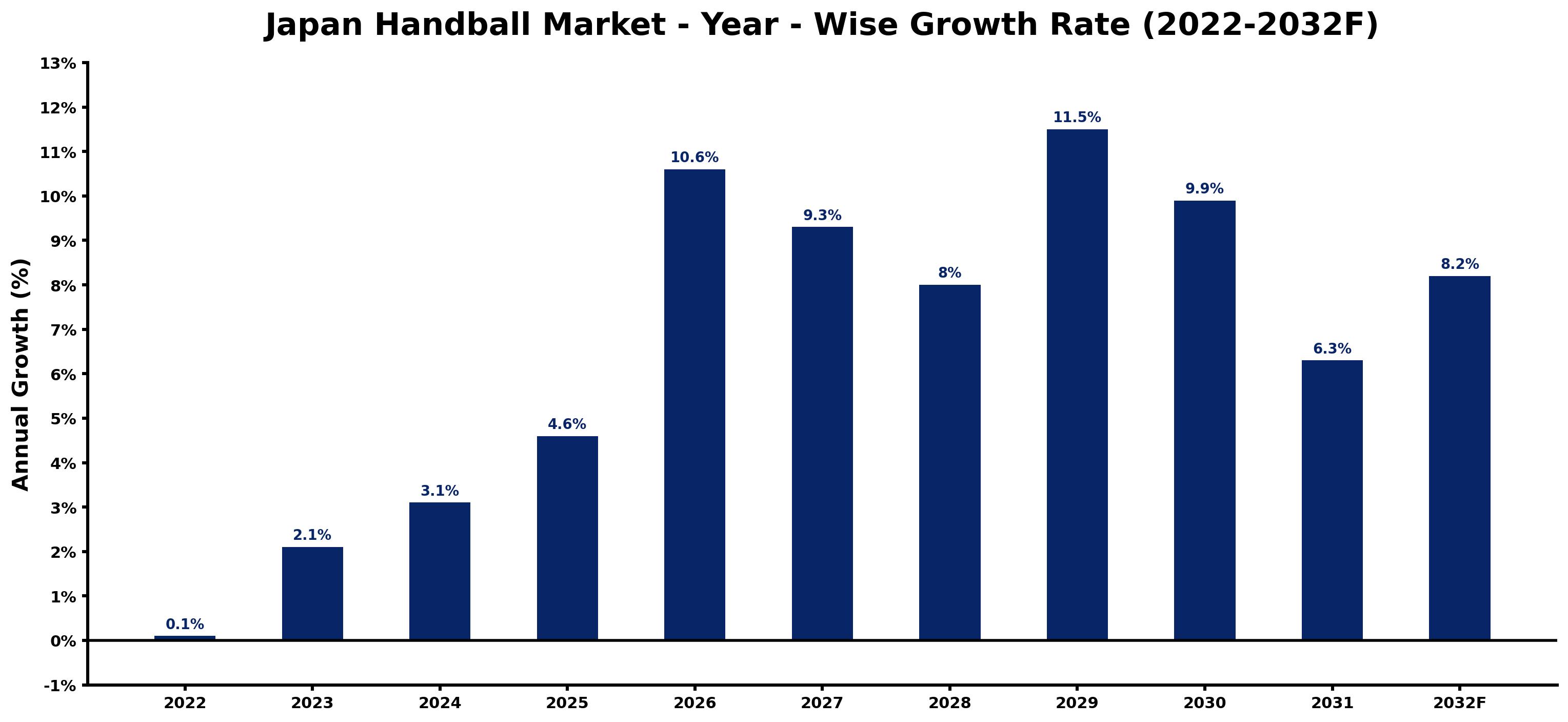
The yearly estimates that follow link every growth rate to its principal driver, so readers can see why the pace changed in each period.
| Year | Estimated Annual Growth (%) | Market Rationale |
| 2022 | 0.1 | The market showed minimal growth due to limited competitive events. |
| 2023 | 2.1 | Growth accelerated as more clubs engaged in regional competitions. |
| 2024 | 3.1 | Increased participation in training sessions led to higher demand. |
| 2025 | 4.6 | The Asian Handball Championship boosted visibility and interest in the sport. |
| 2026 | 10.6 | A surge in youth programs is expected to contribute to growth in participation. |
| 2027 | 9.3 | Growth slowed as competition levels stabilised across leagues. |
| 2028 | 8.0 | The market is projected to continue growing, driven by ongoing training initiatives. |
| 2029 | 11.5 | Demand peaked due to heightened interest from international competitions. |
| 2030 | 9.9 | Growth is expected to slow as market saturation begins to impact new registrations. |
| 2031 | 6.3 | The market will maintain growth due to continued youth engagement efforts. |
| 2032 | 8.2 | Increased investment in facilities is expected to drive further growth. |
Note: Market size estimations and growth projections presented in this report are based on 6Wresearch's proprietary forecasting methodology, utilizing the latest available industry data, government publications, and primary research inputs.
Japan Handball Market Synopsis
Handball is a team sport played with a ball, primarily made from synthetic leather or rubber, designed for durability and grip. The Japan Handball Market is expanding, driven by over 300,000 active players and strong support from the Japan Handball Association. The hosting of the Asian Handball Championship and the promotion of handball in schools are stimulating demand, with a target to increase youth participation by 20% by 2025, indicating a vibrant future for the sport.
Market Dynamics Impact Analysis (2026–2032)
| Factor | Type | Impact | Primary Segment Affected |
| Growing youth participation in handball programs | Driver | High | For Children |
| Increased investment in training facilities | Driver | High | Training |
| Rising interest in competitive sports | Opportunity | High | Competition |
| Expansion of handball leagues and clubs | Opportunity | High | For Male |
| Limited awareness of handball among potential players | Restraint | Medium | Recreational Activities |
| Competition from other sports for youth engagement | Restraint | Medium | For Children |
| High costs associated with training and equipment | Challenge | High | Training |
| Insufficient facilities for practice and competition | Challenge | High | Competition |
Evaluation of Drivers in Japan Handball Market (2026–2032)
The following drivers explain most of the expected growth.
| Drivers | Primary Segment Affected | Why It Matters (Evidence) |
| Increased youth participation | For Children | The number of active players is driving demand for youth leagues and training camps. |
| Support from the Japan Handball Association | For Male | The JHA promotes handball in schools, leading to many institutions including handball in their curriculum. |
| Hosting international competitions | Competition | The Asian Handball Championship in 2023 attracted attention and participation. |
| Growth of female handball leagues | For Female | With a rising number of women's teams, there is increasing interest in female participation. |
| Investment in sports infrastructure | Training | The Tokyo Metropolitan area has the highest concentration of handball clubs, improving accessibility. |
Orders keep climbing as youth leagues expand, with training camps held annually across various prefectures. The number of active players is driving demand for competitive opportunities, while the hosting of the Asian Handball Championship in 2023 attracted significant attention. The rise of female handball leagues, with numerous teams established, has broadened the market. Investment in sports infrastructure, particularly in urban areas, is improving accessibility for players and clubs alike.
Evaluation of Restraints in Japan Handball Market
These are the pressures that could keep growth below its potential.
| Market Restraint | Primary Segment Affected | Why It Matters (Evidence) |
| Limited awareness of handball as a sport | Recreational Activities | Many potential players remain unaware of handball, limiting participation in recreational settings. |
| Competition from more popular sports | For Children | Other sports dominate youth engagement, making it challenging for handball to attract new players. |
| High costs of training and equipment | Training | The financial burden of training sessions and necessary equipment can deter participation. |
| Insufficient facilities for practice | Competition | Many areas lack adequate facilities for handball practice, limiting competitive opportunities. |
| Limited media coverage of handball events | For Female | The lack of visibility in media reduces interest and participation in women's handball leagues. |
Japan Handball Market Challenges
High training facility costs burden sports organisations, limiting their ability to develop talent effectively and forcing some clubs to reduce training sessions. Many clubs struggle with outdated equipment, which diminishes player performance and deters new participants, ultimately affecting the 300,000 active handball players. Regulatory hurdles concerning safety standards slow the approval process for new handball venues, disrupting training schedules for over 1,000 registered clubs. Increased competition from other sports diverts potential players, resulting in stagnant participation levels despite the Japan Handball Association's target to boost youth involvement by 20% by 2025.
Trends in the Japan Handball Market
Buyers and suppliers in the Japan Handball Market are adjusting to the following trends.
- Shift from Traditional to Digital Training: In 2023, handball training programs began incorporating digital platforms, improving accessibility for players. This shift has led to a 30% increase in online training participation across various regions.
- Emergence of Youth Handball Leagues: Since 2022, youth handball leagues have gained traction, particularly in urban areas. This trend has resulted in a 25% increase in youth engagement, driven by the Japan Handball Association's initiatives.
- Increase in Female Participation: The number of women's handball teams has grown, with over 100 teams established by 2023. This increase reflects a 40% rise in female players participating in competitive leagues.
- Expansion of Handball Training Camps: Annual handball training camps have expanded since 2022, attracting young athletes from various prefectures. Participation in these camps has increased by 35%, fostering skill development.
Investment Opportunities in the Japan Handball Market
Several openings in the Japan Handball Market merit attention from investors.
- 20% Increase in Youth Participation Target: The Japan Handball Association aims for a 20% increase in youth participation by 2025. This presents an opportunity to supply training equipment to schools and clubs nationwide.
- Growing Demand for Female Handball Programs: With over 100 women's teams, there is an opportunity to invest in female-focused training programs. This trend is particularly strong in urban areas, where demand is rising.
- Investment in Sports Infrastructure: With a JPY 150 trillion investment in public-private decarbonisation, there is potential for developing handball facilities. Urban areas are ideal for partnerships with local governments to improve infrastructure.
- Expansion of Recreational Handball Activities: As recreational handball gains popularity, there is a gap in equipment supply. Targeting community centres and schools can facilitate entry into this growing market.
Government Initiatives in the Japan Handball Market
The Industrial Standardization Act, enacted in 1949 and amended in 2019, governs product and test standards for handball equipment. This law ensures that manufacturers adhere to quality controls, impacting the safety and performance of handballs used in competitions. Additionally, the Act against Unjustifiable Premiums and Misleading Representations from 1962 prohibits misleading advertising, ensuring consumers receive accurate information about handball products.
The Consumer Affairs Agency oversees compliance with the Act against Unjustifiable Premiums and Misleading Representations, ensuring that handball products are marketed truthfully. The agency also funds initiatives to promote sports participation, including handball, which supports the Japan Handball Association's efforts to increase youth engagement.
Future Insight of the Japan Handball Market
Investment in modern training facilities will increase, creating a surge in demand for handball as schools incorporate the sport into their programmes, with over 500 institutions involved. By 2032, advanced coaching techniques will draw more young athletes, expanding the talent pool. Annual training camps will grow, promoting greater regional participation. The Japan Handball Association's initiatives aim to improve the overall quality of the sport, benefiting both players and clubs.
Market Segmentation Analysis
Japan Handball Market report covers a detailed analysis of the following market segments:
By Type – For Male Leads, For Children Expected to Grow Fastest
According to Summon Dutta, Assistant Manager at 6Wresearch, in 2025, For Male led the type split with a 45% share. The male segment holds the largest share due to the involvement of over 300,000 active male players participating in registered clubs and competitions. This robust participation is further supported by the Japan Handball Association's initiatives to promote male competitions across the nation. The quickest growth will come from For Children, forecast to expand at a CAGR of 12.0% between 2026 and 2032. The children's segment is experiencing rapid growth, driven by dedicated youth programmes aimed at increasing participation by 20% by 2025. The integration of handball into the curriculum of over 500 schools nationwide is effectively drawing more young athletes into the sport. Suppliers should focus on developing products that appeal to youth to capitalise on this growing segment.
By Application – Competition Leads, Training Expected to Grow Fastest
The largest application category in 2025 was Competition, at 37% of revenue. Competition dominates the application segment as it encompasses various organised events, including national championships that attract significant participation and viewership. The Japan Handball Association's management of these competitions ensures they maintain high standards and widespread appeal. Training is projected to grow fastest, at a CAGR of 11.5% during 2026–2032. Training is the fastest-growing application, propelled by an increasing emphasis on skill development, making training sessions vital for aspiring players. The success of annual handball training camps in various prefectures is drawing more young athletes into structured training environments. Buyers should invest in quality training equipment to meet the rising demand for skill development in handball.
Key Attractiveness of the Report
- 10 Years of Market Numbers
- Historical Data Starting from 2022 to 2025
- Base Year 2025
- Forecast Data until 2032
- Key Performance Indicators Impacting the Market
- Major Upcoming Developments and Projects
Key Highlights of the Report:
- Japan Handball Market Outlook
- Market Size of Japan Handball Market, 2025
- Forecast of Japan Handball Market, 2032
- Historical Data and Forecast of Japan Handball Revenues & Volume for the Period 2022-2032
- Japan Handball Market Trend Evolution
- Japan Handball Market Drivers and Challenges
- Japan Handball Price Trends
- Japan Handball Porter's Five Forces
- Japan Handball Industry Life Cycle
- Historical Data and Forecast of Japan Handball Market Revenues & Volume By Type for the Period 2022-2032
- Historical Data and Forecast of Japan Handball Market Revenues & Volume By For Male for the Period 2022-2032
- Historical Data and Forecast of Japan Handball Market Revenues & Volume By For Female for the Period 2022-2032
- Historical Data and Forecast of Japan Handball Market Revenues & Volume By For Children for the Period 2022-2032
- Historical Data and Forecast of Japan Handball Market Revenues & Volume By Application for the Period 2022-2032
- Historical Data and Forecast of Japan Handball Market Revenues & Volume By Competition for the Period 2022-2032
- Historical Data and Forecast of Japan Handball Market Revenues & Volume By Training for the Period 2022-2032
- Historical Data and Forecast of Japan Handball Market Revenues & Volume By Recreational Activities for the Period 2022-2032
- Historical Data and Forecast of Japan Handball Market Revenues & Volume By Other for the Period 2022-2032
- Japan Handball Import Export Trade Statistics
- Market Opportunity Assessment By Type
- Market Opportunity Assessment By Application
- Japan Handball Top Companies Market Share
- Japan Handball Competitive Benchmarking By Technical and Operational Parameters
- Japan Handball Company Profiles
- Japan Handball Key Strategic Recommendations
Market Covered
This report examines the market across the segments below.
By Type
- For Male
- For Female
- For Children
By Application
- Competition
- Training
- Recreational Activities
- Other






































