Japan Health Wearables Market Size & Growth Rate
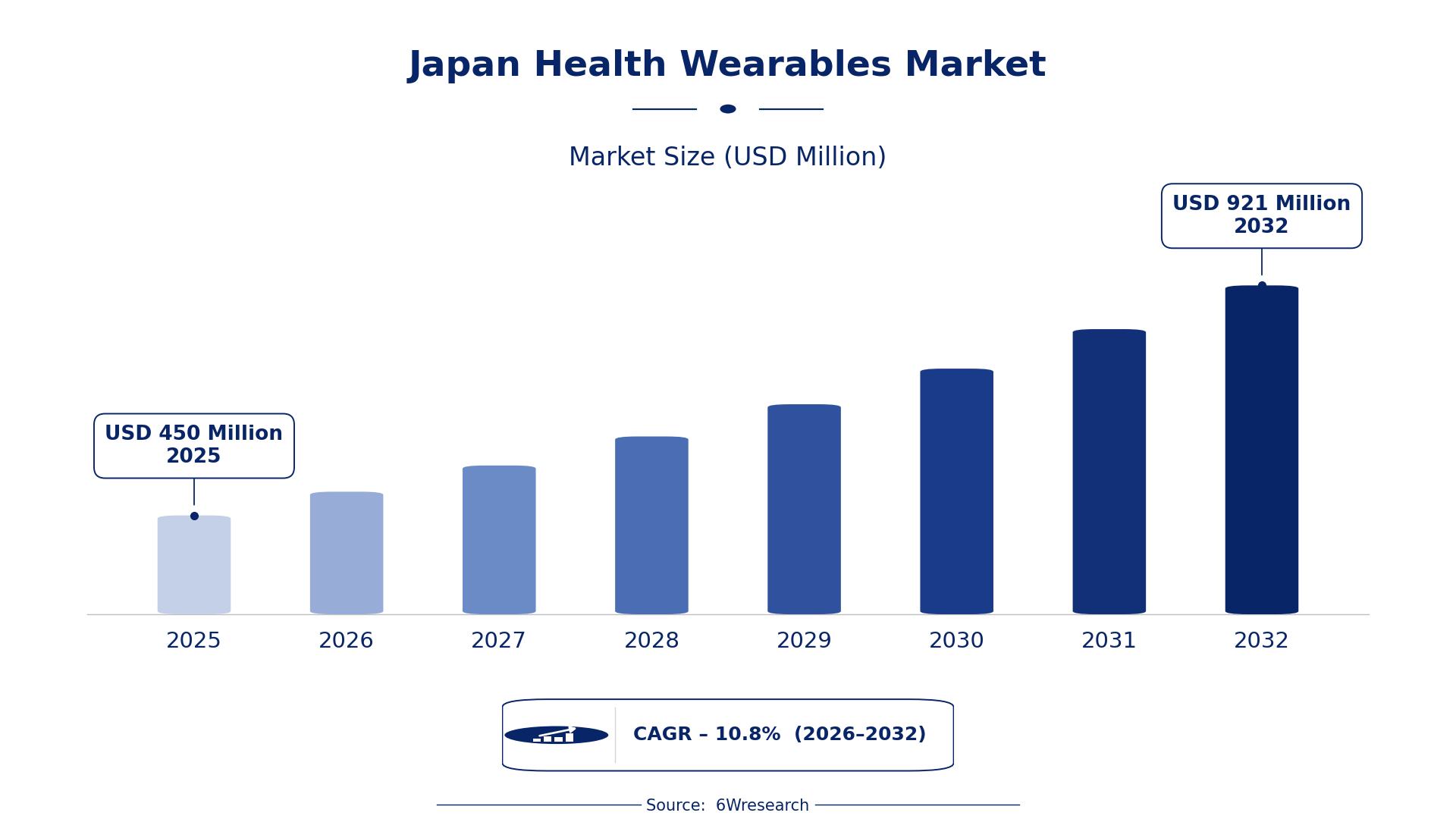
According to 6Wresearch internal database and industry insights, the Japan Health Wearables Market was valued at USD 450 Million in 2025 and is projected to reach USD 921 Million by 2032, growing at a CAGR of approximately 10.8% during 2026–2032.
Japan Health Wearables Market Highlights
| Report Metric | Details |
| Report Name | Japan Health Wearables Market (2026-2032) |
| Market Size 2025 | USD 450 Million |
| Market Size 2032 | USD 921 Million |
| Absolute Growth 2025–2032 | USD 471 Million |
| CAGR 2026–2032 | 10.8% |
| Peak Annual Growth | 12.0% in 2031 |
| Forecast Period | 2026–2032 |
| Historical Data | 2022–2025 |
| Base Year | 2025 |
| Leading Wearable Type, 2025 | Smartwatches (41% share) |
| Leading Tracking Feature, 2025 | Heart Rate & ECG (51% share) |
| Leading Distribution Channel, 2025 | Online Tech Retailers (43% share) |
| Leading End User, 2025 | Health-Conscious Users (47% share) |
| Fastest-Growing Wearable Type | Wearable ECG Monitors (15.4% CAGR) |
| Fastest-Growing Tracking Feature | SpO2 Monitoring (14.0% CAGR) |
| Fastest-Growing Distribution Channel | Direct to Consumer (13.9% CAGR) |
| Growing Sector | Health-Conscious Users |
| Key End Users | Health-Conscious Users, Working Professionals, Gym-Goers, Cardiologists |
Japan Health Wearables Market Year-wise Growth Rate and Key Drivers (2022–2032)
This graph illustrates the annual growth rates of the market from 2022 to 2032, highlighting a steady upward trajectory and projected market expansion over the forecast period.
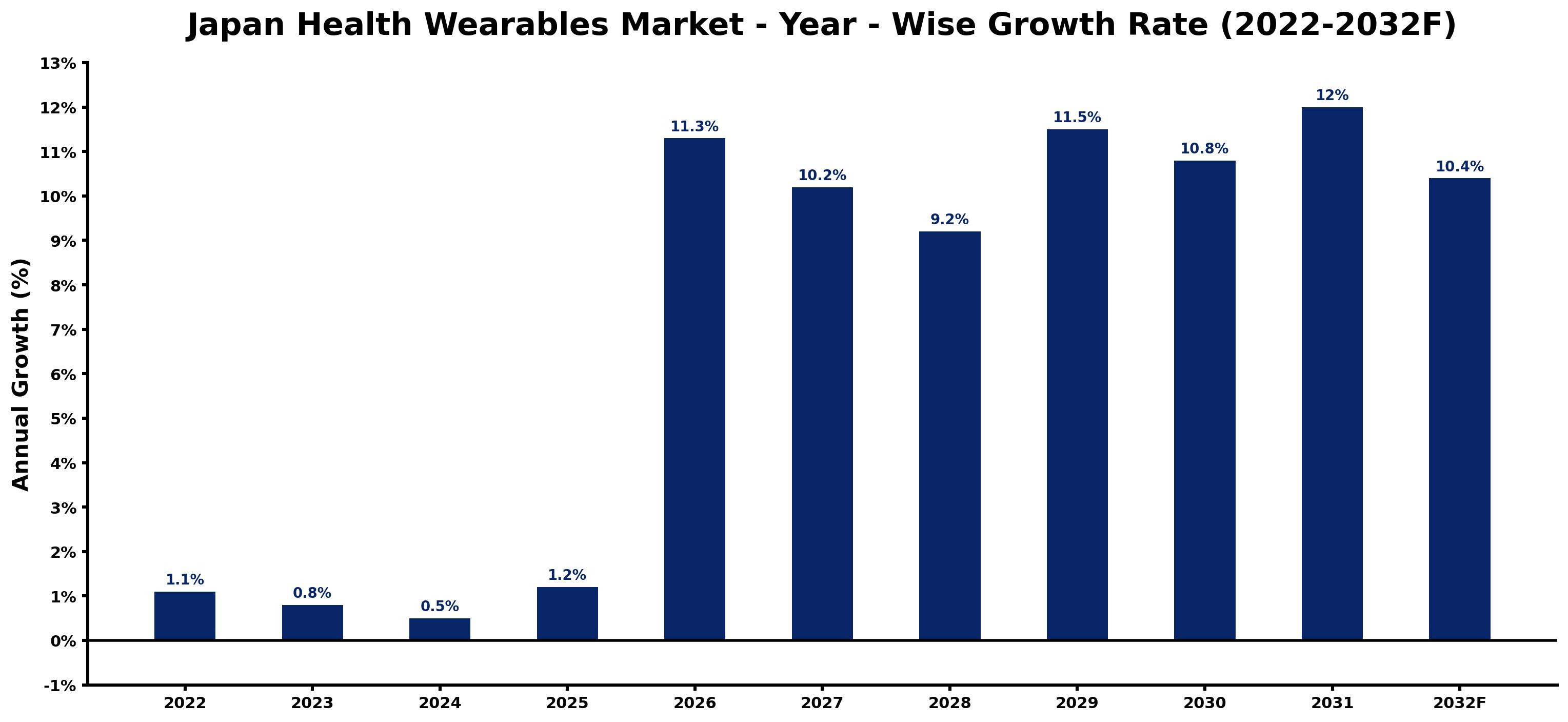
Each row of the following table gives one year's estimated growth and the event or demand shift that explains it.
| Year | Estimated Annual Growth (%) | Market Rationale |
| 2022 | 1.1 | The market experienced steady growth due to increasing health awareness among consumers. |
| 2023 | 0.8 | Growth slowed as consumers became more selective in their wearable technology purchases. |
| 2024 | 0.5 | The market continued to slow down as competition intensified among various brands. |
| 2025 | 1.2 | Growth accelerated with the introduction of new health tracking features in devices. |
| 2026 | 11.3 | The market is expected to surge as corporate wellness programs expand their use of wearables. |
| 2027 | 10.2 | Growth is projected to decelerate slightly as market saturation begins to impact sales. |
| 2028 | 9.2 | The market will see reduced growth as consumers focus on essential features. |
| 2029 | 11.5 | Demand is expected to increase again with rising interest in advanced health monitoring technologies. |
| 2030 | 10.8 | Growth will slow as economic factors influence consumer spending on wearables. |
| 2031 | 12.0 | The market is projected to peak, driven by high demand for health tracking solutions. |
| 2032 | 10.4 | Growth is expected to moderate as the market stabilises with established consumer preferences. |
Note: Market size estimations and growth projections presented in this report are based on 6Wresearch's proprietary forecasting methodology, utilizing the latest available industry data, government publications, and primary research inputs.
Japan Health Wearables Market Synopsis
Health wearables are electronic devices designed to monitor health metrics and fitness activities, utilising advanced sensors and software. The Japan Health Wearables Market is expanding, driven by health-conscious users and corporate wellness initiatives. The increasing adoption of smartwatches, which accounted for 40% of the market in 2023, along with a growing population aged 65 and older, are key factors propelling demand. Urban areas, particularly Tokyo, are experiencing heightened interest in these technologies, further boosting market growth.
Market Dynamics Impact Analysis (2026–2032)
| Factor | Type | Impact | Primary Segment Affected |
| Growing health consciousness among consumers | Driver | High | Fitness Trackers |
| Expansion of corporate wellness programs | Driver | High | Smartwatches |
| Rising demand for advanced health monitoring features | Opportunity | High | Wearable ECG Monitors |
| Increasing interest in SpO2 monitoring | Opportunity | High | Health-Conscious Users |
| Market saturation limiting new customer acquisition | Restraint | Medium | Smartwatches |
| High competition among brands leading to price wars | Restraint | Medium | Fitness Trackers |
| High cost of advanced wearables limiting access | Challenge | High | Wearable ECG Monitors |
| Rapid technological advancements creating obsolescence | Challenge | Medium | Smartwatches |
Evaluation of Drivers in Japan Health Wearables Market (2026–2032)
The main growth drivers and the segments they affect most are set out below.
| Drivers | Primary Segment Affected | Why It Matters (Evidence) |
| Increased health awareness among consumers | Fitness Trackers | In 2023, over 10 million fitness tracker users in Japan actively monitor their daily activities. |
| Adoption of wearables in corporate wellness programs | Smartwatches | Health wearables are increasingly integrated into corporate wellness initiatives, promoting employee health. |
| Growing elderly population seeking health monitoring | Wearable ECG Monitors | 29.3% of Japan's population was aged 65 or older in September 2024, driving demand for heart health monitoring. |
| Technological advancements in health tracking features | Smartwatches | New features, such as ECG monitoring, are attracting more users to smartwatches. |
| Rising interest in personal health data | Health-Conscious Users | The average age of health wearables users in Japan is around 35 years, indicating a tech-savvy demographic. |
Spending rises because the increasing health awareness among consumers is driving demand for fitness trackers, with over 10 million users in Japan in 2023. The growing elderly population, which constituted a significant portion of Japan's demographic, is seeking wearable ECG monitors for heart health. Technological advancements are attracting younger users, while the average age of health wearables users indicates a tech-savvy demographic eager for personal health data.
Evaluation of Restraints in Japan Health Wearables Market
The following restraints limit how fast demand can grow.
| Market Restraint | Primary Segment Affected | Why It Matters (Evidence) |
| Market saturation limiting new customer acquisition | Smartwatches | With smartwatches accounting for 40% of the market in 2023, competition has intensified. |
| High competition among brands leading to price wars | Fitness Trackers | The proliferation of fitness trackers has resulted in aggressive pricing strategies among manufacturers. |
| High cost of advanced wearables limiting access | Wearable ECG Monitors | Advanced features in wearables often come with higher price tags, deterring some consumers. |
| Consumer preference for essential features over advanced options | Health-Conscious Users | As the market matures, many consumers are prioritising basic functionalities over premium features. |
| Technological obsolescence due to rapid advancements | Smartwatches | Frequent updates in technology can render existing devices obsolete, affecting resale value. |
Japan Health Wearables Market Challenges
Competition from low-cost imports forces producers to reduce prices, which can lead to a 15% drop in quality for hospitals purchasing devices. Rising production costs for advanced sensors increase expenses by 20%, burdening suppliers and raising prices for clinics seeking reliable products. Skills shortages in the workforce delay technology adoption, extending timelines by up to six months for buyers wanting the latest innovations. Supply chain disruptions create logistical challenges, risking stock shortages that can postpone patient monitoring initiatives in hospitals.
Trends in the Japan Health Wearables Market
Several trends are reshaping the Japan Health Wearables Market; the most important are set out below.
- Shift from Basic to Advanced Health Monitoring: Japanese consumers are increasingly moving towards wearables with advanced health monitoring features, such as ECG. In 2023, wearable ECG monitors gained traction among cardiologists, reflecting a growing demand for heart health technology.
- Transition from Retail to Online Sales Channels: The distribution of health wearables is shifting from traditional retail to online tech retailers. In 2025, online tech retailers accounted for 43% of sales, making it essential for brands to strengthen their online presence.
- Emergence of Corporate Wellness Initiatives: Corporate wellness programs are becoming a key driver for health wearables adoption in Japan. In 2023, many companies integrated wearables into their health initiatives, resulting in increased user engagement.
- Increased Focus on SpO2 Monitoring Features: Health-conscious users are prioritising wearables with SpO2 monitoring capabilities. In 2023, there was a notable rise in interest in these features, particularly among users with respiratory concerns.
Investment Opportunities in the Japan Health Wearables Market
The openings below show where demand in the Japan Health Wearables Market is visible and how suppliers can enter.
- Growing Demand for Wearable ECG Monitors: With 29.3% of the population aged 65 or older, there is a pressing need for wearable ECG monitors in Japan. Suppliers can target healthcare providers, establishing partnerships to meet this demand.
- Expansion of Corporate Wellness Programs: As companies increasingly adopt health wearables, there is an opportunity to supply devices to corporate wellness programs. Targeting large enterprises in urban areas can facilitate market entry.
- Rising Interest in SpO2 Monitoring: The growing focus on respiratory health creates an opportunity to supply wearables with SpO2 monitoring features. Targeting health-conscious users in metropolitan areas can drive sales.
- Increasing Online Sales Channels: With online tech retailers accounting for 43% of sales in 2025, investing in e-commerce platforms is vital. Collaborating with established online retailers can enhance market reach.
Government Initiatives in the Japan Health Wearables Market
The Next-Generation Medical Infrastructure Act (2017) allows certified bodies to anonymise medical data for research and product development, impacting health wearables by promoting innovation and ensuring compliance with data protection standards. This measure encourages developers to create devices that meet regulatory requirements, supporting market growth.
Health-conscious users benefit from the Clinical Trials Act (2017), which sets standards for the conduct and reporting of clinical research. This law ensures that health wearables undergo rigorous testing, providing buyers with confidence in the safety and efficacy of the devices they purchase.
Future Insight of the Japan Health Wearables Market
By 2032, new corporate wellness programmes will integrate health wearables, enhancing employee engagement in health management. The introduction of standards like ISO 13485 will improve quality assurance in devices, ensuring better reliability for buyers. Urban hospitals will increasingly adopt advanced monitoring technologies, reflecting a shift towards data-driven healthcare. The Tokyo Metropolitan Government's health initiative will further stimulate demand for wearables, aligning with Japan's ageing population and their health needs.
Market Segmentation Analysis
Japan Health Wearables Market report covers a detailed analysis of the following market segments:
By Wearable Type – Smartwatches Lead, Wearable ECG Monitors Expected to Grow Fastest
According to Saurav Kr Singh, Senior Research Analyst at 6Wresearch, with 41% of wearable type revenue in 2025, Smartwatches was the largest category. Smartwatches hold the largest share as they combine fitness tracking with smartphone functionalities, appealing to a wide range of users. Their integration into daily life is evident in urban centres like Tokyo, where health consciousness is high. Wearable ECG Monitors are set to record the highest CAGR in this split, 15.4% over 2026–2032. Wearable ECG monitors are rapidly gaining traction due to their critical role in heart health monitoring, particularly among healthcare professionals in urban settings. The increasing focus on cardiovascular health is likely to drive further adoption in medical facilities. Suppliers should focus on enhancing smartwatch features while also exploring opportunities in the growing ECG monitor segment.
By Tracking Feature – Heart Rate & ECG Leads, SpO2 Monitoring Expected to Grow Fastest
In 2025, Heart Rate & ECG led the tracking feature split with a 51% share. Heart rate and ECG tracking features dominate the market as they are vital for users monitoring cardiovascular health, especially in an ageing population where 29.3% are aged 65 or older. This demographic prioritises health metrics that can prevent serious health issues. SpO2 Monitoring is projected to grow fastest, at a CAGR of 14.0% during 2026–2032. SpO2 monitoring is witnessing rapid growth, driven by heightened awareness of respiratory health among users. The increasing prevalence of respiratory concerns is propelling the adoption of this feature in health wearables. Providers must ensure their products incorporate advanced heart monitoring features while also developing SpO2 capabilities to meet emerging market demands.
By Distribution Channel – Online Tech Retailers Lead, Direct to Consumer Expected to Grow Fastest
The largest distribution channel category in 2025 was Online Tech Retailers, at 43% of revenue. Online tech retailers lead the distribution channel due to their extensive reach and convenience for purchasing health wearables. This channel effectively caters to the tech-savvy population in urban areas, particularly in Tokyo. Over 2026–2032, Direct to Consumer is expected to post the fastest growth, at a CAGR of 13.9%. Direct to consumer sales are increasingly popular as brands seek to establish closer relationships with health-conscious users. This approach allows for more tailored marketing strategies that resonate with specific consumer needs. Suppliers should enhance their online presence while considering direct sales strategies to better engage with health-focused consumers.
By End User – Health-Conscious Users Lead and Record the Fastest Growth
Health-Conscious Users accounted for 47% of the market by end user in 2025. Health-conscious users represent the largest segment, driving demand for health wearables through their proactive approach to health management. Their commitment to monitoring health metrics is reflected in the widespread adoption of these devices. The same category are also set to grow fastest, at a CAGR of 13.5% during 2026–2032. This group is also the fastest growing, as their increasing awareness of health metrics fuels further demand for wearables. Their ongoing interest in personal health monitoring will likely sustain this trend. Suppliers must continuously innovate to meet the evolving preferences of health-conscious users, ensuring their products remain relevant.
Key Attractiveness of the Report
- 10 Years of Market Numbers
- Historical Data Starting from 2022 to 2025
- Base Year 2025
- Forecast Data until 2032
- Key Performance Indicators Impacting the Market
- Major Upcoming Developments and Projects
Key Highlights of the Report:
- Japan Health Wearables Market Outlook
- Market Size of Japan Health Wearables Market, 2025
- Forecast of Japan Health Wearables Market, 2032
- Historical Data and Forecast of Japan Health Wearables Revenues & Volume for the Period 2022-2032F
- Japan Health Wearables Market Trend Evolution
- Japan Health Wearables Market Drivers and Challenges
- Japan Health Wearables Price Trends
- Japan Health Wearables Porter's Five Forces
- Japan Health Wearables Industry Life Cycle
- Historical Data and Forecast of Japan Health Wearables Market Revenues & Volume By Wearable Type for the Period 2022-2032F
- Historical Data and Forecast of Japan Health Wearables Market Revenues & Volume By Fitness Trackers for the Period 2022-2032F
- Historical Data and Forecast of Japan Health Wearables Market Revenues & Volume By Smartwatches for the Period 2022-2032F
- Historical Data and Forecast of Japan Health Wearables Market Revenues & Volume By Smart Rings for the Period 2022-2032F
- Historical Data and Forecast of Japan Health Wearables Market Revenues & Volume By Wearable ECG Monitors for the Period 2022-2032F
- Historical Data and Forecast of Japan Health Wearables Market Revenues & Volume By Tracking Feature for the Period 2022-2032F
- Historical Data and Forecast of Japan Health Wearables Market Revenues & Volume By Steps & Sleep for the Period 2022-2032F
- Historical Data and Forecast of Japan Health Wearables Market Revenues & Volume By Heart Rate & ECG for the Period 2022-2032F
- Historical Data and Forecast of Japan Health Wearables Market Revenues & Volume By SpO2 Monitoring for the Period 2022-2032F
- Historical Data and Forecast of Japan Health Wearables Market Revenues & Volume By Rhythm Tracking for the Period 2022-2032F
- Historical Data and Forecast of Japan Health Wearables Market Revenues & Volume By Distribution Channel for the Period 2022-2032F
- Historical Data and Forecast of Japan Health Wearables Market Revenues & Volume By Online Tech Retailers for the Period 2022-2032F
- Historical Data and Forecast of Japan Health Wearables Market Revenues & Volume By Consumer Electronics Stores for the Period 2022-2032F
- Historical Data and Forecast of Japan Health Wearables Market Revenues & Volume By Direct to Consumer for the Period 2022-2032F
- Historical Data and Forecast of Japan Health Wearables Market Revenues & Volume By Telemedicine Providers for the Period 2022-2032F
- Historical Data and Forecast of Japan Health Wearables Market Revenues & Volume By End User for the Period 2022-2032F
- Historical Data and Forecast of Japan Health Wearables Market Revenues & Volume By Gym-Goers for the Period 2022-2032F
- Historical Data and Forecast of Japan Health Wearables Market Revenues & Volume By Working Professionals for the Period 2022-2032F
- Historical Data and Forecast of Japan Health Wearables Market Revenues & Volume By Health-Conscious Users for the Period 2022-2032F
- Historical Data and Forecast of Japan Health Wearables Market Revenues & Volume By Cardiologists for the Period 2022-2032F
- Japan Health Wearables Import Export Trade Statistics
- Market Opportunity Assessment By Wearable Type
- Market Opportunity Assessment By Tracking Feature
- Market Opportunity Assessment By Distribution Channel
- Market Opportunity Assessment By End User
- Japan Health Wearables Top Companies Market Share
- Japan Health Wearables Competitive Benchmarking By Technical and Operational Parameters
- Japan Health Wearables Company Profiles
- Japan Health Wearables Key Strategic Recommendations
Market Covered
The study includes the following segmentation.
By Wearable Type
- Fitness Trackers
- Smartwatches
- Smart Rings
- Wearable ECG Monitors
By Tracking Feature
- Steps & Sleep
- Heart Rate & ECG
- SpO2 Monitoring
- Rhythm Tracking
By Distribution Channel
- Online Tech Retailers
- Consumer Electronics Stores
- Direct to Consumer
- Telemedicine Providers
By End User
- Gym-Goers
- Working Professionals
- Health-Conscious Users
- Cardiologists































